
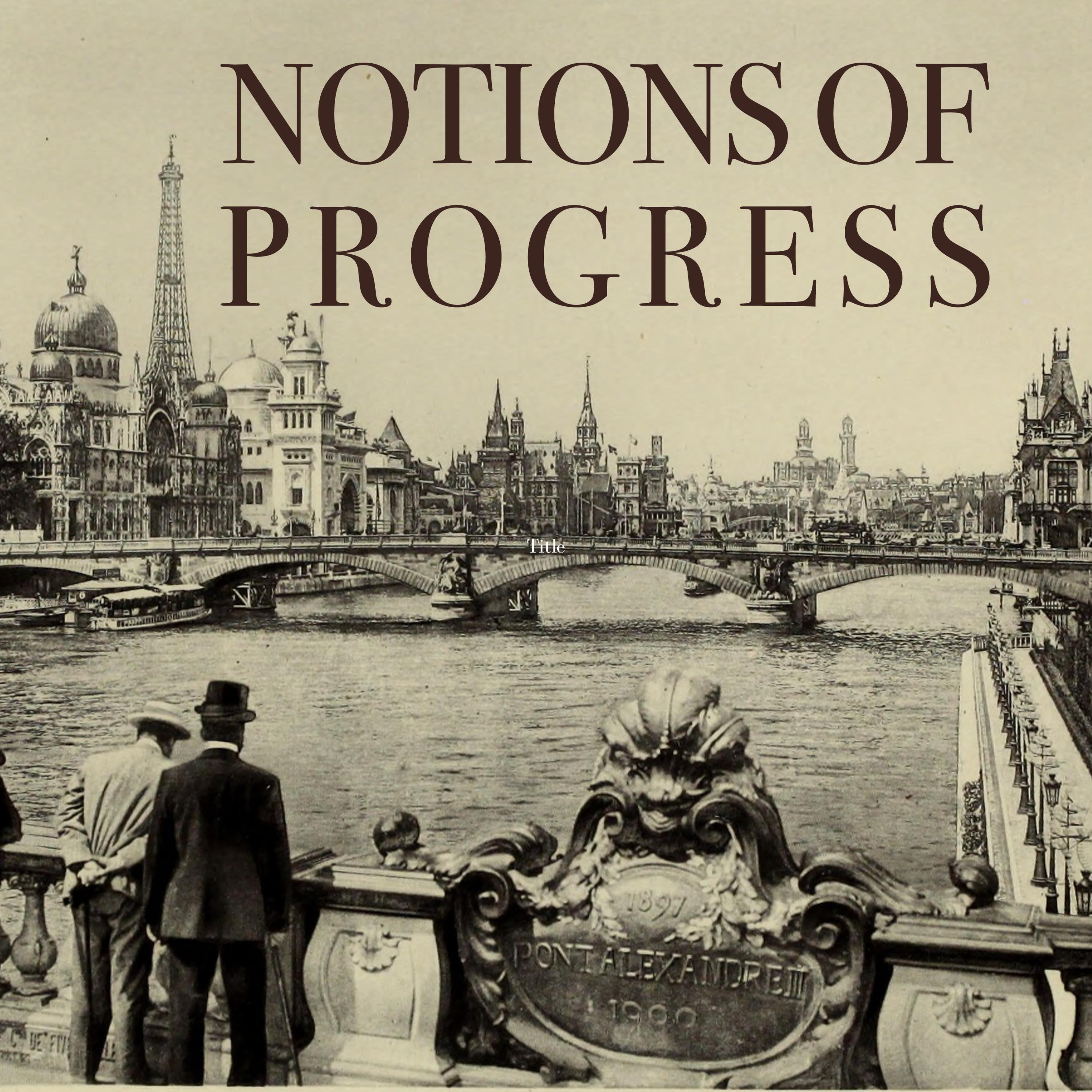
PODCAST · history
Notions of Progress
by Marshall Madow
The idea of progress — that humanity advances through time toward something better — has been a contested assumption throughout history. The question of whether we as a species, a nation, or as individuals are progressing is being interrogated with a renewed urgency that the present moment demands. Whether that advancement is real, illusory, unevenly distributed, or simply beside the point depends on who is asking, from where, and by what measure. Notions of Progress is a podcast that takes those questions seriously, tracing how the idea of progress has been understood, contested, and reimagined from antiquity to the age of artificial intelligence.The series moves from the ancient Greeks’ ambivalence about technological change, through the Enlightenment’s confidence in cumulative human reason, to the contemporary moment in which artificial intelligence has made the question of progress newly urgent. When machines appear to learn, create, and reason, the assumptions buried inside the w
-
10
Aristotle vs. Plato: Two Theories of Progress — and the Institution That Produced Both
The Academy was built on a wager: that philosophy could be institutionalized, accumulated, and transmitted across generations. Episode 10 asks whether the bet paid off — and finds the answer in the man Plato trained himself.This episode traces Aristotle’s intellectual break with Plato, the philosophical distance between their two theories of human advancement, and the founding of the Lyceum as a counter-proposal, not a repudiation. Drawing on Prof. G.E.R. Lloyd’s account of Aristotle’s development, Prof. W.K.C. Guthrie’s biographical anchor in A History of Greek Philosophy (Vol. VI), Prof. Werner Jaeger’s reading of the Cave in Paideia, and Prof. Christopher Moore’s argument in Calling Philosophers Names that Aristotle carried the Academy’s founding principle out the door when he left, the episode reconstructs what the break actually was — and what it was not. The Academy trained its members in dialectical argument without demanding conformity. That method produced its most consequential critic. Moore identifies the principle Aristotle took with him: since progress in philosophy is possible, bring everything of relevance to bear on every question. The bet succeeded in producing a thinker capable of exactly what it promised. It failed in that the institution could not contain him. Both verdicts stand simultaneously.This is the third and concluding episode of the Academy Arc — from the naming of philosophy in Episode 8, through the institution’s mechanics in Episode 9, to the first full test of the founding bet here.Show Notes & Timestamps00:00 — Opening04:36 — Aristotle’s Break06:45 — Two Theories of Agency09:57 — The Vertical Cumulativity Test12:34 — The Lyceum and the Long Argument15:57 — ClosingKey Concepts & TermsTechnē (TEK-nay) — craft, skilled makingThe word has run through this series since Episode 2, where it named the earliest Greek anxiety about technology as gift and curse. It returns here in a new register. Where Plato held that technē was insufficient knowledge without philosophical governance above it, Aristotle argued it constituted a legitimate form of understanding in its own right. As Prof. Lloyd reads him, the builder who knows the purpose of the house does not need a philosopher to supply that knowledge from outside. Technē, in Aristotle’s hands, becomes evidence that genuine knowledge does not require the vertical ascent Plato’s curriculum demanded.Telos (TEH-los) — end, purpose, goalFor Plato, the telos of human life points toward the Forms: eternal, unchanging, and above the world of change. As Prof. Lloyd describes Aristotle’s departure, the telos is relocated — it is immanent, already inside things, waiting to be actualized from within. The seed does not reach toward an eternal original. It already is, potentially, what it will become. Whether this relocation of telos liberates human potential or quietly constrains it — by fixing in advance what each kind of thing can become — is a question the scholarship has not resolved.The Forms (the Platonic Forms) — eternal, unchanging originalsPlato’s claim that behind every particular beautiful thing, just act, or excellent person, there stands an eternal, unchanging original that the particular imperfectly resembles. Aristotle disputed this directly. As Prof. Lloyd argues, form in Aristotle’s model is something gradually acquired during the process of change — not contemplated from above. The philosophical distance between the two men on this point is not a disagreement at the edges. It concerns the nature of reality, the structure of knowledge, and the question of who is capable of progress.Praxis (PRAK-sis) — purposeful human actionAristotle’s account of practical knowledge — reasoning oriented toward action in the world — stands behind one of the most consequential inheritances of his thought. As scholars including Richard Bernstein have argued, Karl Marx’s concept of praxis draws directly on Aristotle’s account, treating purposeful human action as the engine of historical change. The lineage runs from Aristotle’s Nicomachean Ethics through centuries of political philosophy to modern social theory.Fascinating Historical InsightsThe Break That Began Inside the AcademyThe familiar image of Aristotle is of a hardheaded empiricist who arrived at Plato’s school and promptly dismantled it. Prof. Lloyd disputed this image: Aristotle’s earliest works — the Eudemus and the Protrepticus — argue that the soul in its true and natural state is separate from the body, and that the highest human activity is philosophical contemplation, withdrawn from the world. These are not the positions of a critic. They are the positions of an adherent. Prof. Lloyd’s account makes the historical point plain: the break was gradual, and it began from the inside. Aristotle was already criticizing the theory of Forms while still identifying as a Platonist. The institution’s own method — dialectical argument without demanded conformity — made that possible.A Departure That Was Also a Political ExitWhen Plato died in 347 BCE and Speusippus was chosen to lead the Academy, Aristotle left Athens. The departure is often told as a philosophical rupture. Prof. Guthrie’s account is more careful: Aristotle left with Xenocrates, a conservative Platonist, heading toward another Platonic circle in Asia Minor. He was also a metic — a resident alien without citizen rights — with Macedonian ties in a city inflamed against Macedon. The departure was politically overdetermined as well as philosophically motivated. It was not a rejection of the Academy. It was an exit the Academy had, in a real sense, made inevitable.Two Verdicts, Simultaneously TrueProf. Moore identifies the principle Aristotle carried out when he left: since progress in philosophy is possible, bring everything of relevance to bear on every question. Aristotle had absorbed this from the Academy itself. He then applied it fully — and it eventually led him away from Plato’s Forms, away from the curriculum, and into a school of his own. The founding bet therefore produced two verdicts at once. It succeeded in producing a thinker capable of exactly what it promised. It failed in that the institution could not contain him. Moore’s formulation holds both outcomes without resolving the tension between them. That refusal to resolve is itself the argument.From the Lyceum to the Modern Research UniversityWhen Aristotle returned to Athens in 335 BCE, he established himself at the Lyceum — an existing public gymnasium — and built around it a community of inquiry with a shared library, common meals, and rules of procedure. As Prof. Guthrie notes, the customs were modelled on the Academy: a counter-proposal, not a repudiation. As Prof. Lloyd describes it, what the Lyceum institutionalized was systematic research across every field, carried on and extended by Aristotle’s successors after his death. The organizing principle — accumulate knowledge through practice and open inquiry, not formation toward a philosophical summit — surfaced later within medieval universities and the modern research institution. The Lyceum did not merely produce knowledge. It modelled a form of intellectual life that outlasted every institution built on Platonic principles.Resources & Further ReadingPrimary SourcesPlato, Republic, Books VI–VII (514a–541b) — The Allegory of the Cave and the philosopher’s curriculum. Stephanus numbers are edition-independent. The point of reference for the vertical model of progress Aristotle inherits and then disputes.Aristotle, Nicomachean Ethics, Books I and X — Aristotle’s account of eudaimonia, telos, and the relationship between practical and theoretical knowledge. The philosophical distance from Plato becomes clearest here.Works DiscussedProf. W.K.C. Guthrie, A History of Greek Philosophy, Vol. VI (Cambridge University Press, 1981), pp. 18–48 — Aristotle’s years in the Academy, his departure, the founding of the Lyceum, and the succession question. Biographical anchor for this episode. ✓ CONFIRMEDProf. G.E.R. Lloyd, Aristotle: The Growth and Structure of His Thought (Cambridge University Press, 1968) — Lloyd’s account of the gradual break: Aristotle as Platonist, Aristotle as internal critic, Aristotle as founder of an independent school. ✓ CONFIRMEDProf. Werner Jaeger, Paideia: The Ideals of Greek Culture, Vol. II, trans. Gilbert Highet (Oxford University Press, 1944) — Jaeger’s reading of the Cave as periagoge and his analysis of the tension between Plato’s transformative intention and the Academy’s selective practice. ✓ CONFIRMEDProf. Christopher Moore, Calling Philosophers Names: On the Origin of a Discipline (Princeton University Press, 2020), p. 30 — Moore’s identification of the principle Aristotle carried out of the Academy: since progress in philosophy is possible, bring everything of relevance to bear on every question. ✓ CONFIRMEDRichard Bernstein, Praxis and Action (University of Pennsylvania Press, 1971) — The Aristotle–Marx praxis lineage. ⫱ VERIFY (specific chapter/page before recording)Further ContextJulia Annas, An Introduction to Plato’s Republic (Oxford University Press, 1981) — Standard scholarly guide to the Republic’s epistemology; the Platonic model of progress against which Aristotle develops his alternative.Prof. Tyson Retz, Progress and the Scale of History (Cambridge University Press, 2022) — Series anchor. For the conceptual categories that frame the Plato–Aristotle contrast across the full arc of the podcast.Related EpisodesEpisode 5 — The Sophists: Fifth Century Enlightenment? — The horizontal model of progress the Academy was built to refute; th...
-
9
How Did Plato’s Academy Teach What Could Not Be Taught?
Plato named philosophy. But naming it was only the first move. The harder question was whether an institution could be built to make the progress he was wagering on actually work.Episode 9 examines the Academy — not as an idea, but as a place, a community, and a method. Drawing on Prof. W.K.C. Guthrie’s account in A History of Greek Philosophy (Vols. IV and VI), Prof. Werner Jaeger’s Paideia: The Ideals of Greek Culture (Vol. II), and Prof. Christopher Moore’s Calling Philosophers Names, this episode traces what the Academy was in physical and intellectual terms, how it taught through Plato’s radical redefinition of paideia as conversion rather than transmission, and what the Academy’s curriculum reveals about the kind of knowledge Plato believed could anchor cumulative philosophical progress. It then turns to the succession problem — who leads the institution when the founder dies — and closes on Aristotle’s twenty years inside the Academy as the founding bet working exactly as designed: producing a genuine thinker capable of departing. This is the second of three episodes tracing the founding of the Academy, from the naming of philosophy in Episode 8, through the institution’s mechanics here in Episode 9, to Aristotle’s departure and the first full test of the founding bet in Episode 10.Show Notes & Timestamps• 00:00 — The Founding of the Academy• 07:49 — The Nature of the Academy• 12:01 — Teaching Methods and Philosophical Inquiry• 20:04 — The Curriculum and Its Implications• 24:01 — The Legacy of the AcademyKey Concepts & TermsPaideia (pay-DAY-ah) — Greek for ‘education’ or ‘formation.’ The Sophists used it to mean the transfer of civic skills to citizens. As Prof. Jaeger reads the Republic, Plato takes the word back from the Sophists entirely: true paideia is not skill-transmission but the conversion of the whole soul — a turning around (periagoge) from shadow toward light.Propaideia (pro-pay-DAY-ah) — Preparatory training. The name for the mathematical programme that precedes philosophical dialectic in the Academy’s curriculum: arithmetic, geometry, stereometry, astronomy, and harmonic theory. Mathematics is not the goal; it is the necessary discipline the mind must undergo before genuine philosophical inquiry becomes possible.Episteme (ep-IS-teh-may) — Genuine knowledge: understanding that can give a full account of itself and withstand the most sustained questioning without collapsing. Distinct from doxa (opinion), even correct opinion, which cannot guarantee its own stability across time and argument. The Academy’s founding wager is that episteme — unlike rhetoric — can be reliably preserved and extended across generations.Dialectic (dy-ah-LEK-tik) — The method of sustained philosophical questioning and counter-questioning aimed at genuine knowledge. Not rhetorical debate, not the scoring of points, but the rigorous, progressive examination of a claim until it either stands or collapses under its own weight. Socrates practiced it in the streets of Athens; the Academy institutionalized it as a discipline that, on Plato’s own account, took fifteen years to master.Fascinating Historical InsightsThe Lecture Nobody UnderstoodPlato once gave a public lecture on the Good — and most of the audience left baffled. As Prof. Guthrie records it, Plato attempted to present the philosophical core of his thought in a single address, and the audience arrived expecting wisdom but encountered mathematics. Most departed confused. Aristotle, Guthrie notes, was reportedly one of the very few who stayed and followed. The episode is not merely anecdotal. It is evidence that the Academy’s inner circle was deliberately operating at a level of abstraction inaccessible to the wider public — not out of elitism for its own sake, but because, on Plato’s vertical model of progress, genuine philosophical understanding cannot be popularized without being falsified.Two Schools, Two Theories of ProgressThe Academy had a direct rival in fourth-century Athens: the school of Isocrates. Where Plato trained philosophers, Isocrates trained orators and statesmen. As Prof. Guthrie makes clear, these were not merely competing pedagogies but competing theories of what genuine improvement for a city actually consists of. Isocrates argued for civic breadth — education spread wide, producing men capable of effective participation in democratic life. Plato argued for philosophical depth — slow, selective, cumulative formation over decades. The debate between these two schools is the ancient world’s first sustained institutional argument about whether progress is horizontal or vertical.A Community That Lived Its PhilosophyThe Academy was not a school in the modern sense. As Prof. Guthrie describes it, what Plato founded was a community of inquiry — a circle of philosophers who lived, studied, argued, and ate together over decades in the grove sacred to the hero Academus, about a mile northwest of Athens. There were shared meals (syssitia), shared walks, shared rituals, and a common subscription to expenses. Members were not fee-paying students; they were participants in a shared intellectual life. The structure was closer in spirit to a Pythagorean brotherhood or a religious community than to anything recognizable as a university.The Succession Problem and Its Philosophical MeaningWhen Plato died in 347 BCE, the question of who would lead the Academy was not merely administrative — it was philosophical. Prof. Guthrie’s account is careful: Speusippus, Plato’s nephew, was chosen. What is clear is the philosophical distance between the two men. And Aristotle, the other obvious candidate, was legally disqualified as a metic — a resident alien who could not inherit property in Athens without special dispensation. The choice of Speusippus revealed something structural: the institution designed to transmit philosophy across generations had no reliable mechanism to ensure that succession followed its best thinking. That is not a failure of planning. It is a consequence of the theory of knowledge the Academy was built on.Resources & Further ReadingPrimary Sources• Plato, Republic, Books VI–VII (514a–541b) — The Allegory of the Cave and the philosopher’s curriculum, including the propaideia and the ascent to dialectic. Stephanus numbers are edition-independent.• Plato, Seventh Letter — Plato’s own account of his Sicilian visits and the founding conditions of the Academy. Authenticity debated; philosophically central.Works Discussed• Prof. W.K.C. Guthrie, A History of Greek Philosophy, Vol. IV (Cambridge University Press, 1975), pp. 17–32 — The Academy as community, the rivalry with Isocrates, the “On the Good” lecture, and Aristotle’s arrival. ✓ CONFIRMED• Prof. W.K.C. Guthrie, A History of Greek Philosophy, Vol. VI (Cambridge University Press, 1981), pp. 18–45 — Aristotle’s twenty years in the Academy; the succession to Speusippus; the biographical anchor for the E9–E10 arc. ✓ CONFIRMED• Prof. Werner Jaeger, Paideia: The Ideals of Greek Culture, Vol. II, trans. Gilbert Highet (Oxford University Press, 1944), pp. 291–320 — Jaeger’s reading of the Cave as periagoge; the philosopher’s curriculum reconstructed from the Republic in careful stages. ✓ CONFIRMED• Prof. Christopher Moore, Calling Philosophers Names: On the Origin of a Discipline (Princeton University Press, 2020), Ch. 9, pp. 166–167 — The Academy’s formalization of Socratic discussion circles; the first time philosophical pursuit could be sustained full-time and systematically across participants. ✓ CONFIRMEDFurther Context• Malcolm Schofield, “Plato and Practical Politics,” in The Cambridge History of Greek and Roman Political Thought — For the relationship between the Academy’s pedagogical model and Plato’s political ambitions.• Julia Annas, An Introduction to Plato’s Republic (Oxford University Press, 1981) — Standard scholarly guide to the Republic’s epistemology; useful for the episteme/doxa distinction and the philosopher’s curriculum.Related Episodes• Episode 5 — The Sophists: Fifth Century Enlightenment? — The horizontal model of progress the Academy was built to refute.• Episode 6 — Plato vs. the Sophists: The Allegory of the Cave — First introduction of the Cave; episteme and doxa enter the series.• Episode 7 — Plato vs. the Sophists: Rhetoric, Power, and Callicles — The political consequence of Sophistic education and the case for Plato’s alternative.• Episode 8 — The Word and the Wager — The naming of philosophos and the founding of the Academy; the direct predecessor to Episode 9.Coming Up NextEpisode 10 — The Founding Bet. Aristotle departs the Academy to found the Lyceum. His departure is not merely biographical — it is the ancient world’s first internal critique of the founding bet. Was the Academy’s vertical model of progress proven, disrupted, or something more interesting than either? Episode 10 pursues that question with Prof. Guthrie’s biographical account and Prof. Moore’s analysis of what the Academy made possible for the first time.Listen & Subscribe• Apple Podcasts• Spotify• YouTube• Amazon Music• Website — notionsofprogress.com• Email: marshal...
-
8
The Word and the Wager: How Plato Named and Claimed Philosophy | Ep. 8 pt 1
About This EpisodeWhere did the word “philosopher” come from — and who got to decide what it meant? In Episode 8, Part 1 of Notions of Progress, we trace the moment Plato took a word that had begun as a mocking label and transformed it into an institutional claim. Prof. Christopher Moore’s Calling Philosophers Names (Princeton University Press, 2020) shows us how the coining of philosophos was not a neutral act of description but a polemical move — one that drew a sharp line between those who merely acquired knowledge and those who pursued wisdom as a lifelong orientation. Drawing on three of Plato’s dialogues — the Meno, the Phaedrus, and the Gorgias — the episode asks what it meant to found a school on that claim and what that founding bet risked. Prof. W.K.C. Guthrie’s historical account of the early Academy situates the institutional stakes. The episode traces the distinction between episteme — genuine knowledge — and doxa — mere opinion — as the intellectual fault line on which Plato’s entire wager rests. This is the first of three episodes tracing the founding of the Academy, from the naming of philosophy through the institution’s mechanics to Aristotle’s departure and the first test of the founding bet.——————————————————————Show Notes & Timestamps00:00 — Introduction to Plato’s Philosophical Journey02:18 — The Birth of the Academy and Its Claims04:17 — The Evolution of the Term ‘Philosophos’07:57 — The Distinction Between Episteme and Doxa11:51 — Plato’s Selective Approach to Knowledge12:52 — Aristotle’s Departure and Philosophical Expansion13:33 — Recap——————————————————————Key Concepts & TermsPhilosophos (phil-OH-soh-foss) — lover of wisdomAs Moore demonstrates across pre-Platonic and Platonic sources, the word did not emerge as a neutral description. It circulated as a mildly mocking label before Plato claimed it, narrowed it, and redefined its referent entirely. In Moore’s reading, Plato’s decision about who counts as a philosophos is simultaneously a decision about what kind of knowledge matters and who is capable of it. The naming of the discipline was the first move in the founding of the Academy.Episteme (ep-ISS-teh-may) — genuine knowledgeStable, reasoned knowledge — as distinct from opinion — and the object the Academy was founded to produce and transmit. The Meno’s conclusion — that the virtuous statesman operates by true opinion, not knowledge — is the challenge the Academy was built to answer. If doxa cannot be systematically taught or institutionally transmitted, only episteme justifies the existence of a philosophical school. Guthrie’s commentary situates this distinction as Plato’s foundational move against both the Sophists and the democratic assumption of broadly equal political capacity.Doxa (DOX-ah) — opinion or true beliefDistinguished from episteme in the Meno. The virtuous statesman operates by true opinion, not knowledge — like a poet who produces fine things without being able to say why. The Sophist educational programme produces doxa, not episteme — and doxa cannot be systematically taught or institutionally transmitted. Plato’s point is that true opinion, however reliable in practice, will not hold under examination.Technē (tek-NAY) — craft or genuine expertiseThe central spine of the series from Episodes 5–8. A genuine technē has a determinate subject matter, aims at the genuine good of its object, and can give a rational account of itself. The Sophists claimed rhetoric was a technē; Plato argued in the Gorgias that it was not — it is a knack (empeiria), producing persuasion without understanding why. The Academy’s founding claim was that philosophy met the genuine standards of technē and exceeded them, because its object was not persuasion but truth.——————————————————————Fascinating Historical InsightsA Philosopher Was Originally a Term of MockeryBefore Plato, the word philosophos was not a badge of honour. As Moore traces across pre-Platonic sources, the term circulated as a mildly pejorative description — someone suspiciously over-interested in ideas, impractical, unworldly. Plato’s intervention was to take this floating, slightly comic label and claim it entirely: stripping away its mocking connotations, redefining the word’s referent, and making it describe something altogether more serious. The episode shows how this terminological move was simultaneously a philosophical argument and a political act.The Academy’s Founding Claim Was Unprecedented in the Ancient WorldWhat Plato built was not a school in the conventional Sophist sense — a travelling teacher offering instruction for fees. It was a fixed, sustained community of inquiry organised around a shared method and the explicit claim that genuine knowledge, as distinct from opinion, was achievable and transmissible across generations. As Guthrie’s account of the early Academy makes clear, no institution in the ancient world had previously staked its existence on quite this claim. The Academy’s founding was an assertion that philosophy could accumulate: that the next generation could begin where the last left off.Aristotle Was at the Academy for Twenty Years — and Then LeftAristotle arrived at the Academy as a young man and remained for twenty years, until Plato’s death. His departure — and his subsequent founding of the Lyceum — is one of the most consequential intellectual events in ancient history. The episode treats this not as a biographical footnote but as the first serious test of the Academy’s founding bet. If philosophical knowledge genuinely accumulates across generations, Aristotle’s twenty years should have produced a philosophical heir. That he left instead and built something different is the question Episode 10 will address directly.Episteme and Doxa: A Philosophical Argument Against DemocracyPlato’s insistence that episteme is categorically different from doxa was not merely an epistemological position. It was a claim about who is capable of governing. The Sophists had argued that political skill was a form of expertise acquirable by any citizen willing to learn rhetoric. Plato’s distinction cuts against this entirely: if most people operate at the level of opinion and only the philosophically trained can attain genuine knowledge, the democratic premise — that citizens are broadly equal in their capacity for political judgment — is philosophically undermined. The founding of the Academy was, among other things, a counter-argument to Athenian democracy.——————————————————————Resources & Further ReadingPrimary SourcesPlato. Meno, 87c–100b. The teachability argument and its aporetic conclusion. Cooper–Hackett translation recommended.Plato. Phaedrus. The soul’s orientation toward wisdom and the distinction between genuine and imitative rhetoric. Cooper–Hackett translation.Plato. Gorgias, 447a–527e. The full dialogue: rhetoric on trial, the Polus episode, the Callicles section, and the eschatological myth. Cooper–Hackett translation.Works DiscussedMoore, Christopher. Calling Philosophers Names: On the Origin of a Discipline. Princeton University Press, 2020. The primary anchor for Episode 8. Moore traces the etymology and early history of philosophos across pre-Platonic and Platonic sources, demonstrating that Plato’s terminological decisions encoded a philosophical and political programme.Guthrie, W.K.C. A History of Greek Philosophy, Vol. IV. Cambridge University Press, 1975. Guthrie’s historical account of the early dialogues and the Academy’s founding situates the institutional stakes of Episode 8’s argument.Further ContextKerferd, G.B. The Sophistic Movement. Cambridge University Press, 1981. The authoritative account of the Sophist tradition whose horizontal model of civic progress Episode 8 explicitly rejects. Essential background for understanding what Plato was arguing against.Retz, Tyson. Progress and the Scale of History. Cambridge University Press, 2022. The series anchor. See Episodes 3–4 for the full framework.——————————————————————Related EpisodesEpisode 5: The Sophists — Human Agency, Technē, and the First Theory of Civic Progress. Establishes the Sophist framework and the horizontal model of cumulative progress that Episode 8 rejects.Episode 6: Plato vs. the Sophists, Part 1 — The Cave, Recollection, and the Case Against Cumulative Knowledge. The first two pillars of Plato’s counter-argument.Episode 7: Plato vs. the Sophists, Part 2 — Rhetoric, Power, and the Making of Callicles. The direct bridge to Episode 8.Episodes 3–4: Five Faces of Progress — Prof. Tyson Retz. The taxonomic framework applied across the series.——————————————————————Coming Up NextEpisode 9 turns from the naming of philosophy to its institutionalisation. Where Episode 8 asked what the founding bet was, Episode 9 asks how the Academy actually worked — its pedagogy, its method of succession, and the problem Plato may not have solved before his death. Prof. Werner Jaeger’s Paideia, Vol. II anchors the episode’s account of what it meant to build an institution around the transmission of philosophical knowledge.——————————————————————Listen & Subscribe<a href="https://podcasts.apple.com/us/podcast/notions-of...
-
7
Plato vs. the Sophists: Rhetoric, Power, and the Making of Callicles | Ep. 7 pt 2
About This EpisodeCan rhetoric make better citizens — or does it simply make better manipulators through the art of persuasion? In Part 2 of the Plato vs. the Sophists arc, Notions of Progress follows Plato’s argument from the Meno to the Gorgias to answer that question. Building on Part 1’s examination of the Cave allegory and the doctrine of recollection, this episode turns to Plato’s two remaining pillars of response to the Sophists: the unteachability of virtue and the failure of rhetoric as a genuine craft. Scholars W.K.C. Guthrie, E.R. Dodds, Roslyn Weiss, George Klosko, and G.B. Kerferd serve as the scholarly guides. The Meno dismantles the Sophist educational claim — virtue cannot be taught by the Sophist mechanism. The Gorgias then dismantles the Sophist political claim — rhetoric is not the engine of civic progress but its counterfeit. The episode culminates with Callicles: not a villain, but the coherent product of Sophist education working exactly as intended. Applying Retz’s framework, Plato’s counter-attack forecloses the Sophist horizontal theory of civic progress entirely — and replaces it with a vertical reorientation toward the Forms.――――――――――――――――――――Show Notes & Timestamps• 00:00 Introduction to Plato’s critique of Sophist education• 05:54 Can virtue be taught? Socrates’ examination in the Meno• 14:40 The three tests of genuine technē in rhetoric• 18:55 The portrayal of rhetoric in the Gorgias• 22:50 Callicles and the pursuit of power and domination• 26:21 Implications for civic virtue and human progress• 29:16 Conclusion: What does genuine moral education look like?――――――――――――――――――――Key Concepts & TermsPaideia [please add pronumciation] — civic educationThe Sophist programme of education aimed at producing effective citizens capable of participating in democratic life. For the Sophists, paideia centred on the transmission of rhetorical skill as the master tool of civic virtue. Plato’s argument in the Gorgias is that this programme mistakes a knack for a craft — and that its endpoint, as Klosko demonstrates through Callicles, is the production of men who equate political success with moral worth.Technē [please add pronumciation] — craft or genuine expertiseA genuine technē meets three criteria in Plato’s examination: it has a determinate subject matter, it aims at the genuine good of its object, and it can give a rational account of itself. Dodds frames the opening of the Gorgias as a direct test of whether rhetoric qualifies. On every count Socrates argues it fails — rhetoric has no fixed domain, aims at what pleases rather than what is good, and cannot explain its own principles. It is a knack (empeiria), not a craft.Aporia [please add pronumciation] — productive impasseThe state of genuine puzzlement that Socratic inquiry produces. The Meno ends in aporia: virtue cannot be taught by the Sophist mechanism, but what genuine virtue-teaching would require is left deliberately open. As Weiss reads it, this is not a failure of the argument but its point — the clearing of false certainty is the precondition for genuine philosophical inquiry.Doxa [please add pronumciation] — true opinionDistinguished from episteme (genuine knowledge) in the Meno. The virtuous statesman operates by true opinion, not knowledge — like a poet who produces fine things without being able to say why. Plato’s point is that true opinion, however reliable in practice, will not hold under examination. The Sophist educational programme produces doxa, not episteme — and doxa cannot be systematically taught or institutionally transmitted.――――――――――――――――――――Fascinating Historical InsightsDodds and the Nietzsche ConnectionIn his appendix to Plato: Gorgias, Dodds draws a direct line between Callicles and Nietzsche’s will-to-power tradition. The resemblance, Dodds argues, is not accidental — both thinkers start from the premise that conventional justice is simply the mechanism by which the weak restrain the strong. Callicles anticipates the Nietzschean critique of slave morality by two and a half millennia. Dodds takes the connection seriously enough to devote a full appendix to it, treating Callicles not as a period piece but as a recurring philosophical position that resurfaces whenever civic consensus breaks down.The Deliberate Aporia of the MenoThe Meno does not end with a refutation. It ends with a question deliberately left open. As Weiss reads it, Plato’s conclusion — that virtue comes by divine dispensation rather than teaching — is not his final word on the subject but a provocation. The Sophists claimed to be precisely the teachers the Meno cannot find. By ending in aporia rather than resolution, Plato signals that the problem of moral education is genuinely unsolved — and that the Republic will have to address it on entirely different foundations.Gorgias: Honourable but UnreflectiveDodds’s reading of Gorgias himself is one of the episode’s more nuanced moments. Gorgias is not dishonest — he simply has not thought through the implications of his own craft. When Socrates forces the question of whether rhetoric can be used for injustice, Gorgias retreats: he assumes his students already know what is just. Dodds reads this not as evasion but as genuine unreflectiveness. The crack in the Sophist edifice, Plato shows, runs through its most honourable representative — not just through its most dangerous one.The Escalation from Gorgias to Polus to CalliclesKlosko’s reading of the three interlocutors as a dramatic sequence is one of the episode’s structural anchors. Gorgias assumes virtue; Polus drops the pretence and argues for power openly; Callicles takes the logic to its conclusion and argues that natural superiority justifies domination. The escalation is Plato’s argument in dramatic form: the Gorgias does not need to state its conclusion — it enacts it across three progressively candid voices.――――――――――――――――――――Resources & Further ReadingPrimary Sources• Plato. Meno, 87c–100b. The teachability argument and the doctrine of recollection. Any reliable translation serves; Grube is recommended for clarity.• Plato. Gorgias, 447a–527e. The full dialogue: the rhetoric examination, the Polus episode, the Callicles section, and the eschatological myth.Works Discussed• Guthrie, W.K.C. A History of Greek Philosophy, Vol. IV. Cambridge University Press, 1975. pp. 241–265 (Meno commentary) and pp. 294–311 (Gorgias commentary). The standard scholarly baseline for both dialogues. Measured, comprehensive, authoritative.• Dodds, E.R. Plato: Gorgias. Oxford University Press, 1959. Introduction pp. 1–30 and Appendix (Socrates, Callicles, and Nietzsche) p. 387. The critical edition. Dodds’s introduction and appendix are essential reading for anyone serious about the Gorgias.• Weiss, Roslyn. Virtue in the Cave: Moral Inquiry in Plato’s Meno. Oxford University Press, 2001. Chs. 5–6. The most forceful recent reading of the Meno’s aporetic conclusion. Weiss argues the aporia is the point, not the problem.• Klosko, George. The Development of Plato’s Political Theory. Oxford University Press, 2006. Ch. IV, pp. 39–54. Essential for the Callicles-as-coherent-endpoint argument. Klosko’s reading of the three interlocutors as a dramatic sequence structures the episode’s third section.• Kerferd, G.B. Articles on Thrasymachus and Protagoras. Phronesis, pp. 19–27 and pp. 42–45. Establishes the Sophist tradition’s consistent claim that political skill is a form of expertise. Plato’s argument targets the tradition, not just Gorgias.Further Context• Retz, Tyson. Progress and the Scale of History. Cambridge University Press, 2022. The series anchor. Applying Retz’s framework, Plato’s counter-attack forecloses the Sophist horizontal theory of civic progress and replaces it with a vertical reorientation — a move that places Plato firmly within Retz’s first category: No Progress.• Guthrie, W.K.C. A History of Greek Philosophy, Vol. III. Cambridge University Press, 1969. Background on the Sophist tradition established in Episode 5. Protagoras, Gorgias, and the nomos/physis antithesis.――――――――――――――――――――Related Episodes• Episode 5: The Sophists — Human Agency, Technē, and the First Theory of Civic Progress. Establishes the Sophist framework that E7 dismantles.• Episode 6: Plato vs. the Sophists (Part 1) — The Cave, Recollection, and the Case Against Cumulative Knowledge. The first two pillars of Plato’s response.――――――――――――――――――――Coming Up NextEpisode 8 turns to Aristotle — and a fundamentally different theory of human development. Where Plato forecloses the Sophist vision of civic progress, Aristotle rebuilds it on new foundations: telos, potentiality, and a progress that is directional but finite.――――――――――――――――――――Listen & SubscribeApple PodcastsSpotifyYouTubeAmazon MusicWebsite — notionsofprogress.comEmail: [email protected]――――――――――――...
-
6
Plato vs. the Sophists: The Allegory of the Cave As His Answer On Progress | Ep. 6 pt 1
In this episode of Notions of Progress — the first of a two-part examination of Plato — we ask what happens to the Sophists’ theory of progress once Plato is done with it. The Sophists had argued that human beings advance through the accumulation of teachable skill: collectively, cumulatively, and through the civic power of persuasion. Plato systematically dismantled each of those claims. This episode traces the first two dimensions of that dismantling through two of the most consequential passages in the history of Western philosophy.The first is the Allegory of the Cave (Republic Book VII, 514a–521b). The second is the doctrine of recollection, or anamnesis, introduced through the slave boy demonstration in the Meno (80a–86c). Taken together, these passages make a radical argument: genuine knowledge is not built up from experience, it is recovered from what the soul already contains. Progress, for Plato, is not horizontal accumulation — it is vertical ascent toward the eternal Forms, an ascent that is individual, not collective, and philosophical, not technical.Drawing on W.K.C. Guthrie’s A History of Greek Philosophy, Julia Annas’s An Introduction to Plato’s Republic, and David Sedley’s scholarship on the Forms and philosophical education, this episode opens the question of whether Plato’s vision constitutes a theory of progress at all — or something altogether different.Five Important Terms• Paideia (pie-DAY-ah): Formation, or the cultivation of the soul. For Plato, paideia is not the transmission of information but the turning of the whole person — their desires, habits, and perceptions — toward the Good. The Cave allegory is, among other things, an account of what genuine paideia requires.• Anamnesis (ah-nam-NAY-sis): Recollection. Plato’s doctrine, introduced in the Meno, that the soul does not learn new things but recovers what it already knew before birth. If anamnesis is correct, knowledge cannot be transmitted by teachers — it can only be drawn out through the right kind of questioning.• Eikasia (ay-KAH-see-ah): Image-thinking — the lowest stage of cognition on Plato’s Divided Line. This is the condition of the cave-dwellers: taking shadows for reality, images for originals. For Plato, most people, most of the time, live in eikasia.• Doxa (DOX-ah): Opinion or belief. The middle range of cognition, where most people who have escaped the cave still remain — aware of the sensible world but not yet in contact with the Forms. Doxa was precisely what the Sophists trained their students to produce and deploy. For Plato, this was the problem.• Eidos (AY-dos): Form, or the eternal, unchanging pattern that physical things imperfectly imitate. The plural is ‘eide.’ When Plato says the philosopher ascends toward the Good, he means toward the highest of these Forms — the Form of the Good, the sun of the intelligible world.Major Themes• Plato’s systematic response to the Sophists, organized across four dimensions: collectivity, cumulativity , teachability and rhetoric (episode 7) as civic engine — and what each reversal means for the idea of progress• The Allegory of the Cave as a theory of cognitive ascent: the four stages from shadow-watching to encounter with the Form of the Good, and why the ascent is always individual, never collective• The Meno paradox (‘80a): how can you inquire into what you do not know? And what Plato’s answer — anamnesis — implies about the nature and limits of teaching• In the Meno: Socrates draws out geometrical knowledge from an uneducated slave boy through questioning alone — what this shows about knowledge, and what it forecloses about cumulative progress• The Divided Line (Republic 509d–511e) as the epistemological map behind the Cave: the relationship between image-thinking, belief, reasoning, and understanding. More on the divided line to come in episode 7.• The political cost of philosophical ascent: why the philosopher, having seen the light, is obligated to return to and to rule over the dwellers of the cave — and what this means for Plato’s vision of the just cityFascinating Historical InsightsThe Death of Socrates and the Birth of Plato’s PhilosophyIn 399 BCE, a jury of 501 Athenian citizens voted to execute Socrates on charges of impiety and corrupting the youth. Plato was in his late twenties and is believed to have been present. Almost every major dialogue he wrote afterward can be read, in part, as a response to that verdict. The jury that condemned Socrates was drawn from the citizen body that the Sophists had spent decades educating in the arts of democratic persuasion. Plato’s attack on Sophistic rhetoric — and on the claims of democracy itself — cannot be separated from this biographical wound.The Meno Paradox and the Problem of InquiryAt Meno 80a, the character Meno poses what is sometimes called the paradox of inquiry: “How will you look for something when you don’t know at all what it is? … And even if you do happen upon it, how will you know that this is the thing you didn’t know?” This is not a sophistic trick. It is a genuine epistemological puzzle: inquiry seems to require already knowing what you’re looking for. Plato’s answer — that the soul already contains what it seeks, having encountered the Forms before birth — is one of the most ambitious moves in the history of philosophy, and it has direct implications for how he understands progress, pedagogy, and the limits of human teaching.The Slave Boy Who Already KnewTo demonstrate anamnesis, Socrates calls over Meno’s household slave — a boy with no mathematical training — and asks him a series of questions about the geometry of squares. Without being told anything, guided only by Socrates’s questions, the boy arrives at the correct answer. Socrates’s conclusion is that the knowledge was already there, latent in the soul, waiting to be drawn out. For Plato, this is not a pedagogical technique. It is a metaphysical demonstration: knowledge is not transmitted from teacher to student — it is recovered by the soul from itself.The Philosopher Who Must ReturnThe Cave allegory does not end with the philosopher’s liberation. Having made the ascent from shadow to light, the philosopher is compelled to return — back into the cave, back among those who see only shadows, to serve as a ruler of the city. The philosopher does not want to return,but the just city, as Plato conceives it, requires that those who have seen the Good govern those who have not. Progress, in this view, is always asymmetric: a few ascend; the many remain below; and the one who has seen the light must sacrifice the vision to serve the darkness.Show Notes & Timestamps00:00 Introduction to Progress and Education01:18 The Scholarly Guides01:54 What Episode 5 Established02:24 Plato's Counter Proposal to the Sophists04:39 Plato's 4 Pillars05:32 The Allegory of the Cave: Individual Ascent05:56 What This Episode Will Cover07:02 Allegory of the Cave08:36 The Nature of Knowledge and Ignorance11:20 The Implications of Plato's Philosophy on Progress14:56 Against Cumulativity18:20 ClosingKey Concepts/Terms DiscussedThe Allegory of the Cave (Republic 514a–521b)Plato’s most famous image of the human cognitive condition. Prisoners chained in a cave see only shadows cast on a wall by objects behind them; they take the shadows for reality. One prisoner is freed, turns to face the light, and eventually ascends out of the cave into the sunlight — where he finally sees the objects themselves, and at last the sun, which Plato identifies with the Form of the Good. Julia Annas emphasizes that the Cave is not merely a metaphor about ignorance and enlightenment: it is a systematic account of the different cognitive levels mapped in the Divided Line, dramatized. For our purposes, the crucial feature is that the ascent is individual: one person makes the climb. There is no collective advance, no institutional accumulation, no transfer of the vision to others. The prisoner who ascends cannot bring the cave-dwellers with him.The Doctrine of Recollection: Anamnesis (Meno 80a–86c)Plato’s epistemological theory that the soul is immortal and has encountered the Forms before its birth into a body; what we call ‘learning’ is, strictly speaking, the recovery of this prior knowledge under the prompting of experience and questioning. W.K.C. Guthrie notes that anamnesis is Plato’s answer to the Meno paradox — it resolves the puzzle of how genuine inquiry is possible without already knowing the object of inquiry. But its implications for progress are radical. If knowledge is recovered rather than accumulated, there is no genuine cognitive progress in the historical sense. Each soul must make the recovery for itself. The Sophists’ claim that wisdom can be transmitted and that civilization advances through the accumulation of teachable skills is, on this view, doubly mistaken: it confuses opinion for knowledge, and transmission for genuine education.The Divided Line (Republic 509d–511e)Plato’s epistemological schema, introduced just before the Cave, in which he divides the objects of cognition into two main categories — the visible and the intelligible — and subdivides each. The four resulting levels, ascending from lowest to highest, are: eikasia (image-thinking), pistis (belief about visible things), dianoia (hypothetical mathematical reasoning), and noesis (understanding of the Forms themselves). The Cave allegory dramatizes the journey from eikasia toward noesis. Crucially, doxa — opinion, the highest cognitive state the Sophists cultivated and the democratic city depended upon — falls in the lower half of the line, in the realm of the visible ...
-
5
The Sophists: Fifth Century Enlightenment? | Ep. 5 Pt.1
About This EpisodeIn this episode of Notions of Progress — the first of a two-part solo series — we ask a deceptively simple question: were the ancient Greek Sophists the original enlightenment-like thinkers of human progress? These were the famous and sought-after educators of fifth-century Athens. They charged fees, itinerant, and claimed that human excellence could be developed, not just inherited. For that, they were called sophists — a word that still, today,carries a negative connotation.Drawing on W.K.C. Guthrie’s A History of Greek Philosophy, Rachel Barney’s scholarship on technê and Sophistic thought, Joshua Billings’ work on the fifth-century enlightenment, and the authentic fragments of Protagoras himself, this episode examines whether the Sophists represent a genuine ‘enlightenment’ movement — one defined by empirical inquiry and skepticism toward inherited authority, and a theory of civilizational progress through techne,teachable skills.The episode includes five key Greek terms that carry the conceptual weight of the Sophists’ argument, profiles the four major figures of the movement, and closes with Protagoras’s great myth of human origins from Plato’s Protagoras.Five Important Terms Sophistês (so-fis-TAYS): Literally “one who makes people wise.” A professional teacher of practical wisdom and civic skill in 5th-century Athens. Technê (tek-NAY): A Greek word with no exact English equivalent. It equates to systematic, teachable skills — but more than technique. Technê transforms its practitioner. The Sophists believed technê was a key driver of human progress.Aretê (ah-reh-TAY): Excellence, or virtue. For the Sophists, aretê was not a fixed gift of birth or divine favor — it was something that could be taught. Nomos (NOH-moss): Law, custom, convention. What human beings have established through agreement and institutions. Physis (FEW-sis): Nature, or natural reality. The tension between nomos and physis — between convention and nature — is one of the defining intellectual controversies of the fifth century as it informed one’s belief in acquired vs inherited powerMajor ThemesHow the word “sophist” went from a term of respect to an insult, and why it matters for reading the historical recordGeorge Grote’s 19th-century rehabilitation of the Sophists, and Eduard Zeller’s influential counter-verdict — a scholarly debate that still shapes how ancient philosophy is taughtJoshua Billings on the fifth-century enlightenment: three characteristic modes of Sophistic thought — empirical research, arguing both sides, and critical reasoning about divine causalityThe four major figures: Protagoras, Gorgias, Prodicus, and Hippias — what distinguished each of them and what they sharedProtagoras’s great myth from the Protagoras dialogue: a three-stage narrative of human progress from vulnerable animals to skilled craftsmen to citizens capable of governing themselvesWhether the Sophists represent the first systematic theory of progress through human agency — and what that question means for the larger arc of this podcastFascinating Historical InsightsAristophanes’ The Clouds as hostile source materialThe earliest surviving satire of Sophistic teaching is not a philosophical argument — it’s a comedy. In The Clouds (423 BCE), Aristophanes portrays Socrates running a “Thinkery” where students learn to make the weaker argument defeat the stronger. Scholars like W.K.C. Guthrie treat this as evidence of public anxiety about Sophistic education, not as an accurate description of what the Sophists actually taught.Protagoras was reportedly tried, banished, and his books burned in the Athenian agora. He was tried for impiety, expelled from Athens, and — according to ancient sources — his books were gathered and burned publicly in the agora. The man who said human beings were “the measure of all things” was destroyed by the very democratic city that prided itself on open debate. His books have not survived.Plato may have built his philosophy in the shadow of Socrates’ death — and the Sophists were part of what he was reacting againstIn 399 BCE, a jury of 501 Athenian citizens voted to execute Socrates. Plato was in his late twenties and witnessed it. In The Open Society and Its Enemies (1945), Karl Popper argued that what followed was an act of intellectual betrayal: Plato, he wrote, was Socrates’ “most gifted disciple” who “was soon to prove the least faithful.” The jury that condemned Socrates was composed of precisely the kind of citizens the Sophists had spent decades empowering — ordinary Athenians. Whether this was a conscious act of revenge or something Plato could not fully acknowledge, Popper carefully stated “I cannot doubt the fact of Plato’s betrayal... But it is another question whether this attempt was conscious.” (The Open Society and Its Enemies, Vol. 1, Ch. 10, p. 194–195)Plato /Socrates/AristophanesIn Plato’s Apology, Socrates himself argues that Aristophanes’ portrayal — performed 24 years before the trial. Addressing the jury, he seeks to disparage the playwright's work stating “You have seen this yourselves in the comedy of Aristophanes — a Socrates swinging about there, saying he was walking on air, and talking a lot of other nonsense about things of which I know nothing at all."¹Plato, Apology 19c, in Plato: Complete Works, ed. John M. Cooper, trans. G.M.A. Grube (Indianapolis: Hackett, 1997).Show Notes & Timestamps00:00 Introduction to the Sophists and Their Legacy05:37 THe Movement and It’s Moment09:35 Key Figures of the Sophist Movement11:52 Protagoras: In His Own Voice19:37 The Wound That Wouldn’t Close20:49 What’s Next?Key Concepts/Terms DiscussedThe Fifth-Century Enlightenment:Joshua Billings’ term for the intellectual culture of 5th-century Athens, characterized by empirical research and systematic collection of knowledge (historia/polymathy), the practice of arguing both sides of questions (antilogy), and critical reasoning about traditional beliefs including divine causality. Billings sets forth a compelling case as to why the Sophists were not peripheral figures but “the characteristic thinkers of the fifth-century enlightenment.” (Billings, 2021)Technê as Constitutive, Not Instrumental:Rachel Barney’s distinction between ancient technê and modern concepts of technique or technology. Ancient technê is constitutive: it shapes the practitioner’s character, identity, and judgment through the practice itself. Modern technology tends to be understood as value-neutral tools serving pre-existing goals. For the Sophists, all human progress — from fire to justice — moved through technê in this deeper sense.The Constructed Reputation:Because almost all surviving accounts of the Sophists are hostile — especially Plato and Aristophanes — historians must reconstruct what they actually taught against the grain of the dominant tradition. Guthrie argues this requires distinguishing between the Sophists’ genuine philosophical contributions and the caricatures constructed by their opponents first and foremost Plato.Protagoras’s Myth of Human Origins:In the Protagoras dialogue, Plato has Protagoras recount a three-stage account of human development: no natural advantages → practical skill through technê (fire and the productive arts, given by Prometheus) → political skill through justice and mutual respect (distributed equally to all by Zeus). This myth is treated by scholars including Guthrie as encoding Protagoras’s genuine philosophical views about civilizational progress and democratic capacity.The Nomos–Physis Antithesis:The central intellectual controversy of fifth-century Athens: what is the relationship between human convention (nomos) and natural reality (physis)? The Sophists engaged seriously with this question from multiple directions — it is not reducible to a single position. Guthrie’s chapter on the nomos-physis antithesis traces the spectrum of views, from cosmopolitanism and humanitarian anti-slavery arguments to the more dangerous conclusions drawn by figures like Callicles.Resources & Further ReadingPrimary Sources Referenced:Plato. Protagoras. (The great myth of human origins, 320c–322d)Plato. Meno. (The teachability of virtue debate)Aristophanes. The Clouds. (423 BCE — satirical source, hostile to Sophistic education)Protagoras. Fragments. (Collected in Diels-Kranz; key fragments on man as measure and the teachability of aretê)Secondary Scholarship:Guthrie, W.K.C. A History of Greek Philosophy, Vol. III: The Fifth-Century Enlightenment. Cambridge: Cambridge University Press, 1969.Barney, Rachel. “Sophistry.” In A Companion to Ancient Philosophy, ed. Mary Louise Gill and Pierre Pellegrin. Oxford: Blackwell, 2006.Billings, Joshua. “The Fifth-Century Enlightenment.” Chapter in The Oxford Handbook of the Second Sophistic, 2021.Bonazzi, Mauro. The Sophists. Edinburgh: Edinburgh University Press, 2020.Retz, Tyson. Progress and the Scale of History. Cambridge: Cambridge University Press, 2022. (See Episodes 3–4 of this podcast for Retz’s framework, against which the Sophists are being read)Related Notions of Progress Episodes:Episode 2: The Promethean Question: Four Greek Answers (the Sophists’ linear ascent theory in the context of Hesiod, Plato, and Aristotle)Episodes 3–4: Five Faces of Progress — Prof...
-
4
Five Faces of Progress: The Road to Anti-Progress |Prof. Tyson Retz Pt.2 | Ep. 4
About This EpisodeIn this episode of Notions of Progress - Part Two, we continue exploring the fascinating evolution of progress thinking with Professor Tyson Retz, author of "Progress in the Scale of History" (Cambridge University Press, 2022). In this episode, Professor Retz discusses categories 3-5 of his framework: Relative Progress, Everybody’s Progress and Anti-Progress. He starts this opening by detailing the break from absolute progress to more current conceptions beginning in the 19th century with relative progress. It is during this period that a consciousness arises regarding the unequal costs and benefits that come with progress. This new consciousness extends to re-imagining the relationship between history and progress. These notions challenged previous frameworks that envisioned a progression of stages from “primitive” to more “evolved” civilizations along various paths. In yet another departure, Professor Retz takes us into the 20th century in detailing the rise of neo-liberal ideas around progress and the rejection of deterministic frameworks (e.g. historicism) that prescribe a fixed path for history to follow. It is here that he identifies critical totalitarian impulses that seek to control the course of history armed with the knowledge of these pre-determined forces. Lastly, Professor Retz arrives at the modern era whereby he outlines the turn in historical theories that view humankind within a much larger scale that encompasses a timeline leading back to the big bang and the inclusion of natural histories.He ends this interview on an optimistic note by highlighting the spirit beyond the enlightenment conception of progress in seeking to inspire collective action to make the world a better place. Five Categories of Progress: Periodizations from Antiquity to the PresentNo Progress - Why the ancients couldn't conceive of progress as we understand it. "Societies far and wide in the ancient world believed that time destroyed things rather than improved them." (Retz, 2022, p. 13)Absolute Progress - Universal history, stadial theory (civilizations move through stages), and the emergence of progress as a "collective singular" blending scientific, moral, and human advancement. (Retz, 2022, p. 16)Relative Progress - Progress as unevenly distributed and context-dependent. "Progress for some mean[s] decline for others." (Retz, 2022, p. 6)Everybody's Progress - The tension between collective state imposition of historical direction versus spontaneous market order (e.g. Neoliberalism, the rejection of historicism). "Economic growth became the dominant historical narrative in the twentieth century." (Retz, 2022, p. 45)Anti-Progress (Contemporary) - Contemporary rejection or skepticism toward progress narratives, driven by environmental crisis, a focus on the impact of humans across geological times,deep and big history (an expansive historical view extending well beyond the emergence of human existence and encompassing a wide range of areas of exploration). (Retz, 2022, pp. 7-16, from the Introduction)Major ThemesWe discuss relative progress as recognizing that advancement for some often meant decline for others, Japan's pragmatic modernization inspiring marginalized communities worldwide, movements attempting to separate progress from fixed historical paths (China's iconoclasm destroying the past to create new futures, India blending indigenous traditions with Western ideas), everybody's progress as the postwar project to measure and export development globally through neoliberal frameworks, Hayek's rejection of "historicism" and his claim that "guided progress would not be progress," the paradox that free markets require regulation to stay deregulated, how states use statistics to construct narratives of progress, the expansion of historical thinking (big history, deep history, Anthropocene) that reduces focus on human action, anti-progress as recognition that we may have progressed toward undesirable outcomes or that technology now controls us rather than the reverse, and the tension between cultural pessimism and techno-optimism today.Fascinating Historical InsightsJapan's influence on "marginalized states" in the late 19th-early 20th century - Japan's rapid modernization after defeating Russia in 1905 profoundly inspired marginalized communities worldwide, particularly African Americans. Booker T. Washington observed that Japan's rise "has nowhere been studied with greater interest or enthusiasm than by the Negroes of America," demonstrating that non-Western peoples could master Western technologies while maintaining distinct identities.The paradox at the heart of "free market" ideology - Neoliberalism's central contradiction: "a deregulated market requires regulation in order to keep it deregulated." The supposed spontaneous market order actually demands extensive governmental frameworks to maintain competitive conditions—"no regulation is a form of regulation too."China's iconoclasm vs. incremental progress - Chinese reformers introduced a radically different conception: "complete destruction of the past in order to create the future you want." Rather than building incrementally from historical foundations, iconoclasm proposed wiping the slate clean to construct entirely new futures unconstrained by historical inheritance.The technosphere challenges human agency - Peter Haff's theory that "we don't control technology, it controls us"—technology possesses agency separate from human intentions. This represents a fundamental shift from viewing humans as purposeful actors to recognizing non-human forces increasingly shape societal outcomes beyond our control.The role of expansive conceptions of history - Big history, deep history, and the Anthropocene minimize the role of individual human agency, questioning whether humans remain purposeful historical actors in vast temporal and spatial scales.GuestProfessor Tyson Retz Associate Professor of Intellectual History, University of Stavanger, NorwayTyson Retz is an intellectual historian with a PhD from the University of Melbourne. His research examines how concepts like progress, empathy, and historical consciousness have been constructed and contested across different periods.His first book, Empathy and History: Historical Understanding in Re-enactment, Hermeneutics, and Education (Berghahn Books, 2018), explains the role that empathy played in providing history with a philosophical foundation in the eighteenth and nineteenth centuries. Critical of the psychologism of that tradition, the book develops an alternative to 'empathetic understanding' based on Gadamer's hermeneutical reception of Collingwood's logic of question and answer.His second book, Progress and the Scale of History (Cambridge University Press, 2022), appears in the Cambridge Elements series on Historical Theory and Practice. The Element develops five categories of progress from antiquity to the present day, examining how scale shapes our ability to perceive and claim progress.He is also the author of numerous peer-reviewed articles that explore the history of history as a concept and practice. He is a Fellow of the Royal Historical Society, an editor of the Bloomsbury History: Theory and Method digital resource, and serves on the board of the History Education Research Journal.Show Notes & Timestamps00:00 Part 200:36 Relative Progress07:09 Decoupling Progress from History10:16 Everybody's Progress: A Reaction to Historicism15:44 Statistics and the Narrative of Progress18:21 Understanding Anti-Progress24:59 Cultural Pessimism and Optimism in Progress30:06 The Dialectical Nature of Progress35:58 A New Conception of ProgressKey Concepts/Terms Discussed**Relative Progress:** The late 19th century recognition that progress requires evaluation of who benefits and at what cost. R.G. Collingwood defined it as "gain without corresponding loss," marking a shift from universal claims to distributional questions. Marginalized groups formed global networks pursuing progress "in their own terms," though paradoxically still relied on absolute progress as their measuring stick.**Japan's Pragmatic Modernization:** Japan's unprecedented embrace of progress as an instrumental tool for national survival rather than moral improvement, inspiring marginalized communities worldwide. Booker T. Washington noted Japan's rise "has nowhere been studied with greater interest or enthusiasm than by the Negroes of America."**Decoupling Progress from History:** Various movements attempted to separate progress from predetermined historical trajectories. China's iconoclasm proposed "complete destruction of the past to create the future you want," while India's revivalist traditionalism blended indigenous traditions with European liberalism.**Neoliberalism and Anti-Historicism:** Hayek and the Mont Pelerin Society rejected "historicism" (claiming to know history's direction) as politically dangerous. They argued "guided progress would not be progress," advocating for spontaneous market order over conscious historical planning.**The Regulation Paradox:** "A deregulated market requires regulation in order to keep it deregulated"—the neoliberal "free market" paradoxically demands extensive regulatory frameworks to maintain competitive conditions.**Statistics as State Narratives:** The word "statistics" contains "state." Post-WWII governments used statistical data as "hard data that you need to know that your life is getting better," constructing narratives of progress through GDP growth, employment rates, and quality-of-life metrics.**Ant...
-
3
Five Faces of Progress: A Conceptual Framework for Historical Change |Prof. Tyson Retz | Ep. 3 Pt.1
About This EpisodeIn this episode of Notions of Progress, we explore the fascinating evolution of progress thinking with Professor Tyson Retz, an intellectual historian at the University of Stavanger in Norway and author of "Progress and the Scale of History" (Cambridge University Press, 2022). Professor Retz introduces his innovative five-category framework that traces various conceptions of progress as part of a layered and contingent perspective from antiquity to the present day.Five Categories of Progress: Periodizations from Antiquity to the PresentNo Progress - Why the ancients couldn't conceive of progress as we understand it. "Societies far and wide in the ancient world believed that time destroyed things rather than improved them." (Retz, 2022, p. 13)Absolute Progress - Universal history, stadial theory (civilizations move through stages), and the emergence of progress as a "collective singular" blending scientific, moral, and human advancement. (Retz, 2022, p. 16)Relative Progress - Progress as unevenly distributed and context-dependent. "Progress for some mean[s] decline for others." (Retz, 2022, p. 6)Everybody's Progress - The tension between collective state imposition of historical direction versus spontaneous market order (e.g. Neoliberalism, the rejection of historicism). "Economic growth became the dominant historical narrative in the twentieth century." (Retz, 2022, p. 45)Anti-Progress (Contemporary) - Contemporary rejection or skepticism toward progress narratives, driven by environmental crisis, a focus on the impact of humans across geological times,deep and big history (an expansive historical view extending well beyond the emergence of human existence and encompassing a wide range of areas of exploration). (Retz, 2022, pp. 7-16, from the Introduction)Major ThemesWe discuss expanded ideas of scale in shaping progress narratives, the importance of "domain specificity" in analyzing particular historical claims, progress as a "collective singular"—a layered understanding comprised of multiple meanings, statistics as state narratives of progress, and the tension between optimism and pessimism in contemporary progress debates.Fascinating Historical InsightsWhy ancient Greeks celebrated advancement but didn't believe in "progress" - The Greeks recognized technical improvements in specific domains but lacked the conceptual framework to view humanity as progressing through time as a unified whole in the way it is viewed in the modern era.Japan's influence on "marginalized states" in the late 19th-early 20th century - Japan's rapid modernization provided an alternative model of progress for non-Western nations navigating imperialism and development.The paradox of progressive politics rejecting the concept of progress - Contemporary progressive movements often critique or abandon progress narratives even as they advocate for social change.The role of expansive conceptions of history - Big history, deep history, and the Anthropocene minimize the role of individual human agency, questioning whether humans remain purposeful historical actors in vast temporal and spatial scales.GuestProfessor Tyson Retz Associate Professor of Intellectual History, University of Stavanger, NorwayTyson Retz is an intellectual historian with a PhD from the University of Melbourne. His research examines how concepts like progress, empathy, and historical consciousness have been constructed and contested across different periods.His first book, Empathy and History: Historical Understanding in Re-enactment, Hermeneutics, and Education (Berghahn Books, 2018), explains the role that empathy played in providing history with a philosophical foundation in the eighteenth and nineteenth centuries. Critical of the psychologism of that tradition, the book develops an alternative to 'empathetic understanding' based on Gadamer's hermeneutical reception of Collingwood's logic of question and answer.His second book, Progress and the Scale of History (Cambridge University Press, 2022), appears in the Cambridge Elements series on Historical Theory and Practice. The Element develops five categories of progress from antiquity to the present day, examining how scale shapes our ability to perceive and claim progress.He is also the author of numerous peer-reviewed articles that explore the history of history as a concept and practice. He is a Fellow of the Royal Historical Society, an editor of the Bloomsbury History: Theory and Method digital resource, and serves on the board of the History Education Research Journal.Show Notes & Timestamps00:00 Introduction to Progress and Historical Context 01:49 The Concept of Progress: A Paradox 04:22 Scale and Its Impact on Understanding Progress 06:45 Absolute Progress 08:24 Scale 10:00 The Role of Sample Size in Progress Claims 11:02 Bury 12:18 Debates on Ancient Beliefs in Progress 15:11 The First Category: No Progress in Antiquity 16:15 No Progress 17:47 Transition to Absolute Progress 20:28 Relative Progress: A New Perspective 22:57 Japanese Perspectives on Progress 25:25 Conclusion: The Future of Progress Discussions 29:54 End of Part 1Key Concepts/Terms DiscussedScale in Historical Analysis: The temporal and spatial frame through which we view historical change. Professor Retz's central argument regards the perspective we choose—whether 20 years or 2,000 years, local or global, particular or universal—fundamentally determines what claims we can responsibly make about progress. Different scales make different patterns visible: technical improvements appear obvious at small scales, while universal human progress only becomes visible at very large scales requiring frameworks like "universal history."Domain Specificity: The problem of conflating advances in one domain (e.g. technology, science) as progress in other domains (e.g. morality, human flourishing, social justice). Ancient Greeks celebrated technical advancement but kept these improvements confined to their domains.Developmental Improvement vs. Progress: Professor Retz distinguishes between celebrating incremental advances in specific techniques and claiming belief in progress. While "improvement on the iPhone 4" may represent "ongoing cumulative improvement," it does not evidence the claim of "a belief in progress."Collective Singular: The blending of multiple discrete concepts and meanings into a single overarching concept. This Enlightenment innovation, coined by 20th-century historian Reinhart Koselleck, described the melding of domain-specific advances into a unified narrative of human progress. Progress became a collective singular when scientific advancement, moral improvement, technical progress, and human development were woven together into one unified narrative of advancement.Vertical and Horizontal Frames: In antiquity, the better life was available vertically—transcendentally accessible now through philosophy, virtue, or looking to the heavens. The Enlightenment shift to horizontal frames meant progress was related to movement over time toward future objectives. This fundamentally reoriented how human action was conceived.Resources & Further ReadingGuest's Work: • Retz, Tyson. Progress and the Scale of History. Cambridge: Cambridge University Press, 2022. Cambridge University Press • Retz, Tyson. Empathy and History: Historical Understanding in Re-enactment, Hermeneutics, and Education. New York: Berghahn Books, 2018.Works Discussed in Conversation (full episode including pt 2: • Bury, J.B. The Idea of Progress: An Inquiry into Its Origin and Growth. London: Macmillan, 1920. • Edelstein, Ludwig. The Idea of Progress in Classical Antiquity. Baltimore: Johns Hopkins University Press, 1967. • Dodds, E.R. The Ancient Concept of Progress and Other Essays on Greek Literature and Belief. Oxford: Clarendon Press, 1973. • Koselleck, Reinhart. Futures Past: On the Semantics of Historical Time. Translated by Keith Tribe. New York: Columbia University Press, 2004. • Popper, Karl. The Poverty of Historicism. London: Routledge, 1957. • Collingwood, R.G. The Idea of History. Oxford: Oxford University Press, 1946. • Hayek, Friedrich A. The Road to Serfdom. Chicago: University of Chicago Press, 1944. • Chakrabarty, Dipesh. "The Climate of History: Four Theses." Critical Inquiry 35, no. 2 (2009): 197-222.Related Concepts & Further Exploration: • Stadial Theory and Adam Smith's The Wealth of Nations • Georges Sorel's The Illusions of Progress and voluntarist Marxism • Vico's philosophy of history and purposeful human action • The Anthropocene and expanded temporal scales in historiographyRelated Notions of Progress Episodes: • Notions of Progress - Show Trailer | Ep. 1 https://www.notionsofprogress.com/show-trailer-the-long-road-to-progress • The Promethean Question: Greek Views on Technological Progress | Ep. 2 https://www.notionsofprogress.com/the-promethean-question-greek-views-on-technological-progress-notions-of-progress-ep-2/Coming SoonPart 2 of our discussion with Professor Retz exploring Relative Progress, Everybody's Progress, and Anti-Progress in greater depth.Listen & Subscribe Apple Pod...
-
2
The Promethean Question: : Greek Views on Technological Progress | Ep. 2
In Episode 2 of Notions of Progress, we explore the "Promethean Question" - examining Greek antiquity's perspectives on technological progress from 700-300 BCE. Did the ancient Greeks view technology as a divine gift or a dangerous curse?SUBSCRIBE & LISTEN:→ YouTube: https://www.youtube.com/@notionsofprogress?sub_confirmation=1→ Apple Podcasts: https://podcasts.apple.com/us/podcast/notions-of-progress/id1837506445→ Spotify: https://open.spotify.com/show/5WgTlVMBfFzrIQwqkqhiD9WEBSITE: https://www.notionsofprogress.comCONTACT: [email protected]:Music: "Gnossienne No. 3" by Erik Satie, licensed from Pond5 (Item ID: 45475293)Music: "Syrinx" by Claude Debussy, performed by Sarah Bassingthwaite (CC BY-SA 2.0)
-
1
Show Trailer - The Long Road To Progress | Ep. 1
In "Notions of Progress," host Marshall Madow explores the concept of progress through history, examining technological advancements and philosophical ideas. This trailer delves into themes like AI, transhumanism, and technological determinism, tracing progress from ancient Greece to modern times. It questions the assumptions behind progress and its impact on human life, offering a glimpse of what's to come in the series.Host: Marshall Madow holds an MA in History from Cambridge University (thesis on Georges Sorel's epistemology of myth) and an MSc from Oxford Business School in Major Program Management (with a specialization in Complexity Theory and Leadership. He is currently preparing PhD applications in intellectual history for Fall 2027, with research interests in how different intellectual traditions have responded to Enlightenment progress narratives and technological determinism.Contact: [email protected]: [@NotionsProgress on X/Twitter]
No matches for "" in this podcast's transcripts.
No topics indexed yet for this podcast.
Loading reviews...
ABOUT THIS SHOW
The idea of progress — that humanity advances through time toward something better — has been a contested assumption throughout history. The question of whether we as a species, a nation, or as individuals are progressing is being interrogated with a renewed urgency that the present moment demands. Whether that advancement is real, illusory, unevenly distributed, or simply beside the point depends on who is asking, from where, and by what measure. Notions of Progress is a podcast that takes those questions seriously, tracing how the idea of progress has been understood, contested, and reimagined from antiquity to the age of artificial intelligence.The series moves from the ancient Greeks’ ambivalence about technological change, through the Enlightenment’s confidence in cumulative human reason, to the contemporary moment in which artificial intelligence has made the question of progress newly urgent. When machines appear to learn, create, and reason, the assumptions buried inside the w
HOSTED BY
Marshall Madow
Loading similar podcasts...
URL copied to clipboard!