
PODCAST · society
Panglot World Languages
by Stanisław Pstrokoński
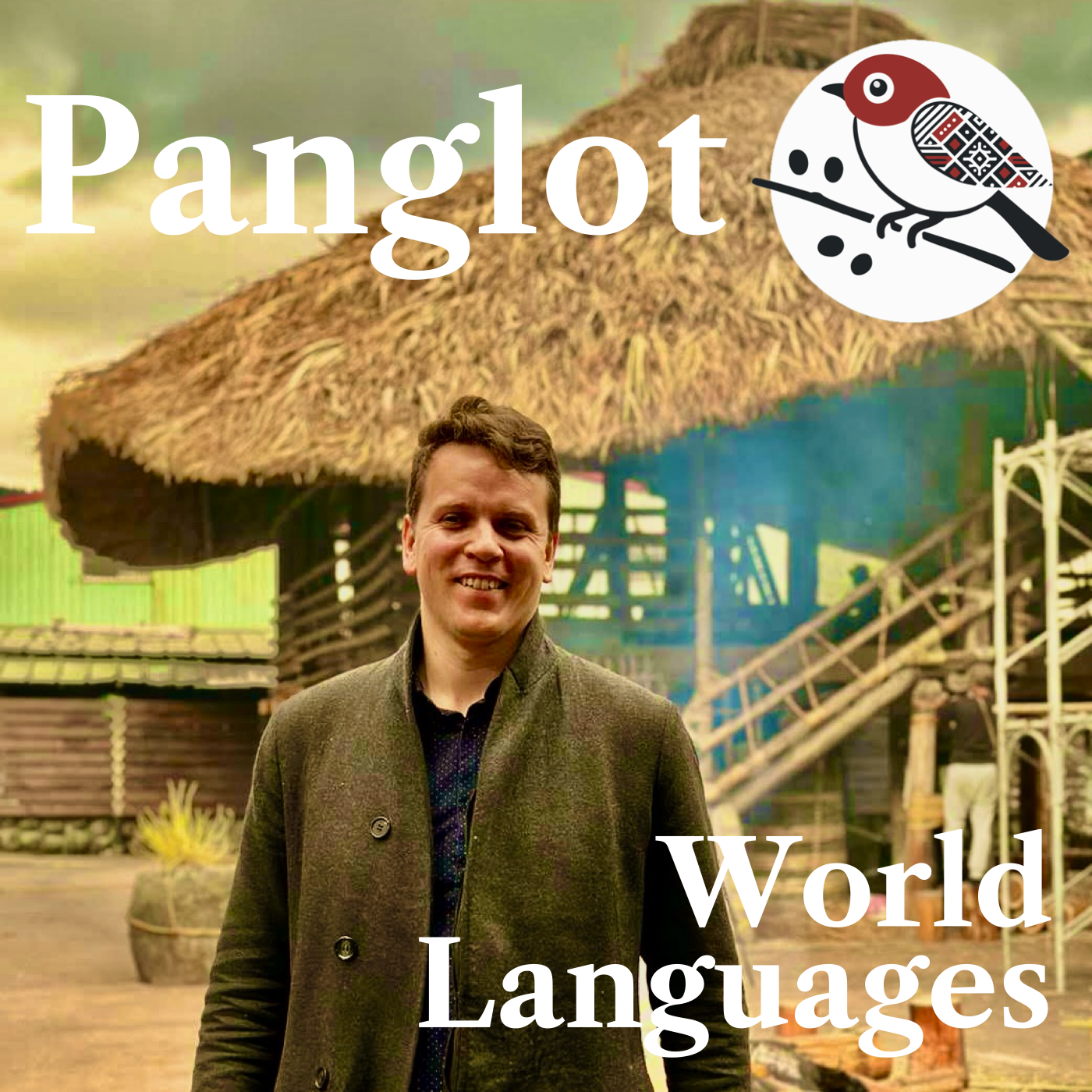
There are 7,000 languages on planet Earth. Come and explore this hidden world with us.Welcome to Panglot World Languages, a show about all the languages you've never heard of, and the speakers who call these languages their home.Linguists see languages as beautiful abstract structures; speakers see them as an expression of identity, heritage, and soul. Both are right. On this podcast, we nerd out (respectfully) about their unique modes of expression, while also listening to the human stories of those who speak, study, and preserve them.Subscribe to hear the world differently.Cover art: Stanisław Pstrokoński in front of the Temple of the War God in the village of Dabang in central Taiwan, home of the Tsou people.
-
9
8. Raising children in Penang Hokkien (Malaysia) with Dr Guy Karavengleman
Guy Karavengleman (a.k.a. Guy Emerson) is a computational linguist at Cambridge University's Computer Laboratory. His mother is a Penang Hokkien speaker but brought him up speaking English. In his twenties, Guy decided to reclaim his linguistic heritage, and embarked on a many-year-long project to learn Penang Hokkien, depsite a dearth of resources for this language and an absence of speakers to practice with. Since then he has had two children and is raising them in this language also. His wife, who does not share his heritage, has also been gradually learning Penang Hokkien and working together with Guy to raise their children in this language.Guy's story is touching and somewhat miraculous. Being a good friend of mine and an academic linguist, there is plenty of room to nerd out here. But I am especially excited to share his personal journey and his deep feeling towards his heritage, as well as his bold actions, since many in the audience may be inspired by his story.Guy had every reason to ignore his feelings or to make excuses, but he chose a more difficult and altogether more meaningful path. In the end this goes beyond language; this is about choosing the person that you want to be and the life that you want to live.Enjoy the episode.Find out more about our work at panglotlanguages.com .
-
8
7. Documenting Kol (Bangladesh) from scratch with Dr Mashrur Imtiaz
Dr Mashrur Imtiaz of Dhaka University is the first person to document the Kol language of Bangladesh.I am excited to meet somebody that has documented a language from scratch - this is a rare find indeed! While many of the world's 7,000 languages remain to be documented (i.e. we literally know almost nothing about them), each such attempt is a real expedition and adventure into the unknown, both socially and linguistically; and a lot of documentation work is a continuation of previous groundwork, whereas in this case we are speaking with somebody who started from the name of a village and a blank sheet of paper.Mashrur's sense of gratitude and warmth towards the Kol people is palpable, and his sense of mission in supporting minority languages in Bangladesh is clearly on display. He maintains a strong link with the Kol people and continues to work with them to this day. The story he shares is both intrepid and hopeful. I hope his story can inspire others in Bangladesh and around the world to continue this meaningful work.Enjoy the episode.You can read Mashrur's article about Kol in The Daily Star here: https://www.thedailystar.net/slow-reads/slow-reads-special/news/language-power-and-the-erasure-kol-4110676 .Find out more about our work at panglotlanguages.com .
-
7
6. Self-help in ancient constructed languages: Sanskrit, Prakrit, and Pali with Dr Alexander O'Neill
Dr Alexander O'Neill of Musashino University in Tokyo returns to the podcast to explain to us the history, significance, cultural output, and current-day relevance of Sanskrit and its relatives Prakrit and Pali.There was a time when Sanskrit speakers could be found all the way from Central Asia to Indonesia. It was a unifying lingua franca that was the centre of education, that books were written in, and that intellectuals would debate each other in on demand (in verse!). It was like Latin was to Europe, except even more important.Literature in Classical Sanskrit covers a huge range, from religious texts and royal decrees to mathematics, astronomy, so-called mirrors for princes (i.e. self-help books for kings) and, famously, the Kama Sutra. And Vedic Sanskrit is the language of the Vedas, passed down through oral tradition over literally thousands of years. It's the only example I've heard of of a language preserved not through writing, but through generations of memorising ritual speech.Classical Sanskrit also had what we might call "daughter languages" Prakrit and Pali. All of these were constructed languages in the sense that they seem not to have been codifications of a language that was spoken, but a codified adaptation from spoken language (the work "Sanskrit" itself means "constructed" or "perfect"). Each of these has had their own role to play in the culture of Central, South and Southeast Asia, and in particular in the religious traditions, literature, and drama of these regions. There is even a modern movement to revive Sanskrit as a spoken language!Dr O'Neill also shares how reading the original Buddhist texts differs from reading them in translation, and the value of understanding the languages themselves.Enjoy the episode.Find out more about our work at panglotlanguages.com .
-
6
5. Bringing back Barngarla (Australia) from zero speakers with Prof. Ghil'ad Zuckermann
In this episode, I have the honour of welcoming Professor Ghil'ad Zuckermann, renowned linguist, language revivalist, academician and public communicator of science, to speak about his work reviving the Barngarla language of Australia.Barngarla is a Pama-Nyungan language which in 2011 had zero living speakers - as Professor Zuckermann puts it, a "sleeping beauty". Starting from a 19th-century dictionary put together by a German missionary, Professor Zuckermann has been working with local people to bring back the language, and has thus far co-published 2 books in the language. He shares with us Barngarla's social and historical context, his process of reviving the language, and some unique features of the language (numbers not going beyond 3, people's names being set according to birth order, "we" pronouns depending on the kin relationship of you and the other person), and gives us a taste of his wider philosophy of language reclamation that he writes about at length in his book Revivalistics: From the Genesis of Israeli to Language Reclamation in Australia and Beyond.Professor Ghil‘ad Zuckermann is listed among Australia's top 30 'living legends of research' by The Australian newspaper (2024). He was elected fellow of the Academy of Oriental Scholars (Shanghai) in 2011 and the Australian Institute of Aboriginal and Torres Strait Islander Studies (AIATSIS) in 2014, and has been an elected board member of the Foundation for Endangered Lanugages (FEL). Zuckermann is currently Wútóng Distinguished Chair Professor at Beijing Language and Culture University (since 2025); Professor (Level E) at Flinders University (Adelaide) (since 2023); Adjunct Professor at the Institute for Positive Psychology and Education, Australian Catholic University (Sydney) (since 2023); Professorial Scientist and Research Fellow at the Braginsky Center for the Interface between Science and the Humanities, Weizmann Institute of Science (since 2012); and Israel & Ione Massada Fellow at Worcester College, University of Oxford (2026).Enjoy the episode.Prof. Zuckermann's Revivalistics book: https://global.oup.com/academic/product/revivalistics-9780199812790 .Barngarla dictionary app (by WCC LP): Andoid https://bit.ly/42Hs8Lu, iOS https://bit.ly/3NuA0f0 .50 Words project (University of Melbourne): https://50words.online/languages/Barngarla .Find out more about our work at http://panglotlanguages.com .
-
5
4. Evading capture in isiShalambombo (South Africa) with Pule ߔߎ߯ߟߍ
Pule (in N'Ko script: ߔߎ߯ߟߍ) is an artist-researcher and cultural technologist from Azania (or South Africa) and is working in transdisciplinary peer-learning, while completing a PhD about the isiShalambombo (anti-)language phenomenon and its manifestation as "effugiolexis", where language forms are obfuscated to avoid being understood from the top down. For example, some European-originated traditions with these cryptolectal ("secret" language) roots include Verlan in many Francophone contexts, and Cockney rhyming slang in certain Anglophone ones.This brings us to a discussion about how the idea of a language as a "thing" (which many people implicitly assume) can be seen as only a heuristic, and that in reality language is a relational practice rather than an object that can be defined and bounded. Pule shares how the social infrastructure of the idea of unitary languages is the legacy of the policies of the colonial and Apartheid state in South Africa.Pule has also been very active with IsiBheqe Sohlamvu script, a.k.a. Ditema tsa Dinoko, which is a phonetic adaptation of symbol forms longstanding in endogenous traditions of beadwork, basketry, pottery, and the "umgwalo" mural arts made famous through isiNdebele expression, also known in Sesotho as "litema". I would argue that it is quite likely the most systematic and linguistically sophisticated writing system in the world, a syllabary using triangular bases (amabheqe) whose rotated orientation indicates vowels, and a composable set of lines and marks within the triangle bases each indicate consonant features (such as voicing and aspiration) rather than arbitrarily saying "this shape means this sound". Pule shares the script’s history, background, and cultural significance with us, as well as the goals of the script at a social level.Ultimately the conversation goes much deeper than any of this, bringing forth |Xam philosophy recorded in the 19th century which could be considered as a "classics" for southern Africa in the same way that Plato and Aristotle are for the West, or Confucius and Mencius are for China. Pule shares his view on relational ontology and the need for understanding the role of the second person ("You") in any discussion of ontology, as the foundation of any notion of subjective ("I") and objective ("it").Listen to this episode also for the beautiful click consonants, and my halting attempts to produce them, all while the philosophical and linguistic back and forth goes unusually deep. It was a very special experience to speak with Pule.Enjoy the episode.
-
4
3. Child's play in Louisiana Creole (USA) with Dr Oliver Mayeux
Louisiana Creole is a French creole language in the US state of Louisiana. Originally developed among African slaves that had been trafficked across the Atlantic, it later came to be spoken by some whites also. Looked down on by many white families, it was nonetheless often spoken at an early age while playing with other children, leading generations to view it with nostalgia, as the language of their childhood.Louisiana Creole has associated with it a rich cultural heritage, particularly of food (fried chicken!) and music (including zydeco and jazz), which remain popular to this day.Oliver Mayeux is a sociolinguist at the University of Cambridge. He has creole heritage and has dedicated his research to studying how this language has historically developed over time.Enjoy the episode.Panglot's website is www.panglotlanguages.comYou can read about Oliver's conference in Cambridge on Language Endangerment here: https://www.mmll.cam.ac.uk/research/cambridge-endangered-languages-and-cultures-group-celc/celc-conferences-and-workshops
-
3
2. Hiding books in Newar (Nepal) with Dr Alexander O'Neill
Newar (also known as Nepal Bhasa) is a Tibeto-Burman language from the Kathmandu valley in Nepal. It has a rich history of centuries of literature and even has its own script. After being the major language of the valley for most of history, in the 20th Century the Nepalese government attempted to suppress it in favour of Nepali, an Indo-Aryan language that had been rebranded from its original name of Gurkhali. Despite this, Newar literature had a golden age in the early 20th Century, with widespread underground bookshops, poets writing some of their best works while in prison, and people hiding books in their attics. Today around 50% of ethnically Newar people can speak their language.Enjoy the episode.
-
2
1. Laz (Turkey & Georgia) with Okan Dale
Laz is a South Caucasian language (i.e. related to Georgian) spoken in northeastern Turkey and southwestern Georgia by around fifty thousand people. Okan Dale grew up in the Laz diaspora in Europe, and is currently based in the US.I failed to mention during the recording that Okan is a polyglot! He speaks German, English, Turkish, Japanese, and Spanish fluently, and also knows French, Laz, Portuguese, and Ojibwe.In this episode, we talk about, among other things:What it means to be a "diaspora in a diaspora" (being seen as Turkish when actually being Laz);Finding oneself in one's heritage language as a teenager;Continuing to research a language that is only partly documented, as a community member rather than a linguist;How linguists should interact with language communities;How the Roman Empire affected Laz;How to teach a language that has significant dialectal variation;How preverbs force you to specify the direction of actions you take (like "I blow the candles out downwards");The long and winding road to getting your language to adopt a writing system;How music can bring a linguistic community a degree of fame and recognition;The pros and cons of linguistic standardisation; andPreserving identity despite external pressures.Enjoy the episode.Panglot's website is panglotlanguages.com.Okan's podcast is called Kutxi - Voices from Endangered Language Communities.You can contact Okan through his website about Laz: lazuri.org.
-
1
Welcome to Panglot World Languages
Fewer than 1% of the languages of the world get any serious attention. It's a whole wide world that almost nobody knows about. This podcast aims to change that. I'm Staś (Stanisław Pstrokoński) and I'm hosting this podcast as a labour of love towards the languages of the world. Each one is both a unique mode of expression with fascinating insights into different ways of thinking and being, and an intangible shared heritage and centre of identity and culture for those who speak it. On this podcast I'll be mostly speaking to guests, mostly about lesser-known living languages; but I won't shy from speaking about any language out there, sometimes on my own about ones I'm particularly familiar with. This little introduction should give you a sense of what the Panglot World Languages podcast is all about.Enjoy the episode.
No matches for "" in this podcast's transcripts.
No topics indexed yet for this podcast.
Loading reviews...
ABOUT THIS SHOW
There are 7,000 languages on planet Earth. Come and explore this hidden world with us.Welcome to Panglot World Languages, a show about all the languages you've never heard of, and the speakers who call these languages their home.Linguists see languages as beautiful abstract structures; speakers see them as an expression of identity, heritage, and soul. Both are right. On this podcast, we nerd out (respectfully) about their unique modes of expression, while also listening to the human stories of those who speak, study, and preserve them.Subscribe to hear the world differently.Cover art: Stanisław Pstrokoński in front of the Temple of the War God in the village of Dabang in central Taiwan, home of the Tsou people.
HOSTED BY
Stanisław Pstrokoński
Loading similar podcasts...
URL copied to clipboard!