
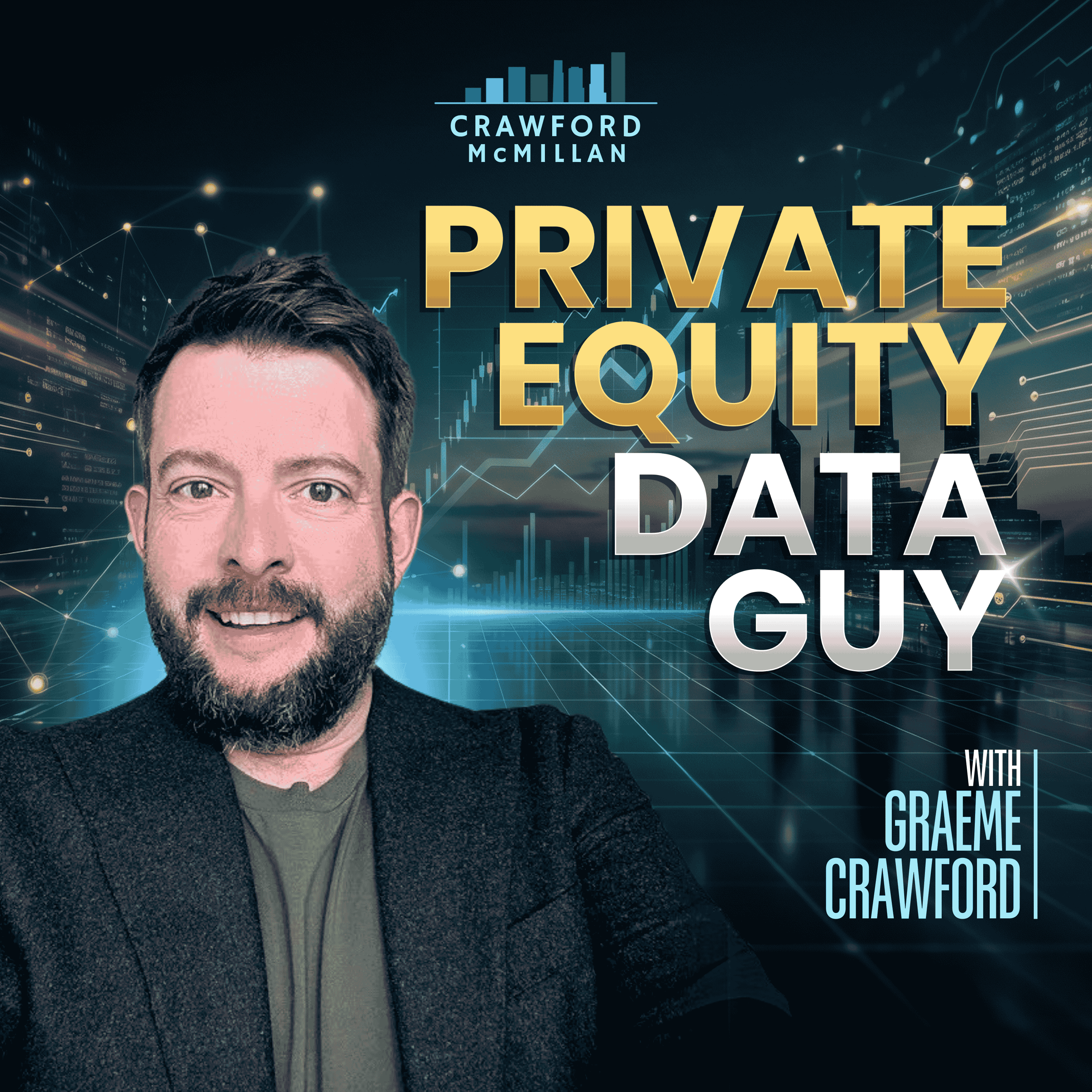
PODCAST · business
Private Equity Data Guy
by Graeme Crawford
Private equity meets data. Conversations with deal teams, operating partners, and portfolio company leaders about the data problems that kill deals, slow exits, and destroy value.Hosted by Graeme Crawford, founder of Crawford McMillan. 20 years leading data programs at Fortune 100 companies. Now helping PE-backed companies fix data before exits so the numbers hold up under scrutiny.New episodes cover diligence red flags, value creation playbooks, and the real stories behind successful (and failed) transactions.
-
35
Why PE Firms Are Asking the Wrong Question About AI
Elon Salfati joined me this week to break down what most PE-backed companies are getting wrong about AI. Not the surface-level stuff, not the board slide version. The real operational gap between clicking a button and actually changing how a business runs. Elon advises PE firms, enterprise operators, and has consulted the UK House of Lords on AI policy alongside leaders from Microsoft and Palantir. His firm, Safari Group, works with businesses to replace manual, people-dependent processes with governed AI systems that scale without adding headcount.What stood out most in this conversation was the idea of decision sovereignty. When a company hands all its strategic thinking to an LLM, it loses its competitive edge. An LLM echoes the past. It will not discover gravity if an apple falls on its server. The real opportunity is flipping the model so the company reaches out to the human for creative judgment, not the other way around. Elon walked through a real case study with Key Loop where they reduced churn by rethinking the entire process workflow before touching the technology.[00:06:43] Wrong question vs right question[00:08:42] Point solutions on broken processes[00:10:39] Political resistance to change[00:16:08] Why AI initiatives stall[00:29:09] Decision sovereignty explained[00:36:09] Human with an army of agents[00:41:19] Turning service companies into software[00:47:01] Personal AI at work and homeGuest InformationElon Salfati is the founder of Safari Group, a Zurich-based AI consultancy. His background spans cybersecurity, scalable systems, and applied AI research. He is currently completing his PhD at Imperial College London focused on building secure AI systems and organizational AI culture.Companies MentionedSafari GroupKey LoopIBMCapital OnePepsiCoBlackrockNewsCorpPalantirMicrosoftAnthropicWebsites Mentionedhttps://www.safari-group.aiTakeawaysAI without process redesign adds chaos, not speed. The companies winning are the ones asking what the operating model looks like when AI runs the operational layer, not just what AI tool to add. Decision sovereignty keeps your competitive edge intact. The shift worth building toward is an army of agents that surfaces decisions to the human, not humans triggering every automation manually.
-
34
This Is How He Turned Agency Ownership Into a Video Game
Peter Kang built Barrel into a cash-flowing agency over fifteen years before he ever touched a deal. That patient foundation is what separates Barrel Holdings from a traditional PE firm. No fund, no management fees, no forced exit timeline. Just cash flows reinvested into acquiring good businesses at fair prices, with SBA financing doing the heavy lifting until the flywheel grows strong enough to need less leverage.We talk through what Peter looks for beyond the obvious numbers, including client retention, average tenure, concentration risk, and whether there is real leadership depth below the founder. We get into the Bolster story, the design agency he incubated, loved, and had to walk away from when he realized he was the only reason it had any business at all. And we get into how AI is changing what agencies can deliver, what clients are willing to pay, and how the hourly model is holding on by a thread in a world that rewards output over time.TIMESTAMPS[0:00] Peter Kang and Barrel Holdings[2:02] Holdco Tycoon game origin[5:18] Holdco structure vs PE fund[8:31] Price, leverage, sourcing lessons[16:18] AI reshaping agency work[21:05] What data matters in acquisitions[23:01] Culture risk and Bolster story[30:26] Documenting failures publiclyKEY TAKEAWAYSBuying discipline matters more than deal flow. Overpaying is one of the fastest ways to get into trouble, and time pressure only makes it worse.Client retention and average tenure tell you more about an agency than revenue growth. Concentration risk is a red flag worth walking away from.Culture is not a feeling. It is the standards a leadership team enforces and models every day. When those standards clash post-acquisition, good people leave.Publishing failures is a sourcing strategy. Trust is built through transparency, and founders looking to exit remember who showed up honestly.AI is not replacing agencies. It is raising the standard for speed and output, and the pricing models that survive will be the ones tied to value, not hours.COMPANIES MENTIONEDBarrelBarrel HoldingsAgency HabitsBolsterWEBSITES MENTIONEDpeterkang.combarrel-holdings.comhttps://www.linkedin.com/in/peterkang34/GUEST INFORMATIONPeter Kang co-founded Barrel in 2006 and spent two decades building it into the foundation for Barrel Holdings, a portfolio of digital agencies across e-commerce, Amazon, B2B marketing, and home services. He published The Holdco Guide and created the Holdco Tycoon game to share the capital allocation lessons he learned the hard way. Peter writes openly about wins and failures and runs Barrel Holdings with a decentralized, operator-led model.
-
33
What PE Buyers Find When They Actually Look at Your Data
In this episode, I sat down with Derek Sather, CRO at KKR-backed Education Perfect, to talk about what actually happens when someone with deep systems thinking and revenue architecture experience steps inside a PE portfolio company. Derek breaks down what it means to move from managing a pipeline to underwriting revenue, and why that shift matters more now than ever before.We get into the real cost of messy data during diligence, what buyers are actually looking for when they dig into your revenue numbers, and why AI will amplify your chaos just as fast as it amplifies your clarity. If you are building toward an exit or trying to make your revenue engine defensible, this one is worth your full attention.[00:01:42] - Derek's background and career path[00:06:16] - What the data looked like going in[00:13:31] - Revenue numbers and diligence breakdowns[00:17:19] - Building credibility one metric at a time[00:22:23] - Demand architecture and the new CRO role[00:29:44] - What buyers look for before an exit[00:34:22] - Retention vs acquisition and compounding growth[00:39:38] - AI, clean data, and the new PE playbookGuest InformationDerek Sather is an MIT-educated systems thinker and current CRO at Education Perfect, a KKR-backed edtech platform based in Sydney, Australia. He spent six years at Winning by Design helping over 600 software companies engineer predictable revenue. Find him on LinkedIn.Companies MentionedEducation PerfectKKRWinning by DesignCapital OneIBMUberWebsites Mentionedhttps://www.linkedin.com/in/dereksatherKey TakeawaysOne metric, one owner, one logic chain. That is how credibility gets built.A messy revenue engine does not get fixed by AI. It gets scaled into more confusion.Revenue quality is the asset. Not just revenue growth.
-
32
Is your Data telling you the right story?
Holli Moeini spent 35 years as a CFO scaling companies through acquisitions before leaving corporate to help founders protect their value when going up against PE buyers. Her book, Find the Missing Millions in M&A, breaks down the five moments in every deal where money moves toward you or away from you. In this episode, she maps out each one and explains what sellers can do before they ever get to the table.The conversation gets into the financial story, working capital, diligence, earn outs, and integration. Each one is a place where the unprepared seller loses. The ones who walk away with the most are the ones who treat their data and accounting as front office functions, not back office overhead.[00:00| You cannot go it alone[04:55| Five crime scenes in every deal[07:15| Cleaner data, better multiple[11:41| Working capital costs millions[20:57| Earn out clarity control cadence[25:29| Integration starts before close[29:02| Data as a front office function[41:49| Run it like you will sellGuest InformationHolli Moeini is a CPA and M&A advisor with over 35 years in finance. She spent her career as a CFO scaling companies from $30M to $200M through acquisitions. She now works with founders and sellers preparing for PE transactions.Companies MentionedIBMCapital OneBarnes and NobleAmazonWebsites Mentionedhttps://hollimoeini.com/
-
31
Private Equity Is a Talent Business, Not a Finance Business
Tim Schulte leads value creation at Council Capital, a healthcare-focused PE firm in Nashville. He spent years at Vista Equity Partners before building something different at Counsel. In this conversation, we get into why the playbook model breaks down across a diverse portfolio, what a toolkit approach actually looks like in practice, and what AI is doing to the work of value creation right now.We get specific on data infrastructure, change management, and why the people question determines whether any of this works. Tim's view on AI is one I share: the tools are getting better fast, the value still sits in implementation and adoption. We cover the state of PE returns, what the industry has to do to justify its position going forward, and how Council Capital is building real operational capability at the lower middle market level.[00:01:53] Tim's path into private equity[00:06:01] What Vista Equity got right[00:10:08] Toolkits vs playbooks explained[00:14:06] Data infrastructure across diverse portfolios[00:19:44] AI and the toolkit build process[00:26:14] Recommending AI across portfolio companies[00:32:47] PE history and what comes next[00:39:37] Where the industry is headingKey TakeawaysThe playbook model breaks down when portfolio companies are diverse. Toolkits that operators choose to use work better than mandated processes.Data strategy has to serve the operating team first. If the PE firm pulls data that operators don't use, the problem is alignment, not data.AI saves time on framework creation. The value is still in getting people to change how they work.Companies MentionedCouncil CapitalVista Equity PartnersRampAnthropicOpenAIBrookdale Senior LivingCignaKrogerUniversity of ChicagoWebsites Mentionedhttps://councilcapital.com/Guest InformationPlease provide details about the guest who will be featured in the episode.Guest's Full NameTim SchulteCompany / OrganizationCouncil CapitalWebsite or Main PageEmptyGuest Social Media Linkshttps://councilcapital.com/
-
30
What PE Gets Right That Corporate America Never Will
Ryan Krook has spent his career at the intersection of data and operations, working inside companies like Uber, Shopify, and McKinsey before founding Pareto Apps. In this episode, we get into what it actually looks like to walk into a mid-market PE portfolio company that has never taken data seriously, and what to do about it. Ryan brings a perspective I don't hear often: he has sat on the LP side, worked as an outside consultant, and now operates hands-on inside the companies fixing the problems that matter most at exit.What stood out to me most was Ryan's take on starting small. Not small as in unambitious, but small as in disciplined. Get one reliable metric. Build from there. That approach, rooted in the Pareto principle, is how you create real operational leverage without pulling people away from the work that actually drives the business. We also got into the risks that come with vibe-coded apps, AI without data governance, and the version control nightmare that happens when everyone builds their own tool.Timestamps[00:02:09] - Ryan's path into data[00:07:49] - Working inside PE at McKinsey[00:15:53] - Mid-market companies and data gaps[00:21:52] - Data governance and why it matters[00:25:09] - Where to start with data investment[00:30:51] - Iterative builds and fast delivery[00:38:00] - Vibe coding risks in enterprise[00:42:04] - AI capabilities, a 1 to 10 takeGuest InformationRyan Krook is the founder of Pareto Apps, a firm that builds bespoke data and AI solutions for PE-backed portfolio companies and early-stage startups. He previously held roles at Ontario Teachers' Pension Plan, McKinsey, Uber, and Shopify. Ryan is based in Canada and focuses on getting companies to a place where their data is reliable enough to actually use.Companies MentionedPareto AppsOntario Teachers' Pension PlanMcKinseyUberShopifyBowellSnowflakeBoltWebsites Mentionedparetoaps.coLinkedInKey TakeawaysStart with one reliable metric before building anything largerData governance is what makes AI outputs trustworthyPE-backed companies move faster because everyone is aligned around the same exit timelineVibe-coded apps carry the same version control risks as unmanaged spreadsheetsThe barrier to standing up solid data infrastructure has dropped significantly in the last few years
-
29
How this company lost $2.8M due to three mismatched numbers
Greg Hood has spent over 20 years as a finance executive inside Canadian and US fintechs and financial services firms. He built Sky Site Analytics to help PE firms, sell-side M&A advisors, and high-growth companies fix the data layer before buyers find it first. We cover the dirty data discount, what actually breaks during exit, and why the back office is always the last to get the budget it needs.If you have ever sat across from a buy-side team watching trust drain out of a room because three reports show three different revenue numbers, this conversation is for you. Greg and I have worked in the same trenches long enough to know that the data problem is almost never a technology problem. It is a process problem wearing a technology disguise.TimestampsChapters:00:04 - Challenges in Product Management03:37 - The Evolution of Data in Finance09:12 - The Importance of Data Quality in Finance23:16 - The Importance of Accurate Financial Data Reporting29:23 - The Impact of AI on Business Practices36:33 - The Value of Data in Business43:49 - The Valuation of Data as an Intangible AssetGuestGreg Hood is a CPA and CMA who held one of the first Chief Data Officer roles earned by a CPA. He founded Sky Site Analytics, a Toronto-based consultancy that works with PE firms and high-growth companies on finance data infrastructure and exit readiness. His team won Most Innovative Finance Department while at Q Trade, an online brokerage, where they cut a two-and-a-half-day close process down to under two hours.Companies MentionedSky Site AnalyticsQ TradeKunaiParamount CommerceCampfire (AI-first ERP)QuickBooksNetSuiteSnowflakeDatabricksAnthropic (Claude)Websites MentionedSky Site AnalyticsGreg Hood on LinkedInKey TakeawaysInconsistent revenue numbers across reports can cost millions in exit valuation, not because the business is bad but because trust is gone.The data layer is routinely skipped during due diligence, and that gap is getting more expensive as data rooms grow from 30 documents to over 300.First-party data can be a monetizable asset, but quality and uniqueness determine value. If your data looks like everyone else's, it is not worth what you think.
-
28
The Data Problem That Kills PE Exit Multiples
Shota Ishii joined me on The PE Data Guy to talk about what happens when PE-backed manufacturers cannot answer a basic question: which products are actually making money? He has spent two decades building systems that give companies a clear picture of where their cash goes, and we got into why that gap exists and what it takes to close it.We covered working capital, data architecture, and what mid-market companies need to do right now to get their data in order before AI can do anything useful for them. Shota shared an example of a $400 million metal company that found $80 million in working capital improvements once they had the right transaction-level visibility.Chapters:00:00 - Understanding Capital Efficiency06:42 - The Journey to Becoming a Robo CFO20:55 - Amazonifying Legacy Industries: The Need for Real-Time Data31:51 - The Importance of Data Strategy in Mid-Market Companies35:18 - The Future of AI in Mid-Market CompaniesGuest InformationShota Ishii is the founder of Proximo Tech, where he works with PE-backed manufacturers on capital efficiency and working capital. He studied applied physics and AI and has a background in quantitative finance, hedge funds, and corporate innovation. He is based in Japan and can be found on LinkedIn.Companies MentionedProximo TechMoody'sBlackstone CreditAmazonSnowflakeDatabricksAWSGoogle CloudSalesforceOpenAIWebsites MentionedProximo TechLinkedInSnowflakeDatabricksAWSGoogle CloudKey TakeawaysClean, granular data at the transaction level is the foundation for improving working capital.The cost of not building a data platform grows over time as competitors who do build one move faster.Data is a company asset. Without structure and governance around it, AI cannot make use of it.Mid-market companies often underestimate how affordable modern data tools actually are.
-
27
Why Your PE AI Program Is Already Failing
Shawn Olds spent two decades building AI companies and advising PE firms on what actually produces returns from the technology. He went from the 82nd Airborne to West Point computer science to co-founding Boodle Box, and along the way he has worked with over 200 companies on AI adoption. The number that should make every operating partner stop: over 80% of AI programs in portfolio companies fail. Not because the technology breaks. Because of decisions made before a single tool is ever deployed.Shawn and I covered why context engineering has replaced prompt engineering, why CEO backing is the one variable that separates companies getting real ROI from those just gaining productivity, and how PE firms can use data scientists during due diligence to surface hidden EBITDA before they close a deal. He also walked through real examples from the security industry that show how unstructured data already sitting inside a company can be turned into millions in annual savings without purchasing a single new tool.Chapters:00:07 - The Role of AI in Prompt Creation02:04 - The Journey into AI Consulting11:08 - Empowering Innovation in AI Adoption24:14 - Harnessing AI in Business: Practical Applications29:39 - The Role of AI in Enhancing Business Processes37:41 - Starting with AI: Understanding the JourneyGuest InformationShawn Olds is an AI strategist and co-founder of Boodle Box, a platform that brings multiple AI models into one collaborative workspace. He studied computer science at West Point and served in the U.S. Army's 82nd Airborne before spending two decades building technology companies across the United States, the Middle East, and Africa. He now advises PE firms and portfolio company CEOs on practical AI adoption that produces measurable business results.Companies MentionedBoodle BoxMcKinseyBainBCGPwCMIT7-ElevenHire AlignedZero Prostate Cancer FoundationWebsites MentionedNotebookLMChatGPTClaudeGeminiPerplexityLinkedIn
-
26
Private Equity Is 20 Years Behind and Running Out of Time
Lee McCabe joined me to talk about why private equity value creation keeps running into the same problem. The problem is messy systems, unclear metrics, and leaders making decisions without clean reporting. Lee shared how that shows up inside portfolio companies, and why the operating partner model often depends on influence, not authority.We also got into what it takes to fix the foundation. Lee laid out where digitization pays off fastest across consumer services and B2B, plus what breaks attribution in longer sales cycles. We closed on PE firms building real brands, the role of content, and what “media plus investing” can look like in a space that usually avoids having a point of view.Chapters:00:00 - The Challenge of Digitizing Businesses02:38 - The Opportunity for Digital Transformation in Private Equity10:04 - The Opportunities in B2B and Consumer Services19:36 - The Changing Landscape of Private Equity28:07 - The Changing Landscape of Private Equity and Media34:29 - The Evolving Landscape of Private Equity Marketing37:30 - The Need for a New Model in Private Equity ConferencesCompanies MentionedeBay: Example of a highly instrumented digital environment.Expedia: Reference point from Lee’s travel background.Facebook: Example of a scaled platform where measurement is built-in.Alibaba: Example of global expansion and operating at scale.Nike: Used to frame the idea of companies built around media and narrative.Google: Example of a company that could offer real product thinking on stage.KKR: Example of a well-known large PE brand.Carlyle: Example of a well-known large PE brand.Apollo: Example of a well-known large PE brand.Blackstone: Example of a well-known large PE brand.Websites Mentionedequity.compartners.comGuest InformationLee McCabe runs Claymore Partners and advises private equity firms on digital value creation. Lee publishes the newsletter Not Very Private Equity and shares opinions publicly, with a focus on what operating partners and portfolio leaders see day to day.
-
25
Data Doesn't Win Wars—This Does
I sat down with Paul Evangelista, Chief Data Officer at the United States Military Academy at West Point, to talk about what happens when decisions carry real weight. Paul spent 30 years in the Army, from engineer officer to operations research analyst, and now leads data strategy where leadership is forged under pressure. We talked about why decision literacy matters more than data literacy, how mission command principles translate to private equity portfolio companies, and why trust is the foundation of high-performing organizations.Behind every value creation plan is a data problem. Paul breaks down how PE firms can build decision systems that work under stress, why fuzzy strategy is more dangerous than messy data, and what the private sector can learn from military command structures. If you care about building organizations that make better decisions faster, this conversation is for you.Chapters:00:10 - The Importance of Real-Time Decision Making01:07 - The Role of Data in Military Decision Making16:25 - Understanding Mission Command in Military and Business28:21 - The Impact of Strategy on Business Resilience36:22 - Transitioning from Military to Private SectorCompanies mentioned in this episode:United States Military AcademyMicrosoftAzureDatabricksCapital OneGuest InformationPaul Evangelista is the Chief Data Officer at the United States Military Academy at West Point, where he leads the Office of Data and Analytics. He spent 30 years as an Army officer, including combat deployments to Iraq and Afghanistan, and holds expertise in operations research, systems engineering, and decision science. Paul is transitioning from military service this spring to bring his experience in high-stakes decision-making to private sector leadership.
-
24
How To Stop Wasting Six Figures On Hires Who Look Perfect On Paper
I've spent 20 years watching brilliant people build companies on gut instinct and prayer when it comes to hiring. After losing a million dollars on a single bad hire who tanked an entire engineering team for six months, I wanted to understand if there was actually a way to measure the thing everyone claims is unmeasurable: culture fit.Jacob Crockett built Higher Aligned after nearly getting fired at one company for the exact same behaviors that made him a star at the next. That personal disaster led him to ask a question most people assume is impossible: can you actually quantify whether someone will thrive in your environment before they walk through the door? We talked about what happens when you stop guessing and start measuring the human side of business decisions. Jacob walked me through how his AI platform scores alignment before the hire, the invisible costs that never show up on any P&L, and why the recruitment industry has devolved into an automated mess where both sides are gaming broken systems. If you've ever hired someone who looked perfect and crashed spectacularly, this conversation will explain exactly why that happened and what you can do differently.Chapters:00:09 - Navigating Workplace Challenges01:34 - Understanding Culture in Organizations: A Data Perspective21:21 - Understanding Workplace Culture and Individual Fit28:06 - The Impact of Culture on Business Success45:12 - The Evolution of Work: From Loyalty to Portfolio CareersCompanies MentionedHigher AlignedUnitedHealth GroupLinkedInTeslaIndeedWebsites Mentionedaligned.comGuest InformationJacob Crockett is the founder of Higher Aligned, a company that uses AI to measure cultural alignment and team fit in hiring. He has a background in data science and has worked at UnitedHealth Group and several other organizations before starting Higher Aligned.
-
23
Why Your AI Projects Fail (You Can't Fire AI)
I sat down with Scott Golder, Senior Director of Data Science at Home Depot, to talk about what actually works when you're building data teams. Scott has spent 20+ years fixing what others couldn't, from Capital One to running algorithms behind one of the top five e-commerce platforms in the world. He breaks down why deeper academic backgrounds don't always make better data scientists, how to make AI trustworthy at scale, and what happens when you fall in love with your methodology instead of the problem you're supposed to solve.This conversation gets into the messy reality of deploying machine learning in the real world. Scott shares how Home Depot uses recommendations differently than selling sweatpants, why human accountability can't be replaced by 10,000 AI coworkers, and which AI tools he actually uses when his kids go to bed. If you're building data products or trying to figure out where AI fits in your business, this one's for you.Chapters:00:00 - The Importance of Seasonality01:43 - Connecting Data Science with Real-World Challenges10:17 - Understanding Customer Empathy in Product Design16:15 - Transitioning to AI and Machine Learning21:41 - Navigating Accountability in AI Decision-Making25:00 - AI in Everyday Life: Personal Experiences and Insights33:10 - The Future of Software Engineering and AI38:14 - The Importance of Data Governance in AICompanies MentionedHome DepotCapital OneIBMGoogleDuolingoGuest InformationScott Golder is Senior Director of Data Science at Home Depot, where his team powers the algorithms behind one of the world's top five e-commerce platforms. He previously helped scale data science at Capital One and has a background in sociology, linguistics, and computer science. Scott specializes in building data teams that blend academic depth with real-world implementation in hostile corporate environments.Key TakeawaysAcademic credentials don't predict data scientist performance. Fall in love with the problem, not your methodology. AI works best for summarization when you fence the data. Human accountability can't be replaced by software. Speed and cost of AI models dictate where they're feasible. Your data foundation must be solid before AI can help.
-
22
Better Data Doesn't Always Mean Better Decisions (Here's Why)
In this episode, I sit down with Ian Alden Russell to talk about something most leaders miss when they look at data. We dig into how cultural signals and qualitative insights can predict market shifts before they show up in your revenue reports. Ian shares his approach to helping companies, from luxury retail to AI startups, understand the human side of business decisions.We explore the concept of leading indicators versus lagging indicators, why pricing can be a cultural statement, and how paying attention to narrative alignment can protect your company's value. If you've ever wondered how to spot trouble before it hits your bottom line, this conversation will give you practical ways to start looking at your business differently.[00:00] Things need to be priced right[00:54] Data versus meaning and context[02:00] Ian's career turning cultural understanding value[02:34] How we met through Bordy AI[04:11] Cultural forces that propel conversations[07:33] AI systems and conversational hacks[09:13] Pricing as cultural expression[13:00] Leading indicators drive market valuationCompanies MentionedBrown UniversityK 11Crawford McMillanBordy (AI networking platform)AmazonLouis VuittonCloudy BayBerkshire HathawayCoca-ColaWells FargoCapital OneMetaClarity (therapy app)Reid.aiWebsites Mentionedianaldenrussell.comGuest InformationIan Alden Russell has spent two decades turning cultural understanding into business value. He's worked across art curation at Brown University, luxury retail growth at K 11 in Hong Kong, and now advises AI startups and private equity firms on how to read the human signals behind market data.Key TakeawaysCultural misalignment between leadership and employees shows up before revenue drops. Pay attention to how people talk about your company and where conversations go silent. Those are your early warnings.Qualitative foresight works as valuation insurance. Companies that sense cultural shifts early can protect their value and make proactive decisions before hard data confirms the problem.Pricing carries cultural meaning beyond pure cost. People judge value based on perception, and underpricing can signal lack of confidence or quality to your market.
-
21
When Lab Data Says Normal But Body Data Disagrees
This conversation with Dr. Marquise Rivera challenged everything I thought I knew about treating chronic pain. Most of us track steps and lab panels but ignore the clearest data source we have: the body's own signals. Dr. Marquise reads what she calls the bioenergetic language of the body through applied kinesiology, muscle testing, nutrition, and trauma release. Her bar is measurable change within the first 15 minutes, confirmed by improvements in range of motion, strength, breath, and a calmer nervous system.What struck me most was her 90% success rate and the way she approaches the body as a live data system. The symptom matrix says back pain, but the real driver might be an unseen system failure like magnesium deficiency. She doesn't just crack and adjust. She stays present, measures real-time data, and turns patients into their own best healers. If your health metrics say normal but your lived experience says otherwise, this conversation is for you.Chapters:00:09 - Understanding Patient Symptoms07:23 - Understanding Kinesiology and the Body's Signals08:56 - The Role of Emotional Factors in Kinesiology23:42 - Understanding Pain: Structural, Nutritional, and Emotional Factors28:42 - Understanding Chronic Pain and Patient Mindset41:58 - Movement as Medicine46:23 - The Importance of Nutrition in Movement and HealthCompanies MentionedIBMCapital OneCrawford McMillanThe Chiro GroupWebsites MentionedInstagram: @ChirowithMarquisGuest InformationDr. Marquise Rivera practices as Chiro with Marquis in Arlington, Virginia with The Chiro Group. She specializes in applied kinesiology, functional medicine, muscle testing, nutrition, and trauma release. Dr. Marquise promises patients will feel a measurable shift within the first 15 minutes of treatment, confirmed by improvements in range of motion, strength, and nervous system response.
-
20
Your Perfect Dashboard Isn't Driving Any Decisions
I sat down with Jordan Mix, Operating Partner at Late Checkout and founder of Startup Empire. Jordan builds, acquires, and scales community driven Internet businesses, and he's seen hundreds of founders succeed and fail. What separates the empire builders from the serial starters? It's not the idea. It's the data loops, the reinvestment cycles, and the systems that actually compound.Jordan breaks down the ACP framework (Audience, Community, Product) and why starting with product is playing on hard mode. We dig into the metrics that reveal whether you're building something durable or just another side hustle. From tweet sized landing pages to instrumented funnels to the hidden data that increases business valuations, this conversation is packed with tactical insights you can deploy immediately.Key Timestamps00:06 - The Challenges of Product Development04:03 - Understanding the ACP Framework14:58 - Introducing the Idea Browser: A New Approach to Business Concepts18:32 - Evaluating Business Ideas Through Data27:31 - The Impact of Algorithms on Advertising29:27 - Growing Value in Businesses45:36 - Starting a New Business: The Importance of Naming49:40 - The Importance of Data in AICompanies MentionedLate CheckoutStartup EmpireCrawford McMillanMetaStripeReplitWebsites Mentionedideabrowser.comGuest InformationJordan Mix is Operating Partner at Late Checkout, where he builds, acquires, and scales community driven Internet businesses alongside Greg Eisenberg. He runs Startup Empire, a community of over 600 builders learning to create cash flowing Internet empires using the ACP framework. With an engineering background and a successful exit under his belt, Jordan helps founders measure what matters and build durable businesses.
-
19
How Data Transforms Your Fitness Journey
Maddie Hill joins us to dive deep into the often misunderstood world of fitness and data, emphasizing that movement is indeed medicine. We explore how many of us, including Maddie, have navigated the overwhelming fitness landscape, often driven by outdated ideas about exercise and body image. She candidly shares her own journey from performance arts into the fitness realm, revealing how personal experiences shape coaching philosophies. In this episode, we tackle the fine balance between pushing ourselves and recognizing the importance of recovery, highlighting that true progress comes from a blend of consistent effort and self-compassion. Whether you're a seasoned athlete or just contemplating your first step into fitness, there's something here for everyone—and some laughs along the way!Takeaways: Many individuals struggle with understanding their bodies and fitness needs, often due to a lack of education and guidance. It's essential to shift your competitive mindset from comparing yourself to others to focusing on personal improvement and self-competition. Movement is not just exercise; it's preventative medicine that contributes to overall well-being and health. Heart rate training is a powerful tool that helps individuals understand their body's responses and optimize their workouts effectively. Rest and recovery are critical components of any fitness journey, and pushing too hard can lead to burnout and injuries. Starting with simple movements, like a 30-minute walk, is a great first step towards integrating fitness into your life.
-
18
Data shows local SEO delivers results in 30 days, expert explains
Elliot Blacklist joins us to share his remarkable journey in scaling a CBD brand through innovative digital marketing strategies, despite fierce competition from well-funded players. We dive into how he leveraged data-driven insights to navigate the complexities of the industry, emphasizing the importance of understanding customer acquisition costs and lifetime value. Elliot’s story is not just about numbers; it’s about building unfair advantages and making meaningful connections with customers through genuine engagement. We also discuss the evolving landscape of local SEO and how it offers unique opportunities for service-based businesses to thrive. Stick around as we explore actionable insights that can help you transform your approach to business in today’s ever-changing market.Takeaways: Creating genuine insights is crucial in today's competitive podcast landscape, as AI-generated content is becoming easier to spot. In e-commerce, particularly in the CBD sector, the right marketing strategies can lead to success despite heavy competition and industry challenges. Local service businesses have unique advantages, as competition is often limited to the surrounding area, making scalability more achievable. Understanding customer acquisition costs versus lifetime value is essential for proper cash flow management in any business. Chapters[00:00] Creating Genuine Value in AI Era[02:12] Building CBD Brand Through Industry Chaos[05:55] Data Driven SEO and Content Strategy[11:17] Adapting Marketing for AI Future[15:16] Measuring Business Metrics for Acquisition[21:39] Local SEO for Service Businesses[27:19] Home Services Business Opportunity[29:12] Competitive Intelligence Using AI ToolsCompanies MentionedSquare - Payment processing platform that terminated the CBD business account due to policy restrictions.Klaviyo - Email marketing and customer data platform providing attribution tracking and customer lifecycle data.Woocommerce - E commerce platform used to run the CBD online store.Google - Referenced for Google Business Profile, Search Console, and Analytics as primary data sources for local SEO.Meta - Social media platform that banned CBD businesses from paid advertisements.OpenAI/ChatGPT - AI tools changing search recommendations and content strategy approaches.Yelp - Review platform heavily weighted by AI recommendations.Cursor - AI powered tool for processing competitive intelligence data.Outscraper - Data scraping tool for aggregating competitor reviews.Guest InformationElliot Blacklist is a digital marketing strategist and former e commerce founder who successfully built and sold a CBD brand despite heavy industry restrictions. He spent six years growing the business through organic search and email marketing, competing against venture backed competitors with larger budgets.After selling the CBD business, Elliot transitioned to helping brick and mortar service businesses leverage local SEO and digital marketing. He specializes in working with home service companies, using data from Google Business Profile, Search Console, and Analytics to drive measurable lead generation and revenue growth. His approach combines technical SEO expertise with practical business metrics, focusing on trackable outcomes like phone calls and quote requests.
-
17
No more human actors?: How AI is Reshaping Hollywood
Today, we dive into the fascinating intersection of art and artificial intelligence, exploring how AI is reshaping the creative landscape. We chat with Ellery, the CEO of Voight AI, who reveals the complexities of navigating AI compliance in entertainment while advocating for the irreplaceable human touch in creativity. As we discuss the impact of AI on artists, Ellery shares her insights on why the fear isn't just about AI creating better art, but rather about it producing more of it—faster, cheaper, and easier. Together, we examine the legal implications of AI-generated content and the changing dynamics in industries like Hollywood, where human artists might feel the squeeze. Join us as we unravel the challenges and opportunities ahead, highlighting that at the heart of creativity lies something that AI will never understand: our humanity.Takeaways: The rise of AI in creative fields is not about quality, but about quantity and speed. Many artists are worried about AI not because it creates better art, but because it can produce it faster and cheaper. It's essential to protect human creativity against AI's encroachment, especially in industries like entertainment. AI-generated content raises significant legal issues, particularly concerning copyright and authorship rights. Data can help elevate and protect human creativity in the age of AI, ensuring authenticity remains paramount. The future of creativity may hinge on our ability to harness our uniquely human qualities to outpace AI. Companies mentioned in this episode: Crawford McMillan Voight AI Disney OpenAI Asteria AI in creative industries, human creativity and AI, protecting artists from AI, generative AI impact on art, AI compliance in entertainment, copyright issues with AI art, AI detection software, digital art and AI, future of AI in filmmaking, human authorship in AI-generated content, AI and visual storytelling, creative authenticity in the age of AI, AI-generated images versus human art, the role of data in creativity, AI's effect on concept artists, art commissions and AI, the intersection of AI and traditional art, the evolution of art in a digital age, AI's influence on the entertainment industry, and ethical considerations of AI art.
-
16
This is the best way to make sales accordingly to psychology data
In a world where sales tactics often resemble a high-pressure game of “sell me this pen,” we challenge the notion that success hinges on pushing products onto disinterested buyers. Instead, we advocate for a sales philosophy rooted in genuine relationships and mutual benefit. Our compelling discussion with Assad Ali, a veteran in leveraging behavioral psychology for sales success, reveals how understanding human decision-making can elevate sales performance. We explore the notion that sales should not be about coercing a sale but about uncovering the needs of clients and driving value for them. We also tackle the often-misunderstood relationship between sales and data, asserting that while numbers can inform strategy, they should not dictate it. The most effective sales teams harness data to guide their interactions, focusing on quality leads and disqualifying unfit prospects swiftly. This episode guides listeners through the intricate dance of sales, revealing how trust, authenticity, and strategic questioning are the real keys to success. We also share insights on how AI is reshaping the landscape, ensuring that while technology aids efficiency, it does not detract from the personal touch that clients value. As we wrap up our conversation, we emphasize the importance of adapting sales metrics to foster a culture of growth rather than one of superficial success. Join us as we explore actionable strategies that not only enhance individual performance but also contribute to a thriving sales ecosystem.Takeaways: In sales, the ideal outcome is creating a mutual fit, not just pushing a product onto someone who doesn't need it. Trust and relationship building are key components in modern B2B sales, where value must be driven for both parties. Sales teams often focus on quantity over quality, which can lead to misaligned incentives and poor decision-making. AI tools can significantly enhance sales activities by automating tasks, but they will never replace the human element of building rapport. Effective salespeople excel at asking insightful questions and genuinely listening to their prospects to uncover needs. Success in sales is about creating momentum and making it easier for clients to work with you, which cultivates trust and long-term relationships. Companies mentioned in this episode: Crawford McMillan Maestro Will Fuentes Make Media Boardy
-
15
The Science of Public Speaking: How Data Shapes Presence
How to Master Public Speaking with Data: Transform Your Communication SkillsChuck Garcia, Columbia University professor and communication expert, joins Graeme Crawford to reveal how data transforms public speaking and leadership communication. They explore the 55-38-7 formula for first impressions, proven techniques to eliminate verbal filler words, and how treating soft skills as measurable data points can accelerate your professional growth. Chuck shares insights from coaching Fortune 500 executives and his upcoming TED talk debut.0:00 Introduction and Chuck's TED talk announcement4:02 The camera as a data collection tool7:00 Breaking down the 55-38-7 impression formula11:43 Three barriers to effective communication17:24 The power of the strategic pause21:45 Common nonverbal communication mistakes27:09 The speed of first impressions31:23 Creating phone-free conversations35:17 Why perfectionism blocks speaking progress39:26 Building speeches in modular pieces44:45 Theater techniques for powerful presentations46:26 How to connect with Chuck GarciaCompanies mentioned in this episode: Crawford McMillan Bloomberg Klein Leadership International Columbia Engineering Goldman Sachs
-
14
How Small Business Financial Data Reveals Success or Failure: M&A Expert Shares Hidden Patterns
The episode of Transformed With Data podcast, Graeme Crawford talks with Michael Young, owner of an outsourced accounting firm, about the hidden patterns in small business financial data. Michael shares insights from analyzing hundreds of M&A deals at PwC and now helping small businesses navigate their finances, revealing why sophisticated data systems can actually hurt small companies and the critical indicators that predict business success. They discuss the dangers of software sprawl, why cash flow understanding matters more than perfect attribution metrics, and how private equity rollups often oversell integration benefits while underestimating the operational challenges of merging multiple businesses.0:00 - Private equity rollup challenges0:26 - AI marketing vs value delivery0:41 - Perfect attribution illusion2:33 - Small business financial patterns3:47 - Cash balance fixation5:53 - Software subscription creep8:05 - Cross-selling opportunities discovered10:36 - Three business segments explained13:14 - Owner focus challenges17:23 - P&L as scorecard20:19 - Financial statement limitations24:02 - CRM consolidation pain26:45 - AI and accounting accuracy29:45 - Customer acquisition complexity32:48 - Attribution measurement challenges35:20 - Instant gratification culture39:00 - Government contracting focus41:36 - Ultra-niche software emergence44:31 - Trust yourself adviceCompanies mentioned in this episode: HubSpot Salesforce PwC Bay Business Group Ramp
-
13
How to Scale Trust in the Age of AI: Data-Driven Marketing That Actually Works
How to Scale Trust in the Age of AI: Data-Driven Marketing That Actually WorksTransformed With Data Episode 13:How to Scale Trust in the Age of AI: Data-Driven Marketing That Actually WorksOn this episode of Transformed with Data, Graeme Crawford talks with Lauren Gibson, marketing professional and strategic brand consultant, about why traditional marketing metrics might be destroying the trust brands need to survive. Lauren shares how she's generated over 41,000 leads by scaling authentic relationship moments through her Connections newsletter and networking events. They discuss why only 22% of brands measure trust at board level despite those who do achieve three times stronger profits, how AI should enhance rather than replace human connections, and why Gen Z's approach to data privacy reveals what really drives business in an age of artificial intelligence.0:00 - The Missing Link in LinkedIn3:31 - Trust vs Traditional Metrics7:25 - Measuring What Actually Matters11:11 - Gen Z and Data Exchange15:33 - Building Trust Through Referrals19:20 - The Power of Personalized Video23:34 - Writing Your Way to Connection26:43 - How Travel Rewires Your Brain31:42 - British vs American Humor38:23 - Mental Health and Physical Connection44:31 - Believing You're Worth ItFind Lauren here:https://www.linkedin.com/in/linkwithlauren/ https://laurenrosegibson.com/ https://letterlaunched.com/Companies mentioned in this episode: LinkedIn YouTube Crawford McMillan Letter Launched McKinsey Amazon Netflix ARK Perplexity Comet Capital One IBM Accenture
-
12
How to lose weight using data
The episode of Transformed with Data, Graeme Crawford talks with Allison Tallman, a registered dietitian, about how people fail at nutrition not from lack of data but from turning that data into self-judgment. Allison shares her approach to breaking the diet cycle through mindset shifts and reconnecting with natural hunger cues rather than obsessing over calorie tracking. They discuss the psychology behind sustainable weight loss, why the current protein myths are misleading, and how busy professionals can achieve their health goals without MyFitnessPal or constant food tracking. The conversation explores alternatives to Ozempic, the importance of metabolism health, and practical strategies for mindful eating that lead to lasting change.0:00 - Ozempic weight concerns0:24 - Protein myths debunked0:41 - Breaking diet perfectionism2:02 - Nutrition data struggles2:58 - Ozempic vs sustainable methods4:50 - Weight loss psychology6:03 - Ozempic insurance issues7:24 - Nutrition label confusion9:10 - Weight compound metrics10:10 - 3M method introduction11:19 - Metabolism starvation mode13:36 - Summer body mindset15:15 - VO2 max longevity17:17 - Protein requirements myth19:36 - Protein quality labeling22:26 - Reconnecting body signals24:59 - Healing food relationships26:44 - Intuitive eating children28:48 - Implementation over knowledge30:24 - All-or-nothing mentality32:00 - Finding your why34:21 - Visual food cues37:36 - Sleep score pitfalls38:37 - Ideal client profile40:47 - Accountability importance42:00 - Free masterclass resources44:14 - Final calorie-free advice
-
11
How to Build a Data-Driven Culture: From Startup to 8-Figure Exit
Transformed With Data Episode 11:How to Build a Data-Driven Culture: From Startup to 8-Figure ExitThe episode of Transformed with Data Podcast, Graeme Crawford sits down with Dmitri Adler, Co-Founder and Chief Solution Architect at Data Society, to discuss why most companies claiming to be data-driven actually aren't. Dmitri shares his journey from automating Wall Street work to building a bootstrapped powerhouse that achieved an eight-figure exit, revealing how the real challenge isn't in doing the analysis but in empowering everyone to use data fluently. The conversation explores why dashboards won't save your culture, what kills true data adoption, and the critical difference between companies that scale with data versus those that simply store it. Dmitri offers hard-won insights on building a culture where mistakes are learning opportunities, why small teams outperform large ones, and how successful leaders can become their own worst enemy when implementing data initiatives.0:00 - Introduction and Data Like Water3:02 - Why Data Initiatives Fail7:02 - Creating a Culture of Transparency11:23 - Measuring What Matters14:37 - Getting Leadership Buy-In17:41 - The Frozen Middle Problem20:00 - Small Teams Win Big24:04 - Delegating Decision Authority27:00 - Technology vs Business Case31:01 - AI and Over-Engineering35:12 - Scaling Without Breaking38:41 - Market-Driven Decision Making42:13 - Embracing Being WrongCompanies mentioned in this episode: Data Society Crawford McMillan Capital One IBM Accenture JP Morgan Air Force Amazon Whole Foods Tesla
-
10
AI Strategy Lessons from the White House
Transformed With Data Episode 10:How to Drive 600% Data Engagement: AI Strategy Lessons from the White HouseThe episode of Transformed with Data podcast, Graeme Crawford talks with Dia Adams, best-selling author of "Winning With AI: A Blueprint for Corporate Leaders" and former enterprise data strategist for the White House. Dia shares how she increased engagement in the SEC's data catalog by 600% through strategic storytelling and reveals why most AI initiatives fail before they start - not because the technology isn't ready, but because organizations aren't. Drawing from her unique experience steering data transformations at Bank of America, Johnson & Johnson, and within federal government, she explains how to secure real buy-in for AI projects, navigate the psychological pressures of high-stakes data decisions, and why successful data leadership is 50% technical and 50% psychological.0:00 - Introduction and data therapy concept3:30 - Government data decision-making challenges7:30 - Coping with high-stakes pressure11:30 - Mentorship under General Colin Powell17:30 - Listening and leadership lessons21:30 - The power of optimism24:30 - 600% engagement increase at SEC30:30 - Data visualization best practices33:30 - Common patterns across industries37:30 - Chief Data Officer challenges40:30 - AI implementation red flags44:30 - Business first, AI second46:30 - Contact information and closing
-
9
How Data Transparency Transforms Democracy
The episode of Transformed With Data podcast, Graeme Crawford talks about data transparency and civic engagement with Chris Piper, former Virginia Elections Commissioner. Chris discusses his role as Executive Director of Virginia's Public Access Project (VPAP), a nonpartisan organization that makes campaign finance data, election results, and legislative information accessible to citizens. The conversation explores how VPAP transforms complex government data into actionable insights, the importance of state and local politics in daily life, and how informed citizens can effectively engage with their representatives. Chris emphasizes that while federal politics gets most attention, state and local governments handle issues like education, transportation, and public safety that directly impact people's lives. He shares insights about election integrity, the role of data in democracy, and how Virginia legislators agree unanimously on over 75% of votes despite perceived political divisions.0:00 - Introduction and Chris Piper Background3:00 - Origins of VPAP in 19966:00 - Evolution to VA News Service9:00 - Civic Navigator Education Program12:00 - State vs Federal Government Impact15:00 - Data Shows Unity in Virginia18:00 - Open Data Challenges21:00 - Maintaining Nonpartisan Balance24:00 - News Curation Process27:00 - Data Maturity Assessment Ad30:00 - Trust in Media Discussion33:00 - Education Data Example36:00 - Elections and Data-Driven Decisions39:00 - Early Voting Analysis42:00 - Informed Citizens Impact Policy45:00 - VPAP as Virginia UnicornCompanies mentioned in this episode: Crawford McMillan Virginia Public Access Project (VPAP)
-
8
How to Build Data Strategies That Actually Work
The episode of Transformed with Data podcast, Graeme Crawford talks with Dylan Anderson, head data strategist at Profusion and creator of the Data Ecosystem newsletter, about why most data strategies fail and how to build systems that actually deliver business outcomes. Dylan shares insights from his recent study of 25-30 data leaders, revealing that successful data transformation requires focusing on business value over technology choices, and that most organizations are more excited about using AI to improve data quality and existing infrastructure than pursuing cutting-edge agentic AI. The conversation explores the critical gap between data architecture and action, emphasizing how data teams must connect their work directly to business strategy and develop strong stakeholder relationships to succeed.Chapter Timestamps:0:00 - AI knowledge and marketing strategy4:30 - Data leaders research study overview7:45 - AI adoption in enterprise reality11:50 - Using Claude for newsletter writing16:20 - Visual frameworks and Excalidraw tools19:45 - Business strategy temple framework23:30 - Shared definition of business success27:00 - Data maturity assessment introduction29:15 - Learning to leverage team expertise33:20 - Poor data infrastructure costs37:10 - CRM implementation challenges41:25 - Growing newsletter to 7500 subscribers45:30 - LinkedIn algorithm and content strategy48:00 - Future hopes for data industry
-
7
Why Smart People Make Terrible Business Decisions
The episode of Transformed With Data Podcast, Graeme Crawford talks with executive coach Glen Hellman about why smart people often make terrible business decisions and how to avoid decision paralysis. Glen, recently recognized as a top executive coach by Inc. Magazine, shares insights on how too much data can actually hinder decision-making, why our brains are wired for simple choices rather than complex analysis, and practical strategies for making better choices in business. They discuss the importance of simplifying decisions, understanding your ideal clients, embracing failure as a learning tool, and recognizing the role luck plays in entrepreneurship.Chapter Timestamps:0:00 - Walking away from bad-fit customers0:29 - Scale your business with data intro1:04 - Why smart people make bad decisions2:04 - Glenn Hellman introduction and credentials2:29 - Decision making and data obsession4:33 - Inc. Magazine recognition discussion4:41 - Smart people and too much data5:02 - Satisficers versus optimizers explained6:45 - Rating cities decision example8:21 - Restaurant app rating system9:05 - Cerebellum versus reptilian brain11:05 - Processing information for decisions11:37 - House buying decision framework14:27 - Alternative house hunting strategy15:23 - Perfect client scoring system16:10 - Walking away from customers17:12 - Coaches are like gloves19:13 - Three bucket customer system21:13 - Grant's tomb burial story22:46 - Coaching failure and risk24:32 - Flight simulator failure analogy25:11 - 80% solution versus perfection25:24 - LinkedIn ads testing example27:16 - Decision making frameworks discussed29:09 - Self-limiting beliefs from childhood32:09 - Rebelling against management story33:20 - School system and curiosity35:44 - Academic team advisory experience37:23 - Context in corporate environments38:48 - Gathering data for decisions39:51 - Perfect decision possibility discussion40:25 - Correlation versus causation examples41:25 - iPhone and WWII veterans42:26 - Nicolas Cage drowning correlation43:26 - Too much data finding correlations44:36 - Data Maturity Assessment advertisement47:53 - Glitter traction versus real traction48:47 - Conversion rates and rate of change50:30 - Intelligence as behavior change51:31 - AI and outdated skills52:54 - Cursive writing value today54:34 - Pattern interrupt marketing strategy55:34 - Lumpy mail and Whoop Ass58:35 - Sarcastic LinkedIn comments strategy59:35 - Teaching outdated skills discussion61:37 - Business success dice analogy63:37 - Luck versus intelligence discussion65:40 - Snake eyes and learning66:40 - Accountability for outcomes67:44 - Best leaders take team failures68:41 - Fault and responsibility discussion69:41 - Summary of key learnings70:42 - Contact information for Glen71:43 - Closing remarksCompanies mentioned in this episode: Crawford macmillan National Science Foundation Inc. Magazine Capital One IBM Accenture Belly
-
6
Why Measuring the Wrong Thing Can Destroy Your Business:
Scale Your Business With Data Episode 6:Why Measuring the Wrong Thing Can Destroy Your Business: Data Lessons from Vietnam to Modern Analytics.On this episode of Scale Your Business With Data podcast, Graeme Crawford talks with Gurwinder Bhogal about the critical importance of measuring what truly matters in business and life. Drawing from historical examples like the McNamara Fallacy from the Vietnam War, they explore how focusing on easily quantifiable metrics while ignoring qualitative data can lead to catastrophic outcomes. The conversation delves into modern applications of data measurement, from social media metrics and sentiment analysis to health tracking devices, emphasizing the dangers of compound metrics like "sleep scores" and the value of specific, high-resolution measurements. Bhogal shares insights on Goodhart's Law, the importance of data storytelling, and why our brains are wired for narratives rather than raw numbers, making this essential listening for anyone using data to drive decision-making.Chapter Timestamps:0:00 - Sleep tracking critique2:12 - Introduction to Gurwinder Bhogal2:42 - The McNamara Fallacy explained7:00 - Measuring sentiment in wartime11:00 - Modern sentiment analysis evolution14:00 - Stated vs revealed preferences17:00 - Goodhart's Law discussion18:00 - The Cobra Effect story20:00 - Social media metrics gaming23:00 - Twitter's influence paradox28:00 - Health tracking compound metrics31:00 - Exercise without metrics33:00 - Identifiable victim effect35:00 - Stories vs data retention
-
5
"Someone's watching over you" - And We're COMFORTABLE With It (Here's Why)
The episode of Transformed With Data, Graeme Crawford sits down with Sukhi Sahni, a senior corporate executive with 20 years of experience in data-driven storytelling and brand communication. They explore how the battle for attention has shifted beyond simple views to meaningful engagement metrics, discussing how authentic human connection combined with strategic data insights drives real business outcomes in today's fragmented digital landscape. The conversation covers the evolution of marketing metrics, the impact of AI on content creation and customer journeys, and why data should be directional rather than definitive in making multi-million dollar decisions.Chapter Timestamps:0:00 - Meeting Customers Where They Are3:15 - Views vs Engagement Metrics7:00 - Multi-Touch Attribution Challenges11:00 - Customer Journey Mapping14:00 - The Creepy Line17:00 - Domain Authority and AI21:00 - Testing at Scale24:00 - Entry-Level Jobs and AI28:00 - Authenticity in Content32:00 - Speed to Market35:00 - Future of Print Media39:00 - Local Journalism's Role42:00 - Immigrant Perspectives46:00 - Cultural Context in Marketing49:00 - Closing Thoughts
-
4
Wikipedia and Beyond: Who REALLY Controls Your Company's Online Reputation?
The episode of Scale Your Business with Data, Josh Greene, CEO and founder of The Mather Group, discusses why Wikipedia is one of the internet's most trusted data sources and its growing importance in the AI era. Josh explains how Wikipedia's human-curated content has become a key source for large language models, making it increasingly valuable for businesses to ensure their Wikipedia presence is accurate and up-to-date. He shares insights on navigating Wikipedia's editing rules, managing online reputation, and adapting to changes in Google search results that now favor user-generated content from platforms like Reddit and Quora.0:09 - Wikipedia's Role in Business2:09 - Meet Josh Greene4:02 - Why Wikipedia Matters7:07 - Wikipedia Editors Explained10:10 - Business Wikipedia Challenges14:17 - Google Search Result Changes18:17 - Reddit and Quora Opportunities22:42 - AI and LLM Search Rankings26:41 - Testing Your AI Presence30:18 - Crisis Reputation Management35:56 - Proactive Reputation Management38:16 - Common Crisis Management Mistakes40:59 - Recommended AI ToolsTakeaways: Wikipedia serves as a pivotal resource for businesses, shaping their online reputation and authority. As a trusted source of information, Wikipedia impacts how companies are perceived across various platforms and media. Engaging with Wikipedia requires understanding its unique editing rules and community standards, which can be complex for newcomers. Businesses must proactively manage their online presence, ensuring Wikipedia accurately reflects their latest offerings and achievements. Wikipedia SEO, digital reputation management, online authority building, Wikipedia editing for businesses, AI and Wikipedia, trusted information sources, business visibility on Wikipedia, Wikipedia for business strategies, managing digital footprint, importance of Wikipedia for companies, SEO strategies for Wikipedia, Wikipedia as a data source, impact of Wikipedia on online reputation, Wikipedia content guidelines, leveraging Wikipedia for growth, AI-driven content strategies, Wikipedia for business owners, enhancing online credibility, Wikipedia editing best practices, navigating Wikipedia's editorial rules
-
3
Will Data Workers Lose Their Jobs? Expert Tris Burns talks about it.
Want Insights> GO HEREWant Help> GO HEREWant Content> GO HERETransformed With Data Episode 3:From Data Service Desk to Strategic Partner: Building Business Value with Tris BurnsThe episode of Scale Your Business With Data podcast, data leadership coach Tris Burns discusses how data teams can evolve beyond the traditional service desk mentality to become strategic business partners. He shares insights on developing emotional intelligence for data leaders, building connections with stakeholders, and creating data-driven cultures that maximize ROI. Tris emphasizes that successful data leadership requires understanding business priorities and demonstrating value through strategic insights rather than just responding to requests.9:35 - Service Desk Mentality Challenges13:12 - Building Stakeholder Relationships18:57 - Centralized vs. Decentralized Models20:42 - Emotional Intelligence in Data Leadership25:48 - Communicating Data Insights Effectively30:15 - Transitioning from School to Business Thinking35:27 - The Future of Data Professionals39:57 - AI as a Tool, Not a Job Title43:15 - Getting Started in Data Leadership46:16 - The Badass Bookshelf Book Club51:25 - Storytelling in Data Communication
-
2
How Chloe Temple Used Personal Data Tracking to Transform Her Leadership
Want Insights> GO HEREWant Help> GO HEREWant Content> GO HEREThe episode of Transformed with Data, Chloe Temple shares her unique journey using data for personal transformation. The founder of popp® discusses her self-developed tracking system called "Me We Be," which helped her overcome depression and transform her approach to leadership by monitoring nine life segments for over seven years. Chloe also draws on her experience as a retail buyer where she used customer behavior data to optimize store layouts and merchandising. Her insights on how supermarkets strategically place products and her perspective on using data for both business decisions and personal growth make this a fascinating conversation about data-driven transformation.02:05 - Internet's second favorite Chloe Temple06:26 - Me We Be personal tracking15:33 - Actionable data dashboard insights22:22 - Shifting focus from career28:03 - Grocery store buyer experience34:00 - Strategic store layouts explained38:18 - Condoms and pregnancy tests41:21 - Algorithm misinterpreting behavior patterns44:12 - Amazon's advanced data collection49:22 - Using data with good intent53:22 - Where to find ChloeCompanies mentioned in this episode: Nestle Unilever Mars
-
1
How Data Strategy Transforms Business Decision-Making w/ Nick White
Want Insights> GO HEREWant Help> GO HEREWant Content> GO HEREScale Your Business With Data Episode Nick White Reveals How Data Strategy Transforms Business Decision-MakingThe episode 1 of Scale Your Business with Data, Graeme Crawford speaks with Nick White, a data strategy leader with over 20 years of experience transforming how organizations leverage their information assets. Nick shares his expertise on bridging the gap between collecting data and making it useful for decision-making, the challenges of KPI alignment in corporate environments, and how AI implementation is reshaping the data landscape. Drawing from his experience at Nike where he revolutionized their approach to KPI management, Nick offers practical insights on how businesses can move beyond simply visualizing data to driving meaningful outcomes.Chapters:00:00 - Understanding AI and User Experience02:06 - Understanding the Gap in Data Utilization10:38 - Navigating Corporate KPIs and Job Security17:05 - The Journey to Understanding Technology and Career Growth27:27 - The Evolution of Nike's Identity30:58 - The Evolution of Design Thinking in Marketing39:25 - The Impact of AI on Data Governance42:47 - Understanding AI's Predictive Nature: Beyond Hallucinations53:40 - Transitioning to a New Chapter: From Data Consulting to PsychotherapyThis episode is about: data strategy, decision intelligence, AI implementation, data governance, data visualization, business analytics, key performance indicators, data-driven decision making, data engineering, user experience design, data quality, machine learning applications, storytelling with data, corporate data management, data insights, AI and business, scalable data solutions, human-centered design, data chaos to insights, data transformation strategiesCompanies mentioned in this episode: Nike Kinnankarta Salesforce HubSpot
We're indexing this podcast's transcripts for the first time — this can take a minute or two. We'll show results as soon as they're ready.
No matches for "" in this podcast's transcripts.
No topics indexed yet for this podcast.
Loading reviews...
ABOUT THIS SHOW
Private equity meets data. Conversations with deal teams, operating partners, and portfolio company leaders about the data problems that kill deals, slow exits, and destroy value.Hosted by Graeme Crawford, founder of Crawford McMillan. 20 years leading data programs at Fortune 100 companies. Now helping PE-backed companies fix data before exits so the numbers hold up under scrutiny.New episodes cover diligence red flags, value creation playbooks, and the real stories behind successful (and failed) transactions.
HOSTED BY
Graeme Crawford
CATEGORIES
Loading similar podcasts...
URL copied to clipboard!