
PODCAST · business
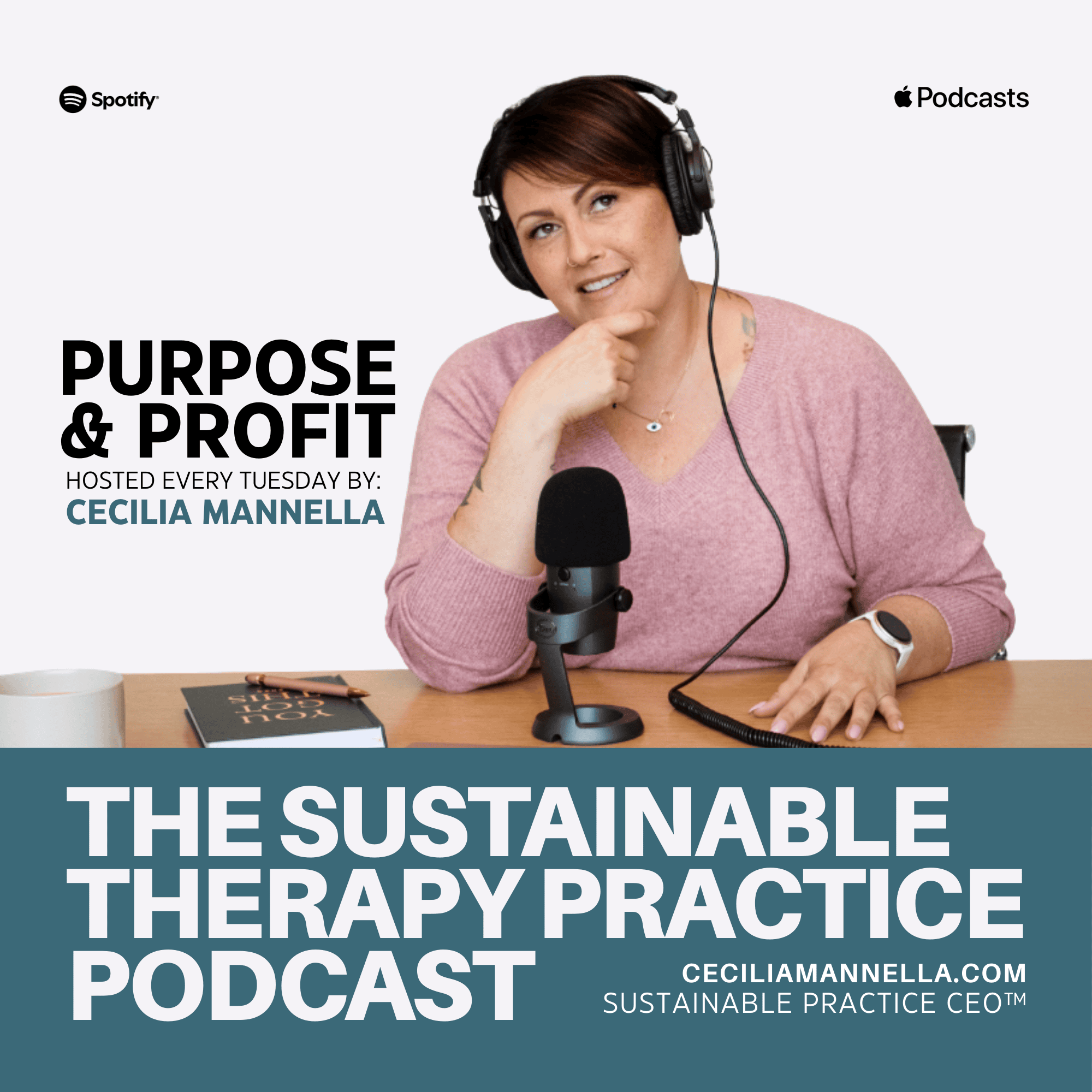
Purpose and Profit: The Sustainable Therapy Practice Podcast
by Cecilia Mannella
Purpose & Profit: The Sustainable Therapy Practice Podcast is for therapists who've built something real and are ready to lead it sustainably.Hosted by Cecilia Mannella, RCC, RSW — mental health practitioner, seven-figure group practice owner, and creator of the Sustainable Practice Framework™ — this podcast explores what it actually takes to build a profitable, sustainable therapy business without shrinking your leadership or losing yourself in the process.Each week, honest conversations about:- Ethical wealth and profit margins you can actually see and understand- Sustainable scaling and leadership evolution- The clinician-to-CEO identity shift — and what it costs to skip it- Team leadership, delegation, and building a practice that runs without you as the single point of failure- Building a practice that serves your clients — and your lifeBecause burnout is not a business model. And purpose without profit isn't sustainable.If you're a therapy practice owner who's tired of b
-
34
EP 33 | We Need to Talk About the Term "AI Therapist"
"Therapy, at its core, is about relationship. And relationship is the one thing AI cannot replicate." I've been sitting with a Facebook post I came across this week — one of dozens I've seen in therapist groups about AI therapists — and I can't stop thinking about the words we're using. Not just what we're debating, but the language we're reaching for to describe it. In this solo episode, I'm deconstructing the phrase "AI therapist" and asking whether we — as a field — are doing ourselves harm just by using it.In this episode, I'm sharing:Why the words we use to describe AI in therapy aren't neutral — and why merging "AI" with "therapist" is doing real damage to how we understand bothWhat AI actually is right now: an LLM drawing on curated, publicly available information that reflects the biases of dominant culture — not a thinking being, not a relationshipWhat therapy actually is at its core — and why I still can't define it in one paragraph after 20 yearsThe diversity of therapeutic relationships that makes the art of therapy so irreplaceable: the therapist who connects with nonverbal children with autism, the one who builds trust with trauma survivors, the one who earns credibility with skeptical high-achieving executivesWhy AI can reproduce the structure of CBT, DBT, IFS, and narrative therapy — and why that is fundamentally not the same as practising any of themThe data question: why would billionaires who built these platforms actually want access to the deepest, darkest secrets of millions of people?What my dad — a Chilean refugee who came to Canada after the assassination of a president — said about things that are offered for freeWhy arguing with each other about AI in therapist Facebook groups is not the same as having the discourse we actually needA call to reclaim the word "therapist" as human-centric — and to stop providing language that normalizes the mergerThis episode is a question, not an answer. If it sparked something for you, I want to have a real conversation about it. Come find me on LinkedIn — link in the show notes — and weigh in. This discourse needs more voices, not fewer. 👉 ceciliamannella.comABOUT YOUR HOST: Cecilia Mannella is a Registered Social Worker, Clinical Counsellor, and therapy practice coach with 25 years as a mental health practitioner and nearly two decades building her own practice from solo therapist to seven-figure group practice. She helps Canadian therapists build profitable, sustainable businesses without apologising for their ambition — or compromising their values. Connect with Cecilia: Website: https://www.ceciliamannella.com/ This Episode: https://www.ceciliamannella.com/purpose-and-profit-podcastLOVED THIS EPISODE? ⭐ Share this with a therapist who's been using the phrase "AI therapist" without thinking twice about it ⭐ Leave a review if this episode gave you language for something you've been uneasy about ⭐ Send this to a colleague who's been arguing about AI instead of having the harder conversation ⭐ Hit follow for more honest conversations about what it actually takes to lead a therapy practicePURPOSE AND PROFIT: THE SUSTAINABLE THERAPY PRACTICE PODCAST Burnout Is Not a Business Model New episodes every Tuesday © CM Consulting — All Rights ReservedWork with me: Apply for Coachinghttps://docs.google.com/forms/d/e/1FAIpQLScnLHz7NPQMjMruYHZij6SJbSBI8JibryK-dGxHcDFhM9VZ9A/viewform
-
33
EP 32 | Vancouver Therapist on Building a Group Practice: Why Therapists Make Reluctant Business Owners
"I've never wanted to be in a position where I'm making decisions based on I just need this session booked because otherwise I can't pay my bills."That's how Nicole Neufeld, Registered Clinical Counsellor (RCC), describes the financial philosophy behind building The Commons Wellness — a virtual group practice based in Vancouver, BC.In this episode, Nicole shares what most therapists are never taught: how to actually run a business — and why avoiding that identity comes at a cost.Nicole’s path into private practice wasn’t linear. With a background in retail management, insurance, and catering, she entered the therapy world with something most new grads don’t have: a working understanding of how businesses operate. That foundation shaped everything from how she built her practice to how she leads her team today.This conversation explores the structural loneliness of therapy work, the gap between clinical training and business reality, and what becomes possible when you stop treating your practice like an accident — and start treating it like a business.In this episode, Nicole shares:Why her pre-therapy career gave her a level of business confidence most clinicians lackThe loneliness built into the therapy room — and why group practice is more than a revenue modelThe mindset shift: becoming a business owner who is also a therapistWhy the lack of business training in grad school sets therapists up to struggleHow she approaches creativity and innovation instead of following “this is how it’s done”Niching as burnout prevention — and how aligned clients change everythingWhy she has never used Google Ads and focuses on SEO, relationships, and organic growth insteadHow she structures her practice around her life goals, not just income targetsThe role of long-term vision (5–10 years) in decision-making and sustainabilityWhy collaborative leadership works — and what trust actually looks like in a group practiceIf you’ve ever felt like you’re running a business without a map, questioning whether the rules you’re following actually fit your values, or quietly burning out trying to do it all alone — this conversation will land.Resources + Links Mentioned:🎙️ Apply for business coaching:https://docs.google.com/forms/d/e/1FAIpQLScnLHz7NPQMjMruYHZij6SJbSBI8JibryK-dGxHcDFhM9VZ9A/viewform🎙️ Book a discovery call:https://www.ceciliamannella.com/business-coaching🎙️ Listen to The Sustainable Practice Framework:https://www.ceciliamannella.com/purpose-and-profit-podcastABOUT YOUR HOST:Cecilia Mannella is a Registered Social Worker, Clinical Counsellor, and therapy practice coach with 25 years as a mental health practitioner and nearly two decades building her own practice from solo therapist to seven-figure group practice. She helps Canadian therapists build profitable, sustainable businesses without apologizing for their ambition or compromising their values.Connect with Cecilia:https://www.ceciliamannella.com/ABOUT THE GUEST:Nicole Neufeld, MC, RCC, is a counsellor and group practice owner at The Commons Wellness, a virtual therapy practice based in Vancouver, BC.With a background in retail management, insurance, and training and development, Nicole brings a strong business foundation into the therapy world — shaping how she builds, hires, and leads. Her practice operates as a collaborative collective of counsellors and interns working within an AEDP-informed framework.Connect with Nicole:Website: https://www.thecommonswellness.ca/LinkedIn: https://ca.linkedin.com/in/nicoledneufeldLOVED THIS EPISODE?⭐ Share this with a therapist who feels like they were never taught how to run a business⭐ Send this to a group practice owner who is questioning their current model⭐ Leave a review and tell us what shifted for you after listening⭐ Follow Purpose and Profit so you never miss a Tuesday episodePURPOSE & PROFIT: THE SUSTAINABLE THERAPY PRACTICE PODCASTBurnout Is Not a Business ModelNew episodes every Tuesday© CM Consulting - All Rights Reserved
-
32
EP 31 | Sustainable Doesn't Mean Easy: What It Actually Takes to Build a Practice That Lasts
"If you've been waiting for your practice to feel calm, predictable, and maybe even low effort before you call it sustainable — that moment is not coming. Not because something is wrong with your practice. Because you've been working from the wrong definition."In this solo episode, I'm taking on the fantasy that's been sold to therapy practice owners - the passive income, the systemised-while-you're-on-the-beach version of sustainability - and offering something more honest, more useful, and actually achievable. Because a sustainable practice is not effortless. It's intentional. And there's a significant difference.IN THIS EPISODE, I'M SHARING:→ The dominant narrative sold to practice owners - and why chasing it sent me into a spiral of 'let's just sell it or burn it down'→ What sustainability actually means: intentional integration of values, vision, time, and attention - not the absence of responsibility→ Why leadership isn't only a group practice concept - solo practitioners lead themselves in relationship to their business every single day→ The identity claim that changes everything: not 'I am a therapist who has a practice' but 'I am a business owner and a leader - right now, not someday'→ Why sustainability and stress are not opposites - and the shift from personalising every stressor as failure to reading it as information→ Team conflict, revenue dips, packed decision-making weeks - what these are actually telling you→ Two real experiments from my practice: the print mental health magazine that's working beautifully, and the $20,000 operations manager hire that taught me exactly what I didn't need→ What a sustainable practice actually looks like: knowing your numbers, making decisions from values, having one honest peer relationship, and stopping the wait to call it a successIf this episode is landing somewhere specific for you and you're sitting with a real question about where you're going and what sustainable growth looks like in your practice - let's talk.I keep a few discovery call spots open each month for practice owners ready to have that honest conversation. No pitch, no pressure. Just a real look at your practice and what's actually possible.Book your discovery call at ceciliamannella.comExplore the Sustainable Practice Framework: ceciliamannella.com/sustainable-practice-frameworkABOUT YOUR HOSTCecilia Mannella is a Registered Social Worker, Clinical Counsellor, and therapy practice coach with 25 years as a mental health practitioner and nearly two decades building her own practice from solo therapist to seven-figure group practice. She helps Canadian therapists build profitable, sustainable businesses without apologising for their ambition - or compromising their values.Connect with Cecilia:Website: https://www.ceciliamannella.com/This Episode: https://www.ceciliamannella.com/purpose-and-profit-podcastLOVED THIS EPISODE?⭐ Share this with a practice owner who's been chasing the effortless passive income dream and quietly feeling like a failure⭐ Leave a review if this episode reframed something you've been carrying as stress into something you can actually use⭐ Send this episode to a colleague who needs permission to stop waiting for calm before she calls her practice a success⭐ Hit follow for more honest conversations about what it actually takes to lead a therapy practicePURPOSE AND PROFIT: THE SUSTAINABLE THERAPY PRACTICE PODCASTBurnout Is Not a Business ModelNew episodes every Tuesday© CM Consulting — All Rights ReservedWORK WITH CECILIAApply for Coaching: https://docs.google.com/forms/d/e/1FAIpQLScnLHz7NPQMjMruYHZij6SJbSBI8JibryK-dGxHcDFhM9VZ9A/viewform
-
31
EP 30 | From Over-Giver to Practice Owner: Using Archetypes to Understand Your Relationship with Profit & Limits
"People treat you the way you teach them that they can treat you."That's how Rebecca Steele, therapist and depth-based coach, opens one of the most honest conversations this podcast has had about why therapists over-give and what that costs a practice.In this episode, Rebecca brings a depth psychology lens to a problem most practice owners feel every single day but rarely name out loud. What does it actually mean that we offer free consults, absorb missed appointments with guilt, and feel like charging for our time is somehow at odds with our values? Rebecca argues there is a name for this pattern, and it is not just professional culture. It is archetypal.In this episode, Rebecca shares:Why therapists unconsciously take on the 'Good Mother' archetype and what it costs when you have no needs of your ownThe orphan archetype explained: how a pattern of emotional deprivation in early relationships shows up later as over-giving and poor boundaries in businessThe connection between bread-crumbing in relationships and the way therapists accept less than they are worthHow guilt about enforcing your cancellation policy is rarely about the policy, and what emotion is actually underneath itWhy Rebecca started charging a $25 fee for consultations and how it changed the power dynamic from the very first contactThe patriarchal structure of the therapy profession: who built the frameworks, who practises them, and why financial inequity is baked into the systemWhy therapists staying invisible while unqualified coaches claim the space is not just a business problem. It is a professional and ethical oneWhat Rebecca's forthcoming book Helper as Mother is naming, and why she is willing to be a contrarian voice in the fieldIf you recognize yourself in the helper archetype, if you have ever felt guilt about enforcing a boundary, wondered why charging feels hard, or quietly resented giving time away for free, this one's for you.Resources + Links Mentioned:🎙️ Take the free CEO Readiness Assessment: https://docs.google.com/forms/d/e/1FAIpQLScnLHz7NPQMjMruYHZij6SJbSBI8JibryK-dGxHcDFhM9VZ9A/viewform🎙️ Book a discovery call: https://www.ceciliamannella.com/business-coaching🎙️ Listen to The Full framework: The Sustainable Practice Framework — ceciliamannella.comABOUT YOUR HOST: Cecilia Mannella is a Registered Social Worker, Clinical Counsellor, and therapy practice coach with 25 years as a mental health practitioner and nearly two decades building her own practice from solo therapist to seven-figure group practice. She helps Canadian therapists build profitable, sustainable businesses without apologizing for their ambition or compromising their values.Connect with Cecilia: https://www.ceciliamannella.com/ABOUT THE GUEST: For over a decade, Rebecca Steele has helped adults untangle the unconscious patterns shaping their relationships, identity, and life direction. In her work as both a therapist and a depth-based coach, she integrates archetype theory, the Enneagram, and relational pattern work to support insight that translates into lived change, not just intellectual awareness. Rebecca is particularly known for her exploration of the Orphan archetype and how it appears across culture and storytelling. Through films and series like The Queen's Gambit, Anne of Green Gables, Peaky Blinders, Adolescence, and Good Will Hunting, she examines how themes of abandonment, resilience, and belonging mirror our own psychological landscapes.Connect with Rebecca: https://www.rebeccaannesteele.com/Instagram: @rebecca.anne.steele | https://www.instagram.com/rebecca.anne.steele/LOVED THIS EPISODE? ⭐ Share this with a fellow practice owner who has ever felt guilty about enforcing their cancellation policy. They need to hear this conversation⭐ Leave a review and tell us: which archetype did you recognise in yourself? Your answer might show up in a future episode⭐ Send this to a newer therapist in your network who is still offering free consults. This is the reframe that changes everything⭐ Follow Purpose and Profit so you never miss a conversation that puts a name to what you are already livingPURPOSE & PROFIT: THE SUSTAINABLE THERAPY PRACTICE PODCASTBurnout Is Not a Business ModelNew episodes every Tuesday© CM Consulting - All Rights Reserved
-
30
Ep 29 | Clinician to CEO Identity Shift: Why Therapy Practice Owners Who Avoid Hard Business Conversations Are Still Leading Like Therapists
If you are a therapy practice owner who makes business decisions every day but still defaults to leading with compassion when clarity and strategy are what's actually needed, this episode is for you. Cecilia names the specific identity shift from clinician to CEO that most established practice owners never recognize is happening — and shares exactly what it looked like in her own group practice and in a recent coaching client's leadership breakthrough. This is Purpose. And it is the piece most established practice owners skip entirely.In This Episode:Why the shift from telling associates what to do to coaching them toward their own growth is the actual threshold between clinician leadership and CEO leadershipThe low-grade frustration and resentment you carry when associates don't perform is a signal you're still leading from your therapist identity, not a sign they're failingClinical training gave you the ability to hold complexity without collapsing it, sit with ambiguity, and notice relational patterns — skills that business leaders pay years and significant money to developA coaching client thought her problem was systems and processes, but the real gap was that she was hiring, leading, and having performance conversations as a therapist instead of a CEOThe three signs you're moving into CEO thinking: you lead relationships with clarity instead of avoidance, you stop outsourcing your authority to peers and coaches, and you stop apologizing for your ambitionIn this episode, we work through the Recognize and Examine steps of the RECLAIM framework — naming the gap between the clinician identity you were trained into and the CEO identity your business actually requires, then examining the beliefs you carry about what kind of person builds a business. If you've been telling yourself that your clinical training should have been enough to prepare you for running what you've built, this is where we name it and start to move through it.Work With Cecilia — 1:1 CoachingYou've built something real. A full caseload, a respected reputation, a practice that runs — mostly — on your own steam. And if you're honest, it's also running you.1:1 coaching is for established Canadian therapy practice owners who are ready to stop managing the chaos and start leading with clarity — fewer clinical hours, cleaner margins, a team that doesn't require your constant oversight, and finally, the time off that doesn't cost you a week of catch-up.Apply here: https://www.ceciliamannella.com/business-coachingResources + Links Mentioned:Website: ceciliamannella.comLinkedIn: linkedin.com/in/cecilia-mannella/Explore the Sustainable Practice Framework: ceciliamannella.com/sustainable-practice-frameworkInterview with Steph Davis on owning leadership mistakes: https://www.ceciliamannella.com/purpose-and-profit-podcast/episode/3367950b/ep-28-or-hiring-growth-and-profits-in-group-practice-how-stefanie-and-lucinda-built-new-ground-wellnessIf This Episode Landed for You:⭐ Share it with a therapist who's feeling the pull between clinical identity and business leadership⭐ Send it to a colleague who apologizes for their ambition more than they should⭐ Leave a review — it takes 90 seconds and helps more Canadian therapists find this work⭐ Hit follow for more honest conversations about what it really takes to lead a therapy practiceAbout Your Host:Cecilia Mannella, RSW, RCC is a therapy practice coach with 25 years as a mental health practitioner and nearly two decades building her own practice from solo therapist to seven-figure group practice. She helps Canadian therapists build profitable, sustainable businesses without apologizing for their ambition or compromising their values.New episodes every Tuesday.© CM Consulting — All Rights Reserved
-
29
EP 28 | Hiring, Growth & Profits in Group Practice: How Stefanie & Lucinda Built New Ground Wellness
ABOUT THIS EPISODEIn this episode, I’m joined by Stefanie Denluck-Larkin, RCC, and Lucinda Wray, RCC — the co-founders of New Ground Wellness in the Okanagan.What started as two therapists sharing office space in Penticton eventually grew into a multi-location group practice serving clients across British Columbia. But like most real practice-building stories, it didn’t start with a perfectly mapped-out business plan.Stefanie and Lucinda share how they built their practice while raising families, navigating risk, and learning the realities behind the idea that group practice is “passive income.” We talk about the financial narratives therapists carry into business, the responsibility of holding other clinicians’ livelihoods, and what it really looks like to grow a sustainable practice over time.They also walk through the full story behind their recent rebrand from South Okanagan Counselling to New Ground Wellness — including what they learned about incorporation, systems, and scaling a practice the second time around.WHAT WE TALK ABOUT IN THIS EPISODE• How Stefanie and Lucinda went from sharing office space in Penticton to co-founding New Ground Wellness with hybrid offices across BC• Why not overthinking their early decisions became one of their biggest advantages as founders• The reality behind the “passive income” narrative of group practice and what it actually costs you in the early years• Independent contractor splits, what 80/20 actually signals in this industry, and why therapists often interpret these numbers differently than other allied health professions• How our money stories often drive business decisions more than our numbers do• What it means to hold responsibility for other clinicians’ livelihoods — and how that leadership role lands differently in a caring profession• The full scope of their rebrand from South Okanagan Counselling to New Ground Wellness, including new incorporation, systems, and infrastructure• Why incorporating earlier would have saved them significant complexity and administrative workABOUT STEFANIE & LUCINDAStefanie Denluck-Larkin, RCC, and Lucinda Wray, RCC are the co-founders of New Ground Wellness, a growing multi-location group practice based in Penticton, BC with hybrid offices across British Columbia.What began as a shared office during the early years of the Okanagan transition grew organically into a full-service wellness practice spanning counselling, breathwork, nutrition, sleep support, and workplace wellness.Their practice is built around three hubs — mind, body, and workplace wellbeing — and serves clients throughout British Columbia and other Canadian provinces.Formerly operating as South Okanagan Counselling, they completed a full rebrand and incorporation into New Ground Wellness in early 2026.Websitehttps://www.newgroundwellness.caInstagramhttps://www.instagram.com/newgroundwellnesscollectiveABOUT YOUR HOSTI’m Cecilia Mannella, a Registered Social Worker, Clinical Counsellor, and therapy practice coach.After 25 years as a mental health practitioner and nearly two decades building my own practice from solo therapist to seven-figure group practice, I now help Canadian therapists build profitable, sustainable businesses — without apologizing for their ambition or compromising their values.Websitehttps://www.ceciliamannella.comPodcasthttps://www.ceciliamannella.com/purpose-and-profit-podcastApply for 1:1 Business Coachinghttps://docs.google.com/forms/d/e/1FAIpQLScnLHz7NPQMjMruYHZij6SJbSBI8JibryK-dGxHcDFhM9VZ9A/viewformENJOYED THIS EPISODE?⭐ Share it with a therapist who’s thinking about group practice and still believes the passive income story⭐ Send it to a colleague navigating a rebrand who needs to hear that the messy middle is normal⭐ Leave a review if this conversation named the financial tension you’ve been carrying but couldn’t quite articulate⭐ Follow the podcast so you don’t miss the next honest conversation about building a sustainable therapy practicePURPOSE & PROFIT: THE SUSTAINABLE THERAPY PRACTICE PODCASTBurnout Is Not a Business Model.New episodes every Tuesday.© CM Consulting — All Rights Reserved
-
28
EP 27 | Nobody Gave You the Map: The Business Training Gap Every Therapist Carries
You have absolutely no idea what you're doing financially, operationally or strategically. Nobody told you what was actually coming — but here's the kicker.Everybody told you to do this.That's Cecilia Mannella, RSW, RCC, naming the thing most therapists in private practice have carried quietly for years.Grad school celebrated private practice as the destination. Supervisors recommended it. Programs normalized it as the path.And then you signed the lease, set up the diffuser, and discovered nobody had sold you the map.In This Episode• Why the training-to-reality gap in private practice is a systemic problem — not a personal failure — and why the profession keeps it quiet• The predictable patterns that show up when therapists receive no business training: pricing at random, overworking or underworking, and paralysis around financial decisions• The identity tension at the centre of it all: clinician who has a business vs. business owner who does clinical work• Why your clinical training already gave you the skills to tolerate uncertainty — and how to apply those same skills to revenue, growth, and business decisions• The shift from reactive clinical responsiveness to proactive strategic thinking• What it actually means to sit in the CEO chair instead of simply tolerating the business side of your practice• Why releasing hustle culture is not optional if you want a practice that lasts — and the Canadian cultural layer that makes financial ambition feel like something to diminish• Three closing reflection questions designed to move you from therapy chair to CEO chairListen If• You've ever blamed yourself for struggling with the business side of private practice• You're a solo practitioner who knows something needs to change• You're trying to bridge the gap between clinical excellence and business sustainabilityListen to Cecilia's full framework: The Sustainable Practice FrameworkAbout Your HostCecilia Mannella is a Registered Social Worker, Clinical Counsellor, and therapy practice coach with 25 years as a mental health practitioner and nearly two decades building her own practice from solo therapist to seven-figure group practice.She helps Canadian therapists build profitable, sustainable businesses without apologizing for their ambition — or compromising their values.Connect with CeciliaWebsite https://www.ceciliamannella.com/Podcast Page https://www.ceciliamannella.com/purpose-and-profit-podcastWork With CeciliaApply for business coaching:https://docs.google.com/forms/d/e/1FAIpQLScnLHz7NPQMjMruYHZij6SJbSBI8JibryK-dGxHcDFhM9VZ9A/viewformInterested in working together?Apply for 1:1 Business Coaching here:https://forms.gle/uSmLFhnsmxAXafZE9Loved This Episode?⭐If this episode put words to the quiet shame you've been carrying about the business side of your practice, share it with a colleague who needs to hear it's not their fault either.⭐Know a therapist who just signed their first lease or is thinking about private practice? Send them this episode before they set up that diffuser.⭐If Cecilia's line about sitting in your own uncertainty the way you ask clients to sit in theirs stopped you mid-commute, leave a review and tell her — it helps more therapists find this conversation.⭐Follow the podcast so you don't miss the rest of March — we're going deep on money, profits, and the entrepreneurial gap all month.PURPOSE & PROFIT: THE SUSTAINABLE THERAPY PRACTICE PODCASTBurnout Is Not a Business ModelNew episodes every Tuesday© CM Consulting — All Rights Reserved
-
27
EP 26 | How a Business Partnership Actually Works: Steph Davis, RCC-ACS on Culture, Leadership & Letting Go
We worked literally next to each other. We didn't meet for eight months.That's how Steph Davis describes the beginning of her business partnership with Laura — the woman who would become her co-founder at Shoreline Counselling, a 25-therapist practice in Fort Langley, BC.In this episode, Stephanie Davis, RCC-ACS, PCC, COC shares:→ How a group therapy invitation (and a weekend with a stranger's husband) turned into a 7-year friendship and business partnership→ Why the biggest challenge of partnership isn't money, contracts, or disagreements. It's making time for the friendship→ How they survived opening six months before COVID with a large mortgage and no roadmap→ The one early decision they regret, & what they'd do differently as leaders now→ Why building culture in a therapy practice is uniquely complex, and why so many group practice owners get it wrong→ The frank conversation about passive income, new grads, and what actually makes a private practice sustainable→ How AI is threatening the field of therapy — and why clinical excellence is our differentiatorIf you're thinking about a business partnership, building a group practice, or navigating the leadership evolution that nobody warns you about — this one's for you.Connect with Steph:Shoreline Counselling: https://shorelinecounseling.caLinkedIn: https://www.linkedin.com/in/stephaniedavisconsulting/Podcast: A Not So Private PracticeResources mentioned:The Sustainable Practice Framework™ — listen to Cecilia's full framework on the podcastWork with Cecilia:Interested in working together?Apply for 1:1 Business Coaching here:https://forms.gle/uSmLFhnsmxAXafZE9ABOUT YOUR HOST: Cecilia Mannella is a Registered Social Worker, Clinical Counsellor, and therapy practice coach with 25 years as a mental health practitioner and nearly two decades building her own practice from solo therapist to seven-figure group practice. She helps Canadian therapists build profitable, sustainable businesses without apologizing for their ambition — or compromising their values.Connect with Cecilia: Website: https://www.ceciliamannella.com/ABOUT THE GUEST: Stephanie Davis, RCC-ACS, PCC, COC is the co-founder of Shoreline Counselling, a 25-therapist group practice in Fort Langley, BC. With over a decade in the field, Steph is known for her work in leadership development, practice culture, and building collaborative business partnerships in the therapy space. She also hosts A Not So Private Practice, a podcast for therapists navigating the realities of running a group practice.Connect with Steph: Website: https://shorelinecounseling.caLinkedIn: https://www.linkedin.com/in/stephaniedavisconsulting/Podcast: A Not So Private PracticeLOVED THIS EPISODE?⭐ Share it with a therapist who's thinking about a business partnership — or wondering if group practice is right for them⭐ Leave a review if this conversation named something you've been carrying quietly⭐ Send this episode to a colleague navigating the leadership evolution nobody warns you about⭐ Hit follow for more honest conversations about what it really takes to lead a therapy practicePURPOSE & PROFIT: THE SUSTAINABLE THERAPY PRACTICE PODCASTBurnout Is Not a Business Model New episodes every Tuesday© CM Consulting — All Rights Reserved
-
26
25 | Live Coaching: From OT to RCC With Lisa Brooks — Building Permission to Self-Promote
When you've got unfinished PESI courses piling up and a background in OT, how do you actually translate all that knowledge into shameless self-promotion? Lisa Kessier-Brock is a registered clinical counsellor who blends her occupational therapy roots with psychotherapy to support parents navigating the messy, never-ending journey of parenthood. Cecilia coaches her through the permission piece, tech overwhelm, and building sustainable marketing systems that don't require dancing on social media.What You'll Learn:Why permission to self-promote is the first hurdle most therapists face (and how to get over it)The tech intimidation factor for women and how to move through it with practical toolsHow to maximize your existing tech stack instead of complicating things with more platformsThe strategic difference between workshops that convert and workshops that just drain your energyWhy time blocking isn't a time management issue — it's a self-boundary issueHow to create automated email sequences that nurture workshop attendees without Jane AppThe real reason content takes three hours instead of 45 minutes (and it's not the content)Why your ADHD brain needs built-in creative time blocks, not rigid productivity systemsKey Topics Discussed:Lisa's journey from OT to RCC and why the mental health piece was always the passionThe COVID-era "everyone has a wait list" myth that set up unrealistic expectationsPermission to share knowledge and why life experience is as valuable as seven courses from PESIShameless self-promotion as a Full Practice Formula breakthroughTech intimidation as a gendered issue and how to overcome itWorkshop strategy: free vs. paid, in-person vs. virtual, and what actually convertsBuilding email automation with MailerLite forms and Google Meet (no Jane App needed)Time blocking as a self-boundary practice, not a productivity hackThe brain's relationship to time allocation and why tasks expand to fill the space you give themIntegrating ADHD needs into your business systems instead of fighting themMentioned in This Episode:Lisa Kessier-Brock, M.Ed., RCC - Registered Clinical Counsellor, Vancouver, BCNurtured Foundations Therapy & Consulting - Lisa's practice supporting parentsFull Practice Formula - Cecilia's program for therapists building sustainable practicesPESI - Professional education platform with endless course optionsMailerLite - Email marketing platform for automation and landing pagesSquarespace - Website platform Lisa usesGoogle Meet - Free video conferencing tool for workshopsJane App - Practice management software (discussed as unnecessary for simple workshops)Comedy Connection - Lisa's brother is a comedian; therapist siblings are a thingLive Coaching Breakthroughs:The Permission Block: "I think one of the many things that I got from the course was just that permission to... there's so much knowledge that we build and it's valuable to share it."The Tech Overwhelm: "I think especially for women, there's like an intimidation level when it comes to tech."The Reframe: Learning tech is easier than learning everything you already know about working with people — you're smarter than you think.The Workshop Trap: Not all workshops are created equal. Free workshops work when they're designed to convert, not just educate.The Time Boundary Truth: "If you give yourself an hour to do a task, you will do the task in an hour. If you give yourself three hours to do the same task, it'll take you three hours."The ADHD Integration: Don't fight your brain — build systems that work with it, including creative time blocks and strategic breaks.Key Coaching Moments:"We have spent at minimum seven years in school, probably eight. We get so overwhelmed with these things that are actually really doable and easy to learn because we have learned the complex things already.""It is just time blocking. You also want to integrate your ADHD need. You need to make space for it.""Whatever we allocate, we will use. That is the self boundary around like, I have this much time to do these things and that is it.""It's not a time management issue, it's a self-boundary issue."Practical Action Steps:Embrace shameless self-promotion — your knowledge and experience are valuableCreate a simple workshop funnel: landing page (MailerLite) → Google Meet → automated email sequenceTag everyone who registers (e.g., "free workshop Feb 2026") so you can track and nurture themTime block your content creation and stick to it — 45 minutes for an email, not three hoursMaximize your existing tech stack instead of adding more toolsBuild ADHD-friendly systems with creative time blocks and intentional breaksRemember: imperfect and done beats perfect and never postedRelatable Struggles:Seven unfinished PESI courses gathering digital dustPermission paralysis around self-promotion and visibilityTech intimidation as a barrier to marketingThe COVID influencer flood that made you want to exit the arenaTime disappearing into tasks that should be quickADHD brain needs vs. rigid productivity systemsFeeling like you need to do TikTok dances to market your practiceWorkshop overwhelm and not knowing where to startThe Comedian-Therapist Connection:Lisa's brother is a comedian, and at the Emmys, multiple comedians said their siblings were therapists too. As Cecilia puts it: "We all work through our trauma differently. Some of us support other people with their trauma to work through it and some people tell jokes."──────────────────────────────────────────ABOUT YOUR HOST:Cecilia Mannella is a leadership coach for therapists and wellness practice owners with 25 years as a mental health practitioner and 17+ years building her group practice from solo therapist to seven-figure success. She specializes in helping therapists find niche clarity and visibility strategies that feel aligned, not gross.Interested in working together?Apply for 1:1 Business Coaching here:https://forms.gle/uSmLFhnsmxAXafZE9Connect with Cecilia:Website: https://www.ceciliamannella.com/This Episode: https://www.ceciliamannella.com/purpose-and-profit-podcastABOUT THE GUEST:Lisa Kessier-Brock is a registered clinical counsellor in Vancouver, BC, with a background in occupational therapy. She blends practical life roles and routines from her OT training with psychotherapy to support parents navigating the journey of...
-
25
24 | From Care Aide to Grief Specialist: Building a Practice That Honours the Messy, Non-Linear
What happens when everything you learned in graduate school about grief contradicts what you experienced in real life? Eliezer Moreno, grief and loss therapist in Vancouver, shares the powerful story of losing his friend Ryan shortly after learning "all the right things" about supporting people in grief—only to find himself confused, lonely, and unable to cry at the memorial. This conversation explores how his grandmother's nursing legacy, hospice volunteering, and personal loss shaped a practice that rejects pathologizing grief and instead walks alongside people in their messy, non-linear healing.What You'll Learn:+ Why the hospice model of "companioning" differs radically from clinical training's pathologizing approach+ How losing a friend shortly after grief training revealed the gap between theory and lived experience+ The physical manifestations of grief that aren't talked about enough+ Why disenfranchised grief keeps people stuck and how to validate every type of loss+ The power of saying "I don't know what to say" instead of trying to fix or solve+ How to build a grief therapy practice that honours mess over models+ Why YouTube and email marketing are essential for grief therapists in 2025+ The one-to-many service model that extends your impact beyond the therapy roomKey Topics Discussed:+ Eliezer's journey: grandmother's nursing legacy in the Philippines → care aide work → collecting stories from clients+ The shift from practical care to therapeutic presence (noticing photos on walls, asking about people's lives)+ Social work training: learning modalities and clinical interventions focused on pathology+ Hospice volunteering: discovering the "companioning" model that honours grief as natural, not broken+ The contrast: graduate school taught five-stage model (Kübler-Ross) in one paragraph; hospice taught complexity+ 2017: losing friend Ryan shortly after 10-year high school reunion+ The loneliness of being the only one not crying while surrounded by grieving people+ Disenfranchised grief: losses that aren't socially recognized or validated+ The pressure to "get over it" after arbitrary timelines (6 months, 1 year)+ Why grief isn't linear and models can be more harmful than helpful+ Supporting LGBTQ2S+ folks in grief (chosen family, complicated relationships with biological family)+ Lessons from Full Practice Formula program (first cohort member)+ Current challenge: wanting to create YouTube content but feeling overwhelmed+ Cecilia's coaching: breaking YouTube into manageable steps (pick topic → record video → create 5-min clip → distribute)+ Email list strategy: nurturing relationships through resources and video contentMentioned in This Episode:+ Eliezer's Grandmother - Nurse from the Philippines, came to Canada in the 1960s, inspired Eliezer's helping profession path+ Hospice Volunteering - Where Eliezer learned the "companioning" model vs. pathologizing approach+ Elisabeth Kübler-Ross - Five-stage grief model taught in graduate school+ Disenfranchised Grief - Losses not socially recognized (friendship loss, non-death losses, ambiguous loss)+ Full Practice Formula Program - Cecilia's program, Eliezer was first cohort member+ Jane App - Practice management software where Eliezer has email permission but hasn't launched list yet+ Meaningful Counselling - Eliezer's practice serving Surrey, Coquitlam, and online in BCThe Physical Reality of Grief:Eliezer shares his personal experience of physical grief symptoms many people don't talk about: jaw clenching at night, body tension, the confusion of not crying when "supposed to." This vulnerability normalizes the non-linear, embodied nature of grief that doesn't fit textbook models.Disenfranchised Grief Explained:Losses that aren't socially recognized or validated: friendship loss, pet loss, miscarriage, job loss, loss of what could have been, ambiguous loss (person is alive but relationship has ended), moving away from homeland, chosen family loss. These griefs are just as real but often dismissed by society's narrow definition of "legitimate" loss.───────────────────────────────────────────ABOUT YOUR HOST:Cecilia Mannella is a leadership coach for therapists and wellness practice owners with 25 years as a mental health practitioner and 17+ years building her group practice from solo therapist to seven-figure success. She created the Full Practice Formula program to help therapists build sustainable, visible practices—and Eliezer was a member of the very first cohort.Interested in working together?Apply for 1:1 Business Coaching here:https://forms.gle/uSmLFhnsmxAXafZE9Connect with Cecilia:Website: https://www.ceciliamannella.com/This Episode: https://www.ceciliamannella.com/purpose-and-profit-podcast───────────────────────────────────────────ABOUT THE GUEST:Eliezer Moreno, MSW, RSW (pronounced Ella-zar, he/him) is a Registered Social Worker with a mission to help people to live without letting go. After 15 years of working in palliative care, hospice, and grief, he launched his private practice, Meaningful Counselling, in 2024, serving Surrey, Coquitlam, and online in BC. His approach is grounded in the hospice model of "companioning"—walking alongside people in their grief rather than trying to fix or pathologize their experience. He's passionate about expanding the conversation around grief to include non-death losses, LGBTQ2S+ experiences, immigrant grief, and the messy, non-linear reality that doesn't fit into stage models.Connect with Eliezer:Website: https://www.meaningfulcounselling.ca/LinkedIn: https://www.linkedin.com/in/eliezer-moreno-msw-rsw-556317118YouTube: https://www.youtube.com/@meaningfulgrief───────────────────────────────────────────LOVED THIS EPISODE?⭐ Share it with someone who's experienced a loss that wasn't recognized or validated by others⭐ Leave a review if you've ever felt confused by your own grief or thought you "should" be grieving differently⭐ Subscribe to Eliezer's YouTube channel @meaningfulgrief for grief education and resources⭐ Hit follow for more conversations about building therapy practices that honour the messy, human experiencePURPOSE & PROFIT: SCALE YOUR THERAPY PRACTICEScale Without SacrificeNew episodes every Tuesday© CM Consulting - All Rights Reserved
-
24
23 | The Social Worker's Dilemma: Making Money Without Betraying Your Values
Social workers are trained to fight capitalism and poverty—so what happens when you decide to open a private practice and charge for your services? April Griffin, MSW and group practice owner, gets brutally honest about the identity crisis, money shame, and values conflict that social workers face in the private sector. This conversation tackles the elephant in the room that nobody in social work education wants to discuss.What You'll Learn:+ Why social workers struggle more than other therapists with the transition to private practice+ The values conflict: anti-capitalist training meets the reality of needing income to survive+ How social work education fails to prepare practitioners for private practice (or even acknowledge it exists)+ Why private practice social workers aren't winning "Social Worker of the Year" awards+ The scarcity mentality that prevents social workers from investing in their practice growth+ How April built a 400-member Facebook group for BC social workers in private practice+ What it takes to reconcile social work values with running a profitable business+ Why "I just wanted to help people for free" is an unsustainable business modelKey Topics Discussed:April's journey: Ukraine volunteer work at 18, Downtown Eastside, addiction/trauma/domestic violence work+ Transition from Fraser Health (Maxine Wright Centre) to private practice during COVID+ Starting in 2020: offering in-person therapy when everyone else was virtual only+ The slow-and-steady build: hourly rental → sublet → own space → group practice (3 associates)+ Social work's "client first" values that leave no room for practitioner sustainability+ The cousin nobody talks about: private practice as the ignored sector in social work+ Money shame: the discomfort of making money from people's pain+ The values contradiction: being praised as a saint in healthcare but judged in private practice+ How having three kids and a partner in school forced a mindset shift about money+ Creating the BC Social Workers in Private Practice Facebook group (started from zero, now 400members)Mentioned in This Episode:+ April Griffin's Group Practice - Emotion Wise Counselling, 3 associates, started ~3 years ago+ BC Social Workers in Private Practice Facebook Group - 400 members, co-created with Dorcas -https://www.facebook.com/share/g/1B8H5Twurm/+ Fraser Health - Maxine Wright Community Health Centre (pregnant/parenting moms, substance use, trauma, domestic violence)+ LinkedIn Strategy - April manually messaged social workers to build community+ Social Work Education - MSW programs that don't teach business or acknowledge private practice+ Anti-Oppressive Values - How they help clinical work but create friction with money+ The COVID Bubble - In-person therapy demand during isolation+ Slow Recovery - April's own journey from "I want to see people for free" to sustainable pricingThe Social Work Values Conflict:+ What Helps: Anti-oppressive lens, understanding social injustice, systemic awareness, trauma-informed care+ What Hurts: Money shame, self-sacrifice narrative, capitalism guilt, scarcity mentality+ The Paradox: Same salary in healthcare = saint; same salary in private = selfish+ The Reality: "This is my only income now. I have three children. I had a partner at school for two years not working."+ The Betrayal Feeling: Moving to private sector feels like abandoning social work's anti-capitalist rootsBuilding Community from Nothing:April didn't wait for someone else to create resources for social workers. She took action:+ Co-created BC Social Workers in Private Practice Facebook group+ Manually added social workers from LinkedIn one by one+ Privately messaged each person to join+ Posted everywhere to gain momentum+ Built to 400 members through intentional effort, not organic growth+ Created the community she wished existed when she startedThe Money Conversation:"I opened a private practice so I could potentially see people for free. Of course I'm struggling with this."April's turning point came from necessity—not ideology. When her practice became her only income, supporting three kids and a partner in school, she had to examine the values that were keeping her from sustainable pricing. The shift wasn't about abandoning social work principles—it was about recognizing that sustainable work requires sustainable income.Key Quotes:"There's zero resources for social workers in private practice in BC. I was the first of all my peers to start their private practice.""I don't see many private practice owners getting these social worker of the year awards.""It's fine when you're in healthcare—you're a saint. But when you're in private practice, there's something very self-serving about it.""I think sometimes people are juggling multiple jobs, maybe they're still in healthcare. And so they say, well, this is kind of a way to help people. But it is how I have to survive.""People don't necessarily see the excitement of building a practice, so they're investing less in it—less marketing time, fewer necessary funds."───────────────────────────────────────────ABOUT YOUR HOST:Cecilia Mannella is a Registered Social Worker (RSW) and leadership coach for therapists with 25 years as a mental health practitioner and 17+ years building her group practice from solo therapist to seven-figure success.She's been navigating the social worker identity crisis in private practice for nearly two decades.Interested in working together?Apply for 1:1 Business Coaching here:https://forms.gle/uSmLFhnsmxAXafZE9Connect with Cecilia:Website: https://www.ceciliamannella.com/This Episode: https://www.ceciliamannella.com/purpose-and-profit-podcastABOUT THE GUEST:April Griffin is a seasoned social worker, trauma therapist, and group practice owner of Emotion WiseCounselling—a practice focused on helping people with complex trauma and emotion regulation find support and wellness. She is an adventurer and healer who has lived her life on both coasts of Canada, as well as internationally and loves new opportunities to connect and learn from and with others. She is also an avid soccer player and mom to 3 wonderful girls.Connect with April:Website: https://www.emotionwise.caLinkedIn: https://www.linkedin.com/in/april-griffin-390135117/Facebook: https://www.facebook.com/emotionwisecounselling/Instagram: https://www.instagram.com/emotionwise/BC Social Workers in Private Practice Facebook Group:https://www.facebook.com/share/g/1B8H5Twurm/LOVED THIS EPISODE?⭐ Share it with a social worker who's struggling with the private practice decision⭐ Join the BC Social Workers in Private Practice Facebook group⭐ Leave a review if you've experienced the values conflict between social work training and business ownership⭐ Hit follow for more honest conversations about money, values, and sustainable practicePURPOSE & PROFIT: SCALE YOUR THERAPY PRACTICEScale Without SacrificeNew episodes every Tuesday© CM Consulting - All Rights Reserved
-
23
22 | Live Coaching: When Your Two Niches Feel Like They Don't Belong Together
What do you do when you have two completely different niches that you're equally passionate about? KelliWheatley is a first-year therapist in North Vancouver who loves working with both chronic pain/mind-bodyconnection AND walk-and-talk nature therapy. On the surface, they seem unrelated—but Cecilia coaches herthrough discovering the powerful connection that makes both niches work under one cohesive brand umbrella.What You'll Learn:+ Why two different niches can work together when YOU are the umbrella+ How to position yourself as the brand instead of fragmenting into separate identities+ The biggest mistake therapists make when entering private practice (expecting to be fully bookedimmediately)+ Why niche clarity is burnout prevention and creates practice longevity+ How to write blog content at a conversational level (the 13-year-old test)+ The mindset shift from "content creator" to "service provider" (one-to-many education)+ Why marketing as a therapist feels gross (and how to reframe it as getting in front of people you cansupport)+ How to connect two seemingly different specialties through the common threadKey Topics Discussed:+ Kelli's background: competitive ballet, body image struggles, chronic illness journey, mind-bodyconnection+ The "COVID bubble" myth: why the "everyone has a wait list" messaging set up new therapists fordisappointment+ First-year reality check: the expectation vs. reality of building a private practice+ Niche confusion: chronic pain/mind-body work AND walk-and-talk nature therapy—how do theyconnect?+ The umbrella concept: YOU are the brand that holds everything together+ Blog writing strategy: conversational tone, accessible language, service-focused content+ Content as service: educating one-to-many instead of performative social media+ The competitive mindset from dance that translates to business+ Making language accessible (masters-level educated people need to simplify)Mentioned in This Episode:Kelli Wheatley - First-year therapist, North Vancouver, UBC graduateKelli's Website - https://www.kelliwheatleycounselling.comWalk-and-Talk Therapy - Nature-based counselling approachMind-Body Connection - Chronic pain, HPA axis, Gabor Maté's workThe 13-Year-Old Test - Would a 13-year-old understand your content?Psychology Today - Where Kelli expected immediate resultsAI Tools - Mentioned as helpful for content creationLive Coaching Breakthroughs:The Problem: Two niches (chronic pain + walk-and-talk) felt disconnected and confusingThe Reframe: YOU are the umbrella—both niches are tethered to your brand identityThe Connection: Both niches are about embodiment and being present in your bodyThe Solution: Position yourself as the intervention, not the modalitiesThe Relief: "I don't have to dance on TikTok"—content can be written, educational serviceThe Permission: You can pivot and evolve your niches over time; you're not married to them foreverKey Coaching Moments:"You're not two separate entities floating around. They're both tethered to you. YOU are the umbrella.""Would a 13-year-old understand this? That's the filter. It's not about dumbing down—it's about making language accessible.""You are here on this podcast because of content that I produced. Content creation IS service.""You are the intervention. Your clients need to know who they're going to get—and that's who they're going toget.""This allows you to pivot at any point. You're not married to your niche forever. Your career evolves."Practical Action Steps:+ Position yourself as the brand umbrella that holds both niches+ Write blog content at a conversational level (13-year-old test)+ Reframe content creation as one-to-many service, not performance+ Identify the common thread connecting your different specialties+ Talk to people you know who might benefit from your services+ Use the soapbox test: can you talk about this topic for an hour without prep?+ Remember: marketing is just getting in front of people you can supportRelatable Struggles:+ Entering practice with unrealistic expectations based on COVID-era messaging+ Feeling like you have to choose between two passions+ Resistance to being a "content creator" or doing TikTok dances+ Writing at too academic/elevated a level instead of conversationally+ Struggling with marketing feeling "gross" as a therapist+ Being the "fly high brain" person who needs to simplify+ Wanting to support people but not knowing how to get visibleThe Competitive Mindset Connection:Cecilia points out that Kelli's competitive ballet background actually translates well to business—competitiveness isn't just about hustle, it's about strategic thinking, discipline, and performance under pressure.Those skills from dance are assets in entrepreneurship.───────────────────────────────────────────ABOUT YOUR HOST:Cecilia Mannella is a leadership coach for therapists and wellness practice owners with 25 years as a mentalhealth practitioner and 17+ years building her group practice from solo therapist to seven-figure success. Shespecializes in helping therapists find niche clarity and visibility strategies that feel aligned, not gross.Connect with Cecilia:Website: https://www.ceciliamannella.com/This Episode: https://www.ceciliamannella.com/purpose-and-profit-podcastABOUT THE GUEST:Kelli Wheatley, M.Ed., RCC, CCC is a clinical counsellor passionate about supporting clients with mind-bodywellness. She takes clients outside onto the trails of North Vancouver for walk-and-talk therapy, and sees clientsvirtually across Canada who are struggling with body image, chronic pain, and illness. She believes everyonehas the capacity to heal and build a full, joyful life; and she takes immense pride in walking alongside folksthroughout their journeys.Connect with Kelli:Website: https://www.kelliwheatleycounselling.comLOVED THIS EPISODE?⭐ Share it with a therapist who's struggling to connect their multiple passions into one cohesive practice⭐ Leave a review if you've ever felt confused about your niche positioning⭐ Apply the 13-year-old test to your own website content and see what happens⭐ Hit follow for more live coaching sessions this monthPURPOSE & PROFIT: SCALE YOUR THERAPY PRACTICEScale Without SacrificeNew episodes every Tuesday© CM Consulting - All Rights Reserved
-
22
21 | Beyond Resolutions: The CEO Pause You Actually Need (New Year Reflection)
New Year's resolutions feel empty because they skip the most important part: honest reflection. This isn't another "new year, new you" message—it's the anti-resolution episode you need. Before you set any goals for2026, you need to pause and look honestly at where you've been and who you're becoming as a practice leader.What You'll Learn:+ Why reflection matters more than resolution-setting for sustainable practice growth+ The exact journaling questions Cecilia uses every quarter to assess her practice+ How to evaluate your year through the lens of lessons learned, not just wins and losses+ What made 2025 successful in Cecilia's practice (ecosystem building, strategic hiring, marketing experiments)+ The habits you need to start and stop to become the leader your 2026 vision requires+ How to identify what needs to be released before you can move forward+ Why personal growth is the prerequisite for business growth (not the other way around)Key Topics Discussed:+ The CEO pause: taking off your clinician hat to reflect as a business leader+ 2025 wins: building an ecosystem practice with diverse specialties, promoting from within, experimenting with AI optimization+ 2025 challenges: bad hires, letting go quickly, investment experiments that didn't pay offLessons learned: + Experimentation mindset, stabilization after growth, team culture importance+ Releasing unfinished conversations and letting go of what no longer serves+ Committing to stopping harmful habits and starting wellbeing habits+ The identity shift required for your next chapter: who do you need to become?+ Measuring success: defining what makes 2026 successful on your own terms+ Growth happens at the edges, not the center—embracing discomfort as necessary+ Personal disclosure: Cecilia's commitment to stop phone scrolling and prioritize self-care habitsMentioned in This Episode:Reflection Questions Worksheet - Download the complete journaling prompts from this episodeFull Practice Formula Program - Over 50 graduates excelling in practice growthMarketing Experiments - AI optimization, blog post format testing (changed 5 times)2026 Focus - Stabilization year after growth and experimentationKey Frameworks:The Reflection Process - What went well, what didn't, why it happened, lessons learned?Habits Assessment - Committing to starting new habits and stopping old onesIdentity Evolution - Who you need to become for your success visionThe CEO Pause - Stepping into leadership perspective quarterlySuccess Definition - Your definition, not external benchmarksReflection Questions from This Episode:+ How did 2025 go for you? (What went well and why?)+ What lessons did you learn that you're taking forward?+ What needs to be released before moving into 2026?+ What habits are you committing to starting and stopping?+ What would have to happen by the end of 2026 for you to consider it successful?Who do you need to become for this year's chapter to turn out the way you'd write about it?Interested in working together?Apply for 1:1 Business Coaching here:https://forms.gle/uSmLFhnsmxAXafZE9ABOUT YOUR HOST:Cecilia Mannella is a leadership coach for therapists and wellness practice owners with 25 years as a mental health practitioner and 17+ years building her group practice from solo therapist to seven-figure success. She practices what she preaches—using quarterly reflection to guide strategic decisions and sustainable growth.Connect with Cecilia:Website: https://www.ceciliamannella.com/Download Reflection QuestionsLOVED THIS EPISODE?⭐ Share it with a practice owner who needs permission to pause & reflect⭐ Download the reflection questions worksheet and actually use it⭐ Leave a review sharing one insight or commitment you're taking into 2026⭐ Hit follow so you don't miss the live coaching sessions coming this monthPURPOSE & PROFIT: SCALE YOUR THERAPY PRACTICEScale Without SacrificeNew episodes every Tuesday© CM Consulting - All Rights Reserved
-
21
20 | Why Great Leaders Still Drown in Chaos (4P — Process Pillar)
You've got your purpose clear, your profit strategy solid, and your team aligned with your values. So why are you still spending 17+ hours a week drowning in administrative chaos? Here's the truth nobody tells you: You can have the best vision, strongest profit margins, and most authentic leadership—but if your operations don't have clear systems, they're going to burn you out. This final episode in the 4 Pillars series tackles the unsexy but essential foundation that makes everything else possible: processes.What You'll Learn:Why 50-80% of your non-clinical time goes to operational issues that could be systematisedThe hidden cost of hiring without a structured process (and how it's draining your time and money)How to stop being the bottleneck in every single decision your team needs to makeThe six priority systems every therapy practice needs—and the exact order to implement themWhy documentation isn't bureaucracy—it's the key to scaling without losing your mindHow to build team communication structures that actually work instead of fragmenting across platformsThe firing and off-boarding process you need before you need it (because it never gets easier)Key Topics Discussed:Operational chaos symptoms: hiring without systems, financial mystery, communication fragmentation, performance management avoidance, documentation resistance, and crisis-mode firingThe real cost of not having processes: reactive hiring, constant re-explaining, self-doubt, financial uncertainty, wasted time, team frustration, legal vulnerability, and burnoutSix priority systems in implementation order: hiring and onboarding, financial tracking and reporting, performance management and feedback, team communication and decision authority, regular check-ins, and firing/off-boarding protocolsHiring system essentials: clear job descriptions, structured interview processes, comprehensive onboarding plans, and 30-60-90 day check-insFinancial clarity requirements: monthly profit and loss reviews, quarterly projections, clear bookkeeping systems, and knowing your numbers at all timesPerformance management framework: regular check-ins, real-time feedback culture, documented conversations, and early issue identificationTeam communication infrastructure: choosing one platform, creating decision-making matrices, and eliminating the bottleneck dynamicDocumentation as protection: policies and procedures that prevent misunderstandings and provide legal coverageClient-centred off-boarding: respecting client autonomy, ensuring continuity of care, and maintaining ethical standards during transitionsMentioned in This Episode:Sustainable Practice Framework™ - All 4 Pillars working together: Purpose, Profit, People, ProcessRECLAIM Process - Applied to the Process Pillar for operational transformationCecilia's Story - Spending 17-20 hours weekly on administrative chaos despite having money and team to solve itOperational Audit Exercise - Track everything for 1-3 weeks to identify pain pointsPriority System - Focus on one system at a time, starting with hiring/onboardingPrevious Episodes - Purpose Pillar (Episode 17), Profit Pillar (Episode 18), People Pillar (Episode 19)Key Frameworks:Process Pillar - Create energy-intelligent systems that support growth while protecting your capacitySix Priority Systems - The essential operational infrastructure in order of implementationDecision-Making Matrix - Clarifying who makes what decisions to eliminate bottlenecks30-60-90 Day Check-ins - Structured onboarding timeline for new hiresOperational Audit - Data-gathering exercise to identify biggest pain pointsAction Steps from This Episode:Operational Audit - Track all operational tasks for 1-3 weeks with no judgment, just data collectionIdentify Pain Points - Write down your top three operational frustrations (what takes most time, feels most chaotic)Choose One Priority - Select the system that would give you the biggest relief and focus there firstTalk to Your Team - Ask them what operational improvements they'd suggest (they often see what you don't)Start Small - Don't try to fix everything at once; build one system at a timeReview All Four Pillars - Revisit episodes 17-20 and identify which pillar needs your attention mostTake One Action - Pick one concrete step from one pillar and implement it this weekSeries Reflection:This episode concludes the 4 Pillars series covering the complete Sustainable Practice Framework™:Purpose Pillar - Clarifying your vision and values-aligned growthProfit...
-
20
19 | Why You Can't Scale Without Letting Go (4P — People Pillar)
You've built a thriving practice, you're at capacity, and you know the next step is hiring—but here's what nobody tells you: being an excellent therapist doesn't automatically make you a great leader. Most therapy practice owners struggle to scale not because they can't, but because we were never taught how to shift from clinician to leader. And the fear of becoming the kind of manager you never wanted to be? That's keeping you stuck in solo practitioner mode even after you've hired associates.What You'll Learn:Why clinical excellence doesn't translate to leadership skills (and what actually does)The three most common leadership scenarios that keep therapy practice owners stuck in micromanagement modeHow to create boundaries between being a leader and being a therapist for your teamThe difference between transactional leadership and transformational leadership—and why only one works for values-driven practicesFive essential leadership conversations every practice owner needs to masterPractical strategies for building team culture that reinforces your practice valuesHow to step into authentic leadership without becoming someone you don't want to beKey Topics Discussed:The leadership crisis: transitioning from solo clinician to team leader without any trainingThree common struggles when scaling: micromanagement, blurred boundaries, and leadership resistanceWhy most business leadership advice doesn't work for therapists (and what does)The myth of "natural born leaders" and why your therapeutic skills are actually your secret weaponBreaking down transactional vs. transformational leadership modelsFive critical leadership conversations: vision alignment, performance coaching, difficult feedback, growth planning, and boundariesCreating intentional team culture through values, rituals, psychological safety, and consistencyThe RECLAIM process applied to the People PillarMentioned in This Episode:Sustainable Practice Framework™ - The 4 P's Strategic Pillars: Purpose, Profit, People, ProcessRECLAIM Process - Seven-step methodology for leadership transformationStory Reference: "Maria" - Cecilia's personal experience with micromanagement in early group practice yearsLeadership Development Resources - Coaching, mentorship, peer groups, and mastermindsKey Frameworks:People Pillar - Build and lead values-aligned teams through authentic leadershipTransactional Leadership - Management based on tasks, performance metrics, and complianceTransformational Leadership - Leadership focused on vision, development, empowerment, and meaningFive Essential Leadership Conversations - Vision alignment, performance coaching, difficult feedback, growth planning, boundariesAction Steps from This Episode:Write down your top three leadership fears (be honest—nobody's listening)Identify one limiting belief about leadership you're willing to examineIf you have associates, schedule a structured one-on-one with a clear agendaRecognize external expectations about leadership that you've absorbedGet clear on your practice values (actual operational values, not just mission statements)If hiring soon, identify values that matter most in candidates beyond clinical credentialsCreate one team culture initiative this quarterGet leadership support for yourself (coach, therapist, peer group, or mastermind)ABOUT YOUR HOST:Cecilia Mannella is a leadership coach for therapists and wellness practice owners with 25 years as a mental health practitioner and 17+ years building her group practice from solo therapist to seven-figure success. She's lived through every leadership identity phase herself and now helps Canadian therapists navigate their own leadership evolution to scale sustainably.Interested in working together?Apply for 1:1 Business Coaching here:https://forms.gle/uSmLFhnsmxAXafZE9LOVED THIS EPISODE?⭐ This is real talk about the messy parts of business ownership—share it with another practice owner who needs to hear they're not alone⭐ Leave a review sharing which leadership struggle resonated most with you⭐ Hit follow so you don't miss next week's episode on the Process PillarPURPOSE & PROFIT: SCALE YOUR THERAPY PRACTICEScale Without SacrificeNew episodes every Tuesday© CM Consulting - All Rights Reserved
-
19
18 | Why Therapists Leave Thousands on the Table (4P —Profit Pillar)
How much money would you be making if you didn't have beliefs about what therapists are "supposed" to charge? This episode tackles the profit problem in our profession: why therapists with incredible expertise, advanced training, and transformational impact are charging as if they're fresh out of grad school—and leaving tens of thousands of dollars on the table every single year.What You'll Learn:Identify five core money beliefs - Recognize the limiting narratives keeping you stuck, including "therapists don't get rich," the guilt loop around profit, the martyr narrative, accessibility traps, and growth mythsUnderstand the roots of therapy's money issues - How patriarchy and the historical undervaluing of women's work created the belief that good helpers aren't motivated by moneyDistinguish revenue from profit - Why six-figure income doesn't equal six-figure security and how to calculate healthy profit margins (goal: 30% or higher)Navigate Canadian-specific considerations - Provincial regulations, tax implications, business structure decisions, and regional fee variations across CanadaImplement strategic pricing - How to structure fees that reflect your expertise, specialisation, training, and the transformational value you provideApproach fee increases confidently - Annual review strategies, gradual implementation plans, and communication frameworks that announce rather than apologizeCreate sustainable sliding scales - How to offer genuine accessibility by setting floors, limiting availability, using strategic scheduling, and giving yourself permission to say noKey Topics Discussed:This episode explores the inherited beliefs that create artificial income ceilings for therapists, including how the guilt loop equates fees with ethics and the martyr narrative connects to centuries of undervaluing women's work in a profession that's 90% female. We examine why financial security for therapists isn't selfish but sustainable, and how having associates complicates rather than fixes money mindset issues. The conversation covers the critical distinction between revenue and profit, with most therapy practices operating at 5-10% margins when the goal should be 30% or higher. Cecilia provides specific strategies for fee structuring, annual increases, and sliding scale implementation, plus guidance for group practice owners on pricing leadership value appropriately. We discuss sustainable profit metrics including calculating revenue per billable hour, tracking profit margins, building emergency funds, and creating long-term wealth beyond annual income.Mentioned in This Episode:This episode continues the Sustainable Practice Framework™ series with the Profit Pillar, exploring how ethical profit supports rather than compromises your purpose. We reference how the Purpose Pillar (Episode 1) connects to profit decisions, the importance of knowing your numbers for sustainable practice management, Canadian tax considerations including RRSPs and TFSAs for wealth building, and the upcoming People Pillar (Episode 3) on authentic leadership and values-aligned hiring. Key concepts include the difference between revenue and profit, healthy profit margin calculations, revenue per billable hour metrics, and strategic approaches to fee increases and sliding scales that maintain both accessibility and sustainability.Next Episode Preview: Episode 3 explores the People Pillar—authentic leadership, values-aligned hiring, and how to scale your impact through others without losing your mind.Take Action This Week:Research market rates for therapists with your credentials in your regionCalculate your current earnings per billable hourIdentify three money beliefs and notice which limits you mostIf below market rate, create a 12-month fee increase planFind a business accountant if you don't have oneABOUT YOUR HOST: Cecilia Mannella is a leadership coach for therapists and wellness practice owners with 25 years as a mental health practitioner and 17+ years building her group practice from solo therapist to seven-figure success. She's lived through every leadership identity phase herself and now helps Canadian therapists navigate their own leadership evolution to scale sustainably.Interested in working together? Apply for 1:1 Business Coaching here: https://forms.gle/uSmLFhnsmxAXafZE9LOVED THIS EPISODE? This is real talk about the messy parts of business ownership—share it with another practice owner who needs to hear they're not alone ⭐ Leave a review sharing which money belief resonated most with you ⭐ Hit follow so you don't miss Episode 3 on the People Pillar next weekPURPOSE & PROFIT: SCALE YOUR THERAPY PRACTICE Scale Without Sacrifice New episodes every Tuesday © CM Consulting - All Rights Reserved
-
18
17 | Why Your Profitable Practice Feels Empty (4P — Purpose Pillar)
You've hit your revenue goals, your calendar is full, and your practice looks successful from the outside. So why does it feel hollow? This episode tackles the growth paradox nobody warned you about: you can build a massively profitable practice that feels like a complete betrayal of why you became a therapist in the first place.What You'll Learn:Identify the growth paradox - Why hitting revenue markers can feel surprisingly empty and what this disconnection reveals about misalignment between external success and authentic purposeRecognize common misalignments - The four ways therapy practices drift from their original vision, including the gap between the practice you built versus the one you actually wantedUnderstand the real cost - How misalignment creates burnout that vacations can't fix, affects your team and relationships, and builds resentment toward the business you're creatingDefine authentic purpose - What purpose actually means beyond fluffy mission statements and how it becomes your operational North star for business decisionsApply the four elements of purpose - Vision alignment, values integration, energy sustainability, and meaningful impact as the foundation for sustainable practice growthUse purpose as your decision-making compass - How clear purpose prevents decision fatigue, protects you from comparison, guides you through challenges, and invites others into your authentic visionImplement the RECLAIM Process - Practical steps to recognize external expectations, examine inherited beliefs, and build a practice that actually reflects your valuesKey Topics Discussed:This episode explores why inherited success narratives from business culture don't fit therapy values and how financial pressures push therapists to follow blueprints that weren't designed for healing practices. We examine common misalignments—like building 40-hour practices when you wanted 20 hours or marketing services you've lost passion for—and their real costs including deep-seated burnout and building something you resent. The conversation covers the four elements of authentic purpose (vision alignment, values integration, energy sustainability, and meaningful impact) and how purpose becomes your decision-making compass that protects you from comparison and compromise. Cecilia shares her real-world experience of two different paths to seven figures, contrasting hustle-driven growth with purpose-driven rebuilding, plus practical implementation steps including free-writing exercises and the RECLAIM Process.Mentioned in This Episode:This episode introduces the Sustainable Practice Framework™, a four-pillar approach covering Purpose, Profit, People, and Process for building therapy practices that thrive. We reference the RECLAIM Process (Recognize, Examine, Challenge, Liberate, Affirm, Integrate, Manifest) as the methodology for transformation, discuss the Growth Paradox where external success feels hollow without authentic purpose, and break down how purpose functions as a decision-making compass. This is Episode 1 of a four-part series diving deep into each pillar of the framework.Next Episode Preview: Episode 18 tackles the Profit Pillar #2—exploring the specific beliefs keeping Canadian therapists from charging what they're worth, building real wealth, and creating stackable revenue streams.ABOUT YOUR HOST: Cecilia Mannella is a leadership coach for therapists and wellness practice owners with 25 years as a mental health practitioner and 17+ years building her group practice from solo therapist to seven-figure success. She's lived through every leadership identity phase herself and now helps Canadian therapists navigate their own leadership evolution to scale sustainably.LOVED THIS EPISODE? This is real talk about the messy parts of business ownership—share it with another practice owner who needs to hear they're not alone ⭐ Leave a review sharing which aspect of purpose resonated most with you ⭐ Hit follow so you don't miss Episode 2 on the Profit Pillar next weekInterested in working together? Apply for 1:1 Business Coaching here: https://forms.gle/uSmLFhnsmxAXafZE9PURPOSE & PROFIT: SCALE YOUR THERAPY PRACTICE Scale Without Sacrifice New episodes every Tuesday © CM Consulting - All Rights Reserved
-
17
16 | Why Your Therapy Practice Is Losing Money (And How Retention Rates Fix It)
Are you investing in marketing but still struggling to maintain a full caseload? The problem might not be your visibility—it's your retention rates. Most therapy practice owners in Canada aren't tracking how many new clients actually stay beyond a few sessions, which means they're losing thousands of dollars in revenue without even realizing it.In this episode, I'm breaking down exactly what client retention means for therapy practices, why it matters more than almost any other business metric, and how to coach yourself (or your associates) to boost retention rates above 70%. This is the revenue conversation you didn't know you needed to have.What You'll Learn:How to properly define client retention for therapy practices (it's not what Jane App calculates)Why 70% retention over 5+ sessions should be your minimum benchmark for sustainable practice growthThe real cost of poor retention and how it's draining your marketing budgetFour main reasons clients don't return after initial sessions—and specific strategies to address each oneHow to create a simple tracking spreadsheet to monitor retention rates for yourself and your associatesCoaching questions to ask when retention rates are low (these work for solo practitioners and group practice owners)Why better retention creates more confident therapists and transforms team dynamics in group practicesWhy This Episode Matters:If you're spending money on marketing but still feeling like you're on a client acquisition treadmill, retention rates are likely your missing piece. This episode gives you practical, implementable strategies to stop the revenue leak and build a more sustainable, profitable therapy practice—without hustling harder for more leads.Whether you're a solo practitioner or scaling a group practice, improving retention rates will transform both your bottom line and your therapists' confidence in their clinical work.Resources & Next Steps:Struggling with retention in your practice? This is exactly what we address in 1:1 coaching using the Sustainable Practice Framework™. Book a consultation call to explore how strategic business coaching can help you scale sustainably without burnout.Join The Practice CEO Circle to master marketing systems that attract your ideal clients—and learn the operational strategies that keep them engaged in long-term therapeutic work.Share this episode with a therapy practice owner who's investing in marketing but still struggling to maintain a full caseload. The problem might not be their visibility—it might be their retention rates.ABOUT YOUR HOST:Cecilia Mannella is a business coach for therapists and wellness practice owners with 25 years as a mental health practitioner and 17+ years building her group practice from solo therapist to seven-figure success. She's lived through every leadership identity phase herself and now helps Canadian therapists navigate their own leadership evolution to scale sustainably.Interested in working together?Apply for 1:1 Business Coaching here:https://forms.gle/uSmLFhnsmxAXafZE9PURPOSE & PROFIT: SCALE YOUR THERAPY PRACTICEScale Without Sacrifice New episodes every Tuesday© CM Consulting - All Rights Reserved
-
16
15 | The Leadership Identity Crisis Every Therapy Practice Owner Must Navigate
What if I told you the version of you that built your practice to where it is today is actually the same version holding you back from the next level? In this raw, honest episode, I'm sharing my 17-year leadership evolution—including the parts I'm not proud of.From starting with zero strategy and pure mission-driven passion, to the scarcity mindset that made me hoard everything, to accidentally abdicating my CEO role by outsourcing too much, to the breakthrough moment that took me from $600K stuck to seven figures—this is the real, unfiltered story of how leadership identity shapes business growth.In This Episode:- The 4 leadership identity phases every practice owner cycles through- Why your business growth equals your leadership growth- The scarcity trap that kept me stuck at year 5- How outsourcing became abdication (and cost me years)- The strategic shift that broke through the revenue plateau- Permission to be imperfect while you evolvePerfect for: Group practice owners stuck at a revenue plateau, solo practitioners ready to scale, and any therapist-turned-business-owner struggling with the identity crisis between helper and CEO.ABOUT YOUR HOST:Cecilia Mannella is a leadership coach for therapists and wellness practice owners with 25 years as a mental health practitioner and 17+ years building her group practice from solo therapist to seven-figure success. She's lived through every leadership identity phase herself and now helps Canadian therapists navigate their own leadership evolution to scale sustainably.LOVED THIS EPISODE?⭐ This is real talk about the messy parts of business ownership—share it with another practice owner who needs to hear they're not alone⭐ Leave a review sharing which leadership phase resonated most with you⭐ Hit follow so you don't miss the next episode in the leadership seriesInterested in working together? Apply for 1:1 Business Coaching here: https://forms.gle/uSmLFhnsmxAXafZE9PURPOSE & PROFIT: SCALE YOUR THERAPY PRACTICEScale Without SacrificeNew episodes every Tuesday© CM Consulting - All Rights Reserved
-
15
14 | Post-COVID Impact on Therapy Practices with Lianne Perry
Lianne Perry, a Vancouver Island-based virtual therapist, shares how she nearly lost her practice during the post-COVID crash of 2023 and discovered what was actually holding her back. After trying everything—blog posts, office space, contract positions—she realized her "dead website" was the real problem. In this candid conversation, Lianne reveals exactly what changed and why therapists are so bad at the business side of practice.Key TakeawaysYour website is either working for you or against you. Lianne's was listed as "in-person Victoria counselor" while serving online—no wonder clients couldn't find her.You don't know what you don't know. Most therapists skip business training and feel ashamed they "should" know this stuff. Spoiler: nobody's teaching it.Marketing isn't selling. It's making sure the right people can find you. When Lianne understood this shift, everything changed.Week Three is where the breakthrough happens. The moment it clicks that visibility is learnable, like any other skill.AI isn't cheating. It's optimization. Once Gen X therapists get over the baggage, AI becomes their competitive advantage for SEO and content.Geographic targeting matters. Going from "local only" to reaching multiple regions online completely changed her referral sources.Real metrics tell the story. Blog hits went from 35 in 7 years to 30+ on a single post. Website referrals went from nearly zero to 20+ in 8 weeks.The Real Business Training GapLianne's spent thousands on clinical training—EMDR, Gottman couples, master's degrees. Zero on business training. And she feels ashamed about not knowing what she "should" know.Cecilia's take: Therapy schools assume everyone will be self-employed but don't teach business. No other profession does this. Massage therapists, occupational therapists, chiropractors—they all get business training. Therapists? We come by our ignorance honestly and then shame ourselves for it.How Marketing Mental Health Services Actually WorksLianne's original assumption: "Pretty website = clients will find you"The truth: It's not about being salesy. It's about ethical visibility. Show up. Be authentic. Speak to your ideal client. Make it easy to find you.The magic: When people find you and your message resonates—that's when they pick you. Not because you convinced them, but because you showed them who you are and it felt like a fit.Purpose & Profit: Scale Your Therapy PracticeScale Without Sacrifice.Hosted by Cecilia MannellaInterested in working together? Apply for 1:1 Business Coaching here: https://forms.gle/uSmLFhnsmxAXafZE9
-
14
13 | From Intimidated to Empowered: How Orli Built a Women-Led Addictions Practice
What happens when you stop outsourcing your marketing and start owning your expertise? In this episode, Cecilia sits down with Orli Paling, a therapist who transformed her approach to building a group practice by embracing her role as a business owner—not just a clinician.Discover how Orli went from feeling intimidated by website design and marketing to confidently leading a specialized women-led addictions practice in British Columbia. Learn why firing her digital marketing agency was one of the best decisions she made, and how she now produces a month's worth of content in just two hours per week.Key TakeawaysOn the Business Owner Mindset Shift:"We can't grow our business as long as we're looking at it through the lens as a clinician. We have to look at it through the lens as being a business owner." - The transformation that changed everything for OrliOn Marketing Strategy:"The investment in Full Practice Formula will do more for your business than any digital marketing specialist you can hire because your marketing strategy has to align with your values and reflect who you are—and only you can do that."On Content Creation Efficiency:Orli now produces blog posts, newsletters, and social media content for an entire month in just 2 hours per week—and she's actually excited about it.On Building Authority:With newsletter open rates over 50% (industry standard is 25-30%), Orli's authentic content is resonating deeply with her ideal clients.About Orli PalingOrli is the founder of OP Counseling, a women-led group practice in British Columbia specializing in addictions and concurrent disorders. With a background in residential treatment and youth programs, she's built a practice where all clinicians share specialized training in supporting men through addiction recovery—creating a unique positioning in the market.Connect with Orly:Website: opcounseling.comFacebook: @OPCounselingLinkedIn: Orli PalingReady to take control of your practice marketing and stop spinning your wheels? Visit https://www.ceciliamannella.com/ to learn more about the Full Practice Formula and discover why you're the best person to market your own practice.Subscribe to Purpose & Profit wherever you listen to podcasts, and connect with our community of scaling therapists on LinkedIn: https://www.linkedin.com/in/cecilia-mannella/Interested in working together?Apply for 1:1 Business Coaching here:https://forms.gle/uSmLFhnsmxAXafZE9
-
13
12 | Solo to Group Practice in 12 months with Suki Ó Huallacháin
What does it look like to build a thriving therapy practice in less than a year? In this episode, Cecilia sits down with Suki Ó Huallacháin, a Clinical Counsellor who went from working grueling 10-hour shifts in Vancouver's Downtown Eastside to building a successful group practice in Port Coquitlam, BC—all while staying true to her values.Discover how Suki niched down to serve BIPOC women, hired her first associate in just months, and achieved over 100% growth in website traffic—without dancing on TikTok or sacrificing her authenticity.Key TakeawaysOn Finding Your Niche:"We specialize in helping BIPOC women break free from anxiety, people-pleasing, and self-doubt to help them find their own authentic voice and live a confident life." - Suki's transformation from "life transitions" to laser-focused positioningOn Authentic Marketing:"If it's authentic, it actually has to be authentic. It has to line up." - Why Suki rewrote her entire website to match how she actually shows up in sessionOn Sustainable Growth:From working six days a week to hiring an associate and taking back her weekends—all in less than a yearAbout Suki Ó HuallacháinSuki is a Registered Clinical Counselor in Port Coquitlam, BC, specializing in helping BIPOC women navigate anxiety, cultural identity, and life transitions using EMDR and somatic therapies. After nearly six years working in addiction and trauma services in Vancouver's Downtown Eastside, she launched her private practice in November 2023 and scaled to a group practice model within months.Connect with Suki:Website: serenitycounselingbc.comInstagram: @serenitycounselingbcLinkedIn: Suki Ó HuallacháinReady to scale your therapy practice without sacrificing your sanity? Visit ww.ceciliamannella.com to learn more about the Full Practice Formula and start building a practice that actually serves your life.Subscribe to Purpose & Profit wherever you listen to podcasts, and connect Cecilia on LinkedIn: https://www.linkedin.com/in/cecilia-mannella/Interested in working together? Apply for 1:1 Business Coaching here: https://forms.gle/uSmLFhnsmxAXafZE9
-
12
11 | From Burnout to Bold: How Evan Vukets Ditched Perfection Paralysis and Scaled His Practice
Are you exhausted from trying to make your therapy practice marketing "perfect" while your beautiful website sits in your digital garage? In this candid conversation, therapist Evan Vukets shares his journey from 14-hour workdays and perfection paralysis to building a sustainable practice focused on men's mental health – including how he achieved a 1600% increase in website traffic in just weeks.Episode Highlights:The "beautiful lemonade stand in the garage" metaphor – why most therapists create gorgeous practices that no one can findThe surprising truth about niching down – how specializing in men's mental health actually energized rather than limited his workFrom 14-hour days to strategic scheduling – the family wake-up call that forced him to choose sustainability over securityBusting marketing myths – uncovering hidden beliefs that marketing is "salesy" or "unethical" for therapistsReal results that matter – 1600% website traffic increase and immediate ROI from taking ownership of his marketingKey Insight:Evan's biggest breakthrough? Realizing his aversion to marketing wasn't conscious – he was hiding behind being "too busy" while secretly believing good therapists don't focus on money. When he challenged these hidden beliefs and moved his metaphorical lemonade stand from his garage to the street, everything changed.Ready to stop hiding your expertise and start attracting the clients who need you most? This episode proves you can scale sustainably without sacrificing your therapeutic values.Connect with Evan:LinkedIn & Facebook: Evan Vukets CounsellingReady to change your marketing and visibility? Join the next cohort of The Full Practice Formula starting in October 2025!Interested in working together? Apply for 1:1 Business Coaching here: https://forms.gle/uSmLFhnsmxAXafZE9
-
11
10 | Generalist to Specialist: Finding Your Therapy Niche with Lindy Duchesne
Starting a therapy practice at 60? Lindy Duchesne proves it's never too late to pivot your career and build something meaningful. In this candid conversation, Lindy shares her journey from real estate administrator to registered clinical counsellor, and the game-changing moment she realized that being a generalist was keeping her invisible online.Episode Highlights:The career pivot mindset: How Lindy transitioned into private practice as a retirement strategy - creating work that doesn't age out and offers flexibility on her termsThe "hello, pick me" trap: Why casting a wide net as a generalist therapist leads to crickets instead of clients (and what to do instead)The niching breakthrough: Lindy's identity crisis moment that led to clarity about serving women struggling with self-esteem and imposter syndromeThe SEO wake-up call: Going pages deep on Google and not finding yourself - the reality check every new therapist needsInvestment vs. expense mindset: How Lindy evaluated the cost of learning to "fish" versus paying someone to fish for youThe confidence factor: Why blogging and visibility aren't about perfection - they're about helping people find the support they needKey Insights:Lindy's story illuminates a challenge many therapists face: the paralyzing belief that niching down means turning clients away. As she discovered, the opposite is true. Being a generalist left her waving a flag saying "pick me" to anyone and everyone, which actually made her invisible in search results and unappealing to ideal clients.The breakthrough came when she realized that niching isn't just about marketing - it informs everything from the additional training you pursue to the confidence you bring to sessions. When you're working with clients aligned to your passion and expertise, you leave sessions feeling energized rather than drained. That's not just good business; it's the antidote to burnout.Perhaps most importantly, Lindy discovered that learning these business skills herself - rather than outsourcing them - wasn't just about saving money. It was about empowerment. As women therapists, we often tell ourselves we're "not good at tech" or "not business-minded." But these are learnable skills, and knowing them gives you control over your practice's growth and direction.Ready to stop being invisible online and start attracting clients who truly align with your expertise? This episode proves that with the right guidance and a willingness to learn, you can build a therapy practice that honors both your purpose and your profit - at any age.Join for FREE: The 3-Step Marketing Framework Masterclass Get clients through the door by joining The Full Practice FormulaConnect with Lindy:Website: www.lindyduchesnecounselling.comApply for 1:1 Business Coaching - https://forms.gle/uSmLFhnsmxAXafZE9
-
10
9 | Top Tips to Hire Remarkable Associates
Are you tired of generic job postings that attract dozens of applications but zero perfect fits? After 17 years of group practice ownership and countless hiring mistakes (trust me, we've all been there), host Cecilia Mannella shares her game-changing approach to recruiting associates who don't just fill seats—they elevate your entire practice culture.In this episode, you'll discover why hiring for culture beats hiring for skills every single time, and how flipping your traditional recruitment process can save you months of wasted time while attracting associates who actually want to be part of your mission.Episode highlights:Why generic job postings are sabotaging your hiring success and keeping you stuck in the endless interview cycleThe culture-first hiring framework that transforms your practice from a collection of therapists into a aligned teamHow to create magnetic job postings that repel the wrong candidates and attract your ideal associatesThe 15-minute "coffee chat" strategy that filters out mismatched applicants before you invest hours in interviewsWhy sending interview questions in advance leads to deeper conversations and better hiring decisionsThe reference check approach that goes beyond clinical skills to assess cultural fitKey Insights:Drawing from nearly two decades of group practice leadership, this episode tackles the reality that most therapy practice owners face: traditional hiring methods designed for corporate environments don't translate to the unique challenges of mental health practices. Cecilia walks through her evolved hiring process that prioritizes cultural alignment and values-based decision making.The breakthrough insight centers on recognizing that skill sets can be taught, but personality fit for your practice culture cannot. When you hire someone who aligns with your mission and values, you're not just filling a clinical position—you're investing in a team member who will actively contribute to the growth and evolution of your practice culture, even when you're not there.Her strategic approach includes creating job postings that sound intentionally "quirky" or specific because they speak directly to the type of person who would thrive in your particular practice environment. This approach may result in fewer applications, but dramatically increases the quality of candidates who do apply.Connect with Cecilia:Website: https://www.ceciliamannella.com/Free Masterclass: https://www.ceciliamannella.com/masterclassLinkedIn: https://www.linkedin.com/in/cecilia-mannella/This episode is part of the Purpose & Profit: Scale Your Therapy Practice podcast, where we prove that you don't have to choose between your purpose and your profit. For established therapists ready to scale sustainably, this show delivers real strategies for building a practice that serves your life, not consumes it.Apply for 1:1 Business Coaching - https://forms.gle/uSmLFhnsmxAXafZE9
-
9
8 | Transform Your Therapy Practice Website Into a Client Magnet
What if the key to converting website visitors into therapy clients has nothing to do with your photos, fonts, or s Profit: Scale Your Therapy Practice, host Cecilia Mannella reveals why most therapy websites fail to convert and shares the exact copywriting strategies that transformed her practice into a seven-figure success.Episode Highlights:Why your website is your greatest business asset (and the only thing you actually own)The biggest mistake 90% of therapists make on their websites that kills conversionsHow to flip the script from talking about yourself to making your client the heroThe Donald Miller "Story Brand" method adapted specifically for therapy practicesStrategic button placement that converts mobile visitors (65% of your traffic)Why search engines don't care about pretty websites - only your copy mattersKey Insights:Most therapists treat their websites like pretty business cards instead of conversion assets. The problem? We're speaking in our professional language (EMDR certified, IFS trained) instead of our clients' language. Your website copy should make the client the hero of their healing journey, with you as their trusted guide. Instead of saying "I am EMDR trained," try "Are you struggling with flashbacks and intrusive thoughts that prevent you from living your full life? I use EMDR to help you alleviate these symptoms and reclaim your peace."The hard truth is that your credentials matter far less to potential clients than whether they can see themselves in your story and trust you as their guide through their specific challenges.Learn how to make small changes to transform your website conversion rates.Resources Mentioned:"Building a Story Brand" by Donald MillerPurpose & Profit Episode #3: Reducing Leaks in Your Business PipelineApply for 1:1 Business Coaching - https://forms.gle/uSmLFhnsmxAXafZE9
-
8
7 | Niching Down Your Therapy Practice: Why Specialists Win
Struggling to fill your therapy caseload? The problem isn't your skills - it's being too general. In this episode, Cecilia Mannella explains why therapy specialists get more clients, better referrals, and higher rates than generalists.Why "anxiety and depression therapy" makes you invisible onlineThe math: How niching down actually increases your ideal client conversion rateGoogle and AI search engines prioritize specialists over generalistsThe Triple Overlap Method: Find your niche using passion + demand + expertiseReal therapy niche examples that attract steady referralsToday's therapy clients don't want generalists - they want specialists who understand their specific problems. A generalist practice might convert 100 inquiries into 3 mediocre-fit clients, while a niched practice converts 40 inquiries into 20 ideal clients who are excited to work with you.Cecilia shares her Triple Overlap Method for finding your therapy niche: identify what energizes you (passion), what problems exist in your community (demand), and what skills/experiences set you apart (expertise). Your niche exists where all three intersect.You're a therapist struggling with client referralsYour caseload isn't consistently fullYou want to attract more ideal clientsYou're ready to specialize and stand out onlineYou're planning to scale to a group practiceAnxiety therapy for high-achieving womenGrief counseling for pet lossADHD support for late-diagnosed adultsParent support for raising neurodivergent childrenFirst responder trauma recovery centerReady to stop being invisible online and start attracting clients who energize you? Specialists don't just survive in today's therapy market - they thrive.Listen now and discover why narrow focus creates broader appeal to the right people.Episode 3: Boost your therapy practice, no more leeks!Full Practice Formula Waitlist
-
7
6 | Finding the Perfect Office Space for Your Therapy Practice
Finding office space is like Tinder dating - you're swiping through listings wondering if you actually like this space or if you're settling because inventory is low. After 17 years of running a group practice, here's what actually matters when choosing therapy office space without killing your profit margins.Why the biggest mistake is taking on too much space too quicklyThe "Goldilocks principle" for strategic space sizingEssential soundproofing hacks that actually workSafety considerations most therapists overlookWhy 40% annual growth is considered "accelerated" and what this means for your leaseIf you're generating $100,000 annually, accelerated growth takes you to $140,000 the next year - not the doubling many of us envision. Significant growth usually spikes then stabilizes while your business adjusts to its new size. Plan accordingly or you'll end up back in the therapy chair seeing extra clients just to pay that lease.You're looking for in-person or hybrid office spaceYou want to avoid profit-killing lease mistakesYou're ready to think strategically about space utilizationYou work with trauma survivors and need safety considerationsYou want realistic growth projections for space planningMust-Haves: Right-sized offices, functional waiting room, secure bathrooms, soundproofing potential, safe parking with evening lightingFinancial Reality: Factor in annual lease increases and worst-case growth scenarios. Better to maximize smaller space utilization than lose profit margins on space you can't fill.Soundproofing Hacks: Door runners, white noise machines ($10-12), soundproofing curtains, foam blocks for glassReady to make space decisions that support your scaling goals instead of sabotaging your profits? Listen now for the strategic approach to therapy practice real estate.Connect with Cecilia:Website: www.ceciliamannella.comLinkedIn: https://www.linkedin.com/in/cecilia-mannella/
-
6
5 | Why grinding is different than hustling
Are you working hard or just working yourself into the ground? In this episode of Purpose & Profit, host Cecilia Mannella breaks down the crucial difference between intentional grinding that builds your practice and toxic hustling that destroys it. Drawing from her 25 years as a mental health practitioner and 18+ years scaling her group practice to seven figures, Cecilia reveals why not all hard work is created equal—and how to protect your wellbeing while still achieving your scaling goals.The therapist's business dilemma: Why traditional business advice doesn't align with our values and what to do insteadIntentional grinding defined: Strategic hard work with clear purpose, boundaries, and built-in recovery periodsThe hustle trap: How "more is always better" mentality leads to endless work without clear outcomesThe GRIND framework: A practical acronym for sustainable hard work (Goals, Recovery, Intentional timelines, Non-negotiable boundaries, Decisive action)Warning signs you've crossed into hustling: From relationship strain to health decline—plus how to course-correctReal-world application: How Cecilia currently applies these principles during her own practice growth phaseThe fundamental difference between grinding and hustling comes down to intention and boundaries. Grinding is intentional hard work with clear purpose—it's seasonally intense, strategically aligned with your values, and includes built-in recovery. The work actually energizes you because it connects to your long-term vision. Hustling, on the other hand, is the "always on" mentality with zero recovery periods, where you're sacrificing health and relationships for unclear gains.As therapists, we're particularly vulnerable to the hustle trap because we're used to sacrificing for others. But sustainable impact requires sustainable practices. The GRIND framework offers a way to work intensively during growth phases while maintaining the boundaries and values that matter most to you.You're a therapist scaling beyond the 1:1 model but struggling to tell the difference between productive work and burnout-inducing hustleYou feel guilty about rest or find yourself working harder but not smarterYou're in a growth phase and want to maintain your wellbeing while building your practiceYou've fallen into the comparison trap of measuring your behind-the-scenes against others' highlight reelsYou're ready to work with intention instead of just working moreSigns You've Slipped Into Hustling:Can't remember why you're working so hardRest feels impossible or guilt-inducingRelationships are suffering (personal and professional)Making decisions from fear, panic, or scarcity instead of strategyPhysical or mental health is decliningReady to scale your practice without sacrificing your sanity? Listen now and discover how to work hard while protecting what matters most. Whether you're preparing for a group launch or navigating any growth phase, this episode will help you stay aligned with your values while building the practice of your dreams.
-
5
4 | The Real Face of Business Owner Burnout
Picture this: You built your therapy practice because you had an amazing vision - to transform lives, to create meaningful change, to build something that really mattered. But now you might be feeling like you're running on autopilot, going through the motions, and that fire that once drove you feels like it's been reduced to cold ashes.If you're nodding along thinking "that's exactly how I feel," then this episode is for you. Because what we're talking about today isn't just the physical exhaustion everyone associates with burnout - it's something much deeper and more devastating for practice owners.Episode Highlights:The Vision Death: How business owner burnout starts with your original vision slowly dying and taking everything else with itThe Passion Paradox: Why the very passion that drove you to build your practice can become what burns you outBeyond Personal Impact: The ripple effect of practice owner burnout on your team, clients, and quality of careHidden Signs: How burnout shows up as fear-based decisions, avoidance of your own practice, and feeling trapped in what was supposed to give you freedomThe Isolation Factor: Why business owner burnout is uniquely lonely and misunderstoodSustainable Business Antidotes: Energy-first leadership, systems that serve, and treating your team as partners in your visionKey Insights:Drawing from Cecilia's personal experience of nearly selling her 18-year practice after COVID burnout, this episode explores how business owner burnout differs fundamentally from clinician burnout. It's not the "I need a vacation" kind of burnout - it's soul-crushing, vision-killing burnout that makes you question everything you've built.The antidote isn't just better time management or delegation (though those help). It's reconnecting with your vision and building sustainable systems that protect and serve that vision. This means energy-first leadership - managing your energy cycles instead of just your time - and understanding that sustainable business practices for therapy practice owners look different than what typical business coaches teach.I'd love to hear from you:Email: [email protected]: https://www.linkedin.com/in/cecilia-mannella/
-
4
3 | Boost Your Therapy Practice: No More Leaks!
Are you throwing money at marketing and wondering why your practice isn't filling up? Here's the thing nobody talks about you might not need more clients – you might just need to fix the holes in your process to increase conversion rates. In this episode, Cecilia breaks down the client journey that will completely change how you think about growing your practice. Episode highlights:• The analogy that changes everything – why focusing only on getting more clients is like trying to fill a leaky pool• Your website as real estate – the only digital space you actually own (and why that matters more than your Instagram following)• The 7-step client journey breakdown – from website visitor to retained client, with conversion benchmarks for each stage• The meet-and-greet conversion crisis – why 70% of potential clients might be walking away after meeting your therapists• The confidence factor – how being too "un-pushy" is actually pushing clients away (with the mechanic example that'll make it all click)• Strategic measurement tactics – exactly what numbers to track and how often to review themMost therapy practices focus obsessively on acquiring new clients while completely ignoring what happens once those clients enter their process. It's like cranking up the water pressure while ignoring the holes in your hose – you'll just lose more water faster. If you're looking for a greater ROI for your efforts, this episode is for you!
-
3
2 | Your Therapy Practice is an Asset, Not a Salary: How to Think Like a Business Owner (Finally)
Are you treating your therapy practice like a bank account you drain to zero every month? If that hit close to home (and let's be honest, it probably did), this episode is about to shift everything for you.In this candid episode of Purpose & Profit, Cecilia gets real about the business lesson she wishes someone had taught her 15 years sooner: your therapy practice isn't just a business - it's your most valuable asset. And like any asset worth having, it needs strategic reinvestment to grow.Why therapists struggle with business thinking - we got zero hours of entrepreneurship training but somehow expected to master private practice overnight (sound familiar?)The mindset shift that changes everything - moving from "salary mentality" to "asset building" thinking about your practiceHow childhood money stories sabotage business growth - and why that reinvestment account might be the key to breaking free from scarcity patternsThe strategic reinvestment formula - specific ways to allocate funds for sustainable scaling without the financial panicReal talk about business seasons - why you won't always be "in love" with your practice (and that's totally normal)The retirement asset most therapists overlook - your group practice as a long-term wealth-building strategyPerfect For You If:You're hitting revenue ceilings because you haven't reinvested in systems or team growthYou find yourself saying "I can't afford that" when growth opportunities ariseYou're taking home every dollar the practice makes without leaving anything for business developmentYou get triggered by financial decisions in your practice (hello, childhood money stories!)You're ready to think strategically about your practice as a wealth-building assetYou want to scale without the constant financial stress and last-minute scramblingReady to stop treating your practice like a piggy bank and start building the asset it's meant to be? This episode will challenge everything you think you know about practice finances - and give you a clear roadmap for sustainable reinvestment that actually works.Real strategies for real therapists who are done with the financial stress rollercoaster.
-
2
1 | Overcoming Fear in Entrepreneurship
In this episode, Cecilia Mannella discusses the challenges of business ownership, particularly for wellness practitioners. She emphasizes the importance of recognizing and managing fear, which often dominates decision-making. Instead of allowing fear to take control, she advocates for feeding one's vision, which serves as a guiding light in business. By maintaining focus on the vision, entrepreneurs can navigate challenges with curiosity and strategic thinking, ultimately leading to a more fulfilling and successful business journey.TakeawaysFear can dominate decision-making in business.It's important to recognize and manage fear.Feeding your vision is crucial for success.Vision serves as a guiding light in business.Fear promotes scarcity, while vision promotes abundance.Business owners often forget to feed their vision.Curiosity is essential for problem-solving.Vision should be the co-pilot in business decisions.Aligning with vision leads to better team culture.The journey of entrepreneurship is about balancing fear and vision.Time Stamps00:00 Introduction to Business Ownership and Leadership03:06 The Role of Fear in Business Decisions05:40 Feeding Your Vision vs. Feeding Your Fear08:48 The Importance of Vision in Business11:41 Curiosity and Abundance Over Scarcity14:34 Aligning with Vision for Business Success17:50 Conclusion: Embracing Vision Over FearApply for 1:1 Business Coaching - https://forms.gle/uSmLFhnsmxAXafZE9
We're indexing this podcast's transcripts for the first time — this can take a minute or two. We'll show results as soon as they're ready.
No matches for "" in this podcast's transcripts.
No topics indexed yet for this podcast.
Loading reviews...
ABOUT THIS SHOW
Purpose & Profit: The Sustainable Therapy Practice Podcast is for therapists who've built something real and are ready to lead it sustainably.Hosted by Cecilia Mannella, RCC, RSW — mental health practitioner, seven-figure group practice owner, and creator of the Sustainable Practice Framework™ — this podcast explores what it actually takes to build a profitable, sustainable therapy business without shrinking your leadership or losing yourself in the process.Each week, honest conversations about:- Ethical wealth and profit margins you can actually see and understand- Sustainable scaling and leadership evolution- The clinician-to-CEO identity shift — and what it costs to skip it- Team leadership, delegation, and building a practice that runs without you as the single point of failure- Building a practice that serves your clients — and your lifeBecause burnout is not a business model. And purpose without profit isn't sustainable.If you're a therapy practice owner who's tired of b
HOSTED BY
Cecilia Mannella
CATEGORIES
Loading similar podcasts...
URL copied to clipboard!