
PODCAST · business
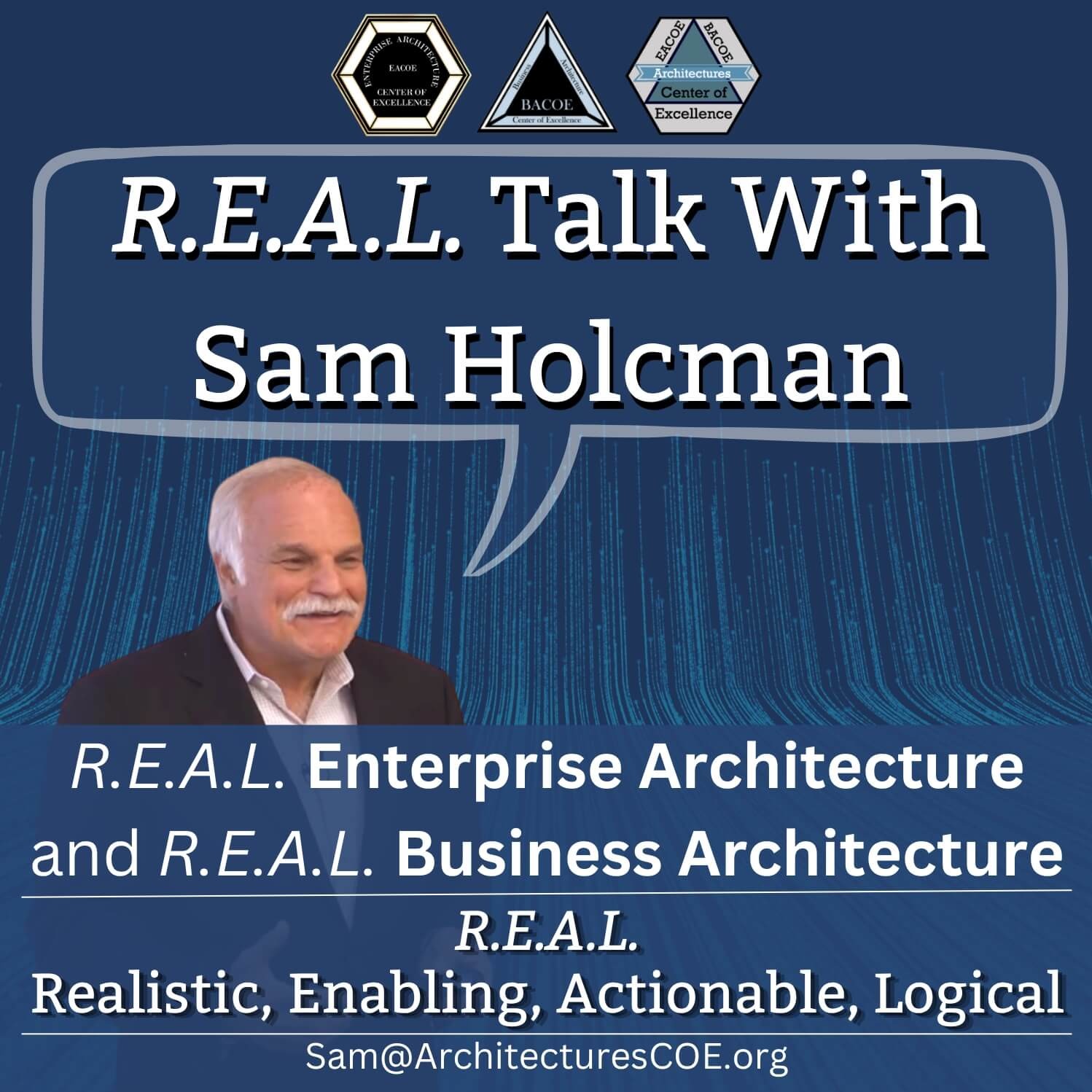
REAL Talk With Sam Holcman
by Sam Holcman
R.E.A.L. - Realistic, Enabling, Actionable, Logical. Every day we hear jargon and see writing from so-called “experts,” and we don’t know what we should follow and what we should avoid. Published practices aren’t always best practices!Listen to episodes from Sam Holcman’s radio show, webinars, and podcasts, Real Talk with Sam Holcman. Each episode gets to the bottom of what business executives, managers, practitioners, and staff actually need to create innovative solutions that deliver- no utopia required. This business podcast provides practice-based insights into business transformation, enterprise architecture, business architecture, organizational transformation, and technology transformation based on real-world practices. We provide you with insights that can provide true value to organizations and individuals that face today’s and tomorrow’s competitive pressures and provide a usable takeaway from each program.
-
250
Rethinking enterprise AI: Why small models fit big organizations
The InfoWorld article “Small language models: Rethinking enterprise AI architecture” argues that as large language models (LLMs) hit limits of scale, cost, and risk, enterprises are shifting toward small language models (SLMs) that are faster, cheaper, and more private for well-defined, repetitive tasks. It highlights three primary advantages: division of labor between small and large models, radical economic efficiency for high‑volume workloads, and improved privacy at the edge when models run on devices or on‑premises. The underlying message is that competitive advantage will increasingly come from how well organizations architect and orchestrate multiple models around their own data, workflows, and governance.
-
249
Ford’s New EV “Assembly Tree” - What It Means for Enterprise Architecture and Business Architecture
Ford’s new electric truck program is being called its “Model T moment” – not because it’s just another vehicle, but because Ford is tearing up a century of manufacturing practice to build something fundamentally different. In doing so, they have replaced the traditional assembly line with what they call an “assembly tree”: a modular way of building that uses far fewer parts, far less complexity, and a completely new production logic.Enterprise Architecture (EA) and Business Architecture (BA) are at a similar crossroads. Most organizations are still using an architectural “assembly line”: long sequences of phases, hand‑offs, documents, and exams that were designed for a slower, more predictable world. These legacy, exam‑centric certifications, methodologies, and frameworks add steps and artifacts, but struggle to produce architectures executives actually use to run and change the business.The Enterprise Architecture Center Of Excellence (EACOE) and The Business Architecture Center Of Excellence (BACOE) represent the modern alternative. They are not “another framework” running down the same line. They are the architecture equivalent of Ford’s assembly tree: a new way of producing outcomes, built around a small number of powerful, reusable components that can be combined quickly to solve real business problems.
-
248
A Manifesto for the Professionalization of Enterprise Architecture and Business Architecture
Enterprise Architecture and Business Architecture are at the same inflection point that software engineering has reached. When a field confuses vocabulary for competence, titles for capability, and exams for professional readiness, it creates a class of certified people who can describe the work without being able to do the work.That model is no longer good enough. The next era of Enterprise Architect and Business Architect certification must move away from exam-centric credentialing and toward practitioner-based professionalization grounded in evidence, judgment, and demonstrated delivery.
-
247
Enterprise Architecture and Business Architecture Briefing - May 2026
Enterprise Architecture (EA) and Business Architecture (BA) have moved decisively toward the center of enterprise transformation in the last 30 days, especially as organizations try to operationalize AI at scale. Recent market and thought-leadership signals show a clear shift away from architecture as static documentation and toward architecture as a business decision capability focused on speed, risk, investment, and operating-model change.
-
246
From Semantic Hubs to Enterprise Augmented Intelligence™: The Missing Step in Agentic AI
In a recent CIO article, by Martin De Saulles, “How effective are semantic hubs in moving agentic AI forward?” the authors argue that semantics are now the backbone of enterprise AI, especially as organizations rush to deploy agentic AI systems at scale. They highlight a critical shift: the challenge is no longer just moving and storing data but ensuring that data means the same thing wherever and however it is used.That is precisely the problem space Enterprise Augmented Intelligence (EAI™) was designed to address. And it is the space EACOE and BACOE have been working in for more than fifty years.
-
245
Purchased Models, Off-the-Shelf Ontologies, and Why Everything Old Is New Again
This topic is one that should sound familiar to anyone who has been around enterprise architecture, transformation, or banking, as one example, for more than a few years: everything old is new again. The latest version of the old story is being told through “purchased models,” “off-the-shelf ontologies,” and what some are now calling the semantic operating system for banking, as one example. Buying somebody else’s model of your industry is not a new idea. It is a very old idea in very new packaging. Twenty-five years ago, it was sold as reference architectures, industry models, enterprise blueprints, and packaged best practices. Accenture sold it. IBM sold it. The Big Four sold it. Entire consulting practices were built around the claim that if you adopted a prebuilt model of your enterprise, you could move faster, reduce risk, and leapfrog the painful work of figuring out your own organization. But here is the Real Talk.
-
244
Your AI Problem Is not Data Debt – It is Executive Relevance
There is a lot of noise right now about Artificial Intelligence (AI) strategy, and one phrase you have probably heard is this: “Your AI strategy will fail if you do not fix your data debt.”Now, there is truth in that. Years of fragmented systems, inconsistent definitions, and patchwork reports really are catching up with us. AI will expose every weakness you have buried in your data.But if you take that message into the C‑suite or the boardroom, and you lead with “data debt” and “process standardization,” you will lose the audience that matters most.Today, I want to reframe the issue. Your biggest AI problem is not data debt. Your biggest AI problem is executive relevance.The real issue: multiple versions of the truth.
-
243
You are Flying Atlas V Missions in a New Glenn World
I want to talk about legacy thinking.Not old thinking. Not wrong thinking. But thinking that was right - sometimes brilliantly right - and then calcified into doctrine.Look up at the sky. Something remarkable just happened in space.Blue Origin flew New Glenn - their massive, orbital-class rocket - for the third time.And they flew it on a booster they already landed and refurbished. The same first stage. Flying again.That is not a space story. That is a legacy story. And yes, there was a glitch on cargo release.The exact same pattern is playing out in enterprise architecture and business architecture right now. The certification became the thing itself. Organizations stopped asking whether the certification and framework served the mission - and started asking whether the mission was being performed according to the certification and framework. Do not keep flying Atlas V missions in a New Glenn world.The new paradigm is not coming. It has arrived.The only question left is whether your organization will be the one catching up - or the one leading the way.
-
242
Why Poor Data Foundations Undermine AI Success
Organizations are learning a costly lesson: AI does not fail first because of the model; it fails because of the data foundation beneath it. More than half of generative AI projects were abandoned after proof of concept by the end of last year, largely because organizations lacked the data readiness required to move from controlled pilots into production environments.This is precisely why EACOE matters. The Enterprise Architecture Center Of Excellence provides the disciplined, practitioner-based framework required to turn scattered, inconsistent, under-governed enterprise data into an architecture that AI can trust, interpret, and scale against. The EACOE AI Data Modeling Master Class operationalizes that discipline by teaching organizations how to build the semantic, governance, and modeling foundation that production-grade AI now demands. This broadcast is based on the work of Joanne Carew titled How poor data foundations can undermine AI success, CIO – April 17, 2026
-
241
Coffee Grinders - Certifiers - and Real Practitioners
Let us be honest - most Enterprise Architects and Business Architects start the day the same way.You roll out of bed, scroll through overnight emails, open at least six tabs of frameworks you will only partially read, warm up yesterday’s coffee because the meeting starts in five minutes, and think…Maybe today I will finally fix that capability model.Because let us face it - every good architect knows their day does not really start until they have had that first cup of caffeine.And speaking of coffee - let me share something interesting that caught my attention.Despite what your friend who refuses to drink anything, but single‑origin pour‑over might tell you, becoming a real coffee expert is not easy. And oddly enough, that is a problem for Wall Street.Starbucks may be on every corner, but qualified coffee graders - the folks who certify bean quality for the commodities market - are in serious short supply.According to the Wall Street Journal, these graders endure a brutal three‑stage competency program: a written exam, a three‑hour coffee grading session, and then a live tasting in front of proctors, identifying defects right down to the bean.Miss one - and you start over.Only five to eight percent pass. That is tougher than passing the California bar exam – or any EA or BA exam I have seen.And it got me thinking: imagine if our industry had that kind of rigor.In Enterprise Architecture and Business Architecture, too many certifications promise instant expertise.Take TOGAF®, for example - you memorize a framework, pass a multiple‑choice test, and suddenly you are called “certified.”Or the Business Architecture Guild’s® CBA® certification - memorize definitions, answer questions, check a box.It is like calling yourself a coffee grader because you can tell the difference between a cappuccino and a macchiato.Look, learning theory matters. But real-world skill does not come from picking the right answer on a multiple-choice exam - it comes from building, evaluating, and adapting.That is why I sometimes say: certifications that only test recall create “credentialed beginners.” You may have sixty percent of the vocabulary, but not the muscle memory.And that is exactly where EACOE and BACOE take a different approach.
-
240
Process Visualization: A Best Practice Blueprint for Reworking Processes Before AI
CIOs are under intense pressure to harness AI to drive efficiency, innovation, and competitive advantage - but as a recent CIO article states on reimagining business processes makes clear, the first step is not to “automate faster,” but to rethink how work actually happens before a single model is deployed. In this context, the EACOE Process Visualization approach emerges as a best‑practice methodology for reworking processes in preparation for AI, ensuring that organizations automate optimized workflows, not legacy inefficiencies.
-
239
Palantir's Real Secret Sauce - Ontologies
If your AI and analytics investments still feel like disconnected projects instead of an enterprise capability, this episode of Real Talk with Sam Holcman shows how Palantir quietly turned ontologies into a strategic moat - and how the same ontology‑driven principles behind EACOE and BACOE can turn your architecture into an execution engine for real business outcomes.
-
238
The Ten Most Misunderstood Words in EA/BA
If you are a CIO, CTO, or Architecture Manager, you are already paying an “architecture tax” you never approved.It shows up as overlapping platforms, programs that cannot finish, and “strategic” projects that quietly die after burning millions. The surprising culprit: ten everyday EA/BA words that your organization thinks it understands - but does not.When these words are fuzzy, your architecture is fuzzy. And fuzzy architecture is expensive.
-
237
Ontology in AI: The Hidden Skill That Makes Architecture and Your Career Work
In both EACOE enterprise architecture and BACOE business architecture, ontology is the backbone: it tells us what kinds of things exist in the enterprise, how they relate, and how those meanings stay consistent as we automate, integrate, and apply AI.Today, that makes ontology not just a theoretical idea, but one of the most valuable, underused skills in the AI job market – and a critical success factor for serious Enterprise Architecture and Business Architecture work.What an Ontology Really Is: Kinds of Things Together and Their Relationships In information and computer science, an ontology is a formal description of knowledge in a domain – the kinds of things (concepts/classes) and the relationships between them. It is more than a glossary; it is a structured model of meaning that both humans and machines can use.
-
236
Business Architecture - Belonging to a Club or Practicing a Discipline
Welcome to Real Talk with Sam Holcman - where we stop confusing activity with progress and start talking about how businesses actually work.Today I want to talk about something touchy in the Business Architecture world: the difference between belonging to a club and practicing a discipline. Specifically, the world of the Business Architecture Guild® and its BIZBOK® Guide on one side… and BACOE, the Business Architecture Center Of Excellence, on the other.
-
235
How to Help the CEO Understand Enterprise and Business Architecture - Without Losing Your Job
Many CEOs excel in vision, leadership, and financial acumen - yet remain only vaguely familiar with the disciplines of Enterprise Architecture (EA) and Business Architecture (BA). They hear the words. They see the frameworks. But they do not always connect with the business value that drives strategy, change, and decision-making. That gap can be dangerous.
-
234
What Is In and Out In Enterprise Architecture (EA) In 2026 From Exams to Practice
Enterprise Architecture (EA) is shifting decisively from theory-heavy, exam-driven certification to demonstrated, practice-based competence that delivers measurable business outcomes. In: Practitioner-based paths that validate portfolios, scenarios, workshops, and demonstrable outcomes - certifying that you can architect, not just that you can pass an exam. Out: Credentials earned solely by scoring above a cutoff on multiple-choice exams, which increasingly fail to differentiate between memorization and actual capability.
-
233
Having A Lot of Data Is Not the Same as Having AI Ready Data
Organizations have been stockpiling data for years, expecting that one day it will become a strategic asset. With generative AI, that moment has arrived - but without disciplined data practices, the promise quickly turns into frustration. The differentiator is no longer access to powerful models; it is the ability to shape, govern, and trust the data that feeds them, which is exactly the gap the AI Data Modeling Masterclass is designed to close.
-
232
LLMs Copyright Infringement as a Service
Let us start with the uncomfortable truth: large language models - ChatGPT, Gemini, Claude, Perplexity, and their peers - are built on a foundation that looks suspiciously like “copyright infringement as a service.” These systems could not exist without consuming massive quantities of human-created text, images, and code. In another industry, that would be called derivative work. In AI, it is called innovation.
-
231
What is In and Out in Business Architecture (BA) in 2026: From Exams to Practitioner Certification
Business Architecture (BA) is undergoing the same transformation: away from framework-centric, multiple-choice exams and toward practitioner-based competence proven through real work, with BIZBOK/CBA®-style certification as a well-known example of the older model, not the only one.
-
230
Why You Can't Modify What You Have Not Done: Absurdity of Theoretical and Book-Learned Architects
There is something absurd happening in enterprise architecture and business architecture today, and it is time we called it out.People are passing multiple-choice exams… or cramming through a sixteen-hundred-page framework manual, and then being told, Now, go modify it. Customize it for your organization.Modify it? Before you have ever used it? Based on what? That is not mastery. That is madness.
-
229
Still Doing Architecture Principles
Most EA principles sound good but do not change a single decision because they are not testable. To make them real, convert each principle into a SMART goal plus 1–3 hard metrics. Now you can wire that into governance (architecture reviews, portfolio decisions, roadmaps) and report progress quarterly. At that point, it stops being a poster on the wall and becomes a scoreboard the business can hold EA accountable to. Let us explain why Architecture Principles faded away in the 1990's - let us not go backwards in time.
-
228
How to Get Your Enterprise Ready for Agentic AI
This Broadcast is a review and analysis of the Jan 22, 2026 - by Koenraad Schelfaut and Andrew Long CIO Article titled How to get your enterprise architecture ready for agentic AI. This article misses the central - and fatal - flaw in its reasoning: it assumes that enterprise data is reliable enough to empower agentic AI when, for most organizations, it is not. A concise 90-day, EACOE EA-anchored roadmap you can use with CIOs and sponsors is provided.
-
227
The Real Cost of Standing Still
“If you are worried about the cost of going for it, just calculate the cost of staying where you are." We have all been there - staring at an opportunity that feels just out of reach. Maybe it is the next career move, a new certification, launching that business idea, or stepping up into leadership. The first thought that comes to mind? “Can I afford this? But here is the truth most people never calculate: staying where you are, has a cost too - it is just hidden.
-
226
The Key Enterprise Architect and Business Architect Survival Skill for 2026: Critical Ignoring
We are living in an age of endless low‑quality information and recycled self-declared “best practices.” Framework tourists. Certification logos with no delivery record. 1,600‑page manuals that need another 800 pages just to implement, and most recently, another rambling set of explanations on the explanations!Your brain was not designed to drink from this firehose.Critical Ignoring means fighting the instinct to “consume everything” and instead curating a very small set of sources.
-
225
LinkedIn Posters: An Analysis of Internet Personas
In a world of infinite content and finite attention, the real competitive advantage is not posting more – it is choosing better who you listen to. In this episode, Sam Holcman breaks down 39 distinct online personas that dominate LinkedIn, Twitter, and professional communities - from the signal-boosting trusted advisor to the humblebrag hero and the engagement farmer. This is not about shaming individuals; it is about sharpening your discernment in a noisy, performative digital landscape. The challenge is simple: look at who you follow and ask, “Is this person helping me think more clearly, act more wisely, and deliver more value?” Time is precious. Aim it at high-integrity, trusted advisors - not at the loudest voices in the feed.
-
224
AI Fabrications, Context, and LLMs
The scientist who helped invent core building blocks of modern AI just walked away from Meta - with a blunt verdict: Large Language Models (LLMs) are a dead end. In this episode of Real Talk, Sam Holcman unpacks why LLMs are fundamentally flawed as a foundation for serious enterprise decision-making - and walks through a live example of confident, credible, and completely wrong AI output. The takeaway is simple and uncomfortable: the answer is not “more prompts” or “more tokens.” The answer is to stop blindly feeding the generic LLM machine and start building your own Enterprise Augmented Information™ (EAI) - an architected, governed data backbone that combines processing power with actual context and understanding, on your terms, for your enterprise.
-
223
Practitioner Certification Transformation: from Multiple Choice Exams to Demonstrated Competency
To the EA and BA Community: SAP’s leadership in the Certification Community is moving them from Multiple Choice Exams to Demonstrated Competency. We in the EA and BA Community are next, moving EA and BA Certification from Multiple Choice Exams to Demonstrated Competency. Enterprise Architecture 5.0 is here now. See more on Enterprise Architecture 5.0: https://www.eacoe.org/enterprise-architecture-5-0 ABOUT: The Enterprise Architecture Center Of Excellence™ (EACOE) and the Business Architecture Center Of Excellence™ (BACOE) provide a universal understanding and competence forum on Enterprise Architecture and Business Architecture for General Management, Technologists, Academicians, and Practitioners interested in implementing Enterprise Architecture or Business Architecture. We are practitioner-based firms advancing the Enterprise Architect and Business Architect profession, discipline, and base of understanding - since 1972. - More on Enterprise Architecture: www.EACOE.org - More on Business Architecture: www.BACOE.org
-
222
Here Today, Gone Tomorrow
This episode walks through 200+ methodologies, tools, frameworks, and technologies that were once sold as the future” - and are now forgotten, marginalized, or quietly replaced. Sam Holcman, who started his career in 1972 when it was all called “Data Processing” (spoiler: we are still just processing data), shares the hard lessons from 50+ years of watching silver bullets come and go. The pattern is brutal and consistent: every one of these darlings was proposed, hyped, taught, certified, and implemented - only to be displaced by approaches that were more understandable, more human-consumable, and actually usable by decision-makers. If your favorite framework, tool, or “AI-powered” platform vanished tomorrow… would your strategy still stand? Because here’s the uncomfortable truth: Your objective is enabling enterprise and business strategy. Everything else - every methodology, modeling tool, or framework - is a means to an end, never the end itself.
-
221
The 47 Second Enterprise: Why EACOE and BACOE Design for Human Attention
Shrinking attention spans are not a myth; they are a measurable reality, and EACOE and BACOE are the only EA and BA organizations whose methods are engineered around that reality rather than fighting it or ignoring it.
-
220
Yes, you CAN begin Enterprise Architecture or Business Architecture Next Monday Morning
In this episode of Real Talk with Sam Holcman, we sit down with Mohammed Khalil, a Senior Enterprise and Business Architect who has implemented Enterprise Architecture across multiple industries worldwide. Mohammed walks through how he applied the EACOE methodology at one of Canada’s largest universities to reinvent how they manage curriculum - from idea to approval to delivery. He shares why he chose the EACOE Workshop and Certification over other alternatives, how he went from completing the EACOE Workshop to real implementation by Monday morning, and the concrete business results that followed: faster, cleaner decision-making, a clear three-year roadmap the business actually understood, and stakeholders who finally felt like architecture was working with them, not to them. Watch on YouTube: https://youtu.be/74lfKxzP8lw ABOUT: The Enterprise Architecture Center Of Excellence™ (EACOE) and the Business Architecture Center Of Excellence™ (BACOE) provide a universal understanding and competence forum on Enterprise Architecture and Business Architecture for General Management, Technologists, Academicians, and Practitioners interested in implementing Enterprise Architecture or Business Architecture. We are practitioner-based firms advancing the Enterprise Architect and Business Architect profession, discipline, and base of understanding - since 1972. - More on Enterprise Architecture: www.EACOE.org - More on Business Architecture: www.BACOE.org
-
219
What Makes a Great Enterprise Architect or Business Architect
A great enterprise architect and business architect is defined by mindset, behaviors, and outcomes in the real organization, not by the ability to pass a multiple‑choice exam. Listen in for valuable parameters to think about.
-
218
Irrational Exuberance and the AI Mania: Are We Living Through a Bubble?
Welcome to Real Talk with Sam Holcman, where we connect ideas, innovation, and intelligent decision-making. Today’s reflection: irrational exuberance - a phrase coined by former Federal Reserve Chair Alan Greenspan in 1996 and revisited today through the lens of the AI revolution. Greenspan’s words warned of a human tendency - collective overconfidence - when belief outpaces evidence. It describes markets, but really, it describes us. Fast-forward nearly three decades, and you will hear the same energy around artificial intelligence: limitless potential, intense speculation, and a sense that this is the future.
-
217
Why TOGAF® Needs a Refresh
TOGAF® is talked about and used, but an increasing number of major practitioners and researchers argue that it misses several critical ingredients for modern, outcome‑driven enterprise architecture. In the age of EA 5.0, these critical ingredients are lacking. This broadcast will outline these ingredients that are lacking.
-
216
When Software Eats Itself
Today’s Broadcast. Billions were wasted, companies bankrupted, and governments embarrassed - all because of something we take for granted: software. This article is based on an outstanding article titled “Why Software Fails” by Robert N. Charette, in IEEE Spectrum, December 2025. You have probably heard the old saying “software is eating the world.” But what happens when software eats itself?
-
215
EA and BA Advice – How Can You Determine How To Best Spend your Time and Money
When evaluating Enterprise Architecture (EA) or Business Architecture (BA) advice, focus on whether the person, book, website, or post can demonstrate real decisions changed, risks reduced, or value created - not just fluency in frameworks and jargon. The most dependable advisors and materials walk through concrete situations, artifacts, and outcomes, and openly acknowledge what they learned. Remember that the time you spend consuming advice is often more valuable than the money you spend on it.
-
214
Agentic AI, EA 5.0, and EACOE
Agentic AI is accelerating all the trends that EA 5.0 and EACOE have been arguing for years: architecture must be business-led, continuously adaptive, and tightly connected to how work actually gets done. In this environment, the EA role does not disappear; it shifts toward orchestrating agents, data, and business capabilities in real time, which is exactly the role EA 5.0 is designed to formalize. www.EACOE.org
-
213
No I Will Not Peg My Biz on AI!
No I Will Not Peg My Biz on AI!
-
212
Data Center Growth – Good or a Waste
"One day, people will realize the DATA BELONGS TO ME" – remember that quote from the inventor of the internet and the web. We do not need larger data centers – we need better data, in an organized manner. It begins with a classification system that organizes stuff – data. Think a library – the Dewey decimal system is the key to finding stuff – not endless building of libraries. In one study of medical databases, more than 50% of the total clinical text was found to be duplicated. Google says 60% of the internet is duplicate.
-
211
To-Be Models and As-Is Models – Which Always Comes First
Developing an as-is model before a to-be model seems logical on the surface - understand where you are, then define where you want to go. Yet, in practice, this approach can unintentionally trap organizations with the limitations of their current reality. The deeper issue is not one of modeling techniques, but of human cognition: when people start by describing the present, they often lose their ability to imagine the future.
-
210
Thought Leader – Thought Mimicker – Cult Follower: Who are you actually hearing?
A thought leader is an authority figure recognized for their expertise in a specific field, often leading discussions and sharing insights that influence their industry. They are known for their ability to innovate and drive change, and they have a significant impact on their community. Self-declaration does not make someone a thought leader. Who are you actually getting information from?
-
209
Data for AI - Building New Age Architecture
Data drives Artificial Intelligence - not the other way around. It is the foundation upon which AI systems are built and the fuel that determines how powerful, accurate, and innovative they can become. The phrase “Data for AI” captures this reality: without high-quality, strategic data, AI cannot function effectively. Developing a data architecture that prioritizes data at the core unlocks agility, insight, and competitive advantage in the era of intelligent automation.
-
208
AI and REAL Enterprise Architecture
AI, driven by hype cycles, is disrupting and in many ways undermining the value of REAL (Realistic, Enabling, Actionable, Logical) Enterprise Architecture - turning a professional discipline into yet another fleeting trend much like previous waves of tool-centric or automation-driven approaches. Instead of enabling architectural vision, the rush to “AI everything” is exposing existing weaknesses and, for many organizations, acting as a costly distraction rather than a true solution.
-
207
Why Real Enterprise Architects and Business Architects Ignore the AI Hype Machine
AI is everywhere - on every page, in every boardroom pitch, and across every trend report. But as any seasoned leader and practitioners know, what creates lasting competitive edge is not the technology buzzword of the moment. It is having an operating model that empowers smart choices, no matter what tool is in play. In this broadcast, I want to challenge the status quo: It is not “AI-powered strategy” that drives transformation. It is strategy-powered architecture - built through proven Enterprise Architecture (EACOE) and Business Architecture (BACOE).
-
206
Prompt Engineering or Prompt Manipulation - A Critical Look at How We Shape AI Responses
The term “prompt engineering” has become popular in recent years to describe the process of carefully designing inputs - known as prompts - for large language models (LLMs). The phrase suggests that prompting is a deliberate, technical process similar to real engineering disciplines such as civil engineering, electrical engineering, or software engineering. Yet, when examined more closely, “engineering” may not be the most accurate word.
-
205
The Executive and CIO’s and Your Risks of Over-Reliance on AI in Enterprise Architecture
Recent advancements in Artificial Intelligence (AI) have been touted to result in dramatic increases in productivity and consistency throughout Enterprise Architecture practices. However, our experience with our clients demonstrates that excessive dependence on AI-driven support - particularly for critical decisions - can bring significant risks to business operations and strategic integrity.
-
204
Human Consume-ability of EA and BA Deliverables
Enterprise Architectures and Business Architectures often suffer from a common problem: the outputs produced by architecture teams may be technically accurate, possibly methodologically sound, and rigorously documented - yet they remain unusable for the decision-makers, stakeholders, and business leaders who most depend on them. This issue, known as Human Consume-ability, highlights the gap between creating models and architectures, and delivering insights that can be readily understood, trusted, and acted upon across organizational boundaries.
-
203
Moving from AI to OI
AI - Artificial Intelligence. OI - Original Intelligence. While AI can excel at processing vast amounts of data and identifying patterns, Original Intelligence allows humans to recognize when solutions need to deviate from established norms or when data is incomplete or misleading. Learn more in this Broadcast
-
202
Learning from Information Technology Implementation Failures
There is always a lot that we can learn from successful technology and software developments. There is also a lot we can learn, unfortunately, from technology and software development “failures”. In analyzing over twenty well-documented and publicized failures, one fundamental issue came through loud and clear. A major mismatch between the enterprise data representations and processes, and the vendor’s data representations and processes. There is a pretty straightforward way to address this situation.
-
201
The Danger of AI – Anything you say to AI can be used against you
Yes, anything you say to AI can be used against you, including things that you thought were deleted. Yes, hitting the delete button or key really does not do anything. Let me translate. Public facing AI and associated models are “dangerous”. EAI – (Enterprise Augmented Information) – AI within the boundary of your Enterprise is the answer. Please listen. And we can help.
No matches for "" in this podcast's transcripts.
No topics indexed yet for this podcast.
Loading reviews...
ABOUT THIS SHOW
R.E.A.L. - Realistic, Enabling, Actionable, Logical. Every day we hear jargon and see writing from so-called “experts,” and we don’t know what we should follow and what we should avoid. Published practices aren’t always best practices!Listen to episodes from Sam Holcman’s radio show, webinars, and podcasts, Real Talk with Sam Holcman. Each episode gets to the bottom of what business executives, managers, practitioners, and staff actually need to create innovative solutions that deliver- no utopia required. This business podcast provides practice-based insights into business transformation, enterprise architecture, business architecture, organizational transformation, and technology transformation based on real-world practices. We provide you with insights that can provide true value to organizations and individuals that face today’s and tomorrow’s competitive pressures and provide a usable takeaway from each program.
HOSTED BY
Sam Holcman
CATEGORIES
Loading similar podcasts...
URL copied to clipboard!