
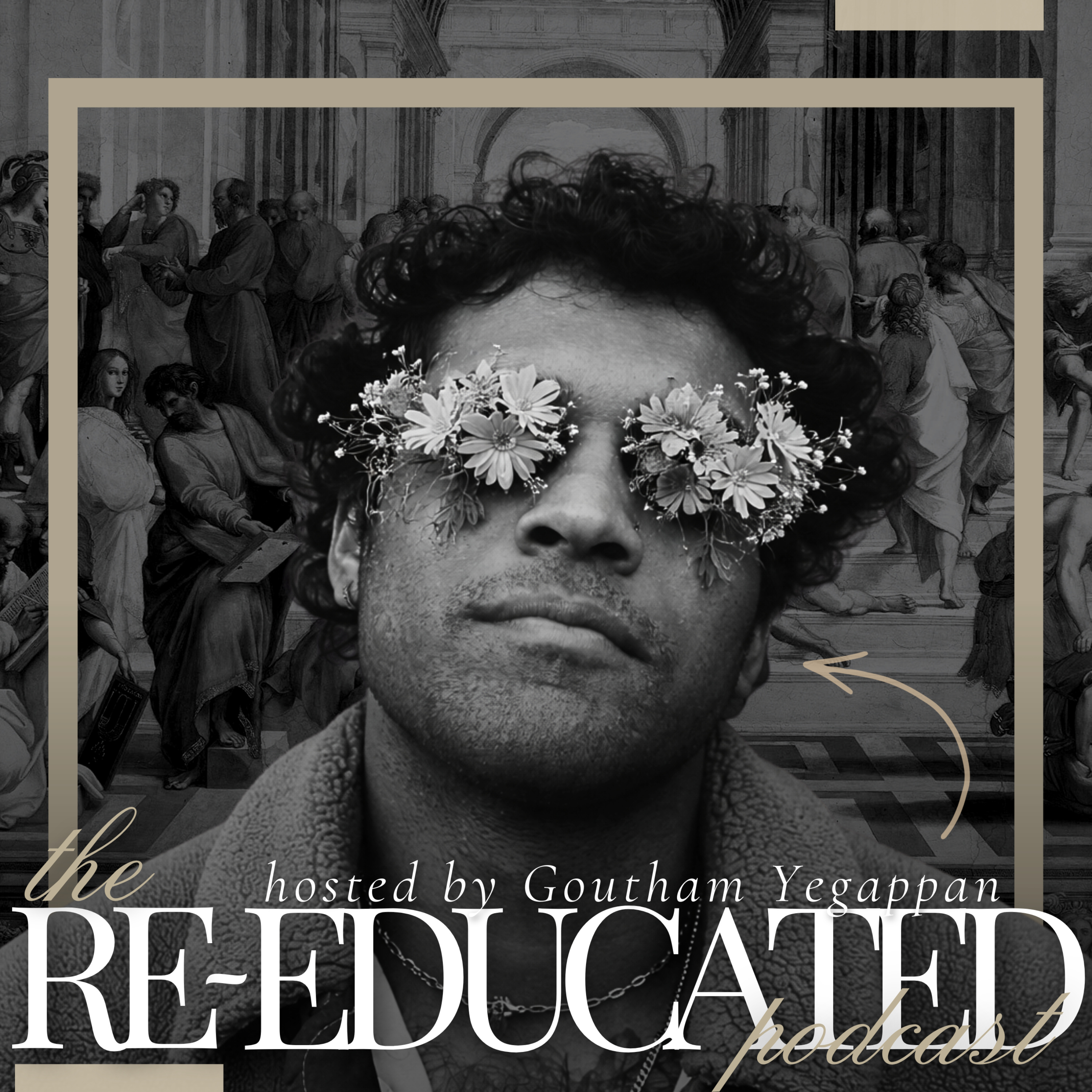
PODCAST · education
reeducated
by Goutham Yegappan
Conversations reimagining, rethinking, and reinventing modern education.
-
229
The Ethics Behind Economic Freedom | Michael C. Munger | Professor of Political Science and Economics at Duke University | Season 13 Episode 6 | #227
In this episode, I sit down with Michael Munger, Professor of Political Science and Economics at Duke University, to explore the moral foundations of markets. We examine what it means for exchange to be voluntary, why consent matters in economic life, and how markets can generate cooperation among strangers. Michael argues that markets are not simply mechanisms for profit but institutions that rely on trust, norms, and shared rules.Our conversation moves into public choice theory and the limits of government intervention. We discuss how political incentives shape policy decisions, why well-intentioned regulation can produce unintended consequences, and how power operates differently in markets and in state institutions. Michael pushes back against simplistic critiques of capitalism, suggesting that many failures attributed to markets are often failures of institutional design.What stayed with me most is the emphasis on consent and mutual benefit. Markets, in this framing, are systems of social cooperation built on agreement rather than coercion. This episode invites listeners to reconsider the ethical assumptions underlying both capitalism and government authority.Chapters :00:00 – Introduction01:04 – The Tie Story & Teaching Philosophy03:36 – Origin Story: From Florida to Douglas North07:21 – Failing Forward: FTC, Politics & Embracing Uncertainty10:00 – Economics vs. Political Science: Incentives & Information17:08 – Markets vs. Politics: Where is the Line Between Mine and Ours?23:00 – What Makes an Exchange Truly Voluntary? The EU-Voluntary Framework31:00 – Do Markets Naturally Expand & Improve Welfare?32:00 – The Cornea Dilemma: When Prohibiting a Bad Deal Makes Things Worse36:11 – Do Markets Produce Inequality by Design?39:27 – Cronyism: The Inherent Corruption Tendency Within Markets41:35 – Poverty vs. Inequality: Two Different Problems45:46 – Chile, Political Swings & the Development Path of Nations48:00 – Division of Labor as the Source of All Wealth49:59 – Can Growth Ever Be Enough? The Nordic Model52:24 – The Endless Desire for More & Adam Smith's Warning54:23 – Closing
-
228
The Legal Foundations of Capitalism | Katharina Pistor | Edwin B. Parker Professor of Comparative Law at Columbia Law School | Season 13 Episode 5 | #226
In this episode, I sit down with Katharina Pistor, Edwin B. Parker Professor of Comparative Law at Columbia Law School and Director of the Center on Global Legal Transformation, to examine one of the most overlooked foundations of capitalism: law. We explore how assets become capital not simply through markets, but through legal coding. Katharina explains how lawyers use contract law, property law, corporate law, and bankruptcy law to endow certain assets with priority, durability, universality, and convertibility, effectively transforming them into wealth-generating capital.Our conversation challenges the common narrative that markets operate independently of government or legal systems. Instead, we examine how legal institutions actively structure economic outcomes and distribute power. Katharina argues that inequality is not an accident of capitalism but is often embedded in the legal architecture that governs financial systems. We discuss how global capital travels across jurisdictions, how crises reveal the asymmetries built into the system, and why reform must grapple with law rather than just market incentives.What stayed with me most is the realization that capitalism is not a natural order. It is constructed, coded, and sustained through legal choices. If the law built the current architecture of capital, it also has the potential to reshape it. This episode invites listeners to rethink where economic power truly comes from and who has the authority to write the rules.Chapters:00:00 – Introduction01:37 – Origin Story: From Socialist Transformation to Capitalism06:34 – What Is Capitalism & How Does Law Code It17:08 – Common Law vs Civil Law: Who Really Writes the Rules28:45 – Inequality by Legal Design & the Challenge of Change41:25 – Digital Contracts, Click-to-Agree & Platform Power46:01 – Can We Recode the System?50:57 – Closing & What's Next
-
227
The Meaning of Liberalism | Daniel B. Klein | Professor of Economics at George Mason University | Season 13 Episode 4 | #225
In this episode, I sit down with Daniel B. Klein, Professor of Economics at George Mason University and JIN Chair at the Mercatus Center, to explore the moral and philosophical foundations of liberalism. We discuss what it means to identify as a classical liberal in the modern world, and how thinkers like Adam Smith inform contemporary debates about markets, government, and freedom. Dan explains that liberalism is not merely a policy position but a broader moral orientation grounded in respect for individual liberty and social cooperation.Our conversation examines the language and evolution of liberalism, including how the term has shifted in meaning over time. We explore the ethical dimensions of markets, the role of virtue in political economy, and the proper scope of government authority. Dan reflects on how freedom requires cultural norms and moral sentiments, not just institutional design.What stayed with me most is the emphasis on humility and openness in public discourse. Liberalism, in this framing, is less about rigid ideology and more about fostering a social order that respects dignity, pluralism, and peaceful cooperation. This episode invites listeners to reconsider what freedom means and how liberal traditions shape modern economic life.Chapters:00:00 – Introduction02:30 – Dan Klein’s Intellectual Background08:10 – What Is Classical Liberalism?14:20 – Adam Smith and Moral Sentiments20:10 – Markets and the Ethics of Exchange26:00 – The Evolution of the Term “Liberal.”32:15 – Government Authority and Its Limits38:20 – Virtue, Culture, and Social Order44:30 – Common Critiques of Liberalism50:40 – Liberalism in Contemporary Politics57:00 – The Future of the Liberal Tradition01:04:30 – Final Reflections and Closing Thoughts
-
226
Workplace Authority and Economic Justice | Elizabeth S. Anderson | Professor of Philosophy at the University of Michigan | Season 13 Episode 3 | #224
In this episode, I sit down with Elizabeth S. Anderson, John Dewey Distinguished University Professor of Philosophy and Women’s & Gender Studies at the University of Michigan, to examine how power operates within modern market societies. We explore her concept of “private government” and the idea that many workplaces function as forms of unaccountable authority. Elizabeth challenges the common assumption that markets are domains of freedom, arguing instead that economic relationships often involve coercion and hierarchy that escape democratic oversight.Our conversation moves through questions of equality, workplace authority, and the moral foundations of capitalism. We discuss how freedom should be understood not merely as the absence of state interference but as protection from domination in all spheres of life, including employment. Elizabeth explains why democratic principles should extend beyond political institutions and into economic structures, and how redefining equality requires confronting concentrated economic power.What stayed with me most is the clarity with which she reframes familiar debates. Markets are not neutral arenas but institutional arrangements shaped by law and power. If we care about freedom and equality, we must examine the structures that govern everyday economic life. This episode invites listeners to rethink what justice demands in a modern capitalist society.Elizabeth Anderson:-https://lsa.umich.edu/philosophy/people/faculty/eandersn.htmlChapters:00:00 – Introduction02:10 – Elizabeth Anderson’s Intellectual Background07:00 – The Concept of Private Government12:30 – Freedom and Workplace Authority18:00 – Rethinking Equality in Market Societies23:40 – The Moral Limits of Markets29:15 – Democracy Inside and Outside the Workplace35:00 – Economic Power and Social Justice40:40 – Law, Institutions, and Market Structure46:15 – Responding to Critiques52:00 – The Future of Democratic Capitalism57:30 – Closing Reflections
-
225
The Future of Capitalism and Corporate Reform | Colin Mayer | Emeritus Professor of Management Studies at the Saïd Business School, University of Oxford | Season 13 Episode 2 | #223
In this episode, I sit down with Colin Mayer, Emeritus Professor of Management Studies at the Saïd Business School at the University of Oxford, to explore one of the most fundamental questions in modern capitalism: what is the corporation actually for? We examine the historical evolution of corporate purpose and how the dominance of shareholder value reshaped business priorities over the past several decades. Colin argues that corporations were never meant to serve shareholders alone but were originally designed to solve problems for society.Our conversation explores how corporate structures influence inequality, environmental degradation, and financial instability. We discuss why short-term profit maximization has distorted incentives and how redefining corporate purpose could restore trust in markets. Colin explains how firms can be structured to align long-term value creation with social benefit, and what reforms are necessary to move beyond narrow financial metrics.What stayed with me most is the idea that capitalism itself is not fixed. The rules that govern corporations are legal and institutional choices. If those rules can be designed, they can also be redesigned. This episode invites listeners to rethink the foundations of corporate responsibility and the future direction of market economies.Colin Mayer:-https://www.sbs.ox.ac.uk/about-us/people/colin-mayer-cbeChapters:-00:00 – Introduction02:05 – Colin Mayer’s Intellectual Journey06:45 – The Historical Purpose of the Corporation12:20 – The Rise of Shareholder Value18:00 – Consequences of Short-Termism23:30 – Corporate Governance and Accountability29:10 – Rethinking Corporate Purpose34:40 – Business, Society, and Long-Term Value40:15 – Environmental and Social Responsibility45:50 – Legal and Institutional Reform51:20 – The Future of Capitalism56:30 – Closing Reflections
-
224
How Global Institutions Shape Our World | Annelise Riles | Associate Provost for Global Affairs and a Professor of Law and Anthropology at Northwestern University | Season 13 Episode 1 | #222
In this episode, I sit down with Annelise Riles, Executive Director of the Roberta Buffett Institute for Global Affairs and Professor of Law and Anthropology at Northwestern University, to explore the often invisible architecture that underpins global financial and legal systems. We discuss how institutions, regulations, and professional networks shape markets in ways that are rarely visible to the public but deeply consequential for economic life. Annelise brings an anthropological lens to finance, helping unpack how expertise, documents, and bureaucratic practices function as the infrastructure of global capitalism.Our conversation moves beyond surface-level critiques of markets and into the structural logic of how financial governance actually operates. We examine what financial crises reveal about institutional fragility, how reform efforts often miss the deeper cultural and professional norms embedded in systems, and why understanding the social life of regulation is essential for meaningful change. Annelise challenges the idea that markets are purely technical systems, showing instead how they are constructed through relationships, shared assumptions, and legal design.What stayed with me most is the recognition that institutions are not abstract forces. They are built by people, sustained by habits of expertise, and shaped by cultural expectations. If we want to rethink global governance or economic reform, we must first understand the hidden architecture that holds these systems together. This episode invites listeners to look beneath the surface of markets and consider the deeper institutional dynamics at work.Annelise Riles:- https://www.law.northwestern.edu/faculty/profiles/anneliseriles/Chapters:00:00 – Introduction02:15 – Annelise Riles’ Path into Law and Anthropology07:10 – The Anthropology of Financial Systems12:40 – How Global Financial Governance Actually Works18:20 – Documents, Expertise, and Institutional Practice24:05 – Financial Crises and Institutional Fragility29:50 – Why Reform Efforts Often Fall Short35:30 – The Cultural Life of Regulation41:00 – Markets as Social Constructions46:25 – Rethinking Global Governance52:10 – The Role of Interdisciplinary Thinking57:30 – Closing Reflections
No matches for "" in this podcast's transcripts.
No topics indexed yet for this podcast.
Loading reviews...
ABOUT THIS SHOW
Conversations reimagining, rethinking, and reinventing modern education.
HOSTED BY
Goutham Yegappan
CATEGORIES
Loading similar podcasts...
URL copied to clipboard!