
PODCAST · science
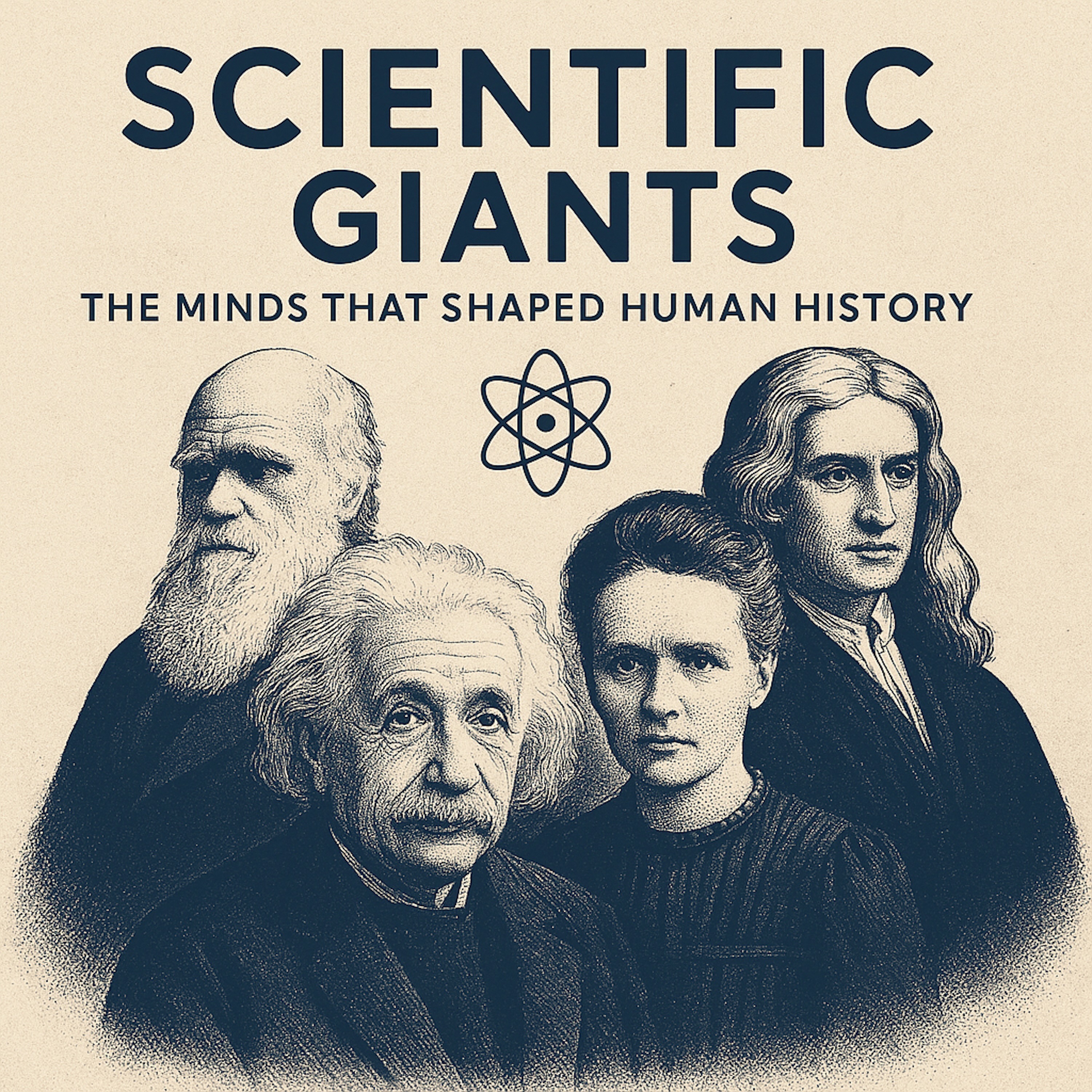
Scientific Giants - Minds that Shaped Human History
by Selenius Media
Scientific Giants takes you on a journey through the lives and legacies of history’s greatest minds. From Newton and Curie to Einstein and beyond, these are the thinkers who reshaped our understanding of the universe and our place within it. Each episode uncovers the struggles, breakthroughs, and lasting influence of the scientists who changed the course of human history — showing how their ideas continue to shape the world we live in today.Produced by Selenius Media
-
28
Jonas Salk – The Vaccine and the Public Good
At the height of polio terror, Salk’s vaccine promised mass immunity, and he stunned the world by refusing to patent it: “Could you patent the sun?”
-
27
Frederick Banting & Charles Best – Stealing Fire for Diabetics
Two young researchers in a sweltering Toronto lab isolated insulin, turning a fatal disease into a manageable condition—and raising questions about patents and profit.
-
26
Alexander Fleming – Accident, Mold, and the First Antibiotic
A contaminated petri dish, a ring of dead bacteria, and a man who saw meaning where others saw mess birthed penicillin and the antibiotic age.
-
25
Barbara McClintock – The Cornfield and the Jumping Gene
Alone with her maize plants, McClintock discovered mobile genetic elements and patiently waited decades for biology to catch up to what she’d seen.
-
24
Thomas Hunt Morgan – The Fly Room and the Chromosome Map
In a cramped Columbia lab buzzing with fruit flies, Morgan and his students mapped genes onto chromosomes and made heredity something you could literally see.
-
23
Gregor Mendel – The Monk of Ratios
In a cloister garden, Mendel counted peas, and from those quiet numbers emerged the laws of inheritance that underlie modern genetics.
-
22
Fritz Haber – Bread from Air, Poison from Science
Haber’s process fed billions by pulling nitrogen from the air, but he also pioneered chemical warfare, making his life a case study in the double edge of discovery.
-
21
Linus Pauling – Bonds, Helices, and Moral Courage
Pauling explained how atoms bond, sketched early models of DNA, and then turned his authority toward nuclear disarmament, earning both a Nobel in chemistry and a peace prize.
-
20
Dmitri Mendeleev – The Man Who Dreamed the Table
Mendeleev’s periodic table wasn’t just arrangement; it was a set of bold predictions about missing elements that turned out, one by one, to exist.
-
19
Chien-Shiung Wu – The Symmetry That Failed
Wu’s precision experiments on beta decay overturned a sacred symmetry of physics and exposed how talent and recognition can fall out of symmetry too.
-
18
Rosalind Franklin – The Woman in the Diffraction Pattern
Working in a basement lab with dangerous X-rays, Franklin captured patterns that revealed DNA’s structure, only to see the spotlight land elsewhere.
-
17
Lise Meitner – Fission and the Burden of Insight
An exiled Jewish physicist, Meitner explained nuclear fission yet saw others take the credit, forcing her to wrestle with the science and the weapon it made possible.
-
16
Erwin Schrödinger – Waves, Cats, and the Question of Life
Schrödinger’s wave equation made quantum mechanics calculable, but his thought experiments and later book What Is Life? pushed physics into biology and philosophy.
-
15
Werner Heisenberg – Uncertainty at the Heart of Nature
In a feverish burst of work on a North Sea island, Heisenberg discovered that at the smallest scales, the more we know of one thing, the less we know of another.
-
14
Niels Bohr – The Architect of the Quantum Atom
Bohr’s model of the atom, his Copenhagen Institute, and his idea of “complementarity” changed not only physics, but what it means to describe reality.
-
13
Max Planck – The Reluctant Father of the Quantum
Trying to fix a minor problem in blackbody radiation, Planck quantized energy, cracked classical physics, and launched a revolution he never fully trusted.
-
12
James Clerk Maxwell – When Light Became an Equation
Maxwell turned Faraday’s lines of force into four dense equations that quietly unified electricity, magnetism, and light—and laid the rails for Einstein.
-
11
Marie Curie – The Radiance of the Invisible
You're listening to "Scientific Giants Who Changed the World." Each episode stands beside one mind and follows a thread of curiosity until it ties to the world we inhabit. Today we descend into a converted shed on the rue Lhomond in Paris, where winter seeps through walls that were never meant to shelter precision work. The air tastes of coal smoke and chemicals. A glass tube glows faintly in the corner—not from any lamp, but from something inside it, something that shouldn't shine at all. At a workbench scarred by acid and heat, a woman in a stained laboratory coat stirs a boiling mass with an iron rod nearly as tall as she is. Her hands will ache tonight; they ache most nights now. She is Marie Curie, and in this cold shed she will make the invisible visible, she will name two elements that rewrite the periodic table, and she will do it at a cost her body will spend decades paying.Begin with what brought her to that shed, because the radiance makes more sense if we know what she was willing to suffer to reach it. She was born Maria Skłodowska in 1867 in Warsaw, a city that had been erased from maps by the powers that carved Poland into portions. Her father taught mathematics and physics in a school that the Russian authorities watched; her mother ran a boarding school and died of tuberculosis when Maria was ten. The family was educated, pious in a quiet way, and poor in the manner of people who sell furniture to pay for books. Maria was the youngest of five children, slight and serious, with a hunger to learn that her teachers noticed and her circumstances obstructed. Women could not attend university in Russian Poland. If she wanted an education that matched her appetite, she would have to leave.But leaving required money, and money required years. She made a pact with her older sister Bronisława: Maria would work as a governess and send money so Bronya could study medicine in Paris; when Bronya finished, she would return the favor. For six years Maria lived in other people's households, teaching children their letters and sums, stealing hours after the family slept to read mathematics and physics by candlelight in cold rooms where her breath made clouds. In one household she fell in love with the eldest son; his parents ended it with the contempt that land and old names reserve for the hired help. She learned what it meant to be bright and useful and disposable all at once. She kept working. She kept sending money. She kept her part of the bargain.
-
10
Nicolaus Copernicus - Astronomer - The Sun, not the Earth, is at the center of the universe.
Nicolaus Copernicus - Astronomer - The Sun, not the Earth, is at the center of the universe.Today we climb a chilly tower stair in Royal Prussia, where sea wind presses against old brick and a bellrope hums in the draft. The town is Frombork—Frauenburg in the Latin letters of the time—perched on the Vistula Lagoon. Below us a canon’s garden is squared into beds; a copper astrolabe hangs near a window to warm just enough that fingers won’t sting when they touch it at dusk; a long wooden staff with sliding crosspieces leans beside a stool. In the narrow room, a man in a dark robe writes in a practiced hand with a patience that does not look like hesitation. He is not a court philosopher. He is not a cloistered mystic. He is a chapter functionary, a physician, an administrator, a careful observer. He is Nicolaus Copernicus, and in this brick quiet he will move the sun to the center of the planetary stage and set the earth in motion, and the consequences will run everywhere human certainty had laid its weight.By Selenius Media
-
9
Shen Kuo - Mathematics & Optics
Today we walk beside an official in a dark robe on a levee outside a river city, where the wind smells of silt and willow and the water keeps trying to escape the channels men have cut for it. He carries a notebook and a compass needle in a small lacquered case; at night he watches stars through a tube; in the morning he kneels to read a shadow’s edge on a stone line he has set exactly north–south. When a clerk recites what the regulation says, he asks what the measurement says. When a craftsman boasts of a trick, he asks whether the trick can be written down so that a stranger can do it tomorrow. His name is Shen Kuo. He lives in the Northern Song, serves emperors, makes enemies, is exiled to a garden he calls Dream Pool, and writes there a book of notes that refuses to flatter ignorance. The notes become a habit for other minds: to make nature speak in numbers you can teach.
-
8
Archimedes - The First Engineer
Archimedes: The First EngineerArchimedes of Syracuse (c. 287–212 BCE) stands as one of history’s true scientific giants. Revered in antiquity and still studied today, he combined mathematical genius with a talent for practical invention. His insights into geometry, calculus-like methods, and the principles of levers and pulleys reshaped how humans understood force and balance. Famously declaring, “Give me a place to stand, and I will move the Earth,” Archimedes embodied the power of applied science.Beyond theory, Archimedes engineered tools and machines that changed daily life. His water-lifting screw, designed for irrigation, is still in use in parts of the world. His studies of buoyancy led to the Archimedes’ Principle, a breakthrough in physics that explained why objects float or sink. In times of war, he devised ingenious war machines to defend Syracuse from Roman attack, showing how mathematics could be transformed into strategy and technology.This episode traces the life and mind of Archimedes, from his explorations in mathematics to his inventive designs. We reflect on how his curiosity, persistence, and ability to bridge abstract thought with practical solutions make him one of the most influential figures in human history. His legacy is not just in discoveries, but in a way of thinking that continues to inspire engineers, scientists, and innovators across centuries.Produced by Selenius Media and The Artificial Laboratory.
-
7
Hypatia of Alexandria – The Last Light of Ancient Science
Hypatia of Alexandria – The Last Light of Ancient ScienceIn this episode of Science Giants, we travel to Alexandria at the twilight of classical civilization to meet Hypatia, the brilliant mathematician, astronomer, and philosopher who became the most celebrated teacher of her age. Guiding students from across the Mediterranean, she embodied the spirit of free inquiry and reason even as political and religious tensions closed in around her. Her tragic death at the hands of a mob ended an era, but her courage and scholarship left an enduring mark on the history of science.Produced by Selenius Media
-
6
Alhazen (Ibn al-Haytham) – The Father of Optics
Alhazen (Ibn al-Haytham) – The Father of OpticsIn this episode of Science Giants, we travel to 11th-century Cairo to encounter Alhazen, the scholar who transformed how we see light and vision. Through painstaking experiments, he proved that sight comes from rays entering the eye, not beams cast from it. His Book of Optics set the stage for the scientific method itself, combining theory with observation and testing. Alhazen’s legacy runs through the work of later giants from Kepler to Newton, making him one of the great bridges between ancient science and modern inquiry.Produced by Selenius Media — Music by The Artificial Laboratory.
-
5
Galileo Galilei - Astronomer
Today we step into a workshop where glass dust floats in the sunlight like a slow snow and a man with quick hands is trying to teach two imperfect lenses to behave as one. Outside, Venice is a quarrel of water and stone, merchants arguing prices while gulls applaud; inside, an instrument is being persuaded into clarity, and with it the sky is preparing to surrender its privacy. The man is Galileo Galilei—Tuscan by birth, mathematician by trade, artisan by temperament, polemicist by necessity. Selenius Media Inc - 10 Podcast about learning.
-
4
Johannes Kepler - a 17th-century astronomer
You’re listening to “Scientific Giants Who Changed Our Understanding of the World We Live In.” Each episode stands beside one mind and follows a thread of curiosity until it ties to the world we inhabit. Today we sit at a wooden table strewn with triangles and circles, where a restless mathematician rubs his eyes and returns to an obstinate set of numbers that refuse to lie nicely. Outside the window a Central European winter gnaws at roofs and horses; inside, a lamp burns over parchment copied and recopied, measurements bled from a decade of cold nights, error bars smudged where fingers hovered too long. The mind at this table loves harmony more than argument, elegance more than compromise, and yet will spend years betraying its favorite ideas in order to be faithful to the world. He is Johannes Kepler: poor, pious, brilliant, nearsighted, fierce; a court mathematician and an exile, a defender of his mother in a witchcraft trial and the inventor of a telescope design, a writer of textbooks and of a book called New Astronomy that made planets obey curves no philosopher had wanted them to follow.By Selenius Media
-
3
Muḥammad ibn Mūsā al‑Khwarizmi
Today we ride east with merchants and translators to a city on the Tigris whose libraries smelled of paper and oil lamps, where geometry was read by day and stars were measured by night, where officials argued about taxes with the same intensity that scholars argued about proofs. The city is Baghdad in the early ninth century, the Abbasid court’s restless mind made into streets and courtyards, and the scholar at the center of our hour is Muḥammad ibn Mūsā al‑Khwarizmi. If Aryabhata taught a civilization to sing its methods in verse, al‑Khwarizmi will teach another civilization to write its methods in prose so clear that clerks can carry them into courts and markets. Out of his pages will come two words so ordinary now we hardly notice their strangeness: algebra and algorithm.By Selenius Media
-
2
Ayabathata Aryabhatta - Indian Mathematician Earth Rotation
You’re listening to “Scientific Giants Who Changed Our Understanding of the World We Live In.” Each episode stands beside one mind and follows a thread of curiosity until it ties to the world we inhabit. Today we travel to Gupta‑era India, to a city on the Ganges known to the texts as Kusumapura—often identified with Pāṭaliputra, near today’s Patna—where a young scholar wrote the sky into verse and taught generations to think with numbers that could be carried in the mouth. His name is Aryabhata. By his own reckoning he is twenty‑three when he fixes his epoch and finishes a slim book that refuses to sprawl. It is not a treatise in the style of Euclid, stepping carefully from axiom to proposition; it is a string of verses you are meant to remember. The book is called the Āryabhaṭīya, and because it is short, and because it is in meter, and because it is maddeningly concise, it spreads.By Selenius Media
-
1
Charles Darwin - Father of Natural Selection and Evolution
Today we push open the door of a quiet house in Kent and step into a study where the drawers have labels and the labels are promises: barnacles, bees, seed dispersal, pigeon skulls, earthworms, questionnaires from far‑flung correspondents bound with red tape. The room smells of paper, camphor, and the faint sourness of spirits used to preserve delicate things. On a table lies a sheaf of pages tied with string and weighted with a stone; on the wall hangs a map with a penciled track looping from Plymouth to Brazil to Tierra del Fuego, up the spine of the Andes and out among islands whose names schoolchildren will learn because a man stood there with a notebook and noticed differences.By Selenius Media
-
0
Albert Einstein – The Relativity of Genius
Albert Einstein is one of those rare names that transcends science and enters everyday language. To call someone “an Einstein” is to call them a genius. His wild hair and twinkling eyes became a symbol for scientific brilliance itself. But behind the caricature is a story richer and more human: a boy who struggled with school, a patent clerk who daydreamed about light beams, a refugee who fled hatred, a pacifist who feared the weapon born of his own theories, and a man who tried until his last breath to read the mind of God in the fabric of the cosmos. In this episode of Science Giants, we trace the life of Albert Einstein, not as a myth but as a person—full of doubts, joys, contradictions, and an unquenchable hunger to understand.He was born on March 14, 1879, in Ulm, in the Kingdom of Württemberg, part of the German Empire. His parents, Hermann and Pauline, were secular Jews. Hermann ran an electrical equipment company with his brother; Pauline nurtured Albert’s curiosity and introduced him to music. Family lore has it that when Albert was very young, perhaps four or five, he was struck with wonder by a simple gift: a compass. Watching the needle swing as if guided by an invisible hand, he felt awe at unseen forces shaping the world. That sense of mystery—how invisible rules govern visible things—would never leave him.By Selenius Media
-
-1
Michael Faraday - New Language for Nature
Today we descend into a basement where iron filings glitter like frost on black paper, where the air smells faintly of oil, hot shellac, and singed cotton, where a man in a plain coat is bending a piece of soft iron and listening—yes, listening—to what happens when a wire is wound and a current persuaded to run. The room is part workshop, part chapel, part classroom of the Royal Institution in London. The man is Michael Faraday, bookbinder’s son, apprentice turned experimenter, a servant who became the steward of a new language for nature. He will show that motion can be drawn from magnetism, that electricity can be summoned from change, that light and magnetism converse in the fabric of glass, that “lines of force” are not metaphors we draw on paper but structures out there in the world, and that a civilization can be electrified without first learning to boast about it.By Selenius Media
-
-2
Antoine‑Laurent Lavoisier
Today we unlock a small laboratory in Paris where the air is weighed as carefully as gold and names are chosen with the seriousness of treaties. On a bench sit a water‑sealed gasometer, a balance so sensitive that breathing on its pans could ruin an afternoon, glass retorts with long swan necks, a furnace that keeps its temper because the person who tends it keeps his. In this room a familiar world of elements will be sorted again, and a rumor with a pleasing name will be weighed and found wanting. The man is Antoine‑Laurent Lavoisier. He will show that air is not a single thing, that water is not an element, that burning is not a spirit fleeing but a combination proceeding, and that chemistry is not kitchen prestidigitation but an exact craft done under the supervision of numbers. He will make a language to keep what he has made. He will tie law to flame, and then politics will cut the cord at the neck. His head will fall in a square; his sentences will keep working in laboratories he never saw.By Selenius Media
-
-3
Isaac Newton - The Father of Gravity
Today we climb a narrow stair in Cambridge, run a palm along a scarred table, and pause at a pinhole cut in a shutter that turns noon into a blade. On the table lies a prism, a small triangle of glass that, to most hands, would be a trinket for teasing color out of sunlight. In these hands it becomes a witness. A beam slants in, strikes the glass, and falls on the opposite wall as a band of colors, edged cleanly enough that you can count where red surrenders to orange and where violet stops pretending to be blue. The man who set this up is young, intense, easily wounded, and immoderately patient. The room smells faintly of smoke and ground glass. He is Isaac Newton, and in this plain light he will teach a civilization to speak a new language—calculus for change, experiment for certainty, gravitation for cause—and he will train it to distrust even its most cherished comfort until a measurement has earned the right to be believed.By Selenius Media Inc
-
-4
Louis Pasteur
Today we unlock a laboratory door in Paris and a faint sweetness greets us—a broth of sugar and yeast, a tang of wine gone wrong, the metallic breath of steam. On one bench a row of glass vessels stands like a choir, each with a long, swan‑curved neck. On another, flasks cradle broths that were boiled and then left to cool under arches of glass that invite air but trap dust. A small flame licks at a burner; a hand adjusts it until the liquid shivers and then calms. The hand belongs to a man with a large brow, a steady gaze, and a patience that can be stern. He lifts a flask, tips it, watches nothing grow, and smiles because nothing is sometimes the most eloquent answer the world can give. The man is Louis Pasteur. Over four decades he will show that asymmetry in crystals reflects an asymmetry in life; that fermentation is the work of living agents rather than a spontaneous rot; that dust, not air itself, carries the seeds of decay; that heating can make food safe without erasing its character; that specific microbes cause specific diseases; that beating those microbes sometimes requires teaching the body in advance—vaccination—and sometimes requires heat, cleanliness, and nerve. His experiments—plain and theatrical, careful and public—will pull medicine out of charm and into rule. He will save wine, silk, sheep, and children, and he will make the laboratory a courtroom where microbes confess.By Selenius Media
No matches for "" in this podcast's transcripts.
No topics indexed yet for this podcast.
Loading reviews...
ABOUT THIS SHOW
Scientific Giants takes you on a journey through the lives and legacies of history’s greatest minds. From Newton and Curie to Einstein and beyond, these are the thinkers who reshaped our understanding of the universe and our place within it. Each episode uncovers the struggles, breakthroughs, and lasting influence of the scientists who changed the course of human history — showing how their ideas continue to shape the world we live in today.Produced by Selenius Media
HOSTED BY
Selenius Media
CATEGORIES
Loading similar podcasts...
URL copied to clipboard!