
PODCAST · business
Series 33 - The Real-Time Tax Network: Global Compliance in an Interconnected Trade World
by Ryigit
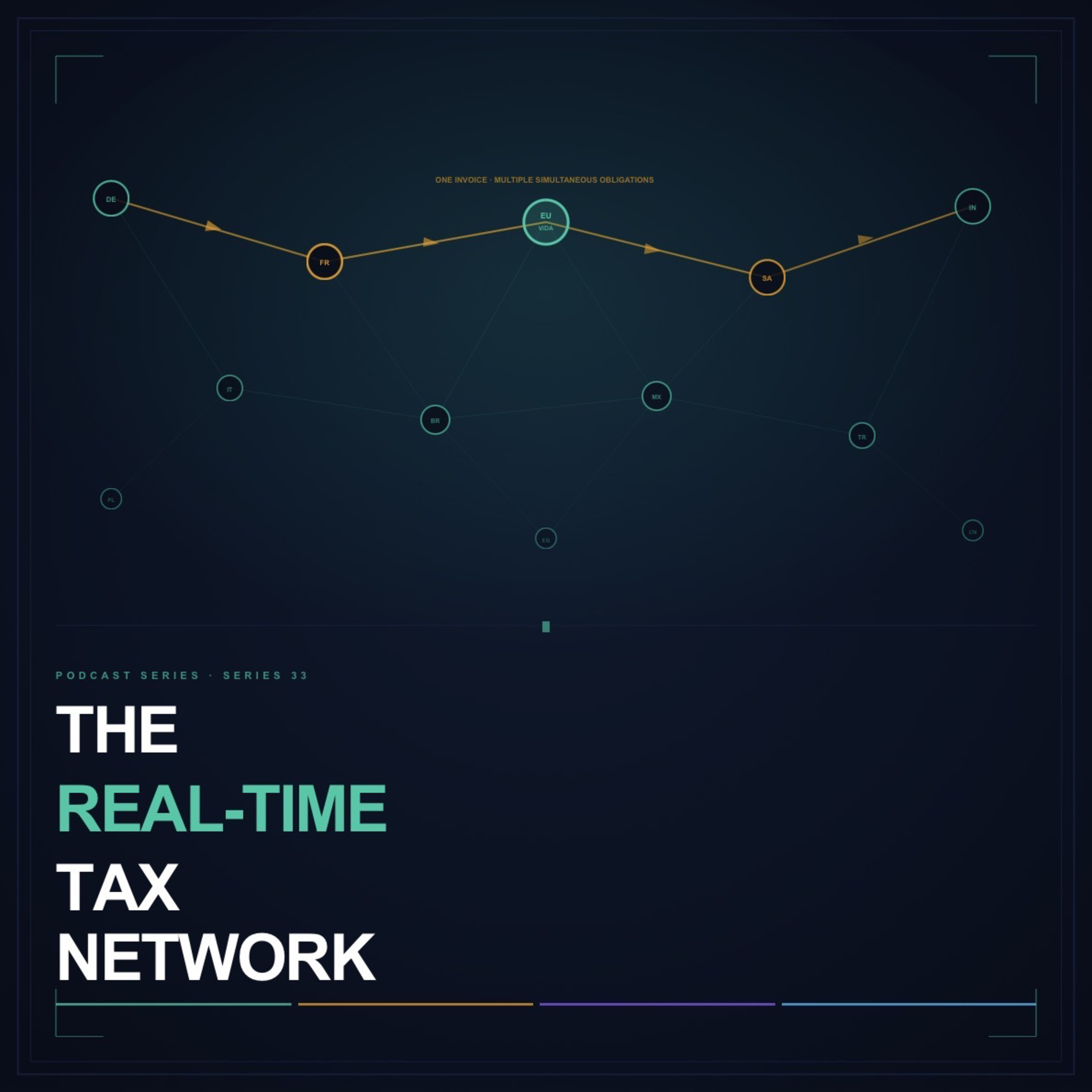
Tax compliance was designed for bilateral relationships: one taxpayer, one jurisdiction, one authority. Global trade has never worked that way — and the digital infrastructure that governments are now building to monitor it in real time is explicitly multilateral. Every cross-border transaction touches multiple tax authorities simultaneously. Every CTC clearance system is a node in a network that is growing denser every year. Hosted by Rıdvan Yiğit | Founder & CEO, RTC Suitertcsuite.com · [email protected] · linkedin.com/in/yigitridvan
-
4
Series 33 - The Debate: Global Tax Compliance as a Network Problem
The reframing of global tax compliance as a network problem rather than a collection of bilateral problems generates a debate that is primarily about timing and investment priority rather than about whether the reframing is correct. Most tax and technology leaders who engage seriously with the question agree that global compliance is structurally a network problem. The debate is about whether it is operationally viable to address it as one now — given the compliance deadlines that are immediate, the budgets that are constrained, and the implementation capacity that is finite.The case for addressing compliance as a network problem now argues from compounding cost. Every bilateral integration that is built in response to a mandate today becomes a component of the network that must be maintained, upgraded, and tested in coordination with every other bilateral integration when the next mandate arrives. The maintenance cost of a collection of bilateral integrations grows approximately with the square of the number of jurisdictions: adding jurisdiction ten does not add one integration but requires testing the new integration against all nine existing ones. At some point — and for most organisations with significant global compliance exposure, that point has already passed — the cost of maintaining the bilateral collection exceeds the cost of rebuilding it as a network. The organisations that wait until that point is obvious are paying the highest price for the longest period.The case for bilateral-first argues from delivery reality. A network-first compliance architecture requires a level of upfront design investment, vendor coordination, and organisational alignment that cannot be completed on the timeline of any individual compliance mandate. The mandate arrives with a deadline. The bilateral integration can be built and tested in the available time. The network architecture cannot. The organisation that chooses network-first when it has a CTC mandate going live in six months will miss the mandate while designing the network. The organisation that chooses bilateral-first will meet the mandate and face the network problem later — which is a worse outcome, but it is a real tradeoff that the network argument must acknowledge rather than dismiss.The resolution: the network architecture should be designed now, even if it is populated with bilateral integrations in the short term. The value of designing the network is not that it eliminates bilateral integrations immediately — it is that it provides the framework that makes each bilateral integration a network-compatible component rather than a standalone point-to-point connection. A bilateral integration built within a network framework can be promoted to a full network component when the framework is operationalised. A bilateral integration built outside a network framework must be rebuilt from scratch.Keywords: global tax compliance network problem, tax compliance network debate, bilateral vs network tax compliance, global tax network architecture, tax compliance network vs bilateral, network tax compliance debate, global compliance network problem, tax network architecture debate, bilateral multilateral tax debate, real-time tax network debate, global tax compliance reframe, tax compliance bilateral network, network approach tax compliance, global tax compliance architecture debate, bilateral network taxAbout the HostRıdvan Yiğit is the Founder & CEO of RTC Suite — the world's first Autonomous Compliance and Payment Intelligence platform, built natively on SAP BTP and operating across 80+ countries.Connect with Rıdvan:🔗 linkedin.com/in/yigitridvan✉ [email protected]📞 +90 545 319 93 44Learn more about RTC Suite:🌐 rtcsuite.com
-
3
Series 33 - The Deep Dive: Building the Digital Hallway of Global Trade
The digital hallway of global trade is the infrastructure through which every cross-border commercial transaction will eventually pass for tax validation, customs clearance, regulatory compliance, and counterparty verification — in real time, before the transaction is commercially completed. It is being built now, not as a single system but as an interconnected network of national clearance systems, supranational data-sharing frameworks, and multilateral tax authority cooperation agreements. The organisations that understand what this infrastructure is becoming and build their compliance architecture to interact with it as a network are building a durable competitive advantage. The organisations that do not are building a compliance burden that compounds with every new jurisdiction that comes online.We begin with the infrastructure map: the current state of national CTC clearance systems and the interoperability frameworks that are connecting them. The EU's ViDA initiative and its implications for cross-border B2B invoice flows within the bloc. The GCC's emerging framework for cross-border CTC validation among Gulf states. The OECD's STSP framework and its implications for the global exchange of real-time transaction data between tax authorities. The Peppol network's role as a transport layer for cross-border e-invoicing, and the bilateral and multilateral agreements that are progressively extending its coverage. Each of these developments is a node in the digital hallway — a point at which a cross-border transaction will be validated against one or more national tax systems before it completes.We then build the compliance architecture for the digital hallway: the transaction data model that captures the full information set that any clearance system in the hallway might require — counterparty identifiers, jurisdictional routing flags, supply type classifications, transfer pricing markers, customs commodity codes, and the document identifiers that allow authorities to correlate the buyer's record with the seller's record across borders. The routing architecture that determines which clearance systems a transaction must pass through, in what sequence, and with what data, based on the transaction's origin, destination, and supply type. The orchestration layer that manages the multi-step, multi-jurisdiction clearance workflow for a single transaction — ensuring that the transaction is only commercially released when every applicable clearance has been confirmed. The exception management architecture that handles clearance failures, authority system unavailability, and disputed determinations without blocking commercial flow. And the audit trail architecture that maintains the complete compliance record of every transaction — the clearance confirmations, the determination results, the authority responses — in a form that satisfies the evidentiary requirements of every jurisdiction that touched the transaction.We address the organisational model: how the tax, trade, technology, and legal functions need to be structured to manage compliance in the digital hallway; how the real-time compliance data that the hallway generates becomes a source of commercial intelligence as well as a compliance record; and how the CFO uses the digital hallway's real-time data to manage the organisation's global tax position continuously rather than periodically. The digital hallway is not coming. It is here, in the jurisdictions where the mandate density is highest. The organisations that are building for it now are building the infrastructure that global trade will require for the next generation.About the HostRıdvan Yiğit is the Founder & CEO of RTC Suite — the world's first Autonomous Compliance and Payment Intelligence platform, built natively on SAP BTP and operating across 80+ countries.Connect with Rıdvan:🔗 linkedin.com/in/yigitridvan✉ [email protected]📞 +90 545 319 93 44Learn more about RTC Suite:🌐 rtcsuite.com
-
2
Series 33 - The Critique: The Shift to Multilateral Tax Networks
The shift from bilateral to multilateral tax compliance is not a future development. It is happening now, in the infrastructure that tax authorities are building to share transaction data with each other and to validate cross-border transactions against multiple national systems simultaneously. The organisations that are still treating this shift as a future risk are misreading the timeline. The bilateral compliance model is already being replaced in the jurisdictions where the most transaction volume flows, and the replacement is not optional.The critique this episode makes is of the three specific failures that organisations are exhibiting in response to the multilateral shift. The first is architectural: most organisations are responding to new mandates by adding bilateral integrations — connecting their compliance engine to the next authority, building the next point-to-point interface, maintaining the next separate configuration. Each bilateral integration solves the immediate compliance problem and makes the network problem worse: the architecture becomes more complex, the maintenance cost increases, and the organisation's ability to respond to the next mandate decreases. The architecture that solves bilateral problems does not scale to a network.The second failure is organisational: the tax compliance function in most organisations is structured around jurisdictions — a team or a capability responsible for each country's obligations — rather than around transaction flows that cross jurisdictions. When the compliance obligation is multilateral — when a single transaction simultaneously generates obligations in multiple jurisdictions — a jurisdiction-structured tax function produces fragmentation: each team sees its piece of the transaction, and nobody sees the transaction as a whole. The transfer pricing implications of a real-time intercompany flow, the customs and VAT interaction at a cross-border shipment, the permanent establishment risk of a pattern of service transactions — none of these can be managed by a team that is looking only at one jurisdiction.The third failure is data: the transaction data that a multilateral compliance architecture requires — the full counterparty chain, the jurisdictional routing, the treatment flags for each applicable regime — is not being captured at the point of transaction origination in most ERP systems. It is being reconstructed from partial data at period-end, which means the compliance positions that the real-time authority systems are recording from transaction data do not match the compliance positions that the organisation's own systems will later calculate. This data gap is the source of the authority queries that follow real-time filing, and it is structural rather than incidental.Keywords: multilateral tax networks shift, shift to multilateral tax, tax authority data sharing, multilateral tax compliance, cross-border tax data sharing, multilateral CTC compliance, bilateral to multilateral tax, tax compliance network shift, authority tax data sharing, multilateral tax architecture, cross-border tax network, real-time multilateral tax, global tax authority network, bilateral compliance failure, multilateral tax compliance architectureAbout the HostRıdvan Yiğit is the Founder & CEO of RTC Suite — the world's first Autonomous Compliance and Payment Intelligence platform, built natively on SAP BTP and operating across 80+ countries.Connect with Rıdvan:🔗 linkedin.com/in/yigitridvan✉ [email protected]📞 +90 545 319 93 44Learn more about RTC Suite:🌐 rtcsuite.com
-
1
Series 33 - The Brief: Tax Compliance for Interconnected Global Networks
The bilateral model of tax compliance — one taxpayer files returns to one authority, jurisdiction by jurisdiction, return by return — was always a simplification. Cross-border transactions have always touched multiple tax systems simultaneously: the VAT on the export in the origin country, the customs duty at the border, the VAT on the import in the destination country, the withholding tax on the service fee, the transfer pricing implications of the intercompany invoice. In the periodic compliance environment, these obligations were managed sequentially: each jurisdiction's return was filed on its own schedule, the connections between them were handled by reconciliation at year-end, and the gaps between systems were filled by accountants with spreadsheets.Real-time compliance has changed the sequencing. When every transaction is transmitted to a government clearance system at the moment of issuance, the tax obligations that were previously managed sequentially are now activated simultaneously. The invoice that crosses a border triggers CTC obligations in both jurisdictions — in the exporter's country at issuance, in the importer's country at receipt. The intercompany service that was previously documented in an annual transfer pricing study is now visible to both tax authorities as a real-time transaction flow. The supply chain that spans five jurisdictions now generates five simultaneous compliance obligations for every transaction in the chain.This is not a complication of the bilateral model. It is the replacement of the bilateral model with a network model — one in which compliance is a function of the organisation's position in a network of interconnected tax systems, not a function of its obligations to each system individually. The organisations that understand this shift are building compliance architectures that manage the network. The organisations that do not are building compliance architectures that add one more bilateral integration every time a new mandate goes live — and discovering that the sum of bilateral integrations is not a network.Keywords: tax compliance global networks, interconnected tax compliance, global tax network compliance, real-time tax compliance network, multilateral tax compliance, global trade tax compliance, cross-border tax compliance network, interconnected global tax, tax network global trade, real-time global tax network, global tax compliance interconnected, network tax compliance, cross-border CTC compliance, global compliance network, tax compliance interconnected networksAbout the HostRıdvan Yiğit is the Founder & CEO of RTC Suite — the world's first Autonomous Compliance and Payment Intelligence platform, built natively on SAP BTP and operating across 80+ countries.Connect with Rıdvan:🔗 linkedin.com/in/yigitridvan✉ [email protected]📞 +90 545 319 93 44Learn more about RTC Suite:🌐 rtcsuite.com
No matches for "" in this podcast's transcripts.
No topics indexed yet for this podcast.
Loading reviews...
ABOUT THIS SHOW
Tax compliance was designed for bilateral relationships: one taxpayer, one jurisdiction, one authority. Global trade has never worked that way — and the digital infrastructure that governments are now building to monitor it in real time is explicitly multilateral. Every cross-border transaction touches multiple tax authorities simultaneously. Every CTC clearance system is a node in a network that is growing denser every year. Hosted by Rıdvan Yiğit | Founder & CEO, RTC Suitertcsuite.com · [email protected] · linkedin.com/in/yigitridvan
HOSTED BY
Ryigit
CATEGORIES
Loading similar podcasts...
URL copied to clipboard!