
PODCAST · business
Series 34 - The Peppol Advantage: When B2B Document Exchange Becomes a Strategic Asset
by Ryigit
Peppol was built as a compliance infrastructure. Most organisations that are connected to it treat it as one. A small number have looked at what Peppol actually is — a structured, addressable, real-time channel to every counterparty in the network — and asked a different question: what can we automate, accelerate, and improve when every B2B document flows through a channel that both sides can read, process, and act on without human intervention? Hosted by Rıdvan Yiğit | Founder & CEO, RTC Suitertcsuite.com · [email protected] · linkedin.com/in/yigitridvan
-
4
Series 34 - The Deep Dive: Peppol Replaces the Broken PDF
The PDF invoice is the defining document format of a compliance era that is ending. It is a human-readable representation of a business transaction, designed to be printed, filed, and read by the accounts payable clerk who processes it. It contains all the information needed to understand what was invoiced, in a format that a human can interpret but a machine cannot reliably process without optical character recognition, natural language processing, or some combination of post-processing techniques that reintroduce the errors and ambiguities that the PDF's unstructured format created in the first place. The PDF invoice is not a data format. It is a picture of a data format — a lossy compression of the transaction data that the ERP generated into a presentation layer that humans can read and systems cannot.Peppol replaces the PDF with a different paradigm. The Peppol invoice is not a representation of the transaction. It is the transaction — a structured data object that carries every field in a machine-readable format, linked by reference to the purchase order, the contract, the delivery note, and the tax determination that are the transaction's legal and commercial context. When a Peppol invoice arrives at the buyer's access point, there is nothing to read. There is a data object to process — to match against the purchase order, to validate against the tax rules, to route to the payment workflow, to post to the general ledger, to report to the tax authority. None of these steps requires human intervention if the data object is correctly formed and the processing rules are correctly configured.We build the complete replacement architecture in this deep dive: the Peppol document specification and what each mandatory and optional field enables in the downstream processing pipeline; the ERP integration model that maps Peppol fields to ERP objects without data loss or transformation ambiguity; the three-way match automation that runs when a Peppol invoice arrives within the configured tolerances for quantity, price, and delivery references; the tax validation layer that checks the incoming tax treatment against the organisation's own tax determination rules before the invoice is approved; the exception workflow that routes out-of-tolerance invoices to the correct resolution path — price dispute, quantity dispute, tax dispute, PO reference missing — without entering a generic AP queue; the payment scheduling that triggers on approval confirmation rather than on AP clerk action; and the real-time reporting connection that extracts the tax data from the approved Peppol invoice and feeds it to the compliance engine before the payment run. We conclude with the transition programme: how the organisation moves from PDF-dominant to Peppol-dominant invoice processing, which counterparties to prioritise for Peppol onboarding, and how to measure the processing time, query rate, and working capital improvements that the transition generates.Keywords: Peppol replaces PDF, PDF invoice broken, Peppol vs PDF invoice, Peppol structured invoice, PDF invoice problems, Peppol document format, Peppol invoice processing, Peppol replace PDF, Peppol B2B document, Peppol three-way match automation, Peppol ERP integration deep dive, Peppol invoice automation complete, Peppol AP automation deep dive, Peppol PDF replacement, Peppol invoice processing complete, Peppol document exchange architecture, Peppol automation architecture deep dive, Peppol structured data invoice, Peppol payment automation, Peppol compliance reportingAbout the HostRıdvan Yiğit is the Founder & CEO of RTC Suite — the world's first Autonomous Compliance and Payment Intelligence platform, built natively on SAP BTP and operating across 80+ countries.Connect with Rıdvan:🔗 linkedin.com/in/yigitridvan✉ [email protected]📞 +90 545 319 93 44Learn more about RTC Suite:🌐 rtcsuite.com
-
3
Series 34 - The Debate: Peppol Strategic Transformation vs Compliance
The debate about Peppol's role in the enterprise has a fault line that runs between two genuine positions: Peppol as compliance infrastructure, which must be connected, maintained, and kept current with mandate requirements at minimum cost; and Peppol as strategic transformation platform, which should be the foundation for a wholesale reimagination of how the organisation exchanges documents with its counterparties and what it can do with the data that structured document exchange generates.The compliance position argues from cost discipline. Peppol connectivity is a regulatory requirement in a growing number of jurisdictions. The cost of compliance is the cost of connection — an access point subscription, a mandate-compliant document format, and the integration to the ERP that sends documents to the access point. The strategic ambition of turning Peppol into a transformation platform is a different investment with a different business case that should be evaluated separately from the compliance requirement. Conflating the two risks producing an overengineered compliance solution that costs more than the mandate requires and delivers capabilities that the organisation is not ready to use. The compliance position is not that the transformation opportunity does not exist. It is that it should be evaluated and funded separately, on its own merits.The transformation position argues from compounding returns. Every buyer that is connected to Peppol is a buyer to whom the supplier can send a structured invoice that processes without human handling. Every structured invoice that processes without human handling is a day's reduction in DSO, a reduction in the query rate, a reduction in the AP headcount requirement at the buyer. The transformation benefits compound with every counterparty that joins the Peppol network — which means the organisation that has invested in the transformation capability earlier extracts more of the compounding return than the organisation that waits until the network is denser before investing. The compliance infrastructure is already built. The incremental investment required to extract the transformation value is bounded. Deferring it is a choice to defer the return.The resolution this debate reaches is sequential rather than binary. The compliance implementation should be designed for transformation readiness — with the data model, the ERP integration, and the exception routing designed to support automation from the outset, even if the automation is not activated immediately. The transformation investment is then not a separate project but the activation of capabilities that the compliance implementation was designed to support.Keywords: Peppol strategic transformation debate, Peppol compliance vs transformation, Peppol transformation platform, Peppol strategic debate, Peppol compliance transformation, Peppol business case, Peppol network transformation, Peppol strategic investment, Peppol compliance infrastructure, Peppol transformation returns, Peppol strategic platform, Peppol debate transformation, Peppol compliance mandate transformation, Peppol strategic case, Peppol transformation readinessAbout the HostRıdvan Yiğit is the Founder & CEO of RTC Suite — the world's first Autonomous Compliance and Payment Intelligence platform, built natively on SAP BTP and operating across 80+ countries.Connect with Rıdvan:🔗 linkedin.com/in/yigitridvan✉ [email protected]📞 +90 545 319 93 44Learn more about RTC Suite:🌐 rtcsuite.com
-
2
Series 34 - The Critique: Scaling Peppol From Compliance to Automation
The compliance use of Peppol is well understood. Connect to an access point, configure the document formats required by the applicable mandate, transmit invoices to the authority's clearance system or directly to the buyer's access point, receive confirmation, post the document. This workflow is what most organisations that have implemented Peppol in a mandated jurisdiction have built, and it works — as a compliance workflow. The critique is that it leaves the majority of Peppol's value on the table, because the structured, machine-readable document that Peppol delivers is being treated as the input to a human review process rather than as the input to an automated processing pipeline.The automation gap in most Peppol implementations is architectural. The Peppol document arrives at the buyer's access point fully structured: every line item identified, every tax classification applied, every payment term specified, every reference to the purchase order resolved. The buyer's AP function then routes this document to a human reviewer who checks it against the purchase order, validates the tax treatment, confirms the delivery references, and approves it for payment — a process that takes days and costs more in human time than the document processing savings that Peppol was supposed to generate. The structured document is being read by a human rather than processed by a system, which means the Peppol investment has delivered compliance without delivering automation.Scaling Peppol from compliance to automation requires three architectural changes. First, the Peppol document must be connected directly to the ERP's three-way match process — invoice against purchase order against receipt — without human intermediation. This requires the invoice data model to be mapped to the ERP's purchase order and goods receipt data structures at the field level, so that the match runs automatically for every invoice that arrives within tolerance. Second, the exception routing must be designed before the automation is deployed: the invoices that fall outside tolerance — wrong quantity, wrong price, missing PO reference — need to route to the right resolution workflow automatically, not to a generic AP inbox. Third, the tax validation must run automatically against the incoming document's tax treatment before the three-way match completes — not after, because a tax error discovered after payment approval is a recovery problem rather than a prevention problem.Keywords: Peppol compliance automation, scaling Peppol automation, Peppol AP automation, Peppol e-invoice automation, Peppol three-way match, Peppol ERP integration, Peppol automation architecture, Peppol from compliance to automation, Peppol structured invoice automation, Peppol AP processing, Peppol invoice automation, Peppol automation gap, Peppol compliance to automation, Peppol e-invoice processing, Peppol automation architecture critiqueAbout the HostRıdvan Yiğit is the Founder & CEO of RTC Suite — the world's first Autonomous Compliance and Payment Intelligence platform, built natively on SAP BTP and operating across 80+ countries.Connect with Rıdvan:🔗 linkedin.com/in/yigitridvan✉ [email protected]📞 +90 545 319 93 44Learn more about RTC Suite:🌐 rtcsuite.com
-
1
Series 34 - The Brief: Peppol Is the Email of B2B Commerce
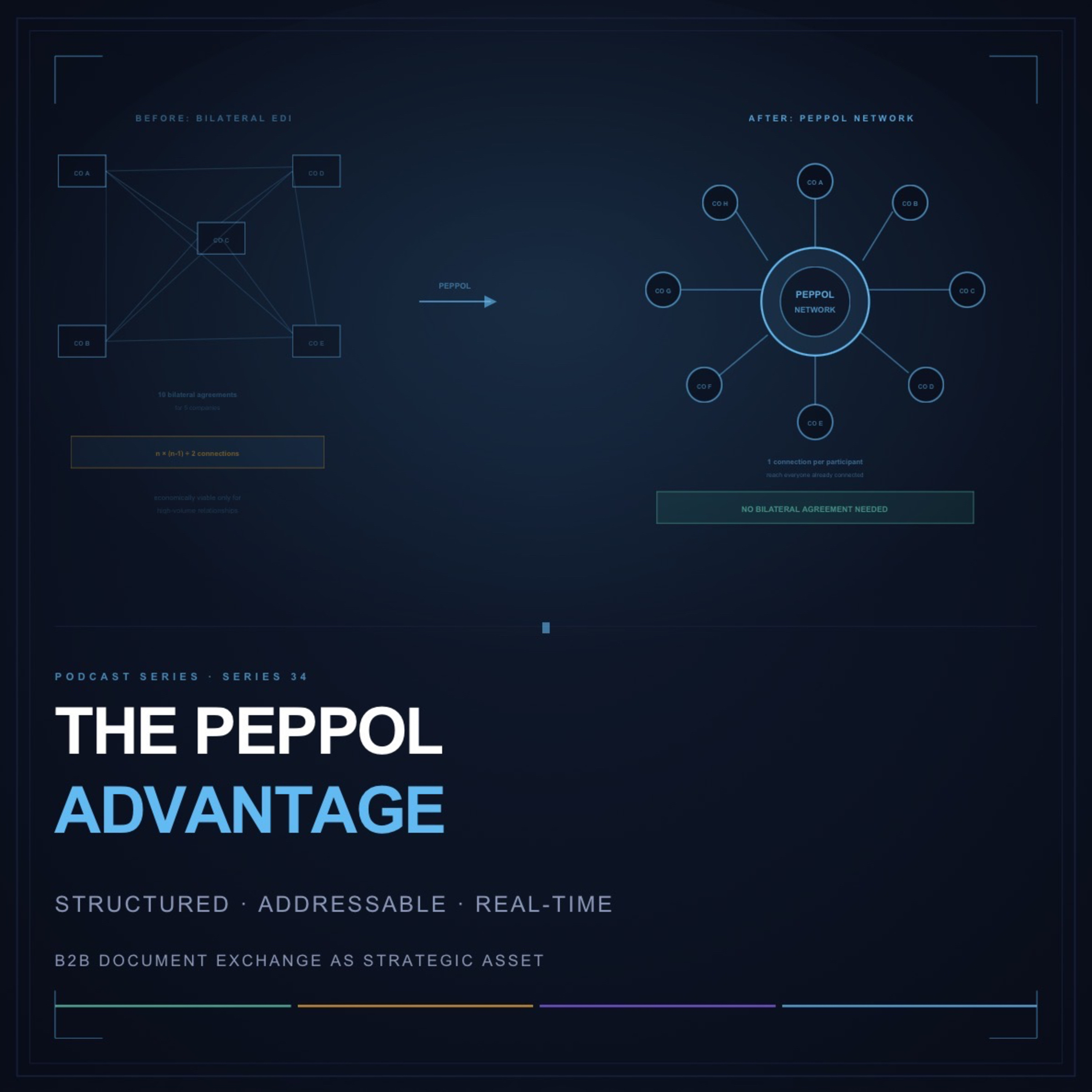
The analogy is precise: before email, business communication required each pair of organisations to agree on a communication protocol, establish a bilateral connection, and maintain that connection independently of every other connection the organisation had. The result was a fragmented landscape in which the cost of establishing a new communication channel was high enough to limit the number of channels any organisation could maintain — which meant that most business communication defaulted to the lowest-common-denominator channel available: the phone call, the fax, the posted letter. Email replaced all of that with a universal protocol: any sender could reach any recipient without a prior bilateral agreement, because both were connected to the same infrastructure through their respective email providers.Peppol does for B2B documents what email did for B2B communication. Before Peppol, sending a structured electronic invoice to a counterparty required a bilateral EDI agreement, a point-to-point connection, and a shared data standard — an arrangement that was economically viable only for high-volume trading relationships and completely impractical for the long tail of suppliers and customers that make up most organisations' counterparty base. The cost of electronic invoicing was the cost of establishing and maintaining bilateral connections at scale. Peppol replaces bilateral connections with a network: any sender connected to a Peppol access point can reach any recipient connected to any other Peppol access point, anywhere in the network, without a prior bilateral agreement. The connection infrastructure already exists. The sender does not need to know which access point the recipient uses. The document arrives structured, machine-readable, and processable without human intervention.The brief this episode makes is that Peppol is not an e-invoicing standard. It is a business communication infrastructure — the same category of investment as the telephone network or the internet, with the same characteristic that its value grows with every new participant that joins it. The organisations that are connected to Peppol because a government mandate required it are using the infrastructure for one purpose. The organisations that understand what the infrastructure enables are using it for many.Keywords: Peppol B2B commerce, Peppol email B2B, Peppol B2B document exchange, Peppol network infrastructure, Peppol e-invoicing network, Peppol B2B communication, Peppol access point, Peppol compliance, Peppol structured invoice, Peppol B2B standard, Peppol network value, Peppol document exchange, Peppol e-invoice infrastructure, Peppol B2B connectivity, Peppol network advantageAbout the HostRıdvan Yiğit is the Founder & CEO of RTC Suite — the world's first Autonomous Compliance and Payment Intelligence platform, built natively on SAP BTP and operating across 80+ countries.Connect with Rıdvan:🔗 linkedin.com/in/yigitridvan✉ [email protected]📞 +90 545 319 93 44Learn more about RTC Suite:🌐 rtcsuite.com
No matches for "" in this podcast's transcripts.
No topics indexed yet for this podcast.
Loading reviews...
ABOUT THIS SHOW
Peppol was built as a compliance infrastructure. Most organisations that are connected to it treat it as one. A small number have looked at what Peppol actually is — a structured, addressable, real-time channel to every counterparty in the network — and asked a different question: what can we automate, accelerate, and improve when every B2B document flows through a channel that both sides can read, process, and act on without human intervention? Hosted by Rıdvan Yiğit | Founder & CEO, RTC Suitertcsuite.com · [email protected] · linkedin.com/in/yigitridvan
HOSTED BY
Ryigit
CATEGORIES
Loading similar podcasts...
URL copied to clipboard!