
PODCAST · business
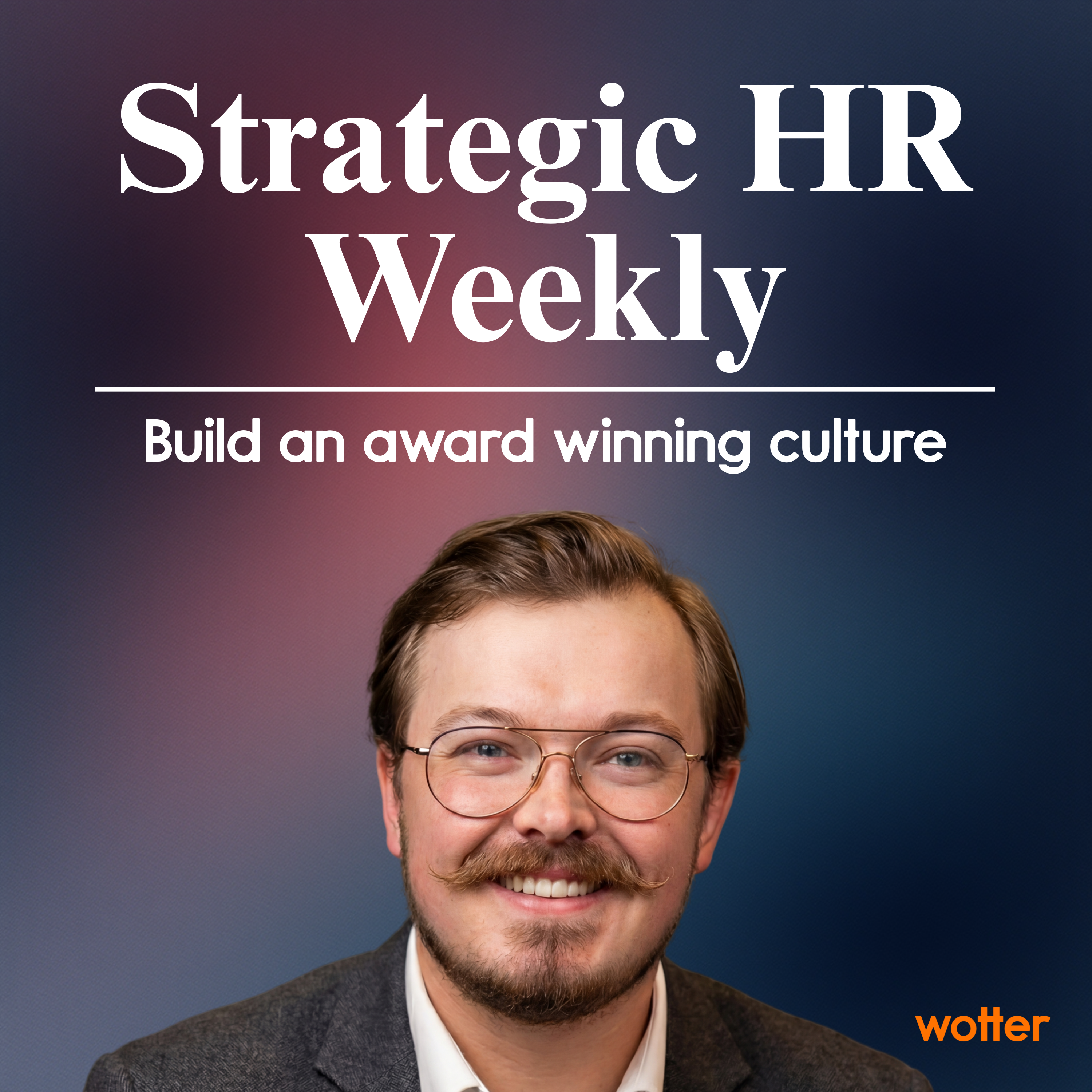
Strategic HR Weekly
by Fraser Duncumb, Wotter
The era of "fluffy" HR is over.Strategic HR Weekly is the essential intelligence briefing for People Leaders ready to secure their seat at the boardroom table. Hosted by Fraser Duncumb, we ditch the vanity metrics to focus on the commercial realities of human capital: Regrettable Attrition, Billings Continuity, and Profit Protection.Whether you are battling the "Accidental Manager" crisis or trying to prove the ROI of culture to a sceptical CFO, this is your playbook for turning sentiment into strategy.If you are done measuring "happiness" and ready to start forecasting the financial impact of your people, let's get to work.
-
15
Ep. 14 - You Said, We Did: How to get it right
Most mid-sized agencies think employees are bored of being asked questions. They aren't. They suffer from Action Fatigue—the psychological fallout of handing leadership a roadmap to fix bottlenecks, only to receive silence or a sanitised summary six months later.Asking for feedback without acting immediately signals that your staff's time is a low priority. When people are your only inventory, this isn't just an HR oversight—it’s a direct hit to your EBITDA through avoidable attrition.What We Cover:The 41% Attrition Risk: Why nearly half of regrettable exits happen because employees feel ignored, and why listening is your best retention strategy.The Death of the Annual Survey: Why a 180-day delay in processing surveys is a P&L liability. By the time results are "sanitised," top billers have checked out.Adult-to-Adult Communication: Moving past the “Parent-Child” dynamic. Why radical honesty—including a hard “No”—builds more trust than vague PR spin.The Validation Loop: Tactical steps to link actions directly to feedback (e.g., “You said X, so we are doing Y”) to reinforce a high-performance culture.The Sanitisation Tax: Why staff assume the worst when leadership hides the truth, and how this "unknowing" spikes organisational anxiety and turnover.“41% of employees leave simply because they feel ignored. To stop the talent drain, stop treating feedback like a PR exercise and start treating it as strategic intelligence.”Timestamps:[00:01] - The Survey Fatigue Myth: Why it’s actually “Action Fatigue.”[03:45] - The 41% Stat: The correlation between silence and regrettable turnover.[06:30] - The Annual Survey Death Spiral: Why a 6-month delay is a strategic failure.[08:50] - Sanitisation vs. Credibility: How PR-friendly summaries destroy leadership ROI.[12:15] - Closing the Loop: The “You Said, We Did” framework for real-time adjustments.[16:40] - The Power of “No”: Why admitting you can’t fix something beats a corporate lie.[21:10] - Psychological Safety: Using vulnerability as a tool for transparency.Next Steps: Commercialise Your People StrategyIf you are ready to move beyond "vibes" and start treating culture as a P&L asset, here is your toolkit:The Playbook: Stop guessing where your culture is broken. Download the 5 Stages of Cultural Maturity eBook to benchmark your agency against the top 5% of the market.The Intelligence: For commercial insights delivered directly to your inbox, join Strategic HR Weekly. You’ll also get access to our "Revenue-First HR" Custom GPTs and Gems, giving you tailored, strategic advice from your favourite AI.The Network: Follow Fraser Duncumb on LinkedIn for daily "Hot Takes" on the accidental manager crisis and retention maths.The Solution: If you need to stop the revenue bleed now, see how Wotter turns feedback into EBITDA protection.
-
14
Ep. 13 - Beyond the EVP: Transforming Daily Habits into Strategic Leverage
Your EVP doesn’t stop a consultant from cutting corners on a client call or neglecting a lead when the pressure is on. Culture isn’t what you say in the boardroom; it’s the sum of micro-behaviours that occur when management isn't in the room. If your culture isn't treated as an operational asset, it is a silent revenue leak.In the recruitment and consultancy world, your people are your inventory. When standards slip, from how they prep for a meeting to how they handle a grievance, your operational excellence erodes, and your EBITDA follows. In this episode, we move past the HR fluff and treat culture as the hard-edged business tool it actually is.What We Cover:The "Teamship" Framework: Borrowing from Sir Clive Woodward’s Olympic strategy to turn high-level strategic goals into non-negotiable, daily micro-habits that mitigate operational risk.The Hand Sanitiser Logic: Why enforcing small, seemingly "trite" rules is actually a calculated move to reduce team downtime and protect billable hours.The "Washing Up" Litmus Test: How micro-tasks (like cleaning a coffee cup) act as a proxy for personal accountability and client-centricity. If they won’t wash a cup, they won’t protect your margin.Architecting for EBITDA: Why your culture must be architected specifically to match your financial goals. You cannot build an "Efficiency" culture using "Innovation" behaviours.The Self-Enforcement Loop: How shifting to employee-led rules creates a culture that automatically attracts high-billers and repels low-performers without top-down policing."Culture isn't just about being nice. It’s about clarity. It is operational discipline. If your business relies on high-performing teams, you cannot afford slipping standards, because when those micro-behaviours degrade, your bottom line takes the hit."Timestamps:[00:00] – The Revenue Leak: Why behaviour when no one is watching dictates your margin.[02:45] – The Clive Woodward Strategy: Using "Team-ship Rules" to mitigate macro risks.[05:12] – The "Zero" Case Study: Using micro-tasks to test for humility and accountability.[08:30] – The EVP Disconnect: Why boardroom values rarely survive the transition to the shop floor.[11:45] – Beyond Top-Down: Why your values must be employee-owned to be self-enforcing.[14:20] – Strategic Alignment: Engineering your culture to hit specific financial KPIs.Next Steps: Commercialise Your People StrategyIf you are ready to move beyond "vibes" and start treating culture as a P&L asset, here is your toolkit:The Playbook: Stop guessing where your culture is broken. Download the 5 Stages of Cultural Maturity eBook to benchmark your agency against the top 5% of the market.The Intelligence: For commercial insights delivered directly to your inbox, join Strategic HR Weekly. You’ll also get access to our "Revenue-First HR" Custom GPTs and Gems, giving you tailored, strategic advice from your favourite AI.The Network: Follow Fraser Duncumb on LinkedIn for daily "Hot Takes" on the accidental manager crisis and retention maths.The Solution: If you need to stop the revenue bleed now, see how Wotter turns feedback into EBITDA protection.
-
13
Ep. 12 - How to tackle financial wellbeing when there's no money for payrises
Most founders believe a 5% pay rise is the only way to stop a mass exodus during a cost-of-living crisis. They're wrong. You're often throwing EBITDA at a problem money can't solve—like operational friction or poor management—while ignoring structural levers that could improve your team's financial lives at zero net cost to the P&L.A modest £2,000 across-the-board raise for a 300-person firm costs nearly £700,000 once employer taxes are factored in. If that capital doesn't fundamentally change your employees' quality of life, it's a wasted asset. In this episode, we move beyond the "Salary Trap" and explore five ways to build a retention moat by lowering your team's cost of living without increasing your fixed payroll line.What We Cover:The £700,000 Math: Why small raises are P&L killers with diminishing returns, and why happiness from salary peaks earlier than most CEOs realise.The "Interest-Free Loan" Fallacy: Why slow expense reimbursement is a tax on your billers—and why a 48-hour payout window is a zero-cost cultural win.Balance Sheet as a Benefit: Micro-leasing and interest-free loans for season tickets and emergency bills, preventing employee debt spirals.Group Buying Power: Using your headcount to negotiate bulk discounts on childcare, gyms, and commutes.Policy as a "Shadow Pay Rise": Flexible working eliminates peak-time travel and childcare costs—equivalent to a salary bump without the payroll tax."A £2,000 pay rise for a 300-staff organisation costs £700,000. A massive EBITDA hit for a gain forgotten in three months. Instead, use your corporate scale to lower their costs at zero net expense to the firm."Timestamps:[00:00] - The £700k Math: Why salary is the least efficient lever for mid-market firms.[03:45] - The Salary Fallacy: Why staff use 'pay' as a proxy for bad management and cold offices.[08:12] - High-Impact Financial Training: Why 1-on-1 sessions outperform "dead" video libraries.[11:34] - Operational Efficiency: Eliminating the 30-day expense wait to protect employee liquidity.[14:50] - Structural Support: Micro-leasing for season tickets and the business case for emergency loans.[18:22] - Group Buying Power: Negotiating corporate discounts that move the needle on take-home pay.[20:51] - The Policy Lever: How WFH and flexible hours act as a non-taxable salary increase by reducing childcare overheads.Next Steps: Commercialise Your People StrategyIf you are ready to move beyond "vibes" and start treating culture as a P&L asset, here is your toolkit:The Playbook: Stop guessing where your culture is broken. Download the 5 Stages of Cultural Maturity eBook to benchmark your agency against the top 5% of the market.The Intelligence: For commercial insights delivered directly to your inbox, join Strategic HR Weekly. You’ll also get access to our "Revenue-First HR" Custom GPTs and Gems, giving you tailored, strategic advice from your favourite AI.The Network: Follow Fraser Duncumb on LinkedIn for daily "Hot Takes" on the accidental manager crisis and retention maths.The Solution: If you need to stop the revenue bleed now, see how Wotter turns feedback into EBITDA protection.
-
12
Ep. 11 - Don't go for the Big Bang, focus on 1% gains in Culture
Lots of companies think fixing culture requires a £20,000 off-site, a "values" rebrand, and matching hoodies. It’s a massive operational failure we call the "Big Bang Fallacy." You cannot dictate high performance overnight; if your top billers are too afraid to pitch ideas to an untrained manager on Monday morning, your expensive kickoff was just a sunk marketing cost. Culture is not an HR project—it is a continuous operational asset. In this episode, we dismantle the myth of the overnight culture fix and replace it with the cold, hard mechanics of 1% compounding behavior shifts that actively protect your bottom line.What We Cover:The "Big Bang" Fallacy: Why grand culture kickoffs and "core value" campaigns fail to change Monday morning reality (and act as a toxic drain on operational focus).The "Barry" Bottleneck: How a single defensive, untrained middle manager can kill corporate innovation, and the exact diagnostic steps to map this systemic risk.The Team GB Marginal Gains Strategy: Applying Dave Brailsford’s 1% Olympic compounding methodology to corporate behavior to protect millions in billings.The 4-Behavior Limit: The psychological math behind organizational change. Why attempting to change more than four company-wide behaviors per year guarantees operational failure.The Annual Survey Black Hole: Why 12-month feedback loops that take 3 months to analyze yield zero operational change, mask employee churn, and actively destroy trust."Culture isn't a project. It's a high-yield savings account. You don't get wealthy from a million-pound deposit, but through the compounding of 1% gains. Shifting your culture by just 1% per day can protect millions in billings."Timestamps:[00:00] - The "Big Bang Fallacy": Why core-value hoodies and expensive off-sites fail by Monday morning.[02:45] - The "Barry" Bottleneck: Identifying the specific management layers stifling growth and innovation.[06:10] - Tying Values to Market Survival: Moving past woolly HR definitions to build commercial resilience.[09:30] - The Team GB Blueprint: How deploying 1% marginal gains completely rewires company performance.[14:15] - The Capacity Limit: Why you can only successfully change 4 organizational behaviors a year.[18:50] - The Death of the Annual Survey: Why backward-looking, 12-month feedback loops waste money and ignore true churn metrics.Next Steps: Commercialise Your People StrategyIf you are ready to move beyond "vibes" and start treating culture as a P&L asset, here is your toolkit:The Playbook: Stop guessing where your culture is broken. Download the 5 Stages of Cultural Maturity eBook to benchmark your agency against the top 5% of the market.The Intelligence: For commercial insights delivered directly to your inbox, join Strategic HR Weekly. You’ll also get access to our "Revenue-First HR" Custom GPTs and Gems, giving you tailored, strategic advice from your favourite AI.The Network: Follow Fraser Duncumb on LinkedIn for daily "Hot Takes" on the accidental manager crisis and retention maths.The Solution: If you need to stop the revenue bleed now, see how Wotter turns feedback into EBITDA protection.
-
11
Ep. 10 - What actually is a disengaged employee?
Most CPOs and Founders think the loud, disruptive employee is their biggest operational threat. They aren't. Your true P&L risk is the "fine" consultant, the passenger who hits their billable hours but has entirely stopped caring about your firm's long-term growth.Stop hunting the 10% of toxic arsonists while the 75% of your "quietly disengaged" middle slowly bleeds your EBITDA dry. What We Cover: The 75% "Data Black Hole": The Gallup math proves the majority of your workforce is quietly coasting. We explain why transitioning this middle tier to active engagement yields a vastly higher ROI than simply firing your bottom 10%. The "Proactive Friction" Asset: Why you need to stop hiring for "happiness." A truly engaged consultant doesn't just smile and say yes; they actively surface operational bottlenecks and challenge the status quo to protect client delivery. The Macro-Shock Stress Test: How a disengaged inventory fractures and haemorrhages staff during an economic downturn, while an engaged workforce rallies to protect client revenue. Systemic ROI over Tactical Firefighting: The operational roadmap for shifting from reactive P&L rescue missions to continuous, predictable revenue protection. "Searching for disengaged employees by looking for loud disruptors is like hunting an arsonist while your basement floods. In high-pressure consultancy, your biggest risk isn't the failure, it's the person who is fine.They hit their KPIs but have shifted from asset to passenger unnoticed." Timestamps: [00:05] - Hunting Arsonists vs. Flooding Basements: The true cost of the "quietly disengaged" employee. [03:20] - The "Proactively Friction Seeking" Metric: Why your most valuable consultants are the ones bringing you problems. [08:45] - The Attrition Risk of "Fine": Why employees hitting their targets are still highly vulnerable to competitor poaching. [15:10] - Macro-Shocks & Resilience: How employee engagement dictates your firm's ability to survive and scale through a market downturn. [20:45] - The "Green Dot" Fallacy: Why accidental managers equate billable hours with loyalty, and how it destroys retention. Next Steps: Commercialise Your People StrategyIf you are ready to move beyond "vibes" and start treating culture as a P&L asset, here is your toolkit:The Playbook: Stop guessing where your culture is broken. Download the 5 Stages of Cultural Maturity eBook to benchmark your agency against the top 5% of the market.The Intelligence: For commercial insights delivered directly to your inbox, join Strategic HR Weekly. You’ll also get access to our "Revenue-First HR" Custom GPTs and Gems, giving you tailored, strategic advice from your favourite AI.The Network: Follow Fraser Duncumb on LinkedIn for daily "Hot Takes" on the accidental manager crisis and retention maths.The Solution: If you need to stop the revenue bleed now, see how Wotter turns feedback into EBITDA protection.
-
10
Ep. 9 - The Cost of Turnover: Why Retention is the Only Real Growth Lever
Accepting 30% churn as "industry standard" is a funeral dirge for EBITDA. It isn't a benchmark; it’s proof accidental managers are burning inventory just to stay warm. In professional services, you aren’t losing staff—you’re leaking capital.We’re autopsying two firms: the "Leaky Bucket" losing £6M a year, versus the "Compounder" building a retention moat. We strip away HR platitudes to focus on revenue protection. In this industry, your people aren't just assets; they are the entire P&L.What We Cover:The £3.8M Math: A side-by-side breakdown of why a 20% difference in turnover creates a multimillion-pound gap in pure bottom-line profit.People as Inventory: Why a consultant leaving is the equivalent of a factory losing its machinery and its finished product simultaneously.The Accidental Manager Epidemic: Addressing the 82% of managers who were promoted for technical skill but are now inadvertently driving your best talent to competitors.The Valuation Killer: Why Private Equity firms view high churn as a structural instability that guts your company’s exit value.The "Finance Fight" Strategy: How to stop using "happiness" metrics and start using predictive data to win the budget battles in the boardroom."If your P&L shows you’re leaking money because of culture, it will damage your valuation. Investors aren't buying a business; they’re buying predictable revenue. If your people walk, the product walks, and the certainty of that revenue vanishes with them."Timestamps:[00:00] – The Funeral Dirge: Why accepting "standard" churn rates is a quiet surrender of your profit margin.[02:15] – The Leaky Bucket vs. The Compounder: A mathematical autopsy of how turnover costs compound into a £3.8M operational deficit.[05:40] – Inventory Walking Out the Door: Why client loyalty follows the person, not the firm, and the true cost of "opportunity leakage."[09:10] – The Accidental Manager: Confronting the reality that 82% of managers lack the tools to stop talent attrition.[13:30] – Valuation & Predictability: Why retention is the ultimate "social proof" for investors and Private Equity.[17:45] – Winning the Finance Fight: Moving from annual surveys to continuous intelligence to protect your EBITDA.Next Steps: Commercialise Your People StrategyIf you are ready to move beyond "vibes" and start treating culture as a P&L asset, here is your toolkit:The Playbook: Stop guessing where your culture is broken. Download the 5 Stages of Cultural Maturity eBook to benchmark your agency against the top 5% of the market.The Intelligence: For commercial insights delivered directly to your inbox, join Strategic HR Weekly. You’ll also get access to our "Revenue-First HR" Custom GPTs and Gems, giving you tailored, strategic advice from your favourite AI.The Network: Follow Fraser Duncumb on LinkedIn for daily "Hot Takes" on the accidental manager crisis and retention maths.The Solution: If you need to stop the revenue bleed now, see how Wotter turns feedback into EBITDA protection.
-
9
Ep. 8 - Survey Fatigue is a Myth: Why "Lack of Action" is Churning Your Best People
Your board thinks top billers are suffering from "survey fatigue." They aren't. They’re suffering from "lack of action fatigue," which quietly drives high performers to competitors. An annual 60-question survey isn't just an HR bottleneck—it's an operational failure leaving line managers blind to the daily frictions killing billing capacity.In business, silence is a financial vulnerability. We strip away "engagement" buzzwords to expose the true P&L cost of hoarding stale feedback, giving you a blueprint for real-time risk mitigation.What We Cover:The "Survey Fatigue" Fallacy: Why dropping response rates aren't a sign of exhaustion, but a reflection of broken trust and a failure to act.The 20-Question Threshold: The psychological breaking point where survey data degrades from honest feedback to useless compliance.The Insight Gap: Why basic analytics are commercially worthless, and how to shift from pretty PDFs to predictive, EBITDA-protecting actions.The HR Ownership Trap: Why housing culture data exclusively in HR guarantees failure, and how to route risk data directly to commercial leaders.The Cost of Silence: The true P&L impact of a quiet culture, proving the financial ROI of abandoning the annual autopsy for an always-on early warning system."If you've ever heard someone in a board meeting say, 'we can't ask the team for feedback again, they have survey fatigue.' Translate that immediately. It means we didn't do anything with the data last time and we're embarrassed to ask it again."Timestamps:[00:01] - Translating Boardroom Excuses: The myth of "Survey Fatigue" vs. the reality of "Action Fatigue."[02:45] - Structural Failure: Why long-form surveys suffer from critical data degradation after the 20th question.[05:20] - The Insight Gap: Why basic analytics without predictive context are operationally useless to the C-Suite.[07:45] - The Ownership Trap: Why HR hoarding engagement data guarantees failure (and why Line Managers need it instantly).[12:10] - Annual Autopsies vs. Real-Time Mitigation: Catching operational fires before they turn into costly, regrettable exits.[15:30] - The P&L Risk of Silence: How unresolved friction translates directly into lost billing opportunity.Next Steps: Commercialise Your People StrategyIf you are ready to move beyond "vibes" and start treating culture as a P&L asset, here is your toolkit:The Playbook: Stop guessing where your culture is broken. Download the 5 Stages of Cultural Maturity eBook to benchmark your agency against the top 5% of the market.The Intelligence: For commercial insights delivered directly to your inbox, join Strategic HR Weekly. You’ll also get access to our "Revenue-First HR" Custom GPTs and Gems, giving you tailored, strategic advice from your favourite AI.The Network: Follow Fraser Duncumb on LinkedIn for daily "Hot Takes" on the accidental manager crisis and retention maths.The Solution: If you need to stop the revenue bleed now, see how Wotter turns feedback into EBITDA protection.
-
8
Ep. 7 - Stop Pitching "Culture." Start Pitching EBITDA Protection.
You spent weeks building a business case for a culture initiative, only for the CFO to kill it with one question: "What’s the hard ROI?"You lost because you brought an HR argument to a Finance fight. In professional services, your people aren't just staff; they are your inventory. When a consultant walks out, revenue stops instantly. This isn't just an HR issue; it's a P&L issue. In this episode, we dismantle the "Happiness" myth and teach you to translate soft culture data into hard financial risk.What We Cover:The Boardroom Translation Error: Why "Engagement" and "Empathy" sound like "Unnecessary Cost" to a CFO, and how to reframe them as "Risk Mitigation" and "Operational Efficiency."The "People as Inventory" Mindset: Unlike a factory, a consultancy’s assets go home at night. We explain why a resignation is a direct hit to the P&L and how to calculate the revenue leak of a lost biller.The "Accidental Manager" Tax: 82% of managers are untrained. We discuss why your highest-billing Team Leader is likely your biggest retention risk—and how to quantify the cost of their leadership failures.Why eNPS is a Vanity Metric: You can’t take a "Happiness Score" to the bank. We replace soft metrics with "Flight Risk Prediction" to catch the £500k revenue hole before it opens.The "Cost of Doing Nothing" Rule: Never present a budget request without showing the financial penalty of the status quo (e.g., "If we don't spend £60k here, we are guaranteed to lose £400k in billings")."The CFO doesn't care that your manager 'lacks empathy.' They care that your highest billing Team Leader just caused three consultants to walk out to a competitor. That isn't a culture issue; it’s a leak in the P&L."Timestamps:[01:21] - The "Boardroom Translation Error": Why HR and Finance speak different languages.[08:09] - People as Inventory: Why service firms suffer more from churn than factories.[10:27] - The "Accidental Manager" Crisis: 82% of leaders are untrained revenue risks.[12:12] - Why eNPS isn't enough: You can't get a bank loan on "Happiness."[17:06] - The Math: Calculating the "Cost of Doing Nothing" vs. the Cost of Solution.[24:15] - The Golden Rule: Never present a cost without the penalty of the status quo.Next Steps: Commercialise Your People StrategyIf you are ready to move beyond "vibes" and start treating culture as a P&L asset, here is your toolkit:The Playbook: Stop guessing where your culture is broken. Download the 5 Stages of Cultural Maturity eBook to benchmark your agency against the top 5% of the market.The Intelligence: For commercial insights delivered directly to your inbox, join Strategic HR Weekly. You’ll also get access to our "Revenue-First HR" Custom GPTs and Gems, giving you tailored, strategic advice from your favourite AI.The Network: Follow Fraser Duncumb on LinkedIn for daily "Hot Takes" on the accidental manager crisis and retention maths.The Solution: If you need to stop the revenue bleed now, see how Wotter turns feedback into EBITDA protection.
-
7
Ep. 6 - Calculating the Blast Radius: The True Cost of a Toxic High Performer
Why the "Culture Terrorist" Is Your Biggest P&L LiabilityYou justify the toxic behaviour of your star performer because they produce results. This is a calculation error.When you factor in the "Blast Radius"—the silence in meetings, the slowed decision-making, and the resignation of your future leaders—that asset is likely running at a net loss. In this episode, we move beyond "personality clashes" and treat Toxic High Performers as an operational risk bleeding your EBITDA.What We Cover:The "Net Impact" Equation: We calculate the cost of a top performer who causes others to resign. If they drive away talent, their actual value to the business is negative.The Navy SEALs Matrix: Why the world’s most elite unit explicitly rejects the "High Performance / Low Trust" individual.The "Silence Tax": How a Culture Terrorist creates a 20-foot radius of fear, stopping innovation and causing critical information to be withheld.The "Feedback Shock" Protocol: A data-driven test to determine in one meeting if your toxic star is coachable or if they need an immediate exit plan.Behavioural KPIs: Why revenue isn't a shield. How to measure "soft skills" with the same rigour as hard targets."If you tolerate a toxic high performer, you have told the entire company that money is worth more than values. You are signalling that standards are optional."Timestamps:[00:02] - Defining the "Culture Terrorist": The high performer rotting your business.[02:45] - The "Blast Radius": Why the damage extends to everyone in a 20ft radius.[13:58] - The Net Impact Calculation: Why top output is often a technical loss-maker.[16:45] - The Navy SEALs Matrix: Performance vs. Trust (and who gets cut).[18:48] - The "Feedback Shock": How to test for ego vs. coachability.[23:25] - The Conclusion: If you don't address the behaviour, you kill the culture.Next Steps: Commercialise Your People StrategyIf you are ready to move beyond "vibes" and start treating culture as a P&L asset, here is your toolkit:The Playbook: Stop guessing where your culture is broken. Download the 5 Stages of Cultural Maturity eBook to benchmark your agency against the top 5% of the market.The Intelligence: For commercial insights delivered directly to your inbox, join Strategic HR Weekly. You’ll also get access to our "Revenue-First HR" Custom GPTs and Gems, giving you tailored, strategic advice from your favourite AI.The Network: Follow Fraser Duncumb on LinkedIn for daily "Hot Takes" on the accidental manager crisis and retention maths.The Solution: If you need to stop the revenue bleed now, see how Wotter turns feedback into EBITDA protection.
-
6
Ep. 5 - Beyond the Fluff: The ROI of Psychological Safety
Why your "High Performance" culture is actually a Risk Management nightmareYour top billers are lying to you. Not because they are dishonest, but because they are smart. In a high-pressure sales environment, self-preservation is the default setting. If admitting a mistake threatens a bonus or reputation, a rational employee will hide it until it explodes.Most founders treat "Psychological Safety" as HR wellness fluff. It isn't. It is the cold, hard mechanics of Operational Risk Management. If bad news travels slowly in your business, you cannot mitigate client churn. In this episode, we strip away the "cotton wool" myths and look at the Game Theory behind why your team chooses silence over solutions.What We Cover:The Performance Matrix: We map out the difference between the "Anxiety Zone" (High Standards, Low Safety) and true High Performance. Hint: The Anxiety Zone creates "Boiler Room" metrics that look good on paper but bleed revenue through attrition.Game Theory in HR: Why a rational consultant will always choose silence over innovation if the "cost" of speaking up involves even a 1% risk of reputational damage.The "Speed to Truth" KPI: Why the time lag between a mistake happening and leadership knowing about it is the single biggest predictor of client retention.Blameless Post-Mortems: How to switch the investigation from "Who screwed up?" (personnel blame) to "Where did the process fail?" (revenue protection).The "Vulnerability" ROI: Why the Commercial CPO must "bleed first" to lower the cost of failure for the rest of the 200 staff."If admitting a mistake threatens their bonus or their reputation, they'll hide it. And that hidden mistake is a ticking time bomb on your P&L."Timestamps:[00:00] - The "Self-Preservation" Default: Why your team lies to protect their bonus.[03:45] - The Matrix: Distinguishing the "Anxiety Zone" (Boiler Room) from High Performance.[09:30] - Commercial Impact: Calculating the productivity cost of "Image Management."[13:58] - Game Theory in HR: Why silence is the rational choice for your consultants.[20:18] - Blameless Post-Mortems: Moving from "Who did it?" to "Fix the Process."[29:21] - The "Unspoken" Audit: One question to ask in your next Board Meeting to test safety.Next Steps: Commercialise Your People StrategyIf you are ready to move beyond "vibes" and start treating culture as a P&L asset, here is your toolkit:The Playbook: Stop guessing where your culture is broken. Download the 5 Stages of Cultural Maturity eBook to benchmark your agency against the top 5% of the market.The Intelligence: For commercial insights delivered directly to your inbox, join Strategic HR Weekly. You’ll also get access to our "Revenue-First HR" Custom GPTs and Gems, giving you tailored, strategic advice from your favourite AI.The Network: Follow Fraser Duncumb on LinkedIn for daily "Hot Takes" on the accidental manager crisis and retention maths.The Solution: If you need to stop the revenue bleed now, see how Wotter turns feedback into EBITDA protection.
-
5
Ep. 4 - The Performance Gap: 5 Things Elite Cultures Do That Average Cultures Don’t
Why your "Happy Culture" is a toxic revenue leak (and the 5 operational traits of Elite Agencies)You can have a 5-star Glassdoor rating and a stocked beer fridge while missing revenue targets for three straight quarters. Why? Because you’re confusing Morale (feelings) with Culture (performance).In high-growth agencies, culture isn't about comfort; it’s about protecting standards. We’re stripping away the HR fluff to reveal the five operational levers that grow EBITDA 30% YoY.What We Cover:The "Happiness" Fallacy: Why optimising for happiness leads to stagnation. We distinguish "Morale" (a byproduct) from "Culture" (a mechanism for results).The "Culture Terrorist" Tax: Culture is defined by the worst behavior you tolerate. Keeping a toxic high-biller holds your P&L hostage.Onboarding as Revenue Acceleration: Stop treating induction as a tick-box exercise. Use a "Performance Ramp" to cut time-to-productivity by 50%.The HR Data Bottleneck: Don't hoard engagement data. Decentralize metrics to the Line Managers who actually control the variance.Process > Luck: A "lucky win" is more dangerous than a loss. Use blameless post-mortems to enforce operational discipline."Your culture is defined by the worst behaviour you tolerate. If you allow a high-biller to be an asshole because they hit target, that is your true culture. You’ll never rise above that baseline."Timestamps:[00:53] The "Vibes" Trap: Happiness ≠ Performance.[05:25] Why "Politeness" signals business stagnation.[08:24] The "Culture Terrorist": Why you must fire toxic high-performers.[12:35] Onboarding: From "Admin" to "Revenue Acceleration."[17:08] Giving Sales Managers the keys to retention data.[20:10] The "Lucky Deal" Danger: Why bad process ruins strategy.Next Steps: Commercialise Your People StrategyIf you are ready to move beyond "vibes" and start treating culture as a P&L asset, here is your toolkit:The Playbook: Stop guessing where your culture is broken. Download the 5 Stages of Cultural Maturity eBook to benchmark your agency against the top 5% of the market.The Intelligence: For commercial insights delivered directly to your inbox, join Strategic HR Weekly. You’ll also get access to our "Revenue-First HR" Custom GPTs and Gems, giving you tailored, strategic advice from your favourite AI.The Network: Follow Fraser Duncumb on LinkedIn for daily "Hot Takes" on the accidental manager crisis and retention maths.The Solution: If you need to stop the revenue bleed now, see how Wotter turns feedback into EBITDA protection.
-
4
Ep. 3 - The Autopsy vs. The Diagnosis: Why Your Annual Survey is Killing Retention
You wouldn't run a sales desk based on revenue figures from last November. You’d be fired in a week. Yet, this is exactly how most agencies manage their most expensive line item: their fee-earners.The Annual Survey isn't a retention tool; it’s an autopsy. By the time you analyse the data, the frustration has already baked in, the "quiet quitting" is over, and your top biller is already interviewing with a competitor.In this episode, we dismantle the legacy approach to engagement and replace it with a Live Intelligence model designed to protect EBITDA, not just "morale."What We Cover:The "Survey Fatigue" Myth: Your people aren't tired of giving feedback; they are tired of your inaction. We break down why silence is actually a symptom of broken trust, not busyness.The "Open Door" Fallacy: Why your most ambitious consultants will lie to your face about their stress levels (to protect their promotion track) and why only systemic anonymity reveals the risks to your P&L.The "Wet Monkey" Theory: A behavioural science breakdown of how toxic learned helplessness infects new hires, turning eager starters into cynics within 6 months.Autopsy vs. Diagnosis: The commercial difference between lagging indicators (Annual Surveys) and leading indicators (Live Intelligence) in preventing regrettable attrition.Drowning in Data, Starving for Insight: Why 180-question surveys lead to analysis paralysis, and how to switch to "Micro-Corrections" that solve problems before they impact the bottom line."Imagine running your sales team based on revenue from last November. You wouldn't last a week. Yet that is exactly how most businesses manage their most expensive asset. The Annual Employee Survey is a relic. It is an autopsy of the past, not a diagnosis of the present."Timestamps:[00:03] - The Commercial Reality: Why managing people on 12-month-old data is negligent.[02:43] - Why "Open Door" policies fail to capture critical operational risks.[06:30] - Survey Fatigue is a lie: The psychology of inaction and trust loops.[09:00] - The "Wet Monkey" Experiment: How cultural stagnation is learned.[15:32] - The Incentive to Lie: Why top billers hide burnout until they quit.[23:51] - Actionability: Moving from "Data Dumping" to strategic intervention.Next Steps: Commercialise Your People StrategyIf you are ready to move beyond "vibes" and start treating culture as a P&L asset, here is your toolkit:The Playbook: Stop guessing where your culture is broken. Download the 5 Stages of Cultural Maturity eBook to benchmark your agency against the top 5% of the market.The Intelligence: For commercial insights delivered directly to your inbox, join Strategic HR Weekly. You’ll also get access to our "Revenue-First HR" Custom GPTs and Gems, giving you tailored, strategic advice from your favourite AI.The Network: Follow Fraser Duncumb on LinkedIn for daily "Hot Takes" on the accidental manager crisis and retention maths.The Solution: If you need to stop the revenue bleed now, see how Wotter turns feedback into EBITDA protection.
-
3
Ep. 2 - Buying pizza isn't enough: 5 structural levers to fix your culture now
You promote your top biller because you are afraid they will leave. But by forcing a revenue-generator into a leadership role they aren't trained for, you create a "double loss"—you lose the billing revenue, and you gain a dysfunctional team.High attrition isn't bad luck; it is a calculated risk you are failing to mitigate through proper structural design. In this episode, we strip away the perks and focus on five structural levers that protect EBITDA.What We Cover:The "Silence Liability": Why shielding your team from bad financial news (like lost clients) creates anxiety rather than focus, and why transparency is your cheapest retention tool.The "David Beckham" Paradox: Why 82% of UK managers are "Accidental"—and why promoting your top biller to lead the team is often a revenue-destroying mistake.Operationalising Progression: How to build a "Technical Track" that allows consultants to earn more than their managers (e.g., the $2M Meta Engineer model) without forcing them into roles they hate.Killing "Gut Feel": Hybrid work has destroyed your ability to "sense" the room. We discuss replacing intuition with data granularity to predict churn before it happens.The ROI of Psychological Safety: Lessons from Google’s "Project Aristotle"—why the ability to admit mistakes is a financial safeguard against major client loss."Silence is a liability. You can have an open door policy and still have zero visibility on why your top biller just resigned."Timestamps:[01:22] - The "Silence Tax": Why information disconnects kill trust.[06:37] - The Accidental Manager Crisis: 82% of leaders are untrained.[08:51] - The "David Beckham" Fallacy: Top Billers != Great Managers.[11:16] - Decoupling Salary from Hierarchy: The case for the Individual Contributor.[16:34] - Why Hybrid Work killed "Gut Feel" management.[21:18] - Project Aristotle: The financial value of admitting mistakes.Next Steps: Commercialise Your People StrategyIf you are ready to move beyond "vibes" and start treating culture as a P&L asset, here is your toolkit:The Playbook: Stop guessing where your culture is broken. Download the 5 Stages of Cultural Maturity eBook to benchmark your agency against the top 5% of the market.The Intelligence: For commercial insights delivered directly to your inbox, join Strategic HR Weekly. You’ll also get access to our "Revenue-First HR" Custom GPTs and Gems, giving you tailored, strategic advice from your favourite AI.The Network: Follow Fraser Duncumb on LinkedIn for daily "Hot Takes" on the accidental manager crisis and retention maths.The Solution: If you need to stop the revenue bleed now, see how Wotter turns feedback into EBITDA protection.
-
2
Ep. 1 - Why your "Best Companies" award could be hiding a toxic revenue leak
You can have free fruit, Summer Fridays, and a 3-Star Accreditation on your reception wall, and still lose your best consultant for a £5k pay rise.Why? Because you are treating culture as a Marketing Asset (to hire people) rather than an Operational Asset (to keep them billing).In the professional services game, your people are your inventory. When they walk out the door, the revenue stream stops instantly. This isn't an HR issue; it's a P&L issue. In this episode, we dismantle the "Happiness" myth and replace it with the cold, hard math of EBITDA protection.What We Cover:The "Accreditation Gap": Why "Trophy Hunter" agencies often have the most toxic cultures (and why a badge on the wall won't stop your top biller from quitting).The "Regrettable Exit" Calculator: We break down the timeline of a resignation. It’s not just the £30k recruitment fee; it’s the 3 months of "quiet quitting" + the 6-month ramp-up time. Total Cost: ~£90k per head.The 5 Stages of Cultural Maturity: Are you stuck in "Fragile" (Don't ask, don't tell) or "Emerging" (Chaotic feedback)? We define the path to "Resilient."Why Annual Surveys Fail: 180 questions, 30% completion rates, and 6 months to action. Why "Analysis Paralysis" is killing your trust.The Solution: Shifting from "Intensity" (Once a year) to "Consistency" (Continuous listening) to catch the "Data Black Hole" before it impacts the bottom line."If you have 200 staff and 20% turnover, that is £3.6 million worth of revenue that was not earned. If you can turn that 20% into 10%, you save £1.8 million a year. If you want the Board to listen to why culture needs to be your strategy, put that figure in front of them."Timestamps:[00:05] - The "Free Fruit" Fallacy: Why perks don't protect revenue.[05:06] - The Asset Mindset: Viewing Consultants as Inventory, not Costs.[07:53] - The 5 Stages of Cultural Maturity (Fragile vs. Resilient).[17:06] - The Math: Breaking down the true £90k cost of a lost biller.[25:48] - The death of the Annual Survey (and why employees hate them).[28:12] - The "Accidental Manager" Crisis: 82% of managers are untrained.Next Steps: Commercialise Your People StrategyIf you are ready to move beyond "vibes" and start treating culture as a P&L asset, here is your toolkit:The Playbook: Stop guessing where your culture is broken. Download the 5 Stages of Cultural Maturity eBook to benchmark your agency against the top 5% of the market.The Intelligence: For commercial insights delivered directly to your inbox, join Strategic HR Weekly. You’ll also get access to our "Revenue-First HR" Custom GPTs and Gems, giving you tailored, strategic advice from your favourite AI.The Network: Follow Fraser Duncumb on LinkedIn for daily "Hot Takes" on the accidental manager crisis and retention maths.The Solution: If you need to stop the revenue bleed now, see how Wotter turns feedback into EBITDA protection.
We're indexing this podcast's transcripts for the first time — this can take a minute or two. We'll show results as soon as they're ready.
No matches for "" in this podcast's transcripts.
No topics indexed yet for this podcast.
Loading reviews...
ABOUT THIS SHOW
The era of "fluffy" HR is over.Strategic HR Weekly is the essential intelligence briefing for People Leaders ready to secure their seat at the boardroom table. Hosted by Fraser Duncumb, we ditch the vanity metrics to focus on the commercial realities of human capital: Regrettable Attrition, Billings Continuity, and Profit Protection.Whether you are battling the "Accidental Manager" crisis or trying to prove the ROI of culture to a sceptical CFO, this is your playbook for turning sentiment into strategy.If you are done measuring "happiness" and ready to start forecasting the financial impact of your people, let's get to work.
HOSTED BY
Fraser Duncumb, Wotter
CATEGORIES
Loading similar podcasts...
URL copied to clipboard!