
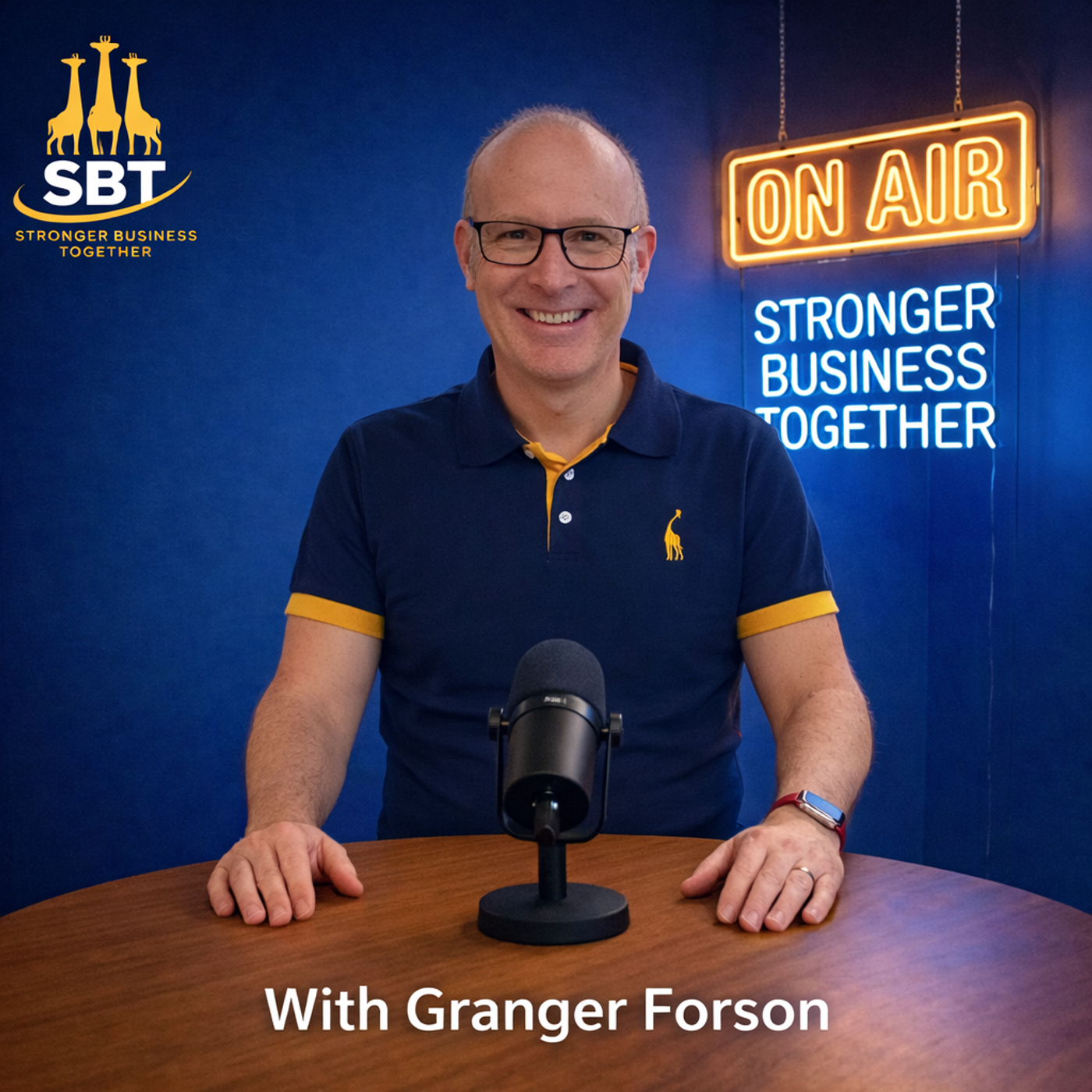
PODCAST · business
Stronger Business Together
by Granger Forson
How would you solve the biggest hurdle in your business right now?The Stronger Business Together Podcast is for business owners who want to make better decisions without adding more complexity.Hosted by Granger Forson, each episode is an honest conversation with an experienced business owner. Together they explore where their business is today, the journey that got them there, and the lessons learnt along the way.During the podcast, Granger and his guests try to overcome a specific business hurdle, that is holding back progress. A decision that feels heavy. A challenge that hasn’t yet been resolved. Together, they slow the thinking down, explore different perspectives, and consider the next sensible step.This podcast isn’t about outsourcing decision-making. Advice is welcome and AI can support thinking, but responsibility stays with the owner.If you believe business can be made simpler, that your peo
-
13
E12 Protect Your Project Margins with Natalie Hamblett
Episode SummaryIn this episode, host Granger Forson is joined by Natalie Hamblett of Severnview Home Improvements, a family-run business specialising in high-quality windows, doors, and conservatories. Natalie shares the company’s journey from its origins in her husband Dean’s lifelong fitting experience to recovering from the sudden loss of a major contract. They discuss the critical importance of the customer journey, the benefits of specialised roles, and a practical "hurdle" session on improving operational efficiency through standardisation and checklists.Key TakeawaysThe Power of Personal Connection: Natalie highlights that in the trade industry, trust is built through personality and empathy. She shares a success story of winning over a nervous client by simply bonding over a love of dogs and putting her at ease.Recovering from "Single-Contract Reliance": Early on, the business relied on one massive, lucrative contract that eventually went quiet. Natalie discusses the hard work of pivoting to organic lead generation and paid platforms to keep the business afloat.Specialisation vs. "Doing it All": A major turning point was outsourcing the pricing and estimation role. This allowed Dean to focus on surveying and fitting while ensuring customers receive accurate quotes within 24–48 hours.The "Small Window" Strategy: Natalie views small jobs (like a single window replacement) as vital trust-building exercises that often lead to full-house installations later.Continuous Lead Generation: Lead generation cannot slow down when operations get busy. Natalie maintains a mix of SEO, paid leads, social media, and traditional "old-fashioned" leaflet drops.The "Hurdle": Fitting Times Exceeding EstimatesNatalie identifies a recurring issue: roughly 50% of fitting jobs take longer than planned, which erodes profit margins due to unallocated overhead costs.The Coaching Discussion & Proposed Experiments:Root Cause Analysis: Delays are often caused by internal factors like lack of communication or missing equipment on a van.The Checklist Solution: Granger compares the trade environment to emergency services. Just as an ambulance crew wouldn't forget a defibrillator, a fitting team needs a standard checklist to ensure every tool and ladder is on the van before leaving the yard.Standardising the "Mobile Workshop": Natalie plans to experiment with organising all company vans identically. This ensures that even a "fitter’s mate" knows exactly where every tool is located, reducing downtime on-site.Feedback Loops: The team will implement a review process where fitters, estimators, and surveyors discuss why a job went over time to build that knowledge back into future estimates.Natalie’s Operational Insight"My priority is the customer journey. You should get a price within three to four days maximum... we ensure as an operations manager that this gets done quickly for the customer."Resource Links & Contact InfoWebsite: severn-view.co.uk Social Media: Look for Severnview Home Improvements on Facebook, Instagram, and LinkedIn.
-
12
E11 Am I Being to Salesy? With Helen Tebay
In this episode, Granger Forson is joined by Helen Tebay, known as The Sales Lady. Helen shares her journey from corporate sales in engineering and pharmaceuticals to building a coaching business that helps service-based founders sell in a way that feels natural and fun. They discuss the "identity level" shifts required to master sales, the power of simple marketing, and how to stop treating sales calls like a "cringe" obligation and start seeing them as the highest service you can offer a client.The "Hurdle": How to Sell Without Looking "Salesy"The most common question Helen receives is: "How do I sell without feeling pushy or repelling people?".The Coaching Discussion & Proposed Experiments:Root Cause Awareness: We often dull down our sales offers because we think we are "taking" from the client rather than giving them access to the help they desperately need.The Brain Dump: Helen suggests writing down every thought and feeling you have about selling to see where unhelpful emotions like shame or embarrassment are scuppering your efforts.Choosing Better Thoughts: Replace "I'm being pushy" with "This is the moment they get to decide to change their life".The "Warm Onion" Strategy: Next week, make offers for simple conversations to people in your closest circle—previous clients and trusted contacts—to practice articulating your value in a low-pressure environment.Helen’s "Simple" Marketing HabitHelen spends just 10 minutes a day on her LinkedIn posts. Her secret? Stop thinking about what you want to say and start thinking about what your client is currently feeling and thinking.Resource Links & Contact InfoWebsite: helentebay.podia.comLinkedIn: Helen Tebay, The Sales LadyProgram: The Sales Refresh
-
11
E10 From Strategy to Action with Alex Wheeler
Episode SummaryIn this episode, host Granger Forson sits down with Alex Wheeler to discuss the realities of building a local wealth management practice. Alex explains how he helps high earners bridge the gap between "earning good money" and achieving genuine financial freedom. They explore the evolution of his business from a national role to a local, client-focused practice, the importance of maintaining face-to-face trust in a digital age, and a tactical coaching session on moving prospects from "strategy" to "action".Key Takeaways• Financial Freedom vs. High Earnings: Many people earn significant income but don't "feel" it. Alex specializes in unravelling complex trusts and creating tax-efficient structures to turn that income into long-term security. • The Power of "Local": After years of national travel, Alex intentionally narrowed his focus to the Southwest and London (M4 corridor) to provide more dedicated, face-to-face connections. • Trust as a Scaling Limit: Alex intentionally keeps his team tight (currently six people) because he believes scaling too large can cause a business to lose the personal connection and trust that clients value in wealth management. • The "War Chest" Mentality: A major success factor for clients isn't just investment returns, but the creation of a "buffer" or "war chest"—3 to 6 months of operational costs that provide the headspace to make better life decisions. • The Strategy is the Product: While Alex implements financial products, his most impactful "service" is the stage-two future financial plan, which provides a running track for the client's life. The "Hurdle": Bridging the Gap from Strategy to ActionAlex identifies a conversion hurdle: while 90% of clients move from a "coffee chat" to a "strategy session," only about 40% commit to the final implementation immediately.Alex’s Perspective on AIAlex uses AI for meeting notes and bullet-proofing final reports to ensure accuracy. However, he notes that AI cannot replace human judgment when it comes to "reading between the lines" of a client's life goals or recognizing when not to invest is the best advice.Resource Links & Contact Info• Website: cwealth.co.uk • LinkedIn: Alex Wheeler
-
10
E9 Which Innovation to Choose? With Craig Hellen
Episode Summary In this episode, Granger Forson is joined by Craig Hellen of Bexmedia, a video production agency currently in its 19th year. From his early days dragging a camera around Southwest skate parks to filming sunrise at Stonehenge for English Heritage, Craig shares a journey of organic growth, technical evolution, and the pursuit of "surprising brilliance". They explore the importance of asking "why" before producing content and dive into a deep discussion on balancing daily operations with the investment needed to stay "bleeding edge" in the era of AI.Key Takeaways The "Why" Behind the Story: Bexmedia focuses on applying creative solutions to connect with audiences by first asking why a story is worth telling. Surprisingly Brilliant: Despite being a small team of four, Craig prides the agency on achieving impressive, memorable results through a "small but mighty" approach. Cross-Pollination of Ideas: Lacking a massive research team, the agency learns by iteration, taking knowledge from one project or market and applying it to another to add value. The Yin to the Yang: Craig emphasises the importance of having someone to balance his "butterfly" nature—someone who focuses on critical numbers and systems to keep the business healthy. Communication as a Growth Tool: A major learning for Craig was that clear communication of goals is vital; without it, both the team and the leader are disabled. Craig’s "Magical" Business MomentCraig shares the story of filming for English Heritage at 4:00 AM in the middle of Stonehenge to celebrate 100 years of it being gifted to the nation. Sitting alone among the stones as the sun rose reminded him why he does what he does—to tell stories that are genuinely special.Resource Links & Contact InfoWebsite: bexmedia.netLinkedIn: Craig HellenInstagram: @bexmedia
-
9
E8 Pivot While You Deliver with Claire Bennett
In this episode, host Granger Forson speaks with Claire Bennett, founder of Hornbeam Workplace Wellbeing. Claire shares her journey from a high-flying global corporate career to launching a mission-driven training and consultancy firm. They explore the critical difference between "box-ticking" mental health training and building a genuine culture of inclusion and wellbeing. Claire also opens up about the "loneliness" of the associate model and the hard-won realization that a business owner shouldn't—and can't—do everything alone.Key TakeawaysFrom Personal Drive to Professional Purpose: Claire started Hornbeam after seeing a best friend suffer severe health and legal consequences due to a poorly managed mental health crisis in the workplace.Consultancy vs. "Sheep Dip" Training: While Hornbeam offers accredited training like Mental Health First Aid, their focus has shifted to consultancy. This ensures businesses have the infrastructure to support staff before the training even begins.The Power of Surveys: Claire shares a success story of a high-pressure public sector client that achieved a massive reduction in sickness absence by first measuring employee welfare and then aligning leadership behaviors with wellbeing goals.Building Your "Right Arm": A major turning point for Claire was hiring a Virtual Assistant (VA) and specialized IT support, allowing her to stop wasting hours on tasks outside her expertise.Resilience in the Face of COVID: Having registered her business just three weeks before the pandemic hit, Claire had to quickly pivot to online delivery and sharpen her problem-solving skills.The "Hurdle": Balancing Core Revenue with New Service GrowthClaire faces the challenge of growing the consultancy side of her business while still needing to deliver the training that currently provides 70% of her revenue.The Strategy & Coaching Discussion:The "Tweaking" Trap: Claire found herself spending too much time customizing consultancy services for every new sector, which stalled her lead generation efforts.Messaging Overload: By trying to solve every problem at once (productivity, legal compliance, attrition, sickness), the core message became diluted.Refining the Offer: Granger suggests that "niching" isn't just about sectors; it's about niching the message. Instead of offering everything, focus on one "door-opening" problem—like productivity or absenteeism—to start the conversation.Claire’s Experiment for the WeekClaire plans to audit her different marketing messages, rank them by strength, and begin trialing them individually to see which one resonates most clearly with the market.Resource Links & Contact InfoWebsite: hornbeamtraining.co.ukLinkedIn: Claire BennettSocial Media: Look for hornbeamtraining on TikTok and other platforms.
-
8
E7 Stop Quoting and Start Selling with Austin Hilton-Ball
In this episode, Granger Forson talks with Austin Hilton Ball about his journey building Your Payroll Manager. Austin shares how he moved from a "side hustle" with a single £12.95 client to running a team of six (and growing) that serves large accountancy practices. They explore Austin's "people-first" philosophy in a highly automated industry, the efficiency of his "pod" team structure, and how he transformed his approach to sales and pricing hurdles.Key TakeawaysHuman-Centric Outsourcing: Austin saw that people were getting lost in high-volume payroll systems, so he built a business focused on "real human contact" and "customer curiosity".The Pod Structure: Payroll is managed by "pods" of two or three people. This builds client familiarity, ensures redundancy, and creates a "familiar in-house service" feel.Niching for Growth: By focusing specifically on helping accountants build better practices through payroll outsourcing, Austin was able to market more effectively and increase turnover."Never Outsource the Outsourcing": A core principle of the business is that all work is delivered in-house by the pod teams, rather than being offshored or subcontracted.Living the Values: The team reports weekly on how they delivered on one of the six core values, such as "create wow moments" or "keep it human".The "Hurdle": Managing Price Shoppers and Low-Value QuotesAustin addresses the common challenge of receiving high volumes of inquiries from people who are only "price shopping" with little intent to buy. The Strategy & Lessons:Strategic Barriers: Austin no longer gives prices over the phone. Instead, he requires a "discovery call" to unearth the client's actual pain points and explain the value of the service.Handling the Price Conversation: Austin shifted from being "petrified" of price to discussing it openly during the discovery call. He focuses on what the client thinks about the price rather than how they feel.Reframing the "Time Waster": By using deep discovery questions, Austin often turns a price shopper into an opportunity by showing them that their real problem isn't the cost, but rather a lack of quality or a burden on their own time.Austin’s Internal Systems for SuccessRecipe for Success Tracker: A positive rebrand of an "error log" used to document mistakes, identify the remedy, and change processes so they don't happen again.Ideas Car Park: A collaborative tool where any team member can "park" a suggestion for a process they find broken or inefficient.The Disk Profile: Austin uses personality profiling to ensure the team has a healthy balance of assertive, analytical, and supportive traits.Resource Links & Contact InfoWebsite: yourpayrollmanager.co.ukLinkedIn: Austin Hilton-BallEmail: [email protected] Mention: Helen Tebay (The Sales Lady).
-
7
E6 Don't React stay on Track with Jessica Morgan
Episode SummaryIn this episode, Granger Forson talks with Jessica Morgan, founder of Carnsight Communications, a PR and social media agency specialising in founder-led businesses. Jessica shares her decade-long journey from starting as a "kitchen table" business while on maternity leave to building an award-winning team. They discuss the importance of proving ROI in PR, the shift toward sustainable growth, and a tactical coaching session on managing the constant tug-of-war between deep, scheduled work and the high-reactivity nature of the media industry. Key Takeaways• Recognition for Founders: Carnsight focuses on getting founder-led businesses the recognition they deserve through practical PR and social media strategies. • The Power of Responsiveness: Success in PR requires high responsiveness to both clients and media trends, often reporting in "real-time" to show immediate impact. • Sustainable Growth over "Boom and Bust": Jessica emphasises longevity and sustainable growth, aiming to grow her team to over 10 people and hit a £1 million turnover as part of a 10-year plan. • Internal vs. External Training: While "osmosis" training is potent in small teams, Jessica highlights the necessity of formal external training to prevent employees from only learning organically. • Self-Belief in Business: One of the hardest lessons learned was developing internal self-belief rather than drawing confidence from the external validation of others. The "Hurdle": Balancing Scheduled Deep Work with Reactive PRThe episode addresses the challenge of "stop press" situations where urgent journalist requests or client needs interrupt scheduled deep work several times a week. The Coaching Discussion & Proposed Experiments:• Strategic Triage: Before reacting, the team now pauses to ask if the task is truly urgent or just a "false deadline" created by a client's energy. • The 10-Minute Timer: When an urgent issue arises, the team gathers for exactly 10 minutes to analyse the problem and create a plan, ensuring most of the team can return to their "doing time" while one person actions the solution. • Scheduled Interruptions: Granger suggests creating fixed "look-up" slots (e.g., at 11:00 AM) to check for emergencies, allowing the brain to stay locked into deep work until that scheduled time. • Capacity Planning: Jessica aims to analyse her tracking data (via Clockify) to work out exactly how much "random event" capacity needs to be baked into the weekly schedule. Jessica’s "Mighty" Business Insight"Are you carrying your business or are you working in your business? Making difficult changes can feel like a weight has been lifted, moving you from carrying the world to forging a path forward." Resource Links & Contact Info• Website: carnsight.com• LinkedIn: Jessica Morgan, Carnsight Communications • Instagram: @carnsightcomms
-
6
E5 Stop being the bottleneck with Richard Hubble
Episode SummaryIn this episode, Granger Forson sits down with Richard Hubble, who has spent nine years building a successful digital marketing franchise in Gloucestershire. Richard shares his transition from an international corporate sales career to supporting startups and small businesses that lack in-house marketing teams. They discuss the benefits of the franchise model, the power of local support, and a significant coaching segment on overcoming the "business owner bottleneck". Key Takeaways• The Franchise Advantage: Richard bought into a franchise to reduce risk and ensure he wouldn't become a bottleneck to growth. This has allowed him to scale to over 350 clients and six staff members. • Local Support Matters: Despite being a digital business, Richard highlights that "local support" is the primary reason customers choose his agency. • Lead Generation Mix: Networking drives 60% of new business, while client referrals account for another 20%. Richard also maintains a physical office on a main road to raise local profile and accessibility. • Service Evolution: By adding social media marketing, PPC, and SEO to his core website services, Richard increased both revenue and client loyalty. • A Healthy Skepticism of AI: Richard remains an "AI cynic," prioritizing original human content and authentic voice for his clients to ensure they rank better on Google and maintain individuality. The "Hurdle": Resolving the Owner BottleneckRichard admits that he is often the bottleneck in his business, with staff frequently coming to him for answers that are "up in his head". The Discussion:• The Trap of the "Oracle": Richard realises he often provides quick answers because it’s faster in the moment, but this prevents his young team from developing their own problem-solving skills. • Tribal Knowledge: A team meeting revealed that a junior staff member had discovered a technical enhancement Richard wasn't even aware of. This underscored the need for better knowledge sharing. The Proposed Experiments:1 Written Preparation: Team members should write down their questions or "lessons learned" before the weekly meeting to provide better clarity of thought. 2 Strategic Deflection: When a staff member asks a non-critical question, Richard will experiment with "sending them off" to do their own research rather than providing the answer immediately. 3 Peer-to-Peer Learning: Encouraging staff to share their findings with the whole team so the owner is no longer the central point of failure. Richard’s "Golden Minute"Richard emphasises the "weekly rhythm" of team meetings as the most vital habit for his business. These meetings prevent staff from "ploughing on in their own journey" without realising the impact on other team members. Resource Links & Contact Info• Website: It'seeze Website Gloucestershire • Email: [email protected] • Phone: 07901 944465
-
5
E4 Finding and Retaining Talent with Chris Kopec
Episode SummaryIn this episode, Granger Forson talks with Chris Kopec of Merge IT, a Managed Service Provider (MSP) that helps businesses transform IT from a cost center into a strategic "business enabler". Chris shares his journey from starting a business during a "midlife crisis" just four months before COVID-19 to navigating the highly regulated waters of FCA and ISO compliance. The conversation dives deep into the "technology maze," the dangers of "tools sprawl," and a significant coaching session on the unique recruitment hurdles facing tech companies in Gloucestershire.Key TakeawaysIT as a Strategy: Merge IT focuses on three-year IT strategy cycles that align technology tools with wider business goals rather than just fixing broken laptops.Compliance is a Vertical: Chris thrives on working with professional services—accountants, lawyers, and architects—that face high regulatory standards like ISO 27001.The "Pint" Challenge: Chris claims he can often save customers money on monthly operating costs simply by identifying duplicated tools or "technology creep".AI and Information Management: The business is pivoting toward "AI enablement," which involves tidying and structuring data so it can be effectively used by automation tools.Security First: Chris warns against putting personal data into free, open AI models; if a tool is free, "you are the product".The "Hurdle": Competing for Tech Talent in GloucestershireChris faces a major challenge in finding and retaining technical staff. Gloucestershire has five times the national average of tech companies, largely due to GCHQ, which "siphons" local talent with high salaries.The Discussion:Recruitment Reality: In the last two years, Chris has seen six apprentices or junior staff poached by larger firms shortly after being trained.High-Pressure Environments: Chris notes that MSP work is rewarding but involves high-stress problem-solving (e.g., a critical printer going down two hours before a payroll deadline), which doesn't suit everyone.The Solutions: * Simulated Stress Testing: Granger suggests adding "artificial pressure" tests to the recruitment process (modeled after Toyota) to see how candidates handle disorganized, high-volume tasks.· Culture Over Salary: By allowing "20% time" for side projects and tech experimentation, Chris can build a "sticky" culture where techies stay because they are growing, not just for the paycheck. Chris’s Productivity TipChris manages "firefighting" and "information overload" by using the Eisenhower Matrix to triage every task by urgency and importance.Resource Links & Contact InfoWebsite: Merge IT (Currently being updated)LinkedIn: Chris is highly active on the platform.Networking: You can often find Chris at BNI events.
-
4
E3 Are you actually productive or busy fighting fires? With Andy Bell of Set Studio
Are you actually productive, or just busy fighting fires? 🧯It’s the classic agency trap, a calendar full of meetings, a Slack notification every 30 seconds, and a team that’s constantly "firefighting." By 5PM, you’ve done a lot, but you haven't moved the needle.🎙️ Today I sit down with Andy Bell from Set Studio to hear his founders story and tackle this exact business hurdle. We dive into how to stop reacting to the chaos and start building systems that actually allow for progress.Along the way we cover many topics including hacks to boost productivity, declining meetings and creating a culture that allows mistakes to be used as valued learning points rather than problems within the business.
-
3
E2 Can AI really set your pricing for you? With Stuart Lee Design
In this episode, Granger Forson talks with Stuart Lee about the evolution of his branding and graphic design business. Stuart shares his journey from freelancing in London to building a local agency in Gloucestershire. They dive deep into the importance of "information design" over mere aesthetics, the challenges of scaling through delegation, and a fascinating "hurdle" session on using AI for complex project pricing.Key TakeawaysInformation vs. Decoration: Stuart emphasises that good design isn't just about "pretty" pictures; it’s about typography and hierarchy that ensure the content is actually legible and engaging.The Transition to Value-Based Pricing: Stuart discusses the difficult but necessary process of raising prices to reflect professional value, even if it means moving away from long-term clients who no longer fit the business model.Delegation is Freedom: By utilising a Virtual Assistant (VA) and a network of specialist designers, Stuart has shifted from "cramming it all in" to focusing on high-level strategy and client relationships.AI as a "Junior Employee": A key insight from the coaching segment is that AI tools like Copilot or ChatGPT should be treated like new hires, they need to be trained on your specific historical data (past quotes/styles) to provide accurate results.The "Hurdle"- Pricing Complex Projects with AIStuart shares a recent challenge where he used AI to quote a 52-page brochure. The result felt generic and was ultimately too high, leading to a lost bid.The Solution: Instead of asking AI general questions, Stuart plans to:Build a Data Set: Feed previous successful quotes into a secure environment (like Microsoft Copilot).Contextual Training: Teach the AI the specific variables of his business (e.g., charity discounts, file types provided by clients).Iterative Feedback: Treat the AI's output as a draft that requires "senior management" sign-off and refinement.00:00 Introduction00:29 Intro: Stuart Lee Design01:52 Act 1: What is Stuart Lee Design08:20 Act 2: Stuarts' business journey14:35 Improving Communication and Delegation18:04 Act 3: The Hurdle - Exploring AI in Pricing19:52 Current state - Pricing system today22:44 How we tried to use AI in pricing24:16 Getting to root cause of AI pricing issues26:09 Leveraging Data for Better AI Pricing29:10 Future Experiments with AI in Pricing32:17 Wrap up and reflections35:20 Stuart's bonus tipStuart’s Pro Design Tip"Use space. It makes everything look better. Never cramp lines together. Don't fill a page with text just because you can, white space allows your message to breathe."Resource Links & Contact InfoWebsite: StuartLeeDesign.co.ukEmail: [email protected]: 01453 70 20 60Guest Bio: Stuart Lee is a graphic designer with a background in corporate information design, now specialising in branding for charities and B Corp-aligned organisations.
-
2
Why I Created The Stronger Business Together Podcast
Welcome to Episode 001 Stronger Business TogetherWelcome to the very first episode of the Stronger Business Together podcast. I’m Granger Forson, and I started this show because I’ve seen too many entrepreneurs drowning in "information" while their actual business stays stuck.In this inaugural episode, I’m laying out the core philosophy of this show. We aren’t here for theoretical fluff; we’re here for practical application.Why I’m Doing ThisI firmly believe that knowledge isn't the issue—application is. We all have access to the same books and podcasts, but the gap between knowing something and truly understanding it is action. I want to help you bridge that gap.Key Insights From This Episode:Business shouldn’t be a constant grind: If it feels hard all the time, something needs to change.Stop building in isolation: You weren't meant to do this alone. Growth happens when we are constructively challenged by others.Comfort is the enemy of development: If you want to grow, you have to be willing to be uncomfortable.Hurdles vs. Problems: I break down why every process has "everyday problems," but why "hurdles" require a completely different approach to clear."Development doesn't come from comfort. If we want to move the needle, we have to go out and fix the friction."Follow the podcastThis podcast isn't a monologue; it’s a community. I want to hear about the specific hurdles you’re facing so we can tackle them together in future episodes. Let’s simplify your processes and get you growing.If you'd like to be a guest on the podcast or have your own business hurdle discussed then you can contact me at [email protected] Breakdown:[00:00] Welcome to the journey.[03:02] My non-negotiable principles for business success.[05:52] The critical difference between a hurdle and a standard problem.[08:53] Why action is the only way to turn knowledge into understanding.[11:52] My invitation to you: Let's do this together.
No matches for "" in this podcast's transcripts.
No topics indexed yet for this podcast.
Loading reviews...
ABOUT THIS SHOW
How would you solve the biggest hurdle in your business right now?The Stronger Business Together Podcast is for business owners who want to make better decisions without adding more complexity.Hosted by Granger Forson, each episode is an honest conversation with an experienced business owner. Together they explore where their business is today, the journey that got them there, and the lessons learnt along the way.During the podcast, Granger and his guests try to overcome a specific business hurdle, that is holding back progress. A decision that feels heavy. A challenge that hasn’t yet been resolved. Together, they slow the thinking down, explore different perspectives, and consider the next sensible step.This podcast isn’t about outsourcing decision-making. Advice is welcome and AI can support thinking, but responsibility stays with the owner.If you believe business can be made simpler, that your peo
HOSTED BY
Granger Forson
CATEGORIES
Loading similar podcasts...
URL copied to clipboard!