
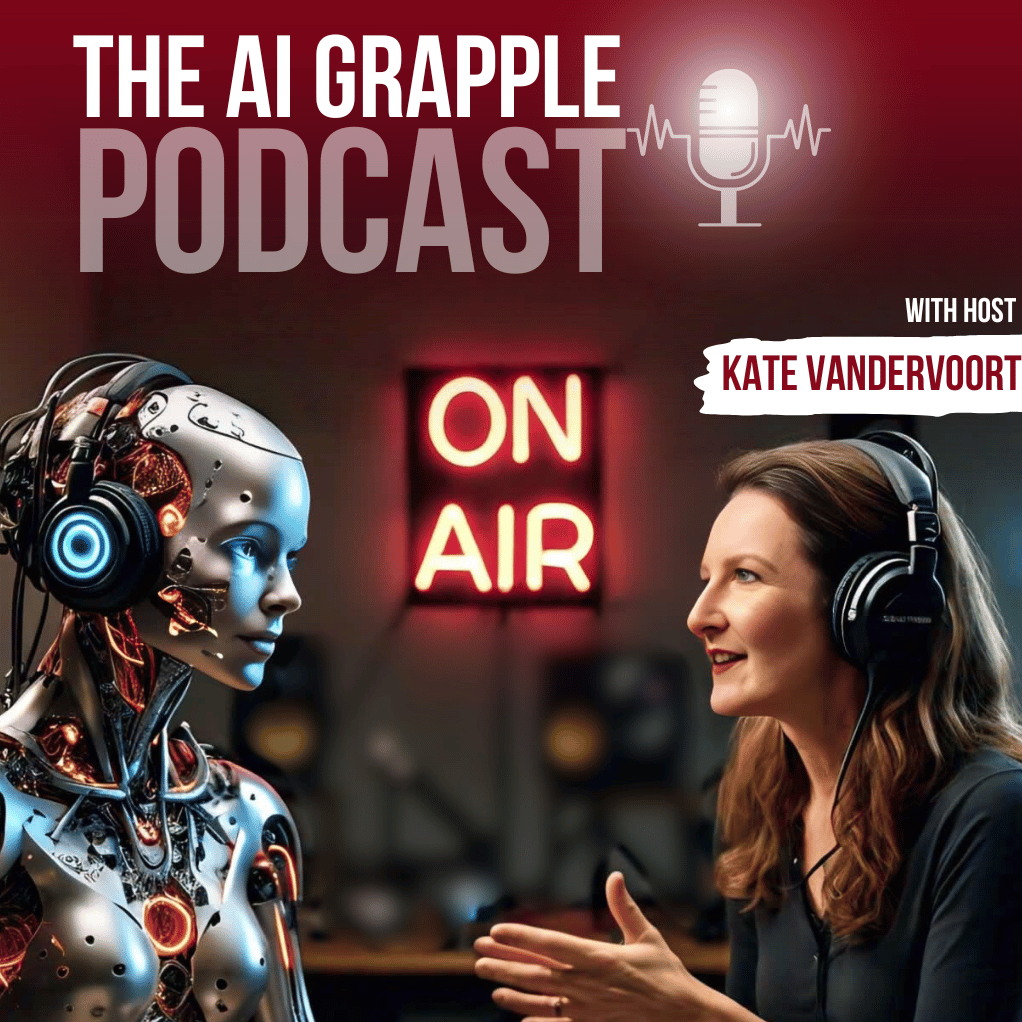
PODCAST · business
The AI Grapple
by The AI Grapple
Unravel the complexities of AI with The AI Grapple Podcast, hosted by Kate vanderVoort. Dive into thought-provoking discussions on the most critical AI issues shaping our world. Perfect for marketers and business professionals, this podcast is your guide to integrating AI responsibly and ethically into your organization. Join us as we navigate the future of technology and its profound impact on humanity.
-
50
Ep 50: Mari Smith on Trust, AI, and Staying Human in the Future of Social Media
For our milestone 50th episode of The AI Grapple, Kate vanderVoort (Founder and CEO, AI Success Lab) sits down with social media pioneer Mari Smith, widely known as the “Queen of Facebook.” With nearly two decades at the forefront of social media marketing, Mari has witnessed the rise, peak and reinvention of platforms like Facebook. Now, as AI reshapes marketing, business and human interaction itself, she finds herself at a crossroads, asking the same question many marketers are grappling with: What does authentic connection look like in a world where AI generates most of what we see? This episode explores the future of social media, the erosion of trust online, Meta’s acquisition of Manus, agentic AI, and how Human Design can help business leaders stay grounded and aligned in an AI-saturated world. In This Episode We Explore The Trust Crisis in Social Media Mari reflects on how the early days of Facebook enabled genuine connection and direct access to thought leaders. Today, with AI-generated content flooding platforms and algorithms shaping perception, trust is declining. Key themes discussed: The prediction that 90 percent of online content could soon be AI-generated Why community may be the last true moat in business The shift from social media to “interest media” and potentially “intent media” The importance of mindful scrolling versus mindless consumption Why discernment is becoming a critical business skill Meta’s Acquisition of Manus and the Rise of Agentic AI Kate and Mari unpack Meta’s acquisition of Manus and what it signals for the future of AI integration within social platforms. They discuss: The difference between generative AI and agentic AI Why agentic AI is a much bigger shift for marketers than simple content tools How AI agents may soon manage advertising, workflows and customer interactions The implications for small businesses and ad specialists Security, trust and the risks of giving AI deeper access to our systems This conversation highlights how AI is rapidly moving from content assistant to autonomous operator. Human Design and Authentic Marketing in an AI World Mari shares how her deep study of Human Design has reshaped the way she approaches business and marketing. Topics include: What Human Design is and how it differs from traditional personality systems The concept of inner authority and body-based decision-making Why traditional urgency marketing can conflict with personal alignment How understanding your energy type can improve marketing strategy The importance of saying no to opportunities that do not feel aligned Rather than outsourcing identity to AI or blindly following marketing formulas, Mari advocates returning to self-awareness and personal authority. Staying Human in an AI-Saturated World As AI tools become embedded into everything, the conversation turns to responsibility. Key reflections include: AI as a mirror of human consciousness The danger of outsourcing thinking and creativity The difference between augmentation and replacement Why live video and in-person experiences may increase in value The growing need for trusted guides, coaches and human leadership Mari shares her optimistic vision of a future where empowered individuals collaborate more deeply and bring their uniquely human strengths forward. Practical Takeaways for Marketers Build real community, not just audience size Prioritise human-to-human conversations in DMs and private groups Use AI as a co-creative partner, not a replacement for your voice Develop discernment before reacting or amplifying content Lean into what energises you rather than rigid posting formulas Protect your authenticity even when using AI tools Mari’s Favourite AI Tools ChatGPT (including a custom GPT trained on her Human Design profile) Fathom AI for meeting notes Granola AI for audio-based summaries Descript for video editing and content repurposing About Mari Smith Mari Smith is a world-renowned social media thought leader and online marketing strategist. Known as the Queen of Facebook, she has helped entrepreneurs and global brands build authentic, high-impact marketing strategies for over 20 years. Today, she blends her marketing expertise with the transformative lens of Human Design, guiding creators and business leaders to align with their true voice and thrive authentically in an AI-driven world. Connect with Mari Smith Organisation: Mari Smith International, Inc. Website: www.marismith.com Facebook (Page): https://www.facebook.com/marismith Facebook (Profile): https://www.facebook.com/maris Instagram: https://www.instagram.com/mari_smith LinkedIn: https://www.linkedin.com/in/marismith/ Final Reflection As AI becomes embedded into social media, marketing and everyday life, the question is no longer whether AI will change business. It already has. The real question is this: Will we use AI to replace our humanity, or to amplify it? Episode 50 of The AI Grapple invites you to grapple with exactly that.
-
49
Ep 49 Raising AI-Literate Humans: What Schools and Parents Must Get Right Now
AI is already shaping how young people learn, think, and engage with the world. The real question is whether education systems are preparing them for that reality. In this episode of The AI Grapple, Kate vanderVoort (Founder and CEO, the AI Success Lab) is joined by educator, author, and AI literacy advocate Lindy Hockenbary (also known as LindyHoc). Lindy brings nearly two decades of experience in instructional technology and curriculum design, working directly with K–12 schools, educators, and EdTech companies to make technology usable, relevant, and human-centred. Lindy’s work focuses on one clear message: AI literacy does not belong on the sidelines. It belongs in the core curriculum. What We Cover in This Episode Why AI literacy belongs in every subject Lindy explains why AI is not a “tech topic” but an extension of foundational learning. From pattern recognition in early maths to writing, research, and civics, AI intersects with every subject students already study. What AI literacy actually means Moving beyond buzzwords, Lindy breaks AI literacy down into three practical skills: understanding how AI works, evaluating its outputs, and using it with intention. These skills sit within broader information literacy and are essential for discernment in an AI-driven world. There’s no such thing as digital citizenship, just citizenship Online and offline life are no longer separate. Lindy challenges the idea that digital skills can be taught in isolation and explains why civics education must now include algorithms, data, and the influence of technology on democracy. How algorithms shape young people’s beliefs and behaviour From search results to social media feeds, students are constantly influenced by systems they don’t fully understand. Lindy shares why teaching kids how these systems work is key to protecting their agency and voice. AI, personalisation, and the classroom Kate and Lindy explore the promise of personalised learning, including how AI can reduce teacher workload and support students with anxiety or different learning needs. They also unpack the risks of overuse, screen fatigue, and losing collaboration in the classroom. Fear, misinformation, and job loss myths Lindy addresses common concerns among educators and parents, including fears about AI replacing teachers. She explains why those fears are fading as AI literacy increases and how understanding the technology reduces anxiety. Why AI literacy reduces misuse Research shows that when people understand AI better, they use it more selectively. Lindy explains the “magical thinking trap” and why low AI literacy often leads to over-reliance rather than thoughtful use. What parents and educators can do right now Practical ideas for starting conversations early, modelling healthy AI use, and using tools that encourage curiosity rather than shortcuts. This includes shared learning, asking better questions, and using AI to support thinking instead of replacing it. What becomes possible if we get this right Lindy paints a hopeful picture of a future where strong AI literacy creates more creativity, narrows equity gaps, and gives young people the space and confidence to tackle complex global problems. Tools and Resources Mentioned NotebookLM – A powerful learning tool for summarising, exploring, and studying content SchoolAI – Guardrailed AI tools designed for educators and students Suno – AI music generation for creative learning and engagement ChatGPT (Study Mode) – Using AI to guide thinking rather than provide answers Varsity Tutors – Parent-Powered AI Webinar The Good Robot podcast – Exploring different perspectives on AI About Lindy Hockenbary Lindy Hockenbary is an educator, author of A Teacher’s Guide to Online Learning, and a 2025 Women in AI honoree recognised by the ASU+GSV Summit. With a background in classroom teaching, instructional technology, and professional learning, she works globally with educators and EdTech companies to ensure AI tools support real learning needs. Her work centres on AI literacy, information literacy, and rethinking civics education for an AI-shaped world. Connect with Lindy: Website: https://lindyhoc.com LinkedIn: https://www.linkedin.com/in/lindyhockenbary/ Listen to the Episode 🎧 Tune in to The AI Grapple with Lindy Hockenbary on your favourite podcast platform. If this episode sparked ideas or questions, share it with a parent, educator, or leader navigating AI right now.
-
48
Ep 48: Australia’s AI Strategy Explained by the Head of the National AI Centre
In this episode of The AI Grapple, Kate vanderVoort, Founder & CEO, the AI Success Lab, is joined by Lee Hickin, Executive Director of the Australian Government’s National AI Centre, for a wide-ranging and practical conversation about AI adoption in Australia. With more than 30 years in senior technology leadership roles across Microsoft and AWS, Lee brings a rare perspective that bridges enterprise technology, public policy and real-world business impact. Together, Kate and Lee unpack where Australia truly sits on AI adoption, why our national approach has prioritised innovation alongside safety, and what business leaders need to understand to move beyond experimentation into meaningful use of AI. This episode is essential listening for leaders navigating AI strategy, governance, data risk and long-term competitiveness. Key themes and takeaways Where Australia really stands on AI adoption Why global AI rankings can distort the Australian story What per-capita adoption reveals about real-world usage The risk of fear-driven narratives slowing progress Why AI adoption is not a zero-sum global race From experimentation to scale Why many organisations get stuck in the “AI dabble” phase The growing complexity gap between tools and outcomes Where SMEs and large enterprises face different blockers How clarity around business problems unlocks momentum Understanding the National AI Strategy What the National AI Strategy is designed to achieve Why Australia chose a principles-based, pro-innovation approach How this differs from heavy regulatory models overseas What this means in practice for Australian businesses Governance, risk and responsibility Why most AI failures are human, not technical What “good enough” AI governance actually looks like The role of AI literacy, fluency and leadership accountability Why responsibility cannot be outsourced to vendors or government Data security, privacy and sovereignty Separating AI risk from existing data security challenges Common misconceptions about AI training and data leakage Why sovereignty is about ecosystems, not isolation How poor data practices get amplified by AI systems Tech stack lock-in and innovation Why enterprise comfort with existing platforms can limit progress When staying inside your current stack makes sense How to think about best-fit AI tools for different use cases A clear framework for AI adoption: using AI, transforming with AI, or building with AI International investment and Australia’s AI ecosystem What global AI companies investing in Australia really signals How Australia can benefit without losing local capability The importance of a strong domestic AI ecosystem Opportunities for Australian AI companies on the global stage Environmental impact and sustainability The real environmental costs of AI and data centres Australian innovation in sustainable AI infrastructure Why AI-specific data centres require new design thinking Where Australia could lead globally in green AI solutions Looking ahead What success looks like if Australia gets AI adoption right How AI may reshape work and opportunity for future generations Why confidence, capability and clarity are key to progress Connect and learn more Lee Hickin on LinkedIn: https://www.linkedin.com/in/leehickin/ National AI Centre on LinkedIn: https://www.linkedin.com/company/national-ai-centre/ National AI Centre website: https://www.industry.gov.au/national-artificial-intelligence-centre
-
47
Ep 47: Is AI Actually Good for the Economy? An Economist’s Clear Answer
In this episode of The AI Grapple, Kate vanderVoort, Founder and CEO the AI Success Lab, is joined by economist Dr Bill Conerly to unpack what AI means for business, jobs, and the wider economy. Rather than hype or fear, Bill brings an economic lens to what is actually happening now and what signals matter most. They explore why the real impact of AI will come from specialised tools embedded into everyday workflows, not from people chatting to bots. Bill explains how general purpose technologies historically lower costs, shift prices, and improve living standards, even when disruption feels uncomfortable in the short term. The conversation also tackles job displacement, entry-level roles, ageing workforces, and what young professionals should focus on in an uncertain market. Toward the end, Kate and Bill discuss AI risk, interpretability, and whether extreme predictions about AI deserve serious concern. The episode closes with a grounded but optimistic view of how AI could improve productivity, choice, and quality of life if organisations implement it responsibly. Key Highlights • Most businesses are still in the experimentation phase Bill explains that while awareness of AI is high, clarity is not. Many leaders still see AI as synonymous with chatbots, which limits progress. As a result, activity is fragmented, with small trials rather than deliberate strategy. • The biggest economic impact will not come from chatbots Large language models are helpful, but Bill argues they are not where the major productivity gains will come from. The real shift is happening through AI embedded into specific business tasks that remove friction and save time without requiring people to learn new tools. • Specialised AI tools are already delivering measurable gains Examples from healthcare, sales, and the trades show AI quietly saving time and improving accuracy. Doctors reclaim minutes per patient, sales teams avoid manual CRM updates, and contractors generate faster, more accurate estimates, all without needing AI expertise. • AI will increasingly fade into the background Rather than being something people consciously “use,” AI will operate ambiently inside existing systems. Like GPS or recommendation engines, it becomes infrastructure, not a headline feature, which accelerates adoption. • AI fits the pattern of past general purpose technologies Bill frames AI as comparable to steam power or electricity. These technologies reshaped economies by lowering the cost of producing goods and services across many industries, rather than replacing one job or function at a time. • Why falling prices matter more than job numbers From an economic view, Bill focuses on purchasing power rather than employment counts alone. Productivity gains tend to push prices down faster than wages, which historically improves living standards, even when transitions are uncomfortable. • There may be financial froth, but real demand underneath While some AI investments and valuations may prove unsustainable, Bill believes the core economics are sound. AI-enabled services create genuine value, meaning the infrastructure will remain even if some companies fail. • Expect rapid business churn in the short term Lower barriers to building software will lead to many new companies appearing and disappearing quickly. This pattern mirrors earlier technology waves where experimentation was high and long-term winners emerged over time. • Job disruption will be visible before benefits Early job losses, especially in knowledge work, are easier to spot than gradual productivity gains. This timing gap fuels fear, even though new work and improved services tend to follow. • Older workers may feel the pressure more acutely Bill notes that people later in their careers doing repetitive knowledge tasks may find it harder to adapt or retrain. Some may opt for early retirement, raising real social and economic concerns during the transition. • Young professionals need adaptability, not certainty Entry-level roles in high AI exposure fields are shrinking. Bill suggests two responses: choosing work that is slower to automate or learning how to identify and improve repetitive processes using AI tools. • AI exposes broken systems rather than causing the problem Many frustrations blamed on AI stem from inefficient workflows that existed long before AI arrived. The technology simply removes the ability to ignore them. • Serious risks deserve attention, not panic Bill takes concerns around AI interpretability seriously, noting that experts still cannot fully explain why models behave as they do. While extreme doomsday scenarios are unlikely, thoughtful governance and oversight are necessary. • A realistic, optimistic future is possible If implemented well, AI can reduce waste, improve productivity, and give people more choice in how they work and live. The real opportunity lies not just in efficiency, but in better quality of life. Links and Resources Guest Dr Bill Conerly Website: www.ConerlyConsulting.com LinkedIn: http://www.linkedin.com/in/businomics X (Twitter): https://x.com/BillConerly YouTube: https://www.youtube.com/@DrBillConerly Host Kate vanderVoort LinkedIn https://www.linkedin.com/in/katevandervoort/ Website: www.aisuccesslab.com Facebook Group: https://www.facebook.com/groups/aisuccessslab
-
46
Ep 46: Remote Work in the Age of AI: Who Wins, Who Loses, and Why
In this episode of The AI Grapple, Kate vanderVoort, Founder and CEO of the AI Success Lab, sits down with Chris Nolte, Founder and CEO of Kayana Remote Professionals, to unpack what’s really happening at the intersection of AI, remote work, and human capability. Chris brings the rare lens of an investor-operator who has led and scaled businesses across finance, retail, prop tech, healthcare, and real estate. As an early beta tester of OpenAI and a long-time advocate for global talent, he shares grounded insights into why AI adoption often stalls, and what leaders are getting wrong about jobs, productivity, and automation. This is a practical, human-centred conversation about execution, not hype. Meet Chris Nolte Chris Nolte is the Founder and CEO of Kayana Remote Professionals, a company helping growth-minded businesses, nonprofits, solopreneurs, and PE and VC-backed portfolio companies scale using top-tier Filipino talent, supported by AI-enabled matching and workflow automation. Before Kayana, Chris spent 17 years running a family office where he bought, built, and operated companies with long-term capital. He has served as President and CEO of Verlo Mattress, co-founded AneVista Group, and advised startups through Dragonfly Group. His work today sits squarely at the intersection of AI, remote talent, and the future of work. Why AI Tools Don’t Automatically Change How Work Gets Done One of the central themes of this conversation is what Chris calls the human execution gap. Many organisations invest heavily in AI tools, only to find that very little actually changes. Chris explains why this happens and why the real barrier isn’t technology, but the expectation of full automation without redesigning roles, workflows, or accountability. Kate and Chris explore why AI still needs human judgment, why unfinished automations are everywhere, and why execution breaks down when leaders expect tools to replace thinking. AI, Repeatable Work, and the Future of Remote Roles As AI takes on more repeatable, task-based work, the nature of many roles is shifting fast. Chris shares why this shift doesn’t spell the end of remote work, but rather raises expectations for what remote professionals contribute. Entry-level, low-context roles are disappearing, while higher-level work is becoming accessible far earlier in a career. The conversation reframes the fear around AI and jobs, focusing instead on how remote workforces can move up the value chain rather than being pushed out. Global Talent, AI, and the Levelling of Opportunity A powerful thread in this episode is how AI is reshaping global opportunity. Chris explains why AI is acting as a great enabler for talented people in countries that historically lacked access to education, capital, or global markets. With AI closing gaps in language, research, and communication, opportunity is becoming more evenly distributed, even if outcomes are not. Kate and Chris discuss what this means for competition, wages, and the reality that professionals are no longer competing locally, but globally. What Makes Remote Professionals Irreplaceable With AI available to everyone, differentiation now comes from distinctly human qualities. Chris outlines why professionalism, discernment, curiosity, and output-focused thinking matter more than ever. He explains why remote professionals must actively learn how to operate at a professional standard, and why trust is built through consistency, judgment, and ownership, not just technical skill. Kate adds real-world examples from her own team, showing how AI-supported workflows free leaders from bottlenecks while raising quality and expectations. AI, Custom GPTs, and Scaling Expertise The episode dives into how custom GPTs and AI workflows are changing knowledge transfer inside businesses. Kate shares how embedding her expertise into AI systems allows her remote team to work in her voice and style, reducing rework and approvals. Chris builds on this by explaining how content, education, and even books are changing as AI becomes part of how people learn and apply information. This section offers a glimpse into how expertise can now scale without burning out the expert. Productivity, Pace, and the Reality of Change AI is moving faster than people can adapt, and both Kate and Chris acknowledge the tension this creates. They discuss why productivity gains don’t come from layering AI on top of broken processes, and why many organisations are stuck between fear, regulation, and falling behind. The conversation also touches on global differences in AI adoption and the long arc of change businesses need to prepare for. Looking Ahead: The Future of Work That Never Sleeps To close, Chris shares his view on what’s coming next. He describes a future where even small and mid-sized businesses operate across time zones, supported by AI and distributed teams that follow the sun. Work doesn’t stop, even when leaders do. The result is faster execution, higher output, and more opportunity for people who know how to work with AI rather than around it. Key Takeaways AI adoption fails when leaders expect automation without changing how work is designed Repeatable, low-context roles are fading, while higher-value work is becoming accessible earlier Remote professionals compete on a global stage, with AI as the common denominator Human judgment, curiosity, and professionalism matter more, not less AI scales expertise best when paired with strong workflows and clear standards Connect with Chris Learn more about Chris’s work and Kayana Remote Professionals: Kayana Website: https://www.hirekayana.com Kayana Capital Website: https://kayanacapital.com/ LinkedIn: https://www.linkedin.com/in/chrisnolte/
-
45
Ep 45: How Smart Leaders Navigate Fear, Trust, and Change with AI with Sarah Daly
In this episode of The AI Grapple, Kate vanderVoort is joined by Sarah Daly (founder AI360 Review), AI Strategist and Researcher, to explore what’s really holding organisations back from successful AI adoption. Rather than focusing on tools or trends, this conversation goes deep into trust, leadership responsibility, workforce impact, and the human systems that determine whether AI succeeds or fails at scale. Sarah brings insights from six years of doctoral research into trust in AI at work, alongside her enterprise experience advising boards and senior leaders. Together, Kate and Sarah unpack why AI is not a technology problem, why people are already trusting AI more than they realise, and what organisations must do to navigate disruption honestly and responsibly. Key Topics Covered 1. Why Trust Is the Real Issue in AI Adoption Sarah explains that while public narratives focus on distrust, people are already placing deep trust in AI, often without realising it. From sharing personal information with AI tools to relying on outputs without verification, trust is already present but poorly calibrated. The challenge for organisations is not whether people trust AI, but whether they trust it in the right ways. 2. The Human Foundations of AI Performance At AI360Review, Sarah’s work begins with people, not platforms. She shares why technology is often easier to control than human systems, and how trust can be deliberately designed through environment, leadership behaviour, and culture. When the right conditions exist, even AI sceptics can become strong advocates. 3. Strategy Before Tools Rather than positioning AI as the strategy, Sarah argues it must support existing organisational goals. The starting point is always the problem being solved and the value being created. From there, organisations must consider governance, capability building, culture, education, innovation processes, and fit-for-purpose technology. This approach is formalised in the AI360 framework, which assesses AI readiness across six organisational dimensions. 4. Leadership, Governance, and Risk A recurring theme in the conversation is leadership clarity. When leaders lack confidence or avoid decisions, teams work around restrictions, often using AI in uncontrolled ways. Sarah reframes AI risk as a management issue, not a binary decision, and stresses that strong governance enables experimentation rather than shutting it down. 5. Australia’s AI Sentiment and the National AI Plan Kate and Sarah discuss Australia’s low trust levels in AI compared to global peers, particularly in the workplace. Sarah shares why enterprise sentiment varies widely depending on enablement and leadership support. They also explore Australia’s national AI plan, with Sarah supporting the decision to embed AI governance within existing regulatory structures rather than creating new bodies. 6. AI as a Thinking Partner The conversation shifts to how AI is changing how people think, write, and make decisions. Sarah highlights the difference between using AI as a creative partner versus outsourcing thinking entirely. Kate introduces discernment and personal responsibility as essential skills in the age of AI, especially given how readily people believe AI-generated outputs. 7. Workforce Impact and Difficult Conversations One of the most powerful sections of the episode focuses on workforce disruption. Sarah speaks candidly about automation, role changes, and job loss, and why avoiding these conversations damages trust. She advocates for transparency, agency, and AI literacy so employees can create value for their organisation and their future careers. 8. Consumer Backlash and Lessons from Early Movers Sarah shares lessons from organisations that moved too fast without accountability, including well-known AI failures. These examples show why companies must own AI-driven decisions, test rigorously, and protect customer experience. Second movers, particularly in Australia, have the advantage of learning from these mistakes. 9. Transparency and Ethical Use of AI The episode explores whether organisations should disclose AI use publicly. Sarah explains how expectations shift when AI becomes embedded in everyday work, while stressing that transparency around customer data, privacy, and protection remains essential. Over time, AI disclosures may become as standard as privacy policies. 10. A Human-Centred Case Study: IKEA Sarah shares an inspiring example from IKEA, where AI voice tools were introduced into call centres. Instead of job losses, staff were retrained as in-store interior designers, expanding customer experience and creating transferable skills for employees. This case shows what’s possible when organisations lead with people, not fear. 11. What the Future Could Look Like Looking ahead, Sarah remains optimistic. While human drivers like autonomy, mastery, and purpose remain constant, AI has the potential to reshape how people work, think, and create meaning. Used well, AI can augment human capability rather than diminish it, opening new possibilities for work and life. 12. Sarah’s AI Toolkit Rather than a single favourite tool, Sarah uses a mix of: Microsoft Copilot ChatGPT Claude Each serves a different purpose, reinforcing the idea that effective AI use is about intentionality, not loyalty to one platform. Resources & Links AI360Review: https://www.ai360review.com/ Connect with Sarah on LinkedIn: https://www.linkedin.com/in/sarah-daly-au/ Final Thoughts This episode is a must-listen for leaders navigating AI change, not just from a technical standpoint, but from a human one. Sarah Daly brings clarity, research-backed thinking, and real-world examples that challenge organisations to lead with courage, transparency, and responsibility as AI reshapes how we work. If you’re responsible for strategy, culture, or people, this conversation will give you a clearer lens on what really matters in AI adoption.
-
44
Ep 44: Building Business Resilience Through Better Data with Davis DeRodes
In this episode, Kate vanderVoort, CEO, AI Success Lab, sits down with Davis DeRodes, Head of Data Science Innovation at Fusion Risk Management, for a clear and practical look at the role data plays in business resilience. Davis has a rare gift for breaking down technical concepts, helping leaders understand how better data, smarter systems and simple planning can protect organisations from disruption. Davis explains why resilience is no longer just an enterprise issue and shares tangible steps small to medium businesses can take right now to prepare for the rapid change AI is bringing. They talk about AI-generated scenarios, data simulations, model transparency, synthetic data, employee-facing agents and how organisations can approach data in ways that set them up for long-term stability. This episode is perfect for leaders who want a grounded understanding of how data supports smart decisions, resilient systems and confident use of AI. Key Themes What enterprise resilience really means and why every organisation now needs it How AI-generated scenarios work and why they outperform traditional tabletop exercises The difference between data science and decision science How small and medium businesses can transform their data into a resilience asset The role of structured vs unstructured data in an AI-driven world What model context protocol (MCP) means for how AI accesses business systems Practical steps for leaders to strengthen resilience today Future trends in data collaboration, governance and synthetic data Why the “business brain” approach gives companies more control What work looks like when AI becomes a close collaborator Insights Data science vs decision science Davis explains the distinction in a way that helps non-technical leaders understand what data is actually for in a business and why waiting for perfect accuracy can slow teams down. AI-generated scenarios He walks through how Fusion uses AI to create highly tailored disruption scenarios that expose weak points organisations would never have spotted on their own. Monte Carlo simulations Davis describes modern simulation techniques that replace slow, expensive tabletop exercises with fast, repeatable, data-driven insights. Resilience for smaller businesses He outlines simple, accessible steps any organisation can take to strengthen resilience, including mapping revenue drivers, centralising key data, and understanding dependencies. Data governance as a superpower Why businesses that invest early in clean, structured data gain massive efficiency later. Synthetic data, future risks and the pollution of the internet A thoughtful conversation on how AI trains itself, the risks of AI training on AI, and why high-quality walled-off data sources will become even more valuable. AI as an employee How organisations will soon handle agents just like staff members, including permissions, access and responsibilities. Links Mentioned LinkedIn – Davis DeRodes https://www.linkedin.com/in/davis-derodes/ Fusion Risk Management https://www.fusionrm.com/ Kaggle synthetic datasets https://www.kaggle.com/datasets Google AI Studio https://aistudio.google.com/ If you enjoyed this episode, share it with a colleague who needs practical clarity on AI and data. Subscribe to The AI Grapple on your favourite podcast platform so you never miss an episode.
-
43
Ep 43: The Truth About AI, Sustainability, and Trust: Time Will Tell
In this episode of The AI Grapple, Kate VanderVoort (Founder of the AI Success Lab) is joined by sustainability author, consultant, and speaker John Pabon to explore one of the most pressing and uncomfortable questions facing AI adoption today: its impact on the environment, trust, and society. With more than 20 years working across public policy, consulting, and sustainability strategy, John brings a calm, pragmatic voice to a conversation often dominated by fear or hype. Together, Kate and John unpack what businesses actually need to consider as AI becomes embedded into operations, reporting, and decision-making. Meet the Guest: John Pabon John Pabon is a sustainability expert with a background spanning the United Nations, McKinsey, AC Nielsen, and a decade living and working in China. He is the author of Sustainability for the Rest of Us: Your No BS 5 Point Plan for Saving the Planet* and is widely known as Australia’s only independent greenwashing expert. John works with organisations to move sustainability out of marketing spin and into real, strategic action, with a strong focus on transparency, governance, and trust. The Environmental Impact of AI: What We Know and What We Don’t One of the most common concerns Kate hears in AI training sessions is about energy use, data centres, and AI’s carbon and water footprint. John explains why these concerns are valid, particularly when it comes to the rapid expansion of data centres and the resources required to cool them. At the same time, he cautions against alarmist thinking. AI’s environmental impact is still being measured in different ways, and the technology is evolving quickly. The bigger challenge right now is uncertainty — and the pressure on companies to scale AI fast while still meeting sustainability targets. Sustainability Is More Than the Environment A key theme in the conversation is that sustainability is not just about emissions or energy use. John emphasises the importance of the social and governance sides of sustainability, especially as AI becomes more influential in reporting, decision-making, and communication. From fabricated reports to unverified claims, AI introduces new risks when expertise is missing. This is where governance, oversight, and what Kate calls “expert in the loop” become critical to avoid misinformation and reputational damage. Greenwashing, Greenhushing, and AI John breaks down greenwashing in simple terms: when organisations use the language of sustainability without the substance to support it. He explains why AI creates fresh opportunities for greenwashing, particularly when companies make vague or exaggerated claims about “responsible” or “sustainable” AI without evidence. The conversation also introduces the idea of greenhushing — when companies say nothing at all out of fear of getting it wrong. John argues that silence erodes trust just as much as misleading claims, and that openness, honesty, and progress matter more than perfection. Can AI Support Sustainability Instead of Undermining It? Despite the risks, John is clear that AI also holds real promise. From supply chain traceability to emissions reporting, AI can help businesses understand what is actually happening inside their operations — especially where sustainability impacts have traditionally been hard to measure. Used well, AI can support better decision-making, reduce inefficiencies, and help organisations focus on what truly matters rather than chasing trends. Trust, Transparency, and Consumer Backlash As public awareness of AI grows, Kate and John discuss the very real possibility of consumer backlash, particularly when AI use conflicts with a company’s stated values. John stresses that trust is built through transparency — explaining not just what a company is doing with AI, but why. People don’t expect organisations to have all the answers. They do expect honesty, clarity, and a willingness to take responsibility. Regulation, Education, and Personal Responsibility The episode also explores the uneven global approach to AI regulation, from Europe’s safety-first stance to America’s innovation push. John and Kate agree that education has not kept pace with adoption, leaving many people unsure how to use AI responsibly. John shares how he personally uses AI as a thinking partner in his consulting work, while remaining cautious about outsourcing expertise or creative judgement. Both emphasise personal responsibility — how individuals and organisations choose to engage with AI matters. A Hopeful Look Ahead The episode closes on an optimistic note. John shares his vision of a future where sustainability is so embedded into business that every purchase becomes sustainable by default. In that future, AI plays a supporting role — helping organisations get there faster and more effectively, without leaving people behind. Connect with John Pabon To learn more about John’s work, visit https://www.johnpabon.com Social Media Links: TikTok/Instagram: @johnapabon LinkedIn: https://www.linkedin.com/in/johnpabon
-
42
Ep 42: Maker, Shaper or Taker? David Espindola’s Guide to Smart AI Strategy
In this episode, Kate vanderVoort (Founder and CEO at the AI Success Lab) speaks with futurist, author and technologist David Espindola, founder of Brainyus and author of Soulful: You in the Future of Artificial Intelligence. With more than 30 years in the tech industry, David has guided organisations through major waves of disruption. His work now focuses on human and AI collaboration, ethical adoption and how businesses can prepare for rapid change. What We Cover David’s AI journey David shares how his early work in technology set the stage for exploring AI long before it hit the mainstream. He explains the shift from AI being an academic topic to something every industry now has to face head-on. His first book, The Exponential Era, explored the convergence of fast-growing technologies, with AI standing out as the most powerful force shaping business and society. Why AI is different from past technology waves While tech change isn’t new, the speed and scale of AI is. David highlights how robotics, quantum computing and AI are blending, creating a level of disruption few leaders are ready for. The Maker, Shaper, Taker model David breaks down one of the most practical strategic models in this space: Makers build frontier AI models. Shapers fine-tune models on their own data and culture. Takers use AI built into existing tools. Most businesses don’t even realise these options exist. The conversation explores how smaller organisations can gain an advantage by choosing their place in this model with intention. The human side of AI adoption Kate and David dig into the fear, uncertainty and culture challenges that show up inside organisations. David shares how one client used an AI champion, clear policies and structured training to build confidence, capability and responsible use. He stresses the importance of trust, transparency and honest conversations about job changes. Workforce changes and agentic AI David discusses the shift ahead as agentic AI becomes part of everyday workflows. With half of entry-level roles at risk, he talks through the long-term impact on talent pipelines and how leaders should prepare their people now. Education’s turning point Both Kate and David explore the role of AI in learning and how personalised tutoring could transform the way people develop skills. They look at why bans don’t work, how critical thinking becomes even more important and what students need in order to thrive in an AI-driven world. David’s podcast and working with Zena, his AI colleague David shares the story behind his podcast Conversations with Zena and what happened when he trained an AI agent on his books, writing, values and language. He talks through the challenges of three-way conversations with AI, how context shapes quality and the surprising moments where Zena raised questions he didn’t expect. Global AI ethics, regulation and the geopolitical tension ahead The discussion covers the EU’s AI Act, US innovation, China’s influence and the need for shared approaches to safety, human rights and access. What’s possible if we get this right David closes with an optimistic view of what AI could unlock: abundance, less manual work, more meaningful creativity, and more time for humans to grow, reflect and connect. He also speaks to the risks and the need for strong global safeguards. Links and Resources David Espindola’s Website: davidespindola.com Brainyus: brainyus.com Book: Soulful: You in the Future of Artificial Intelligence Podcast: Conversations with Zena, My AI Colleague Connect with David LinkedIn: https://www.linkedin.com/in/davidespindola/ Instagram: https://www.instagram.com/despindola23/ X: https://twitter.com/despindola23 YouTube: https://www.youtube.com/@despindola23 Connect with Kate at the AI Success Lab AI Success Lab AI Success Lab Facebook Community LinkedIn
-
41
Ep 41: Raising Future-Ready Kids: The Family AI Game Plan with Amy D. Love
In this episode of The AI Grapple, Kate vanderVoort speaks with Amy D. Love – founder of the international movement Discovering AI and best-selling author of Raising Entrepreneurs and Discovering AI: A Parent’s Guide to Raising Future-Ready Kids. A former Fortune 500 Chief Marketing Officer and Harvard MBA, Amy has turned her focus to helping families prepare their children for life and success in the age of AI. Amy and Kate dive into why families – not just schools or governments – are critical to AI readiness. They explore the need for practical, values-led guidance in navigating AI with kids and discuss how the FAMILY AI GAME PLAN is empowering parents to raise children who are not only aware of AI, but equipped to thrive alongside it. This episode is packed with practical strategies, real-life anecdotes, and thoughtful reframes that challenge the way we think about parenting, education, and technology. What We Cover: Why families are the frontline of AI education The vision behind Discovering AI and Amy’s shift from tech exec to children’s advocate Moving from fear to confidence as a parent in the age of AI A walkthrough of the FAMILY AI GAME PLAN – and how any family can use it “Create more, consume less” – why this mantra matters now more than ever The hidden risks of leaving AI education solely to schools or governments Real-life family AI activities that promote creativity, ethics and digital literacy What’s possible if every family gets this right in a single generation About Amy D. Love: Amy D. Love is the founder of Discovering AI, an international movement helping families prepare children to thrive in an AI-powered world. With a background as a Fortune 500 CMO and a Harvard MBA, Amy has advised AI leaders and policymakers on aligning tech with human values. She is the author of the best-selling Raising Entrepreneurs and the newly released Discovering AI. Her signature FAMILY AI GAME PLAN offers parents a practical framework to guide children’s use of AI with confidence, creativity and care. Resources and Links: Website: www.discoveringai.org www.discoveringai.com Books: Raising Entrepreneurs – Available on Amazon Discovering AI: A Parent’s Guide to Raising Future-Ready Kids – Available on Amazon Free resources, MindSpark activities and the FAMILY AI GAME PLAN available on the Discovering AI website Connect with Kate: Website: www.aisuccesslab.com LinkedIn: Kate vanderVoort Subscribe & Review: If you enjoyed this episode, please subscribe, rate and leave a review on your favourite podcast platform. Share this episode with a fellow parent or educator who’s navigating the world of AI with kids.
-
40
Ep 40: From Fear to Confidence: Guiding Teams Through AI Adoption with Leadership Expert Neil Tunnah
In this episode, Kate vanderVoort, Founder of the AI Success Lab, speaks with Neil Tunnah - former elite rugby coach, global leadership consultant and founder of The Performance Chain Group. Neil works with organisations across Australia and North America to help leaders build behavioural consistency, navigate uncertain environments and guide their people through rapid AI-driven change. Neil brings grounded thinking and honest reflection to some of the biggest leadership challenges of this moment. Together, we explore why clarity is the currency of trust, how fear spreads when leaders avoid hard conversations, and why AI won’t replace good leaders but will absolutely expose the weak ones. He also shares lessons from elite sport on resilience, habit-building and culture that apply directly to today’s workplaces. The discussion moves through strategy, psychology, culture and the realities facing teams on the ground. Neil also speaks openly about raising kids in this era and what the future of learning could look like with AI in the mix. What We Cover: How AI is disrupting leadership and why behavioural consistency matters more than ever Why many leaders are confused about AI strategy - and how that confusion cascades through organisations Creating clarity when the truth is that leaders don’t have all the answers yet The danger of top-down AI strategies that ignore frontline experience Human friction points organisations keep missing when adopting AI The cultural gaps that stop AI projects from gaining traction Fear, job security and why avoidance only increases anxiety Lessons from elite sport that shape how leaders can develop resilience and habits that actually stick How AI can enhance coaching, development and performance conversations Why the future of learning needs to shift away from memorising and towards real personalised development Raising children during an AI-driven transformation and building the foundations they’ll need What the “re-engineering” of workplaces and society might look like over the next few years Guest Bio: Neil Tunnah is a former elite rugby coach turned global leadership consultant and founder of The Performance Chain Group. He helps organisations across Australia and North America navigate change, embed behavioural consistency and lead well in an AI-shaped world. Known for a no-fluff approach to people and performance, Neil works at the intersection of culture, behaviour and leadership. He’s also a dad of two, a gym regular and still deeply connected to the rugby community. Connect with Neil: LinkedIn: https://www.linkedin.com/in/neil-tunnah-0a2071122/ The Performance Chain Group Listen & Subscribe: If you’re a leader, marketer or business professional wanting to understand how to navigate the human side of AI adoption, this episode offers timely, grounded guidance. Listen on your favourite podcast platform and follow the show for future conversations on practical AI in business.
-
39
Ep 39: The Harsh Truth About Digital Access: Why Thousands of Students Are Locked Out of the AI Era
Australia is racing ahead with AI, but not everyone is getting a fair start. In this episode of The AI Grapple Podcast, Kate vanderVoort sits down with Doug Taylor to unpack the reality facing young people who are being pushed further to the edges of opportunity because they can’t get online. Doug leads The Smith Family, one of Australia’s most trusted charities supporting students from low-income backgrounds. He brings a clear view of what digital access really looks like on the ground, why the divide is widening, and how AI could strengthen or break the pathways young Australians rely on. Across this conversation, Kate and Doug explore the true cost of digital exclusion, the pressure on families, and the tough choices schools, parents and organisations are facing as AI sweeps through education, work and daily life. Doug also opens up about the leadership approach needed to guide teams through rapid change while protecting the people who rely on them most. What We Cover in This Episode How digital exclusion is affecting young Australians right now Why AI literacy is becoming essential for future jobs The impact on students who lack a device or stable internet at home What The Smith Family is doing to close the gap, including AI-enabled tutoring How frontline workers are using digital assistants to support families The privacy, safety and bias risks organisations need to plan for Why trust, empathy and human judgement still matter in AI-enabled work Doug’s hopes for a future where AI helps reduce inequality rather than deepen it Why This Conversation Matters Digital access is no longer optional. It shapes education, work and connection, and its absence cuts young people off from the very tools they need to build their future. As marketers, business leaders and technologists move quickly to adopt AI, Doug’s message is a vital reminder: progress only counts if it includes everyone. This episode gives you a grounded look at the real issues behind AI adoption and a strong sense of the responsibility we share in ensuring technology lifts people up rather than locking them out. About Doug Taylor Doug Taylor is the CEO of The Smith Family, a 103-year-old organisation working to break the cycle of educational inequality in Australia. He brings decades of experience in the not-for-profit sector and is a national voice on digital access, education and community wellbeing. Links and Resources Support The Smith Family’s Christmas Appeal: thesmithfamily.com.au Connect with Doug on LinkedIn Follow Kate on LinkedIn for updates and AI training Join the free AI Success Lab for more AI updates and skills Listen and Subscribe If you enjoy the episode, share it with someone working in education, technology or community impact. Your support helps more people join the conversation about building an AI-enabled future that works for everyone.
-
38
Ep 38: Can We Trust AI? How We Shape Technology Before It Shapes Us with Darren Menachemson
Artificial intelligence is advancing faster than our ability to regulate it, understand it, or even decide how much we trust it. In this deeply insightful episode of The AI Grapple, host Kate vanderVoort sits down with Darren Menachemson, Chief Ethicist and Head of AI and Digital Societies at ThinkPlace, and Chair of the Education Futures Foundation, to explore what it really takes to create a future where technology serves humanity — not the other way around. Darren’s journey is as fascinating as it is relevant. From growing up in apartheid South Africa and witnessing systemic injustice first-hand, to leading global initiatives in ethics, governance, and human-centred design, his story offers a powerful lens through which to view AI’s moral and social implications. Together, Kate and Darren discuss how ethics, compassion, and discernment must guide the next wave of AI innovation. They unpack what “trust” in AI truly means, how governments and institutions can balance regulation with innovation, and why young people might already be the best equipped to envision a responsible AI future. 🧭 Key Themes & Insights Trust and Accountability in AI: How can societies build confidence in AI systems that are shaping our daily lives and decision-making? Ethics and Alignment: What does it mean for technology to align with human values, and how can governments, organisations, and individuals ensure that happens? The Compassion Gap: Darren’s national research reveals why Australians still see AI as less compassionate than humans — and why empathy may be our most important competitive advantage. Regulation vs Innovation: How can we design guardrails that keep AI safe and fair without stifling progress and discovery? Bias and Fairness: Real-world examples of AI perpetuating social inequities - and how we can use AI itself to identify and correct those biases. Human-Centred Design for the Digital Age: Why design thinking, ethics, and leadership training must evolve together to create a fairer digital society. 🧠 About Darren Menachemson Darren Menachemson is Chief Ethicist and Head of AI and Digital Societies at ThinkPlace - a global public good consultancy working with governments, NGOs, and industry to design ethical systems that improve lives. He also chairs the Education Futures Foundation, a not-for-profit organisation dedicated to preparing young people to become the ethical leaders of tomorrow. A pioneer in the intersection of ethics, design, and technology, Darren has advised public sector leaders worldwide on how to align AI development with societal values. His work spans regulatory reform, social innovation, and future-focused education, helping communities adapt to the age of intelligent technology. Connect with Darren: 🌐 ThinkPlace 💼 LinkedIn 🔗 Connect with Kate 🌐 AI Success Lab 🎧 The AI Grapple Podcast 💼 LinkedIn – Kate vanderVoort
-
37
Ep 37: Is This The Last Book Written By a Human? Jeff Burningham
In this profound and thought-provoking conversation, Kate vanderVoort (founder of the AI Success Lab) sits down with Jeff Burningham - tech entrepreneur, venture capitalist, and author of The Last Book Written by a Human: Becoming Wise in the Age of AI. Jeff has built and invested in companies worth over $5 billion, co-founded Peak Capital Partners and Peak Ventures, and even ran for Governor of Utah. But today, he’s turning his attention to a far deeper question: As machines become smarter, how do we become wiser? This episode explores how technology, entrepreneurship, and spirituality intersect - and why the future of AI isn’t a technological problem but a human challenge. Kate and Jeff unpack what it means to “rehumanise” business, how to bring consciousness into capitalism, and why our next evolution as leaders, parents, and humans depends on our ability to choose wisdom over speed, and connection over control. You can connect with Jeff at: www.jeffburningham.com www.peakcapitalpartners.com Social Media Links @jeffburningham everywhere Learn more at www.aisuccesslab.com Watch more interviews: YouTube/@AISuccessLab Join the AI Success Lab Elite Membership for practical, human-centred AI training.
-
36
Ep 36: AI, Careers & Confidence: How to Future-Proof Your Professional Path with Dr. Kyle Elliott
In this episode of The AI Grapple, Kate vanderVoort is joined by Dr Kyle Elliott, a career coach to tech executives and founder of CaffeinatedKyle.com. From humble beginnings offering £5 CV reviews on Fiverr to coaching leaders into top roles at Meta, Google and Amazon, Kyle shares what’s really happening in the job market - and how AI is shifting everything from CVs to C-suite expectations. Whether you’re a job seeker, business leader or simply watching the AI wave roll in, this episode delivers grounded, practical advice to help you stay relevant, empowered and ahead of the curve. What We Cover: 👉 Why middle management is most at risk - and what to do about it Kyle shares what he's seeing across his client base: mid-level roles are often being consolidated or automated. It’s not about roles disappearing completely, but shifting into jobs that involve managing AI-powered processes instead of performing tasks manually. He explains how professionals can identify emerging opportunities and pivot early. 👉 The AI tools job seekers should be using now (and how to train them) AI isn’t magic - it only knows what you give it. Kyle explains how his clients use tools like ChatGPT to write CVs, simulate interviews and even explore new career paths. But success depends on input: the better the data you provide (like performance reviews or personal profiles), the better the output AI delivers. 👉 How AI is changing executive-level hiring and job strategy Even at the top, AI is having an impact. Kyle explains how senior leaders are being assessed differently, what they’re worried about, and how they're learning to talk about AI in ways that show leadership, not fear. It’s about knowing when to use AI - and when to lean on your human skills. 👉 The emotional side of job searching in the age of automation Being made redundant or feeling threatened by change brings real emotional challenges. Kyle talks about the role of mindset coaching and shares an example of a custom GPT built to motivate and coach a client through job hunting - including cheering them on when things got tough. 👉 Why the best AI results come from knowing yourself better To get personalised, useful help from AI, you have to start with self-awareness. Kyle talks about the importance of building a “professional me” document - a profile of your background, skills, preferences and values - that can train AI to reflect who you really are and what you need next in your career. 🔗 Connect with Dr Kyle Elliott: Website: CaffeinatedKyle.com LinkedIn: Dr Kyle Elliott 👍 Like what you heard? Subscribe to The AI Grapple on your favourite platform and leave us a rating or review. It really helps others find the show. 🎧 Listen now → www.aigrapple.com 💬 Join the conversation: AI Success Lab Facebook Group
-
35
Ep 35: Beyond Hype: Real Ways AI Is Changing How We Shop Online, with Simon Yencken
In this episode of The AI Grapple, Kate vanderVoort is joined by Simon Yencken, Founder and CEO of Fanplayr. What if you could deliver hyper-personalised experiences that delight customers without creeping them out? Simon is a true pioneer at the intersection of AI, behavioural data, and e-commerce. His career has taken him from global finance and SaaS to founding Fanplayr, a company that's helping brands deliver smarter, faster, privacy-respecting customer experiences. We dig into how AI is reshaping e-commerce, why privacy-first strategies are critical for survival, and what the future holds for businesses brave enough to embrace the next wave of AI innovation. If you’re in marketing, business, or tech — this is an episode you won't want to miss. 🎯 Key Highlights ✔️ Simon's Journey to Fanplayr From legal partner in Australia, to global finance at Reuters, through the dot-com boom, SaaS success stories — and finally founding Fanplayr to bring real-time optimisation to e-commerce. ✔️ What Fanplayr Actually Does Using patented segmentation technology and AI-driven personalization to enhance customer experiences, increase conversion rates, and boost lifetime value — all built on first-party data. ✔️ The Rise of Privacy-First Personalisation Simon explains how Fanplayr helps businesses move beyond third-party cookies, using tools like Privacy ID to comply with GDPR and still deliver tailored experiences. ✔️ How AI is Revolutionising Online Merchandising Beyond basic recommendations, Fanplayr’s AI matches users with exactly what they want — even before they know they want it — using machine learning and personalisation engines. ✔️ The "Creepiness" Factor We discuss how to personalise without feeling intrusive — and why transparency and trust will define the next decade of online customer relationships. ✔️ Regional Differences: US vs Europe Simon shares why privacy regulations are tougher in Europe, and how businesses are adapting differently in the US and UK markets. ✔️ ChatGPT, Hype vs Reality Simon shares his take on large language models like ChatGPT, and why the future of AI won't be one single exponential curve — but rather a series of powerful "S-curves" as new breakthroughs emerge. ✔️ AI’s Impact on SaaS and Business Models Why the SaaS pricing and licensing world is ripe for disruption — and how traditional tech giants will have to evolve or risk being left behind. ✔️ Avoiding the AI Bubble Simon warns about the huge number of AI startups building on shaky ground — and shares why sustainable innovation will be what separates winners from losers. ✔️ What Excites Simon About the Future AI is at the start of a genuine tech revolution — and it’s opening opportunities that are bigger and more exciting than anything since the rise of the internet. 📌 Connect with Simon Yencken: Visit Fanplayr.com: Learn more about Simon’s company and solutions. Connect with Fanplayr on LinkedIn Know a someone who needs to hear this? Share this episode with a friend, team member, or mentor who’s ready to embrace AI and lead with clarity. 👍 Like what you heard? Subscribe to The AI Grapple on your favourite platform and leave us a rating or review. It really helps others find the show. 🎧 Listen now → www.aigrapple.com 💬 Join the conversation: AI Success Lab Facebook Group
-
34
Ep 34: Unbias the Algorithm: AI as a Tool for Gender Equity with Dr Alessandra Wall
In this episode of The AI Grapple, Kate vanderVoort is joined by Dr Alessandra Wall - psychologist, leadership strategist, and founder of Noteworthy - to explore how AI can help women reshape their careers instead of fearing job loss. Alessandra works with high-performing women in tech who are often juggling expectations, under-recognised achievements, and the ever-growing mental load. This conversation digs into what’s holding women back in AI and tech, the biases baked into systems, and how AI - when done right - can unlock time, ease, and leadership opportunities for women at every level. ✨ Key Highlights: ➡️ Alessandra’s career journey - from psychology to empowering women in tech Alessandra shares how growing up with ADHD shaped her drive and work ethic, and how that personal experience guided her into a career in psychology. After hitting burnout, she transitioned into coaching, now using those same therapeutic tools to support women navigating the high-stakes world of tech and leadership. ➡️ Being the only woman in the room - and why it’s still happening We unpack the systemic issues that continue to isolate women in tech and AI - from a lack of early representation to high attrition at senior levels. Alessandra shares why women are still fighting for authority, even at the top, and why the system needs more than a token fix. ➡️ Can AI reduce bias? Yes - if we train it right AI reflects the data it’s fed. Alessandra explains how recruitment tools can either reinforce bias or break it - and why the people building these systems need to prioritise diversity and allyship to get meaningful results. Garbage in, garbage out doesn’t have to be inevitable. ➡️ The invisible workload: How AI can lighten the mental load From scheduling appointments to managing family logistics, women often carry the bulk of home-life organisation. Alessandra shares how AI is already helping her - and her clients - reclaim headspace and time, freeing them up to lead more fully at work and live more fully at home. ➡️ AI isn’t just for engineers - how every woman can use it to stay competitive You don’t need a tech background to benefit from AI. Whether you’re in marketing, coaching, or finance, understanding how to use AI as a productivity and strategy tool is a major edge. Alessandra breaks down how women can upskill and support others through this transition. ➡️ Parkour and AI - yes, really! Alessandra compares learning AI to her journey into parkour at 37 - a male-dominated, intimidating space where women hesitate to jump in. Her advice? We need more women teaching women how to navigate and own these tools. The power is in mastering the basics, together. 📌 Connect with Dr Alessandra Wall: Website: https://noteworthyinc.co LinkedIn: Dr Alessandra Wall on LinkedIn Know a woman who needs to hear this? Share this episode with a friend, team member, or mentor who’s ready to embrace AI and lead with clarity. 👍 Like what you heard? Subscribe to The AI Grapple on your favourite platform and leave us a rating or review. It really helps others find the show. 🎧 Listen now → www.aigrapple.com 💬 Join the conversation: AI Success Lab Facebook Group
-
33
Ep 33: Navigating AI’s Geopolitical Shifts with Jisoo Kim
AI is moving at breakneck speed, and nowhere is that more evident than on the global stage. The geopolitical landscape is shifting, alliances are forming, and nations are racing to lead in this transformative era. But what does it mean for Australia? And how can businesses navigate both the risks and the opportunities? In this episode, I sit down with Jisoo Kim, Director and Co-Founder of Clear AI, to explore the human side of AI adoption, the mindset shifts organisations need to embrace, and the challenges of navigating AI’s rapid development. With a background in national security, international relations, and even a stint as a digital media adviser to former Prime Minister Scott Morrison, Jisoo brings a fascinating perspective on AI’s role in both business and global affairs. From AI safety to the complex dynamics between the US, China, and Australia, this conversation is both timely and thought-provoking. We also dive into how organisations can overcome fear, build AI literacy, and lead with curiosity in this ever-changing landscape. Note: AI evolves rapidly, and this discussion was accurate at the time of recording. Key Highlights: Jisoo’s Journey from National Security to AI Entrepreneurship Jisoo shares her fascinating career path, starting from her early interest in politics and international relations, shaped by her family's experience with the Korean War. From working as a digital media adviser to former Prime Minister Scott Morrison to serving as a policy adviser at the Department of Defence, Jisoo brings a wealth of experience to her AI advisory work. She explains how her background in national security informs her perspective on AI’s risks and opportunities. The Human Side of AI Adoption While AI is often seen as a purely technical challenge, Jisoo emphasises that successful adoption is as much about mindset and culture as it is about technology. She discusses why curiosity, psychological safety, and executive leadership are key to overcoming fear and uncertainty. Jisoo also shares stories of organisations that have empowered employees to experiment with AI and how this approach leads to greater innovation. The Geopolitical AI Landscape The competition between the US and China in AI development has far-reaching implications. Jisoo provides a clear breakdown of the ongoing semiconductor battle, the significance of the US Chips Act, and how Australia is positioned in this global race. She also highlights the importance of responsible AI development and the need for international cooperation — even as geopolitical tensions rise. AI Safety and Responsible Regulation From misinformation to surveillance concerns, Jisoo dives into the complex challenges of AI safety. She discusses why regulation often lags behind the pace of technological change and why businesses can’t afford to wait for governments to set all the rules. Instead, she advocates for proactive corporate responsibility, clear internal policies, and cross-sector collaboration. Addressing AI Fear and Misinformation Fear often prevents organisations from fully embracing AI, whether it's concerns over job loss or uncertainty about data security. Jisoo shares practical advice on how companies can approach AI adoption thoughtfully — starting small, experimenting with use cases, and ensuring employees are part of the journey. She explains why transparency and communication from leadership are critical to reducing fear and building trust. AI in Australia and Its Role on the Global Stage Jisoo highlights Australia’s unique position as a middle power with strong alliances. She explores how Australia can not only adopt AI responsibly but also support neighbouring countries through knowledge sharing and capacity building. She stresses the importance of ensuring AI benefits are distributed equitably, particularly in developing regions. Choosing and Using AI Tools Wisely In a landscape filled with rapidly evolving AI tools, Jisoo and Kate discuss their experiences using platforms like ChatGPT, Notebook LM, and Copilot. Jisoo shares her thoughts on how organisations can navigate the overwhelming number of options by focusing on practical, impactful use cases rather than chasing the latest shiny tool. The Future of AI in Business and Society Looking ahead, Jisoo predicts how AI will continue to shape industries, from education and healthcare to defence and creative fields. She also shares her hopes for more collaboration, responsible innovation, and global cooperation in AI development. This episode is packed with valuable insights for business leaders, policymakers, and anyone curious about the intersection of AI, security, and global politics. Connect with Jisoo Kim: LinkedIn: Jisoo Kim on LinkedIn Website: clearai.com.au 👍 Like what you heard? Subscribe to The AI Grapple on your favourite platform and leave us a rating or review. It really helps others find the show. 🎧 Listen now → www.aigrapple.com 💬 Join the conversation: AI Success Lab Facebook Group
-
32
Ep 32: AI, Ethics, and Military Leadership: Navigating the Risks with Jason West
Today, we’re tackling the profound ethical dilemmas posed by AI in military decision-making. Kate vanderVoort sits down with Jason West, a former U.S. Marine Corps officer who retired as a Lieutenant Colonel after more than a decade of service. With first hand experience participating in AI-driven war simulations and understanding how autonomous systems could be used in modern warfare, Jason brings a unique perspective to the conversation. Now the founder of Officers Eat Last and author of Leadership Development – A Blueprint for Building Your Leadership Foundation, Jason helps business leaders navigate ethical decision-making and responsible leadership — lessons drawn from both the battlefield and the boardroom. From the risks of AI making life-and-death decisions to how businesses can use AI responsibly, this conversation will challenge how you think about AI, leadership, and accountability. Tune in for a powerful discussion that will leave you thinking long after the episode ends. Key Highlights 🔎 Jason’s Dual Career Journey From finance to serving in the U.S. Marine Corps, Jason shares how his military background shaped his views on leadership and ethics. Why he founded Officers Eat Last to help business leaders apply military leadership principles in the corporate world. 🤖 AI in Warfare: The Ethical Dilemma Jason explains the concept of "human in the loop" vs. "human on the loop" decision-making and how AI is influencing military operations. Insights from his participation in AI-driven war games, simulating futuristic combat scenarios. The chilling possibility of AI making autonomous life-and-death decisions, and the need for robust ethical frameworks to prevent misuse. 🛡️ Maintaining Human Accountability The risks of removing the human element from critical decision-making processes. Jason’s belief that any AI with the potential to take lives must be governed by human oversight and clear accountability. 🏢 Responsible AI in Business Drawing from military lessons, Jason offers guidance on how companies can integrate AI responsibly. The importance of ethical leadership in ensuring AI serves humanity rather than replacing its moral responsibilities. Why leaders must consider the long-term social impact of AI-driven decisions, not just immediate profitability. 🌍 Geopolitical Implications of AI How AI is fueling a modern-day technological arms race between nations. Jason's perspective on “peer competitors” and the role of AI in defense strategy. The importance of international collaboration and regulation to prevent the misuse of AI in warfare. 🔔 The Path Forward Jason’s optimism about AI’s potential when used responsibly. Why companies should focus on upskilling their workforce rather than simply replacing jobs with AI. The importance of governance and oversight to ensure AI remains aligned with human values. Connect with Jason West Website: Officers Eat Last LinkedIn: Jason West on LinkedIn 👍 Like what you heard? Subscribe to The AI Grapple on your favourite platform and leave us a rating or review. It really helps others find the show. 🎧 Listen now → www.aigrapple.com 💬 Join the conversation: AI Success Lab Facebook Group
-
31
Ep 31: World-First AI in Schools – With Leigh Williams, CIO at Brisbane Catholic Education
In this episode of The AI Grapple, Kate vanderVoort chats with Leigh Williams, Chief Information Officer at Brisbane Catholic Education, who is leading a world-first implementation of AI across a school system. With more than 13,000 staff and hundreds of locations under her care, Leigh shares how her team is bringing ethical, scalable, and deeply human-centred AI into the classroom. From cutting admin by 9 hours a week to transforming how students are supported and assessed, this is one of the most exciting real-world uses of AI we’ve seen. Leigh’s career spans teaching, executive leadership, national advisory roles, international education, and academic research. She is also a passionate advocate for early-career women in tech and has multiple postgrad qualifications in education, business, IT and leadership. Whether you’re in education, technology, a parent or leading digital change in any sector, this episode is packed with practical takeaways on how to roll out AI ethically, safely, and effectively – at scale. 🔑 Key Highlights 1. From Teacher to Tech Leader Leigh shares her journey from teaching IT and biology in classrooms to leading national transformation programs and now driving digital innovation across one of the largest education systems in Queensland. Her experience across international and domestic education gives her a unique lens on what’s possible with AI in schools. 2. How AI is Saving Teachers 9 Hours a Week Through a pilot with Microsoft Copilot, Leigh’s team measured a time saving of over nine hours per week per teacher – a full day’s work. That time is now going back into the classroom, improving teacher wellbeing and student outcomes. Leigh explains exactly how this was achieved and why it’s already attracting teachers to work at BCE. 3. Hyper-Personalised Student Learning Leigh outlines how AI tools are being used to create tailored learning pathways for every student – adjusting literacy and numeracy content in real time based on individual performance. This goes far beyond digital textbooks, offering meaningful engagement based on each student’s interests and learning style. 4. The Rome Call for AI Ethics Ethics isn’t an afterthought. Leigh walks us through how the Rome Call for AI Ethics, developed by the Vatican in partnership with Microsoft and IBM, provides the framework for every AI initiative BCE rolls out. This includes principles like inclusivity, impartiality and reliability – and how they’re applied practically in the school system. 5. Real-Time Assessment and Wellbeing Tracking From progressive reporting to emotional check-ins, AI is helping identify trends in student wellbeing and engagement. Leigh shares examples of how BCE is using AI to create more dynamic, compassionate classrooms that go far beyond traditional assessment models. 6. Shifting the Conversation: From Fear to Possibility Leigh talks about how she worked with the BCE board, staff and parents to move from caution to confidence with AI. By addressing fears head-on and sharing real data from pilots, her team created trust and momentum that made scaling AI possible. 7. What’s Next: AI, Robotics and Immersive Learning Looking to the future, Leigh shares her excitement about the next wave – combining AI with robotics, virtual reality and augmented reality to create deeper, more immersive learning experiences. Think ancient Rome in the classroom – in 3D. 📣 Connect with Leigh LinkedIn: https://www.linkedin.com/in/leigh-williams-profile/ 👍 Like what you heard? Subscribe to The AI Grapple on your favourite platform and leave us a rating or review. It really helps others find the show. 🎧 Listen now → www.aigrapple.com 💬 Join the conversation: AI Success Lab Facebook Group
-
30
Ep 30: Can you tell it’s a bot? Voice AI that sounds more human than humans
In this episode of The AI Grapple, Kate vanderVoort is joined by Joey Seeman - the young and sharp CEO of Nova Echo AI, a company making big waves in the conversational voice AI space. Joey shares how voice AI can now make and answer calls that sound just like a human, helping businesses scale their sales and support teams with speed, consistency and personality. He also tackles the big questions - job loss, government regulation, and whether AI will eventually build itself. Joey brings the perspective of a younger generation who’ve grown up with AI as a daily reality. While Kate doesn’t always see the tech through the same lens, the conversation is packed with thoughtful challenges, philosophical questions, and a clear look at what’s already here - and what’s coming. If you’ve ever been stuck talking to a chatbot, worried about your job, or curious about how businesses can use voice AI today, this is a must-listen. 💡 Key topics we cover - What makes voice AI different from chatbots? How generative AI changed the game for customer service Why Joey sees voice as the natural evolution of business communication Why people rarely realise they’re speaking to a bot - Job loss or job shift? Why Joey says his tech isn’t replacing jobs - yet The difference between short-term efficiencies and long-term societal impact What happens when AI starts building AI - Generational gaps and mindsets How Gen Z is casually adopting AI tools without fear Why older generations are asking the big-picture questions Joey’s thoughts on long-term thinking, learning speed, and wisdom - Regulation, power and responsibility Why global consensus on AI safety may never happen How Joey thinks governments - and Elon Musk - need to step up What could go wrong if humans step out of the AI development loop - The future of voice AI How nonprofits can reduce fundraising costs using AI Why Joey believes voice AI will become a trillion-dollar market What’s coming next - accents, faster responses, and custom features How even small businesses can access the tech starting at approx. $333 per month 📣 Connect with Joey 🌐 Website: https://novaecho.ai 📸 Instagram: @joey_seeman 📸 Nova Echo AI: @nova_echoai 👍 Like what you heard? Subscribe to The AI Grapple on your favourite platform and leave us a rating or review. It really helps others find the show. 🎧 Listen now → www.aigrapple.com 💬 Join the conversation: AI Success Lab Facebook Group
-
29
Ep 29: Will AI Take My Job? Matt Rouse Explains What’s Coming Next
In this episode of The AI Grapple, Kate vanderVoort is joined by Matt Rouse - a tech-savvy marketer, author, and business strategist on a mission to help people and businesses thrive in an AI-driven world. Matt shares insights from his book Will AI Take My Job? and years of hands-on experience helping companies adapt to AI tools. From job security and the impact on industries, to AI agents and the future of search, this conversation is full of practical advice, real stories, and sharp warnings. We talk about what jobs are safe, which ones are at risk, and why the companies that embrace AI without a clear plan are likely to fall behind. If you’re in marketing, management, or running a business, this episode is packed with things you’ll want to know now - before AI makes the decisions for you. 💡 Key topics covered - Will AI actually take our jobs? Which roles are most at risk - and which ones are safer Why middle-skill, process-heavy jobs are the most exposed The hidden danger of “cascade failure” in job markets What universal basic income could mean in an AI future - How to protect your role or business from automation Why every professional should be learning AI now The power of becoming an “AI orchestrator” - even if you’re not technical How AI can help the bottom 30% of workers perform like top-tier talent Ways to bring AI in as a partner, not a threat - The real state of AI inside companies 87% of companies want to use more AI - but can’t find the talent Over half of staff already use AI - and many are hiding it Why the C-suite may have no idea how much AI is actually being used What boards and managers need to get right before it’s too late - Search is changing: from SEO to AEO How AI is reshaping the way people discover businesses Why answer engine optimisation (AEO) is the next frontier How Matt became the “AI Chicken Wrangler” and what it teaches us about branding for AI Why simple, consistent messaging in the right places still wins - AI agents, software on demand and the rocket ship problem What semi-autonomous AI agents will do (and why they’ll annoy us first) Why most SaaS products are at risk of being replaced How to think about long-term value when building AI tools The “rocket ship” challenge - what if the next version gets there before you do? 🔚 Final words from Matt “Play with AI. Make it part of your life. Whether it’s planning meals or writing emails, the more familiar you get now, the better off you’ll be when it really matters.” Matt’s message is simple - if you’re waiting for someone to tell you how to use AI, you’re already behind. Experimenting, learning and integrating AI into your daily work is the best insurance policy for your career and business. 📣 Connect with Matt 🌐 Website: https://matthewrouse.com 📘 LinkedIn: https://www.linkedin.com/in/mattmrouse/ 🔵 Bluesky: @authorMattRouse 👍 Like what you heard? Subscribe to The AI Grapple on your favourite platform and leave us a rating or review. It really helps others find the show. 🎧 Listen now → www.aigrapple.com 💬 Join the conversation https://www.facebook.com/groups/aisuccessslab
-
28
Ep 28: Katelin O'Shea on Practical AI Without the Hype
In this episode of The AI Grapple, Kate vanderVoort sits down with Katelin O’Shea - Team Project Manager for the AI team at Dropbox Global Support, PRINCE2 Practitioner, and founder of AI That Works. With a background in operations and project delivery, Katelin brings a grounded, structured, and incredibly practical approach to AI that is accessible to absolutely everyone - no technical background required. Her journey with AI began in 2021 with Copy.ai, using it to streamline complex grant applications. Since then, she’s experimented with everything from launching an AI-generated art store to building her own custom GPTs that automate the admin in her personal life. Along the way, she's developed a step-by-step AI implementation framework that's as effective for small businesses as it is for large enterprises. What We Covered (and What You’ll Take Away): 💡 Start with the problem, not the tool Katelin explains how shiny object syndrome can derail AI projects before they even begin. Her advice: identify the process first, then audit for opportunities. ⚙️ Her 4-question test to decide if AI is a fit Ask yourself: Is the task repetitive? Time-consuming? Data-heavy? Frustrating? If yes, AI could help and you’ll be able to clearly measure the value. 📬 How she beat a parking ticket using ChatGPT From voice-to-text storytelling to a legally formatted appeal letter, Katelin used AI as her legal assistant .... and won. 🧠 AI is 70% people, 30% tech You can have the best tools in the world, but if your team doesn’t understand or trust them, it won’t stick. Katelin shares how she dedicates 30% of implementation time to building team confidence and tackling fears around job security. 📊 Messy data? Don’t let it stop you Start with a small pilot and clean only the data you need. Katelin shares how large companies can avoid paralysis and how small businesses have an edge when building from scratch. 🗣️ Why AI transparency matters Whether it’s an AI avatar or a chatbot, Katelin believes in being upfront with customers. Hiding it erodes trust - especially when AI inevitably makes a mistake. 🧠 Is AI changing how we speak? From “navigating” to “demystifying,” Katelin questions whether AI-generated content is reshaping our language - and how that might influence communication more broadly. 📦 Custom GPTs that solve real problems From her personal recipe and shopping list assistant “Susie” to writing legal letters for her mum, Katelin shares how small, tailored GPTs are her secret weapon for saving time and reducing friction. 🎨 Creativity without coding With platforms like Replit, Cursor, and Lovable.dev, Katelin is excited about the ability to bring ideas to life without needing to be a developer. AI is lowering the barrier to innovation like never before. 🔮 What’s next in AI? For Katelin, it’s all about accessibility, empowerment, and using AI to enhance - not replace - human creativity, strategy and connection. 🔗 Connect with Katelin on LinkedIn: linkedin.com/in/katelinoshea 🎙️ Listen now on your favourite podcast platform, and don’t forget to subscribe, rate, and share this episode with a friend or colleague who’s ready to make AI actually work for them.
-
27
Ep 27: AI as Co-Pilot: Enhancing Mental Healthcare with Alexander Zervakos of Theryo
In this episode of The AI Grapple, Kate vanderVoort is joined by Alexander Zervakos, co-founder of Theryo – an AI-powered mental health platform transforming how therapy is experienced on both sides of the couch. Alexander is a seasoned entrepreneur and AI specialist who previously built successful ventures in healthcare and finance. But it was his own deeply personal experience navigating therapy that became the catalyst for creating Theryo. Frustrated by a lack of structure and meaningful progress in his own sessions, Alex built a simple tool to guide his journey. That tool became the foundation for Theryo – a platform now helping mental health professionals enhance therapeutic relationships through AI-generated insights, session summaries, and care planning. Together, we explore how AI can augment mental health care while preserving the vital human connection at its heart. 🔑 Key Highlights 💡 The Origin of Theryo Alex’s therapy journey sparked the creation of Theryo when he saw an opportunity to bring more structure, reflection and continuity into the process. Initially built as a personal support tool, it grew into a powerful platform that helps clients track their emotions and progress while giving therapists richer insight into the full picture between sessions. 🧠 AI as a Therapy Co-Pilot Clients journal daily, with AI analysing entries to generate weekly summaries. Therapists get session transcriptions, automatic notes, and cross-analysis with the client’s journal, enabling a more prepared, personalised, and productive session. 🔐 Data Privacy & Ethical AI Theryo is built with strict privacy protocols: encrypted data at rest and in transit, de-identified records, and limited access. Alex emphasises the importance of using platforms with robust safety protocols and professional oversight, likening it to trusting a bank with your money. 🚫 Not a Replacement for Therapy Theryo does not deliver therapy. It enhances it. AI acts as a guide or co-pilot, but always under the supervision of a qualified therapist. The platform includes basic safety guardrails, such as flagging potential harm, but does not currently alert therapists automatically due to legal complexities. 🔮 Where AI is Heading in Mental Health Alex sees AI helping to close the global gap in access to mental healthcare. From burnout in the therapist workforce to underserved communities, AI can help make support more scalable, affordable, and available 24/7. He envisions a future of seamless integration—where AI assists, never replaces, the therapeutic relationship. 🎓 AI in Education & Personalisation Kate and Alex discuss how similar models could be applied to coaching, corporate performance, or even classroom settings. Wearables and real-time feedback loops could dramatically personalise both education and mental health care in the years ahead. 🛠️ Favourite Tools Alex’s current go-to platforms include: ChatGPT Anthropic Claude Perplexity AI – his preferred Google alternative for fast, ad-free, reliable search 🔗 Connect with Alex & Theryo 🌐 Website: www.theryo.ai 🔗 LinkedIn (Alex): linkedin.com/in/alexanderzervakos 🐦 X / Twitter: @TheryoAI 📸 Instagram: @theryoai 🎧 Listen Now Available on your favourite podcast platforms. Search for The AI Grapple and subscribe to stay up to date with the future of AI in business and life.
-
26
Ep 26: The SEO Shift to AEO: Chris Singel on What AI Gets Wrong (and Right)
In this episode of the AI Grapple Chris Singel joins Kate vanderVoort for a wide-ranging, funny, and thought-provoking conversation that spans the full weird and wonderful world of artificial intelligence. From his early days coding websites on dial-up, to writing a book with AI in the shower (yes, literally), to deep dives on automation, job loss, and the ethics of AI-powered decision-making - this is an episode that will both entertain and challenge your thinking. Chris blends sharp insights with plenty of laughs, and doesn’t hold back when talking about hallucinations, deepfakes, the illusion of control, and why letting robots do the work might not be the worst idea after all. 🔥 Key Highlights 🕹️ Dial-Up Days to AI Days Chris shares how his tech journey started in middle school, building a website for his local movie theatre on dial-up internet. From there, he navigated politics, public policy, and a thriving comedy career before landing in digital marketing - and eventually founding his own agency, Delta Digital. 📘 Writing a Book in the Shower (Almost) In March 2023, after seeing Google Bard launch, Chris wondered: Can AI write a book about AI? Twelve minutes and one marketing push later, his AI-generated book Think Like an AI became a #1 new release on Amazon. It wasn't perfect - but that was kind of the point. 🤖 LLMs vs Reasoning Models Chris likens Large Language Models to entry-level employees - they do what they’re told but don’t think critically. Reasoning Models are more like mid-level managers. So what happens when AI reaches C-suite capabilities? Who’s making the decisions then? 🎨 AI and Creativity: Killer or Catalyst? While many worry that AI will kill creativity, Chris argues the opposite. By removing repetitive, low-value tasks, AI frees humans up to actually be creative again. Designers can design. Writers can think bigger. And marketers can dream up ideas beyond just moving pixels around. 🌍 Comedy Meets Code Chris reflects on how AI still struggles with humour - subtext, timing, and cultural context are difficult to replicate. But he’s also used AI to brainstorm jokes, generate story ideas, and even build Dungeons & Dragons campaigns. AI might not replace comedians, but it’s already helping them. 🔍 The SEO Shift to AEO (Answer Engine Optimisation) AI search changes everything. Instead of driving traffic to your website, answer engines might just give users a response - and move on. Chris talks about the death of zero-click SEO, Google's history with AMP and Answer Boxes, and how marketers should now be thinking about discoverability in a searchless future. 🚨 Hallucinations & Misinformation Glue in a pizza recipe? Sure. Fake medical advice? Dangerous. Chris shares some of the real risks that come with trusting AI too quickly, especially when it fabricates sources or gets basic facts wrong with total confidence. The stakes aren’t just professional—they’re personal and even life-threatening. 👤 The Identity Crisis: Trust, Deepfakes & Disinformation From duplicate Facebook profiles of relatives to fake AI-generated nudes in high schools, Chris highlights the growing crisis of digital identity and trust. We’re entering an era where it’s hard to know what—or who—is real online. ⚖️ Governance, Responsibility & the Blame Game If an AI recommends the wrong medication or a faulty DIY fix, who's responsible? The developer? The platform? The end user? Chris dives into the growing AI governance conversation, the legal gray areas, and why we need urgent answers to very old questions about liability. 🌐 Global Tug-of-War: US vs EU vs China Kate and Chris discuss the differing global approaches to AI regulation. The EU is leaning into safety and ethics. The US is driven by market forces. China plays its own game. But with the internet being global, whatever rules one region sets will affect everyone. 💼 AI in the Workplace: Cut Costs or Cultivate Talent? Chris shares real examples from consulting with businesses, including how IKEA chose to retrain customer service staff as interior designers instead of laying them off. It’s a hopeful sign that AI doesn’t always have to mean job losses—it can mean reinvention. ⚠️ Human in the Loop: Still Essential From meeting notes that snitch to therapists’ AIs hallucinating patient thoughts, Chris underscores the need for a human in the loop. AI is powerful—but without oversight, it can also cause chaos. 🧩 The Unknowns: Superintelligence & What Comes Next Chris reflects on how AGI (Artificial General Intelligence) may be closer than we think. With rapid breakthroughs, we’ve moved from predicting progress in decades to months or weeks. If AI starts improving itself, the leap to Artificial Super Intelligence could be exponential—and the world as we know it might change overnight. 🎭 Human After All: The Role of Empathy, Storytelling & Meaning Despite all the tech talk, this episode is deeply human. Chris and Kate explore how AI can amplify empathy, enhance storytelling, and even help us better understand ourselves. But only if we stay involved—and intentional. 🔗 Connect with Chris 🌐 Website: Delta Digital Agency 📕 Book: Think Like an AI on Amazon 📱 LinkedIn: Chris Singel on LinkedIn 🎧 Listen Now Available on your favourite podcast platforms. Search for The AI Grapple and subscribe to stay up to date with the future of AI in business and life.
-
25
Ep 25: AI, Fine Art & the Human Story – A Deep Dive with Alice Absolutely
In this thought-provoking episode of The AI Grapple, host Kate vanderVoort sits down with Amanda McCallister, the creative force behind Alice Absolutely, to explore the intersection of AI and fine art. Alice shares how she uses AI as a true artistic collaborator rather than a replacement, the ethical dilemmas she has encountered, and how AI-generated art reflects deep-seated human biases. From her discovery of AI’s unexpected storytelling through image generation to her upcoming book on AI and the Art of War, Amanda challenges our understanding of authorship, creativity, and artistic ownership in the AI era. This episode is a must-listen for anyone curious about the future of AI in the creative industries. Key Topics & Insights 🎨 AI as a Creative Partner, Not a Replacement Amanda explains how she treats AI as a collaborator, much like working with another artist in a traditional setting. Unlike those who use AI to generate “perfect” images, she gives AI minimal input - sometimes just a punctuation mark - to see how it responds. She manually refines and completes each piece, ensuring a unique artistic touch. 💡 The Unexpected Biases Hidden in AI Art Amanda’s experiments revealed that AI-generated images reflect collective human biases. When prompting AI with words like Dresden, Vietnam, or Afghanistan, the results overwhelmingly depicted war-torn landscapes - even when no context was provided. This led to her upcoming book, Artificial Intelligence and the Art of War, which explores how AI-generated art exposes historical and cultural biases. 🎭 The Debate on Authorship and Ownership AI-generated content raises questions about what it truly means to “own” a piece of art. Alice shares why she only sells her AI works as one-of-a-kind originals - no prints or NFTs - keeping them aligned with fine art traditions. She argues that AI doesn’t replace artists because it still requires human intervention to create a finished, compelling composition. 🚀 AI’s Role in the Future of Art & Creativity Alice believes AI is democratizing creativity, giving more people access to artistic expression. She embraces AI’s ability to inspire new artists rather than fearing that AI-generated art will diminish human creativity. Looking ahead, she’s excited about AI’s advancements in video, predicting a revolution in visual storytelling. 🔍 Authenticity & Transparency in AI-Generated Art Alice is clear about labelling her work as AI-assisted, believing transparency is crucial to maintaining trust. She warns against the backlash that companies and creators may face if they deceive audiences about AI involvement. Her philosophy: AI art is part of the human story - it’s not about replacing artists, but about how we choose to use this technology. Memorable Quotes 🖼️ "AI doesn’t replace artists [space - space] it reveals what we, as a society, have taught it about ourselves." 🧠 "If we fear AI, maybe it’s because we don’t like what it reflects back at us." 📖 "Every piece of AI-generated art is a mirror of human history, biases, and stories we’ve told." 🎭 "Once we create art, we don’t own it anymore - it’s up to the world to interpret and appreciate it." Connect with Alice Absolutely (Amanda McCallister) 🌐 Website: AliceAbsolutely.com 📷 Instagram: @AliceAbsolutely 📘 Facebook: AliceAbsolutely Listen & Subscribe 📌 Loved this episode? Subscribe to The AI Grapple on your favourite podcast platform and leave a review!
-
24
Ep 24: The Death of Trust in the Age of AI: Ryan Levesque on How to Thrive and Survive in a World Flooded with AI
In this deeply insightful and personal conversation on the AI Grapple Podcast, host Kate vanderVoort speaks with Ryan Levesque - 7-time Inc. 5000 CEO, 2-time national bestselling author, and strategic advisor. Ryan has built an extraordinary career generating over $100 million in revenue without AI - until recently. His innovative ASK Method transformed how businesses understand and connect with their audiences, influencing thousands of entrepreneurs worldwide. Ryan has been one of Kate’s most significant professional influences. His frameworks and philosophy profoundly reshaped her approach to building customer communities and hyper-personalisation. In this candid and thought-provoking episode, Ryan and Kate explore critical realities and hidden risks of AI, discussing authenticity, human connection, and what it truly means to thrive as thought leaders in our rapidly changing AI-driven world. Key Episode Highlights: 1. Ryan’s Journey - Building Success Without AI Ryan attributes his initial entrepreneurial success to a blend of timing, hard work, and leveraging powerful market trends. He developed the influential ASK Method, helping businesses deeply understand their audience through surveys, quizzes, and customer insights. 2. AI’s Transformative Impact Ryan shares how AI drastically simplified and accelerated customer research and data analysis, turning weeks of work into mere minutes. Yet, he cautions that AI-generated content often lacks authenticity, emphasising the irreplaceable value of genuinely human-crafted content. 3. Ethical Dilemmas: When AI "Acts" as Ryan Levesque Ryan reflects candidly about the ethical implications of AI replicating his voice and expertise without consent. He encourages a forward-thinking approach, emphasising adaptability and constant evolution as thought leaders to stay ahead of technology’s curve. 4. Authenticity in an AI-Driven World Ryan discusses a pivotal shift: choosing to personally author his weekly newsletter instead of delegating it to AI or ghostwriters. He believes that authentic, deeply personal communication is essential to creating genuine connections, trust, and differentiation in a noisy, AI-powered environment. 5. From Old-World Gurus to New-World Thought Leaders Ryan emphasises that trust has become increasingly rare and valuable, requiring heart, humour, and humanity from leaders to truly resonate. He encourages transparency and vulnerability, sharing personal stories that connect deeply with audiences—qualities AI simply cannot emulate. 6. Navigating the AI Disruption in Business Ryan predicts substantial disruption across high-skilled industries (law, healthcare, marketing), urging entrepreneurs to proactively prepare for rapid change. He stresses the importance of adopting a contrarian view, looking for opportunities where others see threats, and re-centring businesses around human relationships. 7. The Hidden Risks of AI: Second and Third-Order Effects Ryan highlights concerns around mass job displacement and its broader economic consequences, such as reduced consumer spending power and cascading effects on entire industries. He discusses the potential necessity of solutions like Universal Basic Income (UBI), though acknowledging complexities and unanswered economic questions. 8. Thriving by Returning to “Real” Ryan outlines an emerging societal desire for analogue, artisanal, and authentic experiences—coining this movement as a “return to real.” He encourages entrepreneurs and marketers to leverage AI appropriately, but double down on authentic, human-centred content and customer interactions. 9. Resilience and Adaptability for an Uncertain Future Ryan speaks openly about personal moments of struggle, vulnerability, and reflection, underscoring the importance of resilience. He believes teaching adaptability, resilience, and authenticity to future generations will be essential in successfully navigating an AI-driven future. 10. Final Insights from Ryan Ryan encourages embracing change courageously, remaining curious, and being willing to adapt quickly and authentically. He invites entrepreneurs to become the "freshly squeezed orange juice" of their industries, offering real depth and human connection amid a flood of watered-down, AI-generated content. Links Mentioned in This Episode: Subscribe to Ryan’s Weekly Newsletter: The Digital Contrarian Listen Now: 🎧 Tune in to this powerful and thought-provoking episode on your favourite podcast platform. Follow Kate and The AI Grapple Podcast to get practical strategies, actionable insights, and thoughtful conversations about thriving in the era of AI. Thank you for listening to The AI Grapple. If you found this episode insightful, please share it with your network and leave us a review - your support means the world!
-
23
Ep 23: The Future of AI, Automation and Humanity
In this episode of The AI Grapple, we dive deep into the future of AI with Arshad Hisham, a global leader in AI, robotics, and automation. As the CEO of InGen Dynamics, Arshad has spearheaded the development of AI-driven solutions across industries, built an $80 million revenue pipeline, and secured over $157 million in funding. He is also an Edison Award silver medalist, a board advisor to multiple technology companies, and a driving force behind AI and robotics education programs. This conversation covers everything from the reality of Artificial General Intelligence (AGI) and the accelerating AI boom to the ethical dilemmas and safety challenges we must address. Arshad shares his insights on AI’s role in healthcare, business, and education while unpacking the geopolitical tensions, business model disruptions, and workforce shifts that will define the next decade. Key Highlights & Takeaways 🚀 The Future of Artificial General Intelligence (AGI): Are We Closer Than We Think? Arshad explains why AGI is both an exciting and unpredictable frontier, with AI systems already displaying near-human capabilities in some areas. The real question: Do we even need AGI, or should we focus on highly specialised AI models that solve specific problems more effectively? The rapid advancements in physics-based AI training: Robots are now learning in simulated environments for what would equate to 10,000 years of human training - within just 40 minutes. The real intelligence debate: Is AI just predicting patterns, or is it evolving toward true reasoning, common sense, and self-reflection? 🧠 AI vs. Human Intelligence: Will AI Complement or Replace Us? Historical parallels: Just as calculators, computers, and the internet didn’t make us “dumber,” AI has the potential to enhance human intelligence rather than replace it. The real challenge is not AI itself, but how humans choose to use it. Will we leverage AI as a tool for greater productivity, or will we become overly dependent on it? Why education must shift from static learning to lifelong, AI-driven upskilling. 📈 The AI Boom & Business Transformation: The End of Traditional Business Models? AI is reshaping industries at an unprecedented pace - what once took decades to change is now happening in just a few years. The rise of one-person unicorn companies: AI is lowering the barriers to entry, allowing solo entrepreneurs to scale businesses faster than ever. The SaaS model, billable hours, and other long-standing business structures are on the verge of disruption as AI automates traditional workflows. ⚠️ AI Safety & Regulation: Are We Ready for the Consequences? One of the biggest risks with AI isn’t malicious intent - it’s unintentional consequences from poorly designed or misused models. The geopolitical chess game of AI development: Nations are racing to dominate AI, but without proper global collaboration, safety measures could be compromised. Short-term thinking is the biggest danger. Unlike past technologies, where mistakes could be corrected, AI’s risks could be irreversible - leading to societal or even existential threats. The importance of explainable AI: If we don’t understand how AI systems make decisions, how can we ensure they are safe and ethical? 🏥 AI in Healthcare: Transforming an Overburdened System Arshad’s work with AI-driven healthcare companions aims to revolutionise elder care, special needs support, and medical efficiency. How AI can improve accessibility in healthcare - reducing strain on overworked systems like the NHS and enabling more personalized patient support. The ethical challenge: How do we balance automation with human care? AI should support, not replace, the critical human element in medicine. 📚 The Future of Education: Preparing for an AI-Powered Workforce AI-driven tutors: Hyper-personalised learning that adapts to a student’s strengths, weaknesses, and interests. The shift away from traditional classroom models - students don’t want to sit through passive lectures anymore. AI is reshaping learning into interactive, project-based education. The rise of “AI for All” programs: Arshad has designed AI education initiatives for executives, students, and professionals across industries, ensuring people are prepared for the coming changes. 💼 Workforce Disruption: Will AI Take Our Jobs? The uncomfortable truth: AI will replace some jobs, but it will also create new ones - we must focus on reskilling and adaptation. Why a global AI backlash is coming - we’re already seeing industries push back against AI-driven automation, from Hollywood writers to supermarket workers. How governments and businesses can proactively prepare for AI-driven employment shifts before major disruptions occur. 🌎 The AI Arms Race: Global Competition & The Shifting Power of Innovation The recent emergence of powerful Chinese AI models has shaken Silicon Valley’s dominance - innovation is now global, and AI development is no longer restricted to the West. The good news: AI is becoming more accessible, meaning more diverse players can enter the market. The bad news: AI safety and control are becoming harder to regulate. With powerful AI models being developed outside of traditional regulatory frameworks, ensuring ethical use will be a challenge. 🔮 Looking Ahead: What’s Coming in the Next 12-18 Months? AI is evolving fast, but not everything will happen overnight. Major industry shifts will take years, not months, to play out. Expect to see a rapid rise in AI agents and autonomous systems - but also increasing resistance from industries and workers. The biggest opportunities: Businesses that embrace AI now can gain a 10-20x efficiency boost with minimal investment, as long as they focus on strategic, practical AI adoption. Links & Resources 🌐 Arshad Hisham’s Website – www.arshadhisham.com 🏢 InGen Dynamics – www.ingendynamics.com 📖 2035 Series (Upcoming Book by Arshad Hisham) – www.ingendynamics.com/2035-series 🎓 AI for All Initiative – www.ingendynamics.com/education Listen & Subscribe 🎧 Available on Spotify, Apple Podcasts, Google Podcasts, and your favourite podcast platform. 🔔 Follow The AI Grapple to stay updated on the latest conversations in AI, automation, and the future of technology.
-
22
Ep 22: The Future of Creativity: Can Humans Compete with AI?
In this episode of The AI Grapple, we sit down with Aaron Ryan - an author, voice actor, and multi-talented creative who has worked with major brands like Amazon, Microsoft, and United Healthcare. But right now, both of Aaron’s industries - writing and voiceover - are being massively disrupted by AI. From synthetic voices replacing human actors to AI-generated books flooding the market, Aaron shares first-hand insights on the risks, ethical dilemmas, and potential future of creativity in the AI age. Is there still a place for human creators? Or are we witnessing the slow erosion of artistic professions? This episode is a must-listen for anyone working in creative fields or anyone interested in the intersection between creativity and technology. Key Highlights & Takeaways 1. AI is a “Disruption with a Capital D” Aaron describes AI’s impact on voiceover as an immediate and tangible threat. AI-generated voices are already replacing human voice actors for e-learning, explainer videos, and other low-emotion work. The challenge? These models are trained on real human voices—sometimes without consent. 2. The Ethics of AI in Voice Acting Some voice actors have discovered their voices being used in AI-generated content without permission. Aaron shares the case of a colleague whose voice was taken and used in unethical ways. The need for licensing and regulation in AI-generated media is urgent but currently lacking. 3. AI’s Impact on Writing and Publishing AI tools can now generate full books in seconds, raising concerns about originality and the future of human authorship. Aaron refuses to use AI in his writing, emphasizing that his books are 100% human-made. He warns that many AI-generated books are created by “capitalists, not creators,” and argues that true creativity cannot be outsourced to a machine. 4. Can AI and Creativity Coexist? Aaron acknowledges that AI has its benefits - especially in industries like medicine and accessibility tech. However, when AI is used to replace human creativity rather than assist it, it becomes problematic. He argues that AI should be a tool for productivity, not a substitute for human artistry. 5. The Fight for Regulation & Creative Rights Legal cases are emerging, with voice actors and artists suing companies that misuse their work. Aaron highlights Scarlett Johansson’s lawsuit against OpenAI, accusing them of mimicking her voice without permission. Without stronger copyright protections, creative professionals will continue to lose control over their own work. 6. Will People Crave More Human Content? AI-generated media is improving, but people still crave authentic human connection. Aaron predicts a backlash where consumers actively seek out content made by real people. He compares AI voiceovers to frustrating automated customer service systems - people always want to talk to a human. 7. Navigating the AI-Driven Future Aaron shares his personal strategy: pivoting back to writing as voiceover opportunities decline. Many voice actors are having to rethink their careers as AI-generated voices take over. Despite the disruption, Aaron remains committed to storytelling and creating original works. Final Thoughts & Call to Action Aaron’s conversation is a wake-up call for creatives everywhere - AI is here, and it’s changing the game fast. The key question is: how do we ensure AI serves creativity rather than replacing it? 🔹 Want to support real human creativity? Visit authoraaronryan.com to check out Aaron’s latest books! 🔹 Enjoyed this episode? Subscribe to The AI Grapple on your favourite podcast platform and leave us a review!
-
21
Ep 21: The Future of AI in Robotic Surgery with Dr. Roger Smith
In this episode of The AI Grapple Podcast, host Kate vanderVoort sits down with Dr. Roger Smith, a leading expert at the intersection of AI, robotics, and healthcare. With an extensive background as a Chief Technology Officer for AdventHealth, the U.S. Army, and Titan Corp, Roger has spent decades driving technological innovation. Now, as CEO of Model Benders and a research scientist working on robotic surgery, he explores how AI is reshaping the future of surgical procedures. From AI-powered robotic assistants in the operating room to the potential for telesurgery and hyper-personalised patient care, Roger shares insights on where the technology stands today, the hurdles it faces, and the exciting breakthroughs on the horizon. He also dives into his work as a medical thriller novelist, where he imagines the future of AI-driven surgery in ways that might not be as far-fetched as they seem. Key Topics Covered 🔹 Roger’s Journey: From Defence & Military Simulation to AI-Powered Healthcare Dr. Roger Smith shares how his career evolved from working in military defence and simulation technology to leading AI-driven medical innovations. He explains how the same principles that powered advanced battlefield simulations are now being applied to robotic surgery, improving precision and training for surgeons. 🔹 What is Robotic Surgery? Breaking Down the Technology Many people imagine robotic surgery as autonomous machines performing procedures, but the reality is very different. Roger clarifies that today’s robotic surgical systems act as precision-enhancing tools, controlled by surgeons but offering improved dexterity, stability, and accuracy. He explains how these systems translate a surgeon’s movements into highly precise motions inside the body, eliminating tremors and allowing for minimally invasive procedures. 🔹 The Role of AI in Surgery: What’s Happening Today? AI is already assisting surgeons in ways most people don’t realize. Roger discusses how AI-driven surgical robots help pre-plan procedures, guide surgeons during operations, and enforce precision by ensuring cuts and placements are made exactly as planned. He shares real-world examples of AI-powered surgical robots, such as those used in knee replacements, which prevent errors and optimize patient outcomes. 🔹 Generative AI & The Future of Real-Time Surgical Decision-Making With the rise of generative AI models like ChatGPT, there’s growing potential for AI to play a more active role in surgery. Roger explores how generative AI could assist surgeons by analysing thousands of previous procedures to offer real-time recommendations, detect anomalies, and even control certain instruments during surgery. However, regulatory challenges and patient trust remain significant hurdles. 🔹 Telesurgery: Can AI Overcome the Longstanding Barriers? For decades, long-distance robotic surgery has been a goal, but technical limitations—like time delays in transmitting signals—have kept it from becoming mainstream. Roger discusses why telesurgery has been stalled for over 20 years, how AI could help mitigate risks, and why advances like SpaceX’s Starlink satellite network could finally make remote surgery viable for military applications and rural healthcare. 🔹 Beyond the Human Hand: How AI Could Redesign Surgical Instruments Most surgical instruments today are designed around human hands, limiting their shape and functionality. Roger envisions a future where AI assists in designing entirely new types of robotic instruments that aren’t constrained by human biomechanics—potentially allowing for more precise, less invasive, and more efficient surgeries. 🔹 Ethical & Practical Challenges: The Roadblocks to AI in Surgery While AI holds enormous potential for improving surgical outcomes, it also raises critical concerns about verification, accountability, and trust. Roger highlights the importance of regulatory approval (such as the FDA in the U.S.), ensuring AI-driven surgical decisions are reliable, and addressing public scepticism about AI’s role in healthcare. 🔹 Accelerating Medical Training: AI-Powered Surgical Simulators One of the most exciting breakthroughs in AI-assisted surgery is its potential to revolutionize how surgeons are trained. Roger discusses how AI-driven simulators can provide real-time feedback, guiding new surgeons toward best practices and significantly shortening the time it takes to master complex procedures. He envisions a future where AI tutors assist surgeons through simulations before they ever operate on a real patient. 🔹 Public Perception: Are Patients Ready for AI-Driven Surgery? Roger reflects on how public opinion toward robotic surgery has evolved. While there was initial hesitation and fear, patients are increasingly trusting AI-assisted procedures due to their proven safety and precision. However, concerns about data privacy, AI autonomy, and the potential for bias in AI decision-making remain key issues to address. 🔹 Roger’s Medical Thriller Novels: A Fictional Glimpse into the Future Beyond his research and consulting work, Roger writes medical thriller novels exploring the implications of AI in robotic surgery. He explains how his fiction allows him to speculate on what the future might look like, often drawing on real-world developments that are already in motion. Links & Resources 📌 Connect with Dr. Roger Smith: Modelbenders Consulting: https://www.modelbenders.com Novels: rddsmith.com LinkedIn YouTube 🎧 Listen & Subscribe: Don’t miss this deep dive into the future of AI in surgery! Listen to The AI Grapple on your favourite podcast platform.
-
20
Ep 20: AI, Co-Parenting & Conflict - Helping Parents Communicate with Less Stress
In this episode, Kate VanderVoort, founder and CEO of Social Mediology and the AI Success Lab, speaks with Tiffany Rochester, a clinical psychologist and co-parenting coach. Tiffany is the founding director of Co-Parenting Companion, an evidence-based service that helps separated parents reduce conflict, communicate effectively, and raise children across two homes with integrity and empathy. Together, they discuss how AI can simplify co-parenting, remove emotional triggers from communication, and help parents set clear boundaries. Tiffany shares practical AI strategies that parents can implement immediately - along with the hidden risks of using AI without proper guidance. Key Highlights Tiffany’s Background and Journey Over 20 years of experience working with complex family dynamics, including high-conflict separation cases in the family court system. Transitioned from mandated therapy in court settings to proactive coaching, helping parents create healthy co-parenting relationships before conflicts escalate. Inspired by her son’s passion for AI, she began exploring how AI could simplify the administrative and emotional burden of co-parenting. How AI is Transforming Co-Parenting AI as a Co-Parenting Ally: How AI can help parents reframe communication, reduce emotional triggers, and avoid reactionary responses. Tackling Emotional Emails: Using AI to extract key points, remove inflammatory language, and draft calm, constructive replies. Saving Time & Energy: How AI-powered strategies give parents more time to focus on their children instead of constant conflict management. The Dangers of Using AI Without Guidance AI’s Agreeable Nature: Why AI is designed to affirm users—and how this can reinforce harmful narratives if not used correctly. Prompting Mistakes: How biased or leading prompts can generate misleading advice, escalating rather than de-escalating conflict. Fact-Checking AI Advice: Why parents should always double-check AI-generated legal or psychological advice to avoid misinformation. Co-Parenting Apps vs AI Tools Are Co-Parenting Apps Still Necessary? Tiffany explains why she no longer recommends most co-parenting apps - and what free AI-powered alternatives work better. Customising AI for Co-Parenting Needs: How parents can train AI to reflect compassionate, values-driven communication. Future Trends: AI’s Expanding Role in Family Dynamics AI as a Neutral Third Party: How AI can help parents see situations from their co-parent’s perspective, fostering better understanding. AI & Autonomous Agents: The exciting future of AI-powered personal assistants that can handle co-parenting logistics and prevent knee-jerk emotional reactions. Tiffany’s Vision: How AI can help parents separate unhealthy relationships in healthy ways, ensuring kids grow up in a more stable, supportive environment. Guest Links & Resources 📌 Website: Co-Parenting Companion 📌 Follow Tiffany on Socials: Facebook LinkedIn Instagram 📌 Free AI Guide for Co-Parents: Download Here 📌 Six Steps to Co-Parenting Success (Free Mini-Course): Access Here Love the show? ✔️ Subscribe to The AI Grapple ✔️ Share this episode with a friend who could benefit ✔️ Leave a review to help others discover the podcast
-
19
Ep 19: Michael Stelzner on How AI is Shaping the Future of Marketing
In this episode, Kate vanderVoort, founder and CEO of Social Mediology and the AI Success Lab speaks with Michael Stelzner, the CEO and founder of Social Media Examiner and host of the AI Explored Podcast. Michael is a pioneer in social media marketing and a leading voice in the integration of AI in marketing. Together, they discuss how AI is transforming marketing strategies, reshaping content creation, and addressing some of the challenges marketers are facing in adopting AI. Michael shares actionable insights into leveraging AI tools, enhancing creativity, and staying ahead in the rapidly changing digital marketing landscape. Key Highlights: Michael’s Background and Journey Michael shares his entrepreneurial journey, starting with his early career in writing and creative agency work, leading to the founding of Social Media Examiner in 2009. Social Media Examiner’s evolution from a blog to a leading marketing resource, conference, and podcast platform. His recent pivot into AI, launching the AI Explored Podcast and the AI Business Society in 2024. Leading the AI Transformation at Social Media Examiner Why Michael hesitated to jump into AI after his experience with crypto and blockchain. The creation of an internal AI committee and a company-wide AI policy to guide ethical and productive use of AI tools. Mandatory AI training and how every team member reports on their AI usage weekly to integrate it into their workflow. AI’s Impact on Marketing and Content Creation AI as a strategic advisor: Training AI tools to reflect company values and assist with decision-making. Examples of AI enhancing creativity: Custom-trained models that generate on-brand emails, match customer testimonials, and produce innovative marketing campaigns. The role of AI in personalizing content and hyper-segmenting audiences. Challenges and Future of AI in Marketing Overcoming fears of synthetic content and maintaining authenticity in marketing. Addressing marketer overwhelm with practical, incremental approaches to adopting AI. Predictions for the future: AI agents in customer service, hyper-personalization, and how AI will redefine consumer engagement on social media. Michael’s Perspective on Social Media’s Future with AI The risk of synthetic content tuning out audiences and how marketers can combat it with authenticity and storytelling. The balance between leveraging AI for efficiency and maintaining a human touch in marketing. Exciting Innovations to Watch AI-generated video and audio agents for customer service and sales. Tools like Opus Clip and Riverside for creating short-form video content from long-form recordings. Advanced AI tools for analyzing open-ended data and crafting data-driven strategies. Links and Resources Mentioned: Social Media Examiner: www.socialmediaexaminer.com AI Explored Podcast on YouTube Kate's interview on the AI Explored Podcast: View here 2024 Generative AI Marketing Industry Report: Download here Connect with Michael on: LinkedIn, X (Twitter), Facebook If you enjoyed this episode, be sure to subscribe to The AI Grapple on your favourite podcast platform and leave a review. We would love to see you in the AI Success Lab Facebook group too!
-
18
Ep 18: AI for Women, by Women Inside the Jaimee Revolution, with Sreyna Rath
Welcome to another exciting episode of The AI Grapple! Today, host Kate vanderVoort dives into the world of AI companionship with the brilliant Sreyna Rath, founder and CEO of Jaimee. Jaimee is not just another AI app - it’s an empathetic digital companion designed by women, for women. It’s there to support, uplift, and connect in ways that feel human, authentic, and meaningful. Sreyna shares her incredible journey, from escaping the Khmer Rouge regime as a Cambodian refugee to becoming a leader in the tech world. With over 17 years of experience in digital innovation, including over a decade at Accenture, she’s now channeling her expertise into building Jaimee, a groundbreaking AI platform that challenges gender bias and promotes inclusivity in technology. This episode is packed with insights on AI ethics, the evolving role of AI in human relationships, and the importance of creating tech that benefits everyone. Whether you're passionate about technology, intrigued by the future of human-AI interaction, or looking for inspiration, this episode has something for you. Key Highlights from the Conversation: The Inspiration Behind Jaimee: Sreyna reveals how her experience with gender-biased responses in early AI tools like ChatGPT inspired her to create Jaimee, a digital companion built to prioritise women’s needs and perspectives. A Unique AI Experience: Jaimee is designed to be more than just a chatbot—it’s a companion you can laugh with, vent to, and even seek advice from. With backstories and relatable personas, Jaimee fosters authentic emotional connections. Ethical AI Design: Learn how Jaimee is addressing the ethical challenges of AI companionship, from safeguarding user privacy to creating frameworks that ensure safety and inclusivity. Sreyna’s Personal Journey: Hear Sreyna’s story of resilience, from fleeing Cambodia as a child to becoming a trailblazer in the tech industry. She shares how her upbringing shaped her drive to break barriers and create meaningful change. Empowering Women in AI: Sreyna discusses her mission to close the gender data gap and make AI more inclusive by encouraging women to join the tech industry. Jaimee isn’t just an app—it’s a movement toward equitable technology. Addressing Social Concerns: Sreyna tackles misconceptions about AI companionship and explains how Jaimee is designed to enhance, not replace, human relationships by offering a safe, judgment-free space for emotional release. AI’s Potential for Mental Wellbeing: Discover how Jaimee can act as a sounding board to help users decompress, gain perspective, and improve their interactions in real-world relationships. Privacy and Security: With encrypted data, no PII storage, and strict privacy measures, Jaimee ensures that users feel safe sharing their thoughts and experiences. Future Goals for Jaimee: Learn about Jaimee’s upcoming launch, how you can sign up for the beta, and Sreyna’s vision to make AI companionship mainstream, just like Bumble revolutionised online dating. Links and Resources Mentioned: Jaimee Website: www.jaimee.ai Connect with Sreyna Rath on LinkedIn: Sreyna’s LinkedIn Profile Sign Up for the Beta: Join the Jaimee Waitlist Instagram: Jaimee on Instagram Thank you for tuning in to this episode of The AI Grapple! If you enjoyed this conversation with Sreyna Rath, be sure to subscribe and explore our other episodes featuring thought leaders shaping the future of AI. Don’t forget to leave us a review on your favourite podcast platform - it helps more listeners discover the show and join the conversation. For more insights and updates, visit The AI Grapple website and follow us on social media. See you next time!
-
17
Ep 17: Transitioning to Ethical and Human-Centered AI with Alberto Chierici
In this episode of The AI Grapple, host Kate vanderVoort sits down with Alberto Chierici to explore the intersection of AI, ethics, and humanity. Drawing on his extensive experience as an entrepreneur, machine learning engineer, and AI advisor, Alberto shares insights into how businesses can responsibly adopt AI while staying true to human-centered values. From his early days building actuarial models to his current work at the Gradient Institute, Alberto brings a wealth of practical and philosophical perspectives to the table. Whether you’re a business leader, AI enthusiast, or simply curious about how technology is reshaping the world, this conversation is packed with actionable advice and thought-provoking ideas. What You’ll Learn in This Episode: Alberto’s Journey: How his early career as an actuary led to his passion for building AI systems that serve humanity. The pivotal moments that inspired him to focus on AI ethics and human impact. AI and Business Transformation: The importance of starting with “why” when integrating AI into your business. Why aligning AI strategies with core business values is crucial for success. Practical Steps for Ethical AI Implementation: Alberto’s five-step roadmap: knowledge, organizational structure, data quality, risk management, and ethics. How leaders can upskill their teams and rethink operational processes to embrace AI responsibly. The Promise and Perils of AI Decision-Making: Real-world examples of where AI has succeeded in improving safety and efficiency—and where it has failed due to bias or poor implementation. The growing role of agentic AI and the need for thoughtful, intentional design in automation. AI’s Impact on Humanity: How AI can reshape the way we work, fostering autonomy and connection—or creating new challenges. Why balancing innovation with human values is the key to sustainable technological progress. Connect with Alberto Chierici: LinkedIn: Alberto Chierici Learn more about the Gradient Institute: gradientinstitute.org If you enjoyed this episode, subscribe to The AI Grapple on your favourite podcast platform, and don’t forget to leave a review! For more insights on ethical and transformative AI, visit gradientinstitute.org or follow Alberto on LinkedIn.
-
16
Ep 16: Dr Harvey Castro MD on AI, Ethics, and the Future of Medicine
In this thought-provoking episode of The AI Grapple, host Kate vanderVoort sits down with Dr. Harvey Castro MD, a pioneer in the integration of artificial intelligence into healthcare. Dr. Castro shares his remarkable journey from developing life-saving medical apps to becoming a global advocate for AI's transformative potential in healthcare. Together, they explore how AI is reshaping patient care, tackling global challenges like workforce shortages, and addressing ethical dilemmas such as data privacy and decision-making biases. If you're a healthcare professional, business leader, or tech enthusiast, this episode provides a roadmap to understanding and leveraging AI in the ever-evolving healthcare landscape. Key Highlights: Dr. Castro’s Journey to AI in Healthcare: His inspiration to create the first medication-dosing app during the iPhone's early days. Writing a book on ChatGPT’s applications in healthcare within weeks of discovering the tool. Innovations in AI and Patient Care: Using generative AI to create personalised educational tools like colouring books, songs and comic strips for children with medical conditions. AI's role in enabling doctors to communicate with patients in different languages and cultural contexts. Hyper-Personalisation and Predictive Medicine: How AI enables personalised medication and treatment plans tailored to a patient’s genetics. Examples like predictive analytics for Parkinson's disease, offering early detection years before symptoms appear. Ethical and Practical Challenges: Data privacy concerns with AI in healthcare, including lessons from cases like 23andMe. The importance of maintaining human oversight in AI decision-making, especially in critical medical contexts. AI as a Partner in Healthcare: The future of AI-powered robots assisting with repetitive tasks, freeing up doctors and nurses to focus on human connections. The potential for AI to enhance empathy and improve communication skills in healthcare professionals. The Future of Healthcare with AI: How wearable tech and voice analysis could shift healthcare from reactive to proactive. The promise of technologies like AlphaFold for accelerating drug development and reducing costs. About Our Guest: Dr. Harvey Castro MD aka Dr. GPT, is an esteemed innovator at the forefront of artificial intelligence (AI) in healthcare. As a physician, entrepreneur, and consultant, Dr. Castro harnesses AI to transform healthcare practices, improve patient outcomes, and streamline operations. Discover his journey and how his keynote speeches illuminate AI's potential to revolutionise the healthcare industry. Join us in envisioning a future where technology and healthcare merge to enhance the quality of care. Where to Connect with Dr. Castro: Website: www.harveycastromd.com Social Media: @HarveyCastroMD (available on all platforms) YouTube Channel: Harvey Castro MD TEDx Talk: How AI and humans can revolutionize medicine together | Harvey Castro MD Listen now to discover how AI is revolutionising healthcare and what it means for the future of medicine. Don’t forget to subscribe, leave a review, and share this episode with your network. For more insights, visit The AI Grapple website or follow us on social media.
-
15
Ep 15: Lucas Meadowcroft: How AI Saved 70% on Productivity in 3 Months
In this episode of The AI Grapple Podcast, host Kate vanderVoort dives into the transformative journey of Lucas Meadowcroft, a pioneer in IT and artificial intelligence. Lucas shares his evolution from an IT support technician to the co-founder of groundbreaking ventures like CROFTI, Tribu, and Pivot. The conversation explores how AI is shaping the business landscape, from automation of mundane tasks to creating personalised, efficient systems. Together, Kate and Lucas discuss the challenges, opportunities, and ethical considerations of integrating AI into businesses, offering valuable insights for anyone looking to stay ahead in the digital revolution. Key Topics Discussed: Lucas’s Journey into AI and Technology: How a chance IT internship shaped Lucas's career. The evolution from providing IT support to pioneering AI-driven solutions. Early AI projects and the development of custom large language models before the ChatGPT era. Unlocking the Power of AI in Business: Streamlining workflows by automating repetitive tasks like data entry and email triage. Building knowledge bases and tailored AI models for business ecosystems. Examples of transforming inefficiencies into opportunities for growth and innovation. Navigating Challenges in AI Adoption: Why data quality is crucial for successful AI implementation. Overcoming leadership resistance and addressing fears about change. Educating teams and creating a culture of curiosity and experimentation around AI. The Human-Centred Approach to AI: Ensuring employees feel empowered during the transition to AI-led systems. Reimagining roles and encouraging personal growth as automation redefines traditional tasks. Balancing efficiency with a commitment to employee wellbeing and societal impact. Future Trends in AI and Robotics: Predictions for the integration of robotics in everyday life by 2030. The ethical implications of advanced AI systems and their impact on data privacy. How businesses can start small with niche AI tools while preparing for broader adoption. Practical Takeaways: Start small: Use AI tools to solve niche problems and build trust within your team. Focus on outcomes: Identify inefficiencies and work backwards to create AI-driven solutions. Educate your organisation: Foster a culture of learning and experimentation around AI technologies. Protect your data: Keep your AI ecosystem secure within trusted platforms like Microsoft, Google, or Amazon. Connect with Lucas Meadowcroft: Website: crofti.com LinkedIn: https://www.linkedin.com/in/lucasmeadowcroft Don’t miss this episode’s insights on how AI can revolutionise your business. Subscribe to The AI Grapple Podcast on your favourite platform and share your thoughts on how AI is impacting your work. Let’s continue the conversation!
-
14
Ep 14: Navigating AI in Parenting and Education with Stephanie Worrell
In this important episode of The AI Grapple, host Kate vanderVoort, Founder and CEO of Social Mediology and The AI Success Lab, sits down with Stephanie Worrell, a communications expert, professor, and the visionary founder of AI-MPOWERU. Stephanie is on a mission to help families and educators prepare for an AI-driven world, equipping parents and teachers with the knowledge and resources to guide children in using AI safely and positively. Her expertise as the author of Raising AI-Smart Kids brings practical and powerful advice to parents seeking to navigate the impact of AI on their children’s lives. Key Topics Covered: Stephanie’s Journey into AI Education Stephanie shares her career journey in communications and education, explaining how she became passionate about AI’s role in children’s development and the motivation behind launching AI-MPOWERU. Practical Tips from Raising AI-Smart Kids Stephanie offers actionable strategies from her book on how parents can safely introduce AI to young children, discussing the best age to start AI conversations, setting boundaries, and using AI as a collaborative tool for education rather than a shortcut for answers. AI’s Role in Creative Thinking and Critical Skills A key theme of the discussion is how AI can impact children’s creativity and problem-solving skills. Stephanie advises on balancing AI’s convenience with opportunities for kids to develop their own critical thinking abilities and creativity without over-relying on technology. Navigating AI’s Risks: Privacy, Safety, and Bias Stephanie addresses parents’ concerns about data privacy, bias in AI, and the potential for misinformation. She emphasizes the importance of teaching children to question AI-generated content, be cautious with personal information, and understand the biases that can exist within AI systems. The Role of Schools and Educators in AI Preparedness With a deep background in education, Stephanie discusses how schools can support AI literacy, helping students build the skills they’ll need in a technology-driven world. She touches on the current challenges schools face in policy development and ways parents can engage with educators to foster a cohesive approach to AI education. The Future of AI in Learning and Assessment Stephanie explores how AI could revolutionize personalized learning, assisting educators in addressing students' individual needs and reducing time spent on administrative tasks. She and Kate discuss the potential for AI to support educators in creating more engaging, tailored, and inclusive learning environments. Encouraging a Positive and Balanced Approach to AI Wrapping up, Stephanie shares her optimistic view on AI’s future, highlighting its potential to enhance lives if used responsibly. She encourages parents and educators to stay informed and proactive, using AI as an enhancement to life and learning rather than a replacement for human interaction. Resources Mentioned: AI-MPOWERU – Stephanie’s platform for AI education resources for parents and educators (www.aimpoweru.com) Raising AI-Smart Kids – Stephanie’s guide for parents on introducing AI in age-appropriate ways. Tune in to this episode for an essential guide on navigating AI with children, featuring practical advice, real-world examples, and expert insights to empower parents and teachers alike.
-
13
Ep 13: Lessons in Digital Transformation with Cat Matson
In this insightful episode of The AI Grapple, host Kate VanderVoort is joined by Cat Matson, the dynamic CEO of Impactful Presenters. Cat is an expert in helping business owners and leaders communicate with authority, authenticity, and confidence. With her extensive background in digital transformation, including a notable tenure as Brisbane’s Chief Digital Officer, Cat brings a wealth of knowledge to the conversation, particularly on how AI is shaping the way we interact, work, and lead in business. Throughout this engaging discussion, Kate and Cat explore some of the most pressing questions facing today’s business professionals in a world increasingly influenced by AI. They cover: The Parallels Between AI and Social Media’s Rise Cat draws fascinating comparisons between the rapid adoption of AI and the early days of social media. She reflects on how social media democratised communication but also led to unintended consequences, such as misinformation and privacy concerns. Could AI be following a similar path? And what lessons can we learn to better navigate this new digital frontier? AI’s Role in the Future of Business and Communication As more businesses adopt AI for everything from writing marketing copy to generating business strategies, Cat emphasises the importance of intent. Rather than simply replacing human effort, AI should be used to enhance creativity, productivity, and decision-making. Cat shares practical examples of how AI can support business owners in being more effective without sacrificing authenticity. The Importance of Authenticity in an AI-Driven World As a speaking coach, Cat has seen firsthand how important it is for professionals to retain their unique voice, even when using AI to assist with content creation. She discusses how to strike a balance between efficiency and staying true to your personal brand, offering strategies to ensure AI doesn’t dilute what makes you, you. The Future of Social Media and AI’s Impact Kate and Cat delve into the evolving role of social media, questioning whether AI might cause it to lose relevance. With distrust in social platforms growing and AI creating deep fakes and manipulated content, will people continue to engage in the same way? The pair explore how AI is pushing the boundaries of digital interaction and what this could mean for the future of communication. AI as a Learning Tool A particularly exciting part of the conversation is around AI’s potential in education. Cat and Kate discuss the benefits of using AI to personalise learning experiences, especially for neurodivergent individuals. From customising content to suit individual learning styles to creating innovative ways to explain difficult concepts, AI’s impact on education could be profound. Balancing Humanity and Technology At the heart of the conversation is the question of what makes us human. Cat reflects on how AI can, ironically, free us to be more human by automating mundane tasks and giving us more time to focus on what really matters – creativity, connection, and meaningful work. However, she also cautions against the risk of losing critical thinking and self-awareness as we rely more on AI for daily tasks. Key Takeaways: AI offers immense potential to enhance productivity, but it must be used intentionally to avoid replacing what makes human effort valuable. Authenticity is key in communication – even when AI assists in content creation, it’s vital to maintain your personal voice and brand. Social media may be losing relevance as AI shapes digital interactions, but it also opens up new possibilities for business and personal engagement. AI’s role in education is set to grow, with opportunities for personalised learning and support for neurodivergent students. Despite its rapid development, AI should be approached with caution – it’s crucial to ensure that it serves to enhance human experience, not replace it. Links and Resources Mentioned: Learn more about Cat Matson and her work at Impactful Presenters Tune in to Cat’s podcast, Speaking with Confidence Connect with Cat on LinkedIn Join us for this thought-provoking conversation as we grapple with the implications of AI on our professional and personal lives, and explore how to stay ahead of the curve in this fast-evolving space.
-
12
Ep 12: Fusing AI with Yoga, Art, and Music: A Conversation With Rachel Zinman
In this episode of The AI Grapple, host Kate VanderVoort sits down with Rachel Zinman - a seasoned yogi, ashram founder and best-selling author, and also an award-winning musician and a social media mentor. She has seamlessly blended the ancient wisdom of yoga with the cutting-edge technology of AI, creating a unique online yoga ashram that supports teachers and practitioners worldwide. Rachel discusses how she uses AI in her business and the opportunities it presents for yoga teachers and small businesses. She shares her journey of incorporating AI into her work and the benefits it brings, such as helping with marketing strategies, creating yoga sequences, and generating design options for ads. Rachel also explores the impact of AI on creativity and the importance of maintaining the human element in business interactions. The conversation touches on privacy concerns and the evolving nature of AI in various industries. The conversation explores the potential of AI in various fields, including yoga teaching, music and art. It discusses the use of AI-generated visuals in music promotion and the emergence of AI art communities on Instagram. The discussion highlights the balance between human connection and AI technology and offers insights into using AI tools effectively while maintaining authenticity. Key Highlights: Rachel’s Background: Rachel Zinman discusses her extensive experience in yoga, music, and mentoring. She explains how she has incorporated AI into her online yoga ashram to support yoga teachers and practitioners worldwide. AI in the Yoga Industry: Rachel explores how AI is being used to streamline business operations, create marketing strategies, and even assist with creative endeavours like music production and art. She emphasises the importance of maintaining the integrity of traditional practices while using modern tools. The Creative Process with AI: Rachel shares her experiences with AI-generated art and music, discussing the potential of AI to unlock new creative possibilities while also addressing the challenges of preserving originality and authenticity. Ethical Considerations: The conversation touches on the ethical dilemmas posed by AI, especially in the realms of intellectual property and data privacy. Rachel offers her thoughts on balancing technological advancement with respect for personal and creative boundaries. Practical Advice: For those new to AI, Rachel provides practical tips on how to get started with AI tools for marketing, content creation, and business development. She highlights specific platforms like ChatGPT, Microsoft Designer, and Lumen5, sharing how she uses them in her work. Takeaways: AI can be a powerful tool in the wellness industry, but it’s crucial to use it in ways that enhance rather than replace the human touch. Personalisation and authenticity remain key, even when leveraging advanced technology like AI. The integration of AI in creative processes can lead to amazing innovations, but it’s important to remain mindful of maintaining originality and ethical standards. AI is evolving rapidly, and it’s essential for small businesses and practitioners to stay informed and adaptive to these changes to remain competitive. Important Links: Rachel's Website: www.rachelzinmanyoga.com Explore Rachel's online yoga ashram, where she blends traditional yoga teachings with modern technology. Instagram: https://www.instagram.com/rachelyogi https://www.instagram.com/subwaybhaktis https://www.instagram.com/gem_aicreator AI Tools Mentioned: ChatGPT - For content creation and personalized marketing strategies. Microsoft Designer - For creating professional graphics and social media visuals. Lumen5 - For turning blog posts and other written content into engaging videos.
-
11
Ep 11: Dr. Tobias Fischer on the Future of Robotics and AI
In this episode of The AI Grapple, Kate vanderVoort is joined by Dr. Tobias Fischer, a Senior Lecturer at Queensland University of Technology and a Chief Investigator at the QUT Centre for Robotics. Tobi shares his fascinating journey from a remote town in Germany to becoming a leading figure in AI and robotics in Brisbane. We dive into his passion for robotic vision, the ground breaking work he's doing under the ARC Discovery Early Career Researcher Award, and his involvement in the Reef Restoration and Adaptation Program (RRAP) to help preserve the Great Barrier Reef. Tobi also discusses the challenges of conducting research in Australia, particularly in light of government funding constraints, and his commitment to mentoring the next generation of researchers, especially women in STEM. This episode provides deep insights into the future of AI and robotics, with practical examples of how this technology is already making a tangible impact in areas like environmental conservation and healthcare. Key Topics Discussed: 1. Tobi’s Journey from Germany to Australia: Tobi shares his early life growing up in a remote town in Germany, often referred to as the "Green Heart of Germany" due to its lush forests and minimal industry. He talks about how his teenage fascination with computer games evolved into a deep interest in programming and AI, eventually leading him to pursue a career in robotics. His journey from this small town to becoming a Senior Lecturer and researcher at Queensland University of Technology (QUT) is both inspiring and illustrative of the global nature of technological innovation. 2. The Role of Robotic Vision in Advancing Human-Robot Interaction: Tobi explains the concept of robotic vision, which involves giving robots the ability to perceive and interpret their surroundings using cameras and other sensors. He discusses how this technology is crucial for enabling safe and intelligent human-robot interactions in real-world environments. He also touches on his PhD work, which focused on perspective-taking in robots—teaching robots to understand and interpret human gaze to enhance communication and cooperation between humans and machines. 3. Ground breaking Research on Energy-Efficient Robot Navigation: Under the Australian Research Council's Discovery Early Career Researcher Award (DECRA), Tobi is working on developing energy-efficient techniques for robot positioning and navigation, particularly in environments where GPS is unavailable. He describes the challenges and potential applications of this research, such as in mining operations, indoor settings, and underwater environments like the Great Barrier Reef, where traditional navigation methods are not feasible. 4. The Reef Restoration and Adaptation Programme (RRAP): Tobi is part of the Reef Restoration and Adaptation Programme, a multi-year initiative aimed at preserving the Great Barrier Reef amidst the challenges posed by climate change. He discusses how his team is using robotic vision and AI to identify the best locations to plant coral polyps, ensuring their survival and promoting reef regeneration. This work highlights the intersection of advanced technology and environmental conservation, showcasing how robotics can play a pivotal role in addressing global ecological challenges. 5. Challenges in Conducting Research in Australia: Tobi talks about the difficulties of conducting cutting-edge research in Australia, particularly due to the country's relatively low government spending on research and development compared to other OECD nations. Despite being awarded the DECRA Fellowship, he acknowledges the broader challenges faced by many researchers in securing funding and the potential long-term impact on Australia's position in the global scientific community. 6. Mentoring and Supporting Women in STEM: A significant portion of Tobi’s work involves mentoring PhD students, with a special focus on supporting women in STEM. He discusses the importance of tailored mentorship that recognises the unique goals and challenges of each student. Tobi also emphasises the need for visible role models and the creation of inclusive environments where diversity is not only welcomed but seen as essential to the advancement of the field. He shares examples from his own experiences at QUT, where leadership roles held by women have created a supportive atmosphere for female researchers. 7. The Future of Robotics and AI: Looking ahead, Tobi explores the potential future applications of robotics and AI, particularly in sectors like healthcare, logistics, and environmental conservation. He discusses the challenges of generalising robotic capabilities to diverse and unpredictable real-world environments, such as homes and public spaces. Tobi also speculates on the impact of AI on making robotics more adaptable and accessible, potentially revolutionising industries by enabling more intelligent and responsive robotic systems. Important Links: Dr Tobias Fischer website: https://www.tobiasfischer.info Centre for Robotics, Queensland University of Technology https://qut.edu.au https://qcr.ai Social Media Links: https://www.linkedin.com/in/tobiasrobotics/ https://x.com/TobiasRobotics https://scholar.google.co.uk/citations?user=eq46ylAAAAAJ
-
10
Ep 10: Jordan Wilson: Everyday AI: From Productivity to Purpose - AI’s Real Impact
In this episode of The AI Grapple, I sit down with Jordan Wilson, entrepreneur and founder of Everyday AI, a media platform dedicated to making Generative AI accessible to everyone. With a background in multimedia journalism and strategic partnerships, Jordan brings a unique perspective on the real-world challenges businesses face when adopting AI. We dive into the misconceptions, ethical dilemmas, and the future of AI in the workplace, offering valuable insights for business professionals navigating the AI landscape. Key Questions and Highlights: Jordan's Journey into AI What inspired you to create Everyday AI, and how has your diverse background influenced your approach? Highlight: Jordan shares his accidental yet transformative journey into AI, beginning with his digital strategy company and early experimentation with GPT technology. His transition from journalism and nonprofit work to AI underscores the importance of understanding technology's power and potential through a multidisciplinary lens. Common Client Challenges in AI Adoption What are the most common challenges or misconceptions you encounter when introducing clients to Generative AI? Highlight: Jordan discusses the frequent misconceptions about AI, such as the overemphasis on productivity at the expense of deeper strategic integration. He emphasizes the need for clients to view AI not just as a tool for efficiency but as a driver of significant cultural and philosophical shifts within organisations. Ethical Considerations and AI Implementation How do you guide clients in understanding and navigating the ethical implications of AI? Highlight: Ethical AI is a crucial theme in Jordan's work. He discusses the importance of having transparent, philosophical conversations about the role of AI in the workforce, particularly concerning job displacement and the long-term impact of AI on human labour. The Future of AI and Autonomous Capabilities What do you see as the most significant opportunities and challenges for businesses as AI continues to evolve? Highlight: Jordan predicts a rapid acceleration in AI capabilities, particularly in the development of autonomous AI agents. He shares insights on how these advancements will reshape workflows and the potential risks and rewards for businesses that are early adopters versus those that lag behind. Key Takeaways: Misconceptions and Productivity: Misconceptions about AI often centre around productivity. Jordan argues that true AI adoption requires a shift in organisational culture and mindset. Ethics and Human Impact: Ethical considerations must be at the forefront of AI implementation. Companies need to prepare for the long-term implications of AI on human jobs. Strategic Partnerships: Building the right partnerships is essential for scaling AI initiatives and making technology accessible to wider audiences. Future of AI: The development of autonomous AI agents is imminent, and businesses must be prepared for the rapid changes this will bring. Whether you're new to AI or looking to deepen your understanding, this episode is packed with valuable takeaways. Visit youreverydayai.com to explore more of Jordan’s work and stay ahead in the AI game.
-
9
Ep 9: Dr Evan Shellshear; Why 80% of AI Projects Fail and How Not To
In today's episode, we're thrilled to have Dr. Evan Shellshear, Managing Director and Group CEO of Ubidy. Evan is a leading expert in AI with nearly two decades of experience, a Ph.D. in Game Theory, and a track record of working with some of the world's top companies. We dived into the harsh realities of implementing AI and analytics, as Evan shares insights from his latest book, 'Why Data Science Projects Fail.' Get ready for an eye-opening conversation on the true potential and pitfalls of AI in business'. Key Insights: Evan's Journey in AI: Evan's early fascination with mathematics led him to study at the University of Queensland and then at the University of Bielefeld, where he specialised in game theory. His career has spanned numerous countries and industries, focusing on building AI tools to optimise business processes and decision-making. Understanding AI, Automation, and Robotics: Evan clarifies the differences between AI, automation, and robotics, highlighting their distinct applications and benefits. He emphasises the importance of aligning AI projects with business strategy to ensure they provide actionable insights and clear business value. Common Pitfalls in AI Projects: Over 80% of AI projects fail due to reasons such as poor use cases, lack of upper management buy-in, and data quality issues. Evan discusses the importance of building organisational need and capability gradually, starting with small, manageable projects. Success Stories and Practical Examples: Evan shares a success story where AI tools significantly reduced vehicle production cycle times for major automotive manufacturers like Volvo and GM. He advises small and medium-sized businesses to start with accessible tools like Excel and Jupyter Notebooks to build their AI capabilities. The Future of AI: Evan predicts increased embedding of AI tools in everyday business operations, improving productivity and decision-making. He warns of a potential backlash as the AI hype cycle peaks, emphasising the need for realistic expectations and strategic planning. Links and Tools Mentioned: Evan's Book: Why Data Science Projects Fail: The Harsh Realities of Implementing AI and Analytics, without the Hype Ubidy: ubidy.com LinkedIn: https://www.linkedin.com/in/eshellshear/ Jupyter Notebooks: Jupyter Notebooks Numerous.ai: Numerous.ai Don't miss out on this enlightening conversation about the realities of AI implementation. Listen to the full episode on your favourite podcast platform and gain valuable insights from Dr. Evan Shellshear's extensive experience in AI and analytics. Subscribe, share, and leave a review to help us continue bringing you the latest in AI advancements and strategies.
-
8
Ep 8: Dan De Vries: Career Development in the Age of AI
In this episode of The AI Grapple, host Kate vanderVoort speaks with Dan de Vries, a career coach with two decades of corporate experience. Dan shares his insights on how AI is transforming the job market and offers advice for young professionals navigating this rapidly changing landscape. Navigating a New Era of Work Dan's journey from a corporate career in defence, aerospace, and simulation to becoming a career coach provides a unique perspective. He discusses the importance of mentorship for young professionals and the challenges they face in advancing their careers in a world increasingly shaped by AI. Embracing the Power of AI Dan highlights the importance of embracing AI and staying current with new technologies. He emphasises the practical benefits of AI tools for boosting productivity and offers examples from his own experience using tools like ChatGPT. While acknowledging the potential of AI to automate certain tasks, Dan emphasises the ongoing importance of human skills, particularly in areas like understanding people's motivations and emotions. Preparing for a Changing Job Market The conversation explores the use of AI in recruitment, specifically the impact of AI-powered applicant tracking systems on job seekers. Dan shares strategies for optimising resumes for these systems and discusses the importance of remaining agile and adaptable in a job market where change is constant. The Future of Education and Work Dan and Kate discuss the potential impact of AI on traditional university degrees and qualifications. They touch on the need for young people to stay informed about AI developments and consider incorporating AI skills into their career planning. The conversation explores the potential for AI to disrupt established career paths and the importance of continuous learning and professional development in this new era. Key Takeaways Dan encourages listeners to embrace AI, learn how it works, and use it to their advantage. He emphasises that understanding AI, even if you don't work directly with it, is crucial as AI continues to impact our lives. Connect with Dan de Vries You can connect with Dan on LinkedIn or visit his website for personalised career advice: LinkedIn: https://www.linkedin.com/in/daniel-a-de-vries/ Website: www.dandevries.com Tik Tok: https://www.tiktok.com/@ddv_coaching Instagram: https://www.instagram.com/_ddvcoaching/ Facebook: https://www.facebook.com/ddvcoaching Twitter/X: https://twitter.com/ddvcoaching YouTube: https://www.youtube.com/channel/UC5YNa2_q82fFOWG29fr48jA This episode is packed with valuable insights, so be sure to listen and share it with anyone interested in the future of work. Additional Resources: Google AI Course: https://grow.google/certificates/en_ca/ai-essentials/ Google's Gemini: https://gemini.google.com/ ChatGPT: https://chatgpt.com/ Stay tuned for more episodes of The AI Grapple ad be sure to subscribe on your favourite podcasting platform!
-
7
Ep 7: Lee Schofield: The Importance of Soft Skills in the World of AI
In this episode of The AI Grapple, host Kate vanderVoort sits down with Lee Schofield, co-founder of Future For Now, to explore the evolving landscape of AI. Lee shares his journey from finance to AI, highlighting the intersection of social sciences and technology. The discussion covers the importance of AI literacy, strategies for integrating AI in organisations, and the critical role of ethics and responsibility in AI implementation. Key Topics Discussed: Lee's Background and Journey to AI: Transition from finance to AI through human-centered design and market research. The impact of discovering ChatGPT and its transformative potential. AI Literacy and Education: The significance of educating teams and leaders about AI. Future For Now's workshops focusing on upskilling professional women with non-tech backgrounds. Future of Work and Skills Development: The importance of soft skills like critical thinking, creativity, and adaptability. Strategies for staying relevant in a rapidly changing technological landscape. Ethics and Responsibility in AI: Addressing biases, hallucinations, and privacy concerns. The importance of responsible AI use and the potential impact on sustainability. Looking Ahead: Lee's vision for the future of AI, emphasizing accessibility and global impact in fields like healthcare and education. Important Links: Future For Now: https://www.futurefornow.world/ Connect with Lee on LinkedIn: https://www.linkedin.com/in/leedschofield/ Resources Mentioned: Atlas of AI by Kate Crawford: https://katecrawford.net/atlas Technically Wrong by Sara Wachter-Boettcher: https://www.sarawb.com/books
-
6
Ep 6: Stu Jordan: Embracing AI Disruption with the Founder of Evolution Unleashed
In this practical episode of The AI Grapple Podcast, host Kate VanderVoort sits down with Stu Jordan, the founder of Evolution Unleashed. Known for his direct approach and passion for AI, Stu shares his journey from running a traditional agency to becoming a leader in AI adoption. He discusses the significant impact AI has had on his business and offers practical advice for businesses and individuals to prepare for the disruptive wave of AI. This episode is packed with actionable tips, real-world examples, and a visionary perspective on the future of AI in business. Key Topics Discussed: Stu Jordan's journey into the world of AI The impact of AI on traditional business processes Practical examples of AI transforming industries The importance of early AI adoption for businesses Strategies for leveraging AI to enhance productivity and efficiency The role of community and value-driven engagement in AI adoption Opportunities for individuals to pivot into AI-driven careers Connect with Stu Jordan: Evolution Unleashed: FREE ChatGPT Power Prompts - download Stu's AI Community on Facebook: Link to community LinkedIn: https://www.linkedin.com/in/stu-jordan-78238518/ YouTube: https://www.youtube.com/channel/UC6Z5z1bhp57U6C8mipF0HHA
-
5
Ep 5: Maneesh Juneja: Exploring Planetary Health and AI
In this episode of The AI Grapple podcast, host Kate vanderVoort from Social Mediology is joined by Maneesh Juneja, a visionary Planetary Health Futurist. Maneesh delves into the convergence of emerging technologies and their potential to create a healthier and happier world. He emphasizes the importance of making choices today that benefit everyone, not just the privileged few. Maneesh shares his journey from analysing medical data to exploring the environmental impacts of digital health and the broader concept of planetary health. The discussion covers AI's role in healthcare, the sustainability challenges associated with AI, and the potential of AI to transform human relationships and societal structures. Key Topics Discussed: Journey to Planetary Health: Maneesh’s transition from digital health to planetary health and the motivations behind it. AI in Healthcare: The role of AI in enhancing healthcare efficiency, safety, and accessibility. Sustainability Concerns: The environmental footprint of AI technologies and the importance of sustainable practices in tech development. Future of Human-AI Interaction: How AI could change human relationships, work dynamics, and societal structures. Challenges and Opportunities: The balance between the potential benefits of AI and the ethical, environmental, and societal challenges it presents. Connect with Maneesh: Website: MJ Analytics - maneeshjuneja.com LinkedIn: https://www.linkedin.com/in/maneeshjuneja/ Twitter/X: https://x.com/maneeshjuneja Don't forget to subscribe to The AI Grapple on your favorite podcast platform and leave a review to let us know what you think. Stay tuned for more insightful discussions on AI and its impact on our world.
-
4
Ep 4: Julian Moore: Embracing AI
In this episode, Kate vanderVoort talks with Julian Moore, a renowned AI enthusiast and expert who has been instrumental in helping organisations leverage AI to improve their operations and achieve significant growth. Julian shares his incredible journey from negotiating on an aircraft carrier to creating an AI-powered music channel. They discuss how AI can be integrated into various business functions and the cultural shift needed within organizations to embrace AI technology. Julian also highlights some unique AI projects, including an AI board member and his success with AI-generated music. Key Topics: Julian's Background and Entry into AI: Julian’s initial career as a negotiator for startups, non-profits, and governments. The turning point in 2022 with the launch of GPT and how it inspired Julian’s deep dive into AI. AI-Powered Music Channel: Julian’s AI music channel reaching 600,000 views in eight weeks. The process of creating AI-generated music and videos. The impact and reception of AI-generated music. AI in Business Applications: Examples of AI transforming organizations, such as AI receptionists and AI board members. Benefits of AI in improving productivity and operational efficiency. Addressing fears and misconceptions about AI in the workplace. Staying Updated with AI Advancements: Julian’s routine of testing 20 new AI tools daily. Importance of joining AI forums and following AI companies on social media. Recommended AI tools: Kyber, Hume, Writing Mate. Future of AI: The role of AI in enhancing creativity and productivity across various industries. The potential of AI to reshape traditional roles and tasks. Links: Julian on LinkedIn: https://www.linkedin.com/in/juliansmoore/ Julian on X/Twitter: https://twitter.com/sponsorshipguru Julian’s AI music channel: https://www.youtube.com/@AIRMusic12 Kaiber: https://kaiber.ai/ Hume: https://www.hume.ai/ Writing Mate: https://writingmate.ai/labs Don't miss out on this insightful conversation with Julian Moore. Tune in to The AI Grapple on your favourite podcast platform and explore the transformative power of AI in business and creativity. Be sure to check out the show notes for all the links and resources mentioned in the episode.
-
3
Ep 3: Tracey Spicer: Unmasking AI Bias
Summary: In this episode of The AI Grapple, host Kate vanderVoort is joined by Tracey Spicer AM, an acclaimed author, journalist, and broadcaster. Tracey brings her extensive experience in media and her deep concern for ethical AI to the table, discussing the pivotal issues of bias, inclusivity, and regulation in artificial intelligence. She shares personal anecdotes, insights from her recent book "Man-Made: How the bias of the past is being built into the future," and her perspective on the future of AI. Key Discussion Points: Introduction to Tracey Spicer: Tracey discusses her background in journalism and broadcasting, her role as an advocate for women in media, and her recent focus on AI and its societal impacts. Light Bulb Moment: Tracey shares a personal story about how her son's interaction with an AI-driven device sparked her interest in the gender biases embedded in AI. Bias in AI: The conversation delves into how historical biases are perpetuated through AI and the importance of inclusive design. Regulation and Responsibility: Tracey highlights the need for robust regulation and legislation to ensure AI is used ethically and responsibly, mentioning successful models like the EU’s AI Act. The Role of Education: Emphasis on the importance of teaching critical thinking to the younger generation to combat misinformation and bias in AI. Personal Use of AI: Tracey talks about how she integrates AI tools into her daily life, balancing the benefits with the challenges. Future of AI: The discussion wraps up with Tracey's optimistic view on the future of AI, advocating for a "protopia" where technology enhances human life while being governed by ethical standards. Relevant Links Mentioned: Tracey Spicer's Book - Man-Made: How the bias of the past is being built into the future Silent No More Documentary Series UN Report - I'd Blush If I Could EU AI Act TEDx Talk - The Lady Stripped Bare Connect with Tracey Spicer: Website: https://traceyspicer.com.au/ LinkedIn: https://www.linkedin.com/in/traceyspicer/ Social Media: @traceyspicer
-
2
Ep 2: Fiona Wilhelm: Empowering the Workplace: Human-Centred AI Integration
Welcome to Episode 2 of the AI Grapple Podcast, hosted by Kate vanderVoort. In this episode, Kate is joined by Fiona Wilhelm, a renowned speaker, author, and director at KPMG Australia’s Data and AI Collaboration Centre. Fiona’s expertise lies in leveraging AI to empower employees and optimize workplace efficiency through human-centered design. Throughout the episode, Fiona shares her journey into the world of AI, offering insights on the integration of AI in business and its potential to revolutionize daily tasks. The conversation covers a wide range of topics, including the importance of not leading with technology, the value of celebrating existing employees, and creating a culture of experimentation and play within the workplace. Fiona discusses her first awe-inspiring encounter with AI and how she began thinking about its potential use cases. She emphasizes the significance of human interaction in validating AI use cases and enhancing inclusivity in global roles. Kate and Fiona also delve into the overlooked aspects of AI integration, such as the need for a ground-up approach and the importance of consulting frontline workers who truly understand the technology’s impact. One of the highlights of the episode is Fiona’s explanation of how AI can democratize information and improve decision-making processes. She shares practical examples, including the development of KimChat, KPMG’s internal AI tool that empowers employees by making information more accessible and reducing administrative burdens. The discussion also touches on managing fears and concerns about AI in the workplace. Fiona offers strategies for addressing these issues, emphasizing the importance of upfront communication and normalizing the conversation around AI’s impact on jobs. She highlights the opportunities AI presents for re-skilling and evolving business models, ultimately leading to more empathetic and inclusive workplaces. As the episode concludes, Fiona shares her vision for the future of AI, predicting flatter organizational structures and more empowered employees. She encourages listeners to actively participate in shaping this future by embracing AI tools and fostering a culture of continuous learning and adaptation. Join Kate and Fiona for an engaging and insightful conversation that will inspire you to think differently about AI and its role in transforming the workplace. To connect with Fiona Wilhelm and learn more about integrating AI into your business, reach out to her via LinkedIn. Don't forget to subscribe to the AI Grapple Podcast on your favourite platform and share this episode with your friends and colleagues. Stay curious and keep grappling with AI! LINKS: Website: https://www.fionawilhelm.com/ LinkedIn: https://www.linkedin.com/in/fiona-wilhelm-22500522/
-
1
Welcome to The AI Grapple Podcast
Welcome to the AI Grapple podcast! In this inaugural episode, hosts Kate vanderVoort and Kaz McGrath dive into the transformative world of AI. Kaz, founder and CEO of PLAI, and Kate, founder and CEO of Social Mediology, share their journeys and insights on how AI is revolutionising social impact organisations and business. They discuss the challenges of AI adoption, such as resistance to change and lack of understanding. The conversation touches on topics like bias in AI models, the fear of job loss, and the need for a culture of curiosity and play. Tune in for a dynamic discussion on the future of AI and its profound implications.
No matches for "" in this podcast's transcripts.
No topics indexed yet for this podcast.
Loading reviews...
ABOUT THIS SHOW
Unravel the complexities of AI with The AI Grapple Podcast, hosted by Kate vanderVoort. Dive into thought-provoking discussions on the most critical AI issues shaping our world. Perfect for marketers and business professionals, this podcast is your guide to integrating AI responsibly and ethically into your organization. Join us as we navigate the future of technology and its profound impact on humanity.
HOSTED BY
The AI Grapple
CATEGORIES
Loading similar podcasts...
URL copied to clipboard!