
PODCAST · education
The American Presidents
by Selenius Media
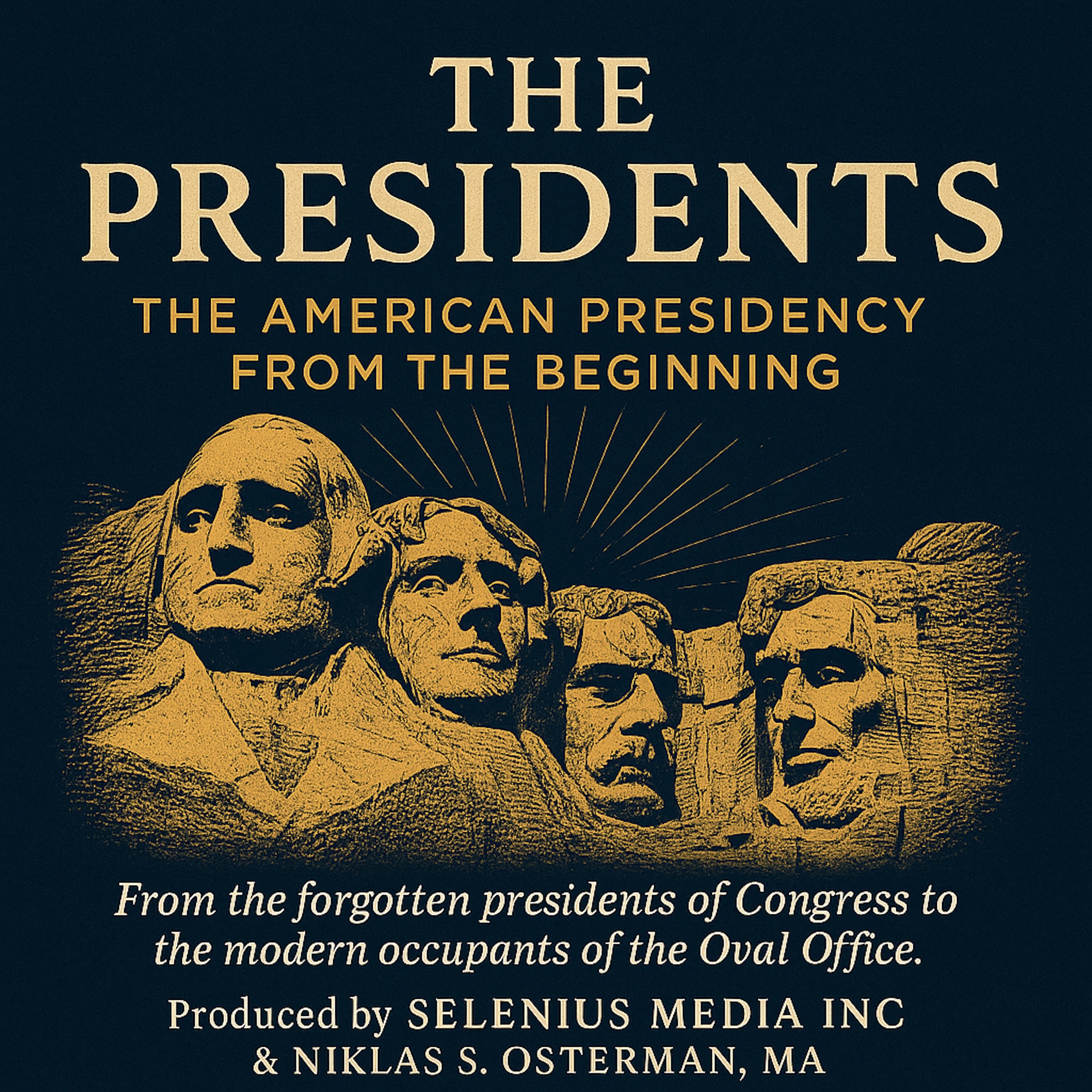
“The Presidents” is a long-form narrative project that tells the American story through the people who carried its executive power before it had a president and after the office had a name. We start where most textbooks don’t—inside the dim rooms of the Continental Congress—then move through the Articles era and into the modern Oval Office, treating each figure not as a bust on a mantel but as a decision-maker inside a living system. Every chapter asks the same unforgiving questions: What did this person actually do? What did they refuse to do? Who paid for their choices, and who prospered because of them? We separate campaign mythology from archival fact, trace how ideas turned into institutions, and watch the office grow teeth, rituals, and limits. The famous are made specific; the forgotten are restored to the map. It’s the republic told in scenes—treaties negotiated, vetoes drafted, wars averted or invited, roads and schools imagined into being, rights opened and closed—so liste
-
62
President Joseph R. Biden Jr
President Joseph R. Biden Jr On a chilly January afternoon in 2021, amidst profound national turmoil, Joseph R. Biden Jr. stood on the West Front of the U.S. Capitol, placed his hand on a hefty family Bible held by his wife Jill, and took the oath of office to become the 46th President of the United States. The scene was starkly different from inaugurations past: the National Mall was largely empty, save for flags representing absent spectators, a precaution due to the raging COVID-19 pandemic. Just two weeks earlier, the very Capitol steps where Biden now stood had been the site of violent insurrection. Now, as the oldest man ever to assume the presidency at 78, Biden addressed a nation in pain and disarray. He spoke of unity, of restoring the “soul of America,” and of overcoming the cascading crises at hand—pandemic, economic collapse, political division. The journey that brought Joe Biden to this pinnacle was long, winding, and marked by personal tragedy, decades of public service, and a resilient faith in the power of government to do good.Joe Biden’s life began in the blue-collar city of Scranton, Pennsylvania. Born November 20, 1942, he was the first of four siblings in an Irish Catholic family. His father, Joe Sr., worked various jobs—cleaning boilers, selling cars—and his mother, Catherine “Jean” Biden, was the family’s heart, instilling in young Joe a fierce belief in perseverance and dignity. The Bidens fell on hard times when Scranton’s economy declined in the 1950s. When Joe was 10, the family moved to Claymont, Delaware, in search of better opportunities, eventually settling in the neighboring town of Wilmington. There, Joe Sr. found more stable work selling used cars. The experience of seeing his father struggle but never lose his optimism left an indelible mark on Joe. It gave him a genuine relatability to working-class struggles and a chip on his shoulder about proving oneself.Selenius Media
-
61
President Donald J Trump
President Donald J TrumpOn the evening of November 8, 2016, Americans and the world looked on in astonishment as the election results defied almost all expectations. Donald J. Trump—a billionaire real estate mogul and reality television star with no prior political office—was declared the winner of the U.S. presidential race. It was one of the most extraordinary political upsets in American history. To Trump’s fervent supporters, many of whom felt ignored and left behind by the political establishment, it was a jubilant victory, a chance to “Make America Great Again” and shake up a status quo they despised. To his opponents, it was a moment of shock and alarm, as a man known for his brash, norm-breaking persona now prepared to occupy the Oval Office. Trump’s rise to the presidency marked a sharp break from political tradition and signaled a deeply polarized era ahead, with clashes over fundamental values that would test America’s institutions.Donald John Trump was born on June 14, 1946, in Queens, New York City, into a life of privilege and blunt ambition. He was the fourth of five children of Fred Trump and Mary MacLeod Trump. Fred was a successful real estate developer who built middle-class housing in Brooklyn and Queens; Mary was a Scottish immigrant who had met Fred in New York. Young Donald grew up in a stately home in the Jamaica Estates neighborhood. As a boy, he was strong-willed and confident—to the point of being considered a troublemaker at times. At 13, after Donald got into some misbehavior (reportedly frequent bullying and possibly involvement in vandalizing a neighbor’s property), his father decided he would benefit from discipline and sent him to the New York Military Academy. There, Donald Trump thrived under the regimented lifestyle. He became a student leader, played multiple sports, and learned the value of projecting strength and winning—traits that would become central to his identity.Selenius Media
-
60
President Barack Obama
President Barack ObamaOn the night of November 4, 2008, tens of thousands of people gathered in Chicago’s Grant Park, their breath visible in the crisp autumn air, united by a shared moment of history. Barack Obama—son of a Kenyan father and a Kansan mother—walked onto the stage, having just been elected the 44th President of the United States. He was the first African American ever to claim the nation’s highest office, and as he addressed the roaring crowd, many wept with joy and disbelief. “If there is anyone out there who still doubts that America is a place where all things are possible,” he began, inviting a hopeful reflection on how far the country had come. Obama spoke of hope and the enduring power of the American ideal, famously reminding the nation, “Yes we can.” That electrifying victory speech marked not just the culmination of a remarkable campaign, but the dawn of a presidency laden with sky-high expectations and daunting challenges.Barack Hussein Obama II was born on August 4, 1961, in Honolulu, Hawaii. His very name and heritage foreshadowed the diverse path his life would take. His mother, Stanley Ann Dunham (known as Ann), was a white woman from Kansas with a free-spirited intellect, and his father, Barack Obama Sr., was a Black man from a small village in Kenya who came to the University of Hawaii on a scholarship. They met in a Russian language class, fell in love, and had Barack, their “Barry,” as a young couple. But the marriage was short-lived; Barack’s father left Hawaii when the boy was two to pursue a Ph.D. at Harvard and then returned to Kenya. Obama’s early childhood was thus shaped primarily by his mother and her parents, with only distant memories of a brief visit from his father when Barack was 10. Ann Obama was a curious, idealistic woman. When Barack was six, she married an Indonesian man, Lolo Soetoro, and the family moved to Jakarta. For four years, from ages 6 to 10, young Barack lived in Indonesia, attending local schools—where he sometimes was noted for being the only foreign, Black child in class—and absorbing the sights and sounds of a very different world. He’s recalled waking to the call to prayer from mosques, walking past open sewers to school, and seeing beggars and farmers in the streets—experiences that broadened his perspective about global inequality at an early age.Selenius Media
-
59
President George W Bush
President George W BushGeorge W. Bush had been President of the United States for less than a year when the course of his tenure was transformed in a single morning. On September 11, 2001, as the sun rose into a clear blue sky, Bush found himself confronting the worst terrorist attack in American history. The nation watched as he learned of the attacks in a Florida classroom, a moment of dawning crisis. In the hours and days that followed, this relatively new president—born into one of America’s prominent political families but still carving out his own legacy—became the face of a nation’s grief and resolve. With a bullhorn in hand amid the rubble of Ground Zero, he promised a stunned country that those responsible would “hear from all of us soon.” It was a defining moment that would come to overshadow the rest of Bush’s presidency and shape the era in which he governed.To understand how George W. Bush came to that moment of trial, one must trace the arc of his life and career from its roots. George Walker Bush was born on July 6, 1946, in New Haven, Connecticut, the first child of George Herbert Walker Bush and Barbara Pierce Bush. The Bush family legacy loomed large: his father would rise to serve as a congressman, ambassador, director of the CIA, and ultimately the 41st President of the United States, and his grandfather Prescott Bush was a U.S. senator. Yet young George’s early years were spent far from the corridors of East Coast power. When he was a toddler, the family moved to West Texas, where his father entered the oil business. George W. Bush grew up in Midland, Texas, in the 1950s—a dusty oil town where his boyhood was more about Little League baseball and neighborhood mischief than political privilege. The Bush household was loving but disciplined, imbued with a strong sense of public service and faith. His parents taught him the value of personal responsibility and compassion—a theme Bush would later call “compassionate conservatism” in his own political rhetoric.Selenius Media
-
58
President Bill Clinton
President Bill ClintonOn a humid August night in 1963, a teenage boy from Hope, Arkansas, stood in the East Room of the White House and shook hands with the President of the United States. John F. Kennedy looked thinner and more fragile than he did on television, but to the seventeen-year-old Bill Clinton he seemed like the living embodiment of possibility—youth, ambition, public service bound together in a single image. The moment lasted only a few seconds. A photograph captured the handshake; history later attached great significance to it. For Clinton himself, it lodged in his mind as a kind of private vow: somehow, someday, he too would stand at the center of American politics.Bill Clinton’s road from that handshake to the presidency is one of the most improbable and intensely American stories of the late twentieth century. It is a story of talent and discipline, but also of appetite and risk; of dazzling political skill and self-inflicted wounds; of economic expansion and social reform shadowed by scandal and impeachment. As the 42nd President of the United States, Clinton presided over the end of the Cold War era, the rise of the internet economy, the signing of major trade and welfare laws, and intervention in conflicts abroad. He also left office with a complicated legacy, his achievements locked in permanent argument with his failures.Selenius Media
-
57
President George H. Walker
President George H. WalkerOn a cold January morning in 1989, as Marine One skimmed low over the Potomac River and settled onto the South Lawn for the last time of Ronald Reagan’s presidency, George Herbert Walker Bush stepped out into the crisp winter air and paused. For eight years he had been the loyal vice president, the former rival who swallowed his pride and joined the ticket, the man standing half a step behind one of the most transformative figures in modern American politics. Now he was about to become the forty-first President of the United States, inheriting not only Reagan’s political coalition but a world on the edge of transformation: the Soviet empire cracking, markets globalizing, old certainties dissolving.He did not look like a revolutionary. Bush moved with the careful, slightly stiff bearing of a man raised in privilege and shaped by war, the last representative of a New England Republican tradition that prized restraint, service, and understatement. Yet the four years that followed would coincide with the collapse of the Cold War order, a decisive American military victory in the Persian Gulf, and deep domestic unease that his reserved style never quite soothed. To understand why his presidency feels at once underrated and incomplete, you have to start long before that January morning, in a family and a generation that assumed duty before self.Selenius Media
-
56
President Ronald Reagan
President Ronald ReaganOn a cold January afternoon in 1981, as the temperature hovered below freezing and a sharp winter wind cut across the National Mall, millions of Americans watched a moment that felt like the breaking of a long fever. The country had endured years of inflation, oil shocks, hostage crises, and a grinding sense of decline. Faith in government had sunk to levels unseen since the Great Depression. But now, on the steps of the Capitol, a former Hollywood actor with a warm smile, an easy voice, and a confidence that bordered on serene placed his hand on a Bible and took the oath of office. Ronald Wilson Reagan—“Dutch” to his childhood friends, “The Great Communicator” to many who adored him—became the 40th president of the United States. His very presence seemed to promise a reversal of mood: a return to optimism, strength, and national pride.
-
55
President Jimmy Carter
President Jimmy CarterOn a warm January afternoon in 1977, as the inaugural procession wound slowly along Pennsylvania Avenue, a new president broke with decades of tradition. Instead of riding in the armored limousine provided for him, he stepped out with his wife Rosalynn, took her hand, and began to walk. The Secret Service bristled in panic; agents flanked him tightly. Spectators surged forward, calling his name, shouting blessings, holding out children for him to touch. Jimmy Carter, the peanut farmer from Plains, Georgia, the Sunday school teacher, the former submarine officer who had somehow vaulted from near anonymity into the White House, walked the long stretch of pavement smiling, almost shyly, as if he himself could hardly believe the path he now traveled. In that simple walk—unguarded, earnest, almost naive—millions of Americans saw what they had responded to: a man who seemed to promise decency after Watergate, humility after Nixon, and moral clarity after a long era of cynicism and political exhaustion.Selenius Media
-
54
President Gerald Ford
President Gerald FordIn that moment, many Americans saw Ford for what he essentially was: not a visionary or an ideologue, but a decent, straightforward man who had been dropped into the presidency almost by accident and was now trying to steady a battered system. To understand who he was and what kind of presidency he offered in the wreckage of Watergate, you have to go back to a much messier, more unsettled childhood than his later wholesome image suggested.Selenius Media
-
53
President Richard M. Nixon
President Richard M. NixonRichard Nixon’s presidency begins, in most people’s minds, with an ending: a man in a dark suit stepping onto a helicopter on an August morning in 1974, giving a stiff, awkward double V-sign, and flying away from the White House he had just resigned in disgrace. The rotor wash blows across the South Lawn; aides stand watching, some stunned, some grim. It is the first time in American history that a president has left office not because his term expired or because death claimed him, but because the machinery of law and politics has forced him out.Selenius Media
-
52
President Lyndon Baines Johnson
President Lyndon Baines JohnsonOn the afternoon of November 22, 1963, aboard Air Force One on the tarmac in Dallas, a heavyset man in a dark suit raised his right hand while his left rested on a small Bible. His face was set, grave, exhausted. Beside him stood Jacqueline Kennedy, still wearing her pink suit stained with the blood of her husband, the president who had been shot barely two hours earlier. A federal judge administered the oath. Reporters crowded the narrow cabin; Secret Service agents pressed against the walls; the engines hummed as if impatient to lift the plane into the sky. When it was over, the new president, Lyndon Baines Johnson, turned to the small cluster of witnesses and said simply, “Now let’s get airborne.”Selenius Media
-
51
President John F. Kennedy
President John F. KennedyOn a bright November morning in 1963, the motorcade moved slowly through downtown Dallas. The sky was clear, the air crisp, and the crowds thick along the sidewalks. People leaned out of office windows, waved small flags, and craned for a glimpse of the young president whose face they knew from television. In the open limousine, John Fitzgerald Kennedy sat beside his wife, Jacqueline, her pink suit vivid against the black car. Texas Governor John Connally and his wife were in the front seat. The mood was festive; the trip was meant to mend political fences, to show unity in a state where factions of the Democratic Party were tearing at each other. The president smiled, waved, turned toward one cluster of onlookers and then another. A few minutes later, as the car rolled past the Texas School Book Depository, gunshots cracked through the warm air. Kennedy slumped. The motorcade surged toward Parkland Hospital. Before the hour was out, the man who had promised a New Frontier and asked Americans to ask what they could do for their country was dead at forty-six.Selenius Media
-
50
President Dwight Eisenhower
President Dwight EisenhowerOn a raw January morning in 1953, as a cold wind cut across the National Mall, a former five-star general stood on the podium of the Capitol, hand on a Bible, about to become president of the United States. Dwight David Eisenhower—“Ike” to practically everyone—was sixty-two years old, broad-shouldered, with the square, reassuring face that had stared out from war posters and newsreels throughout the 1940s. The crowds that lined Pennsylvania Avenue did not see a politician in the usual sense. They saw the man who had commanded Allied armies in Europe, the soldier who had overseen D-Day and watched Nazi Germany fall. To many Americans, his election felt less like a partisan victory than an act of national common sense: the country, weary of Korea and anxious about the Cold War, had turned to the general who had already led them through one global crisis.Selenius Media
-
49
President Herbert Hoover
President Herbert HooverOn the night of March 4, 1929, as the festivities of Inauguration Day faded and Washington’s elite drifted from ballroom to ballroom, Herbert Clark Hoover sat for a quiet moment in the Red Room of the White House, staring into a vase of white roses. The celebrations had been grand: bands, parades, speeches, dignitaries—all hailing the nation’s new president, a man whose life story seemed almost mythic. A self-made millionaire, a global humanitarian who had fed millions during and after the Great War, a brilliant engineer, an organizer known worldwide as “The Great Humanitarian,” Hoover appeared to represent everything the optimistic, technologically driven America of the late 1920s wanted to believe about itself.Selenius Media
-
48
President Calvin Coolidge
President Calvin CoolidgeIn the summer of 1923, a small, spare bedroom in a Vermont farmhouse filled with the soft, uneven glow of lamplight. Outside, the village of Plymouth Notch slept under a sky pricked with stars. Inside, a middle-aged man in a simple nightshirt stood at attention beside the bed where his father, John Coolidge, a notary public and storekeeper, held an open Bible. A telegram lay nearby on a small table, its message as stark as ink on paper can be: the President of the United States, Warren G. Harding, was dead. The vice president, Calvin Coolidge—who had come home to visit his father and escape the Washington heat—was now, by law and by fate, the new president. There was no grand ceremony, no band, no cheering crowds. At 2:47 a.m. on August 3, 1923, in that quiet, lamp-lit bedroom, John Coolidge administered the oath of office to his son. Calvin placed his hand on the Bible, repeated the words of the presidential oath, and then, as later accounts have it, went back to bed.
-
47
President Warren G. Harding
President Warren G. HardingOn a humid July evening in 1921, the new President of the United States leaned back in the upholstered seat of a White House car rolling slowly up Pennsylvania Avenue. Warren Gamaliel Harding had just delivered a speech titled “Not Heroes, but Partners,” praising the teamwork required to rebuild a nation emerging from war. Crowds lined the sidewalks, many of them smiling at the tall, handsome man with silver hair and movie-star features. Veterans tipped their hats. Older women waved handkerchiefs. Reporters scribbled his every gesture. Harding acknowledged them with his characteristic easy warmth. He had a gift for it—an instinctive, almost unconscious ability to make people feel comfortable in his presence. More than any president since perhaps McKinley, he simply looked the part: dignified, reassuring, polished in a way that restored confidence after years of turmoil.
-
46
President Woodrow Wilson
Woodrow Wilson was born into a world divided and left it even more fractured, yet forever changed by his vision. Few American presidents are as contradictory, as intensely moral and yet as blinkered, as the twenty-eighth president. He was a Presbyterian minister’s son who preached politics as if it were a sermon, a scholar who dreamed of remaking the world through ideas, and a Southern-born progressive who wrapped racial prejudice in the language of order and science. To tell the story of Woodrow Wilson is to trace the arc of the early twentieth century: the last years of the old empires, the rise of modern bureaucratic government, the shattering violence of the First World War, and the birth of an American habit of thinking of itself as the conscience of the world. It is also to follow one man’s rise from shy, stuttering student to the most powerful office in the United States, and then to watch his body and mind collapse under the weight of his own ambitions.
-
45
President William Howard Taft
President William Howard TaftWilliam Howard Taft moves across the American story like a large, courteous ship that prefers deep water to spectacle. He is remembered in cartoons as girth and in footnotes as an asterisk—only man to be both president and chief justice—but the truth is more intricate: he was a craftsman of institutions, a temperament tuned to law and procedure in an epoch that rewarded drumbeats and banners. He did not hunger for the presidency; he wanted the Court. Yet the republic, in one of its recurring experiments, placed him first where he was least comfortable and later where he was always meant to be. To understand the man is to watch intelligence and decency continually choose duty over desire and to see how that choice, repeated long enough, becomes a kind of greatness that the loud decades often mishear.Selenius Media
-
44
President Theodore Roosevelt
President Theodore RooseveltHe begins as a small boy fighting air and time. The asthma comes at night like a thief and sits on his chest; the child hears the rattle of his own breathing and learns, much earlier than most, that life does not hand out strength—it must be built. In a brownstone on East 20th Street, in a house that smells of books and leather and ocean salt carried in on his father’s coats, he studies insects in jam jars, birds through a little window onto the roof, muscles through pain with the help of a doting, formidable parent who tells him the sentence he will carry like a creed: you have the mind but not the body; make the body. He sets up a gym in the family home, lifts iron dumbbells until his arms shake, pounds a bag, rows, hikes, wrestles his own lungs into submission. He reads like a person storing fuel—Plutarch and Darwin, Froissart and Prescott, Audubon and the Federalist—feeding a mind that wants the world entire. His father, Theodore Senior, is philanthropy in a waistcoat, a reformer who despises cruelty and idle vanity and takes his son to the charitable societies and the workshops where the city’s other children learn to survive. The boy watches, notes, decides that duty can look like joy if you refuse to notice how heavy it is.Selenius Media
-
43
William McKinley
William McKinleyWilliam McKinley enters American history with the light behind him rather than in his face: a small-town son with a soldier’s steadiness, a lawyer’s patience, and a politician’s ear tuned not for applause but for the faint crackle that runs through a country when prosperity is possible again. He is born in Niles, Ohio, in 1843, into a household that believes work is a sacrament and education the shortest road between a wish and its fulfillment. He is not a prodigy; he is dependable. At Poland Seminary he learns the grammar of argument, the usefulness of quiet, and the art of listening long enough to hear what people actually mean beneath what they say. When the war comes he enlists without embroidery, a private in the 23rd Ohio, and discovers in the field that courage often looks like carrying hot coffee to a forward post under fire because men fight better when they are warm. Antietam imprints him; so does the winter that follows; so do the promotions earned not by brilliance but by being where he is supposed to be, doing the thing that needs doing. By the end he wears an officer’s straps and the settled look of someone who has watched chaos and decided never again to make a mess where order will suffice.Selenius Media
-
42
Stephen Grover Cleveland
Stephen Grover ClevelandGrover Cleveland’s reputation begins with a sentence he repeats so often it stops sounding like a slogan and starts sounding like a moral reflex: public office is a public trust. The phrase is spare, almost severe, and it reflects a sensibility forged not in salons or at universities, but in parsonages, law offices, and municipal chambers where the nearest romance is the romance of balancing a column of numbers. He is born Stephen Grover Cleveland in Caldwell, New Jersey, the son of a Presbyterian minister whose sermons leave the family as rich in admonition as they are poor in cash. Early on he learns two permanent lessons: that work is both duty and shelter, and that respectability is not a costume but a habit. When his father dies, the boy goes to work rather than to college, finding in Buffalo a ladder made from law books and late nights, apprenticing in the old way—read, copy, draft, argue—until the trade is not a trick but a muscle. He is not a virtuoso; he is a metronome. Clients trust him because his sentences carry weight that is not borrowed from anyone else’s name, and because he treats details as if they are the only place where justice will stand quietly long enough to be measured.Selenius Media
-
41
Benjamin Harrison
Benjamin HarrisonBenjamin Harrison arrives in American history with a paradox stitched neatly to the inside of his coat: a quiet man descended from noise. He is the grandson of a war hero president who died too soon to do much harm or much good, the son of a congressman with a frontier’s sense of town duty, and himself a lawyer whose sentences are careful at the edges and firm in the middle. He grows up with the knowledge that his name is already a quotation and decides, early, that the only answer to inherited echo is unshowy competence. Born in North Bend, Ohio, in 1833, he spends his first years under the long shadow of William Henry Harrison’s fame and the short shadow of that fame’s brevity. The family moves to Indiana, where weather and work combine to build the sort of character that lacks adjectives. He reads law under established hands, marries Caroline Scott—earnest, musical, attentive to improvement—and settles in Indianapolis to make a living by making arguments that judges can trust. His voice is clear without being theatrical; his industry is the kind that makes clerks smile; his piety is a daily grammar rather than a sermon delivered at strangers. If you are looking for a figure destined to belt a nation into a new shape, you will miss him at first glance. If you are looking for a figure designed to keep the machine of law from rattling itself apart, he is almost ideal.Selenius Media
-
40
Stephen Grover Cleveland
Grover Cleveland’s reputation begins with a sentence he repeats so often it stops sounding like a slogan and starts sounding like a moral reflex: public office is a public trust. The phrase is spare, almost severe, and it reflects a sensibility forged not in salons or at universities, but in parsonages, law offices, and municipal chambers where the nearest romance is the romance of balancing a column of numbers. He is born Stephen Grover Cleveland in Caldwell, New Jersey, the son of a Presbyterian minister whose sermons leave the family as rich in admonition as they are poor in cash. Early on he learns two permanent lessons: that work is both duty and shelter, and that respectability is not a costume but a habit. When his father dies, the boy goes to work rather than to college, finding in Buffalo a ladder made from law books and late nights, apprenticing in the old way—read, copy, draft, argue—until the trade is not a trick but a muscle. He is not a virtuoso; he is a metronome. Clients trust him because his sentences carry weight that is not borrowed from anyone else’s name, and because he treats details as if they are the only place where justice will stand quietly long enough to be measured.
-
39
Rutherford B. Hayes
Rutherford B. Hayes enters national memory under gaslight—calm voice, careful eyes, a lawyer’s temper tucked into a soldier’s frame—and for more than a century the shorthand that follows his name is a quarrel about legitimacy. The most contested election in American history lifted him into the presidency by a whisker measured in affidavits and midnight negotiations; the story’s machinery is so noisy that it can drown out the person who had to live with the noise. Yet to see Hayes whole is to watch an unshowy reformer try to keep his footing on a floor that was still shaking from war. He did not speak like a prophet. He did not perform the office like a general returned to his parade. He worked, and he tried to make the government work better, while persuading a country tired of virtue’s cost that reform was not a luxury but the only way republican government could continue to deserve consent.Selenius Media
-
38
Ulysses S. Grant
Ulysses S. Grant enters American life as a contradiction that grows truer the closer one looks: shy but unflinching, ordinary in bearing yet relentless in execution, a man who disliked blood and became the general who ended the bloodiest American war, a president whose name is still dragged through the mud of scandals and still stands under the clean architecture of civil rights written into law and enforced by federal will. He begins as Hiram Ulysses in Ohio, the son of a tannery owner whose vats taught a boy the smell of hides cured with acid and labor. The family moves to Georgetown, and the boy learns horses as if he were learning a language—balance, patience, the quiet command that persuades a nervous animal to lower its head. When a local congressman obtains an appointment to West Point, a clerical error prints “Ulysses S.” on the papers; the letter S, borrowed from his mother’s maiden name, never stands for anything and ends up standing for everything. At the Academy he is neither scholar nor swashbuckler; he ranks high in horsemanship, low in demerit points, and middle in reputation. He is smallish, spare, averse to boast, and possessed of two talents that will not announce themselves until the world is ready to listen: the ability to see the essential position on a map and the ability to keep moving toward it when other men’s nerves begin to tremble.Selenius Media
-
37
President Harry S. Truman
President Harry S. TrumanOn an April evening in 1945, a clerk from the White House hurried up the marble stairs of the Capitol and down a dim corridor toward the office of the vice president. Inside, Harry S. Truman was sitting with House Speaker Sam Rayburn, sharing a drink and the easy, almost gloomy camaraderie of two men who had spent years in the rough-and-tumble of Congress. The vice presidency, Truman liked to say, was about as useful as a cow’s fifth teat. He had not been invited into the inner circle on the great questions of the war. He did not know the secrets that Franklin Roosevelt and a handful of advisers carried around like invisible weight. When the phone rang and a voice ordered him at once to the White House, he could not yet imagine that in a few minutes his own life—and the life of the country—would tilt on a hinge.Selenius Media
-
36
President Franklin D. Roosevelt
President Franklin D. RooseveltOn a gray March afternoon in 1933, as a cold rain fell on Washington and banks failed across the country in a kind of slow-motion collapse, Franklin Delano Roosevelt rode in an open car toward the Capitol, his head high, his jaw set in that familiar, confident line. Around him, the city was tense. Unemployment had reached heights Americans had never seen. Breadlines looped around city blocks. Farmers lost their land; factory whistles fell silent. In the weeks before the inauguration, the financial system itself had begun to buckle. State after state declared “bank holidays” to stem panicked withdrawals. By the morning of March 4, the entire banking structure of the United States was functionally frozen.Selenius Media
-
35
Andrew Johnson
because of bad carpentry when, in truth, the frame has shifted with the building. He is not a creature of salons or law schools; he is a tailor from Raleigh, apprenticed at ten, run away at sixteen, a self-taught reader who learned syllables from a wife who had more book in her fingers than in her family’s purse. Eliza McCardle placed a primer and a grammar on the table the way other brides lay out a dowry; the young husband bent over vowels and consonants at night, and a life began to take a different shape. In Greeneville, Tennessee, he pieced coats by day and pieced arguments by evening, slipping from workbench to stump with a craftsman’s confidence that if you know how to measure, you can make things fit. He entered town government, then the statehouse, then Congress, bringing with him a certainty that democracy must be a ladder wide enough for men who begin with nothing. He distrusted bankers, monopolies, and aristocracies with the fury of a poor boy who had watched well-dressed men pass laws like mirrors. He championed the homesteader and the mechanic, despised the planter’s condescension, and cultivated a Jacksonian stubbornness that placed the “plain people” in his mouth like a vow.Selenius Media
-
34
Abraham Lincoln
Abraham Lincoln enters the American story as a silhouette before he becomes a figure—long-limbed, awkward, moving through a world of stumps and distances, carrying books as if they were tools and ideas as if they were debts. He is born in a Kentucky cabin that later generations will remake into a shrine and, later still, into a contested metaphor; his childhood is a short ledger of hard labor, thin schooling, and a frontier that measured intelligence by the quality of a fence. The family walks—first to Indiana, then to Illinois—because poverty is not merely a condition, it is an address, and sometimes the only way to improve it is to change the map. He grows in that American way: borrowing other men’s books, arguing with himself, turning chores into calisthenics for endurance, and discovering that his mind prefers the architecture of sentences to the arithmetic of acres. He reads the law the way a starving man reads menus, memorizes poetry to find rhythms stronger than weather, and learns in the rough legislature at Vandalia and Springfield that politics, for all its theatrical rage, is a patient craft built out of listening. The rail-splitter carpenter’s gift is not muscle; it is perspective. He can see through timber to the beam inside it, through crow
-
33
Chester A. Arthur
Chester A. ArthurChester Alan Arthur enters the American imagination as a contradiction that slowly resolves into character: a genial machine man who becomes a gentleman reformer, a collector of customs turned collector of virtues, a vice president chosen to keep spoils flowing who ends up closing the tap, a politician famous for waistcoats and dinners who quietly builds a modern state out of statutes and steel. He does not begin with the aura of destiny. He is the son of a strict Baptist minister who moved parishes the way other men changed coats, born in a northern Vermont farmhouse, raised across the New York frontier where sermons braided with snow, where books and thrift, not lineage, were the natural furniture of a life. He studies, argues, teaches school, reads law, and absorbs the moral grammar of the Whig world: order over frenzy, improvement over improvisation, self-command as the precondition of public command. In his twenties he takes a case that becomes a parable. A Black woman named Elizabeth Jennings has been forced from a segregated New York City streetcar; Arthur helps argue the suit that wins damages and pries open the cars to equal passage. The episode will be remembered later as a foreshadowing, the neat note a biographer circles in the margin: remember this when the country forgets who he was supposed to be.Selenius Media
-
32
James Buchanan
James Buchanan enters the presidency like a lawyer walking into a burning building with a leather briefcase and a belief that precedent can outshout fire. He is, by the time the oath touches his lips in March 1857, the most experienced public servant in the country: state legislator, congressman, senator, minister to Russia, secretary of state, minister to Great Britain, confidant to party captains on both sides of the Appalachians, a Pennsylvanian with Southern friends and Northern clients. His résumé reads like the ledger of a republic that still believed patience would always be rewarded, and his temperament is exactly the sort that ledger trains: courteous to a fault, attentive to forms, allergic to improvisation, convinced that if every clause is carefully read and every channel of consultation respected, even the angriest currents can be coaxed into a harbor. He is unmarried, which his enemies will later use as a hook for gossip and his friends as a sign that the country can be his household. He is careful with money, protective of reputation, and persuaded that moderation is not merely a tactic but a philosophy. This combination—skill, caution, confidence in law—would have made him an admirable administrator in a quiet decade. He is not given a quiet decade. He is given the hinge on which the nineteenth century swings, and he tries to oil it with memoranda.Selenius Media
-
31
Franklin Pierce
Franklin Pierce enters the presidency like a man who has already used up his share of good fortune and would spend his mandate trying to keep the country from noticing the same thing about itself. He is small-boned, soft-spoken, vain about a certain smoothness that reads, to friendly eyes, as grace and to suspicious eyes as glaze. He is born in New Hampshire, schooled at Bowdoin among minds that will leave long shadows—Hawthorne, Longfellow—and trained in the old New England art of becoming important without frightening the neighbors: read law, memorize names, master the grammar of local gratitude. He rises quickly because he is attentive rather than brilliant, convivial rather than doctrinaire, and because his politics fit a moment when northern Democrats discovered that loyalty to the Union could be rented out as sympathy for the South. In the legislature he learns how to pass favors through committees; in Congress he learns the schedule by which outrage softens into votes; in the Senate he learns that position is not the same as power and that resignation can sometimes look like character when the truth is simply weariness. He marries Jane Appleton—delicate, devout, at war with the worldly noise that nourishes politics—and tries to stitch together a domestic peace stout enough to withstand the winds that follow ambition. Three sons are born; two die early; the third, Benjamin, will be taken from them in a wreck that drops a railcar down a snowy New England embankment between election and inauguration. The president-elect carries his child’s body out of the shattered carriage; the papers do not print the sounds he and Jane made in the snow. Jane becomes a shade moving quietly through the White House, her grief a permanent winter; Pierce becomes, in the eyes of those who knew him before and after that day, a man who could never again speak loudly enough to be heard over the noise inside himself.Selenius Media
-
30
Millard Fillmore
Millard Fillmore enters the record without the thunder that posterity likes to lend its protagonists. He is the kind of American the nineteenth century produced in bulk and then too often forgot: a boy born in a cabin on land not yet steady in title, apprenticed to a cloth-dresser who worked the dye into homespun, self-taught enough to teach, then self-taught enough to read law by firelight, patient enough to wait for a borrowed book, and stubborn enough to return it with marginalia. His manners are plain; his clothes are tidy without being dashing; his sentences run straight and do not wink; his pride sits in the middle distance, visible but not gaudy. He is an upstate New Yorker before upstate becomes a political noun—a man who knows the feel of a winter road in shoes that leak and the sound a creek makes when it cheats a miller.Selenius Media
-
29
Zachary Taylor
Zachary Taylor enters the American story as a paradox—an unpolished professional, a planter who lived most of his life in tents, a man of few public sentences who nonetheless became, by sheer steadiness under fire, one of the most quoted names in the country. He did not seek office with arguments; he acquired it by reputation. Before he was a candidate, he was a contour on a map of the West, the officer whose columns appeared where the line between “frontier” and “country” was being drawn in real time. He spent forty years in service before he ever spoke as a politician. He learned on the Mississippi and along the Red River that logistics is the true sovereign of a campaign, that road and ration outrank most kinds of courage, and that men will forgive a general for almost anything except letting them go hungry. His nickname—Old Rough and Ready—was not a costume; it was a daily habit: a straw hat when regulations preferred plume, a simple coat when gilt was expected, a willingness to receive a private’s complaint that looked to soldiers like respect and to some colleagues like laxity. The grand theorists of war made diagrams; Taylor made sure the wagons got through the bad place. He was not dreamy about the nation’s destiny; he was practical about the day’s march. He belonged to that early American type that did not confuse eloquence with competence. When his name arrived on broadsides in the late 1840s, it was attached to verbs—held, advanced, refused, endured—more than to adjectives, and that difference is the core of him.Selenius Media
-
28
James K. Polk
James K. Polk steps onto the national stage the way a man steps into a room where the argument has already begun and the hours are numbered. He is not the loudest voice in the party nor the most beloved figure in the country. He does not look like a romance. He looks like a ledger brought to life—compact, exact, already measuring how many days remain between promise and audit. He comes from a plain Tennessee house, trained by the disciplines that make ambition tolerable to neighbors: work, punctuality, a belief that talking should accomplish something that can be seen on a map or counted in a book. His apprenticeships are severe and useful. He learns parliamentary combat under Andrew Jackson’s shadow and then without it, chairing committees until he can steer an entire chamber, rising to the Speakership with the calm of a man who thinks power is a form of housekeeping. After Congress he tests himself as governor and learns how quickly prestige can be stolen by the weather. He loses re-election, then loses again, and discovers a lesson that often breaks men but sharpens him: reputation is a poor shield when the wind blows from the wrong quarter; the only durable protection is a plan that can be finished before fashion changes its shoes. When the Democratic National Convention deadlocks in 1844, the room turns to a name that had been a footnote the day before, and the footnote accepts. “Dark horse,” they call him. He smiles with the politeness of a man who recognizes that invisibility is sometimes the surest way to approach a difficult job. He declares himself the instrument of purposes so clear you can write them on the back of an envelope: settle Oregon, lower the tariff, restore the independent treasury, bring Texas into the Union, and take, by negotiation or by purchase or by war if war comes, California and New Mexico from a Mexico that cannot defend the line its maps describe. He promises one term, because time is his favorite kind of pressure.
-
27
John Tyler
John Tyler enters the line of presidents like a quiet hinge that suddenly bears the weight of a door no one expected to open. He is there in the background of the parade—Virginia lawyer, legislator, gentleman of the Tidewater—until the nation’s most theatrical campaign puts him in the second chair as a flourish on a slogan. Then the first chair is empty far too soon, and the man meant to be a symbol discovers he must be a system. He takes up the pen with a composure that angers those who think accidents should apologize for themselves, and he proceeds to act as if legitimacy lies in duty performed, not in the manner of one’s arrival. “His Accidency,” they sneer, inventing a nickname to reduce a constitutional question to a joke. He answers the way a careful man answers a jeer: not at all, and then with a string of decisions that make the joke irrelevant. The oath he takes is not half an oath; the office he occupies is not a regency. From the moment John Tyler asserts that he is the President—the whole of it—his story becomes a study in how institutions ripen under stress and how a republic learns, in the space of a month, what it means to have a succession even when its parchment did not yet say so in the neat words later generations would add.
-
26
William Henry Harrison
William Henry Harrison enters the line of presidents like a figure carved from the timber of the Old Northwest—raw-edged, weather-tested, built more out of marching orders than out of pamphlets. He is not the architect of a doctrine; he is an officer trained to turn geography into sentences that can be obeyed. Before his presidency reduces itself in popular memory to the arithmetic of thirty-one days, he has already lived the better part of the republic’s first half century as a surveyor’s son, a soldier who learned the frontier’s grammar, a territorial governor who turned treaties into roads, a general who taught anxious towns to sleep through a spring, a diplomat who could be courteous without being vague, and a candidate who understood sooner than most that, in an age of crowds, a symbol can be as effective as a statute. His story is less a straight line than a succession of posts: this fort, that river, this assembly, that election—each a place where the young nation discovered how far it was willing to travel to make its maps true.Selenius Media
-
25
James A. Garfield
James A. Garfield steps onto the national stage with the air of someone who has already worn half a dozen lives and is suspicious of fame because it looks too much like a costume. He is born in a one-room cabin in Orange Township, Ohio, the last child of a widowed mother who has nothing to offer but work and the belief that work is convertible into dignity. The boy is small, eager, and afflicted with a restlessness that in a harsher age might have been called fate: he runs away to the canal, becomes a mule driver, learns the night-rhythm of towpaths and the profanity of men who live by weather. He nearly dies of fever, returns to the cabin chastened and taller, and confronts the unglamorous truth at the heart of the American promise: books are ladders and ladders do not climb themselves. At the Western Reserve Eclectic Institute—later Hiram College—he reads languages until his tongue aches and logics until the world begins to show its hinges. He is so hungry for instruction that the line between student and teacher blurs; soon he is both, lecturing by day, cramming by night, graduating to Williams College and bringing back to Ohio a method and a polish that never extinguish the frontier candor in his voice. He marries his fellow student and quiet counterpart, Lucretia Rudolph—“Crete”—whose devotion to order, texts, and understatement will later be the only gravity strong enough to anchor a life pulled by politics. He enters the Disciples of Christ ministry because faith, to him, is not theater but grammar: sentences about duty that you live or you do not deserve to speak.Selenius Media
-
24
Martin Van Buren
Martin Van Buren enters the American story not as a battlefield silhouette or a thunderous orator, but as a tactician born to a borderland of languages, a boy of Kinderhook whose first music was Dutch and whose adulthood would be devoted to translating popular feeling into the grammar of power. He is small, immaculate in dress, soft in voice, and relentless in purpose. Where others carve reputations with swords or pamphlets, he builds something less theatrical and more durable: an apparatus that makes consent repeatable. He believes parties are not diseases of the body politic but its circulation; that faction, disciplined, can become representation; that loyalty, organized, can become law. The republic, suspicious of parties in theory and addicted to them in practice, needs a builder who will admit the addiction and supply the infrastructure. Van Buren is that builder. If Washington gave the executive its posture and Jefferson its conversational tone, Van Buren gives politics its system, and with it the long habit of peaceful alternation that later ages will mistake for inevitability. He is not a statue’s hero. He is something subtler: an engineer of legitimacy.Selenius Media
-
23
Andrew Jackson
Andrew Jackson enters the American chronicle as a refusal that never cooled. A teen in a war, ordered by an enemy officer to polish a pair of boots, he answered with a no that earned steel across his face and set the pitch of his life. The slash did not create his temper; it certified it. Orphaned by the Revolution’s chaos and sickness, hardened in the Carolinas where arguments were settled by nerve before they were settled by law, he learned the world’s first lesson early: that authority often arrives as a boot, and dignity sometimes begins as a refusal to kneel. The boy became a rider over bad roads, the rider a lawyer with sentences like blows, the lawyer a judge who treated procedure as a kind of frontier carpentry, the judge a militia general who could make a mixed crowd stand in a straight line by force of presence alone. In him, a republic still deciding whether it wished to be governed by rules or by voltage found a man who could impersonate both. He widened the circle for millions of white men and closed it brutally for peoples who stood where expansion wanted to go. He despised public debt as if it were a personal insult and distrusted institutions whenever they took on the smell of a class that thought itself born to supervise. He loved law when it blessed necessity and suspected it when it opposed his sense of what the hour required. He spoke of the people with a sincerity that moved cities and a selectiveness that erased entire nations.Selenius Media
-
22
John Quincy Adams
He first steps into the American narrative not as a veteran of a field but as a boy of a household calibrated to history. He watches Bunker Hill’s smoke from the ridge near his father’s farm and feels the country’s lungs fill with a new kind of breath. Before he is old enough to vote he is old enough to leave, ferrying across the Atlantic with a diplomat-father who teaches him that patriotism sometimes looks like dispatches copied by candlelight and sums added carefully at the bottom of each page. Paris, Amsterdam, St. Petersburg—he gathers a grammar of power the way other boys gather heroes, learning that courts conceal boredom inside ceremony, that bankers speak a dialect of caution the bold must learn to translate, that treaties are machines for converting appetite into rules. He keeps a diary because he suspects that the only witness who will never lie to him is the page. The habit becomes a spine. He writes on ships, in rented rooms with thin walls, in ministerial apartments whose windows look down on streets filled with gossip and horses, in inns where thunder walks the roof. He writes angrily, carefully, penitently, and with a severity toward his own motives that would have broken a softer conscience or turned a politician into a cynic.
-
21
James Monroe
James Monroe begins not as a doctrine but as a boy with a musket, a student who left his books at Williamsburg to follow a general across a dark river toward an impossible dawn. Before he was the last of the Virginia dynasty, before editorialists softened the weather of his years into the easy label of an “Era of Good Feelings,” he was nineteen, marching with cold feet and an appetite for risk that had not yet learned to call itself duty. He crossed the Delaware with Washington on Christmas night and took a ball through the shoulder at Trenton in the morning light. That wound did not make him a hero; it made him a witness. He saw how resolve feels when rations are low and shoes fail and the arithmetic of survival becomes a series of small obediences done in hard weather. The soldier became the measure of the statesman he later chose to be: not a theorist who loved the symmetry of plans more than the stubbornness of facts, but a practitioner who believed that nations are built out of logistics and promises kept under strain.
-
20
James Madison
James Madison enters the scene not with the thunder of a soldier’s drum or the roar of a crowd but with the modest scrape of a chair in a quiet room, a notebook open, and a mind intent on turning friction into form. He is small in stature and huge in gravity, frail in appearance and relentless in attention, a man whose power is the patient sentence and whose temperament is that of a mechanic of liberty rather than a herald of it. He would never be the loudest voice in a hall, but halls accustomed to noise learned quickly that it was Madison’s hushed questions—the precise framing, the tested premise, the meticulous next step—that moved assemblies from complaint to architecture. If Washington invented the posture of the executive and Adams tested the dignity of law under storm, Madison built the room where those postures and dignities could have a regular life. He is the author of habits disguised as doctrines: a theory of factions that became a way of breathing for a large republic; a grammar of separated powers that reads like common sense until you try to live without it; a practice of amendment that turned a revolution’s poetry into a citizen’s tool. In his wake the United States became the sort of place where disagreement is not a pause between wars but the air in which public life keeps its lungs working.
-
19
Nathaniel Gorham – Acting President of Congress (1785–1786)
Nathaniel Gorham’s turn in the chair began not with trumpets but with the small, exacting necessities that keep a weak government from collapsing into embarrassment. The famous man elected to preside—John Hancock, emblem of independence, governor of Massachusetts, a name large enough to be a logo—was largely absent, held at home by illness, comfort, and the quiet calculations of a state politician who knew where his power actually lived. Congress could not wait for a celebrity’s joints to loosen. It needed someone who would come to the room, count the votes that existed rather than the ones a letter promised, and convert the country’s nervous energy into minutes, resolutions, and dispatches that made the semblance of union feel a shade more real than the day before. Gorham, a compact Charlestown merchant with a ledger’s memory and a neighbor’s practicality, took the gavel “in the absence of the President” and did what New England men do when ceremony fails them: he set a rhythm and held it. In late 1785 and into 1786, first as acting chair under Hancock’s airy title and then as president in his own right, he gave the Confederation precisely what it could actually use—speed, order, candor without theatrics, and the courage to admit that the frame itself was failing and needed something sturdier than exhortation.Selenius Media Inc
-
18
Richard Henry Lee – President of Congress (1784–1785)
Richard Henry Lee’s tenure in the chair arrives in the afterglow of a miracle and the onset of a long migraine. The miracle was the war’s end—Washington’s graceful bow at Annapolis, the definitive treaty now in hand, the last redcoats filing onto ships. The migraine was everything that followed: soldiers’ certificates turning to dust in taverns, creditors knocking at doors, frontier fires flaring where maps pretended to make peace, states bargaining with themselves about whether promises made as a Union might be honored as a state. Into that atmosphere, in late 1784, came a tall Virginian whose fame had been forged eight years earlier in a single, flint-striking sentence—his resolution that “these united colonies are, and of right ought to be, free and independent States.” The drama of that day in June 1776 had branded him into the memory of every man who had been in the room. What the public did not see as clearly was the other part of Richard Henry Lee: the committee worker, the drafter, the country gentleman of Westmoreland who understood that independence, if it were to be more than a mood, had to be measured into laws, land lines, and ledgers. As President of the United States in Congress Assembled from late 1784 to late 1785, he presided over the first serious attempt to convert the boundless West into a republic’s geometry and to make the Confederation look, to the outside world, like something steadier than a brave memory.Niklas S Osterman, MA Selenius Media Inc
-
17
Thomas Mifflin – President of Congress (1783–1784)
Thomas Mifflin – President of Congress (1783–1784)Thomas Mifflin’s year in the chair belongs to the narrow space where performance and contrition meet: a politician and soldier with a reputation dinged by whispers from the coldest winter of the war, returned to preside over its official ending and to stage, with fastidious care, the most important act of self-restraint in American military history—the resignation of George Washington’s commission. If you want a single life that shows how the Revolution turned improvisation into ceremony, disorder into paperwork, hurt pride into public ritual, you can follow Mifflin from a Quaker countinghouse on Water Street to the long table at Annapolis where he bowed Washington out of the army and then shepherded the ratification of a peace that would make that farewell more than theater. He was complicated—quick, ambitious, exquisitely attuned to rank and to the gestures that establish it; a man whose energy made him invaluable in emergencies and whose energy, in the wrong corridor, could look like intrigue. He had disappointed Washington once, and Washington, who kept his disappointments quiet until he didn’t, did not forget. Yet it was Thomas Mifflin, as President of the United States in Congress Assembled from late 1783 to late 1784, who gave the republic a pair of canonical scenes: the general laying down power and the Congress ratifying the definitive Treaty of Paris. He did the choreography and the signatures. He made sure the right words were said in the right room and recorded in the right hand. If redemption in public life is possible, it rarely comes cleaner than that.Niklas Osterman MA
-
16
Elias Boudinot – President of Congress (1782–1783)
Elias Boudinot – President of Congress (1782–1783)In the last hard winter of the war, when rumors of peace traveled faster than pay and slower than hunger, a compact, careful New Jersey lawyer with a Huguenot name took the chair of Congress and tried to carry a country across the narrow bridge between victory and legitimacy. Elias Boudinot did not have the theatrical silhouette of a general or the lapidary sentences of a pamphleteer. He had instead a habit of exactness, a tenderness for procedures that protect the weak, and a talent for guiding a room without scalding it. In November 1782 the delegates elected him President of the United States in Congress Assembled, an office that was mostly gavel and very little scepter, and for the next twelve months Boudinot presided over a string of decisions that would decide whether the United States could turn a battlefield triumph into a government other nations would trust. The work seldom looked heroic while he was doing it. It looked like letters answered on time; soldiers coaxed back from fury to patience; treaties shepherded through etiquette as intricate as lace; and, when the republic came near humiliation in its own capital, a firm hand on the tiller that steered Congress out of danger without making fresh enemies. If the Revolutionary decade can be read as the passage from improvisation to institutions, Boudinot’s year in the chair is one of the moments when that passage became visible in the angle of a pen and the timing of a proclamation.Selenius Media Inc
-
15
John Hanson – Often mythologized as “first president under the Articles” (1781–1782)
John Hanson – Often mythologized as “first president under the Articles” (1781–1782)The story most people hear about John Hanson arrives as a neat provocation: before George Washington there was another “first president,” a dignified Marylander who held the office under the Articles of Confederation and whose name we somehow forgot. The claim survives because it flatters the appetite for secret histories and because Hanson, when you look closely, does sit at a hinge in time—with a gavel but without an army, receiving dispatches from generals and ministers while presiding over a government that called itself the “United States in Congress Assembled.” The myth confuses titles with power, but it points at something real: a single sober year in which an untheatrical planter-merchant from Charles County occupied the chair at the center of a fragile union and, by working it like a desk .Selenius Media Inc
-
14
Samuel Huntington – Last Continental Congress president / first under Articles in practice (1779–1781)
Samuel Huntington – Last Continental Congress president / first under Articles in practice (1779–1781)
-
13
John Hancock (again) – Elected but largely nonresident/absent (1785–1786)
The second time John Hancock’s name was lifted to the top of Congress, it was less a summons to govern than a bet on the power of a signature. The war was over; the treaty had been ratified; the chair in the national chamber had begun to pass each year to a different steward who kept the papers moving and the façade intact. In that rotation, which felt at once ceremonial and necessary, the delegates reached for a figure whose autograph had become the emblem of independence. They chose him again, the man whose ink in 1776 had swelled like a flag across the page, hoping that prestige could do what statutes could not—pull far-flung men to a seat of government that had money in theory and authority mostly on paper. He accepted with the politeness of a gentleman who knew what his name could do and what his joints could not. He promised to arrange his affairs, to take the road, to sit where the law now lived. He did not arrive. An absence became the shape of a year.Selenius Media Inc
We're indexing this podcast's transcripts for the first time — this can take a minute or two. We'll show results as soon as they're ready.
No matches for "" in this podcast's transcripts.
No topics indexed yet for this podcast.
Loading reviews...
ABOUT THIS SHOW
“The Presidents” is a long-form narrative project that tells the American story through the people who carried its executive power before it had a president and after the office had a name. We start where most textbooks don’t—inside the dim rooms of the Continental Congress—then move through the Articles era and into the modern Oval Office, treating each figure not as a bust on a mantel but as a decision-maker inside a living system. Every chapter asks the same unforgiving questions: What did this person actually do? What did they refuse to do? Who paid for their choices, and who prospered because of them? We separate campaign mythology from archival fact, trace how ideas turned into institutions, and watch the office grow teeth, rituals, and limits. The famous are made specific; the forgotten are restored to the map. It’s the republic told in scenes—treaties negotiated, vetoes drafted, wars averted or invited, roads and schools imagined into being, rights opened and closed—so liste
HOSTED BY
Selenius Media
CATEGORIES
Loading similar podcasts...
URL copied to clipboard!