
PODCAST · history
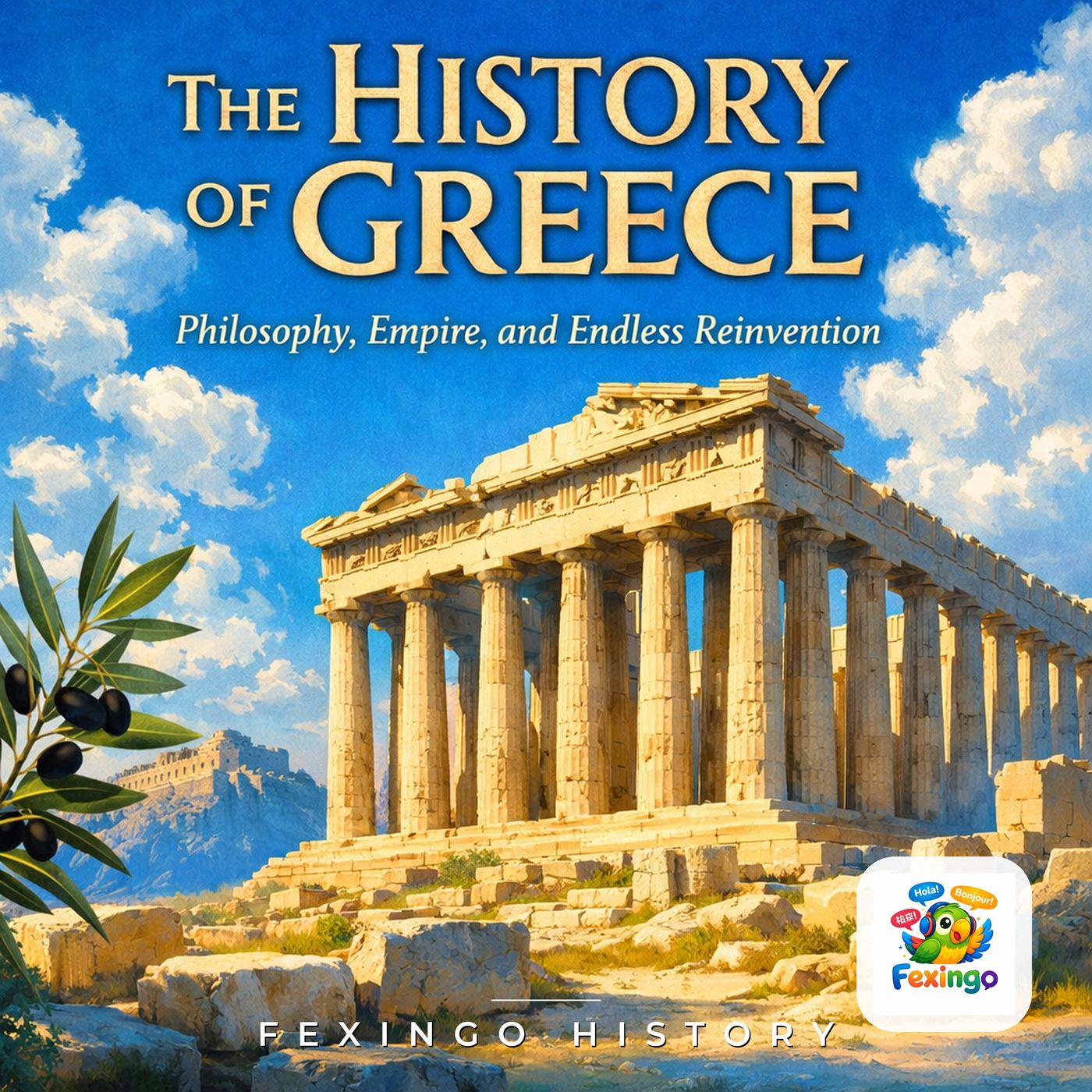
The History of Greece: Philosophy, Empire, and Endless Reinvention — Fexingo History
by Fexingo
From the Minoan thalassocracy to the fall of Constantinople, Greece has reinvented itself more times than any other civilization. Lucas and Luna guide listeners through the labyrinth of Hellenic history: the palace politics of Mycenae, the hoplite phalanxes at Marathon, the philosophical revolutions of Socrates, Plato, and Aristotle, and the imperial ambitions of Alexander the Great. They explore the Hellenistic kingdoms that spread Greek culture to the Indus, the Roman conquest that turned Greece into a province, and the Byzantine Empire that preserved Greek learning for a thousand years. The show examines the fractious city-states—Athens, Sparta, Thebes, Corinth—and their rival alliances like the Delian and Peloponnesian Leagues. It delves into the Persian Wars, the Peloponnesian War’s brutal logic, and Alexander’s campaigns that reshaped the known world. Later episodes cover the Roman-era Greek renaissance under Hadrian, the rise of Christianity, and the Ottoman centuries before the
-
34
The Melting of the Bronze Age: How Climate Destroyed Mycenaean Greece — Fexingo History
Around 1200 BCE, the Mycenaean palaces that had dominated Greece for centuries began to collapse. For a long time, historians blamed invaders—the mysterious Sea Peoples or Dorian tribes. But recent research points to a different culprit: climate change. In this episode, Lucas and Luna explore how a prolonged drought and famine may have brought down the Mycenaean civilization, from the palaces of Mycenae, Tiryns, and Pylos to the collapse of trade networks across the Eastern Mediterranean. They dive into the evidence from sediment cores and tree rings, the Linear B tablets that record desperate food rationing, and the way the Bronze Age Collapse reshaped Greece into the fragmented, proto-Iron Age world of Homer. It's a story of how even the greatest empires can be undone by a shifting climate—a lesson that resonates today.#MycenaeanGreece #BronzeAgeCollapse #LateBronzeAge #ClimateChange #Drought #SeaPeoples #LinearB #Pylos #Mycenae #Tiryns #Paleoclimatology #AncientHistory #GreekHistory #Homer #DarkAges #SedimentCores #TreeRings #FexingoHistory #AncientGreece #ClassicalGreeceBecome a supporter of this podcast: https://www.spreaker.com/podcast/the-history-of-greece-philosophy-empire-and-endless-reinvention-fexingo-history--6985266/support.
-
33
The Peace of Callias: Did Athens Really Make Peace with Persia? — Fexingo History
In this episode of The History of Greece: Philosophy, Empire, and Endless Reinvention, Lucas and Luna dive into one of the most controversial moments in ancient Greek diplomacy: the Peace of Callias. Was it a real treaty ending the Persian Wars in 449 BCE, or was it Athenian propaganda invented centuries later? We explore the evidence from Thucydides, Diodorus Siculus, and Plutarch, the role of the Athenian statesman Callias, and the geopolitical aftermath that allowed Athens to build its empire. From the Battle of the Eurymedon to the Delian League's transformation, we unpack what the peace — real or not — meant for Greek history. Join us for a nuanced look at how historians debate the past, and how a single document (or its absence) can change everything.#PeaceOfCallias #Athens #PersianWars #Callias #Thucydides #DiodorusSiculus #Plutarch #Eurymedon #DelianLeague #ArtaxerxesI #Cimon #Pericles #AncientGreece #GreekHistory #Diplomacy #Historiography #History #FexingoHistory #ClassicalGreece #MinoanCivilizationBecome a supporter of this podcast: https://www.spreaker.com/podcast/the-history-of-greece-philosophy-empire-and-endless-reinvention-fexingo-history--6985266/support.
-
32
The Ionian Revolt: The Spark That Ignited the Persian Wars — Fexingo History
In this episode, we explore the Ionian Revolt (499–493 BCE), the crucial uprising of Greek city-states in Asia Minor against Persian rule that set the stage for the Greco-Persian Wars. We examine the revolt's causes, including the tyranny of Darius's appointees and the appeal of democracy. Key figures like Aristagoras of Miletus, the tyrant-turned-demagogue who sparked the rebellion; the historian Hecataeus, who advised caution; and Artaphernes, the Persian satrap, are discussed. The episode covers the pivotal Battle of Lade, where the Ionian fleet was decisively defeated due to the desertion of the Samian contingent, and the brutal Persian reconquest of Miletus. We also look at the aftermath: the Persian destruction of the Temple of Apollo at Didyma, the deportation of Milesians to the Persian Gulf, and the long-term consequences that led to Marathon and Thermopylae. The conversation delves into the cultural and political dynamics of Ionian identity, the role of the Delphic oracle, and the legacy of the revolt as both a failure and a catalyst for Greek unity.#IonianRevolt #PersianWars #Aristagoras #Miletus #DariusI #Artaphernes #Hecataeus #BattleOfLade #Histiaeus #IonianGreeks #GrecoPersianWars #Sardis #DelphicOracle #TempleOfDidyma #AncientGreece #AchaemenidEmpire #History #FexingoHistory #ClassicalGreece #MinoanCivilizationBecome a supporter of this podcast: https://www.spreaker.com/podcast/the-history-of-greece-philosophy-empire-and-endless-reinvention-fexingo-history--6985266/support.
-
31
The Delian League: From Alliance to Athenian Empire — Fexingo History
In this episode, Lucas and Luna explore the evolution of the Delian League from a voluntary alliance against Persia into an Athenian empire. They discuss the league's founding in 478 BC, the role of Aristides in setting tribute assessments, the transfer of the treasury from Delos to Athens, and key events like the siege of Naxos and the battle of the Eurymedon. They also examine the shift from contributions in ships to cash payments, the use of league funds for Athenian building projects like the Parthenon, and the growing resentment that led to the Peloponnesian War. Figures like Cimon, Pericles, and Thucydides the son of Melesias are discussed, along with the fate of rebellious allies such as Thasos and Samos.#DelianLeague #AthenianEmpire #AncientGreece #PeloponnesianWar #Aristides #Cimon #Pericles #Thucydides #Naxos #Thasos #Samos #Eurymedon #ClassicalAthens #PersianWars #History #FexingoHistory #GreekHistory #Imperialism #ClassicalGreece #MinoanCivilizationBecome a supporter of this podcast: https://www.spreaker.com/podcast/the-history-of-greece-philosophy-empire-and-endless-reinvention-fexingo-history--6985266/support.
-
30
The Siege of Rhodes: Hellenistic Warfare's Greatest Test — Fexingo History
In 305 BC, the island city of Rhodes faced one of the most extraordinary sieges in ancient history. Demetrius Poliorcetes — 'the Besieger' — son of Antigonus Monophthalmus, arrived with a massive army and the most advanced siege equipment the world had ever seen: helepolises towering nine stories high, tunneling machines, and naval blockades. But the Rhodians, led by their admiral Ameinias and with help from Ptolemy I, held out for a full year, turning Demetrius's own weapons against him. This episode explores the siege's engineering marvels, the political maneuvering between the Diadochi, and the legendary Colossus of Rhodes — built with the spoils of Demetrius's abandoned siege equipment. We also uncover the little-known Rhodian resilience and the treaty that preserved their independence as a trading powerhouse. Join Lucas and Luna as they unpack a story of grit, innovation, and the birth of one of the Seven Wonders.#SiegeOfRhodes #DemetriusPoliorcetes #HellenisticWarfare #ColossusOfRhodes #AncientEngineering #Helepolis #Diadochi #PtolemyI #AntigonusMonophthalmus #Ameinias #Rhodes #Mediterranean #AncientHistory #MilitaryHistory #SevenWonders #HellenisticPeriod #History #FexingoHistory #AncientGreece #ClassicalGreeceBecome a supporter of this podcast: https://www.spreaker.com/podcast/the-history-of-greece-philosophy-empire-and-endless-reinvention-fexingo-history--6985266/support.
-
29
The Ostracism of Themistocles: Athens Turns on Its Hero — Fexingo History
After the Battle of Salamis in 480 BCE, Themistocles was the most famous man in Greece. Yet within a decade, Athens ostracized him, and he ended his days as a fugitive in the service of the Persian king Artaxerxes I. This episode explores the politics of ostracism — the democratic institution that let Athenians exile a citizen for ten years by popular vote. Lucas and Luna trace Themistocles' meteoric rise, his cunning use of the silver mines of Lavrion to fund the fleet that saved Greece, and his bitter rivalry with Aristides the Just. They unpack how ostracism worked in practice: the shards of pottery (ostraka) inscribed with names, the annual vote that could target anyone from a general to a potter, and the archaeological discoveries of actual ostraka bearing Themistocles' name. They also examine the historical debate: was Themistocles really a Persian spy in his final years, or just a proud man who outlived his usefulness to the city? The episode ends with a reflection on how democracies treat their heroes when peace returns. Specific figures: Themistocles, Aristides, Cimon, Artaxerxes I, Ephialtes. Places: Athens, Salamis, Magnesia, Argos, Lavrion. Concepts: ostracism, ostraka, Athenian democracy, Persian Empire, long walls.#Themistocles #Ostracism #AthenianDemocracy #Salamis #Aristides #ArtaxerxesI #Lavrion #Ostraka #PersianWars #ClassicalGreece #AncientHistory #Cimon #Ephialtes #Magnesia #Argos #LongWalls #History #FexingoHistory #AncientGreece #MinoanCivilizationBecome a supporter of this podcast: https://www.spreaker.com/podcast/the-history-of-greece-philosophy-empire-and-endless-reinvention-fexingo-history--6985266/support.
-
28
The First Punic War: Rome vs Carthage at Sea — Fexingo History
In this episode, Lucas and Luna explore the First Punic War (264–241 BC), the epic conflict that turned Rome from a land power into a Mediterranean naval force. They dive into the war's origins over control of the Mamertines in Messana, the innovative Roman invention of the corvus (a boarding bridge), and the brutal naval battles at Mylae and the Egadi Islands. Lucas explains how the Roman Republic built a fleet from scratch, copying a captured Carthaginian quinquereme, and how the corvus allowed Roman soldiers to turn sea battles into land fights. The episode covers the massive loss of life on both sides, the role of the Carthaginian general Hamilcar Barca (father of Hannibal), and the war's aftermath: Rome's first province (Sicily) and a Carthaginian indemnity that sowed the seeds for the Second Punic War. Lucas and Luna also discuss the controversy over the corvus's abandonment due to its instability in rough seas, and the significance of the Lutatius Catulus treaty. This is a focused look at a war that transformed the ancient Mediterranean.#FirstPunicWar #Rome #Carthage #Mamertines #Messana #Corvus #Quinquereme #Mylae #EgadiIslands #HamilcarBarca #LutatiusCatulus #Sicily #RomanNavy #AncientNavalWarfare #PunicWars #Mediterranean #History #FexingoHistory #AncientGreece #ClassicalGreeceBecome a supporter of this podcast: https://www.spreaker.com/podcast/the-history-of-greece-philosophy-empire-and-endless-reinvention-fexingo-history--6985266/support.
-
27
The Aetolian League: Greece's Federal Experiment — Fexingo History
In this episode, Lucas and Luna explore the Aetolian League, a federal state that rose to power in 3rd century BC Greece. They discuss its unique political structure, the role of the strategos, the League's clash with Rome in the Aetolian War, and the figure of Skopas. The episode examines how this league of mountain tribes challenged the major Hellenistic kingdoms and Rome, only to be crushed after the Battle of Thermopylae in 191 BC. Key figures include Flamininus, Antiochus III, and the Aetolian general Damocritus. The conversation also touches on the League's alliances, its control of Delphi, and its eventual dissolution into the Roman province of Achaea.#AetolianLeague #AncientGreece #HellenisticPeriod #RomanEmpire #FederalState #Strategos #Skopas #Flamininus #AntiochusIII #Thermopylae #AetolianWar #Delphi #MacedonianWars #Polybius #GreeceHistory #History #FexingoHistory #BattleOfThermopylae #ClassicalGreece #MinoanCivilizationBecome a supporter of this podcast: https://www.spreaker.com/podcast/the-history-of-greece-philosophy-empire-and-endless-reinvention-fexingo-history--6985266/support.
-
26
The Library of Alexandria: Scholarship and Fire — Fexingo History
Long before the Museum and Library of Alexandria became legend, they were the brainchild of Ptolemy I Soter and his son Ptolemy II Philadelphus. In this episode, Lucas and Luna explore how the Ptolemies transformed a small Mediterranean port into the intellectual capital of the Hellenistic world. They discuss the library's founding, its ambitious acquisition policies—including the infamous seizure of ships' books—and the scholars who worked there: Callimachus, Eratosthenes, Euclid, and Aristophanes of Byzantium. They also examine the library's destruction, separating fact from myth across the fires of Julius Caesar, Aurelian, and the Arab conquest. The conversation highlights the library's role as a hub for textual criticism, literary canon formation, and scientific innovation, and reflects on how its legacy of knowledge gathering shaped later civilizations.#LibraryOfAlexandria #PtolemaicKingdom #Callimachus #Eratosthenes #Euclid #Alexandria #HellenisticPeriod #AncientLibraries #PtolemyISoter #PtolemyIIPhiladelphus #MuseumOfAlexandria #TextualCriticism #AristophanesOfByzantium #AncientScholarship #FireOfAlexandria #History #FexingoHistory #AncientGreece #ClassicalGreece #MinoanCivilizationBecome a supporter of this podcast: https://www.spreaker.com/podcast/the-history-of-greece-philosophy-empire-and-endless-reinvention-fexingo-history--6985266/support.
-
25
The Hellenistic Economy: Trade, Piracy, and the Rhodian Maritime Law — Fexingo History
In this episode of The History of Greece, Lucas and Luna explore the economic transformation of the Hellenistic world. They discuss how Alexander's conquests opened up trade routes from India to the Mediterranean, turning Rhodes into a commercial powerhouse. The Rhodian Maritime Law, the first comprehensive code of sea commerce, regulated loans, shipwrecks, and piracy. They delve into the rise of piracy in the eastern Mediterranean, the slave trade, and the political power of merchant guilds. The episode also covers the role of the Ptolemaic grain monopoly, the Seleucid royal economy, and the cultural exchange along the Silk Road. From the invention of the lateen sail to the standardization of coinage, discover how economic forces shaped the Hellenistic kingdoms.#HellenisticEconomy #RhodianMaritimeLaw #Rhodes #Piracy #TradeRoutes #SilkRoad #PtolemaicGrain #SeleucidEmpire #AlexanderTheGreat #HellenisticPeriod #MediterraneanHistory #AncientEconomy #Coinage #SlaveTrade #MerchantGuilds #LateenSail #History #FexingoHistory #AncientGreece #ClassicalGreeceBecome a supporter of this podcast: https://www.spreaker.com/podcast/the-history-of-greece-philosophy-empire-and-endless-reinvention-fexingo-history--6985266/support.
-
24
The Athenian Navy and the Battle of Salamis — Fexingo History
In 480 BCE, the Athenian navy under Themistocles faced the Persian fleet of Xerxes in the narrow straits of Salamis. This episode explores the strategic genius of Themistocles, the construction of the Athenian fleet from the silver mines of Lavrion, the trireme design, and the battle itself. We discuss the alliance with Sparta, the role of the Corinthian commander Adeimantus, and the aftermath that established Athens as a naval power. Drawing on Herodotus and Aeschylus, we separate fact from legend, including the controversial evacuation of Athens and the mysterious disappearance of the Persian fleet after Salamis.#Themistocles #BattleOfSalamis #AthenianNavy #Trireme #PersianWars #Xerxes #LavrionSilverMines #Herodotus #Aeschylus #Adeimantus #NavalHistory #AncientGreece #Marathon #Artemisium #DelianLeague #GreekHistory #History #FexingoHistory #ClassicalGreece #MinoanCivilizationBecome a supporter of this podcast: https://www.spreaker.com/podcast/the-history-of-greece-philosophy-empire-and-endless-reinvention-fexingo-history--6985266/support.
-
23
The Delphic Amphictyony: Greece's Sacred League — Fexingo History
In this episode, Lucas and Luna explore the Delphic Amphictyony, a religious league of Greek tribes that managed the oracle of Apollo at Delphi and the Pythian Games. They trace its origins from the mythical founding by Amphictyon to its political importance in the 4th century BCE, when it became a tool for Thebes and Philip of Macedon. Lucas explains how the Amphictyony controlled the Sacred Wars, notably the Third Sacred War (356–346 BCE), which allowed Philip to intervene in central Greece. They also discuss the organization of the league, the voting rights of its members, and the famous decree to rebuild the Temple of Apollo after an earthquake. The episode covers the decline of the Amphictyony under the Roman Empire and its eventual dissolution under Theodosius I. Specific names include the Oetaeans, Thessalians, and Phocians, as well as the hieromnemones (representatives). Lucas also touches on the Pythian Games' musical competitions and the Pythian truce.#DelphicAmphictyony #Delphi #PythianGames #Amphictyon #ThirdSacredWar #PhilipII #Thebes #Phocis #SacredWars #Apollo #AncientGreece #GreekReligion #Oetaeans #Thessalians #Hieromnemones #PythianTruce #History #FexingoHistory #ClassicalGreece #MinoanCivilizationBecome a supporter of this podcast: https://www.spreaker.com/podcast/the-history-of-greece-philosophy-empire-and-endless-reinvention-fexingo-history--6985266/support.
-
22
The Cynics: Diogenes and the Art of Living Without Shame — Fexingo History
In this episode, Lucas and Luna dive deep into the world of the Cynics, focusing on its most famous (and infamous) figure: Diogenes of Sinope. They explore his radical philosophy of living according to nature, his public acts of defiance (including his famous encounter with Alexander the Great), and how he embodied the Cynic ideals of autarkeia (self-sufficiency) and anaideia (shamelessness). The conversation also covers Diogenes' predecessors (Antisthenes) and successors (Crates of Thebes, who taught Zeno of Citium, founder of Stoicism), and the legacy of Cynic thought in later movements like early Christianity and modern anarchism. Specific topics include Diogenes' exile from Sinope for defacing currency, his life in a tub in Athens, his rejection of social conventions, and the legendary anecdotes told by Diogenes Laërtius. The episode also touches on the Cynic rejection of Plato's theory of Forms and the famous 'plucked chicken' retort.#Diogenes #Cynic #AncientGreece #Philosophy #Autarkeia #Anaideia #AlexanderTheGreat #Antisthenes #CratesOfThebes #ZenoOfCitium #Stoicism #Plato #Sinope #Athens #HellenisticPhilosophy #FexingoHistory #GreekPhilosophy #History #ClassicalGreece #MinoanCivilizationBecome a supporter of this podcast: https://www.spreaker.com/podcast/the-history-of-greece-philosophy-empire-and-endless-reinvention-fexingo-history--6985266/support.
-
21
The Sack of Delphi: Celts vs Greeks in 279 BC — Fexingo History
In 279 BC, a Celtic army swept down from the north and threatened the sacred sanctuary of Delphi. This episode tells the story of the Gallic invasion of Greece, the desperate defense of Delphi, and the aftermath that reshaped the Hellenistic world. We explore the Gallic leader Brennus, the Greek coalition led by the Aetolians, the legendary divine intervention of Apollo, and the eventual settlement of the Celts in Anatolia as the Galatians. Learn about the archaeological evidence from Kallipolis, the political fallout for the Aetolian League, and how this event became a symbol of Greek resistance against barbarian threats. We also discuss the ancient accounts by Pausanias and Diodorus Siculus, and the historical debate over whether the rockslide at Delphi was natural or a miracle.#GallicInvasion #Delphi #Brennus #AetolianLeague #Galatians #CelticHistory #AncientGreece #HellenisticPeriod #Pausanias #BattleOfDelphi #Apollo #GreekSanctuaries #Kallipolis #BarbarianThreat #MilitaryHistory #FexingoHistory #History #AncientWorld #ClassicalGreece #MinoanCivilizationBecome a supporter of this podcast: https://www.spreaker.com/podcast/the-history-of-greece-philosophy-empire-and-endless-reinvention-fexingo-history--6985266/support.
-
20
Plato's Academy: The School That Shaped Western Thought — Fexingo History
In this episode, Lucas and Luna explore the founding and legacy of Plato's Academy, the ancient school in Athens that became the intellectual powerhouse of the classical world. They discuss how Plato established the Academy around 387 BCE, its physical location in the grove of Academus, and its unique structure combining philosophical inquiry, mathematical research, and political training. The conversation delves into key figures like Plato himself, his successors Speusippus and Xenocrates, and the Academy's most famous student, Aristotle. They examine the curriculum, including the study of geometry, astronomy, and dialectic, and how the Academy influenced later institutions, from the Lyceum to medieval universities. Lucas also addresses the Academy's closure by Emperor Justinian in 529 CE, a symbolic end to ancient pagan learning. Along the way, they touch on controversies, such as the Academy's alleged secrecy and its relationship with Athenian politics. This episode offers a fresh perspective on a foundational institution that continues to shape education and philosophy today.#Plato #Academy #AncientGreece #Philosophy #Athens #Speusippus #Xenocrates #Aristotle #Justinian #Lyceum #Mathematics #Dialectic #WesternThought #Hellenistic #Education #History #FexingoHistory #GreekPhilosophy #ClassicalGreece #MinoanCivilizationBecome a supporter of this podcast: https://www.spreaker.com/podcast/the-history-of-greece-philosophy-empire-and-endless-reinvention-fexingo-history--6985266/support.
-
19
The Battle of Pydna: Rome's Decisive Victory Over Macedon — Fexingo History
In 168 BCE, the Roman Republic faced off against the Macedonian kingdom at Pydna, a battle that would end the Antigonid dynasty and seal Greece's fate. This episode dives into the clash between the Roman legion and the Macedonian phalanx, focusing on the manipular system versus the sarissa formation. We explore the roles of Aemilius Paullus and King Perseus, the tactical genius of the Roman commander, and the chaos that ensued when the phalanx broke apart on uneven ground. We also touch on the political aftermath: the division of Macedon into four republics, the deportation of thousands, and the beginning of direct Roman rule over Greece. Lucas and Luna discuss Polybius's account, the symbolism of the captured Macedonian royal treasury, and what the battle meant for the Hellenistic world. This episode offers a vivid, ground-level look at a turning point that reshaped the Mediterranean.#BattleOfPydna #AemiliusPaullus #PerseusOfMacedon #RomanLegion #MacedonianPhalanx #Polybius #AntigonidDynasty #ManipularSystem #Sarissa #HellenisticPeriod #RomanConquest #168BCE #AncientWarfare #MilitaryHistory #Greece #Rome #History #FexingoHistory #AncientGreece #ClassicalGreeceBecome a supporter of this podcast: https://www.spreaker.com/podcast/the-history-of-greece-philosophy-empire-and-endless-reinvention-fexingo-history--6985266/support.
-
18
The Archimedes Palimpsest: A Lost Mind Revealed — Fexingo History
In this episode of The History of Greece, Lucas and Luna explore the extraordinary story of the Archimedes Palimpsest — a medieval prayer book that hides the lost works of antiquity's greatest mathematician. Written over erased Greek texts by a scribe in 1229, the palimpsest contains treatises by Archimedes that were thought lost forever: 'On the Method of Mechanical Theorems,' 'Stomachion,' and 'On Floating Bodies.' Through infrared imaging and scholarly detective work, these erased texts have been recovered, revealing Archimedes' early use of infinity and the combinatorial puzzle of the Stomachion. The episode traces the manuscript's journey from Constantinople to Jerusalem, from a Nazi-era auction to a private collector's vault, and finally to the Walters Art Museum in Baltimore, where modern science unlocked its secrets. Lucas and Luna discuss how this single book reshaped our understanding of ancient Greek mathematics, the ethical complexities of collecting, and what the palimpsest tells us about the transmission of knowledge across centuries.#Archimedes #Palimpsest #GreekMathematics #Syracuse #WaltersArtMuseum #Constantinople #OnFloatingBodies #Stomachion #InfraredImaging #MedievalScribe #Byzantine #LostWorks #HistoryOfScience #ArchimedesPalimpsest #OnMethod #Siracusa #FexingoHistory #History #AncientGreece #ClassicalGreeceBecome a supporter of this podcast: https://www.spreaker.com/podcast/the-history-of-greece-philosophy-empire-and-endless-reinvention-fexingo-history--6985266/support.
-
17
Pyrrhus of Epirus: The King Who Won Too Well — Fexingo History
The phrase 'Pyrrhic victory' is famous, but the man behind it is far more fascinating. In this episode, Lucas and Luna explore the life and campaigns of Pyrrhus of Epirus, the Greek king who nearly defeated Rome. They trace his early adventures as a hostage, his military innovations with war elephants, and his costly victories at Heraclea and Asculum. Lucas explains why Pyrrhus's successes were so ruinous, how his Sicilian gambit failed, and how his tactics influenced later generals like Hannibal. The conversation covers Pyrrhus's diplomacy with Carthage and the Greek cities of Magna Graecia, his use of the Macedonian phalanx against Roman maniples, and the legend of his dying words. Along the way, they touch on his mentor Demetrius Poliorcetes, the Epirote alliance system, and the peculiar nature of 'Pyrrhic victories' in military history. A nuanced portrait of a king who won battles but lost wars.#PyrrhusOfEpirus #PyrrhicVictory #AncientGreece #RomanRepublic #WarElephants #BattleOfHeraclea #BattleOfAsculum #BattleOfBeneventum #Epirus #HellenisticPeriod #MagnaGraecia #Tarentum #Hannibal #MilitaryHistory #AncientWarfare #Phalanx #HistoryOfGreece #FexingoHistory #ClassicalGreece #MinoanCivilizationBecome a supporter of this podcast: https://www.spreaker.com/podcast/the-history-of-greece-philosophy-empire-and-endless-reinvention-fexingo-history--6985266/support.
-
16
The Pyrrhic Victory: How Rome Defeated Pyrrhus of Epirus — Fexingo History
In the early 3rd century BCE, a Greek king from Epirus invaded Italy and nearly broke the Roman Republic. Pyrrhus of Epirus, a brilliant general and relative of Alexander the Great, brought war elephants to Italy and won two devastating battles against Rome — but at such a cost that his name became a byword for hollow triumph. This episode explores the Pyrrhic War (280–275 BCE), the battles of Heraclea and Asculum, the Roman alliance with Carthage, and how Pyrrhus's failure in Sicily sealed his doom. We also examine the legacy: how Rome's resilience against Pyrrhus proved it was a rising power that would soon dominate the Mediterranean. Join Lucas and Luna as they unravel a pivotal moment when Greek ambition met Roman steel.#PyrrhusOfEpirus #PyrrhicWar #AncientGreece #RomanRepublic #Epirus #Heraclea #Asculum #Beneventum #WarElephants #Carthage #HellenisticPeriod #PyrrhicVictory #Pyrrhus #RomeVsGreece #AncientWarfare #History #FexingoHistory #MediterraneanHistory #ClassicalGreece #MinoanCivilizationBecome a supporter of this podcast: https://www.spreaker.com/podcast/the-history-of-greece-philosophy-empire-and-endless-reinvention-fexingo-history--6985266/support.
-
15
The Battle of Cynoscephalae: Rome Breaks Macedon — Fexingo History
In this episode, Lucas and Luna dive into the Battle of Cynoscephalae in 197 BCE, where Roman legions clashed with the Macedonian phalanx for the first time. They explore how Titus Quinctius Flamininus outmaneuvered Philip V using the manipular system, a flexible formation that exploited the phalanx's rigidity on rough terrain. The conversation covers the geopolitical backdrop of the Second Macedonian War, the role of the Aetolian League, and the lasting impact of the battle—declaring Greece 'free' under Roman oversight. They also touch on Polybius' anecdote about Flamininus weeping at the sight of Greek dead, a moment of historical poignancy that shades Rome's imperial ambitions. The episode brings in details like the sarissa, the velites, and the elephant charge, all woven into a narrative that feels immediate and human.#Cynoscephalae #Flamininus #PhilipV #MacedonianPhalanx #RomanManiple #SecondMacedonianWar #AetolianLeague #Polybius #Sarissa #Velites #AncientRome #AncientGreece #MilitaryHistory #BattleAnalysis #HellenisticPeriod #GreekHistory #History #FexingoHistory #ClassicalGreece #MinoanCivilizationBecome a supporter of this podcast: https://www.spreaker.com/podcast/the-history-of-greece-philosophy-empire-and-endless-reinvention-fexingo-history--6985266/support.
-
14
The Cynics: Ancient Greece's Original Outsiders — Fexingo History
Before the Stoics and Epicureans captivated the Hellenistic world, a more radical philosophical movement flourished on the streets of Athens: Cynicism. In this episode, Lucas and Luna explore the life and legacy of Diogenes of Sinope, the most famous Cynic, who rejected all social conventions and lived as a beggar in a clay tub. They discuss his famous encounter with Alexander the Great, his biting wit, and the core Cynic ideal of self-sufficiency (autarkeia) and shamelessness (anaideia). They also examine the origins of Cynicism with Antisthenes, a student of Socrates, and its later influence on Stoicism through Crates and Zeno. The conversation covers Diogenes' provocative acts—like carrying a lamp in daylight looking for an honest man, and parading a plucked chicken to mock Plato's definition of man—and the deeper philosophical critique behind them. Lucas explains how Cynicism offered a radical rejection of wealth, power, and pleasure, and how its outsider stance continues to resonate in modern counterculture movements. Tune in to discover why Diogenes was known as 'Socrates gone mad' and how the Cynics challenged the very foundations of Greek civilization.#Cynicism #DiogenesOfSinope #Antisthenes #AncientPhilosophy #HellenisticPhilosophy #Autarkeia #CratesOfThebes #ZenoOfCitium #AlexanderTheGreat #Plato #Socrates #Athens #AncientGreece #Philosophy #SelfSufficiency #Shamelessness #History #FexingoHistory #ClassicalGreece #MinoanCivilizationBecome a supporter of this podcast: https://www.spreaker.com/podcast/the-history-of-greece-philosophy-empire-and-endless-reinvention-fexingo-history--6985266/support.
-
13
Greek Fire: The Byzantines' Secret Weapon — Fexingo History
In this episode of The History of Greece: Philosophy, Empire, and Endless Reinvention, Lucas and Luna dive into the mysterious incendiary weapon known as Greek fire. Used by the Byzantine Empire from the 7th century onward, this napalm-like substance helped defend Constantinople from Arab sieges and gave the Byzantines a decisive naval advantage. Lucas explains the historical context—the Umayyad sieges of 674–678 and 717–718—and walks through the chemical debates over its composition: was it petroleum-based with quicklime, or included saltpeter? He discusses the legendary siphon projectors mounted on Byzantine dromonds, the role of the inventor Kallinikos of Heliopolis, and the empire's obsessive secrecy that ensured the formula was lost to history. Luna asks about modern experiments and the ethical implications of weaponizing fire. The episode also touches on the broader legacy of Greek fire in medieval warfare and its place in Byzantine identity. Specific names and terms include: Greek fire, Constantinople, Kallinikos, dromond, siphon, Theodore Laskaris, Umayyad, Leo III Isaurian, and the chemical elements quicklime, naphtha, and saltpeter.#GreekFire #ByzantineEmpire #Constantinople #Umayyad #Kallinikos #Dromond #Siphon #MedievalWarfare #IncendiaryWeapon #SiegeOfConstantinople #LeoIII #Napalm #Quicklime #Naphtha #Saltpeter #ByzantineNavy #History #FexingoHistory #AncientGreece #ClassicalGreeceBecome a supporter of this podcast: https://www.spreaker.com/podcast/the-history-of-greece-philosophy-empire-and-endless-reinvention-fexingo-history--6985266/support.
-
12
The Antikythera Mechanism: An Ancient Greek Computer — Fexingo History
In 1901, sponge divers off the coast of Antikythera stumbled upon a shipwreck that yielded a corroded bronze lump. Over a century later, that lump is recognized as the world's first analog computer: the Antikythera Mechanism. This episode explores the device's intricate gears, its ability to predict eclipses and track the Olympic Games, and the mystery of its origin. Did Archimedes or Hipparchus build it? How did such advanced technology vanish for over a millennium? Join Lucas and Luna as they unravel the story of a machine that rewrote our understanding of ancient Greek science, from the craftsmanship of its dials to the computer tomography scans that unlocked its secrets.#AntikytheraMechanism #AncientGreekTechnology #Archimedes #Hipparchus #AnalogComputer #Shipwreck #SpongeDivers #GreekAstronomy #Meteorology #EclipsePrediction #OlympicGames #GreekEngineering #BronzeAge #HistoryOfScience #UnderwaterArchaeology #AncientInventions #History #FexingoHistory #AncientGreece #ClassicalGreeceBecome a supporter of this podcast: https://www.spreaker.com/podcast/the-history-of-greece-philosophy-empire-and-endless-reinvention-fexingo-history--6985266/support.
-
11
The Achaean League and the Sack of Corinth — Fexingo History
In this episode, Lucas and Luna explore the final chapter of independent Greece: the rise and fall of the Achaean League. After the decline of the Aetolian League, the Achaean League emerged as the last major Greek power, uniting Peloponnesian city-states under leaders like Aratus of Sicyon and Philopoemen. We follow their struggle against Spartan tyrants and Macedonian influence, culminating in a fateful alliance with Rome that turned sour. The episode focuses on the siege and sack of Corinth in 146 BCE by the Roman consul Lucius Mummius—a brutal event that ended Greek political autonomy and saw the destruction of Corinth's art and temples. We discuss the role of the Roman Senate, the leadership of Critolaus and Diaeus, and the lasting legacy of this disaster. Lucas brings in details from Polybius, the Greek historian who witnessed the sack firsthand. The episode also touches on the creation of the province of Achaea and how Greece became a Roman protectorate, ending centuries of city-state independence.#AchaeanLeague #SackOfCorinth #LuciusMummius #Philopoemen #AratusOfSicyon #Polybius #Critolaus #Diaeus #146BCE #RomanRepublic #Peloponnese #Corinth #MacedonianWars #LastGreekIndependence #HellenisticGreece #AncientGreece #History #FexingoHistory #ClassicalGreece #MinoanCivilizationBecome a supporter of this podcast: https://www.spreaker.com/podcast/the-history-of-greece-philosophy-empire-and-endless-reinvention-fexingo-history--6985266/support.
-
10
The Aetolian League: Greece's Third Power — Fexingo History
While Athens, Sparta, and Thebes dominate the story of Classical Greece, a different kind of power emerged in the 4th century BCE: the Aetolian League. In this episode of The History of Greece, Lucas and Luna explore how a confederation of mountain tribes and towns in west-central Greece built a state that challenged Macedon and Rome. They trace the League's origins in the 5th century, its rise after the death of Alexander, its unique federal institutions like the primary assembly and the elected general (strategos), and its aggressive expansion into Delphi and the surrounding regions. The episode covers key figures such as the Aetolian leader Skopas, the League's role in the Third and Fourth Macedonian Wars, and its dramatic confrontation with Rome in the Aetolian War (191-189 BCE), ending with the sack of Ambracia and the League's forced submission. It also touches on the League's internal democracy, its control over the Delphic Amphictyony, and how its federal model later influenced the United States. This is a story of an unsung power that held its own for over a century before being crushed by the rising Republic.#AetolianLeague #AncientGreece #FederalState #MacedonianWars #RomanRepublic #Delphi #Ambracia #Skopas #Strategos #ThirdMacedonianWar #AetolianWar #190BCE #Thessaly #Democracy #History #FexingoHistory #GreekHistory #HellenisticPeriod #ClassicalGreece #MinoanCivilizationBecome a supporter of this podcast: https://www.spreaker.com/podcast/the-history-of-greece-philosophy-empire-and-endless-reinvention-fexingo-history--6985266/support.
-
9
The Epicureans: A Philosophy of Pleasure in a Turbulent Age — Fexingo History
In Episode 15 of The History of Greece, Lucas and Luna turn from the Stoics to their great rivals: the Epicureans. Who was Epicurus, and why did he teach that pleasure—understood as the absence of pain and fear—was the highest good? They explore the Garden school in Athens, Epicurus's atomic materialism borrowed from Democritus, and his controversial view that the gods take no interest in human affairs. The conversation covers Epicurean physics, ethics, and the famous Tetrapharmakos or 'four-part cure' for anxiety. They also discuss how Epicureanism spread through the Hellenistic world and later influenced Roman poets like Lucretius. This episode sheds light on a philosophy often misunderstood as mere hedonism, revealing its practical, almost therapeutic goal of achieving ataraxia—tranquility of mind. For history lovers who want to understand the full spectrum of Greek thought beyond Socrates and Plato, this is a deep dive into a school that rivaled Stoicism for centuries.#Epicureanism #Epicurus #AncientPhilosophy #TheGarden #Athens #HellenisticPeriod #Tetrapharmakos #Ataraxia #Atomism #Democritus #Lucretius #Pleasure #PhilosophyOfLife #GreekHistory #FexingoHistory #HistoryPodcast #AncientGreece #Philosophy #ClassicalGreece #MinoanCivilizationBecome a supporter of this podcast: https://www.spreaker.com/podcast/the-history-of-greece-philosophy-empire-and-endless-reinvention-fexingo-history--6985266/support.
-
8
The Stoics: Philosophy for a World in Chaos — Fexingo History
In the upheaval after Alexander's death, a new philosophy emerged in Athens that would shape minds from Roman emperors to modern soldiers. This episode traces Stoicism from its founder Zeno of Citium, a Phoenician merchant who lost everything in a shipwreck, to its evolution through Cleanthes and Chrysippus. We explore the core Stoic ideas: living according to nature, the dichotomy of control, and the concept of the logos as a rational principle governing the universe. Learn how Zeno taught in the Stoa Poikile, or Painted Porch, how Chrysippus systematized the school into a comprehensive worldview encompassing logic, physics, and ethics, and why Stoicism became the go-to philosophy for Greeks and Romans facing political turmoil. We also touch on the paradox of the Stoic sage and the school's enduring influence on cognitive behavioral therapy. A concise dive into a philosophy that promised resilience in an unpredictable world.#Stoicism #ZenoOfCitium #Chrysippus #Cleanthes #StoaPoikile #AncientPhilosophy #HellenisticPeriod #Athens #Logos #DichotomyOfControl #GreekPhilosophy #Philosophy #CognitiveBehavioralTherapy #AncientGreece #HellenisticPhilosophy #History #FexingoHistory #PhilosophyOfResilience #ClassicalGreece #MinoanCivilizationBecome a supporter of this podcast: https://www.spreaker.com/podcast/the-history-of-greece-philosophy-empire-and-endless-reinvention-fexingo-history--6985266/support.
-
7
The Hellenistic Kingdoms: Greek Culture after Alexander — Fexingo History
After Alexander the Great's death in 323 BCE, his empire splintered into rival kingdoms ruled by his generals, the Diadochi. This episode explores the Hellenistic period that followed, focusing on the Seleucid Empire in the east, the Ptolemaic Kingdom in Egypt, and the Antigonid dynasty in Macedon. We discuss how Greek culture spread across the Near East, from the founding of cities like Antioch and Alexandria to the fusion of Greek and local traditions. Key figures include Seleucus I Nicator, who built a sprawling empire from Anatolia to India; Ptolemy I Soter, who established a Greek dynasty in Egypt and founded the Library of Alexandria; and Antigonus II Gonatas, who stabilized Macedon. We delve into the cosmopolitan nature of Hellenistic cities, the role of Greek as a lingua franca, and the cultural exchanges that produced hybrid art, religion, and science. The episode also covers the decline of these kingdoms in the face of Rome's rise, culminating in the Battle of Pydna in 168 BCE, which ended Macedonian independence. Join Lucas and Luna as they unpack the legacy of this often-overlooked era, when Greek civilization became a world civilization.#HellenisticPeriod #SeleucidEmpire #PtolemaicKingdom #AntigonidDynasty #AlexanderTheGreat #Diadochi #SeleucusINicator #PtolemyISoter #AntigonusIIGonatas #Alexandria #LibraryOfAlexandria #BattleOfPydna #GreekCulture #Hellenization #AncientHistory #Mediterranean #FexingoHistory #History #AncientGreece #ClassicalGreeceBecome a supporter of this podcast: https://www.spreaker.com/podcast/the-history-of-greece-philosophy-empire-and-endless-reinvention-fexingo-history--6985266/support.
-
6
Alexander the Great's Death and the Wars of the Successors — Fexingo History
In 323 BCE, Alexander the Great died suddenly in Babylon at age 32, leaving no clear heir and an empire that stretched from Greece to India. His generals, the Diadochi, immediately began jockeying for power, triggering four decades of war that would reshape the ancient world. This episode explores the immediate chaos after Alexander's death—the Babylon Settlement, the rise of Perdiccas, the revolt of the Greek cities in the Lamian War, and the brutal infighting among figures like Ptolemy, Antigonus Monophthalmus, Seleucus, and Lysimachus. We examine how Alexander's body was hijacked by Ptolemy, how Perdiccas was assassinated by his own officers, and how the empire fractured into successor kingdoms. Special attention is given to the Battle of Ipsus (301 BCE), where Antigonus fell, and to the cultural legacy of Hellenization that followed. We also touch on lesser-known figures like Eumenes of Cardia, a Greek secretary who became a brilliant general, and the role of the Silver Shields—Alexander's elite veterans—who ultimately betrayed their commander for gold. This is the story of how Alexander's dream died, and the Hellenistic world was born.#AlexanderTheGreat #Diadochi #HellenisticPeriod #BattleOfIpsus #Ptolemy #Seleucus #AntigonusMonophthalmus #Perdiccas #LamianWar #EumenesOfCardia #SilverShields #BabylonSettlement #Lysimachus #Cassander #AncientGreece #FexingoHistory #History #Podcast #ClassicalGreece #MinoanCivilizationBecome a supporter of this podcast: https://www.spreaker.com/podcast/the-history-of-greece-philosophy-empire-and-endless-reinvention-fexingo-history--6985266/support.
-
5
Philip II: The Macedonian Who Conquered Greece — Fexingo History
In this episode, Lucas and Luna explore the rise of Philip II of Macedon, the father of Alexander the Great, who transformed his kingdom into the dominant power in Greece. They discuss Philip's early years as a hostage in Thebes, his military reforms—including the creation of the Macedonian phalanx with the sarissa pike—and his innovative use of diplomacy, bribery, and marriage alliances to unify the fractious Greek city-states. The episode covers key battles like the Battle of Chaeronea in 338 BCE, where Philip, alongside his son Alexander, crushed the combined forces of Athens and Thebes, ending Greek independence. Lucas also delves into Philip's assassination in 336 BCE, the controversies surrounding his death, and the legacy of his League of Corinth. Throughout, they highlight how Philip's achievements laid the groundwork for Alexander's conquests, yet are often overshadowed by his son's fame.#PhilipII #Macedon #BattleofChaeronea #Sarissa #MacedonianPhalanx #LeagueofCorinth #AlexanderTheGreat #Demosthenes #SacredBand #Thebes #Athens #AncientGreece #MilitaryHistory #ClassicalAntiquity #History #FexingoHistory #GreekHistory #MacedonianEmpire #ClassicalGreece #MinoanCivilizationBecome a supporter of this podcast: https://www.spreaker.com/podcast/the-history-of-greece-philosophy-empire-and-endless-reinvention-fexingo-history--6985266/support.
-
4
Epaminondas and the Battle of Leuctra: The End of Spartan Supremacy — Fexingo History
In this episode, Lucas and Luna explore the dramatic end of Sparta's dominance in Greece, focusing on the Theban general Epaminondas and his revolutionary tactics at the Battle of Leuctra in 371 BCE. They discuss the rise of Thebes after the Peloponnesian War, the Sacred Band of Thebes, and how Epaminondas used an oblique formation to crush the Spartan phalanx. The conversation also covers the subsequent invasion of the Peloponnese, the liberation of Messenian helots, and the founding of Messene. Lucas explains how Epaminondas's innovations—like deepening the left flank and using cavalry as a shock force—changed Greek warfare forever. They touch on the political aftermath: the brief Theban hegemony, the death of Epaminondas at Mantinea, and the ultimate exhaustion of the Greek city-states that paved the way for Macedon.#Epaminondas #BattleOfLeuctra #Sparta #Thebes #SacredBand #Phalanx #Hoplite #PeloponnesianWar #Mantinea #MessenianHelots #Messene #GreekWarfare #AncientGreece #History #FexingoHistory #MilitaryHistory #ClassicalGreece #ThebanHegemony #MinoanCivilization #MycenaeanGreeceBecome a supporter of this podcast: https://www.spreaker.com/podcast/the-history-of-greece-philosophy-empire-and-endless-reinvention-fexingo-history--6985266/support.
-
3
Corinthian War: The Battle That Broke Spartan Power — Fexingo History
After defeating Athens in the Peloponnesian War, Sparta became the undisputed hegemon of Greece, but its brutal rule quickly bred resentment. By 395 BCE, a coalition of Athens, Thebes, Corinth, and Argos—backed by Persian gold—rose up against Sparta. In this episode, Lucas and Luna explore the Corinthian War (395–387 BCE), a chaotic conflict that saw the first major use of mercenaries, the revival of Athenian naval power, and the devastating Battle of Cnidus where the Persian fleet destroyed Sparta's navy. At the heart of the story is Conon, the Athenian admiral who rebuilt Athens' Long Walls with Persian money, and Agesilaus II, the Spartan king who fought a bitter campaign in Asia Minor before rushing home to defend his city. The war ended not on a battlefield but at the Peace of Antalcidas, a treaty dictated by the Persian king Artaxerxes II that shattered the myth of Greek independence. We also look at the role of the Corinthian commander Timolaus, the use of the peltast light infantry, and how this forgotten war set the stage for Thebes' rise under Epaminondas.#CorinthianWar #AncientGreece #Sparta #Athens #Thebes #Corinth #Persia #Conon #AgesilausII #ArtaxerxesII #BattleOfCnidus #PeaceOfAntalcidas #Peltast #Mercenaries #PeloponnesianWarAftermath #GreekHistory #History #FexingoHistory #ClassicalGreece #MinoanCivilizationBecome a supporter of this podcast: https://www.spreaker.com/podcast/the-history-of-greece-philosophy-empire-and-endless-reinvention-fexingo-history--6985266/support.
-
2
Socrates and the Trial That Defined Athens — Fexingo History
In this episode of The History of Greece, Lucas and Luna explore the trial and execution of Socrates, one of the most iconic events in classical history. They set the scene in 399 BCE Athens, just a few years after the restoration of democracy following the tyranny of the Thirty. Lucas explains the political and social tensions that led to Socrates' indictment on charges of impiety and corrupting the youth. He details the key accusers—Meletus, Anytus, and Lycon—and the role of Socrates' association with controversial figures like Alcibiades and Critias. The conversation covers the Apology, Socrates' famous defense speech, and his provocative claim that 'the unexamined life is not worth living.' Lucas describes the narrow conviction, the proposed punishment, and Socrates' refusal to flee or compromise, which led to his death by hemlock. They also discuss the aftermath: how Plato, who witnessed the trial, immortalized Socrates in his dialogues. This episode reveals how the philosopher's martyrdom became a foundation for Western philosophy and a cautionary tale about democracy's treatment of dissent.#Socrates #TrialOfSocrates #AncientAthens #GreekPhilosophy #Plato #Apology #399BCE #Hemlock #Democracy #AthenianLaw #Meletus #Anytus #Lycon #Critias #Alcibiades #WesternPhilosophy #History #FexingoHistory #AncientGreece #ClassicalGreeceBecome a supporter of this podcast: https://www.spreaker.com/podcast/the-history-of-greece-philosophy-empire-and-endless-reinvention-fexingo-history--6985266/support.
-
1
The End of Athens: Lysander, the Thirty Tyrants, and Sparta's Brutal Victory — Fexingo History
The Peloponnesian War didn't end with a whimper but with a roar — and a Spartan general named Lysander. In this episode, Lucas and Luna explore the final, devastating act of Athens' war against Sparta. Lysander, a ruthless and innovative commander, rebuilt the Spartan navy with Persian gold, outmaneuvered Athenian fleets at Notium and Arginusae, and finally crushed them at Aegospotami in 405 BCE. The siege of Athens that followed brought famine, surrender, and the dismantling of the Athenian empire — its walls torn down to the music of flutes. But Lucas explains that the real brutality came after: the installation of the Thirty Tyrants, a pro-Spartan oligarchy that terrorized Athens for eight months, executing thousands and driving many into exile. The episode also touches on the aftermath: the democratic restoration, the trial of Socrates, and how the war's legacy echoed through Greek history. Specific names and events include Lysander, the Battle of Aegospotami, the Long Walls, the Thirty Tyrants, Critias, Theramenes, Thrasybulus, and the amnesty of 403 BCE.#Lysander #PeloponnesianWar #BattleOfAegospotami #ThirtyTyrants #Critias #Theramenes #Thrasybulus #SpartanHegemony #AthensSurrender #LongWalls #AncientGreece #GreekHistory #Socrates #DemocracyRestored #Amnesty403BCE #WarAndPeace #History #FexingoHistory #ClassicalGreece #MinoanCivilizationBecome a supporter of this podcast: https://www.spreaker.com/podcast/the-history-of-greece-philosophy-empire-and-endless-reinvention-fexingo-history--6985266/support.
-
0
Alcibiades: The Traitor Who Saved Athens — Fexingo History
In this episode, Lucas and Luna explore the wild career of Alcibiades, the most controversial figure of the Peloponnesian War. From his youth as Pericles' ward and pupil of Socrates, to his role in convincing Athens to launch the disastrous Sicilian Expedition, Alcibiades defected to Sparta, then to Persia, and finally returned to Athens as a general. They discuss the mutilation of the Hermae, his military brilliance at Cyzicus, and how his shifting loyalties changed the course of the war. Learn about the battle of Notium, the oligarchic coup of the Four Hundred, and the tragic irony of Athens' desperate need for a man they never trusted.#Alcibiades #PeloponnesianWar #SicilianExpedition #AncientGreece #Athens #Sparta #Socrates #Hermae #FourHundred #Cyzicus #Notium #Thucydides #Xerxes #Greece #History #FexingoHistory #AncientHistory #Podcast #ClassicalGreece #MinoanCivilizationBecome a supporter of this podcast: https://www.spreaker.com/podcast/the-history-of-greece-philosophy-empire-and-endless-reinvention-fexingo-history--6985266/support.
-
-1
The Plague of Athens: How Disease Destroyed Pericles' Golden Age — Fexingo History
In 430 BC, at the height of the Peloponnesian War, a mysterious plague swept through Athens, killing perhaps a third of its population and shattering the city's confidence. Lucas and Luna explore Thucydides' harrowing firsthand account of the disease, its symptoms, its social consequences, and the tragic death of Pericles himself. They discuss how the plague eroded trust in law, religion, and civic duty, and how it changed the course of the war. They also touch on modern theories about what the pathogen might have been—typhoid fever, Ebola-like viral hemorrhagic fever, or something else—and why Thucydides' description remains a model for understanding epidemics today. This episode brings to life a turning point often overshadowed by battles and politics, showing how a invisible enemy reshaped history.#PlagueOfAthens #Pericles #Thucydides #PeloponnesianWar #Athens #AncientGreece #Epidemics #TyphoidFever #Ebola #HistoryOfMedicine #GreekHistory #FexingoHistory #AncientHistory #WarAndDisease #ThucydidesAccount #PericlesDeath #Sparta #History #ClassicalGreece #MinoanCivilizationBecome a supporter of this podcast: https://www.spreaker.com/podcast/the-history-of-greece-philosophy-empire-and-endless-reinvention-fexingo-history--6985266/support.
-
-2
Pericles and the Golden Age: How Athens Ruled an Empire — Fexingo History
In this episode, Lucas and Luna explore the era of Pericles, the towering statesman who led Athens during its most powerful decades. They discuss how the Delian League, originally a defensive alliance against Persia, was transformed into an Athenian empire through force and tribute. Lucas recounts Pericles' ambitious building program — the Parthenon and the Long Walls — and the radical democracy that paid citizens for public service. They also examine the controversial 'Megarian Decree' that helped trigger the Peloponnesian War, and Pericles' famous Funeral Oration, which still resonates as a vision of democratic ideals. Along the way, they touch on key figures like Thucydides, Phidias, and Aspasia, and the tensions between Athens' imperial might and its democratic values.#Pericles #GoldenAgeOfAthens #DelianLeague #AthenianEmpire #Parthenon #LongWalls #FuneralOration #Thucydides #Phidias #Aspasia #MegarianDecree #PeloponnesianWar #AncientGreece #History #FexingoHistory #AncientDemocracy #ClassicalAthens #Acropolis #ClassicalGreece #MinoanCivilizationBecome a supporter of this podcast: https://www.spreaker.com/podcast/the-history-of-greece-philosophy-empire-and-endless-reinvention-fexingo-history--6985266/support.
-
-3
Themistocles and the Wooden Walls: How Athens Bet on the Sea — Fexingo History
In the decade after Marathon, Athens faced the existential threat of a second Persian invasion under Xerxes. This episode zeroes in on Themistocles, the brilliant and controversial politician who persuaded Athens to bet everything on naval power. We explore his radical ship-building program funded by the Laurion silver mines, the creation of the largest fleet in Greek history, and the desperate strategy behind the 'wooden walls' oracle. We also examine the rivalries with Aristides, the internal debates at Athens, and the astonishing mobilization that set the stage for the decisive battles of Artemisium and Salamis. This is a story of foresight, risk, and the transformation of Athens from a land power into a maritime empire — a pivot that would define the Classical Age.#Themistocles #Athens #PersianWars #Xerxes #Salamis #Artemisium #LaurionSilver #WoodenWalls #OracleAtDelphi #Aristides #Trireme #NavalWarfare #ClassicalGreece #HistoryOfGreece #FexingoHistory #AncientHistory #GreekHistory #MediterraneanHistory #AncientGreece #MinoanCivilizationBecome a supporter of this podcast: https://www.spreaker.com/podcast/the-history-of-greece-philosophy-empire-and-endless-reinvention-fexingo-history--6985266/support.
-
-4
The Battle of Marathon: How Athens Defeated Persia — Fexingo History
In this episode, Lucas and Luna dive into the Battle of Marathon, one of the most pivotal moments in Greek history. They explore how a vastly outnumbered Athenian force, aided by the Plataeans, faced the Persian army of Darius I on the plains of Marathon in 490 BCE. Lucas explains the strategic genius of the Athenian general Miltiades, who convinced his fellow commanders to attack despite the odds. They discuss the hoplite phalanx in action, the famous 'double envelopment' tactic that crushed the Persian center, and the controversial role of the Persian cavalry—was it even present? The conversation also touches on the legendary runner Pheidippides, the rise of Athenian confidence that led to the golden age of Pericles, and the deep cultural memory of this victory. Along the way, they consider the archaeological evidence from the battlefield and the political aftermath that shaped Greek identity. A deep dive into a battle that changed the world.#BattleOfMarathon #AncientGreece #PersianWars #Miltiades #DariusI #Athens #Plataea #Hoplite #Phalanx #Pheidippides #490BCE #Marathon #AncientHistory #MilitaryHistory #GreekHistory #PersianEmpire #History #FexingoHistory #ClassicalGreece #MinoanCivilizationBecome a supporter of this podcast: https://www.spreaker.com/podcast/the-history-of-greece-philosophy-empire-and-endless-reinvention-fexingo-history--6985266/support.
-
-5
The Dawn of Greece: From Minoans to the Birth of Democracy — Fexingo History
In this pilot episode of The History of Greece, Lucas and Luna begin at the very beginning—standing before the ruins of Knossos on Crete, where the Minoan civilization flourished around 2000 BCE. They explore the labyrinthine palace of King Minos, the myth of the Minotaur, and the mysterious Linear A script. Then they jump forward to Mycenae, the bronze-age powerhouse that fought the Trojan War, and meet Agamemnon. Finally, they land in the so-called Dark Age, only to see the first flicker of what would become the polis, or city-state. Lucas explains how the geography of Greece—its mountains and seas—shaped its fractured, competitive culture. They touch on the emergence of the hoplite phalanx, the spread of colonies across the Mediterranean, and the stirrings of philosophy in Ionia. By the end, the stage is set for the classical era: Athens, Sparta, and the revolutionary idea that ordinary citizens could govern themselves. A reflective question about what we owe to the Greeks lingers in the air.#MinoanCivilization #Knossos #LinearA #Mycenae #TrojanWar #Agamemnon #GreekDarkAge #Polis #Hoplite #Colonization #IonianPhilosophy #Thales #Crete #Mediterranean #AncientHistory #Greece #Democracy #FexingoHistory #AncientGreece #ClassicalGreeceBecome a supporter of this podcast: https://www.spreaker.com/podcast/the-history-of-greece-philosophy-empire-and-endless-reinvention-fexingo-history--6985266/support.
No matches for "" in this podcast's transcripts.
No topics indexed yet for this podcast.
Loading reviews...
ABOUT THIS SHOW
From the Minoan thalassocracy to the fall of Constantinople, Greece has reinvented itself more times than any other civilization. Lucas and Luna guide listeners through the labyrinth of Hellenic history: the palace politics of Mycenae, the hoplite phalanxes at Marathon, the philosophical revolutions of Socrates, Plato, and Aristotle, and the imperial ambitions of Alexander the Great. They explore the Hellenistic kingdoms that spread Greek culture to the Indus, the Roman conquest that turned Greece into a province, and the Byzantine Empire that preserved Greek learning for a thousand years. The show examines the fractious city-states—Athens, Sparta, Thebes, Corinth—and their rival alliances like the Delian and Peloponnesian Leagues. It delves into the Persian Wars, the Peloponnesian War’s brutal logic, and Alexander’s campaigns that reshaped the known world. Later episodes cover the Roman-era Greek renaissance under Hadrian, the rise of Christianity, and the Ottoman centuries before the
HOSTED BY
Fexingo
Loading similar podcasts...
URL copied to clipboard!