
PODCAST · education
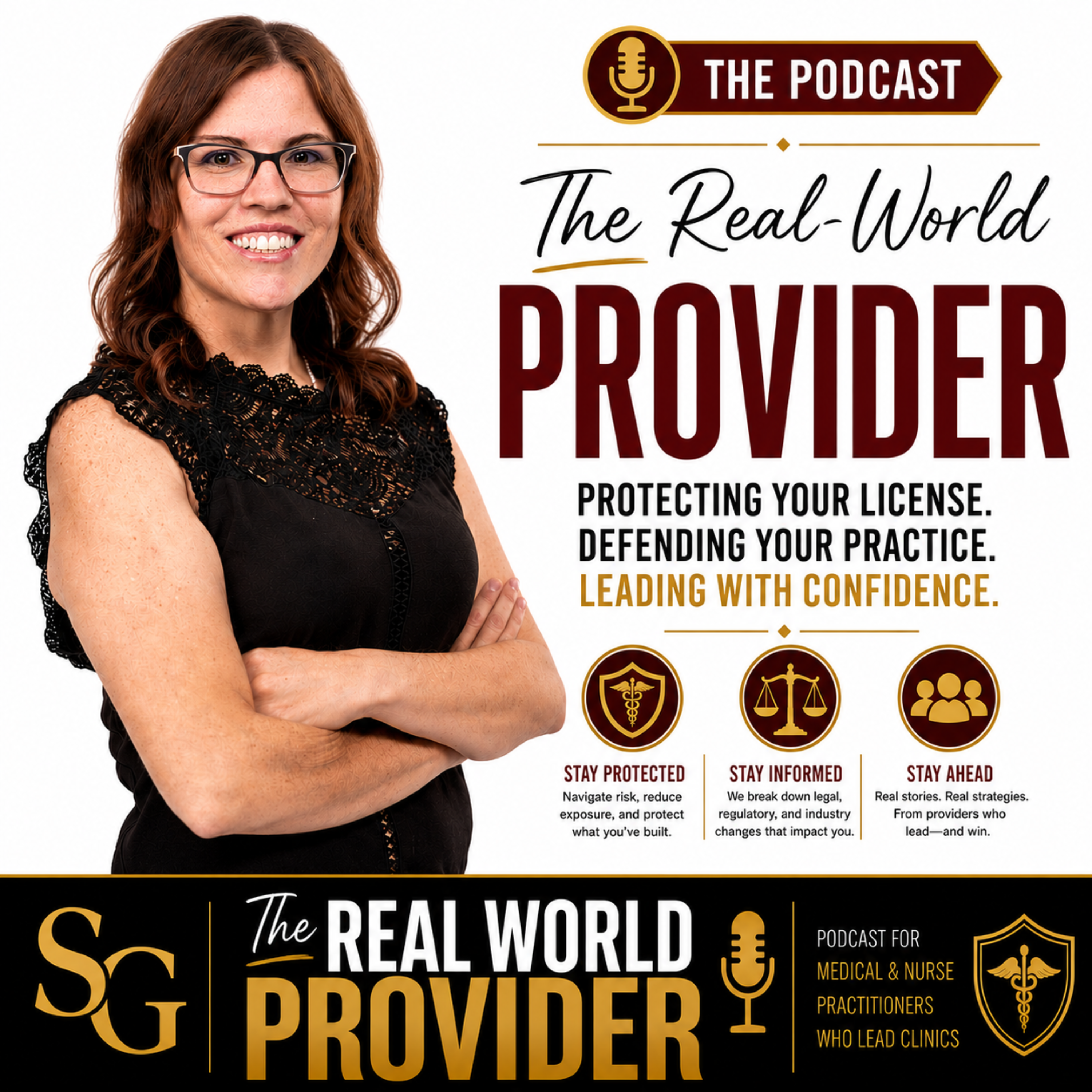
The Real-World Provider
by Danni Owens, FNP
Welcome back to the podcast.If you’re a nurse, NP, PA, or provider running—or working in—a clinic, this episode is for you.Because today, we’re talking about something that almost no one prepares you for…And yet, it can cost you your license, your livelihood, and your peace.And it all comes down to one sentence:“We tried to go by the book… but no one ever gave us the book.”Disclaimer:This podcast is produced by Slimming Grace Academy and is intended for educational and informational purposes only. The content discussed is not medical advice and should not be used as a substitute for professional medical judgment, diagnosis, or treatment. Listening to this podcast does not establish a provider–patient relationship. Always consult a qualified healthcare professional regarding individual medical decisions.
-
17
Peptides in the Clinic: What Providers Need to Know Before Offering Peptide Therapy
Peptide therapy is one of the fastest-growing areas in clinical practice — and one of the most confusing when it comes to what's legal, what's evidence-based, and what actually belongs in your clinic. In this episode of The Real World Provider, Danni Owens, FNP-BC, breaks down the peptides every healthcare provider should know about in 2026: from healing peptides like BPC-157 and TB-500, to growth hormone secretagogues like ipamorelin and CJC-1295, to immune modulators, cognitive enhancers, longevity peptides, and more. This episode covers the 2026 FDA reclassification announcement, the difference between Category 1 and Category 2 peptides, what RFK Jr.'s announcement actually means for your practice, and the five things every provider needs to do before prescribing peptide therapy. If you're an NP, PA, or physician offering — or considering — peptide therapy in your clinic, this is your real-world guide. Peptides covered: BPC-157, TB-500, GHK-Cu, Ipamorelin, CJC-1295, Sermorelin, Thymosin Alpha-1, AOD-9604, Selank, Semax, KPV, MOTS-c, Epitalon, DSIP, and Kisspeptin-10.
-
16
Running a Weight Loss Clinic on GLP-1s: What Every Provider Needs to Know Right Now
Are you a provider running — or thinking about starting — a weight loss clinic using GLP-1 medications? In this episode of The Real World Provider, Danni Owens, FNP-BC, breaks down everything healthcare providers need to know about semaglutide and tirzepatide in 2026. From the FDA's oral Wegovy approval to the compounding pharmacy legal battles, prescribing authority by state, clinical protocols, cash-pay pricing models, and where the GLP-1 market is heading — this is the real-world guide to building a sustainable weight loss practice with GLP-1 receptor agonists. Whether you're an NP, PA, or MD looking to add GLP-1 prescribing to your clinic, or you're already offering weight management services and want to stay ahead of the regulatory changes, this episode covers it all. Topics include: semaglutide (Ozempic, Wegovy), tirzepatide (Mounjaro, Zepbound), 503A vs. 503B compounding pharmacies, FDA shortage list updates, patient selection criteria, titration protocols, side effect management, cash-pay clinic models, oral GLP-1 medications, insurance coverage trends, and how to compete with telehealth and retail clinics.
-
15
-
14
When Staff Betray You: Internal Threats to Your License: Episode 11
Let me start with something that most providers do not want to hear. Some of the biggest threats to your license… Are not patients. They’re not competitors. They’re not even investigators. Sometimes the biggest threat to your license… Is sitting in the chair at your front desk. Or drawing blood in your lab room. Or texting your patients from the clinic phone. And I say this with complete respect for good staff — because great staff are priceless.
-
13
Documentation That Defends You in Court and at the Board: Episode 10
Let me say something that may completely shift how you chart starting today. Your documentation is not for the patient. It is not for billing. It is not for insurance. It is not for your memory. Your documentation is for the worst day of your career. It is for the attorney reading it five years from now. It is for the Board investigator who has never met you. It is for the expert witness who is trying to decide if you were reckless… or reasonable. Documentation is not a task. It is a defense strategy. And today, we’re talking about how to document in a way that protects you in court and at the Board. Because minimal charting is comfortable… But comprehensive charting is protective.
-
12
Toxic Competition and Reporting Culture in Healthcare: Episode 9
There is something happening in healthcare that nobody wants to say out loud. Some investigations… Don’t start with patient harm. They start with competition. They start with jealousy. They start with someone watching your growth and deciding they don’t like it. And instead of improving their own clinic… They file a complaint. Welcome to the reporting culture of modern healthcare. Where your success can become someone else’s motive. Today we’re talking about toxic competition — how it shows up, how it escalates, and how to protect yourself without becoming paranoid. Because we’re not operating in fear. We’re operating in awareness.
-
11
You’re Practicing Medicine Like an Employee — But You Own the Clinic - Episode 8
Slimming Grace Academy Keywords: board investigation, patient complaint, medical license, documentation, malpractice insurance, healthcare attorney, emotional impact, preventative measures, clinical reasoning, patient safety summary In this episode, we explore the critical steps to take when a patient complaint escalates into a board investigation. The discussion emphasizes the importance of documentation, emotional management, and strategic responses in the first 72 hours following an investigation notice. Listeners are guided through the process of auditing their practices, understanding the emotional toll of investigations, and implementing preventative measures to safeguard their medical licenses. takeaways What you do in the next 72 hours can protect your license. Most investigations do not start because you harm someone. You lose your license because your documentation doesn't defend you. Do not alter a single chart. You need to look at it as if you're the investigator. If needed, consult a healthcare attorney. Demonstrate corrective action. An investigation does not mean that you're incompetent. The goal is not survival. The goal is prevention. Protect your license like it feeds your family. Titles Navigating Board Investigations: A Strategic Approach The First 72 Hours: Protecting Your License sound bites "Do not alter a single chart." "If needed, consult a healthcare attorney." "Demonstrate corrective action." Chapters 00:00 Introduction to Board Investigations 02:23 Understanding the Investigation Process 04:47 Critical Steps in the First 72 Hours 06:45 Emotional Impact of Investigations 07:45 Preventative Measures for Board Proof Medicine
-
10
When a Patient Complaint Turns Into a Board Investigation – What To Do in the First 72 Hours - Episode 7
Keywords: board investigation, patient complaint, medical license, documentation, malpractice insurance, healthcare attorney, emotional impact, preventative measures, clinical reasoning, patient safety summary In this episode, we explore the critical steps to take when a patient complaint escalates into a board investigation. The discussion emphasizes the importance of documentation, emotional management, and strategic responses in the first 72 hours following an investigation notice. Listeners are guided through the process of auditing their practices, understanding the emotional toll of investigations, and implementing preventative measures to safeguard their medical licenses. takeaways What you do in the next 72 hours can protect your license. Most investigations do not start because you harm someone. You lose your license because your documentation doesn't defend you. Do not alter a single chart. You need to look at it as if you're the investigator. If needed, consult a healthcare attorney. Demonstrate corrective action. An investigation does not mean that you're incompetent. The goal is not survival. The goal is prevention. Protect your license like it feeds your family. Titles Navigating Board Investigations: A Strategic Approach The First 72 Hours: Protecting Your License sound bites "Do not alter a single chart." "If needed, consult a healthcare attorney." "Demonstrate corrective action." Chapters 00:00 Introduction to Board Investigations 02:23 Understanding the Investigation Process 04:47 Critical Steps in the First 72 Hours 06:45 Emotional Impact of Investigations 07:45 Preventative Measures for Board Proof Medicine
-
9
EXCLUSIVE - My Story
This episode is not a scandal. It’s a warning — and a survival story. In this raw, unfiltered episode, I share what really happened when I became the target of a professional investigation — how it started, how fear was used as leverage, and how quickly your career can feel like it’s slipping out of your hands, even when you’ve done nothing intentionally wrong. I walk you through: How investigative agencies use pressure and urgency to push providers into “quick decisions” What it feels like to be told — before a hearing — that your license could be on the line Why being “cooperative” can sometimes hurt you more than help you How consent agreements, letters of intent, and “friendly conversations” are not always what they seem And the moment I realized the system is not designed to protect providers — it’s designed to test how much fear you can tolerate I also share my experience with federal oversight, how past mistakes can be resurrected years later, and the emotional toll of realizing that the rules change once you’re under scrutiny. If you are a nurse, NP, PA, or provider who owns a practice — or plans to — this episode is not optional listening. This is what they don’t teach you in school. This is what no one warns you about. And this is why being clinically skilled is not enough anymore. 🎧 Listen. Learn. Protect your license.
-
8
The Gap Between What You’re Taught and What Can Cost You Everything: Episode 6
If you’ve been listening to this show from the beginning, then you already know this isn’t a podcast about hypotheticals. This is a podcast about what actually happens when real providers collide with real systems. We started this series with Clinic Under Fire—that moment when everything you’ve worked for suddenly feels unstable. Then we talked about investigations in healthcare, the hidden mistakes providers don’t realize they’re making, documentation that looks fine until it isn’t, and that dangerous mindset of “everyone does it”—until suddenly, it’s a problem. Today’s episode is the connective tissue between all of those.
-
7
Understanding Investigations in Healthcare - Episode 2
You don’t get blindsided because you’re reckless. You get blindsided because no one tells you where the real risks are.
-
6
Hidden Mistakes in Healthcare - Episode 3
In Episode 3 of The Real-World Provider, we talk about the hidden mistakes providers make every day without realizing they’re creating risk. These aren’t reckless decisions—they’re common habits, shortcuts, and assumptions that feel normal inside a clinic.
-
5
Clinic Under Fire
Clinic Under Fire: When We Tried to Go by the Book—But No One Gave Us the Book
-
4
When “Everyone Does It” Becomes a Problem - Episode 4
Just because something is common doesn’t mean it’s safe. In this episode of The Real-World Provider, we unpack how shared habits, clinic culture, and industry norms quietly create risk for individual providers. You’ll learn why following what others do doesn’t protect you, how boards view “standard practice,” and why inherited systems often become liabilities. This episode is especially important for providers working in group practices, specialty clinics, aesthetics, or weight loss settings. If you’ve ever relied on “this is how it’s always been done,” this episode is for you.
-
3
Documentation That Looks Fine—Until It Isn’t - Episode 5
In Episode 5 of The Real-World Provider, we take a deep dive into documentation that appears complete, appropriate, and routine—yet falls apart under regulatory review. This episode explains the difference between clinical documentation and defensible documentation, how charts are interpreted during investigations, and why explanations don’t matter if they aren’t written down. If you’ve ever assumed your charting would “speak for itself,” this episode will fundamentally change how you document.
We're indexing this podcast's transcripts for the first time — this can take a minute or two. We'll show results as soon as they're ready.
No matches for "" in this podcast's transcripts.
No topics indexed yet for this podcast.
Loading reviews...
ABOUT THIS SHOW
Welcome back to the podcast.If you’re a nurse, NP, PA, or provider running—or working in—a clinic, this episode is for you.Because today, we’re talking about something that almost no one prepares you for…And yet, it can cost you your license, your livelihood, and your peace.And it all comes down to one sentence:“We tried to go by the book… but no one ever gave us the book.”Disclaimer:This podcast is produced by Slimming Grace Academy and is intended for educational and informational purposes only. The content discussed is not medical advice and should not be used as a substitute for professional medical judgment, diagnosis, or treatment. Listening to this podcast does not establish a provider–patient relationship. Always consult a qualified healthcare professional regarding individual medical decisions.
HOSTED BY
Danni Owens, FNP
Loading similar podcasts...
URL copied to clipboard!