
PODCAST · history
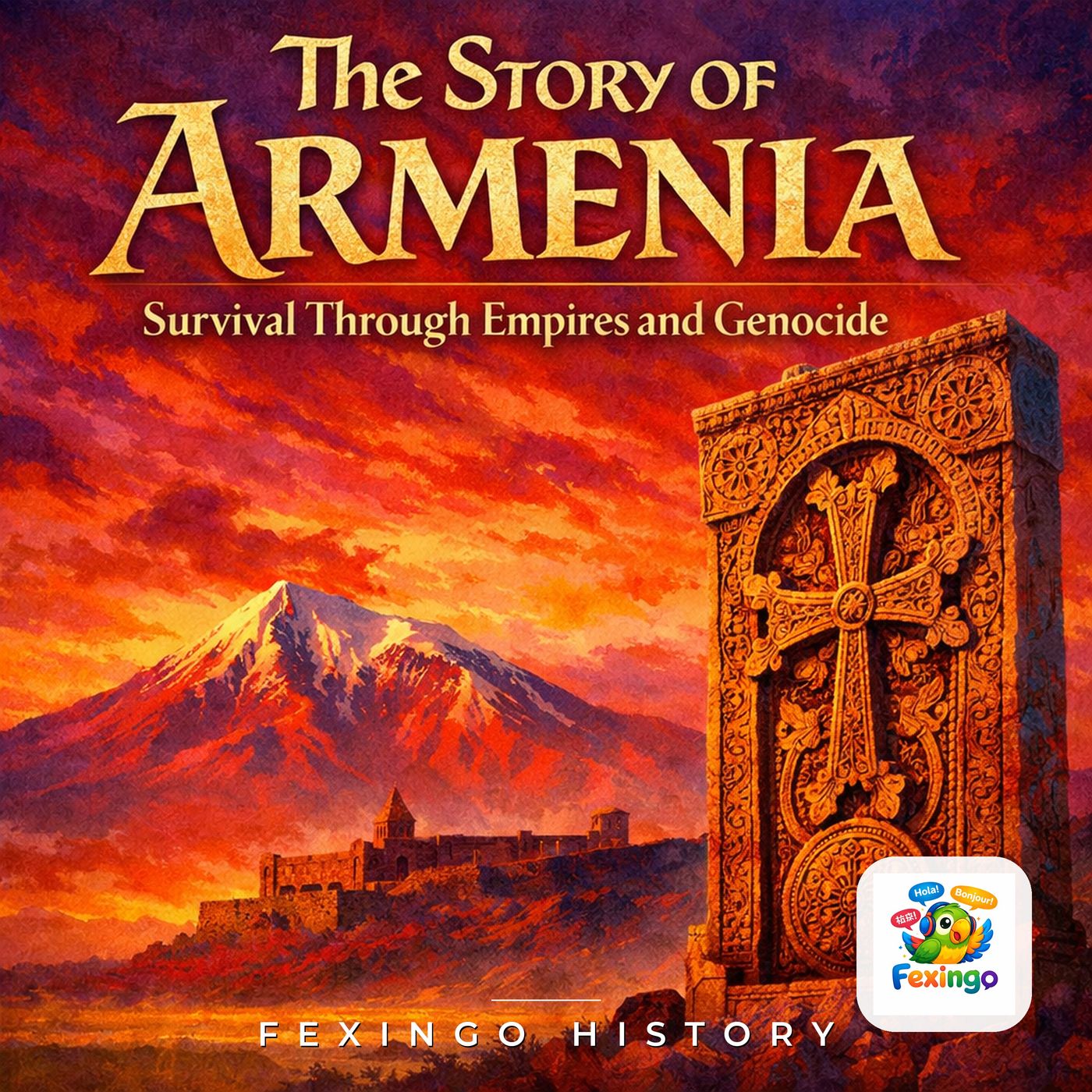
The Story of Armenia: Survival Through Empires and Genocide — Fexingo History
by Fexingo
Perched at the crossroads of East and West, the Armenian Highlands have witnessed the rise and fall of empires for millennia. In 'The Story of Armenia: Survival Through Empires and Genocide,' hosts Lucas and Luna guide listeners through a saga of resilience that begins with the Urartian kingdom (9th–6th centuries BCE) and extends to the modern Republic of Armenia. The series traces Armenia's adoption of Christianity as a state religion in 301 CE under King Tiridates III, the creation of the unique Armenian alphabet by Mesrop Mashtots, and the country's role as a buffer between Rome and Persia, Byzantium and the Seljuks, Ottomans and Safavids. It delves into the medieval Bagratid and Cilician Armenian kingdoms, the devastating Mongol invasions, and the centuries under Ottoman, Persian, and Russian rule. The show does not flinch from the darkest chapters: the Hamidian massacres (1894–1896), the Adana massacre (1909), and the Armenian Genocide (1915–1923), which erased 1.5 million lives.
-
34
Urartu: The Mountain Kingdom Before Armenia — Fexingo History
Long before the kingdom of Tigranes the Great or the conversion to Christianity, the Armenian highlands were home to a powerful and sophisticated civilization: Urartu. In this episode, Lucas and Luna explore the rise and fall of the Kingdom of Van, centered around the majestic fortress of Tushpa. They discuss how the Urartians built an irrigation network that still waters the fields of modern Armenia, the mystery of their cuneiform inscriptions left on mountainsides, and the devastating invasion by the Scythians and Medes that brought their kingdom to an end. Lucas explains how Urartu's legacy persisted through the Armenian language and the name Ararat itself, linking biblical tradition to archaeological fact. From the god Ḫaldi to the canals of Menua, this episode uncovers the roots of Armenian civilization in the Bronze and Iron Ages, setting the stage for everything that followed.#Urartu #KingdomOfVan #Tushpa #Ararat #Cuneiform #Aldi #Menua #ArgishtiI #SarduriII #Scythians #Medes #ArmenianHistory #BronzeAge #IronAge #AncientNearEast #Caucasus #FexingoHistory #History #MountArarat #ArmenianGenocideBecome a supporter of this podcast: https://www.spreaker.com/podcast/the-story-of-armenia-survival-through-empires-and-genocide-fexingo-history--6985433/support.
-
33
Tigranes the Great: Armenia's Forgotten Superpower — Fexingo History
Long before the Roman Empire crushed Armenia between the millstones of geopolitics, an Armenian king briefly made his kingdom the most powerful state in the Near East. In this episode, Lucas and Luna explore the astonishing career of Tigranes II—better known as Tigranes the Great—who at his height ruled an empire stretching from the Caspian Sea to the Mediterranean. They trace his rise from a hostage prince to a king who conquered the Seleucid Empire, built a magnificent capital at Tigranocerta, and took the title 'King of Kings'. But his ambition brought him into conflict with Rome's Lucius Licinius Lucullus and later Pompey the Great. Lucas explains the dramatic Battle of Tigranocerta in 69 BCE, where Tigranes' polyglot army faced Roman discipline—and lost. He also discusses the diplomatic tightrope Tigranes walked between Rome and his father-in-law Mithridates VI of Pontus, the eventual collapse of his empire, and the legacy of a ruler who, for a fleeting moment, made Armenia the heart of an empire. For anyone who thinks Armenia was always a pawn, this episode reveals a king who almost changed the course of history.#TigranesTheGreat #Tigranocerta #ArmenianEmpire #KingOfKings #Lucullus #Pompey #Mithridates #SeleucidEmpire #RomanRepublic #BattleOfTigranocerta #ArtaxiadDynasty #HellenisticPeriod #AncientArmenia #HistoryOfArmenia #CaucasusHistory #EmpireBuilding #AncientWarfare #FexingoHistory #ArmenianHistory #MountAraratBecome a supporter of this podcast: https://www.spreaker.com/podcast/the-story-of-armenia-survival-through-empires-and-genocide-fexingo-history--6985433/support.
-
32
Armenian Legions of Rome: Emperor Trajan's Forgotten Allies — Fexingo History
In this episode, Lucas and Luna explore a little-known chapter of Armenian history: the Armenian legions that fought for the Roman Empire. They follow the story of the Legio I and II Armeniaca, auxiliary units raised in the Armenian Highlands during the Roman-Parthian wars. Lucas explains how these troops were deployed as limitanei on the eastern frontiers, garrisoning forts like Satala and helping secure Rome's border against Persian invasions. The conversation covers Trajan's annexation of Armenia in 114 CE, the creation of the province of Armenia Maior, and the crucial role Armenian archers and cavalry played in Rome's military machinery. They also touch on the legacy of these legions in Armenian folk memory and the debated connection to modern Armenian symbols like the eagle and the double-headed axe. Listeners will learn about key figures such as Emperor Trajan, King Tiridates I, and the later Armenian legionaries who were stationed as far away as Britain. A must-listen for anyone fascinated by Armenia's strategic importance in the ancient world.#LegioArmeniaca #Trajan #ArmeniaMaior #RomanArmenia #Satala #ParthianWars #AncientArmenia #RomanLegions #TiridatesI #CaucasusHistory #MilitaryHistory #AncientRome #ArmenianHighlands #Limitanei #RomanAuxiliaries #ArmenianCavalry #History #FexingoHistory #ArmenianHistory #MountAraratBecome a supporter of this podcast: https://www.spreaker.com/podcast/the-story-of-armenia-survival-through-empires-and-genocide-fexingo-history--6985433/support.
-
31
Armenia's Iron Curtain: The First Republic's Struggle for Survival — Fexingo History
Fresh off the collapse of the tsarist empire, the First Armenian Republic faced a desperate fight for existence from 1918 to 1920. This episode zooms in on the republic's founding moment at the Battle of Sardarabad, where an improvised civilian army halted the Ottoman advance and secured a fragile independence. We explore the republic's internal challenges: a starving population, a shattered economy, and the impossible task of building a state in the chaos of the Russian Civil War. Lucas and Luna discuss the controversial Treaty of Batum, which reduced Armenia to a sliver of its historical territory, and the doomed diplomacy with the Allied powers in Paris. Key figures like Aram Manukian and Hovhannes Kachaznuni come to life as they navigate betrayal by former allies and the relentless pressure of Kemalist Turkey and Bolshevik Russia. The episode concludes with the republic's final days, the Sovietization orchestrated by the Red Army, and the question of whether those two years of independence—so brief and brutal—meant anything at all. A story of defiance against overwhelming odds, and the bitter cost of sovereignty.#FirstRepublicOfArmenia #BattleOfSardarabad #AramManukian #TreatyOfBatum #HovhannesKachaznuni #ArmenianGenocideAftermath #Dashnaksutyun #RussianCivilWar #KemalistTurkey #Sovietization #ParisPeaceConference #CaucasusHistory #OttomanEmpire #ArmenianIndependence #SardarabadMemorial #20thCenturyHistory #History #FexingoHistory #ArmenianHistory #MountAraratBecome a supporter of this podcast: https://www.spreaker.com/podcast/the-story-of-armenia-survival-through-empires-and-genocide-fexingo-history--6985433/support.
-
30
The Battle of Sarikamish: Armenians in the Russian Army — Fexingo History
In December 1914, as World War I raged, the Russian Imperial Army launched an offensive into Ottoman territory near the city of Sarikamish. Among the Russian forces were thousands of Armenian soldiers serving in volunteer battalions, many of whom had survived the Hamidian massacres and saw this as a chance to liberate their homeland. This episode tells the story of the Battle of Sarikamish—a catastrophic Ottoman defeat that cost tens of thousands of lives—and the pivotal role of Armenian volunteers like Khetcho and Dro. We examine how the battle hardened Ottoman suspicions of Armenian loyalty, directly leading to the deportations and genocide that began months later. Lucas and Luna explore the clash of empires, the heroism of Armenian troops, and the tragic irony that their service would be used to justify their destruction.#Sarikamish #ArmenianVolunteers #WWI #OttomanEmpire #RussianEmpire #EnverPasha #Khetcho #Dro #ArmenianGenocide #CaucasusCampaign #BattleOfSarikamish #ArmenianHistory #History #FexingoHistory #ArmenianBattalions #HamidianMassacres #WorldWarI #Erzurum #MountArarat #UrartuBecome a supporter of this podcast: https://www.spreaker.com/podcast/the-story-of-armenia-survival-through-empires-and-genocide-fexingo-history--6985433/support.
-
29
The Kingdom of Commagene: An Armenian Kingdom on the Euphrates — Fexingo History
In this episode, Lucas and Luna explore the fascinating Kingdom of Commagene, a small but strategically vital Armenian kingdom that flourished between the 1st century BCE and 1st century CE. Nestled in the upper Euphrates valley, Commagene was a unique fusion of Armenian, Persian, and Hellenistic cultures, best exemplified by the spectacular tomb-sanctuary of King Antiochus I Theos at Mount Nemrut. Lucas explains how Commagene navigated the shifting power dynamics between the Roman Republic and the Parthian Empire, eventually being annexed by Rome under Emperor Vespasian in 72 CE. The episode also delves into the kingdom's religious syncretism, with Antiochus I claiming descent from both the Persian Achaemenid king Darius I and the Greek conqueror Alexander the Great. Listeners will learn about the ruins of Arsameia, the Tyche of Commagene, and the extraordinary limestone statues at Nemrut that still stand today. The conversation touches on the kingdom's role as a buffer state and its legacy in Armenian history as a testament to cultural resilience.#Commagene #Nemrut #AntiochusI #KingdomOfCommagene #Euphrates #RomanEmpire #ParthianEmpire #Hellenistic #ArmenianHistory #MountNemrut #Arsameia #Vespasian #DariusI #AlexanderTheGreat #Tyche #Syncretism #History #FexingoHistory #MountArarat #UrartuBecome a supporter of this podcast: https://www.spreaker.com/podcast/the-story-of-armenia-survival-through-empires-and-genocide-fexingo-history--6985433/support.
-
28
Armenia's Lost Kingdom: The Principality of Khachen — Fexingo History
After the fall of the Bagratuni kingdom and the Seljuk invasions, much of historic Armenia fell under foreign rule — but in the rugged mountains of Artsakh (Nagorno-Karabakh), a small Armenian principality not only survived but thrived for centuries. This episode explores the Principality of Khachen (also known as the Kingdom of Artsakh), a little-known but resilient Armenian state that endured from the 10th to the 18th century. We discuss how its mountain fortresses, like the impenetrable fortress of Kachen, and its strategic location along trade routes allowed it to resist Mongol, Turkic, and Persian invasions. We also cover its unique cultural legacy, including the creation of the Dadivank monastery complex and the spectacular Haghpat Monastery (though it's in neighboring Lori, the cultural ties are deep). And we touch on the rise of the melikdoms — the Armenian noble houses that preserved a degree of autonomy under Persian rule, and whose legacy fueled later Armenian nationalism. This is a story of survival against the odds, and a crucial chapter in Armenia's long history of endurance.#Khachen #Artsakh #NagornoKarabakh #Dadivank #Haghpat #Melikdoms #ArmenianHistory #Caucasus #MedievalArmenia #Seljuk #MongolInvasion #Safavid #ArmenianNobility #Fortress #MountainKingdom #Survival #History #FexingoHistory #MountArarat #UrartuBecome a supporter of this podcast: https://www.spreaker.com/podcast/the-story-of-armenia-survival-through-empires-and-genocide-fexingo-history--6985433/support.
-
27
Vaspurakan: The Forgotten Kingdom of Armenian Kings — Fexingo History
In this episode of The Story of Armenia, Lucas and Luna explore the Kingdom of Vaspurakan, a powerful Armenian state that flourished in the 9th and 10th centuries around Lake Van. They discuss its ruling Artsruni dynasty, the construction of the magnificent Holy Cross Cathedral on Akdamar Island, and the kingdom's eventual absorption into the Byzantine Empire. The episode highlights King Gagik I Artsruni, the cathedral's architect Trdat, and the unique blend of Armenian, Persian, and Byzantine influences that defined Vaspurakan's culture.#Vaspurakan #Artsruni #GagikIArtsruni #Akdamar #HolyCrossCathedral #Trdat #LakeVan #ByzantineEmpire #ArmenianKingdom #MedievalArmenia #ArmenianArchitecture #Bagratuni #9thCentury #10thCentury #Caucasus #History #FexingoHistory #ArmenianHistory #MountArarat #UrartuBecome a supporter of this podcast: https://www.spreaker.com/podcast/the-story-of-armenia-survival-through-empires-and-genocide-fexingo-history--6985433/support.
-
26
The Battle of Avarayr: Faith and Fire in Fifth-Century Armenia — Fexingo History
In 451 CE, on the plains of Avarayr in Persarmenia, a small Armenian army, outnumbered and outmatched, stood against the might of the Sassanid Persian Empire. Their commander, Vartan Mamikonian, led them not for territory or treasure, but for the right to remain Christian — the right to read their scriptures in Mesrop Mashtots' newly created Armenian alphabet, to baptize their children in the name of Christ. This episode explores the events leading to that desperate battle: the Sassanid shah Yazdegerd II's edict forcing Zoroastrianism on the Armenian nobility, the cryptic letters from the Persian court, and the failed uprising that preceded it. We examine the battle itself — the charge of the Armenian cataphracts against Persian war elephants — and its aftermath: Vartan's martyrdom, the collapse of organized resistance, but the stunning survival of Armenian Christianity. Why? Because the Persians realized they could not destroy a faith so fiercely defended. We also discuss the legacy: how the Battle of Avarayr became a defining moment of Armenian identity, celebrated in literature and liturgy, and how it set the stage for future resistance. Featuring figures like Vartan Mamikonian, his brother Hmayak, the Catholicos Hovsep I, and the Persian general Mihr Narseh.#Armenia #Avarayr #VartanMamikonian #SassanidEmpire #YazdegerdII #ArmenianChristianity #Zoroastrianism #MihrNarseh #Persarmenia #451CE #Martyrdom #ArmenianApostolicChurch #Cataphracts #WarElephants #PersianArmenia #AncientHistory #History #FexingoHistory #ArmenianHistory #MountAraratBecome a supporter of this podcast: https://www.spreaker.com/podcast/the-story-of-armenia-survival-through-empires-and-genocide-fexingo-history--6985433/support.
-
25
Armenia and the Silk Road: Merchants, Monasteries, and Cultural Exchange — Fexingo History
In this episode of The Story of Armenia, Lucas and Luna explore the pivotal role of the Armenian Highlands as a crossroads of the ancient Silk Road. They discuss how Armenian merchants, monasteries, and kingdoms facilitated trade between East and West, exchanging goods like silk, spices, and lapis lazuli, as well as ideas—including Christianity, art, and technology. The conversation covers the impact of the Silk Road on Armenian cities like Dvin and Ani, the emergence of the Armenian merchant community in New Julfa under the Safavids, and the lasting cultural legacy of this exchange, from khachkars to manuscripts. Lucas highlights key figures such as the 13th-century merchant prince Khoja Panoush, discusses the role of the Armenian Church in providing safe havens along trade routes, and delves into how the Mongol conquests both disrupted and revived trade. The episode also touches on the decline of the Silk Road with the rise of maritime trade and the fall of the Mongol Empire, and how Armenian Diaspora communities in Venice and India continued these networks. New listeners will learn about specific trade goods, the logistics of caravans, and how the Silk Road shaped Armenian identity and survival amidst empires.#SilkRoad #Armenia #Trade #NewJulfa #Dvin #Ani #KhojaPanoush #Mongols #Safavids #Christianity #Khachkar #Manuscript #Diaspora #Caucasus #History #FexingoHistory #CulturalExchange #MedievalTrade #ArmenianHistory #MountAraratBecome a supporter of this podcast: https://www.spreaker.com/podcast/the-story-of-armenia-survival-through-empires-and-genocide-fexingo-history--6985433/support.
-
24
Armenia's Medieval Kingdom of Cilicia: A Crusader State — Fexingo History
In this episode, Lucas and Luna explore the Kingdom of Cilician Armenia, a unique crusader state that emerged in the 12th century on the Mediterranean coast. They discuss how the Rubenid dynasty established a principality after the Seljuk conquest of Greater Armenia, and how Cilicia became a crucial ally of the Crusader states. Lucas explains the crowning of Levon I as king in 1198, the role of the Hethumid dynasty, and the kingdom's flourishing trade with Italian city-states like Genoa and Venice. The conversation also covers the kingdom's cultural and religious fusion, its adoption of Western chivalric practices, and the eventual decline under Mamluk pressure. Luna asks about the kingdom's end with Levon V and the lasting legacy of Cilician Armenia in Armenian identity.#CilicianArmenia #RubenidDynasty #LevonI #HethumidDynasty #CrusaderStates #MamlukSultanate #Genoa #Venice #Sis #CrusaderKingdoms #MedievalArmenia #ArmenianHistory #LevonV #PrinceBohemond #PopeCelestineIII #Korikos #History #FexingoHistory #MountArarat #UrartuBecome a supporter of this podcast: https://www.spreaker.com/podcast/the-story-of-armenia-survival-through-empires-and-genocide-fexingo-history--6985433/support.
-
23
The Armenian Alphabet: A Script That Saved a Nation — Fexingo History
In this episode, Lucas and Luna explore the creation of the Armenian alphabet by Mesrop Mashtots in 405 AD. They discuss how this 36-letter script was developed not just to translate the Bible, but to forge a cultural identity that would preserve Armenian Christianity and language through centuries of foreign domination. Lucas explains the political context under King Vramshapuh, the role of the Catholicos Sahak Partev, and the legend of Mashtots receiving divine inspiration. They also cover the script's unique features, such as its order echoing the Greek alphabet and its inclusion of letters for sounds not found in other languages. The conversation touches on the immediate impact: the Golden Age of Armenian literature, the translation of works by Greek and Syriac scholars, and the establishment of schools. Luna asks about the challenges of creating a new script from scratch, and Lucas describes how Mashtots traveled to Edessa, Samosata, and even among the Georgian and Caucasian Albanian communities. They conclude by reflecting on how the alphabet became a symbol of resilience, especially during the genocide, when it was used to record testimonies and preserve memory. A deep dive into how a writing system can be an act of defiance and a vessel for a people's soul.#ArmenianAlphabet #MesropMashtots #GoldenAge #ArmenianLiterature #Christianity #Vramshapuh #SahakPartev #Edessa #Samosata #CaucasianAlbania #GeorgianAlphabet #Translation #Bible #Identity #Resilience #Genocide #History #FexingoHistory #ArmenianHistory #MountAraratBecome a supporter of this podcast: https://www.spreaker.com/podcast/the-story-of-armenia-survival-through-empires-and-genocide-fexingo-history--6985433/support.
-
22
Armenian Fedayi: Guerrilla Fighters Before the Genocide — Fexingo History
Before the Armenian Genocide, a generation of Armenian guerrilla fighters known as fedayi took up arms to defend their villages in the Ottoman Empire's eastern provinces. This episode follows the story of the fedayi movement from the late 19th century through the 1908 Young Turk Revolution. We discuss key figures like Aghbiur Serob, Andranik Ozanian, and Kevork Chavush, and their battles at Holy Apostles Monastery and Sulukh. Lucas and Luna explore how these fighters emerged in response to Hamidian massacres and Kurdish raids, their tactics, their complex relationships with Ottoman authorities and Armenian political parties like the Dashnaks and Hunchaks, and the legacy they left for Armenian resistance. The conversation also touches on the role of fedayi women like Sosé Mayrig, and how the movement's ethos influenced later armed struggles in the Caucasus and diaspora. This is a deep dive into a lesser-known but crucial aspect of Armenian history, blending military history, social context, and national memory.#ArmenianFedayi #AghbiurSerob #AndranikOzanian #KevorkChavush #SosMayrig #OttomanArmenia #HamidianMassacres #ArmenianGenocide #Dashnaksutyun #Hunchak #HolyApostlesMonastery #Sulukh #GuerrillaWarfare #ArmenianHistory #Caucasus #History #FexingoHistory #Resistance #MountArarat #UrartuBecome a supporter of this podcast: https://www.spreaker.com/podcast/the-story-of-armenia-survival-through-empires-and-genocide-fexingo-history--6985433/support.
-
21
Armenian Music: The Soul of a People — Fexingo History
In this episode, Lucas and Luna explore the rich and resilient tradition of Armenian music, from ancient liturgical chants to modern folk melodies. They begin with the invention of the Armenian alphabet and the development of khaz notation, which preserved sacred music for centuries. Moving to the 20th century, they discuss the life and work of Komitas Vardapet, the ethnomusicologist who collected over 3,000 folk songs and became a symbol of cultural survival after the Armenian Genocide. They touch on the Soviet era's influence, the revival through the duduk, and the global reach of Armenian musicians like Aram Khachaturian. The episode also covers the role of music in preserving identity in the diaspora, with specific examples from the post-genocide community in Lebanon and the United States. Throughout, Lucas and Luna emphasize how music acted as a vessel for memory and resistance, echoing the broader story of Armenia's survival through empires and genocide.#ArmenianMusic #Komitas #KhazNotation #Duduk #AramKhachaturian #ArmenianGenocide #Ethnomusicology #FolkMusic #LiturgicalChant #ArmenianDiaspora #SovietArmenia #CulturalSurvival #MountArarat #Caucasus #ArmenianHistory #MusicHistory #FexingoHistory #History #Urartu #TiridatesIIIBecome a supporter of this podcast: https://www.spreaker.com/podcast/the-story-of-armenia-survival-through-empires-and-genocide-fexingo-history--6985433/support.
-
20
Armenian Architecture: The Hidden Masterpieces of Tatev and Geghard — Fexingo History
This episode of The Story of Armenia explores the architectural wonders of medieval Armenia, focusing on the monasteries of Tatev and Geghard. Lucas and Luna discuss the unique construction techniques, the symbolism of cross-stones (khachkars), and the role of Prince Ashot III and Queen Khosrovanuysh in commissioning these structures. They delve into the legend of Tatev's swinging pillar, the acoustic properties of Geghard's rock-cut chambers, and the survival of these sites through invasions and earthquakes. The conversation also touches on the work of architect Momik and the preservation efforts of the modern era. Specific terms like Gavazan, Astvatsatsin, and the Syunik region are woven into the narrative, providing listeners with concrete details about Armenia's architectural heritage and its resilience through centuries of foreign domination.#ArmenianArchitecture #TatevMonastery #GeghardMonastery #Khachkar #PrinceAshotIII #QueenKhosrovanuysh #Momik #Syunik #Gavazan #Astvatsatsin #MedievalArmenia #Caucasus #CrossStones #RockCutArchitecture #ArmenianHistory #FexingoHistory #History #Podcast #MountArarat #UrartuBecome a supporter of this podcast: https://www.spreaker.com/podcast/the-story-of-armenia-survival-through-empires-and-genocide-fexingo-history--6985433/support.
-
19
The Armenian Diaspora: From Silk Road to Global Community — Fexingo History
In this episode, Lucas and Luna explore the Armenian diaspora, tracing its roots from the medieval Silk Road to the modern global network of Armenian communities. They discuss early merchant colonies in India and Persia, the role of Armenian traders in the Safavid and Mughal empires, the establishment of the first Armenian printing press in Venice, and the impact of the 1915 genocide on the dispersal of Armenians worldwide. The conversation highlights key figures like the merchant prince Khoja Panoush, the Mamluk-era diaspora in Cilicia, and the cultural institutions that sustained Armenian identity abroad. They also touch on the post-Soviet wave of emigration and the strong diasporic ties to the homeland. This episode offers a unique lens on Armenian history through the story of its global communities.#ArmenianDiaspora #SilkRoad #KhojaPanoush #SafavidEmpire #MughalIndia #ArmenianPrinting #Venice #NewJulfa #OttomanArmenians #GenocideAftermath #DiasporaCommunities #ArmenianIdentity #GlobalHistory #TradeNetworks #CulturalSurvival #History #FexingoHistory #Podcast #ArmenianHistory #MountAraratBecome a supporter of this podcast: https://www.spreaker.com/podcast/the-story-of-armenia-survival-through-empires-and-genocide-fexingo-history--6985433/support.
-
18
Soviet Armenia: Stalin, Spitak, and the Karabakh Movement — Fexingo History
In episode 7 of The Story of Armenia, Lucas and Luna explore Armenia's 20th-century odyssey within the USSR, from Stalin's purges to the 1988 Spitak earthquake and the Nagorno-Karabakh conflict. They discuss how Soviet modernization transformed Yerevan, the role of the Armenian diaspora in the Karabakh movement, and the enduring legacy of the 1915 genocide in shaping national identity. The conversation touches on key figures like Anastas Mikoyan, the first Soviet Armenian to hold high office, and the cultural touchstones of Komitas and the Matenadaran. It's a story of survival, resilience, and the moral ambiguities faced by a nation caught between empires.#SpitakEarthquake #NagornoKarabakh #SovietArmenia #Stalin #AnastasMikoyan #Komitas #Matenadaran #KarabakhMovement #Perestroika #Gorbachev #Yerevan #ArmenianDiaspora #ArmenianGenocide #USSR #History #FexingoHistory #Caucasus #ModernArmenia #ArmenianHistory #MountAraratBecome a supporter of this podcast: https://www.spreaker.com/podcast/the-story-of-armenia-survival-through-empires-and-genocide-fexingo-history--6985433/support.
-
17
The First Armenian Republic: Independence Amid Chaos — Fexingo History
In the wake of the Armenian Genocide and the collapse of the Ottoman and Russian empires, a fragile window of opportunity opened for Armenian statehood. This episode examines the short-lived First Republic of Armenia (1918–1920), focusing on its desperate struggle for survival against Ottoman forces, famine, and territorial disputes with neighboring Georgia and Azerbaijan. We explore the pivotal Battle of Sardarabad, where Armenian forces repelled an Ottoman invasion, and the subsequent Treaty of Batum that forced Armenia to cede vast territories. The republic's leaders—including Aram Manukian and Prime Minister Hovhannes Kachaznuni—grappled with the immense challenge of building a government amidst refugee crises and economic collapse. Their efforts at state-building, from establishing a currency to founding Yerevan State University, laid foundations for future Armenian identity. The episode also covers the controversial Treaty of Alexandropol, which ended the war with Turkey on devastating terms, and the ultimate Sovietization of Armenia in December 1920. Through this lens, we understand how the brief independence shaped modern Armenian nationalism and the long shadow of genocide.#FirstRepublicOfArmenia #Sardarabad #ArmenianGenocide #TreatyOfBatum #TreatyOfAlexandropol #AramManukian #HovhannesKachaznuni #YerevanStateUniversity #ArmenianNationalism #OttomanEmpire #RussianEmpire #Sovietization #Caucasus #History #FexingoHistory #20thCentury #Genocide #Independence #ArmenianHistory #MountAraratBecome a supporter of this podcast: https://www.spreaker.com/podcast/the-story-of-armenia-survival-through-empires-and-genocide-fexingo-history--6985433/support.
-
16
The Armenian Genocide: Ottoman Annihilation and Survival — Fexingo History
In this episode, Lucas and Luna explore the Armenian Genocide of 1915, a systematic campaign of mass killing, deportation, and cultural erasure carried out by the Ottoman Empire during World War I. Lucas explains the context of Ottoman decline, the rise of Turkish nationalism under the Committee of Union and Progress (CUP), and the role of figures like Talaat Pasha and Enver Pasha. They discuss the use of forced marches into the Syrian Desert, mass burnings, and the infamous Red Sunday of April 24, 1915, when Armenian intellectuals were arrested. Lucas names specific sites of atrocity like Deir ez-Zor and Ras al-Ayn, and details the official death toll of 1.5 million. He also covers the legacy of the genocide, including Raphael Lemkin's coinage of the term 'genocide' based on this event, and the ongoing campaign for Turkish recognition. Luna reacts with solemnity, asking clarifying questions about the scale and aftermath. The episode ends by reflecting on how the genocide shapes Armenian identity and diaspora, tying back to themes from earlier episodes.#ArmenianGenocide #1915 #OttomanEmpire #TalaatPasha #EnverPasha #RedSunday #DeirEzZor #RasAlAyn #SyrianDesert #YoungTurks #WorldWarI #RaphaelLemkin #Genocide #ArmenianDiaspora #CUP #ArmenianHistory #History #FexingoHistory #MountArarat #UrartuBecome a supporter of this podcast: https://www.spreaker.com/podcast/the-story-of-armenia-survival-through-empires-and-genocide-fexingo-history--6985433/support.
-
15
Armenia Under Ottoman Rule: The Millet System and the Seeds of Tragedy — Fexingo History
In this episode, Lucas and Luna explore Armenia's experience under Ottoman rule, focusing on the millet system that allowed Armenians to maintain their religious and cultural identity as a confessional community. They discuss how Armenian merchants, bankers, and clerics thrived within the empire, building churches and schools in Constantinople, while peasants in the eastern provinces faced increasing exploitation and insecurity. The conversation examines the gradual erosion of the millet's protections in the 19th century as Ottoman reforms and rising nationalism clashed. Lucas explains the 1894 Sasun rebellion and the brutal Hamidian massacres that followed, killing hundreds of thousands of Armenians. They also touch on the 1908 Young Turk Revolution and the false hope it brought, setting the stage for the 1915 genocide. Key figures include: Sultan Abdul Hamid II, the Hamidiye regiments, and the Armenian Patriarch of Constantinople. The episode provides essential context for understanding how a once-stable system of coexistence unraveled into catastrophe.#Armenia #OttomanEmpire #MilletSystem #HamidianMassacres #SasunRebellion #AbdulHamidII #ArmenianGenocide #YoungTurks #Constantinople #ArmenianPatriarch #HamidiyeRegiments #Caucasus #History #FexingoHistory #OttomanReforms #Nationalism #EasternProvinces #ArmenianMerchants #ArmenianHistory #MountAraratBecome a supporter of this podcast: https://www.spreaker.com/podcast/the-story-of-armenia-survival-through-empires-and-genocide-fexingo-history--6985433/support.
-
14
Armenia's Cilician Kingdom: Crusaders, Commerce, and Catastrophe — Fexingo History
After the fall of the Bagratuni dynasty, Armenian nobles carved out a new kingdom far from the homeland — in Cilicia, on the Mediterranean coast. This episode follows the rise and fall of the Armenian Kingdom of Cilicia, from its founding by the Rubenid dynasty in 1080 to its eventual conquest by the Mamluk Sultanate in 1375. We explore how Armenian rulers navigated the Crusader states, forged alliances with the Knights Templar, and adopted Western feudal and ecclesiastical practices. Key figures include Prince Levon I, King Levon II (who secured a crown from the Holy Roman Emperor), and King Levon V, the last Armenian monarch who died in exile in Paris. We also discuss the kingdom's economic prosperity through trade with Genoa and Venice, its unique Cilician Armenian script and coinage, and the tragic internal divisions that left it vulnerable. The episode concludes with the legacy of the Cilician kingdom as a symbol of Armenian resilience and its role in preserving Armenian identity abroad.#CilicianArmenia #RubenidDynasty #LevonII #Crusades #KnightsTemplar #MamlukSultanate #Sis #Cilicia #ArmenianKingdom #MedievalArmenia #Hethumids #LevonV #Genoa #Venice #ArmenianDiaspora #History #FexingoHistory #ArmenianHistory #MountArarat #UrartuBecome a supporter of this podcast: https://www.spreaker.com/podcast/the-story-of-armenia-survival-through-empires-and-genocide-fexingo-history--6985433/support.
-
13
The Bagratuni Dynasty: Armenia's Golden Age — Fexingo History
This episode explores the Bagratuni dynasty, which led Armenia through a remarkable cultural and political revival from the 9th to 11th centuries. Lucas and Luna discuss how the Bagratunis navigated between the Byzantine and Arab empires, establishing a semi-independent kingdom centered at Ani, the 'City of 1001 Churches.' They cover the rise of Ashot I, the architecture of the Cathedral of Ani designed by Trdat, and the flourishing of Armenian literature and art under King Gagik I. The episode also examines the dynasty's eventual collapse due to Byzantine annexation and Seljuk invasions, and the legacy of the Bagratunis in Armenian national identity. Key figures include Ashot I, Gagik I, and the architect Trdat. Key places: Ani, Lake Van, and the Bagratuni capital. The dialogue touches on the complex relationship with the Byzantine Empire and the Caliphate, the role of the Armenian Church, and the cultural achievements that define this golden age.#BagratuniDynasty #Ani #AshotI #GagikI #Trdat #CathedralOfAni #MedievalArmenia #ByzantineEmpire #ArabCaliphate #SeljukInvasion #GoldenAge #ArmenianArchitecture #ArmenianLiterature #LakeVan #Caucasus #History #FexingoHistory #ArmenianHistory #MountArarat #UrartuBecome a supporter of this podcast: https://www.spreaker.com/podcast/the-story-of-armenia-survival-through-empires-and-genocide-fexingo-history--6985433/support.
-
12
Armenia: Between Empires at the Crossroads of Civilizations — Fexingo History
In this pilot episode of The Story of Armenia, we begin in the year 301 AD, just outside the city of Vagharshapat, where King Tiridates III makes a decision that will shape Armenian identity for millennia. Lucas and Luna explore the geographical reality of the Armenian Highlands—a natural fortress without natural borders, perpetually squeezed between Rome and Persia, Byzantium and the Caliphate. They unpack the invention of the Armenian alphabet by Mesrop Mashtots, the founding of the Armenian Apostolic Church, and the kingdom's early golden age under Tigranes the Great. The conversation also touches on the shadow of Mount Ararat, the enduring symbol of Armenian identity, and how a small nation survived conquest after conquest by building its identity around faith, language, and memory. This episode sets the stage for a series that will trace Armenia's story through the Byzantine-Sassanid wars, the Bagratid renaissance, the Mongol invasions, and into the modern era. It is a meditation on survival, adaptation, and the power of a people who refused to disappear.#Armenia #HistoryPodcast #CaucasusHistory #MountArarat #TigranesTheGreat #MesropMashtots #Vagharshapat #ApostolicChurch #RomanEmpire #SassanidPersia #Byzantine #Crossroads #ArmenianHighlands #KingTiridates #Alphabet #AncientHistory #FexingoHistory #Survival #ArmenianHistory #UrartuBecome a supporter of this podcast: https://www.spreaker.com/podcast/the-story-of-armenia-survival-through-empires-and-genocide-fexingo-history--6985433/support.
No matches for "" in this podcast's transcripts.
No topics indexed yet for this podcast.
Loading reviews...
ABOUT THIS SHOW
Perched at the crossroads of East and West, the Armenian Highlands have witnessed the rise and fall of empires for millennia. In 'The Story of Armenia: Survival Through Empires and Genocide,' hosts Lucas and Luna guide listeners through a saga of resilience that begins with the Urartian kingdom (9th–6th centuries BCE) and extends to the modern Republic of Armenia. The series traces Armenia's adoption of Christianity as a state religion in 301 CE under King Tiridates III, the creation of the unique Armenian alphabet by Mesrop Mashtots, and the country's role as a buffer between Rome and Persia, Byzantium and the Seljuks, Ottomans and Safavids. It delves into the medieval Bagratid and Cilician Armenian kingdoms, the devastating Mongol invasions, and the centuries under Ottoman, Persian, and Russian rule. The show does not flinch from the darkest chapters: the Hamidian massacres (1894–1896), the Adana massacre (1909), and the Armenian Genocide (1915–1923), which erased 1.5 million lives.
HOSTED BY
Fexingo
Loading similar podcasts...
URL copied to clipboard!