
PODCAST · society
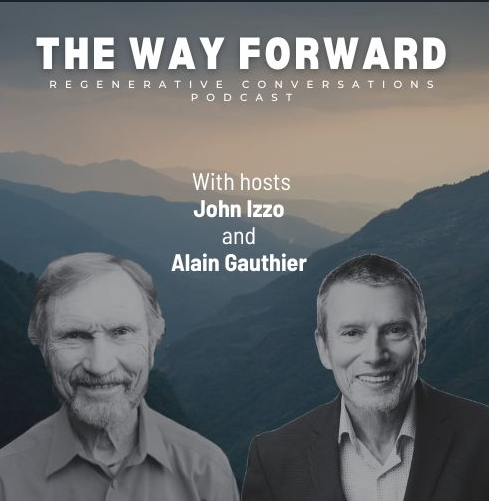
The Way Forward Regenerative Conversations
by Dr. John Izzo, Alain Gauthier & Jim Burke
Three Elders explore how to renew the world we helped mess upThe Way Forward Podcast is dedicated to Regenerative Conversations about the future of humanity and planet. We think we need to re-think the current paradigm. Each episode explores how we can find a positive future forward for society and for ourselves. We explore the question: What is the Way Forward? We don’t have the answers, but we hope to stimulate all of us to imagine what is possible. We bring a wide variety of guests – including people at the leading edge of their field and willing to think out of the box – and engage into stimulating conversations with them, in a place of open curiosity. Topics will include a wide range of issues including environmental change, technology, governance, organizational design, sustainability, international peace, agriculture, and personal renewal.Alain Gauthier and Dr. John Izzo (the co-hosts) and Jim Burke (the producer) offer together more than a hundred years of organizational exp
-
58
The Iran Conflict: Roots, Realities and What Comes Next a conversation with Barbara Slavin
What is really happening in the growing conflict involving Iran, Israel, and the United States — and how should we understand it beyond the headlines? In this episode of The Way Forward: Regenerative Conversations, veteran journalist and Middle East expert Barbara Slavin joins us for a thoughtful exploration of the historical, political, and cultural forces shaping the current crisis. Barbara is a Distinguished Fellow at the Stimson Center, one of Washington’s leading non-partisan think tanks focused on international peace and security. With more than three decades covering Iran and nine visits to the country, she brings rare depth and nuance to a conversation often reduced to polarized narratives. This discussion explores the Iran conflict, U.S.–Iran relations, Israel–Iran tensions, Middle East geopolitics, nuclear diplomacy, sanctions policy, and the future of regional stability. Rather than amplifying fear or taking sides, we slow down and ask: What historical forces led to this moment? • How does Iranian nationalism shape current events? • What geopolitical realities lie behind the headlines? • What roles do Russia, China, Europe, and regional powers play? • What realistic paths forward might still exist? Our goal — consistent with the spirit of The Way Forward — is to offer a calm, reflective conversation that helps us understand complex global events with greater depth and wisdom. Topics Covered Iran–Israel tensions and escalation risks • U.S.–Iran relations and the legacy of the 1953 coup • Iran’s nuclear program and regional security • Russia and China’s role in Middle East geopolitics • Economic pressures and protests inside Iran • Iranian nationalism and public opinion • Drone warfare and asymmetric military strategy • Diplomacy, sanctions relief, and possible paths forward • Cultural understanding between the United States and Iran Timestamps 00:00 Introduction — why this conflict matters now 03:15 Barbara’s 30-year journey studying Iran 06:00 Escalation from the 2025 bombings 06:22 Was the strike on Iran a surprise? 09:29 Iranian nationalism and the legacy of the 1953 coup 11:37 Possible pathways for the crisis 14:59 Iran’s drone capabilities 15:22 The human dimension inside Iran 19:43 Economic pressures and protests 20:21 The nuclear question 25:01 Why targeting leaders rarely works 26:48 Diverging U.S. and Israeli objectives 30:06 Russia and China’s strategic role 33:35 Impact on Gulf states and regional stability 35:52 Diplomacy and sanctions relief 38:03 Iranian culture and civilization 43:05 Iranian public opinion on Israel 46:00 Can Europe play a constructive role? 48:06 Barbara’s closing reflections 52:05 John’s closing thoughts About Our Guest Barbara Slavin is a Distinguished Fellow at the Stimson Center, a leading Washington think tank dedicated to international peace and security. She previously reported for The Economist and USA Today and has covered Iran and the Middle East for more than 30 years. Her book Bitter Friends, Bosom Enemies remains one of the most insightful analyses of U.S.–Iran relations. Watch Our Previous Conversation The Middle East in Crisis: A Conversation with Barbara Slavin https://www.youtube.com/watch?v=dwiYDua4Jnk&t=863s About The Way Forward The Way Forward: Regenerative Conversations is hosted by Dr. John Izzo, Alain Gauthier, and producer Jim Burke. The podcast explores the deeper questions facing humanity through thoughtful dialogue with scholars, leaders, and practitioners working toward a more regenerative future. Connect With Us Linktree https://linktr.ee/thewayforwardrc Website https://wayforwardpodcast.com Email [email protected] Join the Conversation If you value thoughtful conversations like this: 👍 Subscribe to the channel 🔔 Turn on notifications 💬 Share your reflections in the comments What perspectives on Iran or the Middle East deserve deeper discussion?
-
57
Minneapolis, Immigration, and America’s Struggle With the Outsider
Immigration has become the defining fault line of our time — but are we really as divided as it seems? Dr. John Izzo and Alain Gauthier are joined by Kathryn Ringham, an elder activist living at the center of the storm in Minneapolis. Together they unpack what's happening on the ground, what the polling data actually reveals, and what a genuine way forward looks like. 🎧 What You'll Hear John's Sicilian grandparents and why the melting pot has always been a myth Kathryn on 'Metro Siege': fear, unmarked cars, and a community under pressure 50,000 protesters in minus-29-degree wind chill — and the 'Minneapolis Model' What polling actually shows: where Republicans and Democrats agree 40 years of failed reform — IRCA 1986, the Johnson-Reid Act, McCain-Kennedy 2006 Alain on Europe's parallel identity crisis and the power of relational energy 💡 Key Quotes "Immigration is not a crisis to eliminate — it's a force to manage wisely." — Kathryn Ringham "The extremes are holding the conversation — but most Americans are far more nuanced." — Dr. John Izzo "We need to move from fear to love — relational energy people feel for their children and grandchildren." — Alain Gauthier 📊 Key Data 79% of Democrats support deportation of criminal immigrants 65% of Republicans say immigration is good for the United States 60% of Republicans support a path to status for long-term, law-abiding residents 60% of Americans say ICE tactics in Minneapolis were too harsh Last major immigration reform: IRCA, 1986 — nearly 40 years ago 👥 Hosts & Guest Dr. John Izzo — bestselling author, keynote speaker, board member of Elders Action Network, and co-host. Nine books, 500+ companies advised, 1M+ people reached. Alain Gauthier — international facilitator, systems thinker, and co-host. French immigrant and 40-year green card holder bringing a rare transatlantic lens to every conversation. Kathryn Ringham — elder activist, retired clinical social worker, and lifelong Minneapolis resident. Member of the Elders Action Network, living two miles from the epicenter of the ICE surge. 📲 Subscribe & Stay Connected Subscribe on YouTube, Apple, Spotify, or Podbean Leave a comment — your voice helps others find us Share this episode with someone who needs a thoughtful conversation 🔗 linktr.ee/thewayforwardrc 🌐 wayforwardpodcast.com 📧 [email protected] Thank you for being part of our community. Honest conversations are where the way forward always begins.
-
56
From Retirement to Regeneration: Why Elders Matter More Than Ever
Episode Overview In a culture obsessed with youth, are elders still relevant — or more necessary than ever? Across traditional societies, elders were honored as wisdom keepers and guides. Yet in modern Western culture, aging is often equated with retirement, retreat, and irrelevance. What if this moment in history calls for something radically different? In this powerful episode of The Way Forward: Regenerative Conversations, Dr. John Izzo, Jim Burke, Diana Shoemaker, and Alain Gauthier explore the rise of the Regenerative Elder — blending inner transformation with outer activism to serve future generations. A Regenerative Elder is someone who consciously integrates inner growth, community wisdom, and courageous action to help regenerate society, democracy, and the living Earth for future generations. Together, through the work of Elders Action Network (EAN) and its educational and activist initiatives — including Elders Rising — they examine how elders can move from retirement to regeneration and become a vital force for societal renewal. Whatever your age, this conversation may transform how you see aging, leadership, activism, and the future itself. 🌱 The Role of Elders Action Network This episode highlights the unique role of Elders Action Network, a national organization committed to combining inner development with meaningful civic engagement. Unlike many organizations that focus solely on activism, EAN integrates personal reflection, worldview transformation, and community-building with action in climate, democracy, and regenerative living. A special focus in this episode is Elders Rising, the emerging educational and community hub within EAN. Elders Rising serves as an entry point for elders seeking: A deeper exploration of purpose Community with like-minded elders Training for regenerative leadership Tools for activism rooted in reflection Intergenerational collaboration Elders Rising centers and connects EAN’s programs — including the Regenerative Elder Process, Resilience & Acceptance, Future Design, and Exploring Elderhood — into a coherent pathway for elder transformation and contribution. ⏱ Episode Chapters 00:00 Introduction – The Role of Elders in Modern Society 01:09 John’s Experience with Elders in Tanzania 02:42 Introducing the Elders Action Network 04:25 Why Elder Activism Matters Now 05:42 EAN: Purpose and Practice 13:43 The Regenerative Elder Process (REP) 20:17 Upcoming Courses & Community Engagement through Elders Rising 24:38 Why Elder Cohorts Matter 27:21 Community & Belonging in Later Life 28:14 Elders Taking Action Locally 30:33 Intergenerational Collaboration & Future Design 31:54 Elders, History & Patriotism 33:37 Education, Resilience & Sacred Activism 36:19 Rebuilding Community & Cooperation 46:41 How to Get Involved with Elders Action Network 50:41 Final Reflections & Encouragement 🌱 How to Get Involved with Elders Action Network & Elders Rising If this conversation speaks to you, here are ways to engage through Elders Action Network and Elders Rising: Join a Climate or Sound Democracy action team Participate in the Regenerative Elder Process (REP) Begin your journey with Exploring Elderhood Join the Resilience & Acceptance (RA) community Participate in the EAN Book Club Volunteer in a leadership role Support intergenerational initiatives through Future Design EAN operates through volunteer leadership and community engagement — elders are not just participants, but co-creators of the work. 🔗 Resources & Links Dr. John Izzo’s TEDx Talk (Boomers & Legacy) The Defining Moment for a Generation-In-Waiting: Dr. John Izzo at TEDxVancouver Elders Action Network (EAN) https://eldersaction.org/ Elders Rising https://eldersaction.org/elders-rising/ Regenerative Elder Process (REP) https://eldersaction.org/regenerative-elder-process/ Future Design Program Future Design Intergenerational Workshop - Session 1 of 3 — Elders Action Network Podcast Episode on Future Design 👉https://www.youtube.com/watch?v=7Bbsu-Ph-R0 Resilience & Acceptance (RA) Resilience & Acceptance in the Face of Collapse — Elders Action Network EAN Book Club & Programs Book Study Group — Elders Action Network Exploring Elderhood Course Exploring Elderhood — Elders Action Network 👥 About Our Guests Dr. John Izzo Leadership expert, bestselling author, and TEDx speaker. John serves on the board of Elders Action Network and is a global voice on purpose-driven leadership, legacy, and generational responsibility. Jim Burke Producer of The Way Forward: Regenerative Conversations, longtime healthcare leader, Vietnam veteran, and regenerative elder activist. Jim is deeply involved with Elders Action Network, Elders Rising initiatives, and climate resilience efforts in Washington State. Diana Shoemaker Executive Director of Elders Action Network. Diana leads national initiatives in elder activism, community resilience, and regenerative leadership, and oversees the development of Elders Rising as a central educational platform. Alain Gauthier Co-founder of the Regenerative Elder Process and longtime leadership consultant. Alain brings deep experience in worldview transformation, regenerative thinking, and elder wisdom traditions within Elders Action Network. 🎧 Stay Connected If this conversation resonates with you: 👉 Subscribe on YouTube or your favorite podcast platform https://www.youtube.com/@thewayforwardrc/featured 👉 Like & Comment — we read every comment 👉 Visit our website https://thewayforwardrc.com Visit our Linktree (all platforms & support links): 👉 https://linktr.ee/thewayforwardrcfor events, programs, and ways to support the work 👉 Share this episode with someone navigating retirement or rethinking elderhood Your engagement helps grow a movement of regenerative elders through Elders Action Network and Elders Rising. 🙏 Thank You Thank you for being part of this community. Whether you are an elder, becoming an elder, or reflecting on your place in a rapidly changing world — you matter. The future is not something we wait for. It is something we co-create — together.
-
55
Is Trump a Symptom—or a Wake-Up Call? Reflections on 2025
Was 2025 a year we should forget—or the year everything finally became undeniable? As we step into 2026, the hosts of The Way Forward: Regenerative Conversations take on the hardest questions of our time: polarization, democracy, violence, climate disruption, and the collapse of shared meaning. This conversation is honest, provocative, and deeply personal—and we don’t all agree. If you’re wondering where to put your energy now, this episode is for you. 🧭 Show Notes – Episode Summary In this special 2025 Reflections / 2026 Looking Forward episode, all three hosts—John Izzo, Alain (Alon) Gauthier, and Jim Burke—come together to examine what 2025 revealed about the state of humanity, democracy, and the planet. They explore: How social media algorithms curate entirely different realities—and fuel polarization Why the rule of law and social norms are breaking down globally Whether figures like Donald Trump are causes—or symptoms of a deeper systemic failure The rise of narcissism at every level: individual, national, and even species-wide Why mitigation alone is no longer enough for climate change—and why adaptation and regeneration must happen together The twin inflection points of democracy and artificial intelligence in 2026 Why the real work ahead is inner and outer, personal and systemic The conversation moves beyond headlines and elections to ask a deeper question: Who are we becoming—and how will we choose to respond? This episode also gives listeners a rare chance to get to know the hosts personally: what grounds them, what challenges them, and where they’re putting their energy in the year ahead. 👥 Host Bios Dr John Izzo, PhD John Izzo is a bestselling author, speaker, and former Presbyterian minister whose work focuses on purpose, meaning, leadership, and the future of humanity. He brings moral clarity, historical depth, and a gift for asking the questions most people avoid. John is the author of multiple books, including The Purpose Revolution: How Leaders Creae Engagement and Competive Advantage in an Age of Social Good, and a longtime voice calling for deeper reflection in times of disruption. Alain Gauthier Alain is a systems thinker, facilitator, and co-creator of the Regenerative Elder process. Drawing from Indigenous history, lived experience, and spiritual inquiry, he helps individuals and communities integrate inner transformation with outer action. His work focuses on regeneration, resilience, and the re-emergence of elder wisdom in a fractured world. Jim Burke Jim Burke is the producer of The Way Forward and a lifelong health professional, systems thinker, and climate activist. He serves on multiple local and regional committees focused on infrastructure, climate resilience, and regenerative community development. Jim is deeply interested in longevity, lifestyle medicine, clean energy, and redefining elderhood for the 21st century. 🔗 Links & Where to Find Us Podcast & Website: 👉 https://thewayforwardrc.com Linktree (all platforms & support links): 👉 https://linktr.ee/thewayforwardrc Listen & Watch: YouTube Apple Podcasts Amazon Podcasts Spotify Instagram & YouTube Shorts 📣 Call to Action (Subscribe, Comment, Engage) If this conversation resonated with you: ✅ Subscribe on YouTube or your favorite podcast platform 💬 Leave a comment—we read them and respond 🔁 Share this episode with someone who’s asking similar questions ☕ Support the show via Buy Me a Coffee (linked in our Linktree) Your engagement helps us grow this community of thoughtful, courageous, regenerative conversations.
-
54
No More Illusions: McKibben, McLaren & Read on the Climate Truth We Can’t Ignore
In this episode of The Way Forward: Regenerative Conversations, John Izzo hosts Bill McKibben, Brian McLaren, and Dr. Rupert Read for a raw and urgent dialogue on the climate crossroads. Together, they confront illusions, speak truth we can’t ignore, and explore what agency we still hold in shaping our future. Perfect for listeners seeking depth, courage, and clarity in the climate conversation. Summary In this powerful conversation, recorded live at The Climate Crossroads, our panel explores the defining moment humanity now faces. Bill McKibben highlights the accelerating physical realities of a warming planet — and the political forces working to slow progress. Dr. Rupert Read explains why adaptation, resilience, and community transformation may be our most underused leverage points. Brian McLaren examines the spiritual and psychological roots of the crisis, and why outdated worldviews continue to hold us back. Together, they illuminate how technological change, moral courage, and community-scale action must converge to create a livable future. They invite us to move beyond false optimism and paralyzing doom — toward grounded, regenerative action rooted in compassion, clarity, and connection. This is the first in a series of Crossroads Conversations exploring how elders, activists, and communities can rise to meet the challenges of our time. 👥 Guest Mini-Bios Bill McKibben Bill McKibben is a pioneering climate author, journalist, and activist who wrote the first major book on global warming, The End of Nature. He is the founder of 350.org and Third Act, mobilizing older Americans for climate action. His latest book, Here Comes the Sun, explores the global revolution in solar energy. 🔗 https://thirdact.org 🔗 https://350.org 🔗 “Here Comes the Sun” (2024) Brian D. McLaren Brian McLaren is a former pastor, public theologian, and bestselling author whose work explores spirituality, social transformation, and climate consciousness. His recent book, Life After Doom, examines our spiritual response to the ecological crisis and the path to deeper courage and connection. 🔗 https://brianmclaren.net 🔗 “Life After Doom” (2023) Dr. Rupert Read Dr. Rupert Read is a philosopher, author, and co-founder of the Climate Majority Project, focused on mobilizing broad societal engagement in climate adaptation. He served as a prominent spokesperson and strategic voice for Extinction Rebellion, helping shape its early messaging and global impact. His work, including Why Climate Breakdown Matters and Transformative Adaptation, calls for a profound shift in how communities prepare for a rapidly changing world. 🔗 https://rupertread.net 🔗 https://climatemajorityproject.com 🔗 “The Climate Majority Project” (2024) 🔗 “Transformative Adaptation” (2024) 🙏 Sponsor Acknowledgment This episode is brought to you by the Elders Action Network (EAN) and Elders Climate Action (ECA) — two organizations mobilizing elders across the world to stand for democracy, climate justice, and a regenerative future. 🌐 https://eldersaction.org 🌐 https://eldersclimateaction.org 📣 Audience Call to Action (YouTube & Podcast) If this conversation moved you, inspired you, or challenged you — please support our work: ✅ Subscribe to the podcast & YouTube channel ✅ Leave a comment with your insights or questions ✅ Share this episode with five people who care about our future ✅ Visit our website for episodes, resources, and upcoming events: 🔗 https://linktr.ee/wayforwardpodcast
-
53
How to Stop a Nuclear War — and Why We’re Not Talking About It
In this powerful and timely conversation, Dr. John Izzo and Alain Gauthier sit down with award-winning filmmaker and journalist Paul Jay, whose upcoming documentary How to Stop a Nuclear War dives deep into the existential risks humanity continues to ignore. Together, they explore why the Cold War never truly ended, how nuclear weapons remain an urgent and immediate threat, and what each of us can do to break the silence and reclaim our collective future. This episode is not just about nuclear war — it’s about truth, power, media silence, and our responsibility as citizens of a shared planet. Jay shares the untold story behind the nuclear threat and the making of his new film inspired by Daniel Ellsberg’s The Doomsday Machine. He argues that the Cold War didn’t end — it simply evolved — and that the same forces of fear, profit, militarism, and denial continue to push humanity toward catastrophe. You’ll hear why policymakers rarely talk about nuclear weapons, how media myths shape public perception, why dialogue with our “enemies” is essential, and how ordinary citizens can influence extraordinary change by confronting the “house of dynamite” we all live in before it explodes. About Paul Jay Paul Jay is an award-winning Canadian filmmaker, journalist, and founder of TheAnalysis.news (https://theanalysis.news). Formerly CEO and senior editor of The Real News Network, Jay has produced highly acclaimed documentaries including: Hitman Hart: Wrestling with Shadows Return to Kandahar The Four Horsemen (producer) Lost in Las Vegas He is also the founding chair of the Hot Docs International Documentary Festival, now the largest documentary festival in North America. Paul is currently directing How to Stop a Nuclear War, based on Daniel Ellsberg’s The Doomsday Machine, examining the systems of power that shape global nuclear policy — and how citizens can reclaim agency over issues that determine humanity’s survival. Explore more of his work: https://theanalysis.news Our Sponsors This episode is made possible through the generous support of our partners: Elders Action Network — https://eldersaction.org Elders Climate Action — https://eldersclimateaction.org Their work empowers elders everywhere to stand up for democracy, climate action, justice, and the future of life on Earth. Stay Connected Thank you for joining us on The Way Forward: Regenerative Conversations. If this episode moved you, please: Subscribe to the channel Like the episode Share it with friends and allies Leave a comment — we read every one and deeply appreciate your thoughts Tell us: What gives you hope about the way forward? Explore more episodes and sign up for updates at: https://www.youtube.com/@thewayforwardrc Upcoming Live Event The Climate Crossroads: Why Haven’t We Changed — and How We Do Now 📅 Tuesday, December 2 ⏰ 8:00–9:30 am PT / 11:00 am–12:30 pm ET A live global event presented by The Way Forward: Regenerative Conversations Podcast. https://www.youtube.com/@thewayforwardrc We know the science — yet society still struggles to change. Why? Join three of the most respected voices in the climate movement for a rare, candid dialogue: Bill McKibben — Founder of 350.org & Third Act Dr. Rupert Read — Philosopher, author of Parents for a Future Brian McLaren — Theologian, activist, and author Moderated by Dr. John Izzo, this 90-minute event confronts the hard truth of where we stand — and explores the pathway from paralysis to courageous collective action. Hosted by Elders Action Network, Elders Climate Action, and The Way Forward: Regenerative Conversations Podcast. Attendees will have the chance to ask live questions. 👉 Register now and be part of the generation that turns awareness into action: The Climate Crossroads: Why Haven’t We Changed — and How We Do Now - Elders Action Network
-
52
Solar’s Global Rise and China’s Energy Leadership — A Conversation with Bill McKibben
Bill McKibben joins The Way Forward to explore the rapid rise of solar energy and China’s commanding role in the clean energy economy. Drawing from his latest book Here Comes the Sun, McKibben shares how the solar revolution is reshaping global dynamics — from the shift away from fossil fuels to the acceleration of decentralized power — and why local action still holds the key to a regenerative future. In this episode of The Way Forward: Regenerative Conversations, environmental leader Bill McKibben reveals the remarkable—and largely untold—story behind the global solar energy boom. Drawing from his new book Here Comes the Sun, McKibben explains how solar has moved from the margins to become the world’s cheapest, fastest-growing energy source, reshaping geopolitics, economics, and the fight for a livable planet. We explore why the transition is accelerating so quickly, how China surged ahead in clean-energy manufacturing, what’s blocking progress in the U.S., and why decentralized energy strengthens both democracy and community resilience. McKibben makes a powerful case that the most impactful climate action isn’t individual—it’s collective organizing to change policy and scale solutions that match the crisis. This is a conversation about speed, possibility, and the decisive decade ahead—and why a sun-powered world is much closer than we think. Bill McKibben—author, journalist, and founder of 350.org and Third Act—is one of the world’s most influential climate voices. His new book, Here Comes the Sun, charts the extraordinary rise of solar power and what it means for the future. Themes Solar is exploding globally—faster than anyone expected. Renewables are now the cheapest energy on Earth. China is dominating clean-energy manufacturing. Batteries and virtual power plants are transforming the grid. Collective action—not individual consumption—is what shifts systems. UPCOMING LIVE EVENT THE CLIMATE CROSSROADS – December 2, Live Online A powerhouse panel with Bill McKibben, Dr. Rupert Read, and Brian McLaren, moderated by Dr. John Izzo as they explore what it will take to move from paralysis to action. Hosted by Elders Action Network, Elders Climate Action, and The Way Forward: Regenerative Conversations, this 90-minute event blends moral clarity with practical hope. 🗓 December 2 8–9:30 AM PST | 11–12:30 PM EST | 4–5:30 PM GMT 📍 Hosted by Elders Action Network, Elders Climate Action & The Way Forward Podcast 🔗 Register here: https://shorturl.at/hNYKg Also visit and register at our Sutra to have an interactive experience with our 3 guests. Climate Crossroads Sutra The Way Forward: Regenerative Conversations is hosted by Dr. John Izzo & Alain Gauthier and produced by Jim Burke. 📺 Watch on [YouTube] https://www.youtube.com/@thewayforwardrc| 🎧 Listen on [Apple Podcasts] podcasts.apple.com/us/podcast/the-way-forward-regenerative-conversations/id1651941803| 🌍 Connect with us: [Website] https://wayforwardpodcast.com/ 🌿 Special Thanks to Our Sponsors This episode of The Way Forward: Regenerative Conversations is made possible through the generous support of Elders Action Network (EAN) https://eldersaction.org/ (Elders Action Network) and Elders Climate Action (ECA) https://eldersaction.org/ (Elders Action Network. These organizations are dedicated to empowering elders to take collective action for a thriving, just, and sustainable future. We’re deeply grateful for their leadership and for modeling what it means to be regenerative elders in action.
-
51
Transform or Collapse? Dr. Rupert Read and Manda Scott on Climate Adaptation & Moral Courage
In this powerful episode of The Way Forward: Regenerative Conversations, hosts John Izzo and Alain Gauthier sit down with philosopher and climate activist Dr. Rupert Read and Manda Scott to explore the groundbreaking new book, Transformative Adaptation. Is it too late to stop climate change? What does it mean to adapt with courage, not despair? And how can we transform ourselves and our systems to save what truly matters? We dive deep into: The difference between shallow and transformative adaptation Why collapse isn’t inevitable — and how hope can be radical The moral and spiritual dimensions of climate action Practical steps for individuals and communities to adapt with integrity Episode Summary In this episode of The Way Forward: Regenerative Conversations, hosts Dr. John Izzo and Alain Gauthier sit down with Rupert Read and Manda Scott to explore their new book Transformative Adaptation: Another World Is Still Just Possible. We ask: Is it too late to stop the climate and ecological crisis? What’s the difference between “shallow” adaptation and “transformative” adaptation? How can communities move from resilience to true system change? Why do new stories—like Thrutopia—matter for creating a liveable future? From real examples in Nepal and Rojava to the spiritual and narrative shifts needed to heal our “trauma culture,” this episode will leave you questioning what kind of future we can still build—together. 👥 Guest Bios & Links Rupert Read – Philosopher, former Extinction Rebellion spokesperson, co-founder of the Climate Majority Project, and co-author of Transformative Adaptation. 🔗 Rupert’s Website | Climate Majority Project Manda Scott – Award-winning novelist, podcaster (Accidental Gods), and co-author of Transformative Adaptation, pioneering the concept of Thrutopia storytelling. 🔗 Accidental Gods Podcast | Thrutopia 🙌 Call to Action ✨ Subscribe to The Way Forward: Regenerative Conversations for more deep dialogues on climate, culture, and regeneration. 💬 Share this episode with a friend who cares about the future. ⭐ Leave us a comment—what does “transformative adaptation” mean to you? 🎙 Show Branding The Way Forward: Regenerative Conversations is hosted by Dr. John Izzo & Alain Gauthier and produced by Jim Burke. 📺 Watch on [YouTube] https://www.youtube.com/@thewayforwardrc| 🎧 Listen on [Apple Podcasts] podcasts.apple.com/us/podcast/the-way-forward-regenerative-conversations/id1651941803| 🌍 Connect with us: [Website] https://wayforwardpodcast.com/ 🌿 Special Thanks to Our Sponsors This episode of The Way Forward: Regenerative Conversations is made possible through the generous support of Elders Action Network (EAN) and Elders Climate Action (ECA). These organizations are dedicated to empowering elders to take collective action for a thriving, just, and sustainable future. We’re deeply grateful for their leadership and for modeling what it means to be regenerative elders in action.
-
50
Faith, Love, and Courage After Collapse: A Conversation with Brian McLaren, Author of “Life After Doom”
On The Way Forward: Regenerative Conversations, John and Alain sit down with Brian McLaren to explore what it means to live—and lead—after doom. Drawing from Life After Doom, Brian reframes “doom” as the moment we realize our problems outsize our current solutions, then walks us from anger to grief to love as a generative path forward. Along the way, we unpack overshoot and the polycrisis beneath climate change, a practical four‑scenario map of possible futures, and everyday practices that keep us grounded—finding companions to talk with, time in nature, and deep honesty in prayerful reflection. The result is a clear‑eyed conversation that neither sugarcoats nor catastrophizes—and calls us to show up with courage, compassion, and love. Show notes summary What we cover What “doom” really names: not inevitable extinction, but the psychological shock when our problems feel bigger than our solutions—and how naming it opens a path beyond paralysis. Under the climate “cherry”: overshoot (taking too much, dumping too much) and the polycrisis that makes single‑issue fixes insufficient. Four scenarios for what’s next: collapse avoidance, collapse rebirth, collapse survival, collapse extinction—plus why clinging to certainty (optimism or despair) discourages action. From anger → grief → love: how grief can sweeten into love for places and people—and even temper how we regard those doing harm. Practices that help right now: find a small circle to talk with; seek daily time outdoors (“the birds are being awesome”); and cultivate honest, contemplative prayer—“holding our thoughts to the light.” Faith, power, and coalition: engaging Christian communities without dehumanization; critiquing money‑power capture; and reaching beyond left/right toward a deeper, earth‑honoring vision. Key takeaways Name the feeling; don’t freeze there. Recognizing doom as an inner experience creates room for courage and community. Think systemically. If we “solve carbon” but ignore overshoot and the polycrisis, our children still inherit cascading risk. Work the middle path. Refusing both naïve optimism and total doom keeps us in the arena of action. Grief reveals love. Lament can deepen solidarity with people and places—and clarify what we will protect. Lead with love, not dehumanization. Our language matters; contempt escalates violence, while love enlarges coalitions. Our heartfelt thanks to Elders Action Network (EAN) and Elders Climate Action (ECA) for the work they do and for their support of this conversation and community. Subscribe & Share If this episode resonated, please subscribe on Apple Podcast or your favorite podcast app, and leave a comment—your engagement helps others find the show. Connect with Us Web: https://wayforwardpodcast.com Email (comments & ideas): [email protected]
-
49
# 49: How to Overcome 5 Toxic Mindsets to Reclaim Happiness Now
In this episode of The Way Forward Regenerative Conversations, co-hosts Alain Gauthier and Jim Burke, our producer stepping into the host role, dive into humanity’s greatest challenges and the transformative opportunities they present. Join us as they interview Dr. John Izzo, who takes the guest seat to explore “What is the way forward?” for a thriving planet and future. This podcast is a bold call to action, inspiring regenerative practices and mindset shifts to build a better world. About This Episode Struggling to stay grounded amidst wars, climate crises, or AI hype? Dr. John Izzo, author of The Five Thieves of Happiness, reveals how five toxic mindsets—Control, Conceit, Consumption, Comfort, and Coveting—are stealing your happiness. Discover the “Notice, Stop, Choose” method to overcome these thieves, practice “attention without attachment,” and challenge outdated patterns like tribalism. From social media coveting to reimagining capitalism, Izzo offers practical tools to transform your inner life and spark outer change. Perfect for activists, elders, and visionaries ready to build a regenerative future. About Dr. John Izzo Dr. John Izzo is a bestselling author, speaker, and leadership expert with over 25 years advising Fortune 500 companies like IBM and Coca-Cola on sustainability and regeneration. His nine books, including The Five Thieves of Happiness, blend spirituality, science, and practical wisdom, inspiring millions globally. A former minister and Camino de Santiago pilgrim, Izzo’s TEDx talks and podcasts deliver bold, actionable insights for personal and collective transformation. Get Involved Like & Comment: Which toxic mindset is holding you back? Share your top takeaway below! Subscribe: Join our visionary conversations on YouTube, Apple Podcasts, Spotify, or Podbean! Visit Us: Dive into show notes, archives, and our community at https://wayforwardpodcast.com/. Hashtags: #Happiness #MindsetShift #ToxicMindset #PositiveMindset #OvercomeNegativity #ReclaimHappiness #MindsetMatters Thank Our Sponsors Elders Action Network: Empowering elders to channel wisdom into social change—a true catalyst for hope and collaboration. Elders Climate Action: Mobilizing seniors to fight for climate justice, paving the way for a sustainable, thriving planet. Your support drives these regenerative discussions. Thanks for listening!
-
48
# 48 : The War on Truth and the Struggle for Democracy – a conversation with Katherine Stewart
In this gripping episode of The Way Forward: Regenerative Conversations, we dive deep into the explosive revelations of Katherine Stewart’s new book, Money, Lies, and God. With nearly two decades of investigative journalism exposing the rise of Christian nationalism and the anti-democratic forces reshaping America, Stewart reveals the unholy alliances of billionaires, culture warriors, and ideological extremists working to dismantle our democratic foundations. This conversation is essential listening for anyone who cares about truth, pluralism, and the future of the American experiment. Katherine Stewart is an award-winning journalist and New York Times bestselling author who has covered the rise of the anti-democratic movement in the U.S. for over 16 years. Her latest book, Money, Lies, and God: Inside the Movement to Destroy American Democracy (Bloomsbury, 2025), builds on the critically acclaimed The Power Worshippers and The Good News Club. Stewart’s work appears in The New York Times, The New Republic, and Religion News Service. Follow her work at website https://katherinestewart.me/ katherinestewartbooks.substack.com and on Bluesky at katherinestewart.bsky.social. If you enjoyed today’s conversation, please subscribe to our podcast and visit our website at www.wayforwardpodcast.com to join our community, explore show archives, and stay connected. Special thanks to our sponsors: Elders Action Network – org Elder Climate Action – org Their support makes these vital conversations possible.
-
47
#47 What Needs to Change Now: Breaking Free from the Old System – A Conversation with Otto Scharmer and Katrin Kaufer
Have you ever felt powerless to change the system—wondering if one person's actions can truly make a difference in a world overwhelmed by complex challenges? In this provocative and inspiring episode of The Way Forward: Regenerative Conversations, we confront the limiting belief that individual actions don't matter—a mindset Otto Scharmer and Katrin Kaufer describe as the "illusion of insignificance." Joined by hosts Dr. John Izzo and Alain Gauthier, we directly address elders and regenerative activists, empowering listeners to reclaim their agency and become active participants in reshaping our collective future. In this deeply insightful conversation, Otto and Katrin share transformative concepts such as "islands of coherence," the essential "social soil" that nurtures societal change, and "fourth-person knowing," a profound form of collective intelligence. Drawing practical connections from their new book Presencing, they illuminate how aligning attention, intention, and agency can empower individuals and communities to break free from outdated systems. You’ll discover how your small yet intentional actions can create powerful ripples of change, building on ideas explored in previous episodes such as intergenerational collaboration, climate adaptation, and regenerative elderhood. Otto Scharmer is a Senior Lecturer at the Massachusetts Institute of Technology (MIT) and the Founding Chair of the Presencing Institute, an organization dedicated to activating awareness-based systems change through action research. Otto co-authored the influential books Theory U and Leading from the Emerging Future, introducing the transformative practice known as "presencing"—learning from and responding effectively to emerging futures. Drawing inspiration from his regenerative farming upbringing, Otto emphasizes nurturing "social soil," referring to the quality of relationships, awareness, and collective capacity crucial for profound systemic transformation. His work has significantly influenced leadership practices, organizational behavior, and societal change globally. Katrin Kaufer is the Managing Director and oversees research activities at the Presencing Institute, of which she is also a co-founding member. She serves as a Lecturer and Program Director at MIT's Department of Urban Studies and Planning, where her research focuses on leadership, social transformation, and mission-driven finance. Katrin co-authored Leading from the Emerging Future: From Ego-system to Eco-system Economies with Otto Scharmer and authored Just Money, exploring principles of mission-based banking and sustainable finance. Through her research and practice, Katrin highlights how the quality of our relationships significantly defines collective outcomes and advances practices that align attention, intention, and agency, deepening our understanding of transformative leadership and "fourth-person knowing." About the Presencing Institute and U-School: The Presencing Institute, founded by Otto Scharmer, is a global organization committed to enabling profound societal transformation through awareness-based systems change and innovative action research. Known worldwide for its groundbreaking Theory U methodology, the institute actively collaborates with leaders, organizations, and communities to cultivate deeper collective understanding and facilitate meaningful change across sectors. The U-School is an innovative global platform within the Presencing Institute dedicated to helping change-makers, educators, and leaders deepen their understanding and mastery of Theory U. U-School provides transformative learning journeys, workshops, and community initiatives that empower individuals and teams to respond creatively and effectively to complex societal challenges by fostering greater personal and collective awareness, intention, and agency. Learn more about their impactful work at Presencing Institute. About The Way Forward: Regenerative Conversations: The Way Forward: Regenerative Conversations podcast is proudly supported by the Elders Action Network and Elders Climate Action. We extend our deepest gratitude to these organizations for their steadfast commitment to empowering elders and addressing critical environmental, governance, and social challenges, helping create a thriving world for generations to come. If this conversation inspires you, please subscribe to our YouTube channel and Apple Podcast to ensure you never miss an episode. Join our growing community and explore additional transformative resources at wayforwardpodcast.com.
-
46
#46 Redesigning Democracy: Future Generations at the Table | A Conversation with Suzette Brooks Masters & Clint Wilkins
In a time of deep division and rising authoritarianism, what if we could reimagine democracy—not for the next election, but for the next generation? In this inspiring and provocative episode of The Way Forward: Regenerative Conversations, co-hosts Dr. John Izzo and Alain Gauthier speak with two visionary leaders who are doing just that. Suzette Brooks Masters, leader of the Better Futures Project and advisor to the School of International Futures, and Clint Wilkins, retired educator and intergenerational climate action leader with Elders Climate Action, introduce us to the practice of Future Design—a foresight method that invites participants to role-play as future generations. Together, they explore: Why U.S. democracy feels broken—and how Future Design can help renew it. What happened when elders, youth, and midlifers “time-traveled” to the year 2049. How elders can serve as conveners for intergenerational healing and bold democratic imagination. Why local communities—not Congress—may be democracy’s best hope. If you're restless about the state of our world but still believe in the power of human imagination and agency, this episode is your invitation to help shape what comes next. Subscribe. Share. Start a Future Design conversation in your own community. Show Notes Episode Title: Designing Democracy: Future Generations at the Table Guests: Suzette Brooks Masters – Strategic foresight leader and director of the Better Futures Project Website: Democracy Funders Network Report: Imagining Better Futures for American Democracy (PDF) LinkedIn: Suzette Brooks Masters Clint Wilkins – Educator, intergenerational facilitator, and leader at Elders Climate Action Elders Climate Action: https://www.eldersclimateaction.org Elders Action Network: https://www.eldersaction.org Topics Covered: What is Future Design and how it works Role of imagination and intergenerational empathy in civic renewal Inside the ECA Future Design retreat How to bring Future Design into your local town hall Why elders are essential catalysts in shaping long-term democratic vision Production Team: Hosts: Dr. John Izzo & Alain Gauthier Producer: Jim Burke Editing: Camtasia 2025 Watch more episodes of The Way Forward: Regenerative Conversations: https://www.youtube.com/@RegenerativeConversations Special Thanks We’re grateful to our sponsors, Elders Action Network (EAN) and Elders Climate Action (ECA), for supporting this intergenerational exploration of democracy, imagination, and the future. Your leadership shows that elderhood can be a time of action, not retreat.
-
45
#45 From Truth to Action: The Transformation the Climate Crisis Requires: A Conversation with Dr. Rupert Read
In this powerful episode, renowned climate philosopher and activist Dr. Rupert Read challenges us to confront the stark realities of climate breakdown and political instability. Offering a unique blend of radical honesty and transformative action, Read illuminates pathways forward through emotional resilience, transformative adaptation, and community empowerment. This isn't a conversation about easy fixes; it's a compelling call to face our crisis head-on, together. Dr. Rupert Read PhD is a prominent British climate activist, and author. He holds degrees from Balliol College, Oxford, and Rutgers University, where he earned his PhD in Philosophy. Currently, Read is an Emeritus Associate Professor of Philosophy at the University of East Anglia, UK. He has authored several influential books including Transformative Adaptation, The Climate Majority Project, This Civilization Is Finished, do you want to know the TRUTH, and Deep Adaptation, co-authored with Jem Bendell. Read is also well-known for his involvement with Extinction Rebellion and is co-director of The Climate Majority Project, advocating for practical and systemic responses to the climate crisis. His work blends rigorous philosophical thought with frontline activism, emphasizing emotional resilience, transformative action, and community engagement. We extend special thanks to Elders Climate Action and the Elders Action Network, whose support makes these essential conversations possible. Their ongoing commitment empowers elders to lead and inspire transformative actions on climate, democracy, and resilience, truly embodying the power and wisdom of elder activism. If you enjoy this podcast and YouTube channel, please subscribe. You can also find us on Substack and on Bluesky.
-
44
#44 "Elders and the Climate Crisis: A Conversation with Dr Harry R. Moody PhD"
On January 20, 2025, as Donald Trump was inaugurated for his second term as President of the United States, The Way Forward: Regenerative Conversations seized this historic and uncertain moment to discuss the role of elders in shaping our collective future. In this powerful episode, we welcome esteemed author, educator, and activist Rick Moody to explore with us how those aged 65 and older can engage meaningfully in times of political and environmental upheaval. At a time when misinformation is rampant, democracy feels fragile, and the climate crisis looms large, Moody challenges the notion of passive aging and calls for action. He makes a compelling case for why hope is not just a feeling but a practice—one that requires rolling up our sleeves and actively shaping the world we will leave behind. Whether you’re newly retired, deeply engaged in activism, or wondering what your legacy will be, this conversation will inspire and motivate you to embrace the power of your years. In Episode we engage in a thought-provoking discussion with Rick Moody about the intersection of aging, climate change, and civic responsibility. We explore how elders can resist misinformation, foster intergenerational collaboration, and take tangible action to create a better future. Moody shares insights on the importance of truth in an era of political deception, the urgency of climate action, and why aging should be seen as a time of purpose rather than decline. He recalls his experiences working with great thinkers like Hugh Downs and Robert Butler, who coined the term “ageism”, and reflects on how older adults can reimagine their role in society. The conversation is a call for elders to step forward, not step back—to lead, not retreat—to build, not despair. Moody also discusses his latest book, Climate Change in an Aging Society (2023, Routledge), and his ongoing work with nonprofits and grassroots climate movements. He reminds us that history is not something we inherit—it is something we create, and elders have a crucial role in shaping what comes next. Harry (Rick) Moody, Ph.D., is a leading voice in the fields of aging, ethics, and climate activism. A graduate of Yale University with a doctorate in philosophy from Columbia University, Dr. Moody has dedicated his career to exploring the intersection of aging, purpose, and social change. He retired as Vice President for Academic Affairs at AARP and has held faculty positions at Fielding Graduate University and Tohoku University in Japan. Previously, he served as Executive Director of the Brookdale Center on Aging at Hunter College, and Chairman of the Board of Elderhostel (now Road Scholar). Dr. Moody is the author of over 100 scholarly articles and several influential books, including Aging: Concepts and Controversies, a widely used gerontology textbook now in its 10th edition, and The Five Stages of the Soul, which has been translated into seven languages. His latest book, Climate Change in an Aging Society, was published in 2023. A passionate advocate for climate action, Dr. Moody writes a newsletter focused on climate change and aging. He was named one of Utne Reader’s “50 Visionaries Who Are Changing Your World” and received the Lifetime Achievement Award from the American Society on Aging. Subscribe to his climate newsletter here: Climate and Aging Newsletter. We are deeply grateful to Elders Action Network (EAN) and Elders Climate Action (ECA) for their continued support in making this podcast possible. Their dedication to empowering elders to take action on critical social and environmental issues aligns perfectly with the mission of The Way Forward: Regenerative Conversations. To learn more about their work and how you can get involved, visit: Elders Action Network (EAN) Elders Climate Action (ECA) Thank you for listening and remember: History is not a destination—it is what we choose to do today.
-
43
#43: A way forward in these post-U.S. elections times – a conversation with the Podcast Team.
In this special episode of The Way Forward, we confront the stark realities emerging from the latest U.S. elections. With America seemingly more divided than ever, we explore what’s truly at stake for our democracy, our environment, and our social fabric. How do we face an uncertain future? This is not just politics—this is about the values we stand for and the world we wish to leave for our children. Tune in as we grapple with what this election reveals and the urgent questions that we now all face. In this reflective episode, John, Alain, and Jim dive into the aftermath of the recent U.S. presidential and congressional elections. They share their personal reactions and examine the underlying issues driving this pivotal moment in history. They discuss what the results mean for America’s future, the motives driving voters, and the urgent need to rebuild community through genuine conversations. The hosts also commit to moving forward by inviting more diverse voices to the podcast and focusing on the role of dialogue in bridging divides. We would like to thank our sponsors, Elders Action Network and Elders Climate Action, for their continued support. Your commitment to fostering a better future for our children and our planet makes conversations like these possible. Together, we stand strong in our mission to inspire generational action and create a more just and sustainable world. Thank you for your dedication and for being part of our journey.
-
42
#42: Reclaiming Our Democracy: A Conversation with John Sorensen
As we approach this pivotal election, the very fabric of our democracy is at risk. What happens if we let polarization and misinformation guide our choices? In this episode, John Sorensen joins us as we dissect what's truly at stake. Could we lose our rights, freedoms, and the values that make our democracy thrive. Join us as we dive deeply into the hard questions of who we want to be as a nation and how we preserve the democratic principles we hold dear. In this episode, John Sorensen returns to discuss the state of American democracy in the context of the upcoming election. We explore pressing questions about misinformation, the dangers of polarization, and the necessity for civic engagement. John shares the important work he and Elders Action Network (EAN) are doing through Elders for Sound Democracy, focusing on initiatives to protect voting rights, counteract the influence of big money in politics, and support marginalized communities in exercising their right to vote. Together, we challenge the audience to think about the future of our country, the importance of being informed citizens, and why our democracy needs an evolution—a peaceful revolution—to truly reflect the will of the people. Prior to his involvement with Elders Actin Network, John ran a successful aerospace business for twenty years, which he sold in 2005. Following this, he embarked on a personal journey, including humanitarian work in Vietnam that profoundly impacted his worldview and led to his commitment to elder activism. We want to thank our sponsors, Elders Action Network and Elders Climate Action, for their continued support of this podcast. Their dedication to fostering a resilient and empowered elder community has allowed us to bring these vital conversations to you. We appreciate their unwavering commitment to addressing the most urgent issues of our time, from democracy to climate action.
-
41
#41. Urban Agriculture: Reviving Communities and People: A Conversation with Michael Ableman
Join us as we talk as we hold a conversation with renowned farmer and activist Michael Ableman as he unearths the incredible potential of urban farming to heal our cities, our communities, and our souls. In this episode we explore how growing food in unexpected places can be a powerful act of resilience and regeneration. From feeding marginalized communities to reconnecting with the land, this is a conversation that will leave you rethinking the future of food and how you can be part of the solution. In this episode, Michael Ableman shares his inspiring journey in urban agriculture, from the creation of Sole Food Street Farms to his lifelong dedication to sustainable farming practices. He discusses the powerful intersection of food, social justice, and community-building, offering practical insights into how urban farming can transform lives. Ableman also reflects on the broader impact of sustainable agriculture and the need for innovative approaches to feeding a rapidly urbanizing world. This conversation highlights the profound social, ecological, and mental health benefits of reconnecting with the land and growing food. Michael Ableman is a renowned farmer, author, photographer, and one of the pioneers of the urban agriculture movement. With a career spanning over four decades, he has been at the forefront of promoting sustainable farming practices and advocating for food security, social justice, and environmental stewardship. Ableman co-founded Sole Food Street Farms, one of North America's largest urban agriculture initiatives, providing employment and purpose to marginalized communities in Vancouver. He is the author of several acclaimed books, including Street Farm, Fields of Plenty, and From the Good Earth, and his work has been featured in publications worldwide. Ableman continues to inspire through his commitment to sustainable agriculture and community healing. We’d like to extend a heartfelt thank you to our sponsors, Elders Action Network and Elders Climate Action, for their unwavering support in helping us bring these critical conversations to life. Your dedication to creating a better future for all generations makes this work possible, and we are deeply grateful for your partnership
-
40
#40: Becoming a Regenerative Activist Elder: A Journey of Healing and Renewal: A conversation with the Podcast Team
Welcome to a special solo episode of The Way Forward: Regenerative Conversations. Today, we delve into a topic that strikes at the heart of aging with purpose—what does it mean to be a regenerative activist elder? In a world facing pressing challenges like climate change, social inequality, and environmental degradation, the wisdom of elders is more vital than ever. But this isn’t just about passing on knowledge; it’s about actively contributing to the regeneration of our planet and society. Together, we explore the path to becoming elders who lead with intention, resilience, and a commitment to healing the world for future generations. Join us as we rethink elderhood and embrace our roles as agents of change." "In our 40th episode of The Way Forward: Regenerative Conversations, the podcast team engages in a lively dialogue on what it means to become a regenerative activist elder. We examine the challenges and opportunities of elderhood in today’s world and share our personal journeys of transformation. From balancing savoring life and contributing to society, to exploring how elders can foster long-term regenerative change, this episode invites listeners to reconsider what it means to mature into elderhood. Through candid reflections, we uncover how elders can shape the future by embracing regenerative activism as a way of life." John Izzo is a bestselling author, speaker, and expert on leadership and social responsibility. With over four decades of experience, John has dedicated his career to helping individuals and organizations discover purpose and foster meaningful change. He is deeply committed to exploring the role of elders in creating a regenerative future. Alain Gauthier is an international facilitator, coach, consultant and author specializing in transformational leadership. With a passion for deep inquiry and systemic change, Alain’s work bridges inner development and outer societal impact, empowering leaders and elders to create regenerative practices that support community renewal and well-being. Jim Burke is the producer of The Way Forward: Regenerative Conversations and a regenerative activist elder. Jim’s career began in healthcare, where he worked as a healthcare provider and manager within the Veterans Affairs system for over 25 years. His extensive experience in leadership and service led him to focus on regeneration and community engagement, and environmental activism after retirement We want to take a moment to thank our sponsors for their continued support in making The Way Forward: Regenerative Conversations possible. A special thanks to Elders Action Network, and Elders for Climate Action for your dedication to creating a regenerative future and for enabling us to continue these critical conversations. To our listeners, if you found today’s episode inspiring, please subscribe to our podcast on YouTube, Apple Podcasts, or wherever you listen. Your subscription helps us reach more people who are eager to join the movement for a regenerative future. Thank you for listening, and we look forward to having you with us for the next episode!"
-
39
#39: Generational Equity – Sparking Change Across Generations" - A conversation with Steve Higgs
In a world increasingly defined by its complexities, how do we ensure that future generations inherit a planet and society better than the one we found? Join us in this eye-opening episode where we sit down with Steve Higgs, the visionary Executive Director of SAGE (Senior Advocates for Generational Equity). Steve's profound insights into generational equity will challenge the way you think about your role in society, especially as an elder. Discover how every small action we take today can reverberate through time, creating a legacy of hope and sustainability. Whether you're a seasoned activist or just beginning your journey, this conversation will leave you inspired and ready to make a meaningful impact. In this episode, we dive deep into the concept of generational equity. Steve discusses the vital role elders play in creating a better future for the next generations, highlighting how SAGE inspires people over fifty to give forward with their time, money, and voice. The conversation covers pressing issues such as climate change, education, and economic challenges, emphasizing the importance of intergenerational collaboration. Steve also shares his personal journey and how a single walk behind a waterfall sparked his lifelong commitment to environmental sustainability and advocacy. This episode is a call to action for elders to engage in meaningful work that ensures a thriving world for those who follow. Steve Higgs as the Executive Director of SAGE has dedicated over a decade to inspiring and mobilizing elders to give forward for the benefit of future generations. With a rich background as an environmental attorney at Perkins Coie LLP, Steve led significant environmental policy and litigation efforts while spearheading sustainability initiatives. His commitment to environmental stewardship is underpinned by his academic achievements, including a Juris Doctor in Environmental Law and a Master of Science in Resource Policy & Behavior from the University of Michigan. He also served as a U.S. Fulbright Research Fellow in New Zealand, where he focused on mediation in environmental disputes. Earlier in his career, Steve was a Research Fellow at the Ecosystem Management Initiative and advocated for river conservation with American Rivers. Through his leadership at SAGE, Steve continues to inspire intergenerational collaboration and activism, ensuring that each generation contributes to a better future. We'd like to extend our heartfelt thanks to our sponsors, Elders Action Network and Elders Climate Action, for their unwavering support in making this podcast possible. Their dedication to empowering elders to take action on climate change and social justice issues is truly inspiring. If you found this conversation as enlightening and motivating as we did, please subscribe to our podcast and YouTube channel. Your subscription helps us continue bringing these vital discussions to a broader audience. Don’t forget to share this episode with your network, and let's work together to build a better world for all generations. Find us on YouTube, Apple Podcasts, Amazon, and now on Instagram and YouTube Shorts. Together, we can make a difference. We’d love to hear your feedback on today’s episode and any suggestions you have for future guests. Please send your thoughts and recommendations to [email protected]. Your input is invaluable in helping us shape the future of this podcast. To learn more about our sponsors and get involved, visit the Elders Action Network at eldersaction.org and Elders Climate Action at eldersclimateaction.org. Thank you for being a part of The Way Forward community.
-
38
#38: Mobilizing the Green Vote: A Conversation with Nathaniel Stinnett
Today, we have another compelling episode. It is a groundbreaking discussion with Nathaniel Stinnett, founder of the Environmental Voter Project, whose mission is more crucial than ever. With millions of environmentalists failing to vote in past elections, Nathaniel is on a mission to turn this silent majority into a powerful force that politicians cannot ignore. Join us as we explore the untapped potential of environmental voters and how mobilizing them can reshape the political landscape and drive significant environmental progress. In this episode, we sit down with Nathaniel Stinnett, the visionary behind the Environmental Voter Project. Nathaniel delves into the critical importance of mobilizing non-voting environmentalists for the 2024 presidential election. He explains the innovative strategies his organization uses to turn environmental concern into actionable voting power, emphasizing the transformative potential of these voters. Nathaniel discusses the demographics of non-voting environmentalists, the challenges of voter suppression, and the behavioral science techniques that effectively increase voter turnout. This conversation sheds light on the urgent need to engage environmentally conscious citizens in the democratic process to ensure their voices shape future policies. Nathaniel besides being the founder and executive director of the Environmental Voter Project has over a decade of experience as a senior advisor, consultant, and trainer for political campaigns and advocacy nonprofits, Nathaniel is a recognized leader in political strategy. Dubbed "The Voting Guru" by Grist magazine and hailed as a "visionary" by The New York Times, he frequently speaks on innovative campaign techniques and voter behavior. Nathaniel has held senior positions in numerous political campaigns and serves on the Board of Advisors for MIT’s Environmental Solutions Initiative. He holds a B.A. from Yale University and a J.D. from Boston College Law School, and resides in Boston, MA, with his wife and two children. We extend our deepest gratitude to our sponsors, the Elder Action Network and Elders Climate Action, for their unwavering support. Their commitment to empowering elders to take meaningful action on climate issues is instrumental in driving the change we seek. Thank you for championing a sustainable and just future for all generations.
-
37
#37: From Trauma to an Initiation Culture: A Conversation with Manda Scott
Welcome to "The Way Forward: Regenerative Conversations" podcast. In today’s episode, we delve into the heart of regenerative thinking, exploring how we can transform our world amidst a complex meta-crisis. With environmental degradation, social upheaval, and economic instability, our conversation today addresses the urgent need to reimagine our systems and ourselves. How do we transition from a trauma-based culture to one of initiation and healing? How do we foster communities that are resilient, connected, and oriented towards a sustainable future? Our guest today, Manda Scott, brings profound insights into these questions. Manda is a visionary author, shamanic practitioner, and the founder of the Accidental Gods Podcast. Her work focuses on creating pathways to what Indy Johar of Dark Matter Labs calls ‘Inter-Becoming,’ where technology and spirituality intertwine to reconnect us with the living world. Through her platform, Manda offers meditations and visualizations designed to help individuals rediscover their inherent connection to nature and their role in the universe’s unfolding wonder. Manda’s journey began with a series of profound visions in 2018, leading her to establish the Accidental Gods podcast and membership program. She is also a celebrated author, with a diverse portfolio including historical fiction and mythological thrillers. Her latest book, "Any Human Power," explores the intersection of shamanism, politics, and future thinking, providing a narrative blueprint for a world we would be proud to leave for future generations. We extend our gratitude to the Elders Action Network and Elders Climate Action for sponsoring this podcast. These organizations are dedicated to mobilizing elders to address climate change and promote social justice. The Elders Action Network focuses on creating a sustainable and just world for future generations through advocacy, education, and community-building. Elders Climate Action works to empower elders to take action on climate change, recognizing the unique role that older generations can play in fostering a livable planet. Thank you for joining us on this journey towards a regenerative future.
-
36
#36: What Does it Mean to be An Elder? - A Conversation with Lynne Iser
In this compelling episode of "The Way Forward: Regenerative Conversations," Dr. John Izzo and co-host Alain Gauthier delve deep into the profound questions surrounding elderhood. Joined by Lynne Iser, they explore the roles and responsibilities of elders in our society. The conversation centers around two fundamental questions: What does it mean to be an elder, and how can elders become activists at this critical juncture in human history? Lynne Iser is an advocate for elder activism and the Board President of the Elder's Action Network. With a distinguished career spanning public health and social services, Lynne has dedicated her life to fostering community resilience and intergenerational dialogue. She played a pivotal role in developing the Spiritual Eldering Institute with Rabbi Zalman Schachter-Shalomi, which evolved into Saging International. Lynne's activism began with the free clinic and home birth movements of the 1970s, where she worked to reshape social structures and promote holistic health practices. A graduate of Cornell University and University to Texas Health Science Center at Houton, Lynne has made significant contributions to public health, such as developing one of the first farm trails maps and establishing the longstanding Arcata Farmers Market. She founded Elder-Activists.org in 2013, a platform that inspires and supports elders to engage in creating a just and thriving world. Lynne contributed to the documentary film "Praying with Lior " in 2004, an international award-winning film that changed the way people with disabilities are included in places of worship, featuring her son. Since 2016, Lynne has served as President of the Elders Action Network, advocating for climate action and empowering elders to play a crucial role in addressing societal and environmental challenges. Lynne's work extends to creating platforms for meaningful conversations, such as the Women Standing for Peace initiative, which brings together Palestinian and Jewish women to advocate for non-violence and understanding. She has also been a consultant with Creating Elder Communities since 2003, encouraging older adults to use their wisdom and resources to build a sustainable, just, and peaceful world. Her lifelong dedication to social justice, community building, and environmental sustainability makes her a powerful voice in the movement for purposeful aging and elder activism. We would like to thank our sponsors. Elders Action Network and Elders Climate Action.
-
35
#35 Navigating AI: Ethical Challenges and Opportunities a conversation with Hiwot Tesfaye
In a time when AI is both celebrated for its potential and feared for its risks, join us as we dive into the complex world of artificial intelligence with Hiwot Tesfaye, Technical Advisor in Microsoft's Office of Responsible AI. She provides a perspective on how we can harness this powerful technology responsibly. From addressing systemic inequities to imagining a future where AI and humans coexist harmoniously, this episode promises to challenge your thinking and inspire new possibilities." In this episode, we explore the ethical dimensions of artificial intelligence with Hiwot Tesfaye. She delves into the delicate balance of leveraging AI's potential while mitigating its risks, emphasizing the importance of ethical frameworks in AI deployment. Hiwot shares how her journey from health tech startups to AI ethics has shaped her understanding of global inequities and the transformative power of technology. She highlights the need for inclusive and equitable AI systems, ensuring voices from the Global South are included in global AI policy discussions. Hiwot also provides insights from her work with the Stimson Center, a think tank dedicated to global peace and security. She discusses the Center's innovative approaches to addressing the ethical challenges of emerging technologies and promoting global stability. Throughout the conversation, Hiwot offers a thought-provoking perspective on navigating the ethical complexities of AI to create a future that benefits all of humanity. Listeners will be inspired by Hiwot's vision for a responsible AI ecosystem and her commitment to integrating ethical considerations into AI technologies. This episode is a must-listen for anyone interested in the intersection of technology, ethics, and social justice. Hiwot Tesfaye is a Technical Advisor in Microsoft's Office of Responsible AI, where she plays a crucial role in developing ethical frameworks and practices for AI deployment. Born and raised in East Africa, Hiwot's early experiences in Ethiopia sparked her interest in global inequities and the transformative potential of technology. Her childhood in Africa, marked by both challenges and opportunities, deeply influenced her commitment to social justice and equity. Hiwot's educational journey began with a focus on economics and nutritional sciences, which she pursued at the University of Toronto. She then furthered her studies in advanced analytics at North Carolina State University’s Institute of Advanced Analytics. This diverse academic background equipped her with the skills and knowledge to transition from working on health tech startups to becoming a voice in AI ethics Passionate about creating inclusive and equitable AI systems, Hewitt is also a key figure in initiatives that ensure voices from the Global South are included in global AI policy discussions. She serves as a co-chair on the Aether Fairness and Inclusiveness working group, which helps develop perspectives and practices related to Microsoft’s goals and requirements around fairness and inclusiveness. In addition to her role at Microsoft, Hiwot is a Loomis Council member at the Stimson Center, a renowned nonpartisan think tank dedicated to enhancing global peace and security. The Stimson Center is known for its innovative and pragmatic approaches to some of the world's most pressing challenges, including arms control, climate change, and international security. At Stimson, Hewitt contributes to research and policy development aimed at ensuring that AI and other emerging technologies are harnessed for the greater good, promoting global stability and equity. Her work at the intersection of technology and social justice exemplifies her commitment to creating a future where technological advancements benefit all of humanity.
-
34
# 34: Intergenerational Climate Activism: a conversation with Change the Chamber
In this episode, hosts Dr. John Izzo and Alain Gauthier engage in a conversation with youth climate activists Tony Passino and Sarah Hill from the organization Change the Chamber. The discussion revolves around the resurgence of youth activism on college campuses, particularly in relation to the climate emergency. Tony and Sarah share their personal journeys into activism and discuss the work their organization does in fighting the fossil fuel lobby by targeting the U.S. Chamber of Commerce and advocating for climate-friendly policies. The conversation delves into the growing anxiety among younger generations about the future of the planet and the importance of finding hope and determination in the face of the climate crisis. The guests and hosts explore the power of intergenerational collaboration in addressing these issues, emphasizing the need for both younger and older generations to work together and hold each other accountable. They also discuss the upcoming collaborative events between Change the Chamber and Elders Climate Action, highlighting the significance of intergenerational solidarity in the fight against climate change.(June 11 @ 7:00 pm – 8:30 pm EDT and June 25 @ 7:00 pm – 8:30 pm EDT) Tony is a passionate environmental activist currently working on his PhD. His journey into activism began after the passing of his grandfather, whose impact on the community inspired Tony to get involved. Initially focusing on tobacco control and vaping prevention, Tony eventually shifted his focus to environmental activism, which led him to work with Change the Chamber. Sarah's activism journey started in middle school when they became concerned about the environmental impact of Styrofoam lunch trays used in the school they attended. Sara is a nonbinary climate activist who is a current Climate Fellow and the Outreach and Response Coordinator for Change the Chamber Lobby for Climate. They earned their Masters of Energy and Environmental Management this past May. We would like to thank our newest sponsor, Elders Climate Action. They are dedicated to mobilizing elders to address climate change through education, advocacy, and action, ensuring a sustainable and just future for all generations. We would also like to thank Elders Action Network for co-sponsoring this podcast and supporting the voices we bring to these important conversations.
-
33
#33, The Transformative Power of Nature: A Conversation with Dana Carman
Welcome to this episode of The Way Forward Regenerative Conversations podcast, where we delve into transformative ideas and pressing issues that shape the future of humanity and our planet. Today, we explore the profound impact of nature on leadership and personal transformation. As we navigate through unprecedented global challenges, it is crucial to find new ways to lead and live, particularly for those of us in midlife and beyond. Dana Carman, our esteemed guest, is at the forefront of integrating nature into leadership development. With over two decades of experience, Dana has guided countless leaders and their teams through transformative journeys, utilizing nature as a powerful tool for introspection and growth. His deep connection with nature and his 30-year friendship with our co-host Alain Gauthier enrich this conversation with unique insights and personal anecdotes. Dana's journey in human and organizational transformation began in 1984. Since then, he has worked with leaders from more than 200 visionary organizations across five continents, including healthcare systems, multi-nationals, governments, and NGOs. Co-founding consulting firms like Clarion Consulting, Action Inquiry Associates, and Pacific Integral, Dana has pioneered development programs. Dana's company, Integral Consulting, specializes in guiding complex organizational change through an Integral Whole Systems Approach, helping clients achieve breakthrough results and cultivate cultures of agility, resilience, and trust. Dana and Joel Yanowitz run Wayfinding Leadership, a consulting firm dedicated to guiding leaders and teams through transformative experiences in nature, fostering greater alignment, authenticity, and effectiveness in facing contemporary challenges. His passions for telemark skiing, hiking, backpacking, and stand-up paddleboarding reflect his deep connection with the natural world, which he seamlessly integrates into his work. We extend our heartfelt thanks to our sponsor, Elders Action Network, which is dedicated to building a movement of elders addressing social, governance, and environmental justice. Their missions align perfectly with our podcast's vision of empowering elders to make a meaningful impact. Thank you for joining us today. Before we dive into this enriching conversation with Dana Carman, we will hear a few words from host Dr. John Izzo
-
32
# 32: An Activist's Journey-Confronting Power from Forests to Climate a conversation with Tzeporah Berman.
How can we harness the power of activism to transform the environmental landscape and policy worldwide? Today we address this pressing question with Tzeporah Berman, whose life's work exemplifies the profound impact that dedicated activism can have on our planet's future. With a unique blend of direct action and policy advocacy, Tzeporah has navigated the complex interplay between grassroots movements and governmental strategies to spearhead sustainable change. Join us as we uncover the layers of her transformative journey and delve into the significant roles that activists play in shaping environmental policy. We will explore Tzeporah's early encounters with activism and how these experiences set the stage for her later work influencing national and international environmental strategies. From standing in a logging blockade to sitting at negotiation tables, her story is one of passion, resilience, and an unyielding commitment to the environment. We'll also discuss the critical changes needed in global climate policy today and how each of us, especially our elders, can contribute to a legacy of a regenerative future for humanity and our planet. Tzeporah Berman, is a celebrated Canadian environmental activist, author, and educator, whose influence has shaped both policy and activism across the globe. Known for her dynamic role in the 1992–93 logging blockades in Clayoquot Sound, British Columbia, Tzeporah has been a formidable force in environmental circles. She holds a BA with Honors from the University of Toronto and a master’s in environmental studies from York University, and she has been recognized with an Honorary Doctor of Laws from the University of British Columbia for her environmental advocacy. She has served on British Columbia's Green Energy Task Force and Alberta's Oil Sands Advisory Group, providing strategic recommendations on sustainable energy practices. Currently, she teaches at York University, and is the International Director of STAND.earth and leads the Fossil Fuel Non-Proliferation Treaty Initiative, focusing on global strategies to combat climate change. Tzeporah's work has earned her numerous accolades, positioning her as a leader and visionary in the environmental movement. Her Ted Talk “Quitting Fossil Fuels” has had over 2 million views. We would like to thank our sponsor Elders Action Network and Elders Climate Action for their support.
-
31
#31: Aging with Purpose: A Conversation with Richard Leider
Our podcasts explore the way forward and how we can shape our future as a society, our planet, and our personal journeys, especially as we navigate the later stages of life. Today’s episode will resonate with anyone pondering the essence of aging with intention and vitality, whether for yourself or someone you know. We explore aging with a sense of purpose, transforming our later years into a period of profound growth and contribution. Our guest, Richard Leider, is a luminary in the field of purposeful living and aging. He is a best-selling author, having penned numerous books challenging and inspiring us to live life more fully including his latest book Who Do You Want to Be When You Grow Old? The Path of Purposeful Aging. Richard's approach was deeply influenced by his encounters with influential thinkers like Viktor Frankl and Abraham Maslow, He invites us to consider that growing and giving are key to vital aging. With a career delivering keynotes, coaching leaders, and authoring eleven transformative books—including three bestsellers—Richard's insights have touched lives worldwide. His influence extends through his PBS Special "The Power of Purpose," and as the founder of Inventure – The Purpose Company, Richard has guided countless individuals and organizations, including AARP and the Mayo Clinic, towards finding their purpose. Recognized by Forbes among the top coaches globally, Richard also leads Inventure Expedition safaris in Tanzania, reflecting his deep commitment to purpose beyond borders. Dr. Izzo credits his time with Richard in Tanzania as the inspiration for his book The Five Secrets You Must Discover before You Die Richard Shares his profound insights on how we can continue to cultivate a sense of purpose and vitality, both in our inner and outer worlds, as we age. We explore the pivotal choice points and how we can support others in their journey towards a purposeful elderhood. Also, we discuss the critical role health plays in this journey, reminding us that our well-being is tightly linked to our ability to live meaningfully. Join us as we explore the art of aging with purpose and the choices that lead to a more fulfilled and impactful elderhood. We would like to thank our sponsor Elders Action Network “Building a movement of elders to address the environmental, governance and social issues of our time”.
-
30
# 30: The Transformative Power of Storytelling: A conversation with Elliot V. Kotek
In this compelling episode, we engage in a deep conversation with guest Elliot Kotek on the impactful role of storytelling and filmmaking in shaping a sustainable and regenerative future for humanity and our planet. Elliot shares his journey from a young aspiring writer influenced by the cultural richness of Melbourne, Australia, to becoming a purpose-driven filmmaker in Los Angeles, tackling subjects ranging from social justice to environmental sustainability. This episode not only explores the essence and impact of storytelling but also highlights the interconnectedness of purpose, creativity, and community in driving positive change. Whether you’re drawn to stories that delve into the complexities of identity and inequality, or you’re inspired by the potential of technology to foster positive change, Elliot’s journey is a testament to the power of purpose and creativity. His films, recognized by Cannes Lions and Emmy nominations, do not just document reality; they question it, reshape it, and inspire us to think deeper about our role in the world. If you're eager to explore the intersections of film, innovation, and activism, then listening to Elliot V. Kotek is an opportunity you won’t want to miss. Join us as we unravel the stories behind the storyteller who’s changing the way we see the world, one film at a time. Elliot has a remarkable history of film making including his most recent work as Executive Producer on the upcoming 2024 “Black Girls”, and Director of the 2023 AARP’s documentary “The Hidden Power of Purpose”. Elliot is an Australian-born visionary whose transformative work bridges the worlds of storytelling, technology, and social change. From an Australian mergers and acquisitions/biotech lawyer to an acclaimed filmmaker and social innovator, Elliot is also co-founder of the Not Impossible Foundation and Beyond Cinema magazine. Elliot has a diverse body of work, including award-winning projects like "Black Boys", "Little Miss Sumo,” and "Queen Mimi," which highlights his dedication to storytelling that challenges, educates, and inspires. His films not only provide a platform for voices often left unheard, but also showcase his belief in the power of technology and creativity to drive societal change. Elliot’s career is distinguished by interviews with nearly a thousand notable figures, including Oscar winners and nominees, and a Nobel Peace Prize laureate. His career is a testament to the impactful fusion of art, activism, and innovation, making his insights invaluable for anyone interested in the transformative power of film. We would like to thank our sponsor Elders Action Network “Building a movement of elders to address the environmental, governance and social issues of our time”. You can reach us at the email address [email protected]
-
29
# 29: Reflections on this Moment: A Year of Regenerative Conversations.
In this special anniversary episode of "The Way Forward: Regenerative Conversations," hosts Dr. John Isso, Alain Gauthier, and producer Jim Burke reflect on a year of impactful conversations with a diverse array of guests, from biologists and CEOs to indigenous experts, climate scientists and elders finding purpose in their third act. Celebrating 28 episodes of exploring alternatives for humanity and the planet's future, they delve into the current state of global affairs, including elections, wars, and climate change, highlighting the urgency for societal transformation. These episodes serve as a meditation on the lessons learned and the paths forward, inviting listeners to consider the changes necessary for a sustainable and equitable world. Through engaging dialogues, the hosts and their guests have illuminated the complexities of our times, offering insights into possibilities for democracy, governance, technology, and intergenerational wisdom. As "The Way Forward" enters its second year, it continues to inspire actionable hope and encourages a collective effort towards regeneration, being good ancestors and a positive future for all generations current and future. We would like to thank our sponsor Elders Action Network “Building a movement of elders to address the environmental, governance and social issues of our time”. You can reach us at the email address [email protected],
-
28
#28: The Middle East in Crisis: A Conversation with Barbara Slavin
With the humanitarian crisis and ongoing conflict in Gaza and the Middle East on all our minds, passions run high as world leaders and nations attempt to navigate the complexities of this difficult situation and help all parties find a mutually agreeable solution. This episode features an in-depth look at the pressing issues facing the Middle East with Barbara Slavin. From the roots of the Iran-US confrontation to the humanitarian and political crises in Gaza, Barbara offers her comprehensive insights into the region's turmoil. Her analysis not only highlights the intricacies of these conflicts but also discusses potential pathways to peace, emphasizing the importance of diplomatic and multilateral efforts. Barbara Slavin is a Distinguished Fellow at the Stimson Center and a lecturer in international affairs at George Washington University. With a career spanning journalism and policy analysis, her rich journalistic background includes coverage of key foreign policy issues and firsthand reporting from the region. Barbara's insights into the Iran-US dynamic and her advocacy for nuanced, informed approaches to conflict make her a respected figure in international affairs and she has emerged as a leading voice on US foreign policy, particularly regarding Iran and the Middle East. Barbara's work includes founding the Future of Iran Initiative and authoring "Bitter Friends, Bosom Enemies," reflecting her deep engagement with the complexities of international relations and conflict resolution. She is a contributor to the Stimson Center’s “Middle East Perspectives” where you can find her article “American Deaths Add More Reason to End the Gaza War Now”. We would like to thank our sponsor Elders Action Network “Building a movement of elders to address the environmental, governance and social issues of our time”. You can reach us at the email address [email protected] The views, opinions and ideas expressed by our guests during this in any episode are solely their own and do not reflect or represent the positions, beliefs, or policies of any of our podcast sponsors. Additionally, the content shared by our guests does not necessarily align with or reflect the position or beliefs of the podcast hosts or the production team behind “The Way Forward: Regenerative Conversations”.
-
27
#27: A World Drowning in Waste-Innovation in Recycling: A Conversation with Tom Szaky
There is a growing problem in our approach to waste in this country and the world. Our global consumption has increased, leading to a significant rise in waste production and the materials we are using are often less desirable for recyclers due to their declining economic value. This trend has led to a decrease in recycling. Tom Szaky a pioneering entrepreneur and environmental thought leader is best known as the founder and CEO of TerraCycle, a global recycling company that specializes in handling difficult-to-recycle materials. Born in Hungary and raised in Canada, Tom developed an early passion for sustainability, which led him to create TerraCycle while still a student at Princeton University. Under his leadership, TerraCycle has expanded into over 20 countries and has become a prominent name in eco-friendly waste management, with innovative programs like the Loop platform that promotes reusable packaging. Tom is also a prolific author, contributing his insights and experiences to several books on environmentalism and entrepreneurship. His notable works include "Revolution in a Bottle: How TerraCycle is Redefining Green Business," "Outsmart Waste: The Modern Idea of Garbage and How to Think Our Way Out of It," "Make Garbage Great: The TerraCycle Family Guide to a Zero-Waste Lifestyle," and "The Future of Packaging: From Linear to Circular." Through his ventures and writings, Tom has become a leading advocate for regenerative business practices and a circular economy, influencing both industry and consumer behavior towards environmental responsibility. We would like to thank our sponsor Elders Action Network “Building a movement of elders to address the environmental, governance and social issues of our time”. You can reach us at the email address [email protected] The views, opinions and ideas expressed by our guests during this in any episode are solely their own and do not reflect or represent the positions, beliefs, or policies of any of our podcast sponsors. Additionally, the content shared by our guests does not necessarily align with or reflect the position or beliefs of the podcast hosts or the production team behind “The Way Forward: Regenerative Conversations”.
-
26
#26: Can Midlife be Transformative: A Conversation with Chip Conley
With our extended lifespan in the 21st century, midlife can extend from our 30s to our 60s or longer. What are the challenges and potential transformative experiences that face us, as we navigate that part of life? Chip Conley describes his forties as a difficult time for him. He lost five male friends to suicide and faced numerous personal crises. In this conversation, Chip shares his journey and his discoveries that lead him to co-found MEA, the Modern Elder Academy Chip disrupted the hospitality industry twice, first as the founder and operator of the second largest boutique hotel system in the U. S. and then as Airbnb’s Head of Global Hospitality and Strategy. At Airbnb he mentored the three founders and became known as the Modern Elder. Chip Conley is the author of 7 books including his most recent book published January 2024, “Learning to Love Midlife: 12 Reasons Why Life Gets Better with Age” which is about rebranding midlife to help people understand the upside of this often-misunderstood life stage. His Modern Elder Academy has been called the world’s first midlife wisdom school. Its regenerative community has mentored students helping them navigate midlife since 2018. Chip has been featured in a 2023 Ted Talk on “midlife chrysalis” and on “Big Think” video “How to future-proof your career”. We would like to thank our sponsor Elders Action Network “Building a movement of elders to address the environmental, governance and social issues of our time”. You can reach us at the email address [email protected] The views, opinions and ideas expressed by our guests during this in any episode are solely their own and do not reflect or represent the positions, beliefs, or policies of any of our podcast sponsors. Additionally, the content shared by our guests does not necessarily align with or reflect the position or beliefs of the podcast hosts or the production team behind “The Way Forward: Regenerative Conversations”.
-
25
#25: Gen Z: Engaging with and learning from them– A Conversation with Maia Ervin.
How do we find hope or optimism about a regenerative future in the 21st century? For many of the guests on this podcast it has been their experience with young people that inspires hope. In our conversation with Maia Ervin, Chief Impact Officer at JUV Consulting, we explore Generation Z as they emerge into adulthood. Gen Z’s are now in their teens and twenties and are asking different questions. What cultural, societal, and geopolitical experiences have imprinted this generation? How does business engage and work with this generation who quite frankly challenge the way things are currently done and who do not want a seat at the table but want to flip it? How do organizations and government respond to Generation Z’s demands that they do the right thing in addressing the issues of equality, democracy, and the environment? Maia is a dynamic and multifaceted professional known for her strong commitment to multicultural marketing, focusing on amplifying the stories of marginalized communities through purpose-driven campaigns and activations. She serves as the Chief Impact Officer of Juv Consulting helping clients develop purpose-driven campaigns and impactful storytelling opportunities. She formerly served as their Chief People Officer. She has a degree in communication and media studies and is working on her MBA. JUV consulting is a marketing consultancy firm that specializes in understanding and reaching Generation Z. It is known for its unique approach, employing a team primarily composed of Gen Z’s to offer authentic and firsthand insights into the preferences and behaviors of their peers. By doing so, JUV Consulting positions itself as a bridge between traditional business strategies and the emerging consumer and worker base of young people. We would like to thank our sponsor Elders Action Network “Building a movement of elders to address the environmental, governance and social issues of our time”. You can reach us at the email address [email protected] The views, opinions and ideas expressed by our guests during this in any episode are solely their own and do not reflect or represent the positions, beliefs, or policies of any of our podcast sponsors. Additionally, the content shared by our guests does not necessarily align with or reflect the position or beliefs of the podcast hosts or the production team behind “The Way Forward: Regenerative Conversations”.
-
24
#24: How do we navigate life’s transitions at midlife and beyond. A Conversation with Paul Ward.
As we all navigate the many transitions life has in store for each of us, where we can find a guide or map to help us? Paul Ward in his conversation with us today, shares the collaborate journey that has led him with his co-authors to write a new book “Midlife, New Life: Living Consciously in Midlife and Beyond”. In his self-described role as a life transition coach, Paul describes how we can use the Conscious Living Wheel and conscious conversation circles to help us move from attention to intention and finally to action in making our life transitions. Paul is an international conscious leadership and conscious living coach, author of The Inner Journey to Conscious Leadership, and a host of conscious conversation circles. He is sometimes referred to as the consciousness whisperer. Paul is the principal owner of the coaching, consulting, and training company 2Young2Retire, LLC, offering impactful transitions coaching and facilitator certification training. He is the co-author of the upcoming book, Midlife New Life: Living Consciously in Midlife and Beyond. We would like to thank our sponsor Elders Action Network “Building a movement of elders to address the environmental, governance and social issues of our time”. You can reach us at the email address [email protected] The views, opinions and ideas expressed by our guests during this in any episode are solely their own and do not reflect or represent the positions, beliefs, or policies of any of our podcast sponsors. Additionally, the content shared by our guests does not necessarily align with or reflect the position or beliefs of the podcast host or the production team behind “The Way Forward: Regenerative Conversations”.
-
23
#23: Can reducing consumerism help us save the planet and find happiness. A Conversation with J.B. MacKinnon.
The United Nations panel that studies climate change found that consumption surpassed population growth as the biggest driver of resource and material use on the planet at the turn of the 21st century. In the United States the population has increased 60% since the 1970s while the consumption of consumer items has increased 400%. We consume 13 times more than the average person in one of the poorer countries in the world. This means that having two children in the US is like having 20 children in of the poorer countries of the world. J.B. MacKinnon is an award-winning journalist who has authored or co-authored five non-fiction books including the one we are discussing in today’s conversation: “The Day the World Stopped Shopping”. MacKinnon describes his book as “a thought experiment that imagines what would happen—to our economies, our products, our planet, our selves—if we committed to consuming far fewer of the Earth’s resources.” His work has appeared in the New Yorker, National Geographic and the Atlantic. He is an adjunct professor of journalism at the University of British Columbia, where he teaches feature writing. We would like to thank our sponsor Elders Action Network “Building a movement of elders to address the environmental, governance and social issues of our time”. You can reach us at the email address [email protected] The views, opinions and ideas expressed by our guests during this in any episode are solely their own and do not reflect or represent the positions, beliefs, or policies of any of our podcast sponsors. Additionally, the content shared by our guests does not necessarily align with or reflect the position or beliefs of the podcast host or the production team behind “The Way Forward: Regenerative Conversations”.
-
22
#22: Elder Activism in a time of Climate Crisis. A Conversation with Leslie Wharton, Roger Luckmann and Jen Chandler of Elders Climate Action
Elders Climate Action (ECA), a grassroots organization founded as project of Elders Action Network in 2014 has taken the lead in activating elders to be educated about and address the growing climate crisis at the federal, state, and local levels – through national policy initiatives and regional chapters. With a strong emphasis on partnerships - especially intergenerational - ECA addresses climate change while there is still time to protect the well-being of our children, grandchildren, and future generations. Drawing from their experience as members of Elders Climate Action, Leslie, Roger, and Jen help us explore the work of ECA in our conversation with them today. Leslie, the Chair of Elders Climate Action, is a retired attorney, a self-described introvert with a PhD in history. She describes finding her home in ECA as wonderful, like going from a caterpillar to a butterfly. Roger is the co-chair of the ECA National Policy Committee. He came to climate activism after 50 years as a physician, healthcare researcher, and public health practitioner. He draws inspiration from ECA which has led to him to become involved as a heat pump coach and decarbonization advocate in his hometown. Jen is Director of Elders Climate Action and their only salaried employee. She was introduced to climate change and inspired by her mother, an early member of ECA. Over the past eight years Jen has led the volunteer members of ECA to build a coalition of more than 26,000 elders working across the United States We would like to thank our sponsor Elders Action Network “Building a movement of elders to address the environmental, governance and social issues of our time”. You can reach us at the email address [email protected] The views, opinions and ideas expressed by our guests during this in any episode are solely their own and do not reflect or represent the positions, beliefs, or policies of any of our podcast sponsors. Additionally, the content shared by our guests does not necessarily align with or reflect the position or beliefs of the podcast host or the production team behind “The Way Forward: Regenerative Conversations”. Show Notes: Jen Chandler is the Director of Elders Climate Action. Over the past eight years Jen has led the volunteer leadership of ECA to build a coalition of more than 26,000 elders working across the United States. She has brought her experience and skills as an non-profit leader, educator, creative, advocate and a lover of the natural world to support, uplift and amplify ECA’s mission and build a movement of Elders who are taking action to protect future generations. Jen has a Bachelor of Arts in Photography and Adventure Education with a Master of Arts in Arts Administration and Nonprofit Leadership. Prior to working in climate action, Jen taught in the Visual Arts and managed the Prescott College Art Gallery at Sam Hill Warehouse and Visual Arts Center. In her twenties Jen worked as an outdoor guide where she fell in love with the Southwestern United States. She happily splits her time between the central highlands (Prescott) and the northern deserts of the Dine’ nation in (Page) Arizona with her partner, Daniel and best canine companion, Birdie. Roger came to climate activism and ECA in his third act after 50 years as a physician, healthcare researcher, and public health practitioner. In the ECA Massachusetts chapter he serves on the leadership, legislative adn research team. He is also co-chair of the ECA national policy committee and is a heat pump coach and building decarbonization advocate in his hometown of Natick Massachusetts. Leslie was born in July 1951 and raised in the countryside north of Philadelphia, where I spent most of the time I was not in school enjoying the trees, fields, babbling brooks and wildlife. I got a Ph.D in history and then switched gears and went law school, working for 38 years first in private practice and then for a government agency. I retired at the end of 2021. Leslie first heard about climate change in 2007, I assumed that our political leaders act for the public good and institute policies to address climate change. When I looked again in 2014, I was shocked at how little our governments had done. That’s when I decided to become a climate activist and joined Elders Climate Action. As part of the ECA leadership, I work on building and supporting new chapters around the country, building collaborations with other environmental groups, and making ECA a strong voice at the federal, state, county and local level supporting the policies and actions needed to protect our children, grandchildren, and future generations from climate catastrophe.
-
21
#21: Can Health Span be increased: A Conversation with Jim Burke the producer and the guest for this Podcast:
Health span is the period of life during which you are generally healthy and free from serious chronic disease. In the United States the average lifespan historically has been lower compared to many developed countries. The U.S. also faces challenges with chronic disease, obesity and other health issues which negatively impact health span. In 2016 the average life expectancy at birth in the US was 79 years while the health span was only 68.5 years. This meant 10.5 years where a US resident experienced a decreased quality of life, an increased burden of disease and an increase in their health care cost. Is this the future each of us faces? Drawing from experience and study of Lifestyle Medicine, we explore this challenging subject with our guest today, Jim Burke. Jim spent 25 years as a health care clinician and manager for the US Department of Veterans Affairs. He is a retired physician assistant and MSW. He currently a Diplomate of the American College of Lifestyle Medicine and hold a Nutritarian Coach Certificate. Show Notes: In this conversation Jim Burke draws from the work of T. Colin Campbell PhD (The China Study), John Robbins (Healthy at 100), Blue Zones, Joel Fuhrman MD (Eat for Life), Michael Greger MD and Peter Attia MD (Outlive). We would like to thank our sponsor Elders Action Network “Building a movement of elders to address the environmental, governance and social issues of our time”. You can reach us at the email address [email protected] The views, opinions and ideas expressed by our guests during this in any episode are solely their own and do not reflect or represent the positions, beliefs, or policies of any of our podcast sponsors. Additionally, the content shared by our guests does not necessarily align with or reflect the position or beliefs of the podcast host or the production team behind “The Way Forward: Regenerative Conversations”.
-
20
#20: Overshoot and Collapse: Is That What Our Future Holds? A Conversation with Jim Anest
On YouTube and in current books, stories of pending societal collapse are increasingly apparent. Are we just experiencing the recurrence of the age-old theme” the end is near” or is something new happening? Are the increasing climate catastrophes, supply chain shortages, rising fuel and food prices caused by our growing environmental footprint? Are they symptoms of pending societal collapse? Are we in denial of this “new abnormal”? Drawing from the recent work of Jem Bendell, we explore his provocative new book “Breaking Together: A Freedom-Loving Response to Collapse”. Our guest for this conversation is Jim Anest. Jim is an environmentalist, grandfather, musician, intellectual, and retired senior environmental policy analyst for the State of Washington. Jim comes to this conversation with a remarkable history of community service and activism. After attending Northwestern University School of Law in Chicago, he worked as a small-town lawyer for 6 years, where he represented anti-nuclear civil disobedience defendants, battered women, and a case for the ACLU. Most of his career he worked for the Washington State Department of Ecology focusing on toxic cleanup and shoreline management. He also worked with The Washington State Recreation and Conservation Office, where he helped create a compliance program for a state agency that bought the best pieces of land in the state and protected them forever (with a portfolio of over 9,000 grants, valued at over $3 billion dollars). Jim also helped create an intentional cohousing community about 15 years ago in Olympia, Washington, where he and his wife still live. He is also an avid hiker, reader, swimmer, piano player, and conversationalist. We would like to thank our sponsor Elders Action Network “Building a movement of elders to address the environmental, governance and social issues of our time”. You can reach us at the email address [email protected] The views, opinions and ideas expressed by our guests during this in any episode are solely their own and do not reflect or represent the positions, beliefs, or policies of any of our podcast sponsors. Additionally, the content shared by our guests does not necessarily align with or reflect the position or beliefs of the podcast host or the production team behind “The Way Forward: Regenerative Conversations”.
-
19
#19: Finding Purpose and Meaning in the second half of Life: A Conversation with Dr. John Izzo and Alain Gauthier
Retirement is often presented by the media as a time of leaving meaningful work to pursue hobbies, travel, and more time with family. With increased life expectancy and evolving societal norms, the traditional notion of retirement is undergoing change. Some people now opt for semi-retirement, gradually reducing their work hours, or they switch careers to less demanding but more fulfilling work. Others find volunteer opportunities that are consistent with and in line with their passions. Some pursue spiritual quests and or transformational experiences. In this conversation using insights from Age Wave’s latest study “the New Age of Aging” we explore the second half of life as a time for those who want to age regeneratively and leave a better world for future generations. John Izzo is a globally renowned bestselling author of nine books, a professional and dynamic speaker, inspired storyteller, and highly acknowledged business advisor. In his career he has spoken to over one million people, taught at three major universities, and advised over 700 top companies on activating social responsibility and purpose worldwide. John is currently an adjunct professor at the University of British Columbia, where he is a co-founder of Blueprint, serves on the board of Sustainable Brands and co-hosts The Way Forward Regenerative Conversations podcast. Alain Gauthier has a 55-year history as an international consultant, facilitator, educator, and author. He began his journey working with multinational corporations, NGOs, and universities. In his later career, he focused on developing co-leadership emphasizing compassion and dialogue to nurture authentic relationships. As an elder and a volunteer with Elders Action Network (EAN) he is passionate about integrating the inner, inter, and outer dimensions of regeneration – at a time when our patterns of thought and behavior are challenged by the multi-faceted crisis facing society. He initiated a Visionary Planning Process and co-created the Regenerative Elder Process (REP) – which has been offered by Elders Action Network to elders who want to renew themselves while contributing to the regeneration of their communities. We would like to thank our sponsor Elders Action Network “Building a movement of elders to address the environmental, governance and social issues of our time”. You can reach us at the email address [email protected] The views, opinions and ideas expressed by our guests during any episode are solely their own and do not reflect or represent the positions, beliefs, or policies of any of our podcast sponsors. Additionally, the content shared by our guests does not necessarily align with or reflect the position or beliefs of the podcast host or the production team behind “The Way Forward: Regenerative Conversations”.
-
18
#18: What does this moment require of leaders: A Conversation with Akaya Windwood
Many of us feel stuck in a paradigm that no longer serves us or life. Others believe “The Great Turning”, as Joanna Macy calls its, has begun? There is also an emerging request that we Boomers humbly and courageously step beside the next generation of young leaders to support and learn from them? Some call for shared leadership as a model to be embraced. Our guest Akaya Windwood, who serves as lead advisor on the Advisory Council of Third Act, explores these topics with our hosts. Akaya Windwood has embraced transformational change since as a young black child she was of one of eight children to attend a school in San Bernardino California at the time of the integration process. She has focused her energy on leadership and collaboration in the nonprofit and social benefit sector. She is a faculty member at the Just Economy, founder of New Universal and past president of Rockwood Leadership Institute. Akaya received the 2020 Vision Award from Middlebury College and the Ella Award from Ella Baker Center for Human Rights. We would like to thank our sponsor Elders Action Network “Building a movement of elders to address the environmental, governance and social issues of our time”. You can reach us at the email address [email protected] The views, opinions and ideas expressed by our guests during this in any episode are solely their own and do not reflect or represent the positions, beliefs, or policies of any of our podcast sponsors. Additionally, the content shared by our guests does not necessarily align with or reflect the position or beliefs of the podcast host or the production team behind “The Way Forward: Regenerative Conversations”.
-
17
#17: Is a Clean Energy Revolution Possible? A Conversation with Randy MacEwen
In 2005 we deployed less than 1 GW of solar. By 2023 there was 350 gigawatts of solar produced with a cost reduction of 85 to 90%. Hydrogen as a renewable energy source has long been promoted for its potential to revolutionize the energy landscape due to its abundance and clean burning nature. Despite decades of anticipation its widespread adoption and integration into the global energy mix have been slow. Challenges related to production, storage ,and distribution have hampered its progress. The narrative of hydrogen 's potential often feels like the play “Waiting for Godot, where the awaited event or person never arrives. Randy McEwen has always had a longstanding interest in energy conservation and renewable Energy. Early in his career he worked as a lawyer with a focus on mergers, acquisitions, and corporate finance. Recognizing the intertwined challenges of energy security, air quality, and climate change, Randy decided to make a significant career shift. His interest in renewable energy led him to hold executive roles in clean energy companies for the last 20 years, including in hydrogen, fuel cells and solar. Randy MacEwen has served as CEO and a member of the board of directors of Ballard Power since 2014 which has allowed him to align his career with his passion for energy and environmental conservation The views, opinions and ideas expressed by our guests during this in any episode are solely their own and do not reflect or represent the positions, beliefs, or policies of any of our podcast sponsors. Additionally, the content shared by our guests does not necessarily align with or reflect the position or beliefs of the podcast host or the production team behind “The Way Forward: Regenerative Conversations”. You can reach us at the email address [email protected]
-
16
#16: Is the Future Friendly? A Cynical Optimist looks at the Future: A Conversation with Joe Tankersley
Albert Einstein was once asked what question would he most want to know the answer to if he returned to Earth in 500 years, he replied “Is the universe friendly?” We live in a pivotal period where numerous aspects of our modern societies face unprecedented challenges. Some fear we may already be on the path of societal and environmental collapse. It is in this context that redefining and reimagining our future becomes not just essential, but urgent. How do we use foresight and can elders play a special role in creating a regenerative, equitable, and just future for all? Our guest for this conversation is Joe Tankersley, a renowned futurist, writer, and Walt Disney Imagineer. With a rich career spanning filmmaking, writing, and imagining futures at Walt Disney, Joe brings a wealth of knowledge and a unique perspective to our conversation. He has spent most of his professional life using strategic foresight and storytelling to create compelling visions of better tomorrows. Joe is an ardent believer in “Practopia”, a future that is measurably better than today and one that requires us to stretch beyond our perceived limits. Having served on the board of the Association of Professional Futurists, Joe brings expertise and passion to the pressing questions of our time. He is actively involved in creating better tomorrows, not just in his professional work but also through his commitment to local communities and not-for-profits. Joe is the author of “Reimagining Our Tomorrows: Making Sure Your Future Doesn’t Suck”. We would like to thank our sponsor Elders Action Network “Building a movement of elders to address the environmental, governance and social issues of our time”. You can reach us at the email address [email protected]
-
15
#15: Can We Decarbonize and Regenerate our Lives: A Conversation with Brian Stewart
As record breaking temperatures are recorded in the United States and across the world during the summer of 2023, Climate Change” and “Global Warming” can no longer be relegated to the future. For more and more of us it has become a lived experience. What can we do as individuals, groups and as a society to take action in the face of this ever-emerging crisis. Brian Stewart is the founder of “Electrify Now” an all-volunteer organization that believes that electrification through cleaning up your electric supply, electrifying your home, electrifying your ride, and enabling everyone to electrify is the quickest and easiest path to a decarbonized world. In this far-reaching conversation with Brian, former VP of Sustainability for Nike, he shares with us his journey from the corporate world into retirement and becoming an elder. In this journey he discovers his passion and current life’s work as a volunteer in the organization that he and his wife founded “Electrify Now”. With over 30 years of experience in product design, manufacturing, innovation and sustainability, Brian has held senior leadership roles at NIKE Inc. He is a Principal of Cyan LLC where he works with corporations, universities, and other non-profit organizations. We would like to thank our sponsor Elders Action Network “Building a movement of elders to address the environmental, governance and social issues of our time”. You can reach us at the email address [email protected]
-
14
#14: Can Baby Boomers answer the call to Activism: A Conversation with Bill McKibben
The Sixties were a time of cultural revolution in the United States that faded into individualism, consumerism, and a move to right-wing politics. As the Boomer generation become elders, they are faced with unprecedented crisis: climate change has become a lived experience, inequity continues to grow, democracies teeter on the brink and authoritarians are on the rise. Bill McKibben believes the next 5 years may be the most important in the history of the human experiment. He strongly believes that young people need the support and help of elders with their activism, political clout and unprecedented wealth to transform our world’s future. Bill was one of the first voices to write about climate change with his book The End of Nature published in 1989. He is a noted environmentalist and an activist who has authored twenty books including his most recent “The Flag, the Cross, and the Station Wagon: A Graying American Looks Back at His Suburban Boyhood and Wonders What the Hell Happened.” He founded 350.org, Third Act. and led strong opposition to the Keystone XL pipeline. In this conversation we explore the seismic shift in American politics and cultural that happen when Ronald Reagan was elected president, what needs to happen for us to win the fight not just the argument on climate change, how younger generations and elders can work side by side to bring about social change, and lessons from Bill’s lifetime of activism. Note to listeners: This was recorded in a natural setting therefore the soundtrack contains wind noise and bird songs. We would like to thank our sponsor Elders Action Network “Building a movement of elders to address the environmental, governance and social issues of our time”. You can reach us at the email address [email protected]
-
13
#13: Can Companies be Net Positive: A Conversation with Andrew Winston
Corporations and businesses have driven consumerism in the United States and the World since the beginning of the Industrial Revolution. Having more and larger has become the sign of success. Shareholder value, short-term profit and a market-driven economy were assumed to be good for all. As the climate warms, sea levels rise, biodiversity declines and income inequality widen we are becoming more aware that we live on a planet with limited resources and environmental tipping points. Many people are beginning to ask the question: What is the role of companies in contributing to this problem and how can they help in finding solutions. Andrew Winston and Paul Polman in their book “Net Positive” answer the question How do courageous companies thrive by giving more than they take. In this conversation Andrew takes us on his journey of writing this book with Paul Polman the former CEO of Unilever where they share the importance of companies taking ownership of all impacts and consequences, operating for the long-term benefit of all, creating positive returns for all stakeholders, driving shareholder value as a result, and partnering with others to drive systemic changes. Andrew Winston is a globally recognized expert on megatrends and building companies that thrive by serving the world. He was named to Thinkers50 list of the top management thinkers in the world. He is the author of the bestsellers Green to Gold, The Big Pivot, and most recently co-authored “Net Positive: How Courageous Companies Thrive by Giving More than They Take”. Net Positive was one of the Financial Times’ Best Business Books of the Year. Andrew received degrees in economics, business, and environmental management from Princeton, Columbia, and Yale. We would like to thank our sponsor Elders Action Network “Building a movement of elders to address the environmental, governance and social issues of our time”. You can reach us at the email address [email protected]
-
12
#12: The Global Threat to Democracy: A Conversation with Damon Wilson
For the last decade democracies around the world have been in a rut not just a simple recession. In this post globalization world autocrats are waging a sophisticated campaign using new dynamics around information, polarization, and technology. The tools, and tactics of repression are being exported to many countries creating a pernicious environment, a cauldron that has seen a setback in democracy. In this podcast Damon describes the state of democracy around the world and the challenges it faces. He shares with us his belief that Madeline Albright was right, and the future of democracy is bright. He discusses the importance of non-violent democratic movements and the intergenerational partnerships between youth and elders in the continuing regeneration of democracy. Damon Wilson, President, and Chief Executive Officer of the National Endowment for Democracy is dedicated to the growth and strengthening of democratic institutions around the world. NED is an independent nonprofit, bipartisan and transparent foundation that is on the leading edge of democratic struggles in some of the most difficulty circumstances in the world. Damon grew up in rural South Carolina in a community with little diversity. His world change in third grade when his best friend became a boy whose family had fled communist Romania. In high school one of his best friends had fled Iran after the revolution. This led to a long and distinguished career in government and non-governmental organizations. Damon received his master’s degree as the Princeton University’ Woodrow Wilson School of Public and International Affairs. Prior to entering government service Damon worked in Croatia and Rwanda after the genocide. Damon has held positions in NATO, the National Security Council, the State Department and the Atlantic Council. We would like to thank our sponsor Elders Action Network “Building a movement of elders to address the environmental, governance and social issues of our time”. You can reach us at the email address [email protected]
-
11
#11 : The Networked Beauty of Trees-A Conversation with Suzanne Simard
Forests and trees play a critical role for our planet and the people who inhabit it. In this conversation we explore Forests as a complex networked adaptive system where relationships are the defining factor in the continuing health of the ecosystem. Suzanne Simard discusses the importance of these relationships and how our current forestry practices put healthy carbon sequestering forests at risk. She also discusses her ongoing collaboration with indigenous First Nation people who are interested in the preservation and regeneration of healthy forest ecosystems. Suzanne was raised in the old growth forests of British Columbia where the forest was both her teacher and her friend. Her family were early settlers who made their home and their living in these forests. She describes herself as “lucky to become one of the first in the new generation of women in the logging industry, but what I found was not what I had grown up to understand”. In her search to understand the truth, Suzanne became a Professor of Forest Ecology at the University of British Columbia and author of the the ground breaking book book “FINDING THE MOTHER TREE Discovering the Wisdom of the Forest”. She has published over 200 peer-reviewed articles, inspired the Tree of Souls in James Cameron’s Avatar and has had her Ted Talk “How trees talk to one another” viewed by 10 million people worldwide. We would like to thank our sponsor Elders Action Network “Building a movement of elders to address the environmental, governance and social issues of our time”. You can reach us at the email address [email protected]
-
10
#10 Take the Pledge: A Presentation by Dr. John Izzo
In this special edition Dr. John Izzo’s keynote speech launches the Elders Action Networks environmental campaign Take the Pledge. On Monday, May 1st 2023 the Elders Action Network launched it’s one month-long campaign called Take the Pledge. Our campaign invites elders, their families, friends, and neighbors to pledge to reduce their consumption in five major areas: clothing, food, transportation, e-waste, and one other area of their choice. Our overarching purpose is to help people realize that the way we live is directly connected to climate disruption and biodiversity loss. We seek to bring consumer literacy to a wider public and encourage people to replace their current habits with a consumption-reduction mentality and regenerative behavior change. We will examine. The internal resources we need to effectively awaken our capacities for necessary existential change. How people can build physical, emotional, and psychological resilience in the face of our uncertain future. How the experience of our collective action can build community, be fun, improve our health, add meaning and even joy. How to become a “Good Ancestors” who care deeply about the future of the planet and our youth for the next seven generations. In this presentation John shares that many people contend that we are living in a unique moment of human history in which people and the planet are threatened by collapsing ecosystems and a growing lack of international cooperation to solve global issues. Yet, the future isn’t set; it is created by the actions that we take and those we fail to take. The present generations have the opportunity to set Earth on a path toward a brighter future. Now is the time to act! In this opening keynote we will discover how we can become Good Ancestors. Dr. Izzo will help us see the major challenges we face alongside hopeful suggestions of what is possible if we act collectively now. John is a globally renowned bestselling author of nine books, a professional and dynamic speaker, inspired storyteller, and highly acknowledged business advisor. In his career he has spoken to over one million people, taught at three major universities, and advised over 700 top companies on activating social responsibility and purpose worldwide. John is currently an adjunct professor at the University of British Columbia, where he is a co-founder of Blueprint, serves on the board of Sustainable Brands and co-hosts The Way Forward Regenerative Conversations podcast. REGISTRATION: You will be able to join the Take the Pledge Campaign anytime during the Month of May and be able to access all the information, resources, and recordings TAKE THE PLEDGE HERE and receive a full calendar of events NEXT PLEDGE EVENT: Electrify Everything – Your Home and Your Ride with Robert Whitehair – Friday, May 6th 1-2pm PT / 4-5pm ET We would like to thank our sponsors Elders Action Network “Building a movement of elders to address the environmental, governance and social issues of our time“ and Blueprint “Enhancing the well-being of men and communities.” You can reach us at the email address [email protected]
-
9
#9 Indigenous World Views: A Conversation with Lloyd Hansen
In this conversation, we explore Indigenous World Views as a pathway toward regeneration. We talk with Lloyd Hansen – a humble, curious, and wise person who has earned the privilege of being called a 21stcentury renaissance man. He was raised by a minister whose focus was love and social justice. As a young man he became intrigued by the work of Joseph Campbell – which led him to recognize that there were different perspectives possible in seeing and experiencing the world. At age 51, Lloyd was introduced to Peruvian shamanism and began his exploration of Native American wisdom. This profoundly shaped his consciousness and informed his life. For the last 2 ½ years Lloyd has been exploring the work of theoretical physicist David Bohm. This work along with other studies has Lloyd saying: everything is about relationships, everything is related, becoming fully human is doing the inner work necessary to create and nurture these relationships and transformation emerges from wholeness. We would like to thank our sponsors Elders Action Network “Building a movement of elders to address the environmental, governance and social issues of our time“ and Blueprint “Enhancing the well-being of men and communities.” You can reach us at the email address [email protected]
We're indexing this podcast's transcripts for the first time — this can take a minute or two. We'll show results as soon as they're ready.
No matches for "" in this podcast's transcripts.
No topics indexed yet for this podcast.
Loading reviews...
ABOUT THIS SHOW
Three Elders explore how to renew the world we helped mess upThe Way Forward Podcast is dedicated to Regenerative Conversations about the future of humanity and planet. We think we need to re-think the current paradigm. Each episode explores how we can find a positive future forward for society and for ourselves. We explore the question: What is the Way Forward? We don’t have the answers, but we hope to stimulate all of us to imagine what is possible. We bring a wide variety of guests – including people at the leading edge of their field and willing to think out of the box – and engage into stimulating conversations with them, in a place of open curiosity. Topics will include a wide range of issues including environmental change, technology, governance, organizational design, sustainability, international peace, agriculture, and personal renewal.Alain Gauthier and Dr. John Izzo (the co-hosts) and Jim Burke (the producer) offer together more than a hundred years of organizational exp
HOSTED BY
Dr. John Izzo, Alain Gauthier & Jim Burke
Loading similar podcasts...
URL copied to clipboard!