
PODCAST · history
They Tried to Warn Us
by Ray Welling
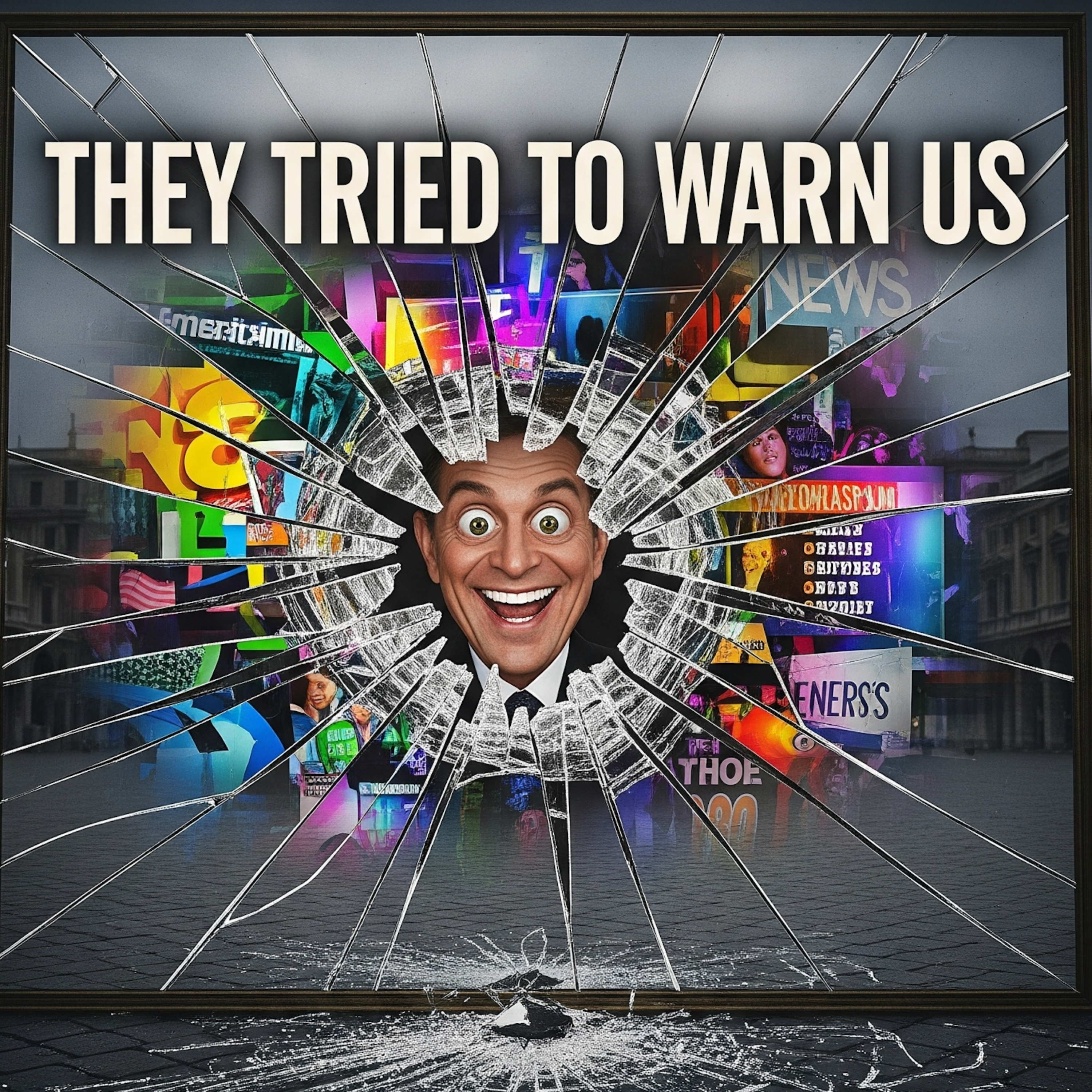
What if the people who predicted the future… could see what we’ve done with it? They wrote books. They issued warnings. They mapped out our technological Faustian bargains before we signed the dotted line.Now they’re back… sort of.They Tried to Warn Us is the podcast that resurrects dead thinkers—writers, theorists, prophets, poets—and asks them what they make of the world we’ve built.Why does it feel like we’re hurtling toward dystopia wearing VR goggles?Because they told us. We just didn’t listen.
-
11
David Foster Wallace: The Cost of Consciousness
David Foster Wallace was not a futurist, technologist, or academic theorist. Yet, few writers captured the emotional and existential toll of modern life as presciently as he did. With a mind equal parts linguistic gymnast and moral philosopher, Wallace wrote about addiction, irony, attention, loneliness, and the quiet, often unbearable burden of being awake to the world. His sprawling 1996 novel Infinite Jest imagined a society paralyzed by its own entertainment, long before anyone had a smartphone in their pocket. His nonfiction work probed American culture with humor and precision. And his 2005 commencement address, “This Is Water,” remains a singular meditation on awareness, compassion, and choice.In resurrecting him for this podcast, we aren’t indulging in nostalgia – we’re acknowledging that Wallace may have been the first writer of the post-internet condition. And we didn’t even notice until it was too late.More information:They Tried to Warn Us, the book: More info on each podcast interview subject, along with 15 more interviews.They Tried to Warn Us, the newsletter: Follow the action on Ray's Substack.
-
10
Herbert Marcuse: The Machine That Sells Obedience
In his 1964 masterwork One-Dimensional Man, Herbert Marcuse described a society where dissent was smothered not by overt oppression but by consumer satisfaction; where entertainment replaced engagement and even protest became another lifestyle brand. He worried that the very tools that could free us – technology, language, imagination – were being hijacked to make us complicit. Marcuse, who died in 1979, transports to 2025 to talk about a world where the machine doesn't need to suppress us; it just needs to make sure we never pause long enough to notice we're already being subdued.More information:They Tried to Warn Us, the book: More info on each podcast interview subject, along with 15 more interviews.They Tried to Warn Us, the newsletter: Follow the action on Ray's Substack.
-
9
Mary Shelley: Frankenstein and the Ethics of Creation
Mary Shelley didn’t just invent science fiction. She wrote a blueprint for the age of innovation without accountability. Frankenstein; or, The Modern Prometheus was a parable of invention, creation, and catastrophic responsibility. It asked what happens when we build something because we can, without asking whether we should. In 2025, we brought her back. She was not impressed. "You’ve now replaced horror with convenience. Awe with speed. Soul with scale. You still believe your cleverness exempts you from consequences. It doesn’t."More information:They Tried to Warn Us, the book: More info on each podcast interview subject, along with 15 more interviews.They Tried to Warn Us, the newsletter: Follow the action on Ray's Substack.
-
8
Aldous Huxley and the Age of Engineered Pleasure
When we think of dystopia, we often imagine Orwell’s jackboot: surveillance, censorship, control through terror. But Aldous Huxley offered a different nightmare – one where oppression wears a grin. In Brave New World (1932), Huxley imagined a world pacified not by fear but by pleasure. A world where citizens are kept docile through engineered happiness,endless distractions, and a little pill called soma. His warning wasn’t about totalitarianism. It was about triviality. A society so inundated with comfort, entertainment, and consumerism that it forgets what it means to be human. Fast-forward to 2025. We live in the dopamine economy. Algorithms serve what we crave. Discomfort is avoided, curated, anesthetized. Huxley saw it coming – and we brought him forward to see what we’ve done with his prophecy.More information:They Tried to Warn Us, the book: More info on each podcast interview subject, along with 15 more interviews.They Tried to Warn Us, the newsletter: Follow the action on Ray's Substack.
-
7
Alan Turing and the Machines That Imitate Us
He cracked the Nazi Enigma code—and may have shortened World War II by two years. He helped invent the modern computer—before the term even existed. He asked a question no one had dared to ask: “Can machines think?” And then set out to answer it.His name was Alan Turing. A Cambridge mathematician turned wartime cryptanalyst, Turing worked in secret at Bletchley Park, leading the effort to break Germany’s unbreakable code. After WWII he turned his mind to the next frontier: intelligent machines and proposed the Imitation Game—what we now call the Turing Test—as a way to measure whether a machine could convincingly mimic human conversation.We brought Alan Turing to 2025 to ask what he thinks of his legacy. We may not be happy with his response.More information: They Tried to Warn Us, the book: More info on each podcast interview subject, along with 15 more interviews.They Tried to Warn Us, the newsletter: Follow the action on Ray's Substack.
-
6
Guy Debord: Society of the Spectacle in the Digital Age
Guy Debord was a Marxist filmmaker and founder of the Situationist International, a group of radical artists and thinkers who believed that modern life had been hijacked by appearances. Debord saw not just the rise of media, but the rise of mediation - and it terrified him. He died in 1994, just before the Internet fully absorbed us, so we brought him back to view an era where the spectacle is not a theory, but an operating system. He took one look at TikTok influencers livestreaming staged protests and muttered: "It's worse than I imagined."More information:They Tried to Warn Us, the book: More info on each podcast interview subject, along with 15 more interviews.They Tried to Warn Us, the newsletter: Follow the action on Ray's Substack.
-
5
Jacques Ellul: The Prophet of Limits in an Age of Acceleration
What happens when the man who warned us about runaway technology comes back to see how it all turned out? In this episode, French philosopher Jacques Ellul—author of The Technological Society—explains why every innovation that can be made will be made, regardless of need or consequence. He introduces his concept of “technique,” showing how efficiency often trumps ethics, and why opting out of modern systems is nearly impossible. With sharp analysis and dry humor, Ellul reflects on how social media, AI, and our obsession with “progress” perfectly match his predictions.More information:They Tried to Warn Us, the book: More info on each podcast interview subject, along with 15 more interviews.They Tried to Warn Us, the newsletter: Follow the action on Ray's Substack.
-
4
Rachel Carson: The Profits of Denial
Rachel Carson wasn't a politician, a futurist or a tech mogul. She was a marine biologist. Her 1962 book Silent Spring sounded the alarm that industry refused to hear. She was accused of being hysterical, anti-progress, even a threat to national security. She died before seeing her work become the foundation of the modern environmental movement.What would she make of the age of carbon markets, eco-branding, microplastics and climate billionaires? We bring her back to see what she has to say.More information:They Tried to Warn Us, the book: More info on each podcast interview subject, along with 15 more interviews.They Tried to Warn Us, the newsletter: Follow the action on Ray's Substack.
-
3
Marshall McLuhan: The Medium is Still Screwing the Message
Before memes, before iPhones, before your mom started texting in all caps—there was Marshall McLuhan. The Canadian media theorist, cultural provocateur, and surprise cameo star in Annie Hall makes his ghostly return to decode the 21st-century media swamp he predicted decades ago.In this episode, Ray sits down with the OG of media studies, a man who once said, “We shape our tools, and thereafter our tools shape us”, then smiled smugly while the rest of us scrambled to keep up. McLuhan takes a long look at the digital age, tries to make sense of TikTok, and assesses whether we’ve finally become the “discarnate beings” he once foretold.Together, they explore:Why McLuhan thinks Twitter is the logical extension of tribal drummingWhat the “global village” actually feels like when everyone’s shoutingHow electric media rewired us into reactive, fragmented mindsWhether he regrets coining phrases people use but never understandThe real meaning behind “the medium is the message”—and why your Kindle isn’t fooling anyoneWhy he might take MarshallGPT personallyAnd yes, how it felt to be more famous for one line in a Woody Allen movie than for reshaping the way we think about mediaIf you’ve ever wondered why Instagram makes you feel overstimulated and underinformed, or why you read McLuhan quotes on Twitter without knowing who he was, this one’s for you.More information:They Tried to Warn Us, the book: More info on each podcast interview subject, along with 15 more interviews.They Tried to Warn Us, the newsletter: Follow the action on Ray's Substack.
-
2
Neil Postman – From Television to TikTok: How We Really Are Amusing Ourselves to Death
“What happens when the man who saw it all coming returns to tell us… we misunderstood the punchline?”In this premiere episode of They Tried to Warn Us, we resurrect the voice and mind of media theorist Neil Postman—the man who warned us that entertainment would devour public discourse, and that we might laugh ourselves into tyranny.Recorded from beyond the grave (don’t worry, it’s not creepy—just uncanny), Postman joins our host Ray Welling for a conversation that feels more relevant now than when Amusing Ourselves to Death first hit shelves in 1985. In fact, it may be more relevant today.We ask Postman what he thinks of:TikTok, Trump, and 24-hour newsWhether Orwell or Huxley got it right (spoiler: Postman was Team Huxley)Why he thought the printing press created reason, and TV dismantled itThe meaning of his infamous phrase: “Now… this.”What schools have forgotten—and why tech won’t save themHow algorithms shape beliefAnd what he thinks of our podcast dragging him back from the dead…Postman responds with the clarity, wit, and dry dismay that made him one of the most prescient cultural critics of the 20th century. This isn’t nostalgia. It’s a warning we’re finally ready to hear.More information:They Tried to Warn Us, the book: More info on each podcast interview subject, along with 15 more interviews.They Tried to Warn Us, the newsletter: Follow the action on Ray's Substack.
-
1
They Tried to Warn Us: Coming soon!
They Tried to Warn Us is the podcast that resurrects dead thinkers—writers, theorists,prophets, poets—and asks them what they make of the world we’ve built.We’ve used a little creative license—and a lot of historical research—to bring back the voices of those who saw it all coming. This season, we talk to ten prophetic voices from across history— from media theorists and science fiction authors to environmentalists, philosophers, and visionaries.Each episode is part time-travel, part interview, part wake-up call.So if you're feeling overwhelmed, confused, or just plain suspicious of your smartphone...You’re not alone.You’re not paranoid.You’re living in the world they warned us about.Subscribe now. Before it’s too late…More information:They Tried to Warn Us, the book: More info on each podcast interview subject, along with 15 more interviews.They Tried to Warn Us, the newsletter: Follow the action on Ray's Substack.
We're indexing this podcast's transcripts for the first time — this can take a minute or two. We'll show results as soon as they're ready.
No matches for "" in this podcast's transcripts.
No topics indexed yet for this podcast.
Loading reviews...
ABOUT THIS SHOW
What if the people who predicted the future… could see what we’ve done with it? They wrote books. They issued warnings. They mapped out our technological Faustian bargains before we signed the dotted line.Now they’re back… sort of.They Tried to Warn Us is the podcast that resurrects dead thinkers—writers, theorists, prophets, poets—and asks them what they make of the world we’ve built.Why does it feel like we’re hurtling toward dystopia wearing VR goggles?Because they told us. We just didn’t listen.
HOSTED BY
Ray Welling
CATEGORIES
Loading similar podcasts...
URL copied to clipboard!