
PODCAST · health
Thought Echoes Podcast
by bethbonness
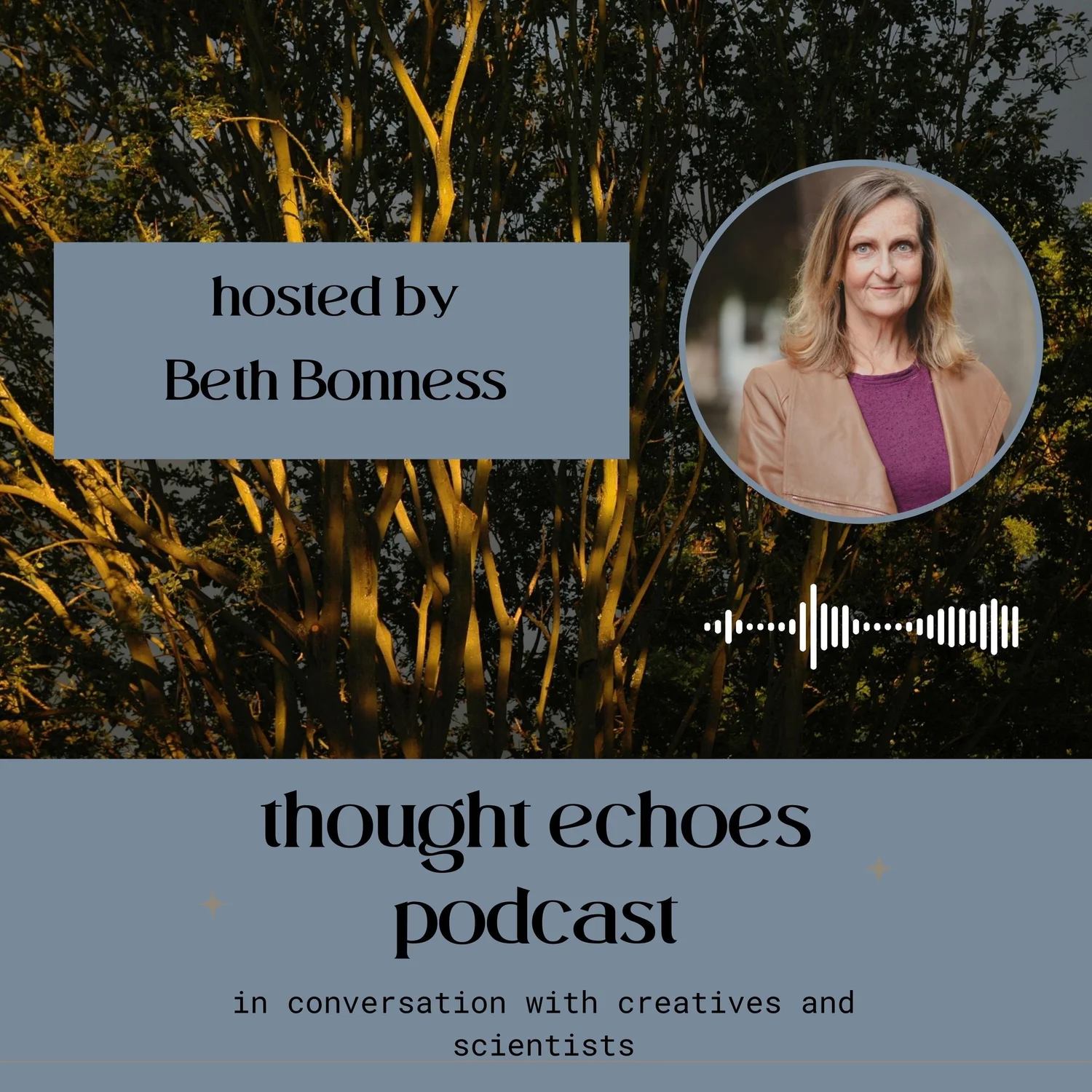
Thought Echoes is a podcast exploring how our thoughts shape meaning, identity, relationships, creativity, and resilience.Hosted by poet and writer Beth Bonness, the show features conversations with authors, researchers, scientists, and thinkers, alongside reflective episodes drawn from lived experience.From consciousness and memory to compassion, neuroplasticity, and transformation, each episode examines the patterns our thoughts leave behind — and how they ripple through our lives.We are all curators of our own thoughts and experiences.
-
42
Robin Gabbert: the healing power of poetry
EPISODE REFLECTION: There’s a quiet courage in choosing not to rush past a moment. I was struck by how poetry becomes less about expression—and more about permission. Permission to sit with what’s unresolved. Permission to revisit what resurfaces. Permission to be honest, even when that honesty feels sharp. Her work reminds us that our lives aren’t linear stories—they’re ecosystems. Interwoven. Contradictory. Alive with both beauty and rupture. And maybe that’s where poetry enters.WHAT YOU’LL HEAR IN THIS EPISODE• Why brain aging is not inevitable• What it really means to be a “super-ager”• How neuroplasticity works in everyday life• The five pillars of brain health• Why midlife can be a new beginning for the brainABOUT THE GUESTRobin Gabbert is an Ekphrastic poet, the winner of Redwood Writers' 2025 Fran Claggett-Holland Award and is a Pushcart Poetry Prize nominee for her poem The Palm Reader. In 2024, her poem Invisible was a finalist in the San Francisco Writers' Conference Poetry Contest and she was long-listed for the Frontier PoetryTanka Challenge. Her book of ekphrastic poetry—The Clandestine Life of Paintings, in Poems was published in 2022 and a full-length book of poetry Somehow, I Haven't Drowned was published by Blue Light Press in August 2025. She has poetry in state, national, and international poetry anthologies including the Ekphrastic Review.LINKS & RESOURCES*Robin Gabbert’s Website*Somehow, I Haven’t Drowned*Robin Gabbert on LinkedIn*Robin Gabbert on FacebookABOUT THOUGHT ECHOESThought Echoes is a monthly podcast hosted by Beth Bonness, featuring conversations with authors, thinkers, and creatives exploring the nature of our thoughts — how they shape our lives, our work, and the meaning we make from experience.THOUGHT ECHOES NEWSLETTERIf you enjoy conversations that explore the nature of our thoughts and the meaning we make from experience, you can subscribe to the Thought Echoes newsletter for deeper reflections:👉https://bethbonness.com/newsletterThank you for listening — until next time, keep exploring the echoes that shape your world.
-
41
Dr. Majid Fotuhi: become a brain super-ager
EPISODE REFLECTION: Rather than framing aging as loss, this conversation invites a shift in perspective: the brain is always adapting. Dr. Fotuhi shows how consistent, intentional choices quietly accumulate — shaping who we become cognitively, emotionally, and physically.WHAT YOU’LL HEAR IN THIS EPISODE• Why brain aging is not inevitable• What it really means to be a “super-ager”• How neuroplasticity works in everyday life• The five pillars of brain health• Why midlife can be a new beginning for the brainABOUT THE GUESTDr. Majid Fotuhi is a neurologist, neuroscientist, and author of The Invincible Brain. He is an adjunct professor at Johns Hopkins and founder of NeuroGrow Brain Fitness Center, where he focuses on preventing and reversing cognitive decline.LINKS & RESOURCES*Dr. Majid’s website*Invincible Brain*Dr. Majid on LinkedIn*Dr. Majid on YouTubeABOUT THOUGHT ECHOESThought Echoes is a monthly podcast hosted by Beth Bonness, featuring conversations with authors, thinkers, and creatives exploring the nature of our thoughts — how they shape our lives, our work, and the meaning we make from experience.THOUGHT ECHOES NEWSLETTERIf you enjoy conversations that explore the nature of our thoughts and the meaning we make from experience, you can subscribe to the Thought Echoes newsletter for deeper reflections:👉https://bethbonness.com/newsletterThank you for listening — until next time, keep exploring the echoes that shape your world.
-
40
Anna Citrino: what are the stories that shape us?
EPISODE REFLECTION: Through poetry, history, and reflection, Anna explores silence, belonging, and the quiet inheritance of stories passed down through generations. This conversation is an invitation to notice the patterns beneath our lives—and to listen more closely to what’s been echoing all along.WHAT YOU’LL HEAR IN THIS EPISODE*How we can live out stories before we’re conscious of them*Why land and place hold emotional and historical memory*The role of poetry in giving voice to what was never spoken*What it means to look back—not to stay there, but to understand ourselves more fullyABOUT THE GUESTAnna Citrino is a poet and the author of Stories We Didn’t Tell. Her work explores land, memory, silence, and the inner lives of women and families shaped by place and history.LINKS & RESOURCES*Anna Citrino’s website*Stories We Didn’t Tell*Anna on LinkedIn*Anna on InstagramABOUT THOUGHT ECHOESThought Echoes is a monthly podcast hosted by Beth Bonness, featuring conversations with authors, thinkers, and creatives exploring the nature of our thoughts — how they shape our lives, our work, and the meaning we make from experience.THOUGHT ECHOES NEWSLETTERIf you enjoy conversations that explore the nature of our thoughts and the meaning we make from experience, you can subscribe to the Thought Echoes newsletter for deeper reflections:👉https://bethbonness.com/newsletterThank you for listening — until next time, keep exploring the echoes that shape your world.
-
39
Amy Leneker: break the hold stress has on you by bringing more joy into your life
EPISODE REFLECTION: Stress is often framed as something to eliminate, outrun, or endure. But what if that framing itself is part of the problem? In this conversation, I was curious about whether our cultural relationship with stress leaves room for something more humane — and more sustainable.Amy Leneker shares how her own experience with burnout led her to question the false choice between stress or joy. Drawing on research and lived experience, she reframes joy not as a reward for surviving stress, but as a practical strategy for buffering against it. We explore why delaying joy only deepens burnout, how uncertainty (“suspense”) quietly erodes our nervous systems, and why resilience can become harmful when it’s misunderstood.What stayed with me most is the idea that stress and joy are not opposites, but companions in a resilient dance. The invitation here isn’t to do less caring, less striving, or less meaningful work — but to notice where small interludes of joy might restore what stress slowly depletes.ABOUT THE GUESTAmy Leneker is an author, speaker, and recovering workaholic turned joy specialist. She is the author of Cheers to Monday, where she explores the intersection of stress, joy, and resilience in modern work and life.LINKS & RESOURCES*Amy Leneker’s website: https://www.amyleneker.com*Cheers to Monday: https://www.amyleneker.com/book#order*Amy on LinkedIn: https://www.linkedin.com/in/amyleneker/ABOUT THOUGHT ECHOESThought Echoes is a monthly podcast hosted by Beth Bonness, featuring conversations with authors, thinkers, and creatives exploring the nature of our thoughts — how they shape our lives, our work, and the meaning we make from experience.THOUGHT ECHOES NEWSLETTERIf you enjoy conversations that explore the nature of our thoughts and the meaning we make from experience, you can subscribe to the Thought Echoes newsletter for deeper reflections:👉 https://bethbonness.com/newsletterThank you for listening — until next time, keep exploring the echoes that shape your world.
-
38
Hiroko Yoda: what does it mean to be grateful?
EPISODE REFLECTION: What does it mean to stay creative—and even hopeful—when life feels uncertain?In this conversation, Hiroko Yoda explores the relationship between creativity, healing, and the unknown. Rather than waiting for certainty before moving forward, she invites us to cultivate a deeper trust in the unfolding process of life.We talk about how creativity can serve as both a compass and a companion during times of transition. By listening more deeply—to ourselves, to others, and to the moment—we may discover that uncertainty is not something to eliminate, but something that can open unexpected possibilities.This conversation is a reminder that imagination, presence, and curiosity can help us navigate complexity with more grace and resilience.ABOUT THE GUESTHiroko Yoda is an executive advisor, teacher, and author who works at the intersection of leadership, creativity, and human development. Drawing from decades of experience supporting entrepreneurs, executives, and creatives, she helps individuals cultivate deeper awareness, clarity, and purpose in their work and lives.Her work explores themes of imagination, possibility, and the role of creative thinking in navigating uncertainty. Through her writing, teaching, and advising, Hiro invites people to engage more fully with the unknown and to approach leadership and life as evolving creative processes.LINKS & RESOURCES*Hiroko Yoda’s website: https://www.hirokoyoda.com/*Eight Million Ways to Happiness: https://www.penguinrandomhouse.com/books/735293/eight-million-ways-to-happiness-by-hiroko-yoda/ABOUT THOUGHT ECHOESThought Echoes is a monthly podcast hosted by Beth Bonness, featuring conversations with authors, thinkers, and creatives exploring the nature of our thoughts — how they shape our lives, our work, and the meaning we make from experience.THOUGHT ECHOES NEWSLETTERIf you enjoy conversations that explore the nature of our thoughts and the meaning we make from experience, you can subscribe to the Thought Echoes newsletter for deeper reflections:👉 https://bethbonness.com/newsletterThank you for listening — until next time, keep exploring the echoes that shape your world.
-
37
Marcy Syms: what does it mean to respect yourself & others?
Episode Reflection: Respect is often treated as something external — something we give, earn, or lose. In this conversation, I was curious about what happens when respect begins closer to home.Marcy Syms reframes respect as a daily practice rather than a status or personality trait. We explore how self-respect shapes boundaries, how unspoken expectations quietly erode trust, and why respectful leadership depends more on attention than authority.What stayed with me is the idea that respect isn’t loud or performative. It shows up in how we listen, how we disagree, and how we care for ourselves and others — especially when things feel tense or uncertain.About the GuestMarcy Syms is an author, executive coach, and leadership expert focused on respectful leadership and healthy workplace cultures. She is the author of Leading with Respect, where she explores how respect — for ourselves and others — can transform relationships, teams, and organizations.Links & ResourcesMarcy Syms’ website: https://marcysyms.comLeading with Respect: https://marcysyms.com/bookMarcy on LinkedIn: https://www.linkedin.com/in/marcysyms/About Thought EchoesThought Echoes is a monthly podcast hosted by Beth Bonness, featuring conversations with authors, thinkers, and creatives exploring the nature of our thoughts — how they shape our lives, our work, and the meaning we make from experience.These are not how-to conversations, but reflective ones — meant to linger, echo, and invite curiosity rather than certainty.Thought Echoes NewsletterIf you enjoy conversations that explore the nature of our thoughts and the meaning we make from experience, you can subscribe to the Thought Echoes newsletter for deeper reflections:👉 https://bethbonness.com/newsletterThank you for listening — and for staying with the echoes that shape your world.
-
36
Josh Davis & Greg Prosmushkin: what if we presuppose good intentions?
Listen as psychologist Josh Davis, PhD, and executive coach Greg Prosmushkin, authors of: The Difference That Makes All the Difference, share their tools for creating fast, lasting change using a scientifically-backed exploration of Neurolinguistic Programming (NLP).
-
35
Céline Santini: finding strength in our imperfections
EPISODE REFLECTION: What if the cracks in our lives weren’t something to hide, but something to honor?In this conversation, Celine Santini shares the philosophy of kintsugi—the Japanese art of repairing broken pottery with gold. Instead of disguising damage, kintsugi illuminates it, revealing how repair itself can become part of the story.We explore how this perspective can reshape our relationship with imperfection, mistakes, and personal growth. Rather than chasing an impossible ideal of flawlessness, we can begin to see our fractures as evidence of a life fully lived—and perhaps even as places where deeper beauty emerges.ABOUT THE GUESTCeline Santini is an author, speaker, and translator known for bringing Japanese wisdom traditions to Western audiences. Her work explores themes such as mindfulness, creativity, and resilience, particularly through the lens of kintsugi, the art of embracing imperfections. Through her books and teachings, she invites readers to see repair, healing, and transformation as integral parts of the human experience.LINKS & RESOURCES*Céline Santini’s website: https://kintsugi-spirit.com*Kintsugi: https://kintsugi-spirit.com/books/#Celine on LinkedIn:: https://www.linkedin.com/in/celinesantini/ABOUT THOUGHT ECHOESThought Echoes is a monthly podcast hosted by Beth Bonness, featuring conversations with authors, thinkers, and creatives exploring the nature of our thoughts — how they shape our lives, our work, and the meaning we make from experience.THOUGHT ECHOES NEWSLETTERIf you enjoy conversations that explore the nature of our thoughts and the meaning we make from experience, you can subscribe to the Thought Echoes newsletter for deeper reflections:👉 https://bethbonness.com/newsletterThank you for listening — until next time, keep exploring the echoes that shape your world.
-
34
Maggie Jackson: what are you paying attention to?
EPISODE REFLECTION: Although Maggie’s book Distracted was originally written in 2008 and re-released in 2018, I didn’t learn about it until I interviewed Maggie in 2024 for her book Uncertain. Took me almost a year to get around to reading Distracted, but the message still resonates today. I’d say there’s a growing urgency for us to learn more about what attention is and how it is being hijacked, so we can reclaim where we choose to place that precious, personal resource.WHAT YOU’LL HEAR IN THIS EPISODE* 3 Types of Attention a* Misnomer of multi-tasking & its unintended consequences * Importance of “slow time”ABOUT THE GUESTMaggie Jackson is an award-winning author and journalist known for her prescient writings on social trends, particularly technology’s impact on humanity. She is author of Distracted and Uncertain.LINKS & RESOURCES*Maggie Jackson’s website: https://www.maggie-jackson.com/*Distracted: https://www.maggie-jackson.com/distracted *Maggie on LinkedIn: https://www.linkedin.com/in/maggiejackson/*Maggie on Instagram: https://www.instagram.com/maggie.jackson.books/ABOUT THOUGHT ECHOESThought Echoes is a monthly podcast hosted by Beth Bonness, featuring conversations with authors, thinkers, and creatives exploring the nature of our thoughts — how they shape our lives, our work, and the meaning we make from experience.THOUGHT ECHOES NEWSLETTERIf you enjoy conversations that explore the nature of our thoughts and the meaning we make from experience, you can subscribe to the Thought Echoes newsletter for deeper reflections:👉https://bethbonness.com/newsletterThank you for listening — until next time, keep exploring the echoes that shape your world.
-
33
Bob Rosen: how do we let go of attachments and aspire to new ideals?
Episode Reflection: Letting go doesn’t mean abandoning responsibility or ceasing to care; it means recognizing when our clinging is rooted in fear rather than purpose. In this conversation, Bob Rosen invites listeners to take stock of the stories and attachments that shape how they think, feel, and act — from the attachment to perfection that silently fuels anxiety to the attachment to self that keeps us isolated rather than connected. What stood out most in our dialogue is the idea that attachments are not just psychological habits — they often operate as invisible tensions that sap energy, narrow perspective, and limit fulfillment. Letting go is not about erasing desire; it’s about discerning which desires enrich life and which diminish it.About the GuestBob Rosen, Ph.D. is a psychologist, global leadership advisor, and bestselling author. In Detach: Ditch Your Baggage to Live a More Fulfilling Life, he explores ten common attachments — like control, perfection, and fear — that shape experience in profound ways, and offers a framework for transforming them into healthy aspirations. Links & ResourcesBob Rosen’s site: https://www.bobrosen.comDetach: Ditch Your Baggage to Live a More Fulfilling Life: https://www.simonandschuster.com/books/Detach/Bob-Rosen/9781637746455Bob Rosen on LinkedIn: https://www.linkedin.com/in/bobrosen/Thought Echoes NewsletterIf you enjoy conversations that explore the nature of our thoughts and the meaning we make from experience, you can subscribe to the Thought Echoes newsletter for deeper reflections:👉 https://bethbonness.com/newsletterThank you for listening — and for staying with echoes that shape your world.
-
32
Anne-Laure Le Cunff: redefining success, one tiny experiment at a time
EPISODE REFLECTION: What if we approached life less like a fixed plan and more like a series of experiments?In this conversation, Anne-Laure Le Cunff shares the philosophy behind her book Tiny Experiments. Rather than chasing a single definition of success, she invites us to explore small, low-risk experiments that help us learn what truly matters.This mindset encourages curiosity over certainty and discovery over rigid goal-setting. By shifting our focus from outcomes to learning, we can create more adaptable and fulfilling paths forward.ABOUT THE GUE4STAnne-Laure Le Cunff is a neuroscientist, entrepreneur, and writer who explores the intersection of curiosity, learning, and human potential. She is the founder of Ness Labs, a learning community focused on mindful productivity and creative experimentation. Her work encourages people to approach work and life as evolving experiments rather than fixed trajectories.LINKS & RESOURCES*Anne-Laure Le Cunff’s website: https://anne-laure.net/*Tiny Experiments: https://nesslabs.com/book*Anne-Laure on LinkedIn: https://www.linkedin.com/in/neuranne/ABOUT THOUGHT ECHOESThought Echoes is a monthly podcast hosted by Beth Bonness, featuring conversations with authors, thinkers, and creatives exploring the nature of our thoughts — how they shape our lives, our work, and the meaning we make from experience.THOUGHT ECHOES NEWSLETTERIf you enjoy conversations that explore the nature of our thoughts and the meaning we make from experience, you can subscribe to the Thought Echoes newsletter for deeper reflections:👉 https://bethbonness.com/newsletterThank you for listening — until next time, keep exploring the echoes that shape your world.
-
31
Hrund Gunnsteinsdóttir: using intuition as your inner compass
EPISODE REFLECTION: Through poetry, history, and reflection, Anna explores silence, belonging, and the quiet inheritance of stories passed down through generations. This conversation is an invitation to notice the patterns beneath our lives—and to listen more closely to what’s been echoing all along.WHAT YOU’LL HEAR IN THIS EPISODE*How we can live out stories before we’re conscious of them*Why land and place hold emotional and historical memory*The role of poetry in giving voice to what was never spoken*What it means to look back—not to stay there, but to understand ourselves more fullyABOUT THE GUESTHrund Gunnesteinstdóttir is a thought leader around intuition and author of InnSæil. Her work explores how we can navigate life with a stronger inner compass using intuition and InnSæi.LINKS & RESOURCES*Hrund’s website https://www.hrundgunnsteinsdottir.com*InnSæi: https://hrundgunnsteinsdottir.com/book/*Hrund on LinkedIn: https://www.linkedin.com/in/hrundgunnsteinsdottir/*Hrund on Instagram: https://www.instagram.com/hrundgunnsteinsdottirABOUT THOUGHT ECHOESThought Echoes is a monthly podcast hosted by Beth Bonness, featuring conversations with authors, thinkers, and creatives exploring the nature of our thoughts — how they shape our lives, our work, and the meaning we make from experience.THOUGHT ECHOES NEWSLETTERIf you enjoy conversations that explore the nature of our thoughts and the meaning we make from experience, you can subscribe to the Thought Echoes newsletter for deeper reflections:👉https://bethbonness.com/newsletterThank you for listening — until next time, keep exploring the echoes that shape your world.
-
30
Katie Prince: poetry invites us to unexpected places
Episode Reflection: Delve into the power of words, the magic of poetry, and the messy beauty of being human. In this conversation, Katie Prince shares how learning to trust intuition — in writing and in life — often requires releasing the need for immediate answers. We talk about the tension between control and surrender, and how listening deeply can become a form of courage rather than passivity.What stayed with me is the reminder that meaning often reveals itself after we take a step — not before. The invitation here isn’t to force certainty, but to remain open to what wants to emerge when we make space.About the GuestKatie Prince is the author of Tell This to the Universe. Her work explores intuition, creativity, and the art of listening — to ourselves, to language, and to the unseen currents shaping our lives.Links & Resources*Katie Prince website: https://www.katieprince.com*Tell This to the Universe: https://www.katieprince.com/booksAbout Thought EchoesThought Echoes is a monthly podcast hosted by Beth Bonness, featuring conversations with authors, thinkers, and creatives exploring the nature of our thoughts — how they shape our lives, our work, and the meaning we make from experience.These are not how-to conversations, but reflective ones — meant to linger, echo, and invite curiosity rather than certainty.Thought Echoes NewsletterIf you enjoy conversations that explore the nature of our thoughts and the meaning we make from experience, you can subscribe to the Thought Echoes newsletter for deeper reflections:👉 https://bethbonness.com/newsletterThank you for listening — and for staying with the echoes that shape your world.
-
29
Elina Teboul: honoring feminine intelligence
EPISODE REFLECTION: What if intelligence includes more than analytical thinking?In this conversation, Elina Teboul introduces the concept of feminine intelligence—a form of knowing that integrates intuition, emotional awareness, creativity, and relational insight.Rather than positioning feminine intelligence as the opposite of traditional intellect, Elina invites us to see it as a complementary dimension of wisdom. When analytical thinking and relational awareness work together, we gain a fuller picture of the challenges and possibilities we face.This episode explores how expanding our definition of intelligence can reshape leadership, decision-making, and personal growth.ABOUT THE GUESTElina Teboul is an executive coach, leadership advisor, and author of Feminine Intelligence. Her work focuses on helping individuals and organizations integrate emotional intelligence, intuition, and relational awareness into leadership and decision-making. She works globally with leaders seeking more holistic approaches to impact and transformation.*Elina Teboul’s website: https://elinateboul.com/*Feminine Intelligence: https://feminineintelligencebook.com/*Elina on LinedIn: https://www.linkedin.com/in/elinateboul/ABOUT THOUGHT ECHOESThought Echoes is a monthly podcast hosted by Beth Bonness, featuring conversations with authors, thinkers, and creatives exploring the nature of our thoughts — how they shape our lives, our work, and the meaning we make from experience.THOUGHT ECHOES NEWSLETTERIf you enjoy conversations that explore the nature of our thoughts and the meaning we make from experience, you can subscribe to the Thought Echoes newsletter for deeper reflections:👉 https://bethbonness.com/newsletterThank you for listening — until next time, keep exploring the echoes that shape your world.
-
28
Dr. Nilanjana Dasgupta: driving culture change
EPISODE REFLECTION: Through the use of a powerful metaphor 'wallpaper,' the underpinning of Dr. Dasgupta’s work uses science to drive culture change and promote greater equality and justice in our communities. She takes us on a journey through the different types of 'wallpaper' - the physical, symbolic, representational, and social norms - that often go unnoticed but profoundly shape our experiences and opportunities.WHAT YOU’LL HEAR IN THIS EPISODE* Belief change doesn't necessarily produce behavior change because of situational forces around us* Stepping outside our bubbles allows us to see live from other people's perspectives* We all have networks that can help other peopleABOUT THE GUESTDr. Nilanjana Dasgupta is a social psychologist and author of Change the Wallpaper. LINKS & RESOURCES* Dr. Nilanjana Dasgupta’s website: https://www.implicitdasgupta.org/ Change the Wallpaper: https://changethewallpaper.com/*Dr. Dasgupta on LinkedIn: https://www.linkedin.com/in/nilanjana-buju-dasgupta/ABOUT THOUGHT ECHOESThought Echoes is a monthly podcast hosted by Beth Bonness, featuring conversations with authors, thinkers, and creatives exploring the nature of our thoughts — how they shape our lives, our work, and the meaning we make from experience.THOUGHT ECHOES NEWSLETTERIf you enjoy conversations that explore the nature of our thoughts and the meaning we make from experience, you can subscribe to the Thought Echoes newsletter for deeper reflections:👉https://bethbonness.com/newsletterThank you for listening — until next time, keep exploring the echoes that shape your world.
-
27
Caroline Adams Miller: the science of goal setting
Episode Reflection: Big goals often come with big expectations — from others, from culture, and from ourselves. In this conversation, Carol Adams Miller invites us to slow down and look beneath the surface of goal-setting to examine the intentions that drive our pursuits.We explore how goals rooted in external validation or pressure can quietly drain energy, while goals aligned with values and meaning tend to endure. Carol shares insights on motivation, resilience, and why revisiting why we want something is just as important as deciding what we want.What stayed with me is the reminder that goals are not just outcomes — they are relationships we maintain over time.About the GuestCarol Adams Miller is an author, speaker, and expert on goal achievement and positive psychology. Her work focuses on helping individuals and organizations pursue meaningful goals that align with values, purpose, and well-being.Links & Resources*Carol Adams Miller: https://www.carolinemiller.com/*Big Goals: https://www.carolinemiller.com/author/About Thought EchoesThought Echoes is a monthly podcast hosted by Beth Bonness, featuring conversations with authors, thinkers, and creatives exploring the nature of our thoughts — how they shape our lives, our work, and the meaning we make from experience.These are not how-to conversations, but reflective ones — meant to linger, echo, and invite curiosity rather than certainty.Thought Echoes NewsletterIf you enjoy conversations that explore the nature of our thoughts and the meaning we make from experience, you can subscribe to the Thought Echoes newsletter for deeper reflections:👉 https://bethbonness.com/newsletterThank you for listening — and for staying with the echoes that shape your world.
-
26
Monica Parker: the power of wonder enriches lives
Listen as Monica Parker shares the importance of knowing what brings us wonder and allows us to embrace the richness of being alive.
-
25
Morgan Baker: the concept of home changes over time
Listen as Morgan Baker explores the concept of home and how it shifts over time.
-
24
Dr. Peter Sjöstedt-Hughes: exploring consciousness
Listen as Dr. Peter explores consciousness, experience, and group mind.
-
23
Dr. Sunita Sah: defiance is acting in accordance with your values when there's opposing pressure
Listen as Dr. Sunita Sah explores reframing defiance and her upcoming book Defy: the Power of No in a World That Demands Yes.
-
22
Maggie Jackson: uncertainty is both a space of possibilities and a state of wakefulness
Listen as Maggie shares how uncertainty is both a space of possibilities and a kind of state of wakefulness. How by teaching tolerance of uncertainty, people's resilience can be bolstered.
-
21
Will Dowd: the liminal space before we fall asleep taps into our creative minds
Listen as Will shares how to access that liminal space before we fall asleep as a way to tap into our creative minds.
-
20
Emily Sadowski: how to become more self-aware of our intuitive hits
Listen to Emily Sadowski share how to become more self-aware of our intuitive hits and how they can help us make choices every day.
-
19
Diana Raab: writing can be used for healing and transformation
Listen to Diana Raab share how writing can be used for healing and transformation.
-
18
Susan Wooldridge: poetry is a mystical way to go inside ourselves
Listen to Susan Wooldridge share how poetry gives us access to ourselves.
-
17
Roxanne Colyer: intuition is part of the creative process
Listen to Roxanne Colyer share her creative process.
-
16
Clay Drinko: improv can improve our relationships
Listen to author Clay Drinko talk about improv in his creative process and how mirroring improves our relationships.
-
15
Katherine Benfante: sci-fi taps into people with a broad imagination
Listen to author Katherine Benfante talk about her creative process.
-
14
Joe Borges: community is important
Listen to Joe Borgess who survived a hemorrhagic stroke and how he’s now a motivation speaker and mindsset coach who helps people around the world connect and build community.
-
13
Marcia Moran: helping others reboot their brains
Listen to how Marcia Moran, who survived a stroke and is rediscovering teaching by working with writers.
-
12
Mimi Hayes: returning to her teacher-self
Listen to how Mimi Hayes, who survived a hemorrhagic stroke and is rediscovering teaching by working with writers.
-
11
Michael Keefe: reconnecting to his music
Listen to how Michael Keefe, who survived two hemorrhagic strokes, is rediscovering music.
-
10
Olivia Lewis: embracing life with transparency & grace
Listen to how Olivia Lewis, who survived a brainstem strokes and locked-in syndrome when she was in college at 21, reframed a devastating event with grace and transparency. Her advocacy work hopes of helping others understand what it felt like to be locked-in without anyone being able to understand you while cognitively she could understand everyone else.
-
9
Alison Shapiro: teaching people to build positive stories
Listen to how Alison Shapiro, artist, author, and mindfulness stroke advocate, who survived 2 devastating & near fatal brain stem strokes 24 hours apart. She discovered she did could and would have a profound impact on the course of that recovery.
-
8
Stacie Broek: passion-finding advocate
Listen to how Stacie Broek, author and activist, who survived a stroke at age 46 as an ex-pat in Tokyo as we explore her transformation into Stacie 2.0 through passion-therapy and how she intends to help other families navigate recovery.Did you like this episode? Let me know by following and rating the show!
-
7
Matthew Goodrich: discovering art after a TBI
Beth Bonness interviews Mathew (Matty) Goodrich who survived an incredible traumatic brain injury in a remote location on Molokai, Hawaii in 2016. Listen to how Matty rediscovered himself through painting and writing by connecting to a community of people where he felt he belonged.Did you like this episode? Let me know by following and rating the show!
-
6
Dr. Kate Allatt: thriving after locked-in syndrome
Beth Bonness interviews Dr. Kate Allatt, author of Running Free: Breaking Out from Locked-in Syndrome. where they talk about what it feels like to be locked inside yourself and not communicate through her incredible recovery, plus the creative projects she’s working on.
-
5
Eileen Haas: memoir as part of stroke-recovery
Eileen Hass, author, suffered a hemorrhagic stroke. Eileen is a former editor and copywriter and recently published an inspirational memoir: Along Came a Stroke: My Story of Survival and Recovery.
-
4
Billy Ethridge: explores life’s options post-stroke
Billy Ethridge, director and founder of WNE4k, suffered a hemorrhagic stroke. Billy is the founder and director of WNE4, an international biotech and strategic consulting firm.
-
3
Giles Turnbull: life as a blind poet
Giles Turnbull, a blind poet and aspiring novelist with brain cancer.
-
2
Andy Dovey: life as a musician post-stroke
Andy Dovey, musician, podcaster, blogger, and YouTuber who suffered an ischemic stroke. Andy is the creator of Brain Attack Music — to help raise awareness of brain attacks (strokes) and raise some money for charity.
-
1
Bob Phillips: life after a concussion
Bob Phillips, author of Absolute Honesty: Building a Corporate Culture That Values Straight Talk and Rewards Integrity and President and CEO of RW & Associates, a Management and organizational consulting firm that specializes in working with companies and leaders to drive change in culture, organizational integrity, and honesty.
No matches for "" in this podcast's transcripts.
No topics indexed yet for this podcast.
Loading reviews...
ABOUT THIS SHOW
Thought Echoes is a podcast exploring how our thoughts shape meaning, identity, relationships, creativity, and resilience.Hosted by poet and writer Beth Bonness, the show features conversations with authors, researchers, scientists, and thinkers, alongside reflective episodes drawn from lived experience.From consciousness and memory to compassion, neuroplasticity, and transformation, each episode examines the patterns our thoughts leave behind — and how they ripple through our lives.We are all curators of our own thoughts and experiences.
HOSTED BY
bethbonness
Loading similar podcasts...
URL copied to clipboard!