
PODCAST · business
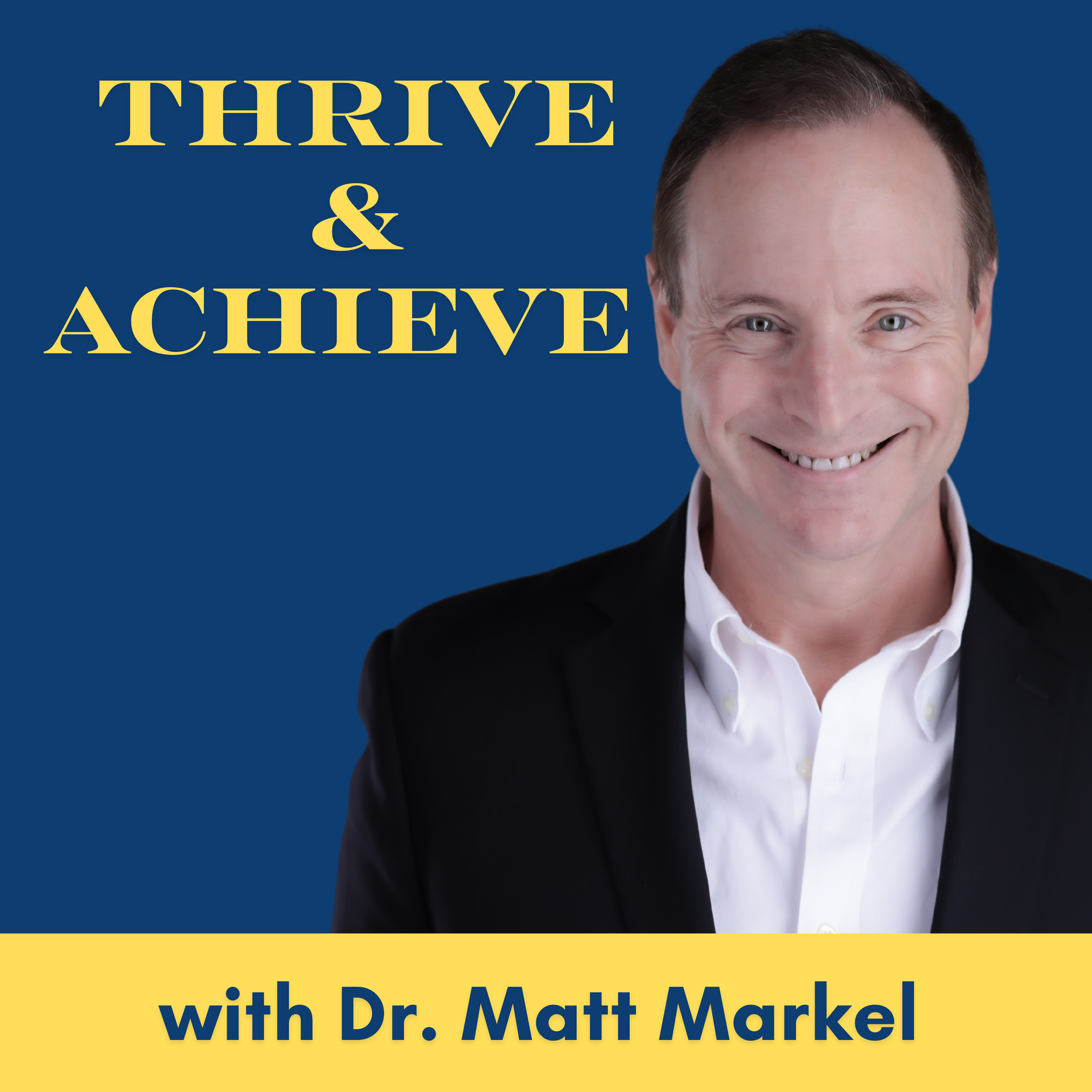
Thrive & Achieve with Dr. Matt Markel
by Dr. Matt Markel
Imagine a workplace where professionals feel valued, careers keep moving forward, and financial confidence replaces worry. That’s the vision behind Thrive & Achieve—a podcast dedicated to W2 and 1099 professionals: make our workplace better and our workforce stronger. We are professionals helping professionals succeed at work and build a more secure financial future.Every week, host Dr. Matt Markel sits down with experts, leaders, and practitioners to explore how professionals can unlock their full potential. Together, we’ll tackle the two biggest challenges facing today’s workforce:1. Career stagnation – feeling stuck, overlooked, or unsure how to reach the next level.2. Financial anxiety – the worry that retirement, savings, and wealth-building are always just out of reach.About the Host:Dr. Matt Markel is an engineer turned executive with 35 years of experience spanning defense, autonomy, and high-tech industries. He has served as CEO, CTO, and President of nine- and ten-figu
-
17
Frankie Kemp: Speak So People Actually Listen
Most professionals don’t fail because they lack knowledge—they fail because they don’t communicate it in a way people care about.In this episode of Thrive and Achieve, Dr. Matt Markel sits down with communication expert Frankie Kemp to break down why technically strong professionals struggle to command attention—and how to fix it.Frankie shares the hidden psychological barriers that hold people back, including the “apologetic mindset,” over-explaining, and failing to communicate from the audience’s perspective. She introduces a practical, repeatable framework to transform any presentation into a compelling, audience-focused conversation.You’ll learn how to structure your message for impact, eliminate unnecessary detail, and present with confidence—even under pressure. Frankie also dives into preparation techniques that don’t require hours of work, how to think on your feet, and why storytelling and simplicity outperform jargon every time.If you’ve ever felt overlooked, unheard, or unsure how to communicate your ideas effectively—this episode gives you the tools to change that immediately.00:00 – Why speaking triggers a primal fear response01:06 – Introduction to Frankie Kemp02:05 – Why smart professionals struggle to communicate04:48 – The core mistake: not seeing through the audience’s eyes06:48 – “No temporal stories” – get to the point faster09:36 – The presentation framework: WIIFM + Think/Feel/Do12:46 – Why you should start in the middle (Ancient Greek method)14:09 – Prompt cards vs slides (and why slides aren’t your presentation)16:50 – How to handle last-minute presentations (no slides needed)18:24 – Mastery vs memorization20:19 – Why jargon kills credibility23:13 – Frankie’s journey from acting to communication expert30:14 – The power of audience feedback and engagement32:22 – A realistic prep plan (without overwhelm)36:37 – Landmarks vs breadcrumbs (how to remember your talk)41:45 – Instant body language fix for confidence44:03 – The biggest mistake in opening a presentation47:54 – Managing nerves by reframing as a conversation50:15 – Bad financial advice to avoid55:05 – Career advice: how to stop being overlooked56:14 – How to connect with Frankie
-
16
Anna Jacobi: Alignment Without Disagreement Is a Red Flag
If everyone in the room instantly agrees, you don’t have alignment.You have compliance.In this episode of Thrive and Achieve, Dr. Matt sits down with Anna Jacobi — electrical engineer, former Chief Product Officer, and AI infrastructure strategist — to unpack what serious product leaders see that others miss.This isn’t a buzzword conversation.It’s a deep dive into how strong product leaders think about failure, governance, AI systems, and durability.Because great teams don’t pretend systems won’t break.They name where they’ll fail.They design governance and security into the architecture — not as paperwork after launch.And they understand that AI has shifted leadership from deterministic systems to probabilistic ones.In this episode, we cover:• Why alignment without disagreement is a warning sign• How to detect fragility before launch day• Why governance and security must be first-order design decisions• How AI changes product leadership from repeatable to probabilistic thinking• The difference between chasing upside and managing downside• Why durable systems outlast hypeIf you build platforms, ship AI, lead product teams, or allocate capital — this conversation will sharpen how you think about risk, trust, and second-order consequences.Connect with Anna Jacobi on LinkedIn: AJacobiSubscribe for more conversations where professionals help professionals thrive in their careers and achieve financial success.00:00 Why strong teams name where they’ll fail00:58 Introduction to Anna Jacobi02:24 From electrical engineer to product leader04:28 Redefining success: building what outlives you07:58 What strong product leaders do differently10:35 Governance and security aren’t add-ons12:05 Early signal of a strong team14:37 AI shifts leadership from deterministic to probabilistic18:15 Second-order consequences in product decisions19:58 Sustainability: environment, ethics, and economics25:08 Responsible speed in AI27:25 The identity and governance problem in AI29:25 Applying product thinking to your career32:53 Bad career advice: “Follow your passion”33:47 One lesson on money and one on career35:03 How to connect with Anna
-
15
Gary Leeman: Building Systems that Scale
You don’t need a better team.You need a better system.In this episode of Thrive and Achieve, EOS Implementer and former COO Gary Leeman breaks down the operational blind spots that sabotage growth—and the system he now uses to help leadership teams build companies that scale without burning out.We talk EOS, execution, leadership focus, equity mindsets, and why solving root problems matters more than solving fast ones.If you're a founder, operator, or team lead trying to scale without spinning out—this episode is for you.In this episode, we cover:What EOS is (and what it isn’t)Why your company keeps missing on executionThe cost of trying to “do it all” as a teamThe difference between goals and systems—and why systems winA career-changing moment (disguised as an insult)When equity doesn’t mean ownership🎧 Listen now to learn how to scale smarter—with systems that actually stick.Follow Gary Leeman:📧 [email protected]🔗 LinkedIn: https://www.linkedin.com/in/garyleeman/Chapters:00:00 Intro – Why most companies do too much01:10 Meet Gary Leeman03:33 Career journey: From engineering to execution05:50 Startup chaos → discovering EOS08:15 How EOS saved their company during COVID10:34 From exit to EOS implementer12:41 Redefining success: Equity vs. salary20:25 Why smart teams still struggle with execution21:46 Multitasking is a lie: Focus as a growth lever25:57 Root cause vs. quick fixes30:29 Governor vs. Director thinking in leadership35:05 What is EOS? Explained simply37:00 Vision → Traction → Healthy (The EOS Model)39:45 Goal-setting that actually drives progress43:12 Systems vs. goals—what really wins?46:57 Why companies succeed or collapse48:35 How to connect with Gary49:06 Outro – Thrive and Achieve
-
14
Frank Agin: Networking Myths Explained
Most professionals think networking means LinkedIn posts, conferences, or handing out business cards.It doesn’t.In this episode of Thrive and Achieve, Dr. Matt sits down with Frank Agin — author, networking expert, and host of an 800+ episode podcast — to break down what networking really is, why it works, and how professionals can use it inside their own companies to accelerate their careers.This is not about being fake, political, or transactional.It’s about building real professional relationships that compound over time.If you’re a W-2 professional, leader, or high performer who wants more opportunities without playing games, this episode is for you.00:00 – The “Cloak of Invincibility” (Why Networking Feels Hard)00:48 – Introduction to Frank Agin01:46 – From Law & Accounting to Networking Expert05:13 – Why Networking Hasn’t Actually Changed06:54 – Knowing Why Networking Works07:46 – Why Face-to-Face Still Matters11:07 – Success, Self-Doubt, and the “Tricycle vs. 18-Wheelers” Effect14:43 – Differentiation Is the Real Career Skill15:38 – What Networking Actually Is (Definition)17:43 – Networking the People You Already Know19:41 – The Shawshank Redemption Story24:59 – Why Small Talk Builds Trust25:26 – How to Walk Into a Room of Strangers30:19 – The “Cloak of Invincibility” Explained32:54 – Simple Networking Systems That Work37:43 – Internal Networking as a Career Superpower41:31 – What Dr. Matt Would Do Differently44:05 – Bad Career & Financial Advice People Still Believe45:42 – The Easiest Way to Get Networked Fast46:20 – How to Connect with Frank Agin
-
13
Michael Davis – The Simple Story Framework That Makes People Listen
Why do smart professionals lose rooms during presentations?Not because of weak slides—but because their message has no turning point.In this episode of Thrive and Achieve, Dr. Matt Markel sits down with Michael Davis, communication coach, speaker, and founder of Speaker CPR, to break down how leaders can communicate with clarity, confidence, and impact—without data dumping or sounding scripted.This conversation is for professionals, executives, and leaders who want to:• Hold attention in meetings and presentations• Communicate ideas clearly to senior leadership• Use storytelling to drive decisions, not just share information• Build confidence by understanding the story they tell themselvesMichael introduces a simple, practical storytelling framework used by effective communicators in business—and explains why most presentations fail even when the data is right.What you’ll learn in this episode:• Why attention isn’t broken—openings are• The AND / BUT / SO storytelling framework for business communication• How to stop overloading audiences with information• Why confidence issues are often identity issues• How silence increases influence and trust• How better communication creates career leverageEpisode Chapters00:00 – Why “BUT” is the most important word in storytelling01:16 – Introduction to Michael Davis02:21 – A first-grade moment that shaped a fear of public speaking05:22 – From financial planner to communication coach06:46 – Why most business communication is forgettable08:58 – Thinking like your audience, not yourself12:38 – The AND / BUT / SO storytelling framework16:58 – Why information overload kills impact22:37 – Turning dry data into compelling executive decisions29:02 – Why you can’t be both the hero and the solution30:33 – Confidence, fear, and internal narratives33:44 – The “sticky note” story that capped success37:05 – Mental tools for leaders under pressure41:40 – The most overlooked communication skill: silence43:12 – Career advice conventional wisdom gets wrong45:12 – One lesson on money and one on career46:03 – How to connect with Michael Davis
-
12
Boris Blum Pt. 2 – The Hidden Risks Lurking in Your 401(k)
Most professionals are disciplined at work—but dangerously passive with their money.In Part 2 of this conversation, Boris Blum and I shift from career execution to financial execution. We unpack why traditional financial advice often fails high-performing professionals, how incentives distort guidance, and what it actually takes to build financial independence with clarity, liquidity, and control.This isn’t about chasing returns.It’s about managing risk, avoiding blind spots, and building a system that works across market cycles.What We Cover in Part 2Why Boris Created Wealth CouncilBoris explains the origin of Wealth Council after noticing a recurring disconnect: people talked about “generational wealth,” but what they actually wanted was financial independence—and they didn’t know how to define or achieve it.He shares his definition of financial independence:Three non-correlated income streamsNot tied to your primary professionKey insight:Most people don’t have a strategy problem. They have a literacy problem.The Problem With Product-Driven Financial AdviceWe dig into why most financial guidance is biased by incentives.If someone sells:Insurance, they recommend insuranceFunds, they recommend fundsReal estate, they recommend real estateBoris explains why this “hammer and nail” dynamic leaves professionals undereducated and overexposed.Key insight:If your advisor is on the chessboard, you’re not getting objective advice.Liquidity: The Hidden Constraint for ProfessionalsWe discuss why many professionals are asset-rich but cash-poor.Most wealth is tied up in:Primary residences401(k)s and retirement plansNeither offers real flexibility in moments of opportunity or crisis.Key insight:Lack of liquidity doesn’t just increase risk—it eliminates optionality.The 401(k) Risk Most People IgnoreBoris breaks down how modern retirement plans actually work:Passive, algorithmic investingMandatory deployment of contributionsLimited control over assets and timingHe explains why these systems amplify both upside and downside—and why most participants won’t see the risk until it’s too late.Key insight:Set-and-forget works—until it doesn’t.Why Downside Risk Matters More Than ReturnsInstead of asking “How much can I make?” Boris argues investors should ask:What can go wrong?Can this go to zero?How do I mitigate that risk?This mindset shift reframes investing away from speculation and toward durability.Key insight:Take care of the downside, and the upside takes care of itself.Education Over DelegationBoris makes the case that professionals must take responsibility for their financial future—even if they work with advisors.Education doesn’t mean doing everything yourself.It means understanding enough to:Ask better questionsSet clear expectationsKnow when something no longer makes senseKey insight:You can delegate execution—but not understanding.Who Wealth Council Is ForBoris explains how Wealth Council works:Education-first, no products soldOngoing participation and accountabilityModel portfolios for context, not copying
-
11
Boris Blum Pt. 1 - The Discipline Behind Elite Execution
Most professionals don’t struggle because they lack talent, intelligence, or ambition.They struggle because they don’t execute deliberately.In this episode of Thrive & Achieve, I sit down with turnaround expert and former family-office CEO Boris Blum to unpack what actually separates leaders who adapt and win from those who stall—despite past success.This isn’t about motivation.It’s about discipline, decision-making, and seeing reality clearly.What We Cover in Part 1Boris’s Unconventional Career PathBoris shares his journey from serial entrepreneur to financial services, to family-office CEO, to turnaround strategist—why each transition happened, and what disillusionment taught him about leadership, incentives, and real problem-solving.Key insight:Experience across multiple systems (entrepreneurial, corporate, advisory) creates pattern recognition most leaders never develop.The 3D Focus Framework: Why Some Leaders Are “Dangerous”Boris introduces 3D Focus, the core traits shared by the most effective leaders he’s worked with:Discipline – consistent execution, not bursts of effortDecisiveness – committing without perfect informationDeliberate action – intentional choices, not driftHe contrasts this with 2D Focus:DistractedDelusional (seeing the world as you want it to be, not as it is)Key insight:High performers aren’t reckless—they’re dangerous in a good way because they act with clarity and commitment.The Real Risk of “Aspirational Thinking”We tackle a subtle but critical leadership tension:Leaders are told to think aspirationallyBut too much aspiration becomes denialBoris explains how leaders must balance vision with brutally honest filters—otherwise optimism turns into delusion.Key insight:Vision without filters isn’t leadership. It’s hallucination.Guiding Operating Principles: The Hidden Advantage of Elite PerformersBoris explains why top performers don’t rely on motivation or willpower.Instead, they use:Personal operating principlesClear decision filtersStandards that eliminate daily negotiationWe discuss how making fewer decisions actually leads to better outcomes—and why discipline is freeing, not restrictive.Key insight:The best leaders decide once, then stop renegotiating.Why Leadership Teams Fail at ExecutionDespite strong strategy and planning, most organizations fail in execution.We break down why:Metrics measure activity, not outcomesLeaders manage instead of leadTeams lack a framework that allows real-time pivotsBoris shares how execution—not planning—is the true differentiator, especially in complex organizations.Key insight:If your KPIs reward busyness, mediocrity becomes the ceiling.Management vs Leadership (And Why It Matters)We explore:Why exponential growth requires leadership, not managementWhy execution frameworks matter more than vision statementsHow teams lose alignment even when everyone is “doing their job”Key insight:Execution is not a personality trait—it’s a system.Coming Up in Part 2In Part 2, we pivot from career execution to financial execution—and why most professionals apply discipline at work but abandon it entirely when it comes to money.
-
10
Susan Filan - Redefining Success After Everything Changes
Leap Before You’re PushedSusan Filan on identity, reinvention, and redefining successIn this powerful and deeply human episode of Thrive & Achieve, Susan Filan — former prosecutor, MSNBC Senior Legal Analyst, and now keynote speaker and life strategist — shares how a near-fatal accident stripped away every role she thought defined her… and revealed what actually matters.This is not a story about starting over lightly.It’s a story about waking up before you’re pushed.In this episode, we explore:Why career success and personal identity often get dangerously intertwinedHow Susan went from high-stakes courtroom battles to a complete life and career reinventionWhat a near-death experience taught her about love, meaning, and real successWhy burnout often signals it’s time to play on a bigger stage, not a smaller oneThe idea that you cannot thwart your soul’s destiny — only delay itWhat “leap before you’re pushed” really means (and why it does not mean quitting your job)How neuroscience and habit formation show the brain is trainable — even after traumaThe role of fear, ego, and identity in keeping professionals stuckWhy money matters — but makes a terrible godHow to reconnect logic and intuition so they work together, not against each otherKey insights you’ll take away:You are not your title, your résumé, your income, or your accomplishmentsWaiting until crisis removes leverage — in your career and your financesOptionality is built in calm moments, not emergenciesIgnoring the inner signal leads to louder wake-up callsGratitude, presence, and love aren’t “soft skills” — they’re stabilizing forcesSusan also shares practical ways professionals can reconnect with themselves without needing a traumatic event — including simple practices around awareness, breath, attention, and asking better questions of themselves.Why this episode matters:Many professionals are succeeding on paper — but quietly drifting away from themselves.This conversation is an invitation to pause, listen, and choose intentionally:before burnout decides for youbefore financial pressure narrows your choicesbefore life delivers a wake-up call you didn’t ask forAbout the guest:Susan Filan is a former prosecutor, senior legal analyst for MSNBC, and nationally recognized trial attorney who has litigated some of the highest-stakes cases imaginable. Today, she brings together legal rigor, neuroscience, and spiritual insight as a keynote speaker focused on resilience, purpose, and conscious leadership.Connect with Susan:Website: SusanFilan.comEmail: [email protected]
-
9
Jess Lane - How to Design a Career You Actually Want
What if your entire career is being shaped by outdated rules you never agreed to?And what if you could redesign it — using your psychology, your experiences, and your “special sauce” — in 90 days or less?In this week’s episode, I sit down with Jesseca Lane, an award-winning marketing executive and psychologist-in-training who has built and scaled global brands like Porsche, Visa, MillerCoors, and Anheuser-Busch — and taken tech startups to unicorn valuations.Then, after a sudden layoff, she had to rebuild her identity and rethink her entire professional path.Her story is raw, powerful, and packed with insight for every W2 professional who’s wondering:“What’s next for my career — and how do I design a life I actually want?”This conversation is a masterclass in reinvention, career design, psychological freedom, and showing up for yourself.What We Discuss in This Episode1. How to stop chasing titles and start chasing experiencesJess breaks down why titles often lie — and why experiences, not roles, accelerate your career faster than anything else.2. The “special sauce” framework that changes how you see yourselfShe explains how to identify your unique combination of skills, stories, and strengths — and how to package them into a career advantage.3. Why layoffs hit your identity harder than your bank accountJess shares the emotional aftermath of being let go after taking a company to unicorn status — and the exact reframing that helped her reclaim her narrative.4. The psychology behind staying stuck in the wrong jobFrom the spotlight effect to social constructionism, Jess unpacks the biases that keep talented professionals in roles that no longer serve them.5. How to use “Yes, and…” to reinvent your careerThe improv principle that helps you make space for your past while designing the future you want.6. Why manager relationships are the number one predictor of workplace well-beingPlus the five pillars from U.S. Surgeon General and WHO guidelines that every company should implement.7. How to own your narrative — even when the company won’tBecause no organization will ever tell you to put yourself first — but your career depends on it.8. Inside her new program: The Strategic Executive ExitJess walks through her 90-day career design framework for senior leaders seeking more alignment, freedom, and purpose.Key TakeawaysYour title isn’t your identity. Your experience is your leverage.You are allowed to pivot — without erasing everything you’ve built.Most people aren’t thinking about you (the spotlight effect). Use that freedom.Burnout is often a system failure, not a personal one.Your career is something you can intentionally design — and you should.
-
8
Wade Reed – The Money Mistake Keeping W-2 Professionals from Achieving Financial Success
In this episode of Thrive and Achieve, Dr. Matt Markel sits down with financial strategist and Money Mastery founder Wade L. Reed, who has spent 20 years helping over 1,000+ families and business owners free up $8.3M+ per year in cashflow.Wade isn’t your typical “financial guru.”His approach cuts through the noise, the fear, and the emotional chaos surrounding money—and replaces it with clarity, control, and confidence.This conversation will change how you think about money, savings, taxes, investing, and your long-term financial strategy.🔥 What You’ll Learn in This Episode1. The Surprising Reason Most People Never Build WealthWade explains the hidden psychological trap that derails even high-income earners—and why traditional “pay yourself first” advice fails for 90%+ of people.2. The Wealth Capture Account (WCA): The Most Important Move You Can Make With Your MoneyThis alone is worth listening to the episode.Wade gives a simple shift that can increase your savings rate from 5% to 30% without changing your lifestyle.(And yes, it’s shockingly simple.)3. The “Awesome Method” for Money MasteryWade breaks down his signature four-step system:OrganizeSystemizeOptimizeMaximizeYou’ll understand exactly how to build wealth even if you’ve felt disorganized for years.4. Why the Volume of Dollars Matters More Than the Rate of ReturnThis is the opposite of what most people think—and Wade proves why chasing investment returns is often the exact thing keeping you stuck.5. The Emotional Side of MoneyWade talks about why money fog happens, how it leads to anxiety and bad decisions, and how to instantly increase your sense of control.6. How Most People Sabotage Their Savings Without Knowing ItDirect deposit → checking account?Wade explains why this one habit destroys your financial potential—and what to do instead.7. The Power (and Misunderstanding) of Whole Life InsuranceNot the salesman version—Wade gives the actual math behind:Infinite bankingHigh early cash valueArbitrageAsset protectionTax advantages that most people never considerThis is a masterclass, not a sales pitch.8. The Pyramid of Wealth: Where You Should Store Money at Each StageWade walks through his 4-tier pyramid—what’s safe, what’s risky, what’s appropriate, and why most people are way too top-heavy.9. The Biggest Tax Mistakes Professionals MakeIncluding the trap inside 401(k)s and IRAs, the misconception about tax deferral, and how taxes can destroy an investment if you don’t plan.10. The #1 Career Mistake That Keeps People PoorWade’s career advice is crystal-clear, contrarian, and spot-on for W-2 professionals.💡 Key Insights You Don’t Want to Miss“Savings is just delayed spending.”“The order of cash flow dictates the outcome.”“Your money should go to you before it goes to anyone else.”“Money is emotional. The more control and clarity you create, the happier you become.”“The highest ROI investment you’ll ever make is improving your own skills.”“Wealth is not a number—wealth is a life you can love and sustain.”
-
7
Travis Griffith – How to Thrive in the Gen Z, Hybrid, Post-COVID Workplace
If you think RTO vs WFH is the real debate, you’re already behind. Listen and find out what really drives culture and performance today!Travis Griffith has decades of experience in human resources and has been everything from the receptionist to VP of people and operations. He’s had the inside track to how both successful careers and healthy company cultures are built.In this conversation, discusses the importance of embracing discomfort in professional growth. He emphasizes that being too comfortable can lead to complacency, which poses risks to career advancement. The dialogue explores how stepping outside of one's comfort zone is essential for personal and professional development. Key Takeaways:1. Comfort is the real career killer.If you’re not stretching, learning, or a little uncomfortable, you’re stagnating — even if it feels safe.2. Say yes to opportunity — even when it requires risk.Geographic moves, new roles, uncomfortable jumps… these create exponential trajectory changes.3. Exposure beats performance.Doing your job well is expected. What moves you up is visibility, relationships, and ownership.4. If you want growth, go where the puck is going.Look ahead. Join projects with future value, not just present comfort.5. The worst job may give you the most valuable skills.Difficult roles often produce the most growth — and the most gratitude later.6. Good attitude > raw talent.Your mindset changes how people perceive you and how effectively you perform under pressure.7. Remote work requires intentional culture-building — not avoidance of in-person connection.Hybrid works, but some problems require the room and spontaneous mentoring moments.8. Generational differences matter — Gen Z demands clarity, feedback, and meaning.Leaders must evolve, not complain. Adaptability wins.9. Companies should talk more about financial wellness.Financial stress drives absenteeism, distraction, turnover, and health costs. Teaching wealth-building is a strategic advantage.10. Employees stay where they feel cared for.Not just compensated — developed, mentored, invested in.It’s the “above and beyond” that creates loyalty.
-
6
David Ellis - Helping outsourced employees and city businesses thrive
David Ellis is a successful executive director at Economic Development Corporations (EDC)- organizations that straddle the line between government and industry. He has also worked as an outplacement consultant - helping recently laid-off employees find new jobs. In this conversation, David draws on both of these experiences. From his vantage point he shares his approach to framing your accomplishments in ways that resonate to business leaders.He also discusses the integrity of job interviews, emphasizing that they should be viewed as a mutual exchange of information rather than a one-sided pursuit of a job offer. He critiques traditional advice that prioritizes securing an offer, arguing that it can lead to misalignment between candidates and companies. Ellis advocates for candidates to ask probing questions to better understand company culture and avoid regrettable job choices.
-
5
Robert Brown - shoe salesman to successful executive in autonomy
How did Robert ascend the corporate ladder while still loving his job? Listen and find out!In this episode of Thrive and Achieve, Dr. Matt Markel interviews Robert Brown, VP of Business Development and Partnerships at Bot Auto, discussing his unique journey from working in a maximum security prison to leading in the autonomous trucking industry. The conversation covers leadership lessons, the importance of networking, financial literacy, and the skills needed to thrive in a fast-paced industry. Robert shares insights on ownership, trust, and the significance of learning from mistakes, while also emphasizing the need for financial education in the workplace. The episode concludes with thoughts on future skills necessary for success in the autonomy sector.Key Takeaways:Robert's journey from a maximum security prison to autonomous trucking is unique and inspiring.Networking is crucial; your network can significantly impact your career.Learning from losses is more valuable than celebrating wins.Ownership and trust are essential qualities in leadership.Financial literacy is often overlooked but vital for career success.Investing in relationships is as important as investing in assets.Embracing AI and technology is necessary for future success.It's okay to not follow a traditional career path; find what works for you.Cold calling and reaching out can open doors to new opportunities.Communicating your career goals to your boss is essential for advancement.
-
4
Carl Pearson - financial advisor for near-retirement professionals
In this episode of Thrive and Achieve, Dr. Matt Markel interviews Carl Pearson, a retirement planner with a diverse background in chiropractic care and financial services. They discuss the importance of financial planning, common mistakes people make as they approach retirement, and strategies for different age groups. Carl emphasizes the need for clarity in financial goals, the significance of income replacement in retirement, and the importance of diversification in investment strategies. The conversation also touches on the differences between Roth IRAs and 401(k)s, the necessity of taking control of one's financial future, and the mindset needed to thrive and achieve financial success.
-
3
Mike Clark - financial advisor to high net worth individuals - on building your own balance sheet
“The Poor buy Things, the Middle Class buy Liabilities, and the Wealthy buy Assets”- Mike ClarkMike Clark is a successful business leader turned financial professional, advising multiple high net worth individuals. In this episode he provides a ton of insights and dives deep on the tricks to understanding assets, liabilities, and equity at the household level. If you don't know where your household stands financially, start here for the play-by-play on how to get started.
-
2
Episode 1: The Two Biggest Pain Points in the Workplace Today
In this inaugural episode of Thrive & Achieve, Dr. Matt Markel takes a hard look at the two biggest pain points facing today’s professionals. Despite making up over 93 million workers and powering every great company, professionals often feel stuck in their careers and anxious about their financial futures. Dr. Matt shares why founders get the spotlight while employees create the real value, and why this overlooked group deserves better. With candid stories and data, he explores how to break free from career stagnation and tackle financial anxiety head-on.
No matches for "" in this podcast's transcripts.
No topics indexed yet for this podcast.
Loading reviews...
ABOUT THIS SHOW
Imagine a workplace where professionals feel valued, careers keep moving forward, and financial confidence replaces worry. That’s the vision behind Thrive & Achieve—a podcast dedicated to W2 and 1099 professionals: make our workplace better and our workforce stronger. We are professionals helping professionals succeed at work and build a more secure financial future.Every week, host Dr. Matt Markel sits down with experts, leaders, and practitioners to explore how professionals can unlock their full potential. Together, we’ll tackle the two biggest challenges facing today’s workforce:1. Career stagnation – feeling stuck, overlooked, or unsure how to reach the next level.2. Financial anxiety – the worry that retirement, savings, and wealth-building are always just out of reach.About the Host:Dr. Matt Markel is an engineer turned executive with 35 years of experience spanning defense, autonomy, and high-tech industries. He has served as CEO, CTO, and President of nine- and ten-figu
HOSTED BY
Dr. Matt Markel
CATEGORIES
Loading similar podcasts...
URL copied to clipboard!