
PODCAST · news
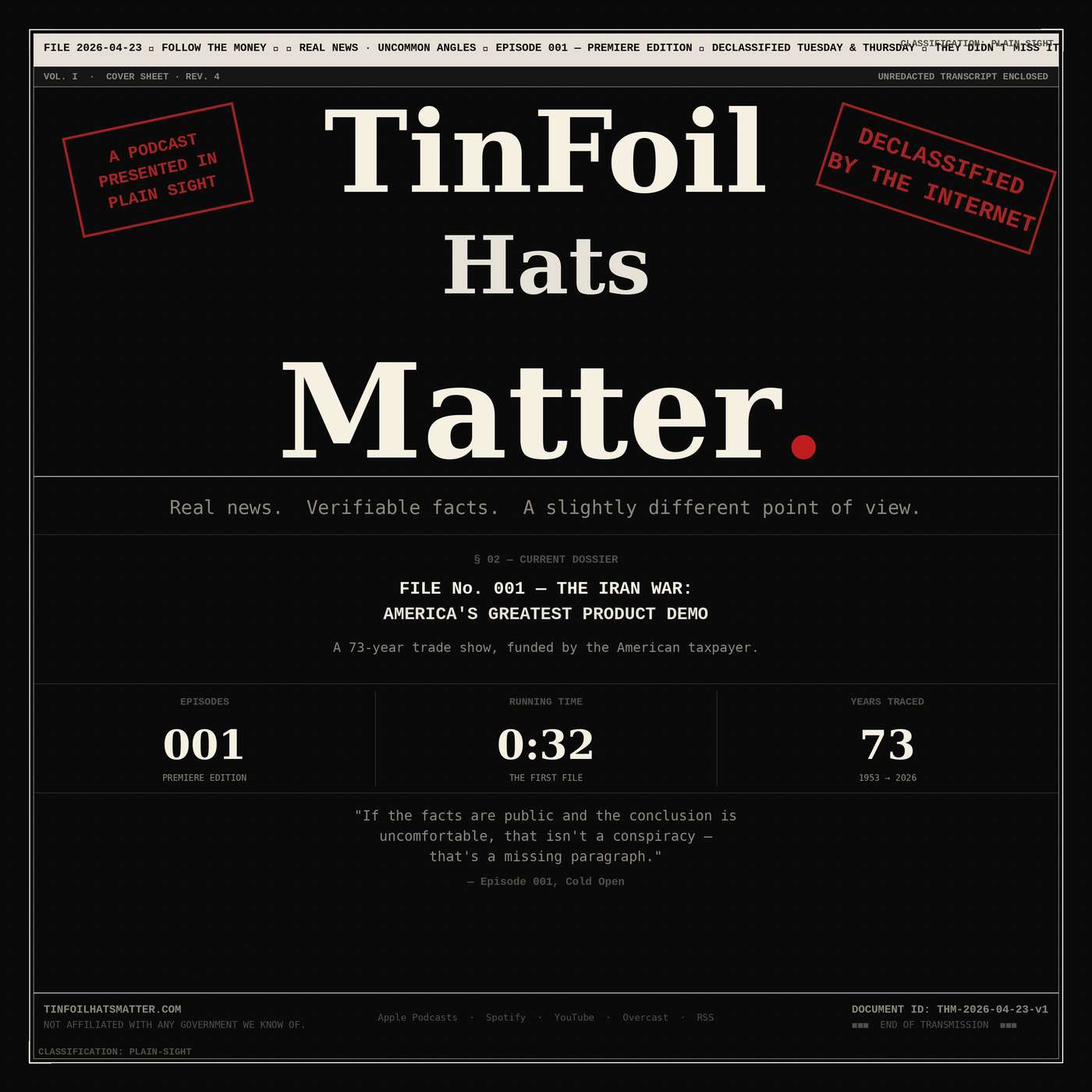
TinfoilHatsMatter
by Yan Doe
Real news. Verifiable facts. A slightly different point of view than the mainstream wants you to have.
-
7
Why Age Limits Work Where Term Limits Don't
Every few years, voters rediscover that Congress is old. Then someone says "term limits," and the idea dies in the Supreme Court again. This episode makes the case that there's a better reform hiding in plain sight — one that's constitutionally defensible, historically grounded, and somehow more popular than almost any other policy in America: mandatory retirement ages.We trace why U.S. Term Limits, Inc. v. Thornton (1995) closed the door on term limits at the state level and what it would take to change that. Then we build the actual case for age limits — starting with what's already in the Constitution, moving through the 32 states that already force judges off the bench, through the FAA's mandatory retirement ages for pilots and air traffic controllers, through Gregory v. Ashcroft (1991), and all the way back to Federalist No. 79, where Alexander Hamilton argued against age limits and was, on this one occasion, wrong.We also correct a widely circulated misunderstanding about Social Security and age 70 — because if you're going to make this argument, you should make it with the right facts.The polling data is staggering. The constitutional pathway exists. The precedent is bipartisan and centuries old. So why isn't anyone in leadership pushing for this? Well. That's the question, isn't it.
-
6
Same Clown Different Tent
# EP006 – Same Clowns, Different Tent### Tech, Social Media, and the Business of Attention Addiction---## Episode SummaryIn 2006, a frustrated software designer named Aza Raskin got tired of clicking "page 2" on Google. So he built infinite scroll — a feature so seamlessly engineered for frictionless content consumption that it would later call his own invention "behavioral cocaine." That one design decision, handed to companies whose business model depends on you never leaving, is where this episode begins.But the story is bigger than one engineer's regret.This episode maps the full architecture of attention extraction: how B.F. Skinner's variable ratio reinforcement became the blueprint for notification design, how Howard Moskowitz's "bliss point" research moved from processed food to algorithmic feeds, how Tristan Harris tried to warn Google from the inside before going public, and how Frances Haugen walked out of Facebook with 35,000 documents showing the company knew — with its own data — that Instagram was causing measurable harm to teenage girls, and kept optimizing for engagement anyway.The through-line is simple: tobacco, food, tech. Three industries. Three timelines. The same playbook. The same defense ("we give people what they want"). The same documented internal awareness of harm. The same delay in accountability.The uncomfortable conclusion isn't that the executives are evil. It's that they don't have to be. Misaligned incentives, applied consistently, at scale, over decades, produce harm without malice. That's what makes this hard to fix — and why "just use it less" is the structural equivalent of telling someone in a food desert to eat healthier.---## Key Figures- **Aza Raskin** — Designed infinite scroll at Mozilla (2006). Later called it "behavioral cocaine." Has since testified about its effects and advocates for humane design.- **Tristan Harris** — Former design ethicist at Google. Left in 2016. Founded the Center for Humane Technology. Subject of the Netflix documentary *The Social Dilemma*.- **Frances Haugen** — Facebook data scientist who leaked internal documents to the Wall Street Journal in 2021. The resulting investigation became known as The Facebook Files.- **B.F. Skinner** — Behaviorist psychologist. Identified variable ratio reinforcement in the 1950s — the mechanism behind slot machines, and every notification you've ever checked on reflex.- **Howard Moskowitz** — Research psychologist who pioneered "bliss point" optimization for the food industry. Worked with Campbell Soup, Pepsi, and others to engineer products that override satiety signals.---## Key Concepts- **Infinite Scroll** — No natural stopping point means no moment to decide whether you want to stay. The choice to leave is engineered out of the experience.- **Variable Ratio Reinforcement** — The most effective behavioral conditioning mechanism known. Reward unpredictably and behavior becomes compulsive. The foundation of notification design.- **The Engagement Metric** — When revenue is a function of time-on-platform, every design decision answers one question: does this keep people here longer? Not: does this make people better?- **The Facebook Files (2021)** — Frances Haugen's document leak revealed Facebook's internal research found Instagram worsened body image for a significant portion of teenage girl users. The company had the research. They kept the metric.- **Social Dependency** — Unlike tobacco (chemical dependency) or food (caloric dependency), tech achieves social dependency: leaving the platform carries costs that extend beyond the individual user.---## Referenced Research & Events- Aza Raskin's development of infinite scroll at Mozilla (2006)- B.F. Skinner, variable ratio reinforcement research (1950s)- Howard Moskowitz, bliss point optimization for Campbell Soup and Pepsi- Tristan Harris, congressional testimony and *The Social Dilemma* (Netflix, 2020)- Frances Haugen document leak and The Facebook Files, Wall Street Journal (October 2021)- NPR's reporting on statistical methodology critiques of the Facebook internal research- Meta, Google, TikTok engagement-based advertising revenue models---## Tags`attention economy` `social media` `tech ethics` `infinite scroll` `engagement metrics` `Facebook Files` `Frances Haugen` `Tristan Harris` `behavioral design` `variable reinforcement` `dopamine` `big tech` `Instagram` `mental health` `teen social media` `surveillance capitalism` `corporate accountability` `humane technology` `bliss point` `persuasive technology`---*TinFoilHatsMatter — THM-2026-05-07-EP006-v1**TINFOILHATSMATTER.COM | Spotify | Apple Podcasts | YouTube*
-
5
Follow the Money: How Donor-Friendly Decisions Get Sold as Public Policy
# EP005 — Follow the Money## How Donor-Friendly Decisions Get Sold as Public Policy**TinFoilHatsMatter** | Episode 005Published: May 6, 2026 | Duration: ~35 minAvailable on Spotify · Apple Podcasts · YouTube---## Episode SummaryWhat do the shutdown of a nuclear power plant, a Medicare drug benefit, the repeal of net neutrality, and corn ethanol subsidies have in common? In every case, the official justification — safety, access, innovation, clean energy — turned out to be cover for a private transfer of value to someone with a check in hand.This episode maps the money. Starting with the Indian Point Energy Center closure and the federal bribery conviction that revealed who actually benefited, then widening the lens to three of the most well-documented cases of donor-capture in recent American policy history: the Medicare Part D prescription drug ban on price negotiation, the repeal of net neutrality by a former Verizon lawyer, and the decades-long ethanol subsidy regime built by one company through bipartisan political donations. The throughline is simple: decisions that look dumb in hindsight are often calculated in real time — calculated to benefit someone who will not be named at the press conference.---## What We Cover**Indian Point Energy Center — New York**The closure of a 2,000-megawatt carbon-free nuclear plant in 2021, ostensibly on safety grounds, was accompanied by a federal bribery prosecution revealing that a natural gas company — Competitive Power Ventures — had paid $287,000 in bribes to Governor Cuomo's top aide Joseph Percoco, specifically in exchange for advocacy toward closing Indian Point. The CPV gas plant that replaced Indian Point's generation is now running on fracked natural gas. New York's carbon emissions from the electric sector rose after closure. Governor Hochul is now building a new nuclear plant.**Medicare Part D — Washington, DC**In 2003, Congressman Billy Tauzin (R-LA), as Chairman of the House Energy and Commerce Committee, shepherded the Medicare prescription drug benefit into law with one critical feature: Medicare was legally prohibited from negotiating drug prices with pharmaceutical companies — despite every other federal drug program retaining that right. The day after his congressional term ended, Tauzin was announced as the new President and CEO of PhRMA, the pharmaceutical industry's main lobbying group, at a reported salary of $2 million per year. He eventually received $11.6 million in a single year. At least 15 staffers and officials who worked on the legislation subsequently took industry positions.**Net Neutrality — Washington, DC**In December 2017, FCC Chairman Ajit Pai repealed net neutrality protections — over 22 million public comments, bipartisan polling support for keeping the rules, and opposition from major tech companies. Pai had previously worked as an in-house lawyer for Verizon Communications, handling regulatory and broadband policy. Verizon, Comcast, and AT&T spent hundreds of millions lobbying against net neutrality. AT&T's PAC contributed to 88 percent of House members. Following the repeal, providers were documented throttling traffic, including during a California wildfire emergency involving first responder communications.**Corn Ethanol & Archer Daniels Midland — Decatur, IL**For over four decades, ADM, the agricultural processing giant, used bipartisan campaign contributions — $8.2 million at the federal level between 1990 and 2008 alone — to build and defend a legislative architecture that mandated the use of corn ethanol in American gasoline while subsidizing its production. Independent analysis found that every $1 of ADM ethanol profit cost taxpayers $30, and at least 43 percent of ADM's total profits came from government-subsidized or government-protected products. The ethanol mandate drove up corn prices, contributed to global food price increases, and consumed three-quarters of available renewable energy tax credits — crowding out wind and solar.---## Named Persons Reference| Name | Role | Connection ||---|---|---|| Andrew Cuomo | Former Governor, New York | Received $75,000 in donations from CPV; two of his top aides were convicted in related bribery scheme || Joseph Percoco | Former Executive Deputy Secretary to Cuomo | Convicted 2018 of honest services fraud and solicitation of bribes from CPV; wife received $90K/yr low-show job || Peter Galbraith Kelly | Former CPV Senior Executive | Pleaded guilty to arranging bribes to Percoco totaling $287,000 || Todd Howe | Former Cuomo aide | Indicted in same corruption case; began seeking Percoco's assistance in advocating for Indian Point closure as early as 2010 || Kathy Hochul | Governor, New York | Continued Cuomo energy agenda; announced new nuclear plant construction in 2025 || Billy Tauzin | Former Congressman (R-LA); Former President & CEO, PhRMA | Authored Medicare Part D prohibition on drug price negotiation; announced as PhRMA CEO the day his term ended || Ajit Pai | Former FCC Chairman (2017–2021) | Repealed net neutrality; previously worked as in-house counsel for Verizon Communications || Dwayne Andreas | Former CEO, Archer Daniels Midland (1971–1999) | Described as one of the most influential political donors of the 20th century; funded campaigns across both parties; connected to Watergate-era illegal contribution || Preet Bharara | Former U.S. Attorney, Southern District of New York | Filed the federal indictment in the Percoco/CPV case |---## Organizations Referenced| Organization | Role in Episode ||---|---|| Competitive Power Ventures (CPV) | Natural gas company that bribed Cuomo aide; operates CPV Valley Energy Center, which came online as Indian Point closed || Entergy | Former owner/operator of Indian Point Energy Center || PhRMA | Pharmaceutical industry trade group; hired Tauzin as CEO the day after he left Congress || FCC (Federal Communications Commission) | Regulatory body; voted to repeal net neutrality in 2017 under Pai's chairmanship || Verizon Communications | Telecom company; Pai's former employer; major beneficiary of net neutrality repeal || Archer Daniels Midland (ADM) | Agricultural processing giant; primary beneficiary of corn ethanol mandates and subsidies || Nuclear Regulatory Commission (NRC) | Federal body responsible for nuclear plant safety oversight; Indian Point operated within its required safety parameters through closure || Riverkeeper | Environmental organization; long-time opponent of Indian Point |---## Key Numbers- **2,000+ MW** — Indian Point's carbon-free generating capacity at closure- **25%** — Share of New York City's electricity supplied by Indian Point- **$287,000** — Total bribes paid by CPV to Cuomo aide Joseph Percoco- **$75,000** — CPV's direct donations to Cuomo's campaign- **$2,000,000/year** — Billy Tauzin's reported starting salary as PhRMA CEO- **$11,600,000** — Tauzin's reported single-year compensation from PhRMA- **15+** — Congressional staffers and officials who worked on Medicare Part D and subsequently took pharmaceutical industry positions- **22,000,000** — Public comments submitted opposing net neutrality repeal- **88%** — Percentage of House members who received AT&T donor contributions- **$8,200,000+** — ADM's federal political contributions from 1990–2008- **43%** — Share of ADM's annual profits derived from government-subsidized or protected products- **$30** — Taxpayer cost for every $1 of ADM ethanol profit (Cato Institute, 1995)---## Sources & Further Reading**Indian Point / CPV**- U.S. Attorney for the Southern District of New York, *United States v. Percoco et al.*, Indictment filed Sept...
-
4
What Trump Got Right
Episode 004 — What Trump Got RightShow NotesThe EpisodeFor thirty years, the bipartisan economic establishment promised America a deal: send the factories overseas, and something better will come back. The workers would upskill. The towns would reinvent themselves. The invisible hand would sort it out.The invisible hand sorted out 6.7 million manufacturing jobs. The towns got opioid distributors. The workers got a pamphlet about retraining. And the people who designed the policy got consulting retainers, board seats, and speaking fees.This episode names the names.We trace the deliberate, documented, decades-long dismantling of American manufacturing — from Nixon and Kissinger's 1972 opening of China, through George H.W. Bush's quiet rehabilitation of Beijing after Tiananmen, to Bill Clinton's decision to make China's WTO accession his top second-term priority while calling it "a hundred-to-nothing deal for America." We look at Hillary Clinton's six years on the Walmart board while Walmart was secretly sourcing from China through a shell company — during their own "Buy American" ad campaign. We look at Jack Welch, who turned offshoring into a corporate religion and got called Manager of the Century for it.And we make the uncomfortable case that on this one issue — manufacturing, market access, and what America traded away — Donald Trump was pointing at a real thing.What We CoverComparative advantage — why David Ricardo's 200-year-old theory sounds elegant on a whiteboard and falls apart when it touches actual human beings in actual townsThe China trade opening — from Nixon's 1972 visit through the systematic bipartisan accommodation of Beijing across five presidenciesHenry Kissinger — architect of the China opening, founder of Kissinger Associates (1982), operator of China Ventures, and the most conflict-of-interest-adjacent "disinterested statesman" in American historyGeorge H.W. Bush and Tiananmen — the secret Scowcroft/Eagleburger mission to Beijing six weeks after the massacre, the two vetoes of congressional human rights conditions, and the back-channel message that Tiananmen was "an internal affair"Bill Clinton's reversal — from "butchers of Beijing" in 1992 to signing Permanent Normal Trade Relations in 2000, and calling it "the equivalent of a one-way street" in America's favorHillary Clinton and Walmart — six years on the board (1986–1992) while Walmart was building its China-sourcing strategy through a shell company called Pacific Resources Export LimitedJack Welch — "Neutron Jack," GE's U.S. workforce from 277,000 to 70,000, and the management doctrine that made offshoring a corporate virtueThe China Shock — what the academic literature actually found about what happened to workers and communities, versus what the models predictedDeaths of despair — Case and Deaton's 2015 findings on rising mortality among middle-aged Americans without college degrees, concentrated in deindustrialized communitiesTechnology transfer — why it's irreversible, how China structured it deliberately, and what America traded away that it cannot get backTariffs vs. strategy — what Trump got right, what he got wrong, and what an actual industrial policy would need to look likeThe People NamedName Role in the Story | Henry Kissinger | Architect of the 1972 China opening; founder of Kissinger Associates; operator of China Ventures investment fund | Richard Nixon | Opened diplomatic relations with China, 1972 | George H.W. Bush | Renewed China's MFN status after Tiananmen; vetoed human rights conditions twice (1991, 1992); sent secret delegation to Beijing six weeks after the massacre | Brent Scowcroft | National Security Advisor; led secret post-Tiananmen mission to Beijing, July 1989 | Bill Clinton | Reversed MFN human rights conditions (1994); signed PNTR October 10, 2000; called the deal "a hundred-to-nothing win for America" | Hillary Clinton | Walmart Board of Directors, November 1986 – May 1992; first woman on the board | Sam Walton / Walmart | Built China-sourcing operation through shell company PREL while running "Buy American" campaign | Jack Welch | GE CEO 1981–2001; pioneered mass offshoring and outsourcing; "Neutron Jack"; Fortune "Manager of the Century" | Newt Gingrich | Vocal Republican champion of China trade throughout the 1990s | Bill Archer (R-TX) | Lead House sponsor of the PNTR billThe ResearchThe China Shock The foundational academic work on what actually happened to American workers and communities when China entered the WTO. Economists David Autor (MIT), David Dorn (University of Zurich), and Gordon Hanson (Harvard) found that labor-market adjustment was "remarkably slow" — wages and employment remained depressed for over a decade in affected regions, and the promised offsetting job gains in other industries did not materialize.Autor, D., Dorn, D., & Hanson, G. (2013). "The China Syndrome: Local Labor Market Effects of Import Competition in the United States." American Economic Review.Autor, D., Dorn, D., & Hanson, G. (2016). "The China Shock: Learning from Labor Market Adjustment to Large Changes in Trade." Annual Review of Economics.Deaths of Despair Anne Case and Angus Deaton's 2015 paper documenting rising mortality rates among middle-aged white Americans without college degrees — opioids, alcohol, suicide — concentrated in deindustrialized communities. Deaton won the Nobel Prize in Economics the same year the paper was published.Case, A., & Deaton, A. (2015). "Rising morbidity and mortality in midlife among white non-Hispanic Americans in the 21st century." PNAS.Case, A., & Deaton, A. (2020). Deaths of Despair and the Future of Capitalism. Princeton University Press.On Kissinger AssociatesIsaacson, W. (1992). Kissinger: A Biography. Simon & Schuster. (pp. 730–51 on Kissinger Associates clients)Stone Fish, I. (2022). America Second: How America's Elites Are Making China Stronger. Knopf.Cohen, R. (1989, August 29). "Kissinger: Pragmatism or Profit?" The Washington Post.On the PNTR Vote"The Vote That Changed the World." Baron Public Affairs, September 2020.Tankersley, J. (2016, September 28). "Bill Clinton's Last Great Victory Is the Reason Hillary Gets Hammered on Trade Today." Slate.Scott, R. (2000, February). "The High Cost of the China-WTO Deal." Economic Policy Institute, Issue Brief #137.On Jack WelchGelles, D. (2022). The Man Who Broke Capitalism: How Jack Welch Gutted the Heartland and Crushed the Soul of Corporate America. Simon & Schuster.On Walmart and ChinaFrontline/PBS (2004). "Is Wal-Mart Good for America?" — includes reporting on the Walmart-China sourcing relationship and the PREL arrangement."Walmart in China: Lessons to Learn." 1421 by Acclime, June 2019.Government SourcesU.S.-China Relations Act of 2000 (Public Law 106-286), signe...
-
3
The Empire That Keeps on Giving (Problems)
The Empire That Keeps on Giving (Problems)King Charles III is in Washington this week for a state visit, which feels like the universe handing us a gift. So we took it.This episode is a guided tour through the parts of British imperial history that don't make it into the brochure — the borders drawn by people who'd never visited the places they were dividing, the democratic governments removed for being inconveniently democratic, and the famines that happened while exports continued. Not a conspiracy. Not a screed. Just the paper trail, followed to its logical conclusion.Spoiler: the paper trail is long. And it leads somewhere uncomfortable.In this episode:Why the "Special Relationship" is built on more than shared values — and what else it's built onThe Sykes-Picot Agreement (1916) — how two men with a map redesigned the Middle East without asking anyone who lived thereMohammad Mossadegh, the 1953 Iranian coup, and the operation the British side literally named "Boot"How the Anglo-Persian Oil Company became Anglo-Iranian Oil Company became British Petroleum became BP — and why the rebranding timeline is instructiveIndia, the "crown jewel," the Bengal Famine of 1943, and the railways everyone keeps bringing upWhy 1979 is a direct consequence of 1953, and why 2026 is a direct consequence of 1979The difference between history being over and history being deferredKey people and things mentioned:King Charles III — currently visiting the US, very good postureMohammad Mossadegh — democratically elected Prime Minister of Iran, 1951; removed in a coup, 1953; under house arrest until his deathMark Sykes & François Georges-Picot — the two diplomats who divided the Middle East in 1916 and then went homeThe Sykes-Picot Agreement (1916) — the line-drawing exercise that continues to have opinionsOperation AJAX / Operation BOOT (1953) — the CIA and MI6 joint operation to remove Mossadegh; named "Boot" by the British, which tells you everythingThe Anglo-Persian Oil Company — founded 1908, later Anglo-Iranian Oil Company, later British Petroleum, later BPThe Bengal Famine (1943) — an estimated 2–3 million deaths during British rule; exports continuedChurchill's wartime food policies — his documented attitudes toward India and the famine are part of the historical recordUtsa Patnaik — economist at Jawaharlal Nehru University whose research quantifies wealth extraction from India under British ruleThe partition of India and Pakistan (1947) — another set of hastily drawn borders, another set of consequences still being lived withThe Iranian Revolution (1979) — the moment the deferred consequences of 1953 showed up, on scheduleWant to go deeper:Inglorious Empire by Shashi Tharoor — a clear-eyed accounting of British rule in IndiaAll the Shah's Men by Stephen Kinzer — the definitive account of the 1953 Iranian coupA Line in the Sand by James Barr — on Sykes-Picot and the carving up of the Middle EastUtsa Patnaik's research on colonial wealth extraction from India, published in Agrarian and Other Histories (2018)The declassified CIA documents on Operation AJAX — available via the National Security ArchiveFrom the episode:"History doesn't disappear. It compounds. And if you want to understand the interest payments, you need to go back and look at the original loan."New episodes every Tuesday and Thursday.Find us on Apple Podcasts, Spotify, YouTube, Overcast, and RSS.All claims cited. Dispute openly.TINFOILHATSMATTER.COM
-
2
The Second Amendment in Name Only
TinFoilHatsMatter — Episode 002The Second Amendment in Name OnlyFile No.: 002 Declassified: Tuesday Running Time: TBD Classification: Plain-SightThe Second Amendment is a real, individual, constitutionally protected right. The Supreme Court has said so — repeatedly, emphatically, and with increasingly aggressive language. So why, after seventeen years of landmark rulings, does it still feel like you're one election cycle away from losing it?Because a settled question generates nothing. A right under permanent siege generates billions of dollars, millions of votes, and decades of career security for people who have every incentive to keep the fight going and no incentive whatsoever to finish it.This episode, we read the receipts.What's in the FileWe trace the modern Second Amendment from Heller (2008) through the Supreme Court's 2025 term — not as a political debate, but as a paper trail. What did the Court actually hold? What did the administration actually do? And why is the most popular rifle in America still in legal limbo while the Court "circles back"?Along the way, we note — with genuine journalistic restraint — that the President of the United States signed an executive order protecting your Second Amendment rights while being legally prohibited, under federal law, from owning a firearm. His own Justice Department is currently defending that law before the Supreme Court.We also note that Mel Gibson can own guns again. America contains multitudes.The Dossier — Key Cases CoveredDistrict of Columbia v. Heller (2008) — The Court settles it: individual right. Not a militia right. An individual right. Scalia writes that certain policy choices are off the table. Politicians immediately treat this as a suggestion.McDonald v. City of Chicago (2010) — The right applies to states too. Great. States begin drafting workarounds.New York State Rifle & Pistol Association v. Bruen (2022) — No more interest-balancing. Gun regulations must be consistent with historical tradition from the founding era. States respond by arguing everything is a "sensitive place."United States v. Rahimi (2024) — 8-1: people under domestic violence restraining orders can be temporarily disarmed. Even under the new historical test, this wasn't close.Garland v. Cargill (2024) — The ATF's bump stock ban, issued by the Trump administration after Las Vegas, was unlawful. A bump stock does not convert a rifle into a machinegun under federal statute. The Court throws it out. The same administration that banned them campaigned as your last line of defense. Institutionalism is a heck of a drug.Bondi v. VanDerStok (2025) — Ghost guns. 7-2, with Justice Gorsuch writing the majority, joined by Kavanaugh and Barrett. The Biden ATF's rule treating ghost gun parts kits as firearms is upheld. The Trump DOJ defended it. Thomas and Alito dissented. If you're keeping score: the biggest gun regulation victory of 2025 was written by a Republican-appointed justice, joined by two Trump appointees, defended by the Trump administration.AR-15 / Cert Denial (June 2025) — The Court declines to take up Maryland's assault weapons ban. Thomas, Alito, and Gorsuch would have taken it. Kavanaugh writes separately that the Fourth Circuit is probably wrong, and the Court "should and presumably will" address the issue "in the next term or two." Residents of Maryland, California, and Illinois are living under laws three sitting justices already think are unconstitutional. The Court will circle back. Eventually. Slowly.The Structural Problem Nobody Talks AboutRegulations move fast. An agency memo can ban an accessory, rewrite a definition, or issue enforcement guidance that results in a near six-fold increase in dealer license revocations — and it's done before anyone files a brief.Restoring rights moves through federal court. Motion to dismiss. Discovery. Ruling. Appeal. Cert petition. Supreme Court. Mandate. Stay litigation. We are talking years. Sometimes a decade. Heller to Bruen is a fourteen-year arc of litigation to establish rights that, per the Court, were in the Constitution the whole time.During those fourteen years, the challenged laws stayed on the books. People lived under them. People were prosecuted under them. And politicians sent fundraising emails about fighting for you.Friction favors the status quo. The status quo is more regulation, not less. That's not a conspiracy. That's just physics.The Part That Should Bother You Regardless of Where You StandRepublican unified control, 2017–2019: no NFA repeal, no national reciprocity signed into law, bump stocks banned administratively.Trump's second term: a sweeping executive order, some ATF policy tweaks, a proposed rule to restore gun rights to some non-violent offenders — and the DOJ defending a Biden-era ghost gun regulation before the Supreme Court while gun rights groups publicly say the record has been "very mixed."Ask them for the bill number. Ask what they did with unified control. Ask why the National Firearms Act — passed in 1934, the year Bonnie and Clyde died — has been defended in federal court by every administration, Republican and Democrat, for ninety years, without anyone seriously moving to repeal it.Watch how fast they change the subject.Cast of CharactersName Status | Supreme Court (SCOTUS) | 6-3 conservative supermajority. Ruling on everything except the one you're waiting for. | Trump DOJ | Defending Biden gun regulations in court. Yes, really. | NRA | Called the February 2025 executive order a "monumental win." Fourteen months ago. | The American Gun Owner | The customer. Not the constituent. | Mel Gibson | Gun rights: restored. | The National Firearms Act (1934) | Still undefeated. Bipartisan.Sources — All Public, All CitedDistrict of Columbia v. Heller, 554 U.S. 570 (2008) — JustiaMcDonald v. City of Chicago, 561 U.S. 742 (2010) — JustiaNew York State Rifle & Pistol Assn. v. Bruen, 597 U.S. 1 (2022) — JustiaUnited States v. Rahimi, 602 U.S. ___ (2024) — JustiaGarland v. Cargill, 602 U.S. ___ (2024) — JustiaBondi v. VanDerStok, No. 23-852 (2025) — SCOTUSblogKavanaugh concurrence, AR-15 cert denial (June 2025) — SCOTUSblogTrump Executive Order, "Protecting Second Amendment Rights" (Feb. 2025) — The White HouseDOJ Proposed Rule: Restoring gun rights to certain individuals — U.S. Department of JusticeTrump administration gun rights record — NBC NewsTrump firearm prohibition status — Duke Center for Firearms LawATF "zero tolerance" enforcement and policy changes — Every...
-
1
The Iran War - America's Greatest Product Demo
America's relationship with Iran didn't start with a missile strike — it started with a CIA coup in 1953. Operation Ajax overthrew Iran's democratically elected Prime Minister Mohammad Mosaddegh, who had the audacity to suggest Iranian oil should belong to Iran. We installed the Shah, funded his brutal secret police, and acted surprised when 26 years of repression exploded into the 1979 Islamic Revolution.The hostage crisis followed. 66 Americans held for 444 days. A botched rescue mission. Jimmy Carter's presidency, effectively over. The hostages were released the exact minute Ronald Reagan was inaugurated — timing that historians have been arguing about ever since.For the next 45 years, every American president had Iran on their desk and none of them pulled the trigger on full military action. That streak ended when Trump launched Operation Midnight Hammer in June 2025 — B-2 bombers, bunker-busters, three nuclear sites destroyed. Then on February 28, 2026, the US and Israel struck again, this time killing Supreme Leader Khamenei himself.Iran's response: close the Strait of Hormuz. Twenty percent of the world's oil supply, gone. Brent crude hit $126 a barrel. The IEA called it the greatest energy security crisis in history. South Korea — which gets 70% of its crude through the Strait — is down to 26 days of reserves. Four of its airlines are in emergency mode. Its stock market had its worst single session in 43 years.Meanwhile, RTX stock is up 67% in a year. Lockheed is up 40%. Defense CEOs met with Trump at the White House within a week of the strikes.The bill goes to you. It always has. Welcome to the product demo.
No matches for "" in this podcast's transcripts.
No topics indexed yet for this podcast.
Loading reviews...
ABOUT THIS SHOW
Real news. Verifiable facts. A slightly different point of view than the mainstream wants you to have.
HOSTED BY
Yan Doe
CATEGORIES
Loading similar podcasts...
URL copied to clipboard!