
PODCAST · arts
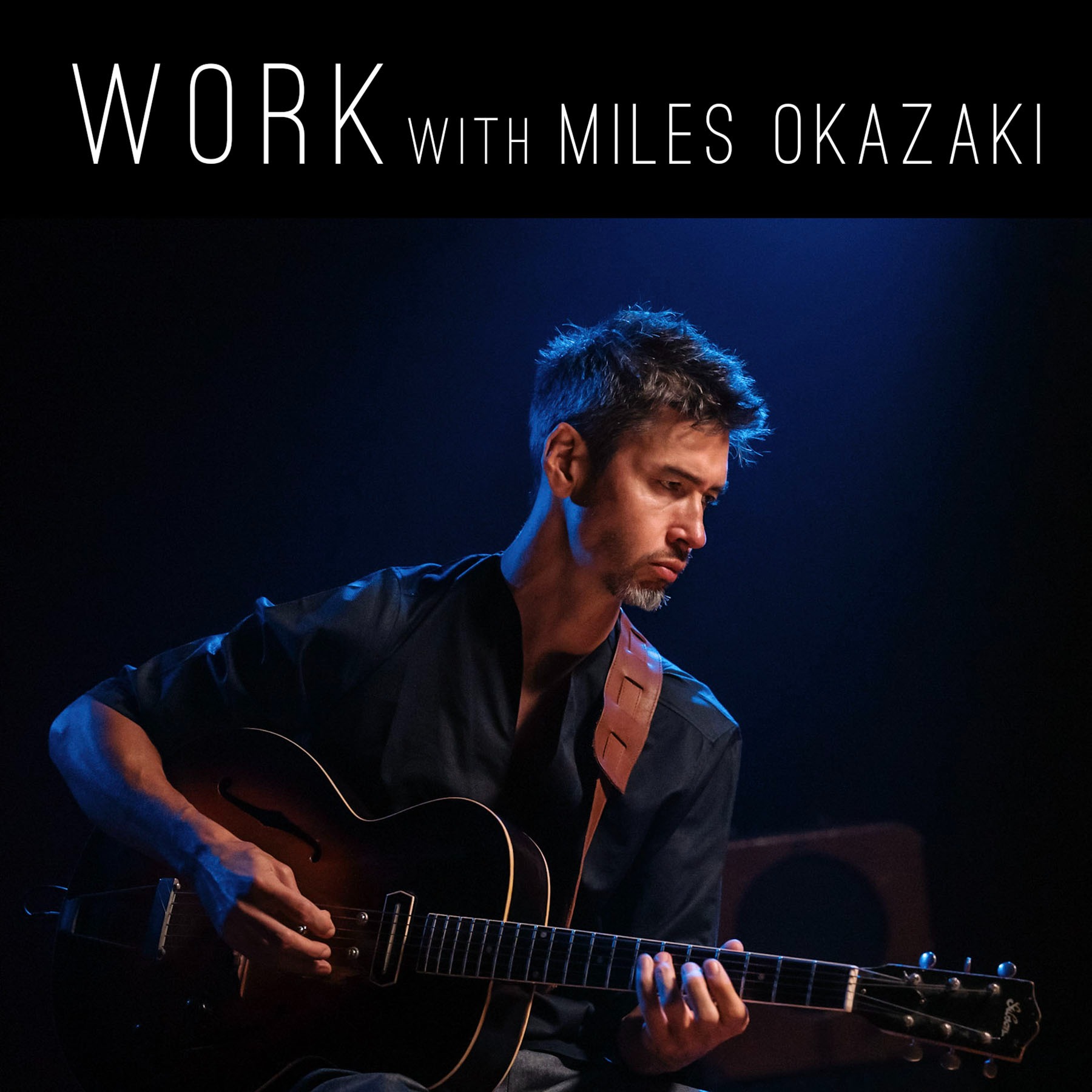
Work, with Miles Okazaki
by Miles Okazaki
This is a podcast version of Miles Okazaki's patreon channel. Okazaki is a guitarist and composer based in Brooklyn, NY.Season 1 (Monk, 65 episodes): How this podcast began: individual guitar studies of every composition by Thelonious Monk. These begin as practice videos without much talking and evolve into episodes on specific topics.Season 2 (Fall 2024, 48 episodes): A 12-part series on the subject of Symmetry, an 8-part series on Drum rudiments with the pick, and a 5-part series on the "Allegro Assai" from J.S. Bach's C major violin sonata. Other episodes include bebop standards "Donna Lee" and "Wail," a series on the chromatic scale, favorite books, listening sessions and exercises for the ear from my book "Fundamentals of Guitar."Season 3 (Winter 2024. 63 episodes): An 11-part series on Polyrhythms, a 7-part series on Charlie Christian's "Stompin at the Savoy" solo, a 4-part series on my song "Dog Star," the first "guided practice" episodes, close looks at
-
166
Danny Boy
Happy Saint Patrick's Day. Here's I am working on "Danny Boy," and talking about the history of the song via my friend Jacob Garchik. If you haven't seen the George Benson version, check that out here. The video gets pretty long as I go into explanations of how I get the guitar voicings from the Percy Grainger arrangement. That arrangement is attached, and I'd encourage you to make your own arrangements of this lovely melody, which can be instructive about how to harmonize a diatonic melody without getting too fancy.
-
165
Mailbag: Melodic Minor
A deep dive into Melodic Minor from a recent member question. We cover uses of this sound as a tonic and dominant in improvisation, a brief look at Raag Charukeshi (a related Indian raga), and then some exercises for getting it under your fingers.
-
164
Bach on Sunday: WTC Book I, Fugue in E minor
Today I look at a two part fugue from the Well Tempered Clavier. This one is especially well suited to the guitar. Two guitarists could play it together without any alterations of the sheet music (attached). I demonstrate this with an overdubbed recording.
-
163
Guided Practice, All-Interval Tetrachord
Today's shape turns out to be All-Interval tetrachord 0137. In the video I go through what this means, and look at some of the sounds that we can get out of this shape in various transpositions and voicings. Sheet from 351 Shapes attached.
-
162
"Hot House" part II
In this video I go through the fingerings that I've found for this somewhat tricky melody. I also talk about the language used in the lines, and how this relates to octatonic scales and expansions of the dominant chord developed by improvisors in the bebop era. My transcription for the tune is attached.
-
161
"Hot House" and the mysterious minor ii-V
This is part 1 of two long videos about the bebop classic tune "Hot House," by Tadd Dameron. In this episode we don't actually get into the tune itself, but work on the background by taking a close look at the underlying harmony, which comes from "What is this thing called love" by Cole Porter. I go through the original piano sheet music for this tune (attached) and then a long discussion about what to do on the common chord progression known as a "minor ii-V" such as Gmi7b5 C7 Fmi. Readings from Dizzy Gillespie's autobiography reveal how he thought about it. The Emily Remler version that I talk about is here.
-
160
Anatomy of a Groove: Dog Star pt. 4, "Lush Life"
Here's a part of live concert in Brooklyn where we combine the Dog Star groove with Billy Strayhorn's "Lush Life." Check out the whole concert for free here. We made a vinyl album out of this series of concerts that's a little different from the video that you can find here. This is the end of the Dog Star series - I hope you've enjoyed it. Let me know if you'd like more of these behind-the-scenes looks at my compositional process. Next week I'll be beginning a new series looking at some standards.
-
159
Anatomy of a Groove: "Dog Star" 3
Here's a second version of the Dog Star groove, after we had been playing it live for a while and it had turned into a different tune. Although there is a studio version of this tune, I opted for this video so that you can see the drummer. This is a "live" album recorded during the early days of the Covid lockdown in 2020, where I sang scratch tracks for the entire concert and then the band recorded to these tracks individually. A bit of an original scratch track is at the beginning of the whole video.
-
158
Anatomy of a Groove: "Dog Star" 2
Here's the groove we talked about yesterday in it's first incarnation, at a recording session at the old Systems Two Studios, one of my favorite places in the world that is sorely missed. The full video can be seen here, along with other tunes from that session that led to the debut album for the band Trickster.
-
157
Anatomy of a Groove: "Dog Star"
This is my first post about composition, a much-requested topic, but one that can quickly go down long rabbit holes. I try to limit the topic by talking about just the drum part from one of my tunes. This one has to do with the possibilty of people in the band feeling a groove different ways, and the idea that maybe this is ok or even desirable. In this post, I'm teaching the groove as I would to a band member - further videos will show this groove in its full context.
-
156
Bach: Cello Suite in C minor, "Sarabande"
Here's a look at an amazing melody by JSB, from Cello Suite no. 5 in C minor.
-
155
Guided Practice: Shape of the Day
Looking at the shape for Feb 26 from the book 351 shapes.
-
154
"Epistrophy" and the Ukelele
Here's a parenthetical episode while we're working on Charlie Christian stuff. Something I discovered recently while messing around with the ukulele.
-
153
Bach: BWV 1005
This episode is a recording of me playing the four movements of J.S. Bach's violin sonata in C major. Two movements on acoustic guitar, and two movements on electric.
-
152
Bach on Sunday: Chorale 98
A look at a Bach chorale, with improvisation.
-
151
Meet your heroes
Random thoughts on the way to work
-
150
Guided Practice, sight reading, intervallic playing
A guided practice using only one scale, progressing from easy to difficult
-
149
Charlie Christian 06: Stompin' chorus 3, 2nd half
This series of videos takes a close look at one of the greatest improvisations of all time, Charlie Christian's solo on "Stompin' at the Savoy" from May of 1941, live at Minton's playhouse. It's focused on the guitar, but other instruments may also dig it.
-
148
Charlie Christian 02: Stompin' chorus 1, 1st half
This series of videos takes a close look at one of the greatest improvisations of all time, Charlie Christian's solo on "Stompin' at the Savoy" from May of 1941, live at Minton's playhouse. It's focused on the guitar, but other instruments may also dig it.
-
147
Charlie Christian 03: Stompin' chorus 1, 2nd half
This series of videos takes a close look at one of the greatest improvisations of all time, Charlie Christian's solo on "Stompin' at the Savoy" from May of 1941, live at Minton's playhouse. It's focused on the guitar, but other instruments may also dig it.
-
146
Charlie Christian 04: Stompin' Chorus 2
This series of videos takes a close look at one of the greatest improvisations of all time, Charlie Christian's solo on "Stompin' at the Savoy" from May of 1941, live at Minton's playhouse. It's focused on the guitar, but other instruments may also dig it.
-
145
Charlie Christian 05: Stompin' chorus 3, 1st half
This series of videos takes a close look at one of the greatest improvisations of all time, Charlie Christian's solo on "Stompin' at the Savoy" from May of 1941, live at Minton's playhouse. It's focused on the guitar, but other instruments may also dig it.
-
144
Charlie Christian 01: History, context, listening
Today we start a new series - one of the most famous improvisations of all time, Charlie Christian's solo on "Stompin' at the Savoy," recorded live at Minton's Playhouse in May of 1941. In this episode I give a brief biography of Charlie Christian (with some recommended reading), and we listen to the solo. I also talk about the history and context of the Gibson ES150, a very important instrument in the history of the electric guitar.
-
143
New Tool! Sight Reading Trainer
The perks of membership keep coming! I finally got this thing working - "Fly Shit" is a thing built in MAX/MSP that generates sight reading material based on all kinds of settings. Make it as easy or hard as you want, customize to the range and tempo, melodic and rhythmic material, and never run out of sight reading material again. This is something that I wish I had when I was younger, because sight reading on guitar is hard, and many of us suck at it.Right now, you can download this version here and use it right away if you have MAX/MSP. If the display doesn't look right, you will need to download an additional package called "BACH" that includes the score display and the pitch circle. I'm working on making a standalone version that works like a regular app, but it's not as easy as I thought.If you don't have MAX (it is expensive), I'll be doing some guided practice sessions here for sight reading, where you just follow along and I'll do different levels of difficulty. Guitar players, we need to get our reading together, and I think this can help!
-
142
On Organization and Creativity
Some disorganized thoughts in response to a member question about how to "get organized." Got a really special post coming tomorrow, make sure to check it out. The Octavia Butler quote I was trying to remember in this video is:“First forget inspiration. Habit is more dependable. Habit will sustain you whether you're inspired or not. Habit will help you finish and polish your stories. Inspiration won't. Habit is persistence in practice.”
-
141
Bach on Sunday: Chorale 274
Let's start the week nice and easy. Here's short one in A minor.
-
140
Pentatonics on "Giant Steps"
This is a follow up to the "Pentatonics in three keys" Guided Practice video, putting that concept into practice on a common tune. Note: This video ends abruptly as my system went down, and I didn't have time to make a new video. But you all can get the main idea, as it was long enough already.
-
139
Anatomy of a Tune: "Lush Life"
Here's a primer on "Lush Life," using Billy Strayhorn's version of it as reference. I'll make another video that goes deeper into analysis, but this a basic chord and melody arrangment. This is similar to the a cappella version that I play on the album "Trickster, Live in Brooklyn."
-
138
Robots
This post is a bit of a weird one. Lately I've been building some stuff in MAX/MSP. I give a little look here at one of my practice tools. Once I work out the bugs, I'll put it up here for free, for people to use as they see fit.
-
137
Mailbag: Melodic Minor
A deep dive into Melodic Minor from a recent member question. We cover uses of this sound as a tonic and dominant in improvisation, a brief look at Raag Charukeshi (a related Indian raga), and then some exercises for getting it under your fingers.
-
136
Tuning the Guitar
What's up with the G and B strings, anyway? A primer on tuning, harmonics, and practical methods for getting the guitar in tune with any ref
-
135
Bach on Sunday: Chorale 206
I looked at the first phrase of this Chorale on the recent mailbag episode. Here it is after practicing it for a little while. In another video today I'll go over the fingerings and a little bit of analysis. Sheet music attached.
-
134
Mailbag: Chorales in four voices and practicing Septuplets
In this mailbag episode I answer questions from members Juan Carlos Hernandez and Soloist. First I go into how I approach playing all four voices of a chorale at once, finding fingerings and voice leading. See attached image for this one. Then about 16 minutes in I go into some ideas about septuplets. To hear the example I talk about at the end with a full band, go to this link to about a minute in to skip the intro.
-
133
351 Shapes
ABOUT THIS BOOK:What you have here is a list of musical scales. You can find any collection of notes from 1 to 12 tones somewhere in it. The format is made to be a practical reference or journal. I've been working on it for a while now, trying to make a sourcebook for my own work thatʼs orderly and useful. None of the data in here is new to the world, but the delivery system is something I've designed to be simple and intuitive.Numbers: There are 351 shapes in the book. This isn't arbitrary - it's what you get when you find all of the unique note formations that are possible with 12 tones (2048) and then group them into families of modes from the same scale. You can arrive at a lower numbers of basic structures if you say that mirror images are sonically equivalent. But if you hear a major and minor triad as qualitatively different, then 351 is the number for you. To make navigation easier, the colors of each page change every 9 days, working through a spectrum of 39 hues.Why a calendar: There's potentially a huge amount of material to wade through in this type of project. You could write out every scale on a staff with every transposition, the names itʼs known by in various musical traditions, the way it connects to similar scales, examples from musical repertoire, all kinds of stuff. And this has been done in heavy books and endless tables of data. As someone who is easily confused, my goal here is to make the thing as streamlined as possible, with clean pages that don't distract with a bunch of clutter and redundancies. I've always enjoyed the challenge of presenting complex ideas in plain language and minimalist design, and have always been vexed by theory books that require the reader to know a bunch of special jargon and obscure references. Music theory doesn't have to be a private club. So in this book, musical shapes progress in a basic format that everyone recognizes (a calendar) with daily melodic prompts, each one different from those before. There are no rules or agenda - the main goal is to provide the reader an inclusive point to entry to discover raw melodic materials for creative practice.
-
132
Guided Practice - Three notes
Here's an idea for creative practice. I play a drone of three notes and improvise on it according what it seems to sound like. Then I change one of the notes, improvise, and repeat.
-
131
Listening session: Grant Green
Last week the New York Times had an article called "Five Minutes that will make you love Jazz Guitar," in which I wrote a little thing about this track, recorded 63 years ago today. Link is here: https://www.nytimes.com/2025/01/08/arts/music/guitar-jazz-music.html?unlocked_article_code=1.nk4.YtfS.b0yowaHFl6O8&smid=url-shareA link to the track itself is here: https://youtu.be/m-mHo8A4x-E?feature=sharedI go through, talk a bit about the history and then listen through the solo with some commentary. Let me know if you like this type of post. They're fun and easy to do, as I like to share my favorite records.
-
130
Bach on Sunday: Chorale 198
Here's a reading of Chorale 198, as usual one voice at a time. Read along with the attached sheet music.
-
129
Bach Prelude for Lute: Lessons from a Master (performance and analysis)
On Sunday I posted a performance of this piece. Here I go through it bar by bar and talk about how I think about memorizing it and what lessons it has for harmony, form, and composition. Sheet music is attached.
-
128
Mailbag: George Van Eps, Picking direction, posture, breathing
today we go into recent comments from Frank Boons, David Sharki, Cameron, and Jesse. Let me know if this clears anything up, or maybe makes it more confusing! This one ends abruptly because I trimmed it too soon, but there's nothing left except a sign off, so the video is complete as is.
-
127
Bach on Sunday: chorale 166
A look at Chorale 166. Play along by looking at the attached sheet music.
-
126
Bach on Sunday: Chorale 86
Chorale 86, four voices. I don't make many guarantees, but I do guarantee that if you look at these Chorales with me on Sundays, your sight reading and sense of harmony will improve. It's always worked for every student I've had, including myself. Apologies, the amp volume is a bit low on this one, I'm working out some microphone stuff. Sheet music is attached for download.
-
125
Polyrhythm 11: 7:5 and 7:6
Today we wrap up the series with a couple of less common polyrhythms. I give some excercises, a cheat code for difficult polyrhythms, and a bit of one of my tunes.
-
124
Polyrhythm 10: Seven against Three
Continuing on the polythyhm series, here's a couple of ways to practice 7:3 or 3:7
-
123
Polyrhythm 09: Seven against Four
Into the world of sevens. We're starting with 7:4 and comparing it to 7:5 with an old tune of mine. For anybody who'd like to hear the whole tune, it can be found, here: https://www.youtube.com/watch?v=qsiG27UvN_4
-
122
Polyrhythm 08: 6 against 5
On to the number 6. A little discussion about the number itself, and then a couple of exercises to get this one together which is a little tricky because the tempos are close together, creating a phasing effect.
-
121
Polyrhythm 07: 3 against 5
Similar exercises to previous vidoes, this time with 5 and 3.
-
120
Polyrhythm 06: 4 against 5
Moving past 2,3 and 4, here's a basic primer on 4:5.
-
119
Polyrhythm 05: Seven Rhythmic Modes
Happy New Year! Here's how to transform the last polyrhythm excercise into seven new rhythms, based on the modes of the diatonic scale. Hope you enjoy!
-
118
Polyrhythm 04: The Rhythmic Major Scale
Big concept day! I talk about an analogy between 12/8 bell patterns and the diatonic scale. This is one of my favorite ideas. I hope you dig it.
-
117
Polyrhythmn 03: three against four with the pick
This video is similar to the last one, except that I'm using a pick. Some members probably don't use the fingers at all, so I thought this would be useful. Plus, it's a much different sound to try to get two tempos happening at the same time with a pick, very good for articulation and accuracy.
No matches for "" in this podcast's transcripts.
No topics indexed yet for this podcast.
Loading reviews...
ABOUT THIS SHOW
This is a podcast version of Miles Okazaki's patreon channel. Okazaki is a guitarist and composer based in Brooklyn, NY.Season 1 (Monk, 65 episodes): How this podcast began: individual guitar studies of every composition by Thelonious Monk. These begin as practice videos without much talking and evolve into episodes on specific topics.Season 2 (Fall 2024, 48 episodes): A 12-part series on the subject of Symmetry, an 8-part series on Drum rudiments with the pick, and a 5-part series on the "Allegro Assai" from J.S. Bach's C major violin sonata. Other episodes include bebop standards "Donna Lee" and "Wail," a series on the chromatic scale, favorite books, listening sessions and exercises for the ear from my book "Fundamentals of Guitar."Season 3 (Winter 2024. 63 episodes): An 11-part series on Polyrhythms, a 7-part series on Charlie Christian's "Stompin at the Savoy" solo, a 4-part series on my song "Dog Star," the first "guided practice" episodes, close looks at
HOSTED BY
Miles Okazaki
CATEGORIES
Loading similar podcasts...
URL copied to clipboard!