0.6 Million Components, One Chip: The Breakthrough That Gives Machines True Vision 🧠📡 episode artwork

EPISODE · Mar 23, 2026 · 17 MIN

0.6 Million Components, One Chip: The Breakthrough That Gives Machines True Vision 🧠📡

from The Deep Dive Lab: Unraveling Materials Science · host Son Hoang

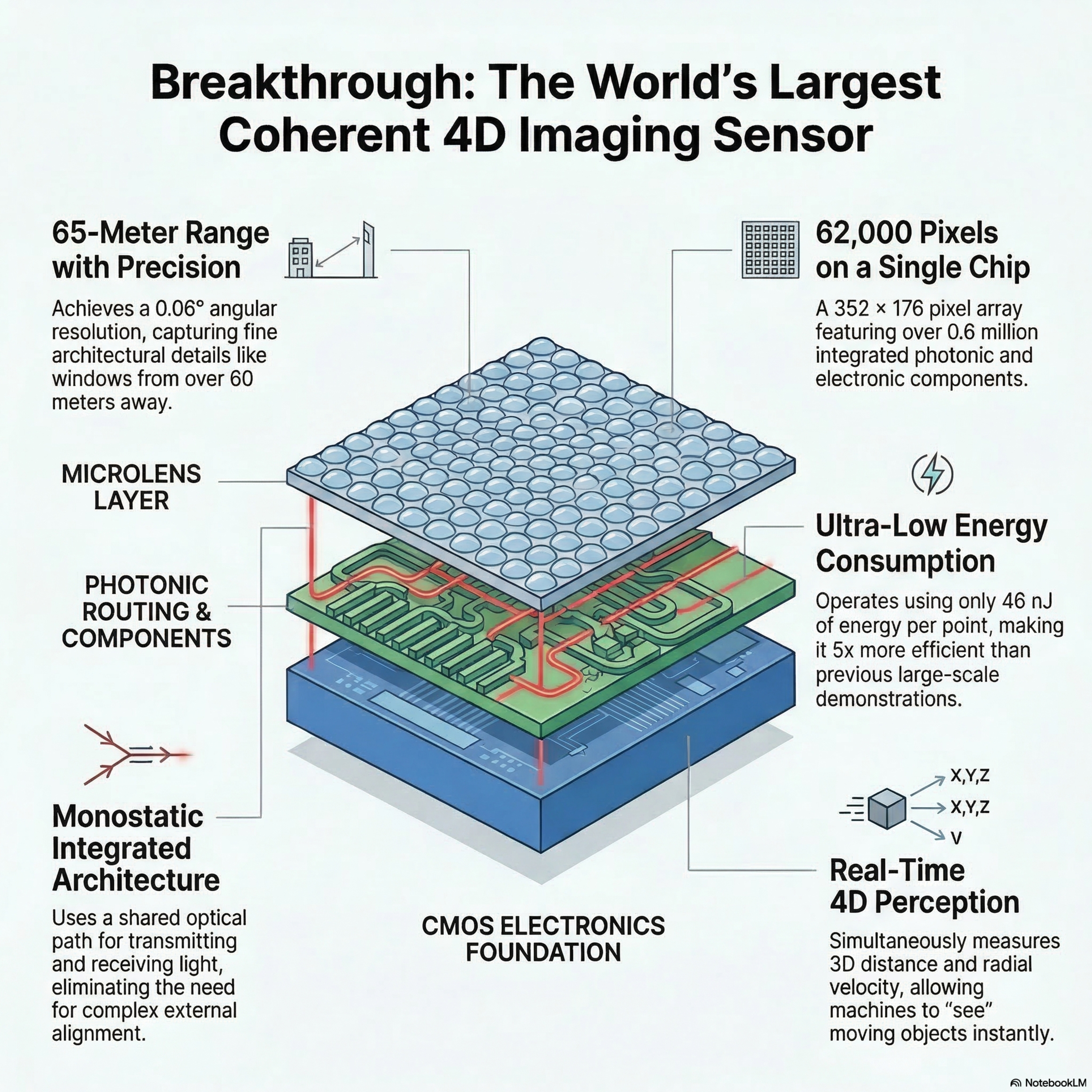
For years, LiDAR—the “eyes” of autonomous vehicles and robots—has remained bulky, complex, and power-hungry. But a new breakthrough is about to change everything.In this episode, we explore a 4D LiDAR sensor integrating over 600,000 components onto a single chip—a true “CMOS moment” for machine vision.🔥 What makes it different?This system doesn’t just see in 3D space—it also measures the speed of every pixel in real time.👉 That means machines no longer just know where you are…they know how fast you’re moving, with incredible precision.In this episode, we break down:🧩 How researchers packed hundreds of thousands of photonic components onto one chip⚡ Why this system operates at nanojoule-level energy, a massive leap in efficiency🎯 How FMCW LiDAR enables instant, high-precision velocity detection🔍 The “camera-like” design—swap the lens, change the entire field of view🚘 Why this could redefine safety for autonomous vehicles and roboticsAnd the bigger question:👉 When machines can see motion as clearly as humans—or even better—are we ready to share the world with them?This isn’t just an upgrade.It’s the beginning of ubiquitous machine vision.📄 Source: A large-scale coherent 4D imaging sensor. Nature, volume 651, pages 364–370 (2026).#4DVision #LiDAR #AutonomousVehicles #AI #DeepTech #Photonics #Semiconductors #Robotics #Innovation #SciencePodcast #deepdivelab

For years, LiDAR—the “eyes” of autonomous vehicles and robots—has remained bulky, complex, and power-hungry. But a new breakthrough is about to change everything.In this episode, we explore a 4D LiDAR sensor integrating over 600,000 components onto a single chip—a true “CMOS moment” for machine vision.🔥 What makes it different?This system doesn’t just see in 3D space—it also measures the speed of every pixel in real time.👉 That means machines no longer just know where you are…they know how fast you’re moving, with incredible precision.In this episode, we break down:🧩 How researchers packed hundreds of thousands of photonic components onto one chip⚡ Why this system operates at nanojoule-level energy, a massive leap in efficiency🎯 How FMCW LiDAR enables instant, high-precision velocity detection🔍 The “camera-like” design—swap the lens, change the entire field of view🚘 Why this could redefine safety for autonomous vehicles and roboticsAnd the bigger question:👉 When machines can see motion as clearly as humans—or even better—are we ready to share the world with them?This isn’t just an upgrade.It’s the beginning of ubiquitous machine vision.📄 Source: A large-scale coherent 4D imaging sensor. Nature, volume 651, pages 364–370 (2026).#4DVision #LiDAR #AutonomousVehicles #AI #DeepTech #Photonics #Semiconductors #Robotics #Innovation #SciencePodcast #deepdivelab

NOW PLAYING

0.6 Million Components, One Chip: The Breakthrough That Gives Machines True Vision 🧠📡

0:00 17:52

No transcript for this episode yet

We transcribe on demand. Request one and we'll notify you when it's ready — usually under 10 minutes.

No similar episodes found.

No similar podcasts found.

Frequently Asked Questions

How long is this episode of The Deep Dive Lab: Unraveling Materials Science?

This episode is 17 minutes long.

When was this The Deep Dive Lab: Unraveling Materials Science episode published?

This episode was published on March 23, 2026.

What is this episode about?

For years, LiDAR—the “eyes” of autonomous vehicles and robots—has remained bulky, complex, and power-hungry. But a new breakthrough is about to change everything.In this episode, we explore a 4D LiDAR sensor integrating over 600,000 components onto...

Can I download this The Deep Dive Lab: Unraveling Materials Science episode?

Yes, you can download this episode by clicking the download button on the episode player, or subscribe to the podcast in your preferred podcast app for automatic downloads.
URL copied to clipboard!