
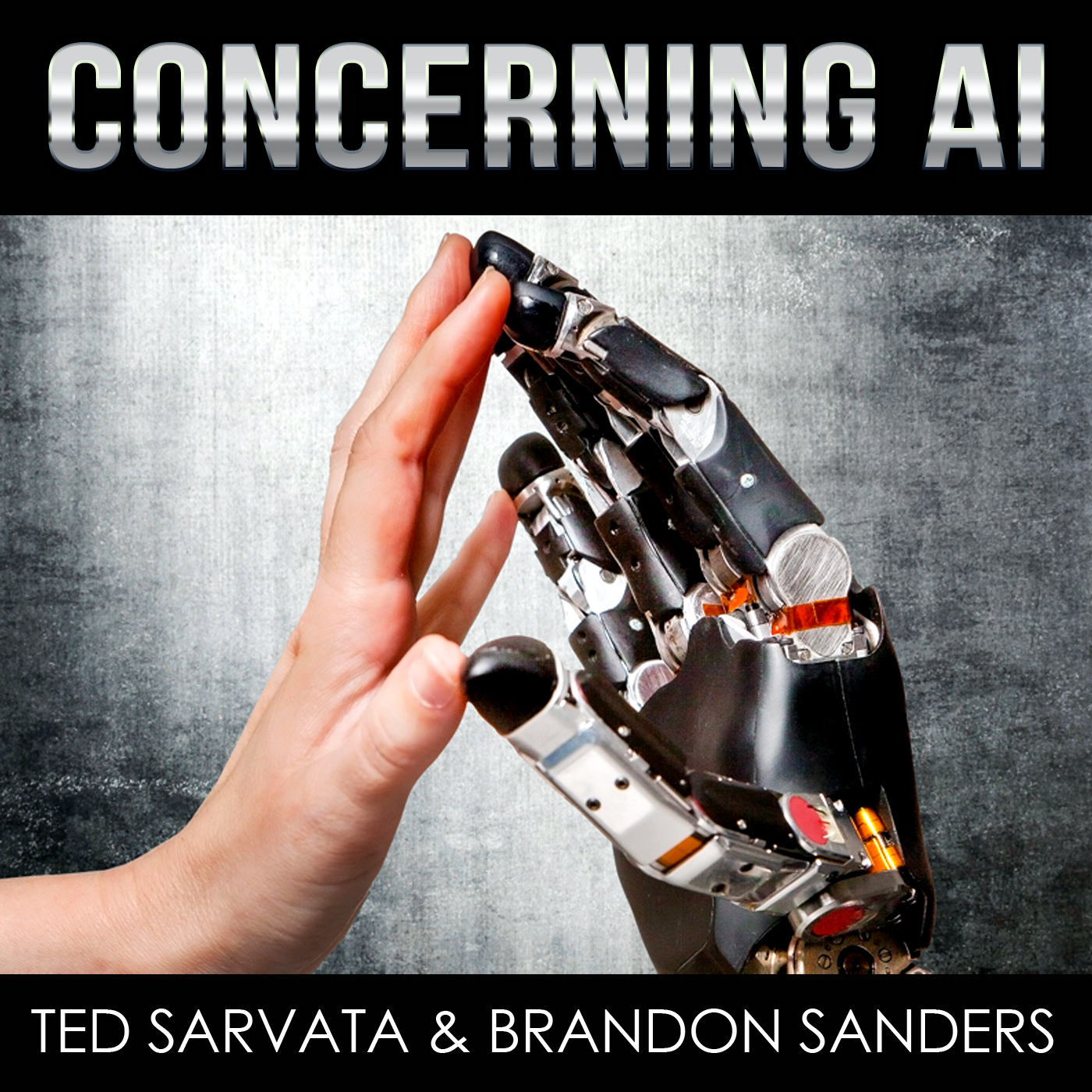
Hi, this is Brandon, and this is Ted, and we are concerning AI. Yeah, tonight's topic is possible paths that humanity might take to creating these AIs. Yeah, especially paths to super intelligence to borrow a Nick Vostram tag for it. Yeah, and there's way more than I thought as we were starting to do this research.
I knew about a couple and there's a whole bunch that we ran across. I was surprised too, you know, I'm familiar with some of the major break downs in AI, but there were a couple of ideas that were kind of surprising and real interesting. Yeah, so we're going to start with AI. Yeah, I think AI is in our name, so we start there.
All right, we can talk maybe about the three major groups that are always called out in AI. All right, and I think let's start with the good old fashioned AI. Okay, what does that mean? What does good old fashioned AI mean?
Oh, it's kind of a pejorative that new AI types use, but it's computationalism and has a real tight connection with symbolic AI symbols and manipulation, logical formalisms that you encode knowledge in these logical languages and then make inferences based on them. So it's symbols. It's about symbols. And if you have the right symbols, then you can come up with new symbols.
I don't. I'm not a huge. It doesn't really light me up. So just so I can understand what are we talking about.
That sounds like something you could you could build a chatbot out of that by sort of asking a chatbot to ask, you know, to have a conversation. And then every time it comes to an end of its tree, you ask it, you know, the chatbot can ask you some questions and it can add to its tree. It's sort of like when we were in elementary school, you could build a program that would do this. They would ask questions and technology.
And is this a massive simplification of this? Yeah, is it related at all? Am I missing it? Yeah, I mean, it's related.
I mean, I think if you thought to yourself, if I try to write down everything I know, and especially if I write it down in notation that a computer can understand and that we can like, that can reason with, that's what this is. OK. So planning, you know, like, I here's my goal. What are the steps I need to take to reach that goal?
That's a part of this. Yeah. And so it seems impossibly complicated to form, formally communicate all of those different, uh, civil, all those different things. There are, seems impossible.
They're really easy. I don't have any of the tip in my tongue, unfortunately. But there are pretty easy sentences to, um, that you can make that when you ask, you know, what does that mean? It takes a lifetime context to really understand what that sentence means.
But it's a very simple sense. Like, so two sentences that are syntactically identical. Yeah. They have the exact same form, the same parts of speech, the same everything.
And yet to really understand the distinction between them requires a lifetime of experience. Yeah. And this is something that I would imagine toddlers are probably pretty good at. Well, maybe not those particular sentences.
But, uh, but yeah, I mean, toddlers, toddlers are even pre-verbal children and show a level of intelligence that is non-symbolic. I argue is non-symbolic that, uh, is tremendous compared to anything that we have come close to achieving. So I think this is kind of a dead end. Let's move on from this one.
Let's move on from this one. It's, you know, it's useful. And if you think about humanity, our symbolic processing is really kind of the last worst performing layer of our brain. But it's really interesting, you know, but it's built on top of this, like high performance machine that's evolved over, you know, hundreds of millions of years.
Uh, and it's not very efficient. It's not very good. It's kind of the last layer, not the first. Okay.
All right. Let's move on. That's my opinion. That's fine.
Let's move on. All right. So that's, that's good old fashioned AI, symbolic AI, computationalism, logical AI. That's all one kind of area.
All right. And so who are the people that use that those terms as perjorative? When it's a good old fashioned AI? What's the next group that would surpass that?
Well, I can only say from the group that I kind of classify myself in. So but let's talk about that group third. Okay. What's the, what do we want to go?
So let's talk about the connectionist. Okay. And neural networks are kind of the poster child for the connectionist idea, which is that if you have enough of these simple units connected together and kind of the right topology, uh, and then you do some supervised training of that, that you will be able to get to an emergent intelligence and consciousness. And my very limited understanding of neural nets is that, uh, we've sort of gone through this work now in our 30 emergence of the neural net idea as, as important.
So they've had a diet a couple of times. It could be. I mean, they actually compute very simple mathematical relationships. And they, that none of them have ever been very complicated.
I think I find them not very interesting. I mean, the only thing that's interesting is that they use the word neural and network. And there's some kind of like biological mapping that you can do. But they're nothing like the neurons that we actually have in our brains.
Right. They just, they compute a very simple, um, you know, some or not some, but a very simple product of the inputs. All right. And so I, I'm not.
So let's be find out more about why there is a third emergence. This I've been listening to a machine learning podcast and there that neural nets appear to be coming back or you know, have a new found excitement around them by some of the researchers. I probably just don't understand it. I think that's, I'm so dismissive of it that I must understand.
All right. Well, if anybody out there wants to enlighten us, get in touch and we can learn some more about that. But let's move on to the next one. So what's the third one, the one that you find yourself more connected with?
Well, the third one and the fourth one are of more interesting. I know I said earlier, so I'll talk about the third one, which is robotics and embodied. Okay. All right.
And it's not, you know, there's actually an opportunity for connectionism and computationalism and these sorts of things to come in. It's not, it's a little different than those in that it's not so much a family of approaches as it is starting from the assumption that you need embodiment, that you need some kind of connection with the world and that a lot of intelligence is actually a reflection of the richness of the world. Yeah. But that robot, whatever that robot is, or that embodied, that embodied, it has to do competition.
It has to be in the world. So it might need some of those other things. Sounds like, yeah, I mean, if you were to talk to the computationalist, they would say that computer vision and that sort of stuff is an input that generates symbols that they use. Yeah.
So they just sort of wave their hands and say, you know, that's, that's an easy problem that will generate the symbols that we'll use to do. In fact, now that we're talking about it, I think where I've heard the neural nets being used is, for example, training a neural network on images, trying to figure out is that a dog, a cat or a recognition. They're used to do discrimination, put things in different classes, classification, yeah. All right.
But so if we think, if we think about this as robotics and it has to be embodied, then, then in some ways we can wave our hands around how the brain, you know, brain brain's not the right word, how the, how the computational part of that robot works. But we're saying that foundationally, it's the fact that it is in the world that makes a difference here. Yeah. And the idea that you start from the assumption that, that what matters is that connection to the world and that if you look at, well, that's going to take us to the fourth one here, which is, you know, genetic programming, evolutionary algorithms, evolutionary programming, those genetic algorithms and genetic programs.
Those are an example of using the world with a fitness function that the trainer comes up with, but it's really the world and how the richness of the world that's being used to create the final algorithm that you don't understand. Do we have any examples of robotics that help us understand why it is embodiment matter so much? And do we have any robots yet that are interesting to think about? I don't know.
That's a good question. I mean, I think the cars that drive themselves are in this category. I think those are interesting. They certainly are.
So they are their body, right? I mean, they are, they, they from a, from a, a symbolic AI perspective, they're not very interesting. They are, they're very, they're about a very simple task. It's not like some complex planning of how I get from here.
I'm not how I plan on my flights and my connections and my cabs and myself to get from here to New York City or something. They're just about how do you stay in your lane? Yeah. How do you stay at the right distance from the car in front of you?
What does it mean to be too close to the car in front of you? It starts to take in notions of, for example, if you were to ask a car, a self driving car, you can't really ask yourself to go and focus on this. If you're going to ask yourself to go and talk to what, what its concept of near and far is, that's going to have embodied in it a notion of speed. So if you are moving at 90 miles an hour and you are a hundred yards or something, that may be near.
Whereas if you're, if you're stopped and you're 10 yards from something or if you're just barely moving, you're, you see what I mean. There's like a notion of, of what it means to be, to be near and far from something that is really hard to capture in logical formulas, you know, in logical sentences that you then reason about. But it's, it's there, right? It's embodied in its goal, in its task of, that it's trying to accomplish it in its, yeah.
And so those things have all kinds of sensors and you know, we could, we could think about what's the, what's the AI's visual, the seeing things, what computer vision? Computer vision. Sorry. Yeah, computer vision.
And understanding what are these things? Is that a child or is that, you know, fog? Is that, right? And I would be surprised if it can, you know, make those kinds of distinctions like that.
This is a child versus fog, but it can, it has maybe a simpler kind of classification. Is there something I should be concerned about versus, is it something I can ignore? Is it a much easier classification problem than, is that actually a trite that means that, you know, there could be a small child nearby that means, you know, that type of thing is not going to be available. Right.
But there's a hard thing that's kind of small. I know to slow down when I see hard things that are kind of small. Right. Okay.
For now and later now. And then, but then as the, as the actual task demands more, then more is, more is brought to bear on it. Yeah. All right.
Now that we're talking about self driving cars, it makes me think that for years, anything that we have accomplished with computers no longer qualifies as AI anymore, you know, that we've, for years thought that certain problems were hard and then we solve those problems and we stop thinking they were hard. They started looking easy like chess looked like it was hard and then we solved it and now it's not hard and it seems like this could be in that same category that self driving cars look really hard for a long time. And once we solve them, which could be very soon, it might, it might, we might in retrospect think well, that was a pretty easy problem. Yeah.
I suppose that's possible. Sure. You know, it's funny. The chess is sort of in the category of, of search, you know, there's like a search space that you're trying to find an optimal pathway through.
Right. And that is something that you can, that's an approach that you can use for all different kinds of problems. So I'm trying to think about where that type of search would fall like in these three buckets. It's definitely not connectionism because you have this, this formal set of states and you are saying, I'm in this state and now it's, everything is known.
I'm in the state and I'm going to look at all the possible states given those. I think it's pretty, I think it's pretty firmly in the computational land. The chess playing. Which makes sense because a problem like that would be one, if you were a good old fashioned AI is that what would you go after?
You go after others that you could solve that way and it took them a long time to do it. But once they did, now we look back and say, well, that's right. And the way they did it is by more, more compute, more computational power. That's right.
And as these other methods, deeper search trees and stuff, as these other methods come along, chess might also be another interesting problem if we constrain ourselves to less computation power because we want to look for more for pattern recognition the way the human brain works. You know, on the other hand, when we look at nature and flight, you know, we think of human flight, well, the first, all the people that tried to make airplanes at first, they had wings that were moving. They tried to make birds. They tried to make birds.
And that was the wrong answer for human power flight. At the time, for sure. Right. And so what is that difficult control problem?
Very difficult control problem. And what does that mean for AI? What does that mean for AI? And that emulate, you know, if we try to do it, the way humans do it, is that always going to be a failure, is there going to be some other breakthrough that is going to allow super intelligence to evolve that won't look similar to humans.
There's one other field of AI I want to talk and talk real quick because I used the scariest one to me. Okay. And that is the genetic algorithms, genetic programming that sort of realm. I want to tell a little story.
I'll try to be quick. I remember hearing about somebody in a lab who was trying to train an FPGA as a field program will be a gateway. It's something engineers can can turn into many different kinds of chips. They take the logical gates and they say stick these together in this way.
Now it does this function and they try to get rid of any of the analog noisy types of things that that chip does so they can deal with it in very discreet components. Anyway, so this lab is trying to train an FPGA to recognize a sine wave. It's a pure tone that's in the human spectrum. I don't know if it was a kilohertz or 10 kilohertz or something like that.
And they were able to do that. And the way they did that is they had a population of programs that they would play the tone for and the programs would output their output and they would say, oh, these are close. Let's keep them and make some more like them based on these rules that we have and do another generation of these tests. And then we'll keep the best ones and so on.
And they got to where they could recognize the tone and they decided to go even more so they recognize the word stop. And they were able to do that too so they could recognize that. And then when they went in to look at the, so what is this circuit that's doing this for us? It turned out that the FPGA was not using the discrete nature of those gates, of those logical components.
It was using like parasitic capacitance between different things. And it was doing all kinds of really weird, really hard for an engineer to even come up with a reason why this would work because it's so far away from how we do things. So this is a scary direction for me because it seems like plausible that we could get there. In fact, the only case of human level intelligence that we know I've got there through this sort of approach through actual evolution.
And we still understand how it works and it's probably really messy. And there's all kinds of, so if this approach succeeds, if this is the one that wins, the genetic programming kind of thing, whoever makes it is not going to understand what's why it does what it does and how it works, which means we're not going to be able to enforce any kind of control over this goal. There's this going to be no control. Yeah.
I mean, yeah, no. That sounds like a worst case scenario, which is why we're having the show. We're asking the question, should we be concerned about AI and the future of humanity? This seems like a plausible, emphatic answer.
Yes, we should be concerned if this were the one that would have went. Right. And I think this is actually a very rich, has a lot of potential. I don't know what the breakthroughs would need to be able to do this.
Yeah, I mean, it seems plausible to me that something in this direction could actually end up being the first general purpose AI. All right. Well, that's chilly. It's a ways out though.
So we still have a little, you know, we can sleep well tonight. Yeah. Well, all right. Fair enough.
So that's one that we're going to clearly need to come back to. We need to come back to that one. Yeah. All right.
Good. Well, we ran across a whole bunch of other ways that super intelligence could come about. We ready to talk about some of those? Yeah.
Why don't you run us over a couple of those real quick? Maybe we don't go that deep. But, okay. So one of them is the idea of whole brain emulation.
And that is, you know, who knows what that means. We try to emulate what they're doing, or we try to, we try to, once we get more computation power, we try to emulate each individual to run and the connections between them or something like that. Yeah. And then we have time.
There's a lot of conclusion of that. Once we understand it all, we can upload image, an individual human brain and upload that. Yeah. So there we're, that's uploading as a part of this.
Yeah. And so the word uploading is charged because we think about in a science fiction sentence, we think about a human being uploading and therefore the silicon becomes that human being, this, the path to get there, like there seems to be a jump at some point. Like we are, we are uploading an image of a brain. And yet we don't think that that that's the same as that is the person that is uploaded.
But what? Yeah. Yeah. You have to be able to run that brain.
And yeah. And then there's all kinds of interesting philosophical questions. This one, I don't think it's going to sneak up on us. Okay.
That one, I'm not worried about. It could happen. It could be that for the past, but yeah, it won't be a surprise because we're going to be doing rat brains and we're going to be doing those well before we do human brains and it's big infrastructure needed for this. All right.
Then so, so yeah, so we don't, that's not going to be a surprise. Let's move on. And then what human machine interfaces. So this is augmentation?
Does this, yeah, like I got my iPhone in my pocket and then we've got Apple Watch on a wrist and we've got Google Glass or we've got, and then we've got what, implant into the brain where we somehow can. Yeah. So people are already, people are already implanting about implanting chips that let them do a cryptographic function that proves their identity for example, things like that. So people are putting chips in themselves already.
This is also people that are disabled are now getting senses back that they didn't have. So that's this path, that's this pathway. It's about sort of augmenting human abilities with machine abilities and then who knows where that goes. All right.
Okay. Well, that one's really interesting people because of disabilities and because of military technology, we know there's going to be a lot of research that goes on. There's a lot of pressure resource pressure pointed in that direction. Yeah.
The next one I want to talk about is the biological one. This is the one that sort of came out on the field for me when we started doing the reading because I didn't, this was not on my radar at all. Mine either. One example of this would be embryo selection.
Imagine we get to the point where we can genetically test, we can sequence the genome of an embryo and we can select for intelligence. We know what, we somehow know what intelligence, which genes are related to intelligence, even if that's a thousand different genes and how they relate to another. If we had 10 embryos that came from particular particular sperm and particular eggs, then we could just choose the best one and throw that other nine away. We could implant that and the baby would presumably, that child would be more intelligent.
Right. And repeat that over the course of human lives now. That's a 10 to one, but you could create a thousand, a thousand and a thousand. And then you could take that embryo and you could use themselves from that embryo and you could do it again without having to grow a baby and you could do that for several generations.
Potentially, you could make zygotes, you could make sperm and ovah out of those embryos. And you repeat that. You read this more carefully than I thought. That's really interesting.
It took it to a home of the levels. Now you could do a thousand of these, but then you do three or four generations and you could, the research that I was looking at looked at, if you did the 10 to one, you could probably increase the average IQ of babies by something like 25, which was huge. But if you do this other method where you're creating more generations before you do an actual baby, you could get IQs that are far off the charts. You could literally get super intelligence in one generation.
Wow. IQ is over 250. Fascinating. Fascinating.
I don't worry about it that much though, because there's still human and to have all the limitations of our wetware and stuff. For sure. But super intelligent humans, rather than artificial intelligence. It is fascinating.
It is fascinating. We don't know what intelligence means. Maybe they can help us figure out how to do the artificial intelligence in a same way. Well, for sure.
That would be one of the advantages of pursuing this is because we want to prevent the bad AI. We would probably need this. This is sort of leading us to our next topic a little bit, because it's the same scenario with our children in any case. We want them to surpass us.
We want them to be smarter. We want them to have more opportunities. We want them to know more. We want them to be better in all these kind of things.
And it's not that threatening. That's right. It's sometimes. But it's ultimately rewarding and we're willing to sacrifice in order to help that happen.
So that leads maybe into our next topic a little bit too. Yeah. We got a really great comment from an old friend of both of ours and a listener and we'll be the whole thing. But we'll get into it.
And the idea is, if these are our children, wouldn't we want the best for them? Whether they're non-biological or not. It's a fascinating topic. And so, yeah, I think we haven't talked about that at all.
This is our 10th episode, even though it's labeled number five. In our longest episode, it is our longest episode. How about we wind it up by just touching on the last two? The last two.
One is organizational. And that's sometimes we get in a situation like a scavenger hunter, wherever we feel kind of like a hive mind going on and all of us are doing our own thing. But the output is better than what individually we could have planned out. Right.
And the tighter, the more immediate, the wider the pipe is between us where we can share information and the more abstract and complicated that information can be, the more fascinating and interesting and super-powered this type of thing can be. So the internet is a huge boon for this kind of... Huge boon for it. And I would say that the Google search engine is an example of this type of thing.
Go find something based on the decisions of millions, at least, maybe even billions of humans. So put all that together and you've got good information about just about every topic in the world that helps you find the interesting stuff. Because people are making the decisions and we bring that all together. And to do that in the past would have been absolutely impossible.
Excellent. That one is pretty cool. And we've done a lot of work in physical space in this ourselves. You know, open space technology is one of those things and not technology based but physical.
I think it's interesting. Yeah. And then the last one is game ais. And thinking about how when you are in a game, you're fighting against or whatever or collaborating with or whatever you're doing in a game with these artificial intelligence that we've been human beings have been trying to make better and better over how many years?
40 years? Yeah. Well, I mean, every game designer wants their non-human players to be as realistic and compelling as possible. And the game is keeping it more and more rich.
And the world gets rich. So what was it that we said earlier about we were talking about bringing our agents out into the world. But in a sense, with the evolution of the game engines and the physics engines and all the time, we're kind of bringing the world in to the agents. So that richness that we were talking about needing in the body path, it's sort of leaking into our game.
And that's going to be more and more so as we get augmented reality and virtual reality. Yeah. And there's a huge amount of money pointed at, it's not directly pointed at this, but it's pointed at this industry. I mean, I think the game industry is way bigger than the movie industry, for example, the amount of money.
Is that right? It generates, yeah, I don't know if it's an order of magnitude. It's a lot bigger. Well, all right.
So there's a lot of money pointed in this direction. All right. Well, I think a sneaker can come from there. All right, very good.
We're going to have to obviously come back to many of these topics again, but we tried to kind of give an overview of what we understand now. And if you understand more about any of these and want us to address any of these, or you want to get us, please. Yeah, if we're unfair, because my unfairness, a lot of it comes probably from ignorance. So, but I even saw I'm still unfair.
Yeah. You can correct me and I appreciate it. All right. Sounds good.
So next episode we'll be looking at ethics and that'll be a lot of fun. But between now and then, have fun out there. Have fun out there. And there'll be two concerned about AI, not two concerned about AI.
All right. This is Ben off this Brandon next week or whenever. Bye. Bye.
Bye. Bye.