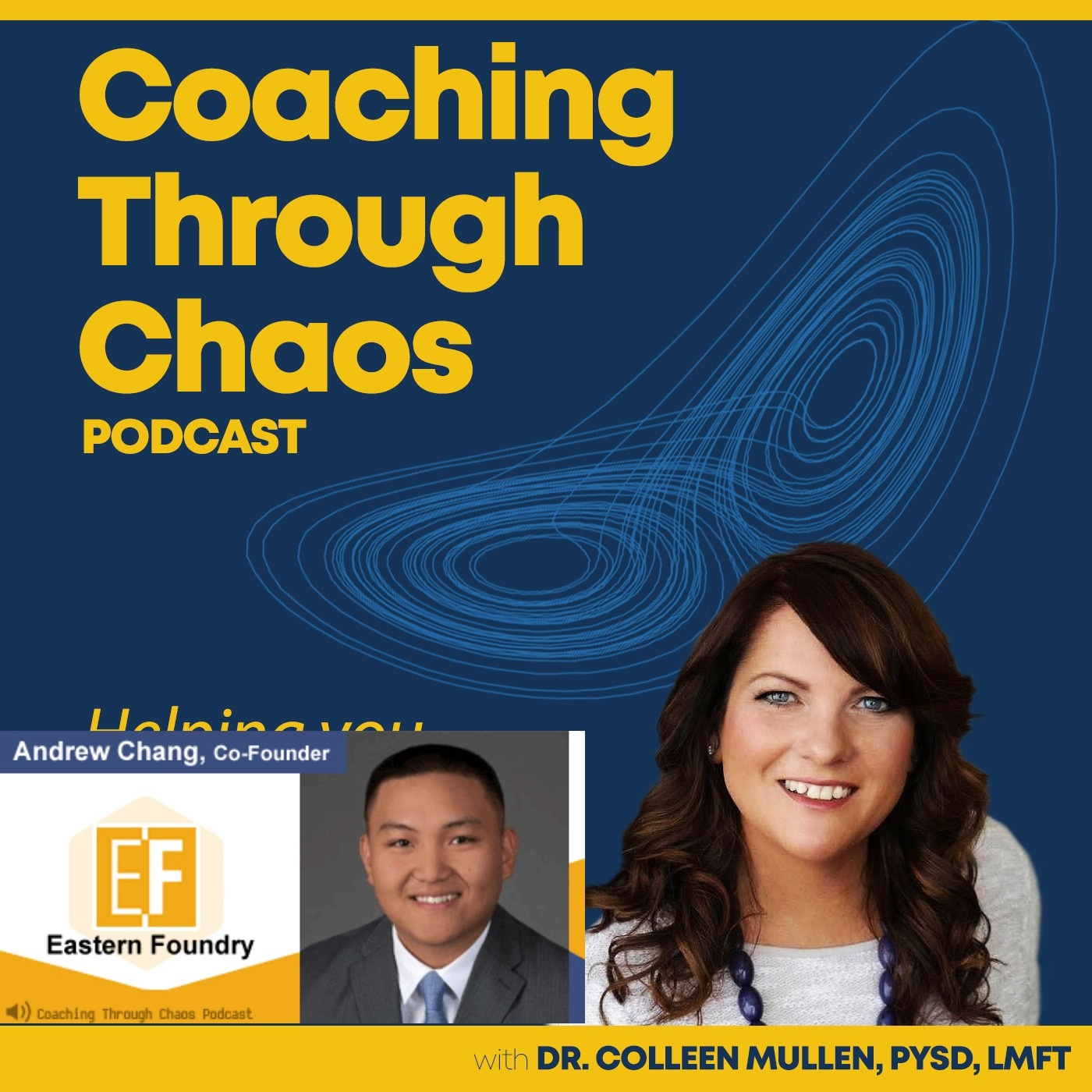
Welcome to the Coaching Through Chaos podcast, helping you conquer the chaos in your life. Your host is licensed marriage and family therapist, Dr. Colleen Mullin. Dr. Colleen has been doing what she does for almost two decades. She's a private practice owner, a chaos musician, a magazine columnist, a best-selling author, and her work or writing has been featured on countless websites including Fortune, Martha Stewart Weddings, Psych Central, The New York Post, Success, and many more. Listen in as she brings you experts in the psychology of life. They may be New York Times bestseller, key players in their profession, or people who have overcome tremendous obstacles in life and are here to share their story to help you live your best life.
Let's get to it. Stay tuned for our next chaos-crushing guest. Here is your host, Dr. Colleen Mullen. Hey, everybody. This is your host, Dr. Colleen Mullen, with the Coaching Through Chaos podcast, bringing you what you need to succeed. I'm building this podcast as a place for you to come for resources to empower you to live successful lives. And as you may remember, each month I'm going to feature a resource for our veteran population. Sometimes it'll be for an outreach program. Sometimes it'll be for a family-based program. And other times, like today, it'll be about new avenues for help for veterans' emotional well-being.
And today's interview is with Andrew Chang. He's a managing partner of Eastern Foundry, which is a veteran-owned government technology and innovation incubator. And I'm interviewing Andrew so he can talk about his Foundry Cup competition. And the Foundry Cup competition is a biannual event that they've created to help identify solutions that will serve our veteran communities. This competition brought together 14 innovation teams to pitch not only their treatment ideas, but their solution ideas for post-traumatic stress disorder. And they've done this in front of a panel of judges. So we're going to get to that interview in just a little bit. But first, let's put the need for this in context.
In the latest information from the U.S. Census Bureau, there are 21.8 million veterans in the U.S., and as of May, there are just over 1.3 million active service members. One in five veterans of the Iraq and Afghanistan wars are diagnosed with PTSD. And it's estimated that about 30% of the Vietnam veterans also have PTSD. And the sad part on top of that is that more than 40% of Iraq and Afghanistan war veterans who responded to a recent survey said that they did not seek mental health care because of a perceived negative impact on their careers. And then there's the widely known statistic of 22 service members per day committing suicide.
These are absolutely horrendous numbers that speak of, number one, a need for new avenues for treatment, and number two, a need for removing the stigma of mental illness in the military. And that idea of the stigma of the mental illness in the military, you know, it's something that's a stigma in the general population as well, but today we're going to focus on the military. And that left me feeling like I wanted to have a discussion with someone about removing that stigma of mental illness from the military. It also needs to be removed from the general public, because we know that that's still a stigma to have a disorder such as bipolar or PTSD, and I don't know why. We're going to talk a little bit about that, and when I say we...
I've pulled my producer, Dr. B, in to help me with this discussion. Hey, Dr. B, how are you doing? Hey, how are you? All right. So, Dr. B, for me, it's pretty simple. If you're going to go into a traumatic situation, there's going to be traumatic injuries that need to be attended to. You know, that can be a military situation or it can be an abuse situation for a kid growing up. There's trauma. They end up with traumatic injuries. And yet when we do it with our soldiers and we put them in what is perceived as a traumatic situation and they end up with traumatic injuries, we want to act like it didn't happen. We want to act like they should just be able to walk out of there with a clear mind and get on with their life. What do you think about that?
Very interesting point. And as we know, 2020 hindsight allows us to look at this and see clearly what is readily apparent. And you obviously have the knowledge and the skill set, having seen so many patients and seeing the patterns, that it is obvious to you. In our culture, in our military culture, it would seem that the prevalent attitude of boys don't cry has to be maintained. Boys don't have trauma. Soldiers don't have trauma. The warrior caste, the man-at-arms, as the profession was called when I was enlisted, is one which has to do all the dirty work for the rest of society. And certain...
requirements are there that you do not have feelings, you do not care, you do not break down. And unfortunately, as has been seen throughout history, when soldiers have to witness or carry out atrocious acts, there are consequences. Right. And as you touched on this, this goes back in history, because although we've only had language for PTSD for about 25 years, we've had... We've had wars throughout history, and this can't be the only time that all of a sudden people are feeling the effects of it. I think, well, if we go back to the last century, the First World War, there were cases of shell shock, which were diagnosable and recognized, but were also being branded as cowardice. There was a lot of stigma at that point dealing with shell shock that the people were just trying to get out of doing a dirty job. So this stigma led on whilst there was the, I believe, the combat stress response, as it is called, or in psychiatry, the active stress response. Acute stress response. I don't see what's cute about it.
The psych field evolved and learned more as it got to see more of its patient. With the advent of better documentation, I think this research is ongoing. However, it's always a surprise when we see the veterans coming back and we ostracize them as the general public, having asked them to do their all, and then they get treated so badly because we don't want to acknowledge that we're asking them to do things that we don't want to do ourselves. Right. And so that, and that as you went back to World War I, that we know that those kind of things went on.
And it was just called different things at the time, or we can assume that they were called different things. I'm guessing that the symptoms were there. They were either ignored or brushed aside, other than obviously that the military has a job to do. And that job is to keep soldiers on the front line doing what they have to do. They have to be maintained in peak performance. So symptoms would be observed. Treatments were developed from World War I, from World War II. But the whole emphasis was getting the soldier back on the line quick as possible to do his job. And then we had World War II. And you and I both grew up with parents who had parents or other relatives who had served.
Is that right? I come from a military family, yes. Yeah. But I don't recall hearing all that much about the need for the help for those soldiers. Do you? I don't recall hearing anything either. It seems that generation, our parents effectively, we're of that age, and I'm guessing a lot of our audience is too. Our parents were of that generation. They grew up with the Great Depression. They suffered immensely. They had the Second Great World War, another war to end all wars.
And they seem to have been more stoic and more able either to cope with it or to internalize it and just turn a blind eye. So it's only since more recent wars that it's become more obvious. Right. And we want to make it clear that just because we think that that's what happened, we actually don't have any literature to back that up. And we certainly wouldn't think that a person should be able to just turn it off because we know now that people can't just turn off those ideas and the stress and the trauma that they've gone through. So that moves us into...
Korea and Vietnam Wars. And that's the war. The Vietnam War is the one that really stands out in our recent history as the one that led us into even making the quote-unquote discovery of post-traumatic stress disorder. But it didn't happen right away. It happened almost 10 years after the war ended.
You mean the labeling of? The labeling of the cluster of symptoms that we've come to know as post-traumatic stress disorder. It was actually quite interesting to see the culture of the time. The Vietnam War was a war by media. This was probably the first time in history it was a byproduct of technology, which negatively impacted the veterans. So when our troops were coming back, they were being treated badly because the people back home had horrible images in their head that they'd got off the television. Right, and yet they went into this war like they do with Iraq and Afghanistan, might have gone in saying, I want to do something good for my country.
When you enlist, you swear an oath. You have patriotic ideals. You are there. You want to do the best. You want to serve your country. And those are very noble ideals. And in the face of oppression, they're very important. What happens when the public you're defending turns against you when you come home? How do you deal with that? It's horrible. And it starts to make me think about this idea that we have in psychology called cognitive dissonance. Essentially, when a person lives a certain way, so they're young man, young woman, think they're morally upstanding. They've got a good set of values. They grow up thinking, I want to do something good for my country. I want to go serve my country.
And when they get into the military, they then are told, you now have to do these other things. And some of them may include causing the loss of life of someone else. And that in itself causes when a person lives one way on the inside with an idea of how they are going about the world and what's valuable to them, and then has to act in a way that is different from that, is what we call cognitive dissonance. And from anything I've heard... I also believe that that is where the trauma even starts, and I think that we are going to see that come out down the road. So does that make any sense to you? Dr. B, I know you were enlisted in the Australian Army, and then you even had an opportunity to go to help in Bagram set up a telemedicine port on the military base. So I know you have some experience being in theatre. Cognitive dissonance brought back some memories. When I was a very young, private, all fresh-eyed, I took offence to the chaplain trying to tell us that it's okay to kill in war, but that God commands that thou shalt not kill the rest of the time. And I could not make any sense of...
what you are labelling as cognitive dissonance, because morally it did not make sense. And I think you're right, that probably causes problems in the long term. It's necessary within the mechanism, part of the necessity, for our troops to be able to dehumanise and do things, but it goes against all of our upbringing. When we look at and talk about PTSD, you know, I see a lot of people who have PTSD. But just so we can let everybody know, there's just a basic cluster of symptoms that make up what a diagnosis of PTSD is. But just some key symptoms are trigger points. You might walk into a room and smell something and all of a sudden you're brought back to the trauma. You might see something that reminds you. And it could be as simple as you saw the back of somebody's head who was wearing a white shirt and that reminded you of something traumatic.
A sound can do it. I know we just passed Fourth of July and there was a lot of banners up all over social media saying, be kind and think of the veterans when you're shooting off those fireworks because those sounds can trigger traumatic responses. And then we get to flashbacks. And that is when you get the image and almost re-experience the trauma in the moment. And certainly something like a firework can set off a flashback. Then we also have emotional withdrawal. And then there's hypervigilance. It's kind of always looking over your shoulder, being aware of your surroundings in a way that is critical.
hypervigilance, triggers, flashbacks, those are some key symptoms of post-traumatic stress. Like I said, you'll find an article posted along with this that has the full diagnostic criteria. That leads us into, you know, some of my own clinical experience. I've had the opportunity to work with military families as a straight out TRICARE insurance provider and seen the impact of combat trauma on the family. And then I've had the privilege and the opportunity to work with people who had retired out of long careers in the military and had seen battle, had seen death, had seen and done things that they never otherwise thought that they would do.
And I saw them for their symptoms of post-traumatic stress disorder as a retired veteran. And they sought out the services only after they retired because of the stigma that was going on. They absolutely felt that their career would be marred by having this on their health insurance record. And what we know about treating trauma is that the sooner you can get to treating the trauma, the better the results and outcomes of treatment. So these people who had the symptoms and were dealing with it while they were still active service members and waiting three years maybe to come for treatment, were really at a backlog of having to try to then outwork.
three years of these symptoms. It really was an uphill climb for them. And yes, they can still get better and they still can recover. But ideally, we need to have the stigma removed so that it doesn't have to be that way. And in fact, I know in a recent interview with the Virtual Reality Medical Center, we know that they've been able to get the VA to allow trials on the bases in Afghanistan, which is just wonderful to know that the system is working towards that to get in and do the treatment right away. And that's going to lead us into our interview with Andrew.
So this interview with Andrew took place about a week before the winner of the Foundry Cup was announced. So after the interview, stay tuned, and I will let you know who won, what they're getting out of this, and how you can participate in the next Foundry Cup if you are interested. All right, then. When we come back, we'll get right into the interview with Andrew Chang. You're listening to Coaching Through Chaos, your host, Dr. Colleen Mullen, reading you what you need to succeed.
Andrew, can you tell us what the Eastern Foundry is and how they are working to help our veteran population? Oh yeah, absolutely. So my partner Jeff and I, we're both veterans and we started East Foundry because we believe that technology innovation can solve some of our nation's toughest challenges, including those that concern mainly our veteran community and the number one topic that's really affecting the veteran community, which is PTSD. But the issue is many of these innovations don't make it into the government agencies due to the bureaucracy and the long procurement cycles. So we created Eastern Foundry with a vision to drive innovation into the federal government by enabling tech entrepreneurs and small businesses to win contracts.
and support agencies and help agencies to adopt the newest technologies that can keep us above anyone else and keep us on the cutting edge. So how we do this is we've created a venue in Crystal City, which is what we call a marketplace, where techies, government contractors, agencies can really convene and share information, business opportunities, and ideas. We provide our members with a co-working space, access to professional services like legal support, accounting, HR support, networking and educational training. All of those things we provide, whether they're veterans or just civilian companies, help them navigate. So you're creating this hub of entrepreneurship in the area of PTSD technology for the veteran population. Right. That's just the Foundry Cup. And can you tell us, so the Foundry Cup is exactly what? So basically, the Foundry Cup is an innovation competition. It was created by the collaborative competition that can help to break down barriers and keep innovative treatment that flows directly to those that need it. It's not like a typical competition where it's very cutthroat. It's more of a collaborative where companies work together to kind of maybe even merge some of their ideas to create better treatment that can better support our fighting men and women.
The Cup is a three-day innovation competition. It's run June 18th through the 20th. It's convening individuals and companies to collaborate on projects together. It's going to tackle some of the toughest issues for lawyers' community, national security, and health. So PTSD really falls into all of those categories. And this spring's Foundry Cup is honing in on individuals and groups that provide technologies and services and provide support to veterans suffering from post-traumatic stress disorder.
We found 14 finalists, and they will be competing for both cash and professional development prizes. It sounds like an amazing competition for the people who are in it. Can you talk a little bit about the collaborative part of it when you say that some companies maybe come together, individuals will merge with others? Do you have examples of that that you can give? Without giving too much away yet. I mean, for example, we have a mobile app company. We also have a technology solutions company. Oh, and then we also have a course that's coming from UCLA where students got together and are using a psychology background as well as technology together to solve it.
We just think there's so many different ways that they can kind of collaborate and come up with even better ideas if they bring their products or their treatments together and come up maybe with a supersized treatment, if you can call it. But we're just not sure because we haven't had the competition yet. But we'll find out at Demo Day on Saturday. Fantastic. I would bet that there's a lot of excitement and buzz around where you are right now with this going on. Will this be an annual event? Yes, it'll be annually. It'll actually be twice a year with every cup having a different topic. But all to benefit the veteran population. Right. I mean, our next cup will likely focus on a topic that's related to international events, but we haven't released the official topic yet.
That's two times. Okay. So, Andrew, how were the finalists chosen and what will the winner receive? So the finalists all applied. We kind of did an ad and marketing campaign to get the cup out there. The Founder Cup finalists will be judged on the following criteria. Number one, which is the likelihood that the idea will yield a positive outcome. Number two, which is the level of innovation.
Number three was a state of development, whether it's an idea, a prototype, a pilot, or a product that's already out there. And the last one was availability to kind of collaborate throughout the program. How flexible are they to joining with another product or adapting to new findings from DTSD, things like that. The first place winner is going to receive $10,000. The cash prize that runner up will receive $5,000. And the people's voice factor will receive $1,000. And all of the finals will receive training, professional services, access to buyers, and several other perks. Again, what a great opportunity you're giving these people. Are you able to tell us about some of the innovative technology your finalists are bringing to the competition? I know you've already mentioned a mobile app company. Is there anything more specific you can give us? Or is it all hush-hush because the competition is just about to get underway? Yeah, absolutely. So we've identified three major groups of solutions that are particularly compelling for the treatment of PTSD. The first one is obviously mobile therapies.
Last year, only about half of the veterans diagnosed with PTSD, especially those coming from Iraq and Afghanistan, received a therapy, and that's according to the Institute of Medicine. So mobile smartphones, I mean, who doesn't really have smartphones these days? I think smartphones can really help change the statistics by connecting that had PTSD with therapists or other that might have similar issues and to kind of talk to each other about it to help ease the pain. And two of the solutions that are coming to the Founder Cup that are related to a mobile category is SoundOff and Self-Echo's Mobile Therapy, which provides veterans with an ability to connect straight with a clinician. That makes it a lot easier than having to go stand in line at the VA or go through a clinic.
and weight. So those are two of them from the mobile category. Another category is physical and interactive treatment, especially in the military camaraderie. It's huge. And the VA has even recommended it over various studies. And I do that myself. I mean, I've experienced losing some guys that I've went with. But once you enter the civilian world, it's a little different. So I think physical camps and treatments that can bring us together, it can really kind of help expedite healing. And three other companies that are going to be in that category are Warriors at Ease, Trauma and Resilience Resources Warrior Camps, and Black Sheep.
MILFA, which is military simulation. And then one last one is going to be high-tech treatments. Studies that the VA has done before show that using virtual reality technologies can really help veterans ease PTSD. And I think this is one of those topics that the VA has not really touched very well, especially with the technology that's available. I really believe exploring cutting-edge technologies can really open new doors. And this is a really interesting company that's brought this on to us. It's the Virtual Reality Medical Center. The center conducts exposure response treatment using 3D computer simulation to kind of treat and eventually control PTSD symptoms.
Yeah, I don't know if you're aware, but I actually had an opportunity to try out some of their equipment and go on a simulation exercise. It's really fascinating stuff. There's an episode earlier featuring them. Yeah, we're very proud of that they were able to make it. All these technologies sound wonderful.
And just when you mentioned that there's a technology coming out, the smartphone one, where they can skip having to go through the red tape of the VA and access a clinician directly, just sounds amazing for getting people that otherwise might not have gone through and reached out for help to give them access to help faster and more conveniently. So it sounds like you've got some really great technology stuff going on there. And whatever they start bringing to the table doesn't sound like anybody's going to go wrong by fostering any of these technologies. In wrapping up, how can a person or organization get involved for the next round of the Foundry Cup event? What would they do and what website would they go to to register? They can follow us on social media, on Facebook, Twitter, and they can get updates about the next event. We'll be announcing the next topic in the next couple weeks. We're going to have thoughts for innovation, sponsors, participants, and we're always looking for volunteers to help with the event. And lastly, visit us on our website, eastern-foundry.com, and sign up for our newsletter. We'll always have updates throughout the newsletter.
Okay, and just for people that might be interested in volunteering to help out, where is the event located? The event's going to be held at our office in Crystal City or Arlington, officially. Virginia, okay. It's 2011 Crystal Drive in Arlington. Okay, fantastic. Well, thanks, Andrew, so much. And I can't wait to hear who the winners are and see what comes of all of this. So thank you. Well, thank you for having me. We're all very excited. You're listening to Coaching Through Chaos, your host, Dr. Colleen Mullen, bringing you what you need to succeed.
Now we're going to get to the winners of the Foundry Cup. DC-based startup Quantify, which uses social media data to detect PTSD, walked away with the first place cash prize of $10,000. I'm going to tell you a little bit more about them in a second. The Foundry Cup runner-up, who's taking home $5,000, was San Antonio-based mobile IT company SoundOff. SoundOff enables veterans to connect with and receive anonymous ongoing care from volunteer counselors and veterans, all from their smartphones. Amazing technology. And then the People's Choice winner went to Arlington-based military lifestyle application Sandbox.
Sandbox enables military service members and veterans to connect with family members, friends, and military units, as well as sends snail mail through their app's mailbox feature. I had the opportunity to correspond with Dr. Glenn Coppersmith. He's the founder and CEO of Quantify, a small company working to scale clinical impact and empower mental health professionals via technology. For the Foundry Cup, they detailed some of their work that provides quantifiable or measurable information about mental health from data not traditionally examined by medical domain. So they take things like social media, movement, and workout data. Their algorithms, based on peer-reviewed research, can extract thousands of bits of information, which on their own only weakly correspond with mental health. However, Glenn points out that when taken together, he talks about it like a braided rope, these weak signals provide a strong picture of a person's mental health.
This data can then help clinicians prioritize care. How cool is that? So they walked away with $10,000 as the first prize winner. And even though that's great, Glenn says that the biggest benefit came from coming together with other incredible diverse and passionate teams similarly motivated to make a dent in the treatment of PTSD. The Eastern Foundry is also providing them with free office space next to some of their fellow Foundry Cup finalists. He says that the importance of this just can't be overstated. The Eastern Foundry has effectively brought together some people that otherwise wouldn't have met and provided material support towards ongoing collaboration in an area in which they all want to see progress made. So if you're interested in participating in the next Foundry Cup competition,
please check out their website, foundrycup.com. They'll be announcing the next competition very soon, and you'll want to check it out right away to get the details and the deadlines. If you're going for it, good luck. As for us, well, we are wrapping up this episode of the Coaching Through Chaos podcast. Next week, I've got author Amy Morin talking about her bestselling book, 13 Things Mentally Strong People Don't Do. She has such a compelling story of personal strength and overcoming loss that led her to write her original list of 13 things. I hope you come back to check out that episode.
I want to thank Andrew Chang and Glenn Coppersmith for their contributions to this episode. And of course, I want to thank Dr. B for joining me in an impromptu discussion on the air. As always, thanks again to BennettSullivanMusic.com for our theme music. And I want to thank you for sticking with us. We had a bit of audio trouble with Andrew, and we recognize that today. And we're still learning things about this recording and production stuff here. So I do appreciate your support as we grow and develop. As always, there'll be an article posted with more information on today's subject on CoachingThroughChaos.com. And also there, you can sign up for my mailing list if you wish to connect with me in between episodes.
You can also follow me on Twitter with the handle at Dr. Colleen Mullen, and I would definitely love to hear from you there. And you can also find me on Facebook at Coaching Through Chaos. All right, then. I hope you have a great week. And if you've got chaos in your life, I hope you're finding your way through it. Take care.