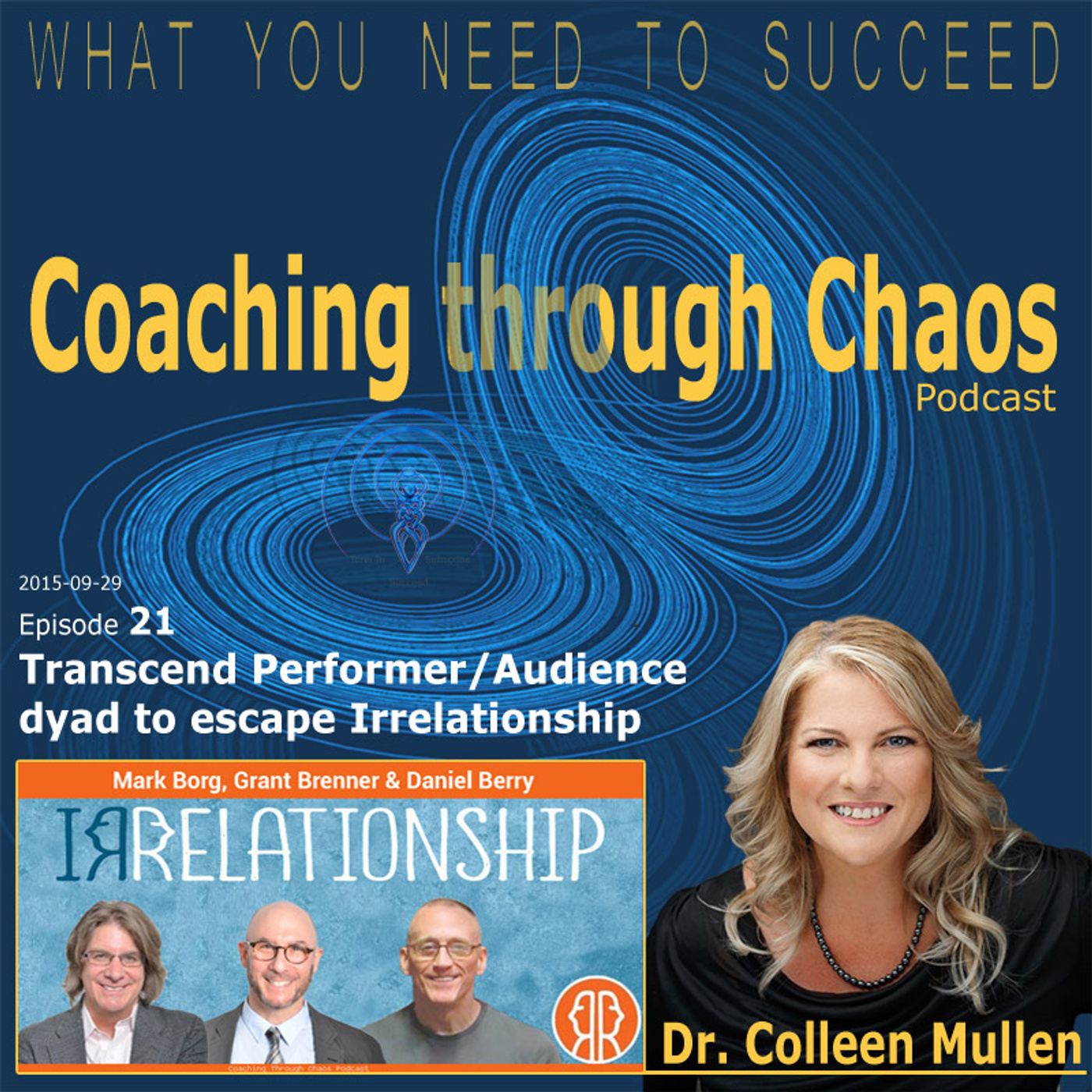
Welcome to the podcast edition of Coaching Through Chaos, bringing you what you need to succeed. Now, here is your host, Dr. Colleen Mullen. Hi, everyone out there in the podcast world. Thanks for joining me. I'm your host, Dr. Colleen Mullen. Here at the Coaching Through Chaos podcast, we bring you weekly interviews with guests who will inspire, motivate and empower you. With all the choices that you have out there for podcasts, I'm thrilled that you've decided to give me a listen or maybe even come back for more. This week, I'm bringing you not one guest, but three. My guests this week are Dr. Mark Borg, Danny Berry and Dr. Grant Brenner, who are collectively the co-authors of the brand new book, Irrelationship, how we use dysfunctional relationships to hide from intimacy.
We all know someone who could benefit from some useful relationship help, right? You may already have heard of Irrelationship through their popular blog on Psychology Today. And by the time you're listening to this, you may already own a copy of the book as it was the number one new psychology release on Amazon for the first two weeks of its launch in early October. For those that don't know Irrelationship, well, they'll tell us exactly what it is. In this interview, you'll hear how a book about compulsive caregiving turned into a book on a brand new relationship dynamic. You'll also hear how Irrelationship protects you in many ways, but not necessarily in the ways you would want, and how Irrelationship short-circuits the possibility of real love.
Danny, Mark, and Grant were friends before this project came about, and their friendship and fun relationship shines through in this interview. They were so much fun to talk to. With that said, let's get right into it. I'm here with Mark Borg, Grant Brenner, and Daniel Berry, who are the authors of Irrelationship, How We Use Dysfunctional Relationships to Hide from Intimacy. Guys, thanks for being with me on the Coaching Through Chaos podcast. Cool. We're glad to be here. Yeah, thanks a lot for having us. It's a real honor, a delight, and a privilege. Fantastic. I'm looking forward to this.
Between the three of you, there's a PhD, an MD, and an RN. How did the three of you come together to write a book about relationships? Our credentials aren't the first thing that bound us together. We're neighbors. Yeah, we're all kind of East Village guys and knew one another. Both Grant and I knew Mark, though, separately. I knew Mark for several years before this project began, and Grant knew Mark longer than I did before I met Mark. And then Grant and I came to know each other after Mark got the idea of having us collaborate on this project. So even though we knew one another, our initial acquaintance wasn't with this idea at all.
But it seemed, from our insight into our personalities and our abilities, like we might make a good team to make a project like this. So that's how this happened. How nice to have that come together like that. Well, then it did start to come together. And we thought we were writing about compulsive caregiving. We thought that we were writing about something that originally we thought of as human antidepressant. We actually were very much inspired by a chapter that Harold Searles had written in a book called The Patient as Therapist to His Analyst. And it was all about this idea of young people caretaking their parents.
and ultimately how this shows up in therapy, specifically psychoanalytic therapy. And so as we went forward, we started writing this book and we started shopping it around. And eventually we were able to get in front of a woman named Gareth Esserski from Carol Mann. And she sat us down. We were talking about how we'd written this book, about this pathology, about compulsive caregiving. And she looked right at us and said that she didn't think that was true. So we started thinking more about what it was we were writing about. It turned out we were writing about a relational dynamic.
about something not that people were doing to each other, but something that people were doing with each other, and it just kicked open the doors in all of our thinking. We started most especially thinking about how it had applied to other relationships that we'd been in, relationships that we were already writing about in our book. It was pretty well completed, this book, but we suddenly took this idea of a dynamic, we started calling it a relationship, and we started looking at every case that we had presented up to that point through a brand new lens, and it really just opened the world to us. It was really interesting, because Gareth is actually our agent. For one thing, it was pretty impressive that somebody with Carol Mangrove was interested in us.
And she was kind of in semi-retirement at that point, but she saw a couple of our chapters and she said pretty quickly, I'm going to meet these guys. And within a couple of days, we were sitting in her office and she was really interested by what we had written. But she said, I don't think this book is it. I think you've got something, but this isn't it. And I definitely think the three of you should write a book. So that was how we moved from a text that already existed and redeveloping it into what we now have. And what you now have is a relationship, which is a whole new way of looking at relationships.
Can you tell us exactly what irrelationship means and how someone would know that they're in one? Our pat answer to that, I mean, this is what we've written about. This is what's on our blog. This is what's in the book is, you know, an irrelationship is a shared, jointly created psychological defense system. It's a defense against the fear and anxiety that comes along with allowing another person to matter. And specifically, what it interferes with is the experience of intimacy, empathy, emotional risk, and emotional investment.
I remember Mark and I were talking about it, and I'm not sure, Danny, if you were there, but Mark and I have done organizational psychodynamic training, and we're all brainstorming. So one of the things that Gareth liked about us, I think, is that we sort of fight with each other. It's a shame we kind of can't talk over each other because a lot of us is a chemistry we have. And I was in analytic training with Mark's ex-wife, with whom I'm friends, and that's how I knew him. And I knew Mark and Danny because Danny knows Mark. And we just had this kind of wild...
Mix. We didn't add it. We have it. We kind of started a birthday party. Remember we came to a birthday party at that Italian restaurant down on First Avenue? I thought that was Mark's birthday. But anyway, we were talking about it and there's a concept from organizational psychology or group relations theory called a social defense. And that is a defense that a group uses in order to avoid something. And for me anyway, that moment really clicked that your relationship is a social defense.
It's a defense that people use together in order to avoid a collective awareness, whether it's two people or three people, whether it's friends or family on the holidays, a relationship where you're dating or in a corporate setting. Your relationship is about staying away from real intimacy. Yeah. I like to call it a hiding place. And that's what came through in reading the book is that there's a way of really avoiding closeness when one really pulls apart some of the relational dynamics that a lot of people are used to. Yeah, yeah, yeah. Well, and we really try to focus when we're talking to people about it in person and each other. We try to focus on this.
really important difference between being psychologically defended against anxiety and the effects and the influence of that anxiety. So your relationship as a psychological defense doesn't protect you from anxiety. It doesn't protect you from fear. It doesn't protect you from pain. It protects you from the awareness of anxiety, fear, pain. Therefore, you are still being hurt by the distance. You are still missing each other. Well, most essentially, people in your relationship are missing each other. They are isolated and they are lonely.
And when people start to talk to us about a relationship, when we actually are able to talk to people who have become, in many cases, our case examples, they're usually missing each other and they don't know why. Well, I was going to say it protects against awareness of anxiety. Not only does it not protect against anxiety, as we know as psychologists, it actually makes us more vulnerable to anxiety because we're not aware of it. And the danger that you're not aware of is the one that's going to get you. So that's a big part of what we do. This is a key insight for a lot of people in a lot of different paths to personal development is awareness of their issues. It works like anesthesia. You can take medications that make you unaware of pain. You can be given medications like when you go into surgery that make you unaware of pain. But that doesn't mean that the damage, the harm isn't being inflicted.
You just don't know about it and you're not defending against it in any way. So the harm goes on. Sure. And certainly we talk a lot about it being a dissociative defense, which is also a concept that people aren't always as familiar with. The dissociation as a defense. People talk about denial and so on. Can you tell us what a dissociative defense would be? Well, dissociation is a last ditch psychological defense.
It's more commonly used, say, by children because the mind of the child is not as developed. A developed mind, a mature adult mind can do other things than dissociate. It's a survival response. It's a little bit like when a lizard that's being threatened by a predator lets its tail break off so that the rest of the lizard can run away. When a person dissociates, they break off parts of themselves so that they can escape. Well, and from our theoretical perspective, we also think about dissociation existing on a continuum from maybe everyday uses of dissociation where you're just able to pay attention to what's going on. For instance, right now we're all able to hear each other. There's a lot of stimulation coming from all of our senses.
But certain uses of dissociation in a very specific way allow us to pay attention. But when it goes into a realm of shutting down anxiety, what it does is it cuts off our connection to each other. And we, you know, specifically in a relationship, we know what exactly it cuts off. It cuts off our ability to empathize with each other, to have empathy, to have intimacy, to take emotional risks, and especially emotional investment. And we, we're basically interpersonal psychoanalysts. And what we see is it operates on a continuum from dissociation, which is a complete cutoff from our experience, from experiential awareness.
Down to very simple uses, which we call selective inattention, which is just, I'm not paying attention to cues I don't need to pay attention to because they're really not relevant to my survival or to what's going on in the moment. So this interpersonal theory works very well with your relationship, including another concept that we call enactment, which in psychoanalytic terms means that people in relationship actually play out the problematic dynamics. And so therapy in the case of using enactment is we kind of work our way into the problem. We kind of get into playing out your relationship among ourselves, the three of us, and then we work our way back out a lot of our awareness of your relationship. painfully at times, has come from working with each other in this model. It's been very intense. We've been working on this for five years. Well, it's learning from reflecting on your own experiences together. Getting into problems and then working our way back out together. The things that are weakly dissociated, sometimes people make a distinction between strong and weak dissociation. The things that are weakly dissociated or selectively inattended, they're kind of low-hanging fruit. So if you give people a way to think about it or a word for it, then they can see it really quickly. So I think in the case of irrelationship, a lot of people, as soon as they read about it and they have...
a symbol or a word to organize their thinking about it, they get it right away. It's right there for so many people all the time. Although they don't necessarily like it. I love the description of the dissociation. I think it's really going to be helpful for the people listening and the selective inattention. Why do you think it is that so many people can relate to the concept of irrelationship? It doesn't sound like something we want to be in, but when you open up that book, I think a lot of people can relate to having those experiences of being in an irrelationship at some point in their lives. One of the most important reasons for that.
is that one of the most pervasive of the cultural mores that we live with is that the unacceptability of discussing how we feel about things, especially to hide our distress. It's not cool. A lot of us have been socialized to think that this is something that's imposed on men more than on women, but that hasn't been our experience. We find women to be just as inhibited as men in admitting their vulnerability. And so I think that's an important reason why it's not surprising that people are responding to our message. Now, plenty of people, when we begin to explain to them what's going on.
And first they're attracted to the book and then they'll say, I'm not sure I want to read that. And that's what I was reflecting on is that when you open up that book, everybody can relate to having been there at least at some point in their life, I think. When we're in younger relationships, obviously there's people that don't find a way to get out of that. And I believe a lot of people are going to open up that book and go, oh my gosh, this sounds like my relationship. Well, I think it's strong medicine, but as I like to say, a spoonful of medicine helps the sugar go down. And I think we have a message that's really kind.
And the other reason, aside from how common it is and how primed people are to think about your relationship, because everyone is more aware of things like attachment theory and the role of development, the timing is good for your relationship because people are thinking about relationships from a systems point of view rather than just thinking about everyone as being isolated individuals. People are getting a little bit smarter. Right. And when you talk about systems and system psychology, what we're talking about is taking the person in the context of the environment in which they live, as opposed to traditional individual psychology where a person is in their own little bubble with a bunch of symptoms. So now we're looking at things from a more systemic perspective.
You're listening to Coaching Through Chaos, your host, Dr. Colleen Mullen, bringing you what you need to succeed. You just were talking about enacting and your book very much makes it relatable when you talk about the dance between the two people in the relationship and you identify them as the performer and the audience. Can you describe what that means? People in a relationship, we do say they fall into the performer in the audience categories. The performer is the more overt caretaker, the one who looks like he or she is doing all the caretaking while the audience is hanging back, allowing the performer to escalate the efforts to rescue, to fix. Basically, it is the caretaker is the one doing all this, quote, treatment while the audience hangs back and looks like he or she is being taken care of.
This is all that we were originally interested in. We were interested in this performer rescuing, fixing, coming in like the, you know, Caped Crusader, whatever. But when we started really looking at it, we started seeing all these cases where the audience, the person who's sort of ostensibly being caretaken, is also playing routine by acting as if the shenanigans of the performer, of the overt caretaker, are actually effective while they're sort of sneaking out the back door. While there is absolutely no intimacy going on, there's no empathy, there's not even really a call for it. And so a lot of the confrontation that goes on in your relationship is the irony of the performer.
disallowing the audience essentially from mattering, from making any contributions, which as we go into some of our examples, we'll see. So that they actually end up devaluing the person who they're performing for by doing all the giving, but not allowing anything to come back. Right. And the performer's act gives the audience their purpose. But I'm thinking that the three of us are probably more on the performer side of the spectrum. And maybe that's part of why we were able to recognize the performer part first, the compulsive caregiver part. We're all professional caregivers as well as unprofessional caregivers in the sense of doing it in our personal lives, of course. Right.
And so it's interesting to think about how that evolved because, of course, we all have had our own experiences where we've tried to take care of our caregivers as children and adolescents and young adults. Well, we see it a lot. You see a depressed mother and you see a child doing whatever kind of routine, being good, being funny, being smart, doing all these kinds of things. And the child can't really discern what depression is. All the child knows is that mom or dad is unhappy. And so the child will develop whatever kind of routine will work to make the mom, let's just say, smile. You know, something as simple as that, these subtle cues that they start seeing. If it works, they'll keep doing it and doing it.
And lo and behold, the next thing you know, not only are they performing, but maybe they become sort of both performer and audience for a time period because they also have to act as if whatever kind of care the mother or the father is offering is actually effective. So they come to expect less and less and less caregiving and have to come up with routines as well to convince the caregiver that whatever's being offered is enough. And the child is always asking the implicit question, am I bad? Did I do something wrong? Am I not good enough? What can I do better? I want food from you. I want love from you.
Are you going to give me what I need to survive? Whatever it takes for the kid to feel safe. The kid will develop whatever behaviors for the caregiver are necessary to make mommy and daddy feel better so that they can be an effective caregiver. And it may or may not be efficacious. Right. And so somebody develops into that as an adult, then they have a childhood like that, they develop into an adult. And I think that really is a good description of the performer. Can you talk about the characteristics of someone who might fall into the audience category? Yeah, I mean, the audience is that person who has a parent, perhaps very self-absorbed, a parent who is very caught up in their own whatever, maybe even well-being. And the audience is a person who has to act as if the very minimal amounts of care that the unavailable parent is offering are good enough. They're doing everything they can to essentially to provoke the parents into caring for them. And part of what they're doing is they're acting.
as if whatever kind of care is good enough. So the audience is very quietly caregiving the parent by acting as if what the parent is giving when it's not is enough. They take every little bit and hold on to that. And that's why they attract the performer as adults or maybe even teenagers. You're basically calling for this person's care and able to act as if it's really effective when it's not, and therefore not really emotionally showing up for the relationship at all. I think the audience is very, very powerful, powerful, quiet role in our society that we're just now beginning to understand that as a power position. It looks like care is being perpetrated upon this poor audience. Meanwhile, the audience is the one who's most likely didn't even show up for the relationship to begin with. So certainly nonviolent opposition, the power of obstinacy and silence.
I was only going to say, though, that the audience is performing also. But the performance is the performance of absence. But it's a very active absence. They're actively absent. Now, you've already mentioned about how being in irrelationship is a good way of avoiding intimacy. And in the book, it talks of irrelationship actually short-circuiting the possibility of having real love. Can one of you talk about why you believe that to be? Irrelationship creates a substitute which is close enough to allow people to fool themselves if they want to be fooled. There are three parts. One is that irrelationship looks like the real thing.
like Little Debbie's cakes look like real cakes until you try to eat one. Two is that people want to be unaware of it to begin with because it is a defense. And three is that until now, there hasn't been a clear framework for symbolizing or naming this dynamic that we call irrelationship. People can tolerate the chronic isolation of irrelationship because they're well-trained to use this kind of dissociative, keep everyone seeming happy social defense and haven't yet been given better tools. Also because they have never experienced real relationship, so they don't know what it's like and they can't see a path to that kind of imaginary place of real relationship.
The other thing I wanted to mention about this was from a brain science point of view and from a habit-based conditioning point of view, your relationship gives a relief and a reward. But you have to keep giving yourself a fix to sustain the effect, as contrasted with real relationship, which is something else completely different, which is really sustaining and is really nutritious from a love point of view. So the brain that's used to your relationship is real relationship naive. A relationship can be a stand-in for intimacy. That's exactly what it is. It's a stand-in. And the behaviors, which actually often look very much like the behaviors of an intimate relationship, are actually, they're an artifice. They're actually ways of keeping the two parties in carefully circumscribed roles that preclude the possibility of any genuine sharing taking place, any intimacy developing. So even though it looks a lot to outsiders, it looks like a relationship, it's not that. And very often, the two principals are involved. They really don't know.
It can take time for it to get ragged enough for them to begin to realize something isn't right with this, though they can't put their finger on what it is. They know there's a piece missing, but they have no means of identifying that. What do you think it is that a person would see in their relationship? People always get stuck in, we'll say, non-working dynamics in relationships for a period of time. And what do you think a person would start to see that would connect for them that this is an irrelationship type of situation? What kind of feelings would they feel? Mostly, again, because it's dissociation, it's more like a feeling that something's missing. And that's not so much a feeling. They may call it a feeling, but it's really a thought.
Because your relationship is a psychological defense, it really comes across as in our thinking, because our feeling is being dissociated. So you get this thinking process that maybe a crisis arises, because this is actually how we discovered it. A crisis arose in a couple that I was working with. And though this couple seemed in many ways the perfect couple, once this crisis arose, they had no way of coming together to deal with it. He was sort of dealing with it in his way, and she was dealing with it in her way. And suddenly he started asking his wife to, you know, the word he used was, show up.
to show up emotionally to deal with this crisis. It was a professional crisis, and she was equally mind-boggled by her inability to do so. And it was only then that they started to look at how unconnected they were, how much he, who was the performer in that relationship, really was missing her, and how much she was really not present in the relationship, which was mind-boggling to her. She didn't realize it. They both thought, and I specifically mean thought, that they were in a relationship, in a real, quote, relationship with each other. But when this crisis arose, she realized that she had been going through a lot of contortions.
To make it seem as if she was responding to his, quote, care because he was very funny and he was very charismatic. And as soon as he needed her and he started missing her, he started actually feeling, this is the point, feeling how much he missed her. He started longing for her. She recognized his need. And that was a complete deal breaker. And they broke up. If someone were to ask, what should I be looking for? If I'm looking for my feelings, that would say I'm in a relationship.
I would say it's the paradoxical experience of feeling lonely, even when you are together with someone who you're supposed to be close to. At the end of every chapter, you have a section called Toward Positive Change, and they are little explorations for a person at the end of each chapter. I know in my reading the book, I thought it was such a useful way to sum up each chapter, where there's this reflective aspect of it. Can you talk about what these explorations are meant to do for the person reading it? We took a lot of trouble, a lot of reflection, put a lot of effort into developing these, and we're really pleased with how they've come out. The Toward Positive Change areas, they employ journaling, they employ reflection, but...
They're not merely journaling. They're not just thinking about. Though the exercises could be mistaken for journaling, but if you use them that way, you're going to miss their point. I've had a fear that what we're going to end up sounding like was supermarket checkout self-help. So that's why we were so careful about how we develop these. What happens in the exercises? Over the course of the whole book, a trajectory is developed in which the reader reflects on step-by-step, chapter-by-chapter, reflects on the main points developed in each chapter, and they take careful note and make notation of what rang true for them in what they've read.
and then attempt to connect what rang true with specific experiences that come to mind when that ring true event happens. Each chapter builds on what was in the chapter before. Ultimately, the reader is taught to learn to accept in a nonjudgmental way the reality of the disappointments they've been through while completely refraining from blame for themselves or for anyone else. They step back and reflect. Now, the stepping back is vital because that's what clears the space for learning new ways to engage experiences that they may be afraid of because of what's happened in the past.
Ultimately, a space that allows them to grow into new whole ways of interacting with others. Thank you. Yes, they're certainly very helpful. And you could see how a person could do a lot of detailed self-reflection throughout that book. There's also components of that that are important to do with another person or to involve other people. So we really like to think of it as self-other help because we recognize that getting out of your relationship is something you can only do with other people. That's right. You need to have your partner playing along with you and understanding that you're caught in that dynamic. I believe you talk of how a person would go about changing their script to get out of your relationship.
Can you talk about recovery as the dream sequence that you describe in the book? The most fundamental tool for changing the script is not learning how to say things or learning new ways of saying things, but learning to listen in ways that very few of us are taught from the time we're small. This learning to make space for what our partner says about his anxiety and his other feelings, that's a real beginning of change. It sounds simple. It sounds like it should be easy, but simple and easy are not the same thing.
I have a comment about this as well. So I agree with everything Danny said. I see it in a complimentary way, I think. The dream sequence presents people with a flexible scaffold. It's not a path that's laid out that they follow like color by numbers, but it's a framework. We know that folks are going to have difficulty seeing the point of it until they're into it a bit of the way. So they need something to help motivate them and something to give them at least an intellectual framework, as well as tools for articulating emotions and tools for directing them toward the kind of work that they themselves need to be doing with people close to them. And what they're trying to do is get out of a vicious cycle, which your relationship is a vicious cycle, and into a virtuous cycle.
where at every step of the way, there's a little bit more mutuality. And it's a little bit like systematic desensitization in cognitive behavioral therapy, where we give people a little bit of a taste and then we help them move higher and higher and higher into deeper and deeper and deeper levels of intimacy. Because after all, we're saying people are afraid of intimacy, so they have to learn not to be afraid of intimacy. I think of it in a funny way as a bait and switch without the switch. And we, the three of us, we use the dream sequence is discovery, repair, which is interactive repair, empowerment, finding alternatives into mutuality. And that's the broad brushstroke. But the nitty gritty for us.
We developed initially a way of looking at relationship that we call the 40-20-40, which is where we look at our contributions and we say, look, we're not going to contribute more than 60% or less than 40. And we try to create a middle ground for communication. We developed a thing called the self-other assessment where we, every time we meet, we set a clock and each one of us speaks for three minutes about our part of what's going on in our team. And it's amazing what comes up. It's amazing the intimacy that's created here in our business relationship. Well, whatever this is, that we use this tool.
and that it has allowed us to work through conflict. It has allowed us to work through ups and downs and backwards and forwards. I mean, it's the tool that makes us, I think it's the empirical evidence that we have in our relationship. Because, you know, as I said time and time again, we may have disagreements about this, but when our agent asked us if working together is like working with brothers, I said, oh my God, it's like being married. Yes, I'm sure it can feel like that at times. My experience is not like that.
In doing that, the level of self-awareness, it must keep you all as a team, keeping you each so self-aware and then aware of what each other is going through. It's just a wonderful tool to use. At the end of the book, there is a step-by-step process for working through the dream sequence. And if you're relating to this at all, you're going to want to check that out. We're getting to the end of the interview. Now, I know you said that Irrelationship has been a project you've been working on for many years. And I know that there's places people can read up on Irrelationship. In addition to the book, they can check out, I believe you have a blog. Where can someone connect with the Irrelationship community online? We have our website is www.irrelationship.com. It's irrelationship.com. We also have a blog on psychology today. But on our website at irrelationship.com, we have a contact form. Also a place where if you want us to come and speak or do a workshop, run a group for you or do consultation, you can make that request there as well.
We also have a presence on Facebook where you'll find a lot of our material posted in addition to us being posted on our blog hosted by Psychology Today and on our own website. And we can be reached through Twitter. Right. Follow us on Twitter, Facebook, and LinkedIn. So you guys are everywhere. If someone's connecting with us and they want to get a taste of what your relationship looks like, there's certainly lots of avenues to connect over the internet. Yes. Mark Borg, Grant Brenner, and Daniel Berry, thank you so much for being with me on the podcast today. Thank you. Thank you, Colin. You've really enjoyed it. It's been wonderful. You're very welcome and enjoy the great San Diego sunshine. Cowabunga.
Okay, so that was Dr. Mark Borg, Danny Berry, and Dr. Grant Brenner of the eRelationship Group and co-authors of the brand new and very popular release, eRelationship, How We Use Dysfunctional Relationships to Hide from Intimacy. Thanks so much, guys, for joining me. I wonder how many of you related to what they were talking about. I know I did. If you found yourself connecting with the dynamic they described and want more information, you can find it on today's blog post at coachingthroughchaos.com. If you decide you want to buy the book, well, you can do that also from Coaching Through Chaos as we just became an Amazon affiliate.
In today's blog post, you'll also find ways to connect with the irrelationship community online, so I'll definitely be checking that out along with you. Coming up next week on the Coaching Through Chaos podcast, I've got a very inspirational guest. Next week, I'm presenting my interview with former fire chief and Ironman triathlete Matt Sjobert. Those two items alone would make for a really interesting story, but I'm actually interviewing him to give him an opportunity to tell the world about how his life changed in a tragic moment in July 2014. He met with a horrific injury in the field that left him close to death. Although he's been physically patched up since then,
His life is altered in ways he never dreamed possible by the effects of post-traumatic stress and traumatic brain injury which he suffered. He is on the path to healing, and he now wants to share his story. He is moving forward and reshaping his life, and I felt honored to interview him. I've met a lot of people in my life, but Matt resonated with me in ways that were so powerful. If you ever wondered what resiliency and mental strength looked like, Matt is truly it. The Coaching Through Chaos podcast is the first place Matt is sharing his story publicly, and I can't wait for you to hear it. You'll definitely want to tune back in for this one. Well, this wraps up another episode of the Coaching Through Chaos podcast.
Dr. B is doing great things behind the scenes to keep us growing, and I'm excited to announce that Bennett Sullivan, my theme music composer, will be a featured musician in Steve Martin and Edie Burkell's upcoming Broadway venture, Bright Star. I had the opportunity to see the show when it previewed here in San Diego last year. I'm so excited for him and that they're taking it to the big stage. Congrats, Bennett.
If you like what we're doing here at the Coaching Through Chaos podcast, make sure you subscribe to the podcast so that you automatically get notified of our episodes each week. And certainly we appreciate reviews on iTunes to help us stay on those WhatsApp pages for more people to find us. If you want to stay connected between episodes, you can sign up for my mailing list at coachingthroughchaos.com slash podcast, and you'll receive a free copy of my ebook, Five Ways. It's 100 Tips for Living a Happier, Healthier Life. That's my free thank you gift to you. And if you want to connect with me, you can say hi to me on Twitter. I'm at Dr. Colleen Mullen, and you can also find me on Facebook at Coaching Through Chaos.
Alrighty then, I hope you have a fabulous week, but if you've got chaos in your life, I hope you're finding your way through it. Take care.