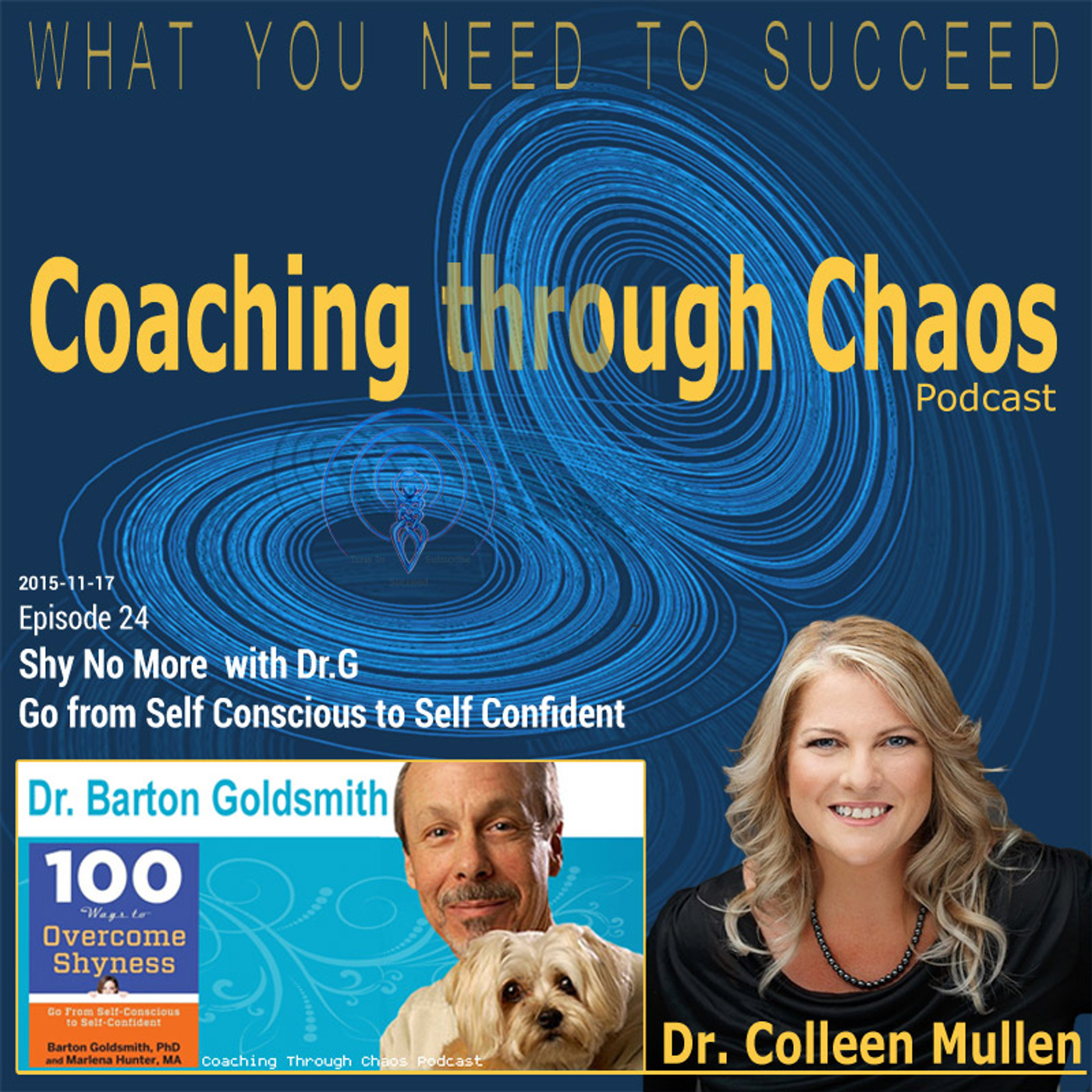
There you go. Welcome to the podcast edition of Coaching Through Chaos, bringing you what you need to succeed. Now, here is your host, Dr. Colleen Mullen. Hi there. Welcome to the Coaching Through Chaos podcast. I'm your host, Dr. Colleen Mullen. I bring you expert interviews each week to inspire, motivate, and empower you whenever you may need it. This show is for anyone seeking to continue their life education. And once a month, I do a show geared towards supporting those who put their lives on the line for us. During those shows, you'll get information on veteran, firefighter, and law enforcement serving organizations and opportunities. We also started a personal story feature for those who have overcome great obstacles in life and now want to share what they've learned with you. Today, I'm talking to Dr. Barton Goldsmith. You may know his name because he gets around.
He's a syndicated columnist. He's a regular TV guest advisor on news and talk shows. He's a radio show host. He's an award-winning therapist and an author of several books and a keynote speaker. And he's a lot of fun. Dr. Barton's books have been very popular. He's had the Emotional Fitness series. There's Emotional Fitness in the Workplace and Emotional Fitness for Couples. But I'm interviewing him about his new book in a new series, The Overcoming Series. Today, we're going to talk about how to overcome shyness from his book, 100 Ways to Overcome Shyness. So many people struggle with bouts of shyness. They may be really competent or confident in some area of life but freeze up in others.
I know I totally relate to that. I was painfully shy as a child, and I expressed myself a lot through my piano playing, but I always wanted to sing along with the playing. But for whatever reason, I would just get too shy to come out of my shell to belt out a song publicly. I think a lot of people can relate to that. I know lots of people get nervous thinking about going to a party or a professional gathering where you don't know anyone, or maybe you'd like to be less shy because you've been tired of being single and you'd like to approach more people socially. Dr. Barton and I are going to dig right in and start talking about how to overcome shyness. Stay tuned for after the interview when I'll tell you about what's coming up here at the Coaching Through Chaos podcast.
All right, let's take a listen. Please welcome Dr. Barton Goldsmith. So, Dr. Barton, your latest book is 100 Ways to Overcome Shyness. Go from self-conscious to self-confident. The book is jam-packed with useful information that we'll highlight in the interview. But before we get there, why do you think overcoming shyness is so debilitating for some people? There's been some new stuff done. And what they've discovered, which is very, very serious, I think, is that loneliness is as dangerous to you physiologically and emotionally as smoking or obesity.
And most shy people, many shy people, are very lonely, partially because of their shyness, possibly because of a trauma. But it's an epidemic. I mean, there are 100 million people, a third of the country, that deal with shyness that is debilitating on one level or another. Maybe you can go to work and socialize with those people or school and the like. But when it comes to going to a party, you can't do it. There's varying degrees. There's many degrees as there are people. One of the things about psychotherapy that I hold very strongly is that every case, every individual is different.
There are way more than 100 tips in this book. I tried to cover myself and my co-author, Marlene Hunter, tried to cover everything. And I think as I reread the book, I went like, okay, I can do that because I'm what you would call a shy extrovert. I'm in front of people. I can give speeches. But when it comes to meeting them socially at parties, I kind of, you know, I get a little nervous, but I've trained myself how to get around that. I think that's great for people to know because we think you see somebody who's out in front of audiences or can talk in lecture in front of people and you don't picture those people as being shy necessarily.
There's a chapter in the book listing many, many famous shy people. Bill Gates, Lady Gaga. I mean, people you would never think that were introverted or shy, and they're different. But I would call myself a shy extrovert. Michael Jordan is shy. Gwyneth Paltrow says she's shy. Harrison Ford says the same thing. David Letterman is probably why he gave up the show. And it goes all the way back to Sir Isaac Newton. He was a shy man, as was Albert Einstein. Being shy doesn't mean that you won't, can't, or shouldn't contribute to the world. Being shy is sometimes a habit we have to break.
Sometimes it's biochemical and that might require some medication from a licensed physician and sometimes therapy will help. But the debilitation of it, the no, I'm not going to go because I don't want to meet new people. And you go back into what I call the despair of loneliness. It's just not a good answer. It's not a good answer for you, for your life, or for those people who deal with that in their life. And yes, many people who are out there in front of the world are shy. I mean, before I give a speech, usually the night before, there's a meet and greet the keynote speaker. And I'm having to talk with all these people that I've never met before. I don't know them. I have no idea what they're into. And it always made me uncomfortable. And so I've learned a couple of things. One, I always keep one hand free.
I can't carry a party plate and a drink in one hand, so I always keep one hand free so I can shake hands. The other thing I always do is I always ask questions. This way, I become the interviewer, and people, most people, like to talk about themselves. And so you just start asking them questions about their life, no matter who you are, where they are, who they are. Ask questions about their vacation. What was the last vacation? What was great about it? And all of a sudden, you see them open up, and the warmth comes out. Because initially, they might be even trying to test you a little bit. You never know. Who is this person? Who is this guy I'm going to spend money to listen to or book to buy or whatever? I mean, I think that people want to know.
the person that they're going to be infotained or entertained by. You know, I think that's important to them. And so you try to give them the best advice you can. Now, I didn't make this asking questions thing up. A lot of other people know this trick.
hostage crisis when Nightline was, you know, they were debating whether they were going to keep it on the air, take it off, and obviously they kept it on. But they were asking Ted Koppel, the host, at the same time, would you be interested maybe in running for president? And he said, no, no, no, no, no. When I have to stop asking questions and start answering them, I'm in trouble. So asking powerful questions is your best friend when it comes to making...
your life and your social life a better place to be. Thank you for that. That was a great way of introducing the whole idea of shyness and how it can be switched, how some of these things that we're going to talk about just are somewhat simple. They take a person out of their comfort zone, but really what you've just said is ask questions and it can make it easier for you to not feel so shy. And that leads us into the next question. For those that struggle with shyness, does overcoming shyness mean going from an introvert to an extrovert? Not at all.
on. There's so much room in the middle there. But I'm sure that you've heard people say, well, I could never do that. I could never go out in front of people and talk. When you even introduce the idea of asking questions at a party, people will say, well, that's not who I am. That's not how I am. That's for the people who are outgoing. So I think it's good to point out that it's not about changing their entire makeup of their personality.
There's some kind of biochemical disorder, medical disorder going on. For example, like a pituitary tumor that needs to get taken care of appropriately and medically, not through asking questions at parties. Okay. The many tips that have been given in this book are quite useful in your normal life too. Sometimes you might be shy about talking to a coworker and especially to your boss. This gives you tips to put yourself in a different frame of mind. For example, I love to use the tool of visualization. Me too.
Right. And that's what I want to focus on a lot of this useful advice that you have in the book. Some of it is just great for life in general. Some of it is strictly for the shy. And so much of our communication is nonverbal. What can a shy person do nonverbally that can help them move into a more confident standpoint?
If you frown, and there are people who have natural frowns, by the way, they can't get rid of them. But if you frown, you are not as approachable. And so it makes people feel that you are not going to be fun to talk to. So you want to keep what is known as an open face, which I think would probably be a better term. Another suggestion that I give to a lot of people and back in the day I've used myself is to get a wingman or a wing girl. That's a really good friend who goes out with you and helps you talk with and meet people you don't know. Because the two of you can carry a conversation together even if you can't do it alone. And it will give you much more confidence when you are out there. Right. Having somebody with you is a nice safe way to start testing the waters. Absolutely better than men, by the way.
And women tend to be much more friendly to each other and will help each other out in that way more than, you know, a guy will say, oh, come on, just buck up and, you know, get yourself out there. But it's really, really hard for some guys, even very gregarious people, when you've just come out of a relationship breakup. And the thought of getting back into a relationship can be terrifying for some folks. Absolutely. Which is normal under those circumstances. If you have a wingman with you to help with the conversation, you can get to know a person sometimes without even asking any questions. Not that I recommend that, but...
Again, people are open if they want to be, if you give them the place to be open, if you give them the opportunity to approach you, to be approachable. And one of the other ways you can do that is to get yourself dressed up as nice as you can for wherever it is you're going to. Obviously, you're not going to wear a tuxedo to a baseball game. Yeah, thank you. But if you're going to a ball game, you know, you look sharp in your L.A. Dodgers hat. I'm a fan. And whatever else you wear, or if you're going to a party, you know, you wear your nicest, casually elegant party clothes.
You always try to look like a million bucks. And one of the things I actually recommend for people who are shy and maybe even depressed about it, in fact, the follow-up book to the shyness book is 100 Ways to Defeat Depression. But for people who are feeling low is to get what a friend of mine used to call manicured depressed. Not manicured depression, but as in manic depressive. We don't use that term anymore. Now we say bipolar. Right. But what she would do is when she was feeling down, she would...
We'd go to Nordstrom's and she'd have her hair done and her nails done. And then she'd buy herself a little black dress and the shoes and stand in front of the mirror and get some pictures taken and really feel good about herself because she looked great. A great tip is to make yourself feel better. Do something that makes you feel fabulous. So you mentioned about getting over a breakup. And for me, it seemed that one of the most important bits of advice or pertinent bits that everybody could use is right in the beginning of this book. Can you tell us why it's so important for a person to be able to accept rejection?
accepting rejection. What I like to say to people is understand something about it. Rejection could also be protection. It's a way of keeping people that are not healthy for you away. If someone decides that they don't want to talk to you, let them go because that person probably isn't the right person for you. Our intuitive inner thoughts know this better than our conscious thoughts.
And if you understand that rejection probably got you and kept you out of trouble or get it from getting mixed up with someone who's going to hurt your feelings or mess with you in some way, it's easier, much easier to accept. And you also have to understand that rejection is a part of everyday life. The expression now is back in the day. And I am talking way back in the day. And I was a singer-songwriter. And I literally did what you hear a lot of people joke about. I papered my living room with my rejection letters. Because back then, pre-email and internet and all of that. You would send in a tape, and they would send you back a nice rejection letter. And I literally...
covered my entire living room wall with it because I had to get used to that. That was going to happen a lot. And even as a writer, initially getting my first book out, that was an interesting and painful process, but it got out. And now there's a total of eight or nine that I have. I was going to say you have a lot of books out now. Yeah, but it's getting past those rejections and saying, okay, I mean, you may not like me, but somebody else will. And that somebody else is probably the writer person for me. And the publishing company that took on that first book, Emotional Fitness for Couples, has published a total of three of my books. So it will keep going if you allow it to. Your shyness will be...
overcome by your productivity if you don't allow the shyness and the hurt that can come from it. And it really does hurt. And you don't allow that to hold you back all of the time. Yes, loneliness, shyness, depression is going to hold you back a little bit, but you can also work through it or work with it. It doesn't mean that you have to be a star athlete or a star writer or a star of any kind. You do what is right for you in terms of balance. You bring people into your life that make your life more balanced. You don't just bring people into your life who are company and you're wondering where the silverware went.
You bring people into your life who are good friends, who will protect you, who will stand up for you. If you've been divorced or separated or a living relationship or relationship is broken up, what I say to a lot of people is find a nice roommate. There's nothing worse in life than a bad roommate. But a good roommate can be worth their weight in gold. And if you are going through a difficult time, you know, having someone stay at your house or share an apartment or whatever can really make a huge difference in how you look at the world. Now, I have clients that I make that suggestion to and say, I couldn't possibly get it.
I'm 40 years old. I couldn't do that. Well, I'm a little older than that, and I have a roommate, and we get along great. I don't see each other very much because we're both really busy, but just the idea that there's another person in the house. That's right. It makes me feel more like hanging out, and they may be doing something they invite me to. I may be doing something that I'll invite them to. It makes my life better. The other thing that makes my life better is if you're lonely, if you're shy, get a dog or a cat. If you go on my website, bartongoldsmith.com, the first thing you're going to see is my face with my dog. That's right. Adorable dog that he is.
And having a picture of yourself with a dog makes you look friendlier, makes you look more approachable. I can go to a party, and I did this for many, many years. She's getting too old now. I just want to stay up that late. But we'd go to a party, and I wouldn't know anybody, but everybody loved the dog and would pet the dog, and she became the topic of conversation. And all of a sudden, we started talking about other things, writing, psychology, television, and got to know one another. Business cards get exchanged, and who knows what can happen after that. Maybe you make a business deal. Maybe you get a new job. Maybe you make a new friend.
Having an animal also will help you with your loneliness. But let me tell you, you cannot go to a dog park and sit there and watch your little dog play with other little dogs or your big dog play with other big dogs and not end up in a conversation with the owner of the other dogs. When I walk around my neighborhood, I live in a walking neighborhood, and I know everybody I see on the street, but not by their names, except for a couple of people. I know them by their dog's name. Yes, yes. I think a lot of people will relate to that who have dogs, yes.
don't have a real life human best friend, a dog can make a big difference. Yeah, I love that tip. I'm a big proponent for the emotional support that pets can give. And I love the idea of taking the dog out with you to parties. It's such a way of helping someone who otherwise might not have left and gone to the party as a conversation starter. So when you talk about there's an idea in your book, focus on something different. Can you tell us what you mean by that and how a person can implement this kind of thinking as a way of averting their shyness? Okay. It's a compartmentalization, but there's zero denial. Okay.
you are feeling. You know that you are shy, but what you are going to do is you are going to act as if you are not. You are going to become an actor for the evening, actress, and you're going to pretend that you are not a shy person. You may have to have a glass of wine beforehand, but that's okay, as long as you don't have three or four. And what you do with the shyness factor is you say to yourself, okay, shyness, I know you're there, you know you're there, but I want you to go to your room, close the door, and stay away for a few hours while I go to this party and meet people. And that's two good ways of dealing with
compartmentalizing or putting away your shyness. Just acting as if you're not. Yeah, it's a wonderful tip and one that if people can really adopt that, can really change their experience of what they thought their limitations were emotionally. And Halloween is coming right up. That's right. Plenty of opportunities for people to adopt a different face where they can even really pretend and go and try out and just be who they want to be for a night.
And I've written about it. I think it's a great way to let your alter ego out. I'm usually Indiana Jones every Halloween, but it's a simple costume and I like the whip. But I think it's a joke, but I think that it's necessary to pretend you're someone else. Do it in your own home and see how it feels. You know, what if I were Kim Kardashian? What if I were Peyton Manning? How would I approach this party? How would I approach this meeting? What if I were the boss? How would I handle this? What if, you know, what if, what if, what? Put yourself in a bunch of different roles. Pretend you're the Lone Ranger.
pretend you're someone else. It's so funny. I think as much as I love that and I practice that myself in trying to adopt new habits, new ways that I want to be. But even when I work with clients and we'll talk about something and they'll get their head around it and then I'll say, okay, well, do you want to role play? We can practice the conversation so that you can practice that assertive line so that you can see yourself doing this and we can successfully get you through. And they'll shy away even in those moments when it's totally safe and they'll still need a little bit more encouragement to get there.
So I think people really hold on at times to this script that they have in their head that that's not them or that it's too bold or something doesn't work for them, that even when you're in a safe environment, and that's why I love that you just told them, just practice at home. Some of this is getting ready to take it outdoors, but the first step is convincing yourself that you can do this. It's such an interesting dynamic when people get stuck in an idea about themselves. It's about practice. Get in Carnegie Hall. Practice, practice, practice.
You just keep doing it. Do it in front of the mirror. If you are one of those many, many people, what's the number one fear in humanity? Do you know? Public speaking, I think it is. Yes. Yes. Absolutely. Oh, very good. Very good. Death is like number six on the list, you know? Right. What I recommend to a lot of people and everyone that's ever worked for me, I have said this to, go to Toastmasters. You may not ever have to give a speech, but I guarantee you it will get you over your shyness and it will make you a stronger person in a lot of ways. Yes, absolutely. I agree with that one.
We were talking before how some of your advice is general good life advice. Can we talk about the importance of being able to face your issues and about getting some emotional help when necessary? Absolutely. The two things that you mostly want to look at are, do you feel hopeless? You feel helpless. And if those two feelings exist, those are the primary thoughts of depression. If that goes on for longer than two weeks, you must see a licensed therapist and a licensed physician, okay? Because some depressions can be biochemical and some can be situational and you need to get help working through it.
I'm a therapist. I can't tell you how many therapists I've talked to who don't go to therapy, which I think is crazy. You know, you've got to know both sides of the couch to be good at this and to understand your clients better. And it doesn't matter from what walk of life you are, get some help from a person who is there strictly to support you. And feeling that this person is there just supporting you is a great lift and a healer on many, many levels for you. But if you are going through a difficult emotional time, don't shy away from therapy.
Okay, shy away from parties. That's okay, but get some help. Don't just sit in your room and ruminate. You have to do something to get out of it. Sometimes depression does go away all on its own, but that can take a very long time. You want to get some help. And shyness can go away on its own, too, but you don't want to be 62 years old and suddenly say, oh, I'm not shy anymore. Let's go to some parties. Yes. I think that being shy is an inner means of protection. I think that, again, it could have been caused by trauma. It could have been caused by the way you were brought up. It could have been caused by some biochemical reaction in your body. But there's a way, many ways, way over 100 ways to get past it. And you don't have to get past it completely to have that limitation taken out of your life. Again, I'm still shy in certain instances, but I also still do.
what I do. Right. And you do it very well. And you sound very natural at it. So you've been able to really talk the talk and walk the walk that you're doing. On that note, let's talk about what a shy person can do when they have to go out. You've talked about Toastmasters. You've talked about how to go to parties and be more outgoing. What would you recommend if they're going to say a meeting, like a job interview? What would be some key things that you could advise them to do so that they feel and appear less shy? And I think appearance is something to focus on as well.
imagining the meeting going well the way you want it to, and getting the job at the end of it, I think that's very important. And you do that for 10 minutes a day, for five days before the meeting. I always do a visualization before a speech. I see the audience laughing at my jokes, very important. I see them applauding, and I see them handing me a check at the end. I mean, all of that is an important part of completing the visualization. Getting dressed appropriately, being dressed appropriately for a business meeting. And nobody can stress how that is. And you might not know, because these days, some companies are incredibly casual.
And other companies are still suit and tie. So do your research and find out what the company dress is, the company look is, and go in looking like you're working for that company. If somebody was wearing a coat and didn't have their sleeves rolled up, they weren't working hard enough for me. Different people have attitudes about it. Know what the expectation is of where you're going.
and try to talk to some other people who work there. It's a job interview and do your research. That's going to reduce your shyness too. You're going to find out what the company stands for, wants, does, what the people are like, and maybe even a little bit of information about the person who's going to interview you. Again, that's going to totally empower you. I love that you said complete the visualization. That's a key factor. Seeing it go full circle. See them offer you the job. So any last bit of advice for our shy listeners?
the job thing. One of the key things that I do or did when I was interviewing for jobs is just before the interview was over and they were discussing the job description. I said, you left one thing off the job description. And they said, what's that? My job is to make you look good. And that is a deal closer. That'll work. Yeah, that's a good one. Want to make your boss look good. That's important. The other thing I would say is believe that you can get over the shyness, that you can overcome it. It's got to start with that. You wouldn't have picked up the book if you didn't think you needed to. Believe that you can. Again, might not be 100%, but the 80-20 rule is pretty good.
And it all starts within you. Believe and want to get over the shyness. Yes. Dr. Barton Goldsmith, if people don't know you, let's let them know a little bit more about you before we have to let you go. Tell us about some of the other books you've written and where people can find you. Well, I have written...
several other books, the Emotional Fitness book series, Emotional Fitness for Couples, Emotional Fitness for Intimacy, and Emotional Fitness at Work. I've also written three of the 100 Ways series, 100 Ways to Overcome Shines, which we're talking about, 100 Ways to Boost Your Self-Confidence, and coming out next spring is 100 Ways to Defeat Depression. That's going to be a great one, 100 Ways to Overcome Depression. It's Defeat Depression. We'll do another interview then. Great. That would be wonderful. I've written those. I've written another book called The New Harbinger, and my newspaper column runs all over the country, all over the world, I think.
And you can just Google me and find lots of articles on self-development, relationships, etc. And my website is my name, Barton Goldsmith, B-A-R-T-O-N, goldsmith.com. And right there is where they'll find that wonderful picture of you with your lovely little dog. That's true. All right. Well, thank you so much, Dr. Barton. It's been great to talk to you. And thanks for being on the Coaching Through Chaos podcast. Well, thank you. Thanks, Dr. Barton Goldsmith, for all the fabulous information. I'm already looking forward to those awkward holiday parties coming up that will hopefully be less awkward when I use some of your tips. We'll have all the links to Dr. Barton's books and his website in today's blog post.
Well, today wraps up season one of the Coaching Through Chaos podcast. This has been such a great experience for myself with all the guests and for Dr. B behind the scenes. I had no idea the types of connections I'd make or who I'd talk to when all this began. We are loving every minute of it. We hope that you're getting what you need from us too. Did you hear the episode when I talked with stalking expert, retired detective Mike Proctor, who had some great but really eerie stories of stalking? And what about my interview with Dr. Bonnie Bergen in the Paws for Purple Hearts episode? She's pairing service dogs with veterans. Or Christian Moore talking about the resilience breakthrough. Or Darlene Lancer talking about codependency. And then there was Eric Zimmer.
host of the very popular When You Feed podcast talking about overcoming addiction to live a prosperous life, and of course, a couple of weeks ago, very powerful story, retired fire chief Matt Schobert talking about how a fateful day on the job changed his life forever. What stories and what great guests. I am truly grateful for them sharing their stories and their work with me. If this is your first time tuning in, I'd love for you to check out some of those earlier episodes and let me know which one is your favorite. Okay, we'll be back in about three weeks. We've got some really great guests lined up for season two. I'm so looking forward to bringing that to you. But in the meantime, we're going to take a little break here so that we can work on a few things between seasons to bring you more experts and stories of resiliency to inspire, motivate, empower you when you need it. To connect with me in the meantime, or just to say hi, you can find me on Twitter. I'm at Dr. Colleen Mullen and on Facebook at Coaching Through Chaos. Please give us a review if you like what we're doing. We so love to hear from you. And if you'd like a free copy of my ebook, it's five ways, 100 tips for living a happier, healthier life. Just sign up for my mailing list at coachingthroughchaos.com slash podcast.
The book is my gift to you. Thanks again to all my guests and Bennett Sullivan music.com for my theme music. And most of all, thanks to you for your support. It's been such a blast. All right. I hope you have a wonderful couple of weeks. And if you've got chaos in your life, I hope you're finding your way through it. Take care.