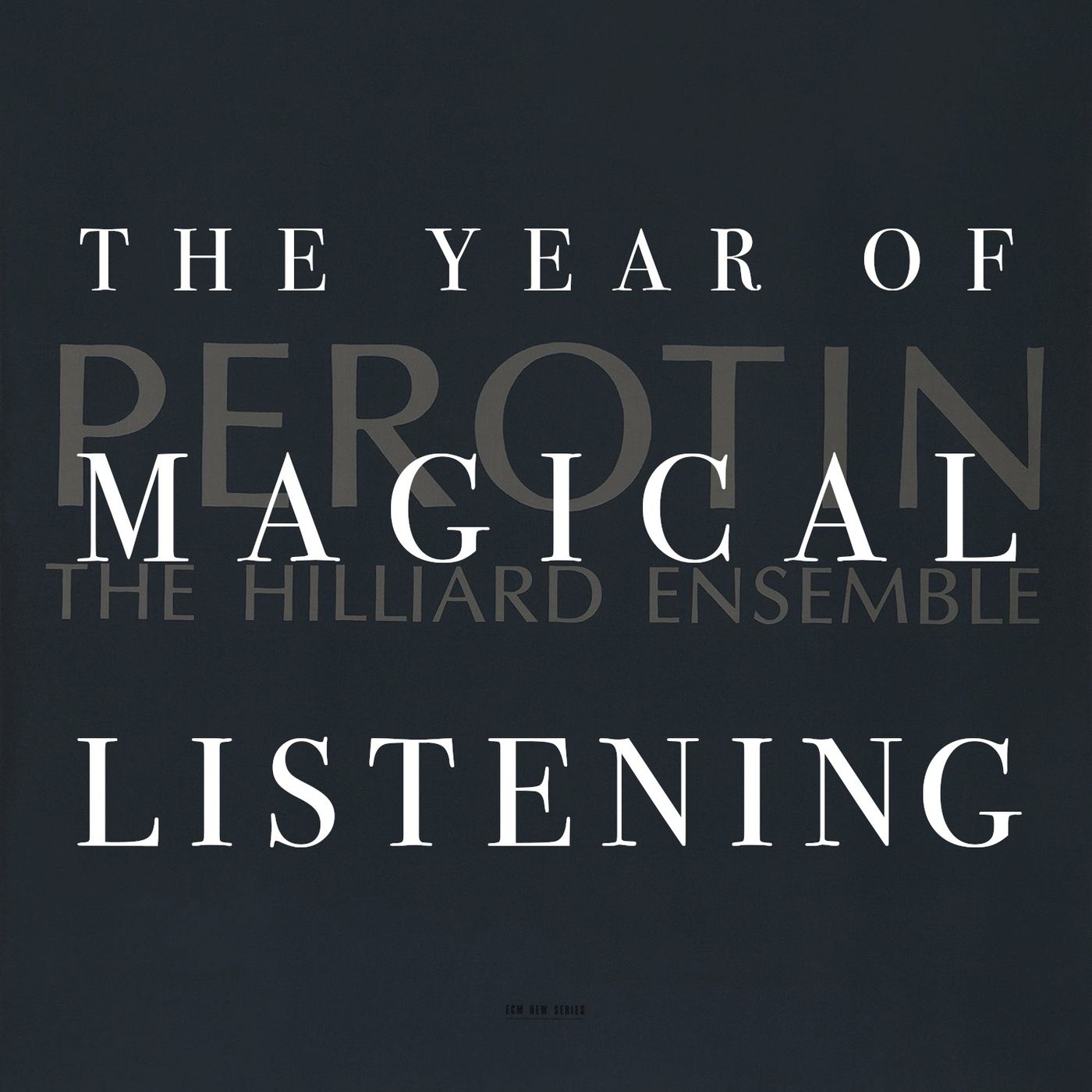
037 :: OMNES episode artwork

EPISODE · Oct 28, 2024 · 13 MIN

037 :: OMNES

from The Year of Magical Listening · host Willie Costello

FEATURING "Viderunt Omnes" by Pérotin, performed by The Hilliard Ensemble, recorded and released by ECM in 1989. Listen TRANSCRIPT In the beginning was the word – a mere syllable – a solitary tone. And then, there were several. And just like that, there was music: harmony, rhythm, dynamics – but more than that, a strange, otherworldly beauty that seems to appear out of thin air, suddenly floating above us and gracing us with its presence. What we are hearing is arguably the genesis of music as we know it, one of the earliest known pieces of polyphonic music in the Western musical tradition. It may in many ways appear rudimentary, its harmony of the simplest kind: a sustained drone in one voice while other voices bob and weave around it, producing a series of resonant intervals circling round their tonal center, and creating an utterly hypnotic harmonic soundscape. Simple, perhaps, but what majesty there is even in this. This music is captivating precisely because it doesn't seem like it should be possible, to pull such beauty out of thin air. How wondrous, that the mere arrangement of sound waves is sufficient to create something like this, so awesome and astonishing, as if it were always there, just waiting for us to tune into its frequency. It's like a tear in the fabric of the universe has been discovered, offering a glimpse into another world.  Of course, this is all apropos to this music's raison d'être, seeing as it is literally sacred music – music of worship, music of the church, music designed to exalt an otherworldly being. But what I hear in this music does not seem tethered or limited to any particular religious tradition or faith. What I hear is music that is putting us in touch with the divine in the most universal sense – a divinity that is revealed to us through sound. And the most remarkable thing is that this divine revelation emerges from the most mundane elements. In other contexts, it may arise out of strings of catgut or rawhide skins; here, it comes about simply from the human voice. And to be sure, these are exceptionally beautiful voices, a paradigm of purity and discipline, moving in perfect coordination, and reverberating in an exquisitely sonorous space. But still, there is nothing supernatural in the mix; everything we hear is the product of human vocal cords and human vocal cords alone. The same instruments we use to talk and yell and argue and curse can also produce this. And that feels like magic. That feels like something that shouldn't be. How incredible that all of this would be present in music this primeval. But take that as a lesson, that music's revelatory powers have been there from the very start – that for as long as there's been music, it's had the capacity to fill us with wonder in this way. And the history of music is not some long march towards the perfection of this capacity, but rather an eclectic chorus of voices, all realizing this capacity to the fullest, but in new and singular ways. Which is to say, the history of music is like a series of worlds revealed to us, a sequence of curtains drawn back, none inherently better or truer than any other one, and all equally sublime. This piece of music may be one of the oldest extant examples of the art form, but its sound is timeless. Timeless, and also strange: the haunting swirls of voices, the glacial harmonic movements, the uncanny synchronicity. But this strangeness is precisely what makes the music so captivating, as if by holding it in our gaze we will spot how it works its conjuring trick. But of course the music resists our efforts and remains inscrutable. We can't ever truly explain it; all we can do is take it in. But that's why we listen. That's why we can't look away. And if this piece teaches us anything, it's that music has always been this way, and always will. 

FEATURING "Viderunt Omnes" by Pérotin, performed by The Hilliard Ensemble, recorded and released by ECM in 1989. Listen TRANSCRIPT In the beginning was the word – a mere syllable – a solitary tone. And then, there were several. And just like that, there was music: harmony, rhythm, dynamics – but more than that, a strange, otherworldly beauty that seems to appear out of thin air, suddenly floating above us and gracing us with its presence. What we are hearing is arguably the genesis of music as we know it, one of the earliest known pieces of polyphonic music in the Western musical tradition. It may in many ways appear rudimentary, its harmony of the simplest kind: a sustained drone in one voice while other voices bob and weave around it, producing a series of resonant intervals circling round their tonal center, and creating an utterly hypnotic harmonic soundscape. Simple, perhaps, but what majesty there is even in this. This music is captivating precisely because it doesn't seem like it should be possible, to pull such beauty out of thin air. How wondrous, that the mere arrangement of sound waves is sufficient to create something like this, so awesome and astonishing, as if it were always there, just waiting for us to tune into its frequency. It's like a tear in the fabric of the universe has been discovered, offering a glimpse into another world.  Of course, this is all apropos to this music's raison d'être, seeing as it is literally sacred music – music of worship, music of the church, music designed to exalt an otherworldly being. But what I hear in this music does not seem tethered or limited to any particular religious tradition or faith. What I hear is music that is putting us in touch with the divine in the most universal sense – a divinity that is revealed to us through sound. And the most remarkable thing is that this divine revelation emerges from the most mundane elements. In other contexts, it may arise out of strings of catgut or rawhide skins; here, it comes about simply from the human voice. And to be sure, these are exceptionally beautiful voices, a paradigm of purity and discipline, moving in perfect coordination, and reverberating in an exquisitely sonorous space. But still, there is nothing supernatural in the mix; everything we hear is the product of human vocal cords and human vocal cords alone. The same instruments we use to talk and yell and argue and curse can also produce this. And that feels like magic. That feels like something that shouldn't be. How incredible that all of this would be present in music this primeval. But take that as a lesson, that music's revelatory powers have been there from the very start – that for as long as there's been music, it's had the capacity to fill us with wonder in this way. And the history of music is not some long march towards the perfection of this capacity, but rather an eclectic chorus of voices, all realizing this capacity to the fullest, but in new and singular ways. Which is to say, the history of music is like a series of worlds revealed to us, a sequence of curtains drawn back, none inherently better or truer than any other one, and all equally sublime. This piece of music may be one of the oldest extant examples of the art form, but its sound is timeless. Timeless, and also strange: the haunting swirls of voices, the glacial harmonic movements, the uncanny synchronicity. But this strangeness is precisely what makes the music so captivating, as if by holding it in our gaze we will spot how it works its conjuring trick. But of course the music resists our efforts and remains inscrutable. We can't ever truly explain it; all we can do is take it in. But that's why we listen. That's why we can't look away. And if this piece teaches us anything,...

NOW PLAYING

037 :: OMNES

0:00 13:32

No transcript for this episode yet

We transcribe on demand. Request one and we'll notify you when it's ready — usually under 10 minutes.

Big Old Life: Heather Blackbird interviews people on planet earth. Heather Blackbird loves asking questions. This podcast is a learning experience. Join me, Heather Blackbird, as I talk to people about their lives. Frequency of new episodes is a little all over the place and I'm learning as I go. Big Old Life is a small way of talking about the vastness of life, one person at a time. If you are reading this or found this podcast it's probably because someone you know gave you a link to it. :) Explicit Tales Of A Superstar DJ The Insomniac Spun seemingly out of nowhere from her complacent life in the corporate world, turned seemingly overnight from 16-Hour shift work and into the life of a literally starving artist and working musician, The Protagonist navigates her supposed rise to fame and superstardom on a journey through spiritual awakening, coming-of-age, and intimate self-realization--guided by an omnipresent force and equipped with the power of love, magic, and music. {Enter The Multiverse.} [The Festival Project] The Festival Project, Inc.™ is a multidimensional multimedia platform which encompasses exploratory and artistic social personifications and expressions on cosmic theory, spirituality, growth, health & wellness, philosophy and theoretic dynamics in entertainment such as music, design, film, television, radio, dance and festival culture, art, fashion, literature, and science. The Festival Project™ and its subsidiary Non-Profit, The Collective Complex © aims to challenge modern artistic and philosop Explicit Bitcoin Is Dead Trey Carson Welcome to Bitcoin is Dead, the ultimate Bitcoin variety show where host Trey takes you on a journey through the ever-evolving world of Bitcoin. Each episode brings new personalities, fascinating locations, and insightful conversations with politicians, educators, and innovators shaping the future of Bitcoin. Whether you're a seasoned Bitcoiner or just starting your journey, tune in for thought-provoking discussions, unique perspectives, and a deep dive into the ideas and people driving the Bitcoin revolution. Explicit The Sacred +Profane Podcast nephtaragrace The Sacred + Profane Podcast is a provocative conversation dedicated to cementing a better future for all. We specialize in unpacking the nuances of what is considered sacred and profane, particularly focusing on sex, death, and all that pertains to the circle of life. Our aim in focusing on such ”taboo” subject matter is to demystify what is unconscious, bring to light what has been known for centuries as ”the occult,” and empower the rapid transformation that is occurring on the Planet. Explicit

Frequently Asked Questions

How long is this episode of The Year of Magical Listening?

This episode is 13 minutes long.

When was this The Year of Magical Listening episode published?

This episode was published on October 28, 2024.

What is this episode about?

FEATURING "Viderunt Omnes" by Pérotin, performed by The Hilliard Ensemble, recorded and released by ECM in 1989. Listen TRANSCRIPT In the beginning was the word – a mere syllable – a solitary tone. And then, there were several. And just like that,...

Can I download this The Year of Magical Listening episode?

Yes, you can download this episode by clicking the download button on the episode player, or subscribe to the podcast in your preferred podcast app for automatic downloads.
URL copied to clipboard!