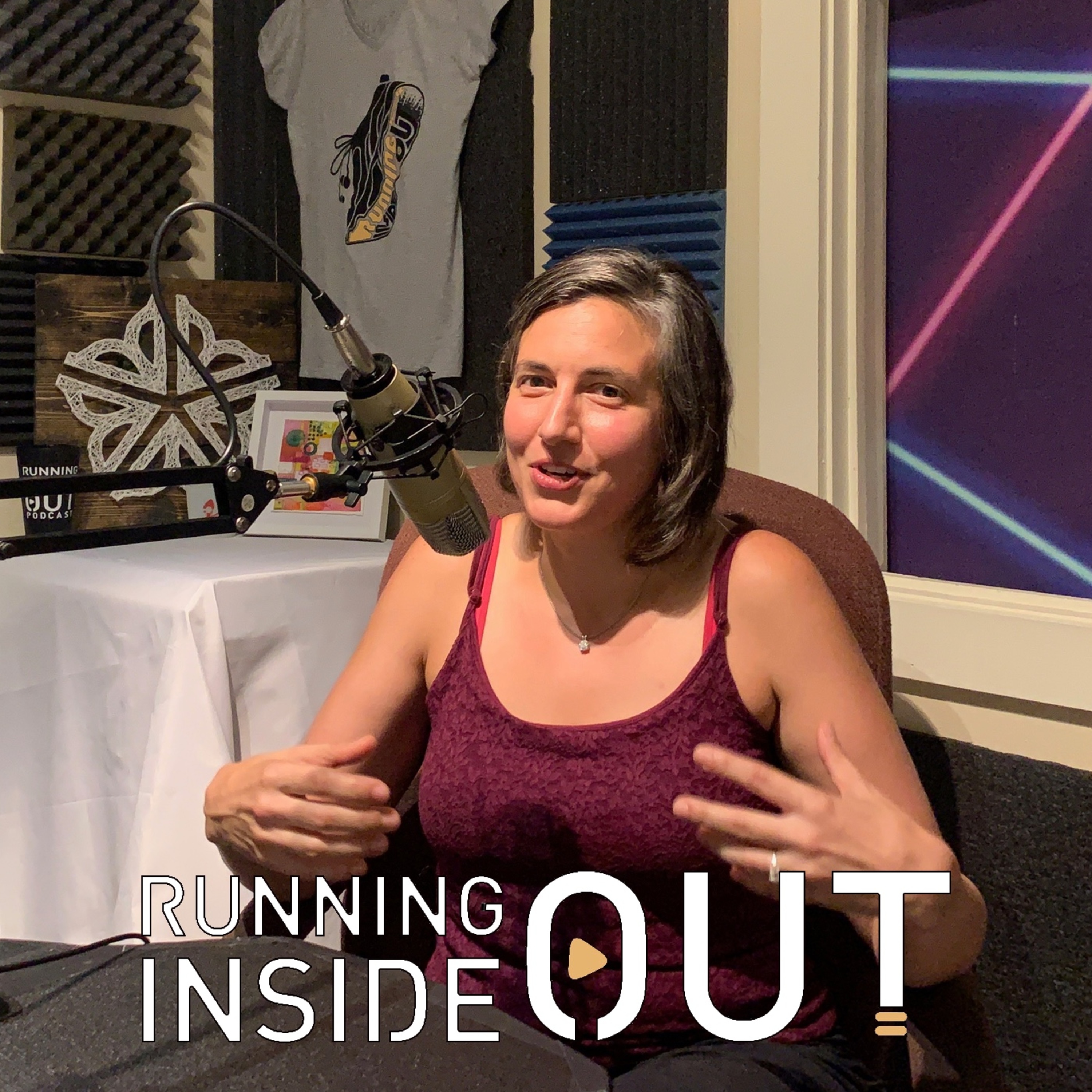
Hello, and welcome to Running Inside Out Podcast, where we talk about the races we ran in, the races we're not in, and getting outside to see what's going on inside the Rochester running scene. In this episode, Brooke Smith ambles into the studio to talk about all the usual stories about love and trail running. eating disorder recovery, quitting dieting, and making a decision to stop trying to change her body, and instead, run as far and as fast as she can in the body that she has. So we're about to get real up in here. As well as talking about her previous Twisted Branch, something near and dear to my heart, her upcoming Twisted Branch, yoga, and anything else that comes up. Before we get into it with Brooke, I wanted to take a quick minute to let you all know that the Rio Pod Racers will be making their triumphant return to Mighty Mosquito 99.
That's right, the fast old team is coming back. What is Mighty Mosquito 99? Well, it's a 99-mile trail run through Menden Ponds Park. That's right, overnight in Menden. So your team of two, three, or six, or if you're one of those crazy ones, you can do it by yourself, will run through Menden Ponds Park relay style. The race is put on by Blue Foundation, a nonprofit organization based in Canandaigua, New York. That's the only Canandaigua I know of. Their mission is to assist local families impacted by cancer while simultaneously raising awareness about men's health issues.
To learn more about the Blue Foundation or to donate, visit their website at bluefoundationny.org. Go find the links to sign up or donate in the show notes. Yeah, that's it. Don't donate in the show notes. That's not how you do it. You go to the link and you can donate there. The Rio Podracers will be running the Skeeter. Will you? Hope to see you there. And with that, let's get into the trails, training, food, friends, and yes, definitely feelings of runners just like you.
I'm already like pouring sweat. Do you see this? I do. It's pretty gross. So anyways, Brooke, you're gearing up for another Twisted Branch. And this one is you got a whole different angle on this one, don't you? I do. Okay. Well, last year, it looked like you managed it well. It's funny. I feel like I managed the first half of it very well. And then everything kind of went.
I had the bright idea of taking Advil right around Palney Road, so the halfway point, because my hips were hurting. And at first, it was awesome because I felt great. I made up a bunch of time on the way to Bud Valley. And then I got to Bud Valley, and Jeff McBeth checked the reservoir in my hydration pack and was like, you have not been drinking enough water, young lady. Oh, you got busted. Yep. And I tried to convince him that I had been drinking plenty of water. Like, oh, I've been sipping on every hill since Patch Road. And he just looked at me and shook his head.
And my now husband, Matt, was there crewing for me. And there's this picture where he has this terrific look on his face where he's like, I ain't buying it and you shouldn't be selling it because he knows that I'm not drinking water. And it was all downhill from there. Well, yeah, it's the middle of the day and you got a marathon left. But Allison got me to the end somehow with great patience. With great patience. Well, I think anybody that's pacing somebody at Twisted Branch, you have to have great patience. Absolutely. You've met that person after 40 miles and you got a marathon left.
So let's go back and how did you get up the gumption to run Twisted Branch? What led you to I want to do 100K? So a combination of things. Many on the Jenny was a huge boost to my confidence. Matt Bertrand put this crazy idea in my head earlier that year that I could do it. Like the first time I ever met him, we were hiking up the hill in Hightower Parish Road and talking about Twisted Branch abstractly. And he was like, you could totally do it.
You just hike the hills and run down and you'll be fine. And was this before or after you ran with Matt at Oil Creek? This was before. Well before. Yeah, that was the first time I'd ever met him. Yeah. So I blame Matt Bertrand entirely. So he was your intro to ultra running, would you say? I would say that he's the one that put it in my head that I could run Twisted Branch now. I didn't have to wait until I had more. I was like, oh, I'll run Manny on the Jenny this year and maybe Kay Yuga Trails the next year and Twisted Branch the year after that. I was going to build up to it like a sane person. Yeah.
But after many on the Jenny, I was like, you know what? I'm never going to be this fit again. I got 40 miles. Exactly. I'm like halfway there. I'll just put in a few more long runs and go for it. You're talking like it wasn't a great decision. I actually I'm so glad that I did do it because I remember the next day limping around like my stomach so upset I couldn't eat. But in this bask of basking glow.
I don't ever have to wonder if I can run Twisted Branch because now I know that I can. Yeah. So you got that going for you. So one's not enough and you're going to come back this year. Yes. Right.
That's happening. So, all right. So, but now it's a whole different mindset. Now, you know, you've done it. And like you said, you're going to manage your race better. A lot of times, like, so in football, you got your all-star quarterback and then you got the other quarterback who is the person who manages the game when the all-star is not there. I'm not saying that's what it sounds like. I'm not saying that, but some people might infer that.
What's your take on your Twisted Branch this year? I'm coming at it from a very different place. So two years ago, I don't know what I was doing wrong in my training, but I was in pain all the time. I know that I wasn't eating enough because it was before I went on this wild journey of giving up dieting and eating whatever I want whenever I want. But I was always in pain. I wasn't sleeping well because either my back hurt or my legs hurt or something hurt. So when I look back on that year, although...
And by looking at my races, I feel like it was the best running year of my life. In a lot of ways, my body was falling apart, which then completely fell apart a few weeks later when I twisted my ankle and ran a bunch more on it. So two years ago, 2017, you didn't really have a thought about Twisted Branch, but you were running longer. I remember going on some of these runs with you, but you were, by all accounts, doing, quote, everything right. You were going to yoga, right? You're doing bar class. You're going supping. You're exercising all those muscles that none of us exercise.
And you're running 20 milers and yet you're feeling inside that just something's not right. So now you're looking at it like, hey, things feel good. Exactly. My training runs are a little slower, but I feel phenomenal. I'm recovering quickly. At Ontario Summit a few weeks ago, I felt awesome on the second lap, except for the blisters on my feet. But I was excited to get to the climb on the second lap. Nobody says that.
Actually, people whose toes hurt from going downhill say that. Yes, right. But they never say, I feel awesome. Let's take it to this hill. All right. So you mentioned a journey and we mentioned at the opening this idea of putting eating disorders to bed and not worrying. And one of the things that you said to me, you said, like, seriously, no diet restrictions, like serious. So this has to be like this had to be a big, long, profound thing to feel this good about it right now. Like it had to be a long, drawn out thing that came to some sort of resolution. Oh, yeah.
What's going on with that? Like, where did it start? You had mentioned to me 10 plus years. Yeah. So I had bulimia when I was younger. It started when I was in high school. I was diagnosed when I was in grad school. And I had eventually I got to a place where I thought that I was recovered. I was mountain biking. I was eating more because I knew that I needed to to sustain the level of activity. And I loved mountain biking. So doing that well meant more to me than anything else.
And that just kind of led into the rest of my adult life, during which I walked around with my head very, very proud, saying, oh, yeah, I'm recovered. Like, real recovery is possible. And then I got to 2017, and I was a mess. I had iron deficiency anemia. I had a bunch of other nutrient deficiencies. Like, my body was falling apart. And as I started to realize...
I had a fairly typical like eating disorder relapse. And in realizing that I didn't want to live like that, I also realized that I pretty much still had an eating disorder all along. So how do you how do you come to that conclusion? If you know you're eating because you know you're doing all this physical exercise, but you don't feel so good. Was it something like where you realized you're only eating when you're exercising or like how did you realize that there was something problematic? I think for me, it was the wake up call was I had extended family visiting and I started hiding food from them.
And then like eating in secret when they weren't there. And it was really stressful for me. I had a bunch of leftovers from the Red Fern from an event, like a professional event that I had helped to coordinate. So I was so happy that I had like this huge catering tray of Buddha bowl stuff and this huge catering tray of the kale salad. And I did not want my relatives to find it.
Which you don't want. So I'm going to look at this from the outside. And I'm just going to say, like, you don't want your relatives to find out that you're squirreling away kale. Sort of. I think I always and this was something I didn't realize till later, but I had a sense of scarcity around food that like food was this incredibly high value and special thing that needed to be like guarded. And when I had it, I had to eat all of it because I didn't know when I would get it again. And it's weird that I felt that way because like we always had food when I was growing up. Yeah.
But I found out later that's also something people develop that habit out of dieting also. Right. Because only once. Exactly. So you got to eat everything. I'll just have a really big lunch and then we're good. Right. I won't eat breakfast. I'll have a big lunch and then like a little snack for dinner or something. And, you know, I it's weird because I'm I'm again to me. It's if you apply all the like different stereotypes of something. Well, you're eating a whole bunch of kale. Big deal. Right. Right. But it's not it's not that it's not what.
It's the how and the motivations behind it. Yeah, it's the mental wear and tear. Once I realized how much I was pouring into obsessing about food, I realized that I was spending hours every day sometimes just planning out what I would eat, like for that day, for the week. There were periods of time that year where I probably lived for many days at a time on like 10 ingredients. Well, so as ultra runners, that's not necessarily a weird thing. Like ultra runners are always thinking about eating, right? I mean, we have to be. You're always running. And if you're going to be out in the woods for seven hours, you darn well better be thinking about eating. And the idea that, you know, managing your calories during an ultra, we talk so much about it.
Your peer group, you have to be around people where we're talking about that all the time. I like to eat 200 calories an hour. And what do you talk about when you're getting ready for a race? You go like, oh, I got my ultimate direction vest. And then I got all these bars. Right. I've got my tailwind so that I can make sure that I'm getting 100 calories every 16 ounces. And I got these goos and I got these snacks and I got. Have you ever tried these? These are really good. Right. And like it's a lot of conversations about food. So when you're saying like, I finally realized, you know, I'm wondering how did how did you do that?
Like, was it when you weren't running? Yeah. Well, I think the wake up call was definitely when I had my extended family visiting. I didn't want them to find all of that delicious food. So I ate all of it. You didn't want them to get any of it? Yeah. I ate so much that I literally made myself sick. And that was kind of like a watershed moment. And that was like, oh, we're doing this again. And then I didn't eat.
I think very little for the next several days, like, you know, trying to force myself to overcompensate. Right. And did you were you doing this all by yourself? Oh, yeah. Totally in secret. Right. Like then the whole thing, even after you realized it wasn't like, oh, my God, I got to go tell everybody. It was like, you got to figure this out. Yep. And I and I think that's when I so when I realized that I had just binged and purged, I started to look at what I had been doing for the last 10 years and realized that it was really just an endless cycle of trying to.
Eat as little as possible and then getting into some situation where I would binge and then trying to eat as little as possible for as long as I could. Wow. And still trying to run large mileage. Of course. Still trying to go to yoga and bar class. Still trying to be physically active in all these things and sort of dealing with that in the background. Exactly. And I think the way I got through 10 years of doing that and thinking I'm like I'm this great recovery story is that that's almost socially acceptable.
Like in our wellness culture that surrounds us and it permeates everything we're exposed to, that's actually like almost normal. And that's what I was kind of saying. Like it's you don't blink an eye when, you know, and I'm sure I've said it a whole bunch. Right. Like, oh, I didn't have breakfast. That's fine. I'll have a big lunch. And then dinner time comes around. I'm like, you know what? I ate a really big lunch. I probably shouldn't eat anything for dinner. Right. And like that that kind of rubber banding is fairly common. Yeah. And especially when you're thinking about the.
The crazy rat race of, you know, people driving to work in their cars, eating their breakfast sandwiches or their bars, having very little time to eat. And then when they do have time to eat, going all out at it again. Right. So I think I do agree with you that I think it's common, but I don't know that anybody would say that that's a problem. You know, it takes some sort of observation.
I think you had this moment of clarity where you're like, wow, I'm still jamming kale. Right. And I wonder if people have that and then just kind of ignore it. You know, one thing that was interesting when I started to look back is that I'd had several. isolated incidents of like literal binging and purging over the last 10 years and they were all because they were all isolated incidents i always just told myself oh it was just a one-time thing like i don't have a problem yeah that was just weird i don't know why i did that right like yeah it's fine what is what's also interesting to me is that you managed this your well you are managing it yourself now and so you didn't say like oh i went to a friend and i had this deep heart-to-heart or somebody caught me or i finally realized i needed to get help it's just kind of like You and some level of self-discipline that you have. And the Internet. Don't forget the Internet. OK. What's the what's the I've heard lately that the Internet is good for nothing. So the Internet is good for everything. So I started looking for therapists after I realized that food had taken over my life and was making me like that not eating was making me physically ill. I interviewed five therapists on the phone. I met with one face to face. The whole thing was a nightmare. I'm it's not for me. Not recommended. So I saw around the time that I was going through all that, I saw a TED talk.
called Why Diets Don't Work by Sandra Amat. And it's a really good science-backed TED talk. It's only like 13 minutes long. Everyone in the world should watch it. But what she explains, she explains the way that the body tries to maintain a fixed weight. But she also cites a lot of research that shows that
being at a higher weight is not unhealthy. And that if you're eating vegetables and exercising and not smoking and not drinking excessively, there's really no correlation between weight and health outcomes. So all of this fear we have around the size of our bodies is really misplaced. And she recommends mindful eating. And of course, at the time, my very confused brain was like, oh, Sandra Amat learned mindful eating and lost 10 pounds. There's still hope for me.
But, you know, one thing about mindful eating that at least I've learned, and it's funny, there's this movie, Matthew Broderick movie, about the guy that invented cornflakes, you know, Kellogg. He had a retreat up in Battle Creek, Michigan, where cereal sort of lives. And it was a wellness retreat, and it taught about mindful eating. And they had a lot of mindful health things. But the whole point was he had that philosophy of chewing your food 32 times. And what I took from that class was it's not about chewing your food 32 times. It's about taking 32 times.
to chew your food, and then to have another bite taking 32 more times. So by the time you've taken 128 chews, you might not eat any more food. You might be done chewing for a little while, right? And so... And he had the idea of you put your spoon down in between bites. You don't just, you know, hold it and keep. And to me, that's what I took as like my introduction to mindful eating. And that is painful. It's a lot of work. And so there was another thing about mindful eating, the way it's usually taught, it didn't resonate with me. And that's this emphasis on like how you prepare your food and how you present it and making it attractive on the plate. Because the truth is that I don't really like cooking. I don't really care what my food looks like.
Now that I am more tuned into my own hunger and fullness, I can honestly say that when I get hungry, I want to eat now. I'm not going to make a meal and plate it and make it pretty. Well, and if it all comes in bars and gels, it's not going to look pretty. Which, to be fair, a lot of the food I eat does. But I think you're hitting on at least one thing, which is...
The attitude with which we treat the food is like it doesn't you don't have to put it on a pedestal, but you probably should respect it a little bit. Right. And not just kind of bang it in and be done with it. Exactly. I think the place that I got to is about really paying attention to how the food feels in my body. So eating a little bit slower, not 32 bites slow. Right. Right. But slow enough.
that I can feel how I'm taking the food in and I'm giving my body time to respond to it. Right. That's the other thing, right? Because your stomach will slowly expand and tell you you're full. Yeah. And the more that you tune into how food feels in your body, the more you're drawn to foods that feel good. And I can honestly say that of all the people I've met, thanks to the wonderful internet, who have given up dieting and learned to eat either intuitively or mindfully or their version thereof.
None of them lived on pizza and cookies forever. I was going to say, it feels like incredibly liberating, like an incredibly liberating idea. I don't care what I eat. It also feels so terrifying. And it first is. So that's called the honeymoon period. Okay. So that's where all of the foods that used to be forbidden are now allowed. Yeah. And there's lots of them that are delicious. And you don't want to think what four slices of pizza feels like in your stomach. You just want to eat four slices of pizza. Exactly. But we're disconnected from our bodies anyway. We stay awake when we need to sleep. We drain through the pain.
We force ourselves to sit at desks all day, even when we're uncomfortable and we want to move. Right. So the fact that we don't want to think about what four pieces of pizza feels like or that we ignore our hunger at other times. I think all of that is just a symptom of how disconnected we've become. Right. We just try to mentally muscle our way through everything. Right. So if you're if you're planning for your day and, you know, you got a crazy day at work and then you have a yoga class or a weightlifting class and then you have to record a podcast and then you have to go somewhere after the podcast. And, you know, and I'm got a little bit of tongue in cheek here, but.
How do you plan that? Because what I see that being, that symptom that you talk about, I see that being Fast Food Nation, right? I see that being, I got to go from here to there. Oh, and on the way there is Dunkin' Donuts. Okay, I got to go from here to there. And on the way there is the pizza shop. And I got to go from here to there. I probably should just grab two extra slices of pizza, right? And so because the planning is, well, there's not planning. So how does that look for you? So when I, for a long time, what that looked like, and it still does sometimes, is a really big purse with a lot of snacks. Because one of the things that I found
that helped me not overeat in anticipation of then going 12 hours until my next meal is knowing that I could always have more food when I wanted it. It wasn't scarce. Exactly. Food is abundant. So I could have a small breakfast or I could wait and eat breakfast whenever I got hungry because there was a granola bar and who knows what else in my purse.
Yeah. And so there is sort of planning, right? But putting some things in place. So what was your honeymoon phase like? Chocolate-covered nuts. Like dark chocolate-covered almonds, dark chocolate-covered walnuts, dark chocolate-covered pecans. For a few weeks, I was just all about the chocolate-covered nuts. And I don't really remember vividly what was after that. There was definitely a lot of misfit donuts at one point. When we were working on one of the rental properties, a lot of misfit donuts were eaten.
And vegan food while vegan might not always be the healthiest in terms of, you know, calories. I can honestly say that one donut feels really good. More than one donut feels a lot less good. And I know that now because I have tested it empirically. A study of one. All right. So, I mean, it feels, you know, it feels like you're it sounds like you're feeling better about this. How has this sort of changed your approach to running? So 2018 was kind of a mess because I didn't know what to do with myself. I knew that I wanted to run. I didn't know if I was ready to follow a training plan or to do it with any sort of consistency or even self-imposed pressure.
And I was still really figuring out the eating thing at the time. I was very much in sort of the end of the honeymoon phase and also figuring out how to listen to both my hunger and my satiety. Another thing that happened that was a huge surprise to me is whereas for years I loved the feeling of being hungry because it meant I'm doing it right. Right. I got afraid of being hungry. Because of how you reacted when you were hungry previously. And I think also because.
So one of the things that's talked about a lot, especially in the intuitive eating community, is the idea that if you ignore your hunger, then you're undermining sort of your mind-body connection or your body's trust that you are going to give it food. And so if you ignore your hunger all day long, then you end up eating everything in the refrigerator at night. But what that led to for me for a while was just this disproportionate fear of hunger where I was like, oh, I'm a tiny bit hungry. I have to eat immediately or I'm going to totally undermine everything I'm trying to do here. Oh, no. Your dial is the other way now. Exactly. Oh, no. So it took me a little while to realize that that didn't feel good either.
OK, because you were trying to relieve the pressure of food and now you're adding. Exactly. I was almost eating before I got hungry in preparation for the fact that I would soon be hungry and I better stay on top of it. Oh, man. It really is a process and a journey. Well, and you find yourself sort of chasing your tail there a little bit, right? I almost made an Ouroboros thing, but I felt like that might not. So you thought, okay, I'm just going to... The same idea with running, right? I'm not going to overtrain. I'll just intuitively run. That was kind of the goal for 2018, and it didn't go great. No, you ended up running 100K Ultra in August. 2017, I ran 100K Ultra in August. Yeah, 2018.
I think I tried to run Ontario Summit on a whim but dropped to the half because I couldn't do the hill twice. Okay. I had a really rough day at SPF. It was hot last year. It's always hot at that race. It was nice once. That's why they decided to do it again. And now we're stuck with it.
So it was just it was a rough year for running. But then in October, I was starting to think I was ready to go back to something more structured. And I saw Erica Mead's Facebook post about working with Chris Dunn, her coach. And I read her post. It was about recovering from an injury and how helpful it was to have a coach. And I just this spark went off in my brain. I was like, how amazing would it be to just offload all of the mental energy I'm putting into planning my training and let someone else deal with that? And then all I have to do is the workouts. Right now, think about it and just trust him. Yeah. And you focus on your other stuff.
OK, so you're a year into working with Chris. Feels pretty good. It's awesome. I didn't realize kind of like I didn't realize how much energy I had been putting into managing my food until I was able to let it go. I didn't realize how much time I was putting into obsessing about my training, like reading articles about training and then making myself training plans in Excel. Would you would you think that in general, I know we're talking about lots of extremes here, but.
You also are, you have other moderation, right? I mean, like you aren't doing yoga 75 times a day. You teach fitness classes. You mentioned like the rental properties. You have the real estate business. And in those areas, you find yourself sort of in the thick middle of these things, right?
Would you say that you have an above average amount of self-control and restraint and, you know, introspection and all that? And just these two, this eating thing was on a whack or, you know, because what I'm trying to think of is what I'm thinking is this girl just kind of looked down at herself and saw herself doing this thing and pulled herself out of the pit because she's just really strong inside and sort of realized this one piece is weird. You make it sound so heroic. You didn't talk about any of the, you know, like, I mean, it sounds that way. I mean, the reality, I think, of course, there was a lot of tears. There was a lot of crying and anxiety. There was also getting a lot of sort of getting angry at some of the people who are the closest to me when they've done nothing wrong just because I was in a state.
Hangry. Yep. I was hangry. And I was just having a really hard time with feelings and emotions and all of it. Right. And that's why I asked the question, because it can sound really rosy. And obviously, we're not going to dig way down into that. But knowing that that was there and knowing that at the same time, you can look at that and go, huh, I was that. I'm not that anymore. Right. And you can sort of you're talking about after, even though it's probably not fully after for you. Right. Like, it's a thing. Yeah. I think I would say that it's like.
I want to say it's fully after. And I think the reality is that it's as after as you can ever be given that we're always going to be during. Right. Yeah. And you're always going to be in that same culture that you were in. Right. You're going to be surrounded by the same advertisements and activities and I don't know, clothing stores and all of the conditions. You haven't moved to a different country. You know, you haven't even moved to a different city. Yeah. And I think so I'm going to go back and answer your first question first. And I'm going to like try to catch all the others. I hope you can remember my first question. Me too.
So I have always been unusually introspective. My mom would joke that I probably had my first existential crisis when I was like four at the latest. But the other thing is, I think at that time, I was incredibly desperate. I was looking for an answer anywhere. And what I ended up finding was an online community of people learning intuitive eating. And that community helped me tremendously through like the first leg of my journey. And then I got to a point where.
I felt very disconnected from them because they were still all in this honeymoon phase. They rejected dieting. They were angry at diet culture. But they were also angry at cauliflower pizza for not being real pizza. And I actually like cauliflower pizza. I don't love normal pizza crust. I think cauliflower pizza is the awesomeness. Because it feels better. Yeah. And honestly, I think cauliflower crust is more interesting.
So I felt very alone on that part of my journey because I'd gotten to this place where a lot of people in the intuitive eating community that I've been participating in really didn't understand. But I was definitely not on the other side yet. And then through pure chance, I got listening to a lot of podcasts about life coaching, which brought me to a whole new level of awareness and introspection. Yeah, nothing like a life coaching podcast. Yeah, I don't have any more on my on my playlist. And I was traveling a lot at the time. So I just had a lot of long hours alone. Just me and the life coaching podcasts. Making wrinkles in your brain. Yeah. So that so I've done a lot of that. I have a lot of audio books in my past as well. Some some really popular ones that you've heard of and other ones not so much. And they can be helpful. But there's also a culture around those. Right. Absolutely. Where you can get there are people who write self-help books.
because they've read a lot of self-help books, but they haven't done the self-help part. They just know all the books. Right. You know, and you can get in that spinning cycle. Yeah, there's like a whole self-help book factory. Yeah. And just like you talked about with the people that were doing the intuitive eating thing, they still want all those things that they say they don't, you know, like you can get into it. This is how you do it well. I'm going to go have this, you know. Yeah. So I think, I mean, if I had to sum it all up, it's about finding your people and your mentors wherever they are in that moment, but also recognizing when you're at a place where you have to.
follow your own voice or follow your own heart. Because as much as you find your mentors, you can't just follow them blindly. And they're different people. Exactly. Now, I guess I just had this thought. We've been saying intuitive eating sort of differently than mindful eating. Yes. So there's like an official definition difference. And I have another interpretation of it also. Okay. So officially, according to the official intuitive eating website, the difference is that mindful eating is a practice, you know, the disciplined practice around taking a lot of bites, paying attention to the visual presentation of your food, the smell, the texture, all that.
Whereas intuitive eating includes mindful eating, but also includes sort of a lifestyle framework to put it in. So what they call joyful movement. So exercising for fun. Not exercising to change your body. Exactly. Or to punish yourself. And, you know, managing your emotions and actively rejecting diet culture. I'm all within a health at every size framework. But then even intuitive eating has been, you know, there's this part of intuitive eating that's like death to cauliflower pizza.
And then there's another whole subgroup in intuitive eating that has almost turned it into another diet, which people refer to as the hunger fullness diet. But the idea is that it's following strict rules. Yeah, because the best way to understand something is put a label on it. Exactly. Yeah. So that had to be frustrating and probably still is frustrating to you. It's very frustrating because one of the things that I've been doing now that I have come out on the other side of it is I've been trying to help more people who are ready.
to let go of their diets and get to the other side faster than I did and with maybe a little bit less crying and lashing out at their loved ones. Right. How do you tell that person? Like I said, it sounds literally terrifying. Yeah. So what I usually I usually start with science, like the basics. You don't need to lose weight to be healthy. You might lose weight. You might not. But you don't need to to be healthy so we can let go of it as a goal or as a moral imperative. Intentional weight loss can actually be detrimental to your health.
You know, diets don't work statistically. You know, depending on the sources you cite, 95 to 99 percent of people who lose weight intentionally on a diet gain it back. And the health consequences of yo-yo dieting or weight cycling are far worse than the health consequences of just maintaining a weight, whatever it is. You know, the stress that we wrap around food can be way worse for us than any of the forbidden foods on our list. That's why I think that's what I when I was mentioning that it feels incredibly liberating is exactly that reason, because you want the thing. The thing looks so amazing. Then you have the thing and then you don't feel amazing.
But it's also once you know you can have the thing, the thing loses all its power. Like, you know, if you're not eating sugar, you're not eating flour. A cookie is like a really big thing. If it's sitting in front of you, it's talking to you. It's whispering your name. It's trying to tempt you. It's saying, like, Chris, just bite. I'm chewing and delicious. And then you eat the cookie. Right. And then you eat the cookie and you feel horribly. You feel horrible mentally. You're beating yourself up because you shouldn't be in the cookie.
Or you feel crappy physically. Or maybe you eat the cookie and it's fine. So do you eat the cookie? If I want the cookie, I eat it. I don't know. Sometimes I want it. Sometimes I don't. And that's the magic. It's that it's not a big deal. Because it's just a cookie. And I'm a grown woman with a steady income. And I can go buy a cookie whenever I want. You're above cookies. I'm not above cookies. I just recognize that they're just cookies. I respect cookies. But I allow them to float in and out of my life. All right. Let the cookie go. And if it comes back to you. It was truly yours.
All right. So with all that in mind, how do you feel about your running today? How do you feel like your body has changed? What's different? So I'm pretty sure my body's gotten a little bit softer and rounder. I haven't weighed myself in almost two years. So that's purely subjective. But I also, I feel very strong.
I said, only person ever to be excited about the hill on the second lap of Ontario Summit. Yeah. And you came in today saying I did my strength training at 90 degree heat. That was awful. I wanted to take a nap on the floor before I was done. Right. And it's not as bad in here as it was when we first started. You're barely even sweating now. It feels like it's cooled down a little bit, you know. So you feel stronger. I do. But you said you've gotten a little bit slower. I sure have. And we've made the joke about managing your Twisted Branch race. Yes.
But one of the biggest things about long endurance events is maintaining your energy, knowing when to eat, knowing when to drink. Do you think you've developed a toolkit for knowing when to eat? I think so. So I learned a very important lesson about hydration at Cayuga this year. I thought you learned that at Twisted Branch two years ago. So it turns out that I didn't actually learn it. This is something I have recognized looking back because we're so much smarter looking back. Yeah, I did not.
drink. I had a ton of coffee before Cayuga and no water. So I didn't even really start drinking water till the second climb. Okay. And I think during the whole race, I only drank about 80 ounces. Not going to cut it. It's always warm at Cayuga. Yeah, I felt really awful for the second half. But I did a really good recap with Chris Dunn. And we talked about hydration and nutrition.
Came up with a good plan for Ontario Summit. I switched from using the reservoir to soft flasks so that I would see how much I was drinking. And I could give myself the goal of drinking at least one soft flask between each aid station and two if I could. And I ended up getting, I think, 170 ounces of water during Ontario Summit. Wow. Okay. Yeah, I think I had 10 soft flasks full during that race. Okay, so you're drinking. Yeah, so I dialed in the hydration. I had tailwind for the first half, so I was getting my calories in also. Did you have the...
What was your hunger and your abatement of hunger like? So for the first half, I didn't really perceive any hunger. In the second half, I think I started to think about food kind of vaguely, and I was also really sick of tailwind. I grabbed something at one of the aid stations. I don't remember what it was, and I should have eaten more. At Twisted, I'm definitely going to make a point, too.
eat more earlier so one of the things we tell beginning ultra runners when we're when we're giving them the the rules of the road and we're like here's how to not bonk you know we give them calories per hour right we often say like i'm eating 100 calories per hour or i find i need at least 200 calories per hour you know take one gel every 45 minutes even set a timer on your watch to beat that 45 minutes to remind you because you're not thinking about it how has all of that um What do you think about as I'm saying those things? It's funny because on principle, I want to reject all of it and be like, no, intuitive everything all the way. But the reality is that it's super helpful. And my official verdict on it, as well as on really anything people choose to cut out of their diets or manage, is that if it doesn't cause you stress and if it makes you feel good, keep doing it. Okay. And I feel like there are some foods that I don't eat.
Because either I don't want to eat them ethically or because they don't feel good. Not eating them doesn't cause me stress. And therefore, I feel really good about my decision to not eat them. And by the same logic, I feel like managing your caloric intake during a race is probably something that doesn't cause stress. and does make you feel better. It certainly does. And I wonder if it's something about the activity, right? You're altering your state of consciousness. And we do say pay attention to your body, but sometimes you don't, right? And you need a reminder. Yeah. And if we're being totally honest, there's something about ultra runners where we can't always pay attention to our body because sometimes our bodies just really hurt. Yeah. If you do pay attention, you might find yourself in trouble. Exactly. You're not going to like what you notice.
So it's funny because I think I feel like you're you're still like you got your you got a framework. You don't have rules, but you have a framework. And and when I ask you a question, you kind of pause and you look and you think about what box the answer. What box does this answer go in? Does this go in the stuff?
that i like is this going to stuff people should do this is the bad stuff like and you have boxes it feels like do you think that these are are these conscious decisions for you at this point or these things that you're sort of doing so i think um communicating it is something that i try to be very like conscious and deliberate about right um instead of because sometimes it is hard to When you come in and you're like, I have a big opinion about something. Sometimes it's hard to communicate all the nuances of it. And it's really easy to just come in and make everything sound so clear cut and black and white. So I think with the boxes, I'm trying to communicate that it is complicated and messy and nuanced because we're all human and we all need to eat. And hopefully we can all find a way to eat that nourishes us and doesn't stress us out. But there's all of these, you know, we're also humans and we're messy and we do stupid things like run 100Ks.
Yeah, well, just being on your feet in the woods for 18 hours at a time when you are supposed to be mindful about what you're eating. Intuitively, I want to lay on this log. I experience that often. I need to get to the snacks so I can't lay on this log. But the Swedish fish are two miles that way. Exactly. And I respect the Swedish fish. I do. I'm not just going to mow them down when I see them. I do. And they can swim in and out of my life because there's always more Swedish fish.
Well, at least you got a handle on this stuff. And I think it's, as we talked about, there were tears and darkness and things. But at the same time, you can kind of look at that as an experience. It's all part of the process. We're messy. We are.
All right. So you can have as many donuts as you want as long as you respect the donuts. So if you take anything away from that, take that away. And try, just try chewing your food 32 times. A couple bites is all you'll need. Be sure to check out the episode show notes for links to some of the topics we talked about. I put that.
TED Talk in there. I put a link to Mindful Eating and Intuitive Eating, Chris Dunn's Ascend Endurance Coaching. So you can find all those things. You'll also find a link to the Blue Foundation and Mighty Mosquito and links to the Strava Run Group and the Patreon page. So thanks to all this month's Patreon supporters, your continued financial support helps me keep making this podcast. So if you look forward to the podcast each week and it inspires, educates, or entertains you regularly, consider becoming a supporter. And then you'll get to hear this after show where Brooke will tell us all the things.
that she didn't tell us now. So check out the homepage on the podcast, runninginsideoutpodcast.com. Click the Patreon banner, and please know that any amount of support is appreciated. Keep in mind, the number one way you can always support the show is to tell a friend and help them subscribe, especially to this episode. This one's going to go down. This one's serious, real talk. So if they seem interested, take their phone and just physically subscribe them. Rip it out of their hands, push the buttons, and give it back to them.
but ask for their permission first. One last thing, I'm always interested in your comments and feedback on the show. So drop me a line at chris at runninginsideoutpodcast.com. Let me know your thoughts. Thank you all for listening, subscribing, and telling your friends. Thanks for sharing your stories and getting out there to create more stories. Until next episode, be thankful for what you've been given, be proud of what you've achieved, and let go of what you've lost. See you out there.