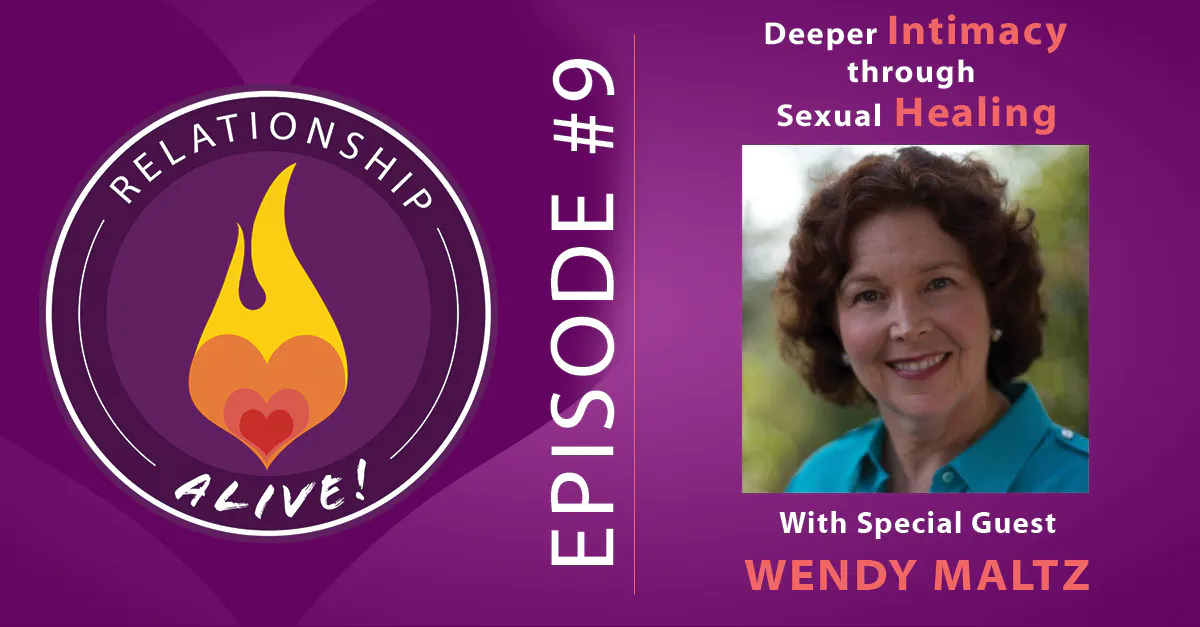
09: Deeper Intimacy Through Sexual Healing with Wendy Maltz episode artwork

EPISODE · Oct 20, 2015 · 1H 4M

09: Deeper Intimacy Through Sexual Healing with Wendy Maltz

from Relationship Alive! · host Neil Sattin

My philosophy is that relationships not only CAN be a vehicle for your own healing, but that it’s actually REQUIRED to do your work to heal from whatever is keeping you from fully showing up - in your life, in your relationship, AND in the bedroom. And just like we touched on in our conversation with Diana Richardson way back in episode two - there is tremendous potential for you, when you’re in relationship, to help your partner on that journey of healing - especially sexual healing.   Today’s guest is Wendy Maltz, author of The Sexual Healing Journey. Her book is about how to recover from sexual trauma and deepen your capacity for intimacy and sexual pleasure. In this episode, we’re talking about how you can take on that legacy of pain and potential disconnect - and use it to build a more solid, loving, sensual, and, yes, sexual connection with your partner.    There are all kinds of things that could have an impact on your sexual development, cause some degree of trauma, and be an obstacle to true intimacy with your partner. So even if you haven’t been specifically affected by some form of assault or abuse, this conversation is for you to find opportunities for your own sexual growth and healing.   If you HAVE been affected by some form of sexual trauma - this conversation could potentially be a trigger for you. My goal through having Wendy on the program is to help you and your partner get through the triggers together, to a place where you can have deep intimacy, connection, and the kind of fulfilling sex life that is your birthright.   Wendy Maltz is an internationally-recognized author, psychotherapist, and a certified sex therapist with over 35 years’ experience.  Along with The Sexual Healing Journey: A Guide for Survivors of Sexual Abuse, which is the topic of our discussion today, she also has written The Porn Trap: The Essential Guide to Overcoming Problems Caused by Pornography, which also factors into our discussion.  Wendy is the co-producer of Relearning Touch, a highly-acclaimed video guide for couples who are healing intimate problems caused by sexual abuse - and which is now available for FREE on her website.  Along with her husband, Larry, Wendy runs Maltz Counseling Associates in Eugene, OR. Here are some of the highlights from the conversation that Wendy and I share about how to develop healthy, deep intimacy with your partner as part of the sexual healing journey that you can be on together: Assault, rape, abuse, and incest affect both men and women directly and indirectly.  Statistics show that 1 in 3 females and 1 in 5-7 males are sexually abused in their lifetime.  When you include the partners of those people, you start to see that this is an issue that affects many, if not most, of us in some way. Are you yourself a survivor? If not, how many people have you been with, or known, who have been? What is sexual abuse?  Wendy defines it broadly as any action that dominates or exploits an innocent victim by sexual activity or suggestion.   When you also look back at your own sexual development, you can often find places where you experienced trauma of some form. Someone laughed at you at the wrong moment, or you experienced shame, or embarrassment, or...any number of things could be the source of sexual “trauma.” Can you identify places in your own history that might need some attention? What are some common relationship problems that can be traced back to sexual abuse?  Wendy says that reactions to abuse can include: fear of sex/withdrawal, viewing sex as an obligation, guilt or shame in touching, sexual function problems, low sex drive, painful intercourse, intrusive sexual fantasies, and dissociation during sex. It can also include hyper-sexualization - becoming overly interested in sexual activity. Realize that there is a distinction between sex and intimacy. As you expand into a broader experience of intimacy and connection with your partner, it can help put sex in a context that eases some of the pressure. This also helps to create a container of safety, which will lead to more sex, and more fulfilling sex. What feeds a relationship over time is the sensual sharing that takes place during true intimacy. What if your partner is a survivor of past abuse?  What can you do to help?  It helps if you, as the partner of a survivor, could be educated about abuse and its repercussions. It’s normal for you to feel in the dark, or isolated. If your sex life is suffering, traditional approaches for “spicing things up” can actually trigger your partner (perhaps you’ve experienced that?). Don’t look at your problem as one of needing to spark more desire - see it as a path towards building a container that’s safe enough for you to explore together. This isn’t to say that, if you’re the partner of someone who has suffered sexual trauma, that you should deny your own desires. Learning how to communicate about your desire in a way that owns it and does not make it your partner’s “problem” can lead to productive conversations about how to meet each other sexually. This might also be an opportunity for you to look back on your sexual development and think about whether what you “desire” is what you actually want! Are you looking for an enormous hit of dopamine, or are you looking for ways to build intimacy with your partner? And if it’s dopamine - while it may feel good, in the moment - is it actually serving you in terms of what you want out of your life and your partnership? Partners should be aware, be conscious, take a team approach together, create safety in sex, communicate, be present, and explore new approaches to touch and intimacy. If something isn’t working - don’t do it! Instead, shift to a mindset of working together to get through it. What if the survivor reacts negatively to sexual intimacy via triggers of past abuse?  The most important thing is for the partner not to take it personally, but focus on doing the OPPOSITE of what a perpetrator might do.  Ask how the other person feels, check in with their feelings, and have compassion and understanding. Is there hope?  Will you ever be able to experience sexuality and intimacy freely together? Absolutely. You can stop behavior that triggers negative feelings, work as a team, change behaviors, process feelings together, and make sex safe and fun.  Above all, realize that love is stronger than sexual abuse. What can a survivor do when they are being triggered to remember the abuse of the past?  The first step is to simply notice that it’s happening, stop what you’re doing, be aware of the reaction, and identify what behavior caused the reaction.  Use this as an opportunity to relax. Breathe, be calm, take a break. Talk about it with your partner if possible, and don’t condemn yourself for being triggered. Putting pressure on yourself to do it “right” is counterproductive! Get in touch with the present. How old are you now? What are you experiencing in THIS moment, with your partner (or yourself). Do what you need to do to pull yourself back into the present moment. After getting back into the present, you can re-approach intimacy. Try a different approach than what caused the trigger moment. How can you anchor each other in the present, in your experience with each other? Definitely check out Wendy Maltz’s Relearning Touch video which is now available for FREE on her website. The video teaches touch exercises that develop skills to relax, communicate, and be present in the moment.  The exercises can be done with or without clothes, and can be used as ideas from which to create your own healing with positive displays of fun and playfulness. These exercises are also detailed in her book The Sexual Healing Journey.   The exercises create a continuum of touch to move slowly toward more sexual activities as they are sequential in intensity, and will lead to completely different associations with sex and sensual contact.  One idea that can be helpful is to agree with your partner to an initial “vacation” - meaning a period of time when you agree that you will NOT be having sex. Having a vacation actually allows you to explore other ways of being intimate and connected with each other (it’s not a connection vacation!) - without having any pressure around having sex. Once the pressure is off, you can discover more subtleties about how to develop your intimate connection with each other. Another helpful technique is to each find a “home base” on your partner’s body, a place that you can touch that can help you feel safe and comforted when triggers bring up past abuse, or when your partner is triggered and you want to communicate your safe presence to them. Visiting the home base on your partner’s body is a way to let them know that you’re going through something and that you need reassurance, safety, and connection from them - allowing you to be in an uncomfortable place without breaking your connection completely during those moments.    On pornography: Pornography that is readily available to children (via the internet) interferes with their normal sexual development.  Children should be allowed to “unfold” their sexuality in a way that corresponds to their maturity level, and many are denied that opportunity because of graphic pornography. Many adults and children are having their view of sexuality potentially formed by their interactions with pornography, versus developing from being present in real-life interactions with partners over time. What is considered a “healthy” exploration of sexuality as children mature?  Boys and girls are naturally curious but should be ready and in control of their sexuality.  They should also be mature enough to know the consequences of their sexual choices.   What is the impact of pornography on relationships?  Many people consider it harmless entertainment, but the repercussions are great.  Porn shows people being used as objects, shows sex as a form of power, and often displays a total lack of intimacy.  Also, about 20% of internet porn involves child sexual abuse - or the simulation of underage sex.  Often, porn is the first exposure young people have with their sexuality, and therefore, they don’t learn the needed relationship skills of self-control, intimacy, and rich connection with a partner.  Porn is like fast food that dulls our appetite for better, creative, healthy food, and can potentially be an obstacle to the enjoyment of a rich, satisfying, nurturing, sexual relationship based on love. It can focus our sexual drive on chasing bigger and bigger hits of dopamine, instead of fostering deeper and deeper intimacy. Those are different mechanisms in the brain, and those choices also have different impacts on a relationship.   Wendy concludes by saying, “Those negatives about being sexually abused don’t have to be the last word on sex for us.  We CAN reclaim sexuality.” Links and Resources: www.healthysex.com  (Wendy’s website with links to resources) The Sexual Healing Journey on Amazon www.neilsattin.com/wendy  is the direct link to this episode. Visit to download the show guide, or text “PASSION” to 33444 and follow the instructions to download the show guide. If you download the guide within the first week of this episode's airing, you are automatically qualified for a chance to win a signed copy of “The Sexual Healing Journey”! Our Relationship Alive Community on Facebook   Amazing intro/outro music graciously provided courtesy of: The Railsplitters - Check them Out!

My philosophy is that relationships not only CAN be a vehicle for your own healing, but that it’s actually REQUIRED to do your work to heal from whatever is keeping you from fully showing up - in your life, in your relationship, AND in the bedroom. And just like we touched on in our conversation with Diana Richardson way back in episode two - there is tremendous potential for you, when you’re in relationship, to help your partner on that journey of healing - especially sexual healing.   Today’s guest is Wendy Maltz, author of The Sexual Healing Journey. Her book is about how to recover from sexual trauma and deepen your capacity for intimacy and sexual pleasure. In this episode, we’re talking about how you can take on that legacy of pain and potential disconnect - and use it to build a more solid, loving, sensual, and, yes, sexual connection with your partner.    There are all kinds of things that could have an impact on your sexual development, cause some degree of trauma, and be an obstacle to true intimacy with your partner. So even if you haven’t been specifically affected by some form of assault or abuse, this conversation is for you to find opportunities for your own sexual growth and healing.   If you HAVE been affected by some form of sexual trauma - this conversation could potentially be a trigger for you. My goal through having Wendy on the program is to help you and your partner get through the triggers together, to a place where you can have deep intimacy, connection, and the kind of fulfilling sex life that is your birthright.   Wendy Maltz is an internationally-recognized author, psychotherapist, and a certified sex therapist with over 35 years’ experience.  Along with The Sexual Healing Journey: A Guide for Survivors of Sexual Abuse, which is the topic of our discussion today, she also has written The Porn Trap: The Essential Guide to Overcoming Problems Caused by Pornography, which also factors into our discussion.  Wendy is the co-producer of Relearning Touch, a highly-acclaimed video guide for couples who are healing intimate problems caused by sexual abuse - and which is now available for FREE on her website.  Along with her husband, Larry, Wendy runs Maltz Counseling Associates in Eugene, OR. Here are some of the highlights from the conversation that Wendy and I share about how to develop healthy, deep intimacy with your partner as part of the sexual healing journey that you can be on together: Assault, rape, abuse, and incest affect both men and women directly and indirectly.  Statistics show that 1 in 3 females and 1 in 5-7 males are sexually abused in their lifetime.  When you include the partners of those people, you start to see that this is an issue that affects many, if not most, of us in some way. Are you yourself a survivor? If not, how many people have you been with, or known, who have been? What is sexual abuse?  Wendy defines it broadly as any action that dominates or exploits an innocent victim by sexual activity or suggestion.   When you also look back at your own sexual development, you can often find places where you experienced trauma of some form. Someone laughed at you at the wrong moment, or you experienced shame, or embarrassment, or...any number of things could be the source of sexual “trauma.” Can you identify places in your own history that might need some attention? What are some common relationship problems that can be traced back to sexual abuse?  Wendy says that reactions to abuse can include: fear of sex/withdrawal, viewing sex as an obligation, guilt or shame in touching, sexual function problems, low sex drive, painful intercourse, intrusive sexual fantasies, and dissociation during sex. It can also include hyper-sexualization - becoming overly interested in sexual activity. Realize that there is a distinction between sex and intimacy. As you expand into a broader experience of intimacy and connection with your partner, it can help put sex in a context that eases some of the pressure. This also helps to create a container of safety, which will lead to more sex, and more fulfilling sex. What feeds a relationship over time is the sensual sharing that takes place during true intimacy. What if your partner is a survivor of past abuse?  What can you do to help?  It helps if you, as the partner of a survivor, could be educated about abuse and its repercussions. It’s normal for you to feel in the dark, or isolated. If your sex life is suffering, traditional approaches for “spicing things up” can actually trigger your partner (perhaps you’ve experienced that?). Don’t look at your problem as one of needing to spark more desire - see it as a path towards building a container that’s safe enough for you to explore together. This isn’t to say that, if you’re the partner of someone who has suffered sexual trauma, that you should deny your own desires. Learning how to communicate about your desire in a way that owns it and does not make it your partner’s “problem” can lead to productive conversations about how to meet each other sexually. This might also be an opportunity for you to look back on your sexual development and think about whether what you “desire” is what you actually want! Are you looking for an enormous hit of dopamine, or are you looking for ways to build intimacy with your partner? And if it’s dopamine - while it may feel good, in the moment - is it actually serving you in terms of what you want out of your life and your partnership? Partners should be aware, be conscious, take a team approach together, create safety in sex, communicate, be present, and explore new approaches to touch and intimacy. If something isn’t working - don’t do it! Instead, shift to a mindset of working together to get through it. What if the survivor reacts negatively to sexual intimacy via triggers of past abuse?  The most important thing is for the partner not to take it personally, but focus on doing the OPPOSITE of what a perpetrator might do.  Ask how the other person feels, check in with their feelings, and have compassion and understanding. Is there hope?  Will you ever be able to experience sexuality and intimacy freely together? Absolutely. You can stop behavior that triggers negative feelings, work as a team, change behaviors, process feelings together, and make sex safe and fun.  Above all, realize that love is stronger than sexual abuse. What can a survivor do when they are being triggered to remember the abuse of the past?  The first step is to simply notice that it’s happening, stop what you’re doing, be aware of the reaction, and identify what behavior caused the reaction.  Use this as an opportunity to relax. Breathe, be calm, take a break. Talk about it with your partner if possible, and don’t condemn yourself for being triggered. Putting pressure on yourself to do it “right” is counterproductive! Get in touch with the present. How old are you now? What are you experiencing in THIS moment, with your partner (or yourself). Do what you need to do to pull yourself back into the present moment. After getting back into the present, you can re-approach intimacy. Try a different approach than what caused the trigger moment. How can you anchor each other in the present, in your experience with each other? Definitely check out Wendy Maltz’s Relearning Touch video which is now available for FREE on her website. The video teaches touch exercises that develop skills to relax, communicate, and be present in the moment.  The exercises can be done with or without clothes, and can be used as ideas from which to create your own healing with positive displays of fun and playfulness. These exercises are also detailed in her book The Sexual Healing Journey.   The exercises create a continuum of touch to move slowly toward more sexual activities as they are sequential in intensity, and will lead to completely different associations with sex and sensual contact.  One idea that can be helpful is to agree with your partner to an initial “vacation” - meaning a period of time when you agree that you will NOT be having sex. Having a vacation actually allows you to explore other ways of being intimate and connected with each other (it’s not a connection vacation!) - without having any pressure around having sex. Once the pressure is off, you can discover more subtleties about how to develop your intimate connection with each other. Another helpful technique is to each find a “home base” on your partner’s body, a place that you can touch that can help you feel safe and comforted when triggers bring up past abuse, or when your partner is triggered and you want to communicate your safe presence to them. Visiting the home base on your partner’s body is a way to let them know that you’re going through something and that you need reassurance, safety, and connection from them - allowing you to be in an uncomfortable place without breaking your connection completely during those moments.    On pornography: Pornography that is readily available to children (via the internet) interferes with their normal sexual development.  Children should be allowed to “unfold” their sexuality in a way that corresponds to their maturity level, and many are denied that opportunity because of graphic pornography. Many adults and children are having their view of sexuality potentially formed by their interactions with pornography, versus developing from being present in real-life interactions with partners over time. What is considered a “healthy” exploration of sexuality as children mature?  Boys and girls are naturally curious but should be ready and in control of their sexuality.  They should also be mature enough to know the consequences of their sexual choices.   What is the impact of pornography on relationships?  Many people consider it harmless entertainment, but the repercussions are great.  Porn shows people being used as objects, shows sex as a form of power, and often displays a total lack of intimacy.  Also, about 20% of internet porn involves child sexual abuse - or the simulation of underage sex.  Often, porn is the first exposure young people have with their sexuality, and therefore, they don’t learn the needed relationship skills of self-control, intimacy, and rich connection with a partner.  Porn is like fast food that dulls our appetite for better, creative, healthy food, and can potentially be an obstacle to the enjoyment of a rich, satisfying, nurturing, sexual relationship based on love. It can focus our sexual drive on chasing bigger and bigger hits of dopamine, instead of fostering deeper and deeper intimacy. Those are different mechanisms in the brain, and those choices also have different impacts on a relationship.   Wendy concludes by saying, “Those negatives about being sexually abused don’t have to be the last word on sex for us.  We CAN reclaim sexuality.” Links and Resources: www.healthysex.com  (Wendy’s website with links to resources) The Sexual Healing Journey on Amazon www.neilsattin.com/wendy  is the direct link to this episode. Visit to download the show guide, or text “PASSION” to 33444 and follow the instructions to download the show guide. If you download the guide within the first week of this episode's airing, you are automatically qualified for a chance to win a signed copy of “The Sexual Healing Journey”! Our Relationship Alive Community on Facebook   Amazing intro/outro music graciously provided courtesy of: The Railsplitters - Check them Out!

NOW PLAYING

09: Deeper Intimacy Through Sexual Healing with Wendy Maltz

0:00 1:04:14

No transcript for this episode yet

We transcribe on demand. Request one and we'll notify you when it's ready — usually under 10 minutes.

LIGHTS, CAMERA, SMILE! Creatives Club Media Lights, Camera, Smile, is a podcast for anyone with a dream to share something with the world, out of the overflow of themselves - be it their mind, their heart, their personalities, and much more. Each of us are alive in this moment in time, with an innate ability to have ideas and create various things to benefit both ourselves and the people around us for a reason, and here, you will find the encouragement, the inspiration, and the motivation to do just that. Hosted by Cicily, founder of Creatives Club, she dives into various topics surrounding creativity and business. Exploring entrepreneurship for creatives in a corporate reality, sharing tips and tricks in a media centered company, answering questions regarding what a creative actually is are just a few of the things discussed on this podcast. Be encouraged to create for yourself as Cicily gets vulnerable by pivoting the camera to herself for the first time.To submit questions for Cicily to answer, or have her address certain t Tao Te Ching by Laozi (Author), Stephen Mitchell (Full Audiobook) Laozi Lao-tzu's Tao Te Ching, or Book of the Way, is the classic manual on the art of living, and one of the wonders of the world. In eighty-one brief chapters, the Tao Te Ching looks at the basic predicament of being alive and gives advice that imparts balance and perspective, a serene and generous spirit. This book is about wisdom in action. It teaches how to work for the good with the effortless skill that comes from being in accord with the Tao (the basic principle of the universe) and applies equally to good government and sexual love; to child rearing, business, and ecology.Stephen Mitchell's bestselling version has been widely acclaimed as a gift to contemporary culture. Psychos with Ryan Williams Ryan Williams This is a podcast on healthcare, trauma, and the future of mental health.On Psychos, Ryan welcomes storytellers, researchers, comedians, actors, teachers, writers, musicians to discuss their relationship with their health. Ryan's conversational interview style gives guests a place to discuss how they are connected to their health, which will be completely new to listeners. We also have a few breathwork classes, and some older episodes from Ryan's old Influencer Economy podcast. You can follow the podcast on iTunes, Spotify, Stitcher, or anywhere else you listen to podcasts. Celebration of Life Church Bozeman COLC It is our desire at Celebration of Life Church to reach into Bozeman and the entire Gallatin Valley with the Gospel of Jesus Christ and impact it for the Kingdom of God; to go beyond the four walls of the church and touch people in our community with the love of God; and to share the goodness of God in such a way that it will draw all men into a loving relationship with the One True Living God. We also desire to train up in the Word of God and encourage them to take the Gospel message to our community through various outreaches and evangelism. Enjoy our podcast and feel free to visit us.

Frequently Asked Questions

How long is this episode of Relationship Alive!?

This episode is 1 hour and 4 minutes long.

When was this Relationship Alive! episode published?

This episode was published on October 20, 2015.

What is this episode about?

My philosophy is that relationships not only CAN be a vehicle for your own healing, but that it’s actually REQUIRED to do your work to heal from whatever is keeping you from fully showing up - in your life, in your relationship, AND in the bedroom....

Can I download this Relationship Alive! episode?

Yes, you can download this episode by clicking the download button on the episode player, or subscribe to the podcast in your preferred podcast app for automatic downloads.
URL copied to clipboard!