
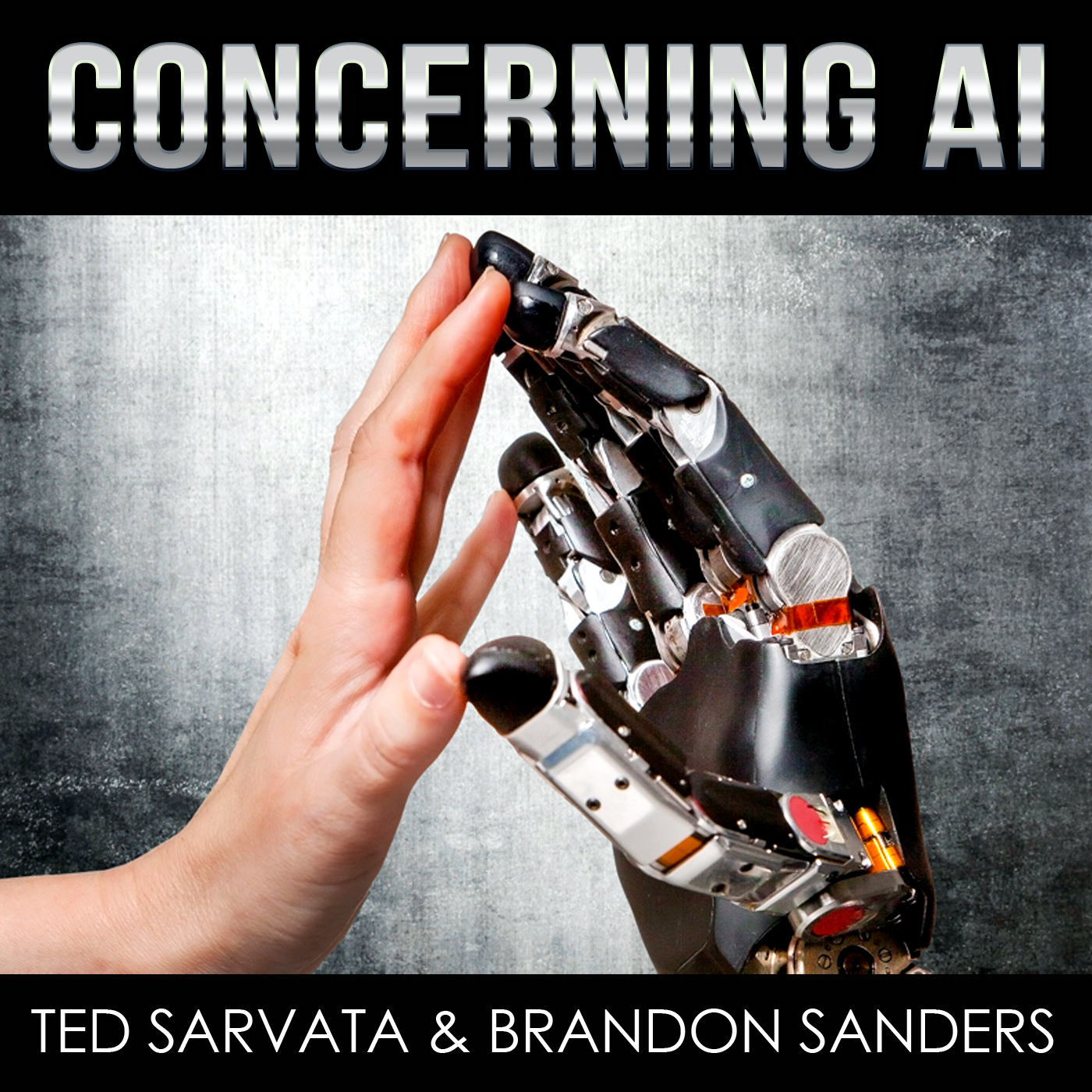
This is Ted. This is Brandon. This is Eric. And this is the podcast that used to think it was going to be called for in the AI.
And today we're talking about, we're talking about what is an AI? Like can we have an AI that's not embodied or does it need a body man or what? We started with that. Fuck.
Yeah. What prompted this was actually Rodney Brooks, an article that Brandon me ran into that where Rodney Brooks was basically saying chill out people. It's going to be hundreds of years before AI is really at the level of something that we need to be afraid of. And so then we were talking about what like where Rodney Brooks comes from in general and the division between sort of the good old fashioned AI folks who are really into logic and symbolic manipulation and proving things to be true and inferring things based on these logical formalism sentences in logical form, that kind of a thing versus Rodney Brooks, who is one of the fathers of embodied AI that says that most of what underlies general level intelligence actually comes from interacting with the world and being situated in it and having a physical form that can actually perceive and manipulate the world.
Yeah. And so we're thinking that about Watson going on Jeopardy and Watson has certain ways to have certain level of perception, can perceive there's a question being answered or a question being asked or an answer being asked on Jeopardy, I guess, to come up with a question. If I can get my mind around that constraint, but it's able to perceive that there's a question and then it has this huge memory bank of data and it's able to make connections between the question and all this data and come up with an intelligent what it looks like, what it seems like, an intelligent answer. And that raises the question, you know, here, is it embodied or is it not embodied?
It doesn't seem like it doesn't walk around. Yeah. Well, the question I'm thinking of is what is embodiment? Like embodiment is really being able to sense something and then take action to change it and then sense whether you change it or not enough, right?
So like a driver in this car, obviously an embodied AI because it's actually sensing the road, deciding whether it should run over that child or not, and then taking action to instantiate its decision, right? But does it need to be embodied at that level or could like a network of computers that just sees the world and keeps pumping people with just the right wrong information to make them do the thing it wants them to do and then seeing whether it succeeded in doing that, would that be embodied? It doesn't have any moving parts. It doesn't actually physically move, but it could alter the world.
I would say that that would be embodied, but that's a horse before the cart. Okay. I'm going to argue from the Rodney Brooks embodied AI perspective. That's putting the horse before the cart that's saying, what if we had general purpose AI and then we hooked it up to the internet and let it interact with people?
Could it actually be embodied in the sense that it could manipulate people into doing things for it? But where did the general purpose AI come from? How did that intelligence that could actually understand natural language and what something actually means? Where did that come from?
I would argue that you actually need embodiment to understand human natural language at the very least because so much of what we say and do is metaphorical based on our direct perceptual experience of the world. So, Brandon, do you mean like when we say as the crow flies, even though we don't necessarily see a crow fly from here to there, as a human being that is in the world, we have some sense of what that metaphor means because we are embodied? Yeah. I mean, think about the crow flies for a second.
That's a very empathetic statement. If you really unpack it in the way I think it means, it means basically if I were to become that crow and fly like a crow flies from my perspective, this, you know, getting from here to there would be like this. I would experience it like this. And so there's a sense of our embodiment that allows us to very easily answer things like what is the front of the truck?
And even like what is the front of a fork or a spoon that has no locomotion really? But you ask almost anybody, they're going to give the same answer. I would argue it because we have an embodied answer for what our front is and a very general purpose module that allows us to empathetically identify as that fork or as that chair or as that thermos or any of these kind of things. And so much of meaning comes from that, those two things, having our experience and being able to project it.
So if you took like a low level artificial intelligence, something that wasn't general purpose yet, and you stuck it in a simulation so that it's surrounded entirely by software, not no hard, it has no control over no hardware, and you let it, you know, evolve and learn in some way to the degree that it could in that environment. Would that be embodied enough? Because then it could certainly, yeah, if the simulation is high enough fidelity, for sure, like you could actually learn principles that apply to the world that we know, then the meanings that you would come up with in that simulation would also translate to the meanings that we hold from our embodiment in the world we're in, which itself made the simulation. Is it actually important to have the simulation be human-like or reality-like?
If you have a different simulation, a simulation that's not at all like human experience, then you'll end up developing a kind of alien AI, right? But it could still be just as AI as an AI that isn't able to function in this world. Yeah, I believe that. You could end up with a, like for example, would you feel comfortable when you feel about an AI that was sort of built off of more of a spider-based?
I love the idea of spider-based AI, because they can do things for us that we can't do, right? Yeah, but would they do things for us? Well, that's the question, right? You know, yeah, when we think about a general purpose AI, why would a general purpose AI do anything for us?
Wouldn't it have its own volition at that point? I mean, why do I do anything for you? Ah, well, there, that's an interesting question. You know, if you socialize the AI, regardless of how alien it is, if you somehow manage to socialize the AI so that it actually interacts with human beings and gets benefits from interacting with human beings, then it will, it will play the tit for tacking.
No, no, I completely disagree with that. Just take dogs and cats, for example. If you try to make a cat, socialize a cat to act like a dog, good luck. Yeah.
They just, they come from a different underlying platform. And if you try to socialize a cat to do anything for you, it's also pointless. Pointless. But if you try to socialize a dog, which also comes from a totally different platform than humans, it will do things for you.
It will do things that you can't do and still be grateful that you gave it some little tidbit. You know, like my, my fear, if I had a fear about AI would be that it gets to the point very quickly where it just regards us like we regard ants with, we don't think about them at all. We step on them and it doesn't matter to us. We don't, we don't give it any thought at all.
It's not that we don't, but I mean, we might dislike ants. We might actually be actively trying to kill ants, but mostly we don't, mostly we just let them do their thing. And if we step on them, no big deal. And if it's better for us to not have them coming out of front door, we will wipe out our entire colony of ants because we don't want them in our house.
And it's not because we don't, you know, we're evil. It's that we disregard them. And that's the thing if, if AI, if an AI could, if an AI, if there is an AI that gets to that level where it just, it just views us the way we view ants, we're in trouble. We could be in trouble.
Of course, the thing that ants are is they're too stupid to do anything for us. If they were smart, they do something for us. And then we wouldn't wipe the map because we like, well, that's really useful, you know. That's a good point.
I can say ants, they want to survive the AI singularity. So you know what we gotta do is learn that's why we could be dogs. Let's be dogs are useful to humans. We like dogs.
Yeah. So we gotta be the dogs of the, of the AI. Like what's the AI as fast as that? Drop your ego because it's pointless.
You are not the all and end all of the world. You know that now. Something gets surpassed you. So I mean, you know, I think about the ants, they could really do a great job cleaning the house.
They could, right? I imagine if you had a couple ant colonies that would just clean the house for you. It's true. It's true.
Yeah. I don't know if we'll be able to do anything like that for the AI. The problem with the AI is that the AI should be able to, once it gets fast infrastructure of nanotechnology, it's gonna have all the effectors that it needs to be able to make the world and spare consciousness and all the sort of things that it needs to do that. Not have to go through the problems that you human interface.
There are a couple of points where we get. Like there's the slightly better than human AI. It could still use us. A huge workforce.
Yeah, but does that exist for more than an hour or a week? That's the question. I know that I read the paper where they said that like AI is just gonna like, continue exponentially growing and we'll go from just slightly smarter to us, smarter than us, then to way way smarter than us in very short time. You've got a year or two.
But I think a whole embodiment question really hits that heart because in order to get more intelligent in a way that affects the world in a real way, you have to actually do the science. You have to figure out how the world really works and you can't necessarily always rush science. So I have a feeling that AI may get way more intelligent but not be way more powerful just because it won't be able to do the science to create better nanites any faster than you can do it. There's gonna be physical limits that it's gonna run into.
So I have a feeling that AI will get like in certain ways it'll get way way more intelligent really quickly but in other ways I think it's gonna be kind of linear. Well for all of us and our children I hope you're right. I do too. I'm a human species.
But eventually if you're bad so sad it will get to the point where it doesn't need us anywhere and then we'll have to go from living like. Okay but that assumes that we can't augment ourselves. That assumes that we won't also augment ourselves in some way but if we don't. Our substrate is so slow though.
To actually take our human substrate and augment it and stuff is slow. It's not a natural. It's really easy for that. You take the brand in and you replace it with another part.
Just one part. Yeah. Well that part would be the why would. The augmentation is a transition plan.
It's not the end game. Yeah. Right. Well how about we take the question of what kind of scenarios can we imagine humans as a species or at least our descendants surviving.
Let's take that question and have it be the question for another podcast. Sounds good. That sounds perfect. Alright I'm Brandon.
I'm Ted. I'm Eric. But you want me. Bye.
Bye. Bye. Bye. Bye.