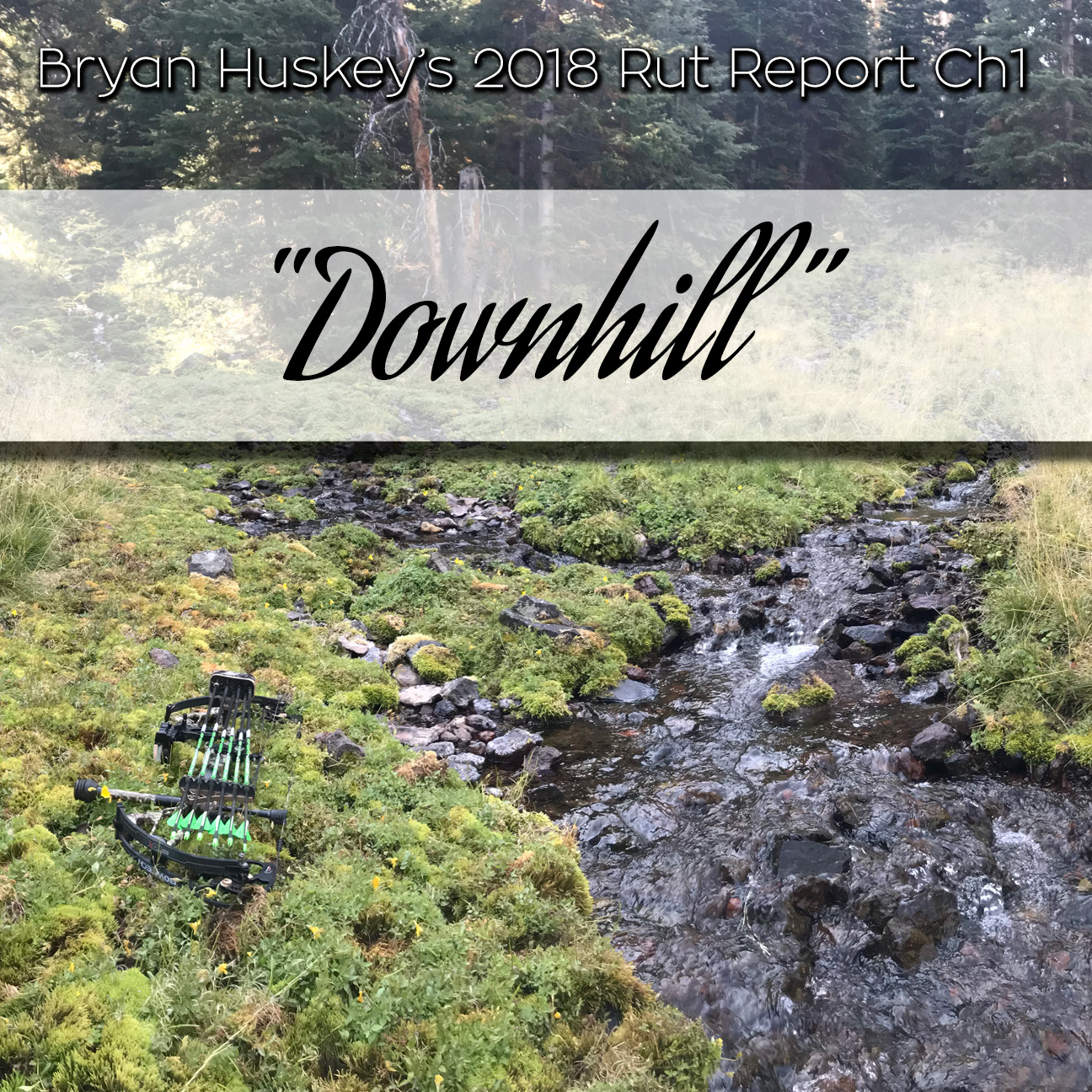
Three years straight, that's a hell of a slump buster, and these past three years of success were doubled up, representing harvest of both deer and elk, following a dry spell of mind-bending frustration and crazy bad luck stacking up on my hunting efforts. To the level that I eventually, albeit reluctantly, proclaimed that I'd been cursed. Because for a decade in the early 2000s, my hunting efforts were plagued with failure, in the sense of tagging out at least. My left hand foiled up and down as the warm summer air slipped past, driving north of Boise.
Warm golden light glanced through the blades of grass and leaves that were still prominently green. I cracked and spat sunflower seeds out the window with an offbeat rhythm. Admiring the late summer scenery, stretching out along crystal clear freestone rivers and hard-scrabble rural communities, I chuckled out loud, taking note as a rural firefighting crew pitched arcs of water from the town's proud fire engine to water the high school football field. Automated irrigation had its finest.
But the thoughts of what entails a streak versus a blip returned to my thoughts, and the fragility of outcomes beyond my control kept pestering this peaceful, yet highly anticipated drive, which I was simply trying to enjoy for what it was. The contemplation of continuing a streak was distracting and irritating to me. Life and the evolving aspects of parenthood, now a year and a half along, had my progress and preparation for the 2018 season nowhere close to where I'd been this time last year. And the fact that I'd become enamored with fly fishing for sneaker or bass and catfish this summer, which also involved a bunch of time and money to restore and return to service a small boat that had belonged to my late father.
Point being, I'd spent a lot of time in that boat fishing and drinking beer, whereas last year I'd been trail running with weights and charting significant fitness high marks. No, not this summer. Since the Robie Creek half marathon in April, I'd not made it trail running once, just the thought of running at this point hurt. When I arrived at my parking and camping location, I was disappointed to find a trio of parties already parked there.
And by early on opening morning, yet another out-of-state rig had arrived. Although this area is expansive and offered a lot of real estate to hunt, I could not help but grumble. Two of the past three areas that I'd chosen to hunt had mysteriously become popular in the years following my arrival and discovery of them, leading to my abandoned and beloved places that I sought to hunt without interference from other hunters. But once the weight of my full pack at my shoulders and the rhythm of a several mile commute hit its stride, I put all of that behind me and relished the big mountain air, game trails, and forest littered with clues of elk and running activity.
A continuation of last year's thrill, I was brimming with excitement to simply explore and chart what this particular location had to offer. I'd spent bits of the past year revisiting memories and observations from my computer screen via Google Earth and had laid all sorts of scenarios out for what I'd hoped to find out that my feet were once again treading the dirt. From ground zero at my creek side parking point, I'd worked my way miles upstream and two and a half thousand feet into thinner air, each step along the way, taking note of tracks and sign on the ground, rubs on trees, browsing patterns on the vegetation, and bedding areas where elk had laid during carefree summer rest. My bow was in my hand, but in all reality, I was only scouting, casing the joint for where I'd plant upcoming hunts later in the season, in places that I'd consider centrally located and ideal for a spike camp.
It was great fun and purely the tactical sense to imagine what opportunities could come from the sprawling network of terrain, the complex of feeder creaks and drainages separated by steep ridges that arch northward in parallel like a jumble of peeled and separated orange segments. South and west facing slopes were mostly open sage, rock, and grass, while portions that faced north into the east were draped in timber, water ran down the bottoms of most of all the parts between. At one point while traversing a steep side slope, which was shaded by a thick canopy of old growth timber, I noticed a large area of dead willows. It seemed odd to me for so many willows of the same size, distribution, and age to all lay dead, bunch after bunch of silver white matchsticks now scattered on the forest floor.
Why had they all died, I wondered, and seemingly all at the same time? As I looked closer, I could see signs that braided channels of waterhead once flowed across the area and downward towards the primary creek bottom, but all that water was now long gone. As I continued uphill, the sound of new and steeply rushing water came to overcome the softer babbling creek below me to my left. A defined row of leafy green and waist-high willows streaked uphill like a fence line.
This entire slope I was traversing was made up of very loose rocks and soil with little ground cover other than the fallen dead pine needles and remnant clusters of willow. I noticed that the entire area was a fan of avalanche deposit, steep side slope with a crown cross section at the center, and here, near the bottom of all of this loose material, a vibrant spring gushed. Yet the entire flow was cut into a single trench, all the current channelized, and racing in a direct line for the bottom. It was wild to think that for hundreds, maybe thousands of years water had been distributed in such a way that countless willows had thrived.
Then one day, not too long ago, with a fateful bit of erosion, gravity, and quite likely snowpack, if not an actual avalanche, a keystone rock was nudged from its holding place, setting off a chain reaction that would result in the entire flow of the creek diverting from one side of this material fan and subsequently into this single channel, essentially choking off willows that for generations had thrived. Like the work of beavers that I'd taken note of and mentioned in last year's Rhett Report in Reading, this was once again a subtle, yet telling example of nature taking its own course. Another element of the scouting process for this trip was the deployment of my trail camera. Trail cams seemed to be something of a trend these days, and I can certainly understand why.
I only have one, so I took careful consideration of where I would place it for this chunk of time between opening day and my next scheduled hunt week or so later. On day two of the season, there was no mistaking where I should place my camera, as I watched a mixed group of five or so bulls bump up and out of a surf canyon. Several of the bulls were muddied, one in particular had mud still glistening in the august sun, coating his rump, and more dangling from his antlers, a wallow. I could not see it at the time, but observing this evidence on actual elk in front of me was all the clue I needed to make certain that I needed to find that wallow.
And in short order I did, nestled perfectly at the base of a large rock field with cliffs and boulders at its rim, which capped and created this dead-end canyon. Three or so hundred feet down from the crest were a pair of wallows, both showing the signs of recent use by the steel dark and muddy water, along with delicate splatters of mud still clinging to grass and vegetation around them. This was clearly a locker room, where groups of bulls would congregate and release all varieties of running frustrations. With amateur haste, I hurriedly strapped the camera to a downfall facing the wallow, hoping that I had all the settings, batteries, and memory properly set.
My imagination could guess and easily run wild picturing what would unfold in front of this camera over the coming week or so. I closed the clasping latches, turned downhill, and raced the late summer shadows down the canyon back to camp.