
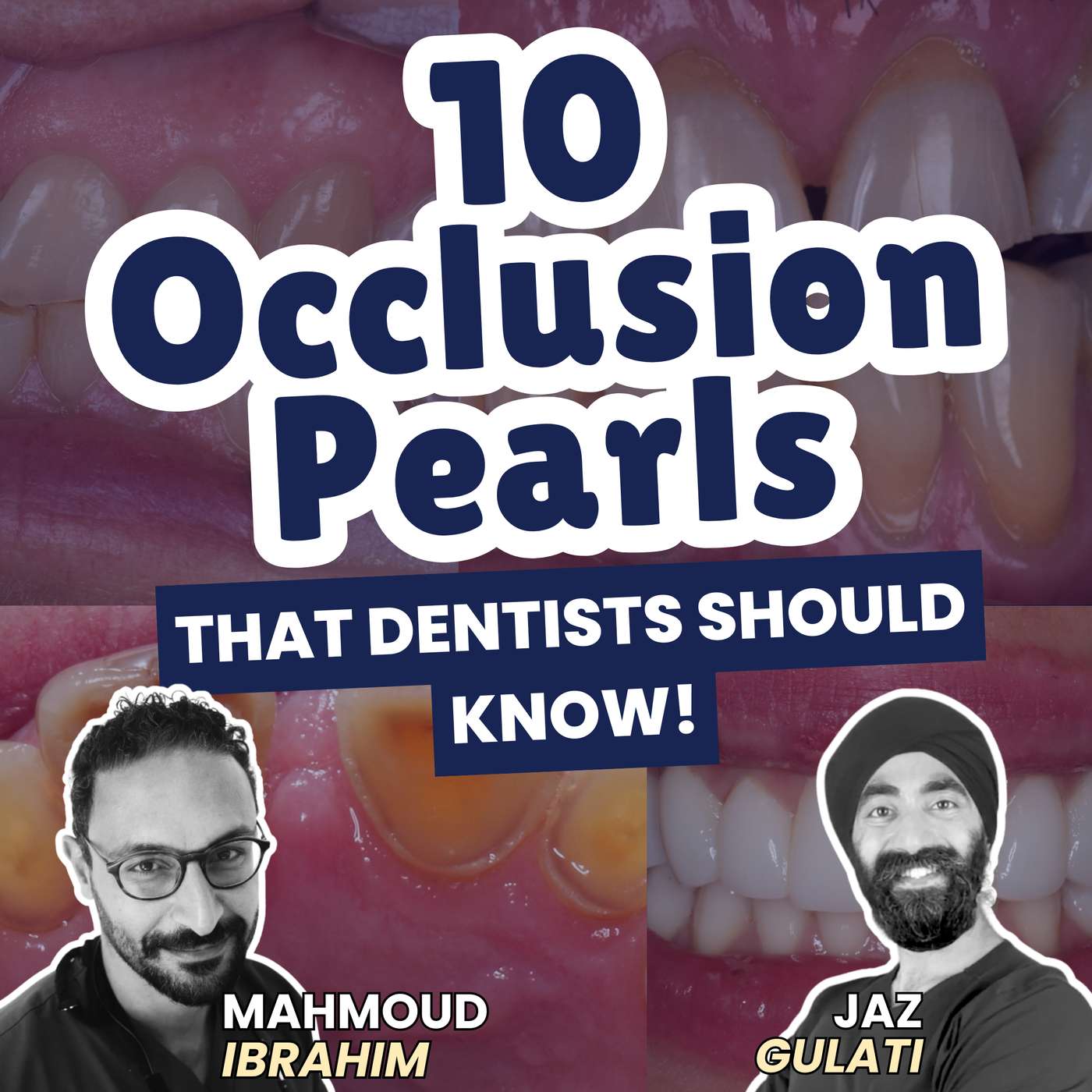
EPISODE · May 11, 2026 · 54 MIN
10 Occlusion Pearls That Will Blow Your Mind – PDP267
from Protrusive Dental Podcast · host Jaz Gulati
Why does occlusion feel so confusing at dental school?What if the problem is not that occlusion is too complex, but that it was taught in the wrong order?How do you make sense of worn teeth, bite scans, shimstock, leaf gauges, provisionals and T-Scan without getting overwhelmed?And which small ideas can genuinely change the way you diagnose, plan and restore?In this episode, Jaz is joined by Dr. Mahmoud Ibrahim for a brilliant occlusion-focused conversation. They each bring five clinical “pearls” that helped occlusion finally click for them — from facially generated treatment planning to checking the contralateral side, muscle palpation, provisionals and digital occlusal data. https://youtu.be/REQ_L5NNEF4 Watch PDP267 on YouTubeProtrusive Dental PearlCreate a PowerPoint or Keynote library of your clinical photos so you can quickly show patients relevant examples during consultations.⚠️ Avoid hunting through random folders chairside — it feels clunky and breaks the flow of the conversation.✅ Build a scrollable visual library of cracks, before-and-afters, complications, direct restorations, overlays, crowns and consent examples to support clearer patient communication.Key TakeawaysOcclusion becomes easier when it is placed inside the treatment planning sequence, not treated as a separate subject.Facially generated treatment planning starts with where the upper teeth need to be for aesthetics.Once the central incisors are planned, the rest of the occlusion becomes easier to organise.Worn teeth that are still in occlusion are often in the wrong position.Anterior wear may be caused by tooth position, contact time, contact force, or a combination of all three.Gingival levels can reveal whether worn lower incisors have over-erupted.Digital bite scans are useful, but they are not always a perfect representation of the patient’s bite.Shimstock remains one of the most valuable and inexpensive tools for checking true occlusal contacts.After fitting a restoration, checking the contralateral side first can reveal whether the new restoration is high.Anterior guidance should be steep enough to separate the back teeth, but shallow enough to allow the lower incisors room to move.Muscle palpation should assess the quality and symmetry of contraction, not just whether the muscles exist.Always assess the opposing tooth before placing composite, ceramic or an indirect restoration.A leaf gauge can help create a more repeatable jaw position when planning more complex occlusal cases.Provisionals are essential for testing aesthetics, function, vertical dimension and occlusion before committing to final restorations.Highlights of the Episode:00:00 Teaser00:56 Introduction03:36 Pearl: Build a Clinical Photo PowerPoint12:48 Pearl 1: Facially Generated Treatment Planning15:56 Pearl 2: Worn Teeth in Occlusion Are in the Wrong Position18:05 Why Tooth Position Matters18:22 Three Causes of Wear to Consider19:34 Pearl 3: Digital Bite Scans Are Not Always Accurate20:24 Why Shimstock Still Matters in Digital Dentistry24:18 Pearl 4: Check the Contralateral Side After a Restoration26:27 Pearl 5: The First Movement of Opening Is Not Pure Rotation28:27 Midroll33:10 Pearl 6: Healthy Occlusion Should Have Coordinated Muscle Contraction35:22 Why Muscle Palpation Is a Useful Data Point38:18 Practical Muscle Assessment Tip38:58 Pearl 7: Always Look at the Opposing Tooth39:33 What to Check Before an Indirect Restoration39:44 Why the Opposing Tooth Matters41:13 Pearl 8: Leaf Gauge for Finding a Repeatable Jaw Position42:43 What a Leaf Gauge Is44:33 Pearl 9: Provisionals Reduce the Fear of Complex Cases47:49 Pearl 10: T-Scan Adds Objective Occlusal Data53:16 Course Options and Learning Pathway55:59 Outro✨Connect with Dr. Mahmoud on Instagram📍 Want to make occlusion more practical?Bulletproof is designed to take occlusion from abstract theory to real-world clinical application — covering posterior crowns, quadrant dentistry, PROPER conformative dentistry, occlusal risk assessment, shimstock, leaf gauges and daily protocols you can use straight away.The next Bulletproof course takes place on 26th–27th June at London Heathrow (Radisson Blu Hotel)Don’t miss it — find out more at bulletproofdentistry.com➡️Check out more episodes on occlusion: Indirect Restorations For Guiding Teeth – PDP196#PDPMainEpisodes #OcclusionTMDandSplintsThis episode is eligible for 0.75 CE credit via the quiz on Protrusive Guidance.This episode meets GDC Outcomes CAGD Subject Code: 180 OcclusionAim: To help dentists improve their understanding and clinical application of occlusion by recognising key diagnostic signs, using practical occlusal assessment tools, and applying occlusal principles to restorative treatment planning.Dentists will be able to –Apply facially generated treatment planning principles when assessing occlusal and restorative cases.Identify how tooth position, contact time and contact force contribute to tooth wear and restoration risk.Use practical occlusal assessment methods such as shimstock, contralateral checking, muscle palpation, leaf gauges, provisionals and T-Scan data.
Embed this episode
Ready to play
10 Occlusion Pearls That Will Blow Your Mind – PDP267
No transcript for this episode yet
Similar Episodes
No similar episodes found.