
A podcast by Sipra. Il Bhatkais et de la Chippe. Bhatkais et de la Chippe. Il Bhatkais et de la Chippe.
Il Bhatkais et de la Chippe. Three-brim Bhatkais. Interviews, background talks and voices from all Alpine countries. Listen to this and more in the podcast of the International Commission for the Protection of the Apps.
www.sipra.org.org. Port slash podcast. What is the environmental impact of the Winter Olympics? These games will use some 2.4 million cubic metres of artificial snow.
A report by scientists for global responsibility said that this year's Winter Olympics will create 930,000 tonnes of greenhouse gas emissions. You just heard some soundbites from the International Media about Olympic Winter Games of Milano, Cortina, 2026. Welcome to the current episode of our C-Pro podcast. My name is Mila Ligams.
What impact did the Games have on the Italian Alps? What is the legacy for local communities? And what can be learned for the next Winter Games in the French Alps 2030? About this and more, I'm going to talk with my guest today.
Francesco Pastorelli, he's Director of C-Pro-Italy. He followed these Winter Games closely, as he already did when 20 years ago, the Games of Torino took place in Italy. Lauren Mostale is Co-Director of T-Pro-France in Grenoble. The French Alps will be the host of the next Olympic Winter Games in 2030.
She will explain to us why civil society raised a lawsuit because of this, and will also talk about the learnings of Milano Cortina. Christina Bush is Director of T-Pro-Germany. German media widely reported about the environmental downsides of Milano Cortina. Tina can tell us more about this and why Munich wants to apply for Olympic summer games.
Milano Cortina set out to be the most sustainable games ever. Francesco, you followed the preparations for these games in the course of several years. How sustainable were these games really compared with Torino 20 years ago? To make an overall assessment, we will wait for next few years when we will see if some of the structure built for the Olympics will be dismantled as an afternoon after Torino 2006, from which no less, in my opinion, have been learned by Milano Cortina, or whether they will be kept running through the inaction of public money.
This was a missing opportunity. Despite the enormous cost and relevant environmental impact, there will be no real improvement in quality of life for local people. Transport is a clear example. Investing in railways and public transport, which the valley absolutely need, would have been a forward-looking choice.
Instead, resources were directed almost toward a road infrastructure. During the Olympics, shuttle bus, for example, to transport visitors around every 20 minutes. But from today, they will back to their usual timetable with the usual inconvenience for local people who have to travel every day. I think that it will be mainly in the mountain area, that will have the most problems managing some of the facility after the Olympic game, as already happened in Torino 2006.
Francesco, what do you think were the biggest failures of these games in terms of climate and environment? You already mentioned some examples, but maybe you have two or three examples that really stood out negatively. I make general consideration. In my opinion, everything is origin from the application dossier that it was not respected.
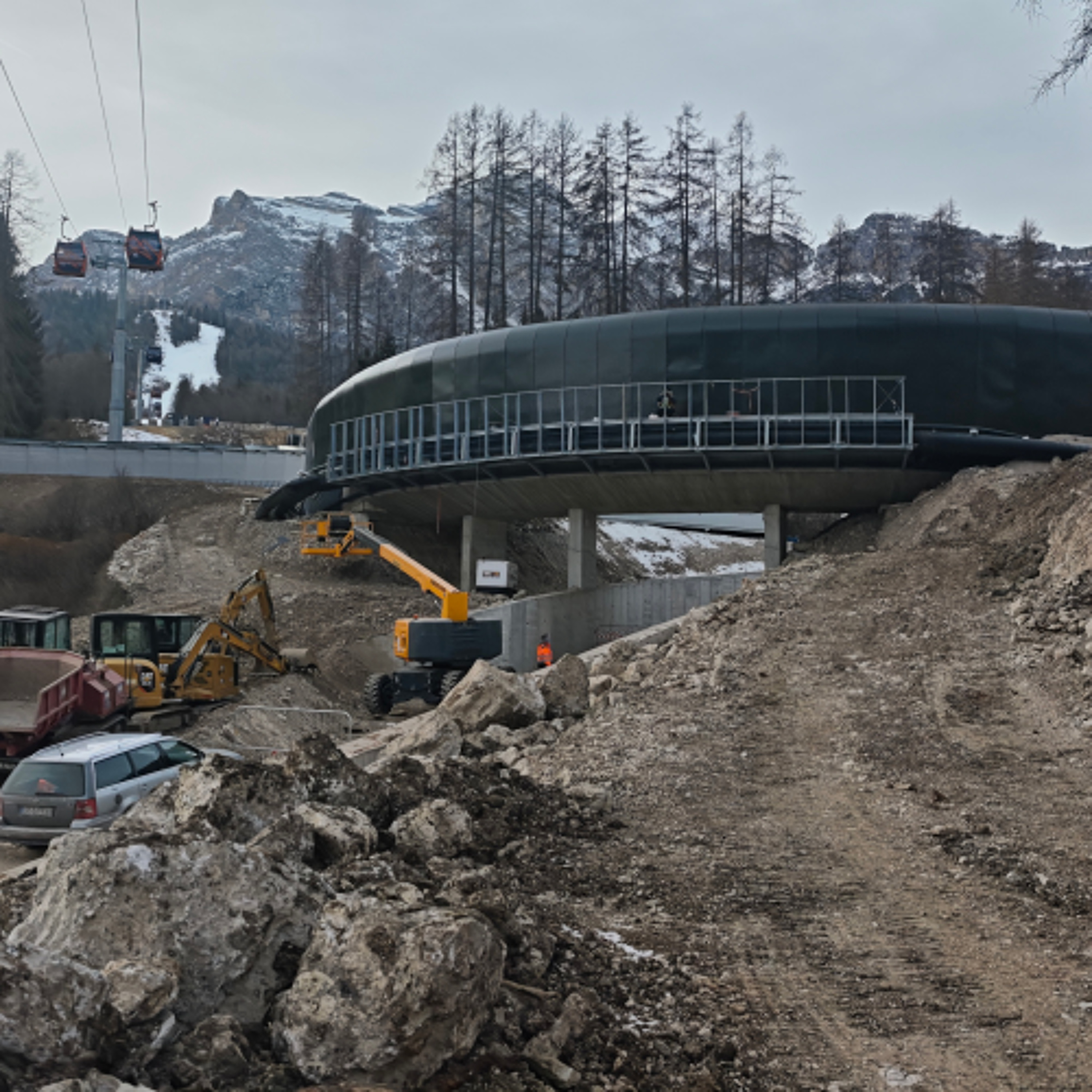
The candidate's dossier really promised about sustainable gains with low cost and low environmental impact, but the cost increased from zero to more than three and half billion hours. Existing facility were meant to be used, instead most of them were completely rebuilt. As for example, the Bob's Lake track cost over under 20 million, add a devastating impact and we don't know if it can be used in the next year due to the operating cost. A new cable car, considering it is essential for the game, has not completed, while environmental consideration were applied to the organization of the competition, the construction of venues and roads, had an hard impact, land consumption, deforestation and the EV use of water and energy, EV use of concrete and steel.
To add the environmental impact, they tried to keep the organization of the race separate from the construction of the facility, but it's not correct. Obtaining the tailored data as impossible so far, we can talk about lack of transparency from the organizer. Yeah, and exactly in response to this lack of transparency by the organizers, Citizens Network called Open Olympics, 2026, was formed with 20 partner NGOs, including C-Pritally. The network published several reports.
What are the most important findings of these reports? The most important effect is that at least we obtained a web portal listing all the projects and their costs. The network was able to analyze mainly cost-related and aspect, because environmental data, such as CO2 consumption for each individual project, was not available. We were able to verify an increase in cost in general, and we were able to verify that only part of the works were completed before the start of the game.
Consider that over 50% will be completed afterward, with the last construction site scheduled for 2043. These are mainly roads, but also they need to complete the construction of the cable car from Apollonia to Socare-Pesser, for transport tourists. But the event was already done, and every part of the Bob's Lake track is waiting to be completed. Inhabitants of Cortina and Milano were also complaining, and some were even protesting.
Why? The reason that Bush hid the population from Milan and Cortina to protest, I think, above all, our lack of involvement of the population with the children imposed from above and very little transparency, especially in mountain areas in Veneto. In Lombardai, part of the population is not satisfied with being on stage for the show, but they would like to see solutions for the problem that have existed for years, such as public service. They are aware that a lot of money has been wasted, and the problem is not resolved.
So a lot of money has been wasted, you say. This is also what the network of Olympics makes public. Olympics also aims to cooperate with French civil society. As the next Winter Games 2030 will take place in the French Alps.
L'Orin, the venues of the Winter Games in 2030, are planned to spread around me's at the Mediterranean Sea to Brion Sol, Ota Vois and Savois. As in Italy, many existing venues could be used, but the performance is critical about all this. Why? First of all, the map of the sites isn't official yet, and it's taking a lot of time to be published.
So we can wonder what's going on behind the scenes and what we already know that, for instance, the de Pertumont of Savois doesn't want to be part of the organisation for the time being anymore, because the budget and the funding of all these projects is not transparent enough, even for a de Pertumont. And other than that, while even though you spread out the sites all over the Alps, it doesn't mean that you're going to have snow. Infrastructure doesn't guarantee snow, so you're just spreading out the problem. And some sites, such as Nice are the Southern Alps, have you less and less snow, even more so than the Northern Alps?
So it's just multiplying the number of artificial snow infrastructure you have to renovate or upgrade to be able to produce enough snow all over the place. And maybe lastly, to answer this first question is, well, it's not the same problem really with infrastructure, is that even if we use existing infrastructure, it exists because it was built, even if it's built now, I mean, the norms and standards will have evolved. And in 2030, maybe it would already be obsolete if the equipment keeps progressing. So it's just also the ideas to not continue always renovating and upgrading and going forward with all this infrastructure and to find a way of really reusing the existing infrastructure without having all these projects around because they say they're reusing existing infrastructure, but there's still projects around and funding to upgrade and to put them up to their current standards and norms.
And maybe the worst would be mobility infrastructure, because it's not really possible actually anymore to build train lines or to build new roads. I mean, the space is very constrained. The SNCF has sold all the land they had, so it's not even possible to imagine building new train tracks. So on this point, we're especially critical because alpine mobility is complicated.
It's complicated in France, and we can't understand how they're promising sustainable mobility and to achieve bring everyone to all the different races and different events. It doesn't sound technically possible, and they haven't given us proof yet that they're going to manage to do it in a sustainable way. So infrastructure, one big point, and also sustainable mobility, where the IOC promises things that can't be done in reality. Ngo's transparency as well.
Ngo's in France pursue a lawsuit against the government concerning the Games 2030. What is the reason for this? There are several reasons. So one of them would be the financial commitment the state made.
We've had a lot of political turmoil over the last years in France with a lot of instability and decisions are often made by people who aren't in power anymore two weeks or two months later. So people are very critical of the budget and how the act of asking for a million of the Games to be in France, how that went down, because I thought on very short notice with people that leave and engage the public budget and the state budget over a long while. And so a figure I have in mind is that, for instance, the French take committed to 500 million euros, guarantee if the event was canceled, for instance. So there's that type of guarantee that's been signed and committed to and NGOs are very critical of this use of public money.
There's also the fact that as is very often the case, when you want to organize such an event and you have to manage to build everything on time, well, the policy makers sometimes are very often chooses to adopt a special law to regulate urban planning and environmental protection because for the needs of this event, environmental law is there for a reason, whether there be an event of tweets or two years or whatever it's not the aim of an environmental law to be flexible. And to come back to why and maybe the major point that's been buzzing in the press is a lack of public consultation and the fact that the French population wasn't consulted about these Olympic Games. And so what these NGOs have done is that they went to the Irish Convention, which strives to involve the general public in the organization of this type of major projects. The big news is that they were deemed heroable, but in any case the Irish Convention is taking this step forward after hearing out the NGOs and hearing out the French government.
And so at this point now, where at least it was recognized on some level that this lack of public consultation exists. So what could be the result of this lawsuit? It gets very technical after that because the Irish Convention is part of the UN and there's a lot of different origins involved that we don't always know about. But from what I've understood is that the French government, they're supposed to prove that they consulted the public.
And there's other points to that under the discussion, the fact that there was no overall environmental impact assessment. And what the NGOs are really counting on is the fact that the French government has to present alternative scenarios, I think, depending on the overall environmental impact assessment and what they hear back from the public. And for instance, one of Super France's member, Mounting Wilderness France, is hoping for the event to be cancelled all in all. And so that's still on the table for some of the NGOs, the canceling of the event, even though what I just said just before that would cost a lot to the public finances of France.
So what if the event, if the Olympic Games take place in 2030, what could French organizers of these games learn from Italy? First of all, there's a hidden cost maybe or the budget wasn't really realistic maybe in Italy or was it on purpose or not? I don't know, but that they should pay attention to their budgets, which is already exploding. I think they immediately did a good job or a better job than usually to point out the environmental impacts of the Olympic Games.
But I feel like we're still missing out on the social impact. So maybe it's not that positive, but it's looking at what happened in Italy, trying to do better on involving local populations or at least taking into account the social aspects. Because I feel like we've covered the topic of environmental impacts and especially concerning ski and ski resorts, like countries who have ski resorts, they should know the environmental impacts. So it's really concerning this major event that has no equivalent in the world to do better on the social impact.
And to collaborate with NGOs or at least networks such as Open Olympics, which is a really good idea. Yeah, the social impact, one of the big topics here for the future as well. How did you perceive media coverage in France about Milano Cortina? Because you also got some media requests.
We did and we got media requests from a very large panel of different medias, whether it be environmentally specialized or large audience or regional press, I was positively surprised. And it was interesting. And I feel like it was normal for the media this time to cover the environmental impacts. But I feel that even the March that took place in Milano, the first weekend that wasn't even like had any echo.
So okay, the word here is a bit of a mess right now, but still there was missing a part of the picture. And the Alps might face winter games again in 2038. Switzerland is in a privileged dialogue with the International Olympic Committee. After the last three bits failed in cantonal referendums, Swiss Olympic changed its tactics.
The competitions are to be held in all four language regions and the population will not be able to vote on the matter. Swiss Olympic promises that existing facilities will be used and that the games will be held in a sustainable manner. Something that we also heard about Milano Cortina. Tina, you are from Germany and you hold a degree in sports science and also in environmental and sustainability management.
So you know both sides of the coin. Enthusiastic for sports on the one side, but also the challenges for nature and society in the context of big sports events. Can large sports events such as the Olympic Winter Games be sustainable at all? So one of the things that stuck to me from my sustainability management degree is the trouble with the word sustainable itself because the term is really not defined anymore or never has been really.
So it doesn't have substance really the word sustainable. I mean everybody knows what direction it goes or what it's meant, but there is no clear frame. So that's the first problem. And then I think we've heard so many points, so many facts, so many things from Laurent and from Tresco already, which makes clear that from my point of view it's absolutely impossible no matter how you define the word sustainable.
First thing is you have people from all over the world coming to one place. So you have a great impact on mobility, on emissions from flights, from mobility all over the world. The second thing is the infrastructure. Well, okay, like Swiss claims now not to build any, but we also know it is impossible if you suddenly have to help so many people in so many competitions in one place, it is almost impossible, especially in the terms or in the regulations of the IOC because we still stack to the higher, bigger, further claim.
So there is no downscaling. And I think as long as we not start to do any downscaling and adapt to what we have instead of trying to only adapt what is there to the Olympics, especially when it comes to environment and to nature, we don't adapt Olympic games to nature, we adapt nature to the Olympic games. And I think that is a really big point in the whole discussion. And this is not yet considered to do the other way around.
We still have regulations, we still have the frame and in that frame it is not possible to help great and sustainable Olympic games. But of course, what is also mentioned is the enthusiasm for the sports, what it does to people, we've seen so especially in Italy. I mean, I've been crying in front of the TV at some stage when Lina do a missed the first gate in her solemn competition or whatever. There is so much passion, there is so much emotions, that is great for people and we should find a way to transport and to keep this but just in a right way, in a way that fits for nature, for society, and for everybody.
And in my opinion, that means we have to start downscaling. We have a position paper about the Olympic Winter Games. And in this position paper, TIPRA is calling for a fundamental reform of the IOC and the framework for planning and holding the Winter Games. It sounds a little bit technical.
Francesco, why does the IOC need to reform? What do you think about this? The IOC must change. Just a suggestion for those preparing to organize next Olympic game in French, Switzerland, or any other country.
Make the candidacy the dossier bending because if the dossier bending as for Milan or Cortina is very well, but after the dossier, the city also changed completely. It don't make sense. And the CEO can't don't take a position on this because the candidacy from Milan and Cortina, I was able to see the dossier. But after five years, we see that the reality was completely different.
Laren, what do you think about this? If you think four years ahead about the next game, there are again big promises and the IOC always says, okay, we have new agendas, but we can't, of course, tell a government what they should do or should not do. So this is always a way for the IOC to keep its hands clean somehow. Sure, but while it's been complicated, just to put our hands also on the conversations and on the documents between the organizers and the IOC.
So I'm maybe going to focus more on ideas that I've been emerging in France. Inspiration, maybe for new guidelines or for what we could wish for, but it was interesting to see, for instance, that the Al Pangtoben France, they published a position that was to remind the Olympic games that they were in reference to a season. We say the winter in the pick games. And so the season comes before the organization and you have to adapt to the season you do the games in.
And if winter conditions aren't there, well, then you're supposed to adapt the Olympic games to the conditions you have. And I thought that was interesting because it's true that a lot of people were actually shocked by the ski jump in the Olympic games this year where you had those people on the side there pushing the snow away because it was less slippery than the artificial snow. And I think even as key jump perhaps it was hit by one of those blowing machines. So the public is also aligned, like the environmental impacts and the general public, the people watching the Olympic games are aligned on that topic is that it's a winterly big game.
So we're waiting for winter images. And other other people in France are also talking about, well, it's always in veterinarians, so we could also celebrate the mountain factor, but they are the mountain landscape. But in that case, the IOC has to allow us to or has to enable the evolution of the list of sports and you have to be able to take off sports and not just add new ones, because some sports could be stopped. And new ones could be added that are maybe more summer sports usually like trade or mountain biking, but that you could do on snow and you can have kind of this merge of whatever winter, spring, summer sports, but celebrating mountaineers.
And the last thing I wanted to add to is that maybe the problem is that it's a country, like everything is linked to countries. And we've also heard those voices emerging that enough with national delegations or celebrating sports persons, they're inspiring, that it's an individual performance, except when there's teams of course. But I've heard a bit of this maybe in reaction also to the current news in the world and all this nationalism rising, but that there should be less highlight on the countries, but more on the people performing. Yeah, that's really the three openings.
Maybe I would, if I see the IOC one day, first of all, I'd like to suggest maybe those different guidelines to inspire them to change their rules. Yeah, these are really interesting ideas, celebrating Mount Olympic Games, for example. Tina also Munich wants to apply for Olympic Games, it doesn't end, but Munich wants to apply for the summer games, which are of course way larger than the winter games. One could think this is not relevant for the Alps because it's in Munich, it's in a big city.
Is this the case or what's your point of view on this? No, definitely not, because Munich is so close to the Alps within an hour with a public transport drive, so when it comes to accommodation, or it might even be a venue there if it comes to mountain biking, we don't know yet, but for sure you will have the traffic in the Alps, you will have more people there, so it will definitely have an impact. And then what we talked about now the last couple of minutes is the whole structure of the IOC, and in this case the IOC, as far as I know, tries to keep the costs for the applications down, and what happens in Germany now is they have four places where they could be held. They all ride a concept, they all have an application, which costs a lot of money in Munich, it's been 8 million so far, only for having an in-nother term in application.
Thank you for this resume concerning Olympic Games in Germany, thank you, Kristina, thank you, Lorena, and thank you, Francesco, for these insights on the Olympic Winter Games. Check out also our articles about Milan-Cortina on our website, tepro.org, there you can find also our position paper with our claims for the reform of the Olympic Winter Games and the International Olympic Committee. One thing is for sure, the Alps cannot afford another decade of broken promises, they are more than just a playground for the Olympics. My name is Michel Gums, and I hope you tune in also for the next episode of our podcast.
Cheers and have a nice day.