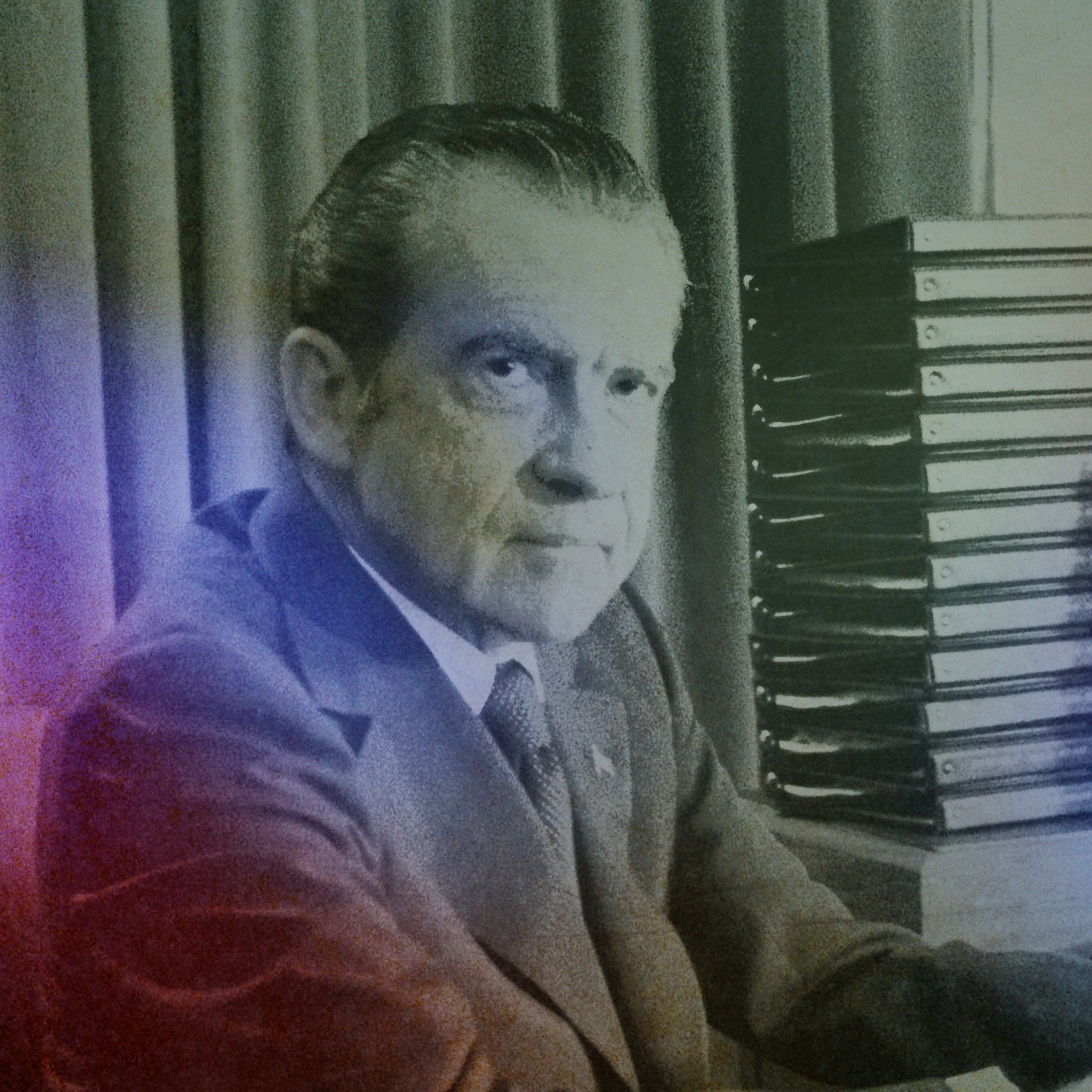
Hello and welcome to the rest of his history, there are bad reviews and then there is the obituary that the Gonzo journalist, Hunter S. Toxin, gave President Richard Nixon. If the right people had been in charge of Nixon's funeral, his casket would have been launched into one of those open sewage canals that empty into the ocean just south of Los Angeles. He was a swine of a man and a jabbering dupe of a president.
Nixon was so crooked that he needed servants to help him screw his pants on every morning. Even his funeral was illegal. He was queer in the deepest way. His body should have been burned in a trash bin.
And as I read that, I hear the laughter from top historian of modern American, Dominic Samrok. Dominic, you gave me that quite. I'm not going to pretend to talk about it itself. Obviously a favorite of yours.
And today's episode, it's not on Nixon per se, but it's on Watergate and Nixon obviously lies at the absolute heart of that scandal. And I thought that maybe the best we've got had loads and loads of questions on this. But I thought maybe the way to kick it off is with a friend of the show, Stephen Jenson, who asks what is it about Watergate that has made the suffix gate synonymous with scandal. Compared to the alternatives, does it deserve the dubious honour of being the linguistic mother of all scandals?
Well, that's a great question, Tom. As you know, I've been looking forward to doing this since we started this podcast. And just on the Hunter of Stonson line, I used to get my students, we did a whole course on Nixon that ran all year. We had four hours every week just on Nixon in their third year.
And I used to get them to read that to be a bit of a right kind of comments on it. Hunter of Stonson actually travelled with Nixon in the 1972 election campaign. And they talked about it, didn't they? And they talked about it.
And they talked about it. Yeah, fair and lay them in the campaign drum. They talked about American football. Hunter of Stonson was astounded by Nixon's knowledge of American football.
So they did have a little bit. There was a little bit of common ground between the two of them. But, Stephen's question, which is a great question, Nixon is at the core of Watergate. So part of it is the character is this extraordinary Shakespearean character that we'll be talking about in a second.
It's also because I think Watergate is the first great TV scandal. So it plays out live on American television often. The Senate hearings are on TV every afternoon where soap opera is used to be. So there's this sense of this kind of melodrama and these extraordinary characters, I mean, we're going to come to some of these characters.
You know, the actual essence of the scandal is actually pretty small, but it comes to consume this sort of almost Dickensian cast of kind of misfits and eccentrics. And it's not the scandal, it's the cover up. That's the thing. Yeah, although the scandal itself is a pretty good scandal.
I mean, bugging your opponent's headquarters. And actually, it's also what the scandal reveals about the Nixon White House and Nixon's own bizarre and tortured psychology. I mean, I think that I like to think that this podcast is definitely the podcast for 70s political scandals. So we've already done the Jeremy Thorpe.
Yeah, which features dead dogs. Free machine mates. Free machine mates. But it is as British as a carry on film.
Whereas this is the scandal for Imperial America. It is. And I guess that that's why it has the resonance that the Jeremy Thorpe does. Well, it's the combination actually, Tom, you absolutely right.
It's the climax of what political historians call the Imperial presidency. So the Cold War presidency. But it's the combination of that with the humdrum, everyday, very human kind of almost petty resentments of Nixon himself that drive the scandal. I mean, I've got so much to say about this, but so much of it is about Nixon, because without Nixon, there is no Watergate.
He's at the absolute center of it. And lying at the center is his background and his all his concept resentments. So on that topic, we have we have a question from James Bagelie, who hope I pronounce his name right, how important is Richard Nixon's feeling of outside the status in understanding his actions? And do you both agree effectively, Dominic, do you agree?
But what links Trump and Nixon is that they're both driven by an anger towards a ruling class that will never truly accept them. Now, I think we should just part of the comparison with Trump. Okay, yeah. That question about about Nixon's upbringing, sense of himself as an outsider.
Important. It's very important. And this is great, because I can now launch into my hour long prepared biography of Richard Nixon. So as I said, I taught this course on Nixon that went all year.
And I, the first thing I got the students to do is to say, well, we're not going to call him Nixon, we should call him Dick throughout, because I really wanted to empathize with Nixon also just amused me in a very childish way. And I think getting inside as I say, you've got to get inside Dick's head. And I thought, I think that's absolutely crucial to understanding how the scandal played out. So let's talk about Nixon.
Nixon is born in 1913 in a place called Yorba Linda, California, which is this scruffy, sort of nondescript edge of LA kind of now suburb, but then kind of on the edge of LA quite rural. And he's absolutely one of those people that we talked about in California podcast and again in our Silicon Valley podcast, he's a white, he's a white Protestant kind of Midwestern American stock, and a little American, he is a quaker. And that's really important. So his quakers don't swear, they don't, they don't drink, they don't swear, they don't dance, they don't approve of kind of fun to put it bluntly.
So his parents, Frank and Hannah, they've moved from kind of the Midwest, and they are the classic kind of people who move to California, and it doesn't quite work out it, everything goes wrong. So they found a lemon ranch, and it doesn't work, they don't sell any lemons. And then they found a grocery store and a garage, a gas station attached to it. And it's really hard work, and young Richard has to get up at four o'clock and kind of load, I don't know, potatoes or whatever it is.
So he grows up in relative poverty. And this Midwestern family, Midwestern stock in California, there's this sense of disappointment that hangs over them in the kind of 1910s, 1920s, 1930s. He's one of multiple brothers, he's enjoyed this time, they're all named after, well, four of the five named after English King. So it's Harold, Arthur, Richard and Edward.
And then there's also Donald, who's, so which Richard is, is Richard Nixon? Richard the Lionheart's apparently. Not Richard the Lionheart's apparently. No, no, no, that's a great comparison.
Or indeed Richard the second. No, he's Richard the Lionheart. So two of the brothers died of tuberculosis, Harold and Arthur, and this kind of hangs over the family. It's quite a sort of grim environment, Nixon says in his memoirs his mother, his mother never hugged him or showed him any physical affection, but he could see from her eyes that she loved him.
So it was thick, it's a sort of very telling. So a kind of classic upper class British. Very, very, very so. So the difference is there's so poor.
So Nixon is that classic, classic thing, he's very driven, he's very bright, he does very well at school and he's offered a scholarship. I think he'll offer the place at Harvard. There's no doubt that he's very clever. And this is why Donald Trump comparison rather falls down.
He can't take it up because he's needed at home to help. And also because his brother is ill and his mum needs to look after the care and all this kind of thing. So Nixon goes to his local college, which he had college. And right there, you have the or you could almost say it also gets starts right there.
He is an out bit of an outsider, kind of a low middle class, kind of poor, relatively poor kid, although very bright, he talks later on about the laughs and slights and snubs that he suffers when he's there. He's not allowed, he's not invited to join the top fraternity on campus, who are called the Franklin's. I think we talked about this right at the beginning of the podcast series with Trump and Caesar and all that stuff. He's so he found his own called the orthogonians, the square shooters who are for the kind of outsiders.
And right there, you have this, he's got that sense. I hate to say this, Tom, but it's you and your your your yachting shoes. Nixon Richard Nixon is a man who goes through life permanently in the wrong shoes. There's even a Kennedy, there's even a very famous one.
Yeah, the right one that Nixon is told to do a Kennedy style photo of by his aides and he walks onto the beach and he's wearing his shoes are too smart. He's wearing smart kind of off the shoes when he should be wearing kind of, you know, deck shoes, your your your shoes. So that that nags at him the whole time. He actually does really well.
He goes to Duke Law School, he goes into the Navy, he's a left hand, he's very bright. Everybody says he's hardworking. Interestingly, one of the things people say about him at this stage is he's honest. So he's not unpopular, but he's just he's an outsider.
He's a he's quite a good ward, doesn't he? Yeah, he's a quartermaster in the Navy. So so so quick as don't fight either. So he could have so he could have.
Right. He comes out and his Quakerism, I think doesn't matter to him kind of theologically, as it were. Yeah, I think it matters culturally. And I think there's always this sense of a mix in that he's a bit.
Somebody's always having more fun than he is and he's missing out and it obviously becomes the Kennedys. And you can absolutely see, I mean, we'll come back to this point, but you can absolutely see he is that classic, you know, that the self made driven kid, very bright, who's conscious that he's missing out that other people have grace and elegance and he's he's never going to be James Bond. Okay, so so so just so he then he kind of gets into Republican. Yeah, because he's a Quaker, he makes and he has no Republican party because he's a Protestant because that's the thing that you do.
Okay, so just this idea that the kind of guy who's looking up at the elite. Yeah, I mean, that's I guess kind of something that is a feature of the Republican Party now, but not then you're right. Nixon's one of the people who who's unusual. It's unusual, isn't it?
It's quite unusual. And it's so it's in a sense is he kind of I mean, he's a kind of portent of this idea that the deplables again to sign up to the Republican a little bit, a little bit, he doesn't really emphasize that as much in the 1940s and 1950s, but certainly later on, he's he's the man who coins the phrase the sign of majority. He talks again and again when he's president about the little guy, the common man, all these kinds of things. So absolutely, he does that he's absolutely part of that kind of real and he's a big anti communist.
Yeah, so it's an interesting thing. Nixon right from the start is regarded as a deplorable himself by the kind of patrician liberal kind of democratic elite. He I think it's because California politics is pretty rough. He used his anti communism in 1946 and again in 1950 when he runs for the Senate.
He he always seems to this weird thing which I he always seems to fight a little bit dirtier or to be a bit more competitive than everybody else. And it's not just a question of substance, question of style, actually. So something that you would forgive in a more patrician who would then be able to make a joke about it afterwards. Nixon, there's always this stuff that he is he's always he starts to be perceived quite early on as kind of dark, jowly, over aggressive, says a famous cartoonist of the fifthist called Herblock who was always drawing him kind of climbing in or out of a sewer.
And then he really that's the thing that tops and picks up yes and he really disgraces himself in the eyes of the sort of patrician liberals. In the early 1950s when he exposes a genuine communist spy, a guy called Alja Hiss in the State Department. So I thought that was contested. It used to be contested, but it's not really contested anymore.
Sort of declassified Soviet archives show that beyond I would say reasonable doubt, I mean, some people disagree, but beyond reasonable doubt, his was a fellow traveler, probably a communist spy. Nixon exposes him in a very aggressive way. And this is perceived as you know, it's infrared. It's not what you do.
Alja Hiss was one of us very well educated, you know, lovely guest at a dinner party, Nixon's this god awful hick from you know, California. So people hold that against him, but that gets in the place as vice president Eisenhower. But then when he gets when he gets that ticket, doesn't he then run into problems again? He does.
He does. So this is a nothing scandal. It's a made up scandal, really, that he has been profiting from a fund by the public and donors in California. But he has the essence of Nixon's appeal.
So what Nixon does, Nixon terrifies that Eisenhower's going to drop him from the ticket, Eisenhower World War II General, because he thinks Eisenhower's basically made it clear that he thinks of Nixon as a kind of an aunt beneath his shoe. And yeah, he despises Nixon. I mean, he basically signs up to he's just Nick, he regards Nixon as an unfortunate necessity. So Nixon makes this unprecedented live TV address.
Right. Okay, so Dominic, we've mentioned the journey thought, yes, which featured a dead dog. Yeah, this features a live you can have a dog in every podcast, right? So this is a live dog.
Nixon, they were two great lines. So one of them, he basically says this is all nonsense. There was a fund, but I haven't brought it from it. You know, it's perfectly legal blah, blah, blah.
He says people that one of the most damaging allegations is that people say my wife, Pat has got a mink coat and he says she has not got a mink. She has a respectable Republican cloth coat and all across the land people are saying, Oh, I love him. And this wonderful. And then he says, now there is one gift that we have that we have taken.
He said, somebody read in the newspaper that my girls, Trisha and Julie, and they wanted a dog. And what did they send us in a box? They sent us a lovely dog. And the girls called him checkers and the girls love the dog.
And whatever they say about it, we're going to keep it or something. And of course, you see, high minded Tom Hollandish people across America are vomiting into their basket and sort of the earth, Dominic Sandrooks are wiping away manly tears and saying, what a man, what a family. So I think Eisenhower was one of these people who's vomiting into it, but he's forced his hand has been forced by Nixon. So Nixon then stays on his on the ticket.
And then of course, there's another great sort of crisis in Nixon's life. So in 1960, he basically inherits the Republican nomination from Eisenhower. Has he been a good vice president? He's been a good vice president.
Yeah, he's done more than any vice president before. I mean, Eisenhower treats him like dirt throughout and tries to get rid of him in 1956. But Nixon's like a sort of, he's like a cockroach. He can't be killed.
So Nixon goes on trips and stuff and people throw stones at him in South America. And yeah, so he kind of looks, he's fine. And he's right in the center of the republic. He's a moderate.
He's a moderate. He's actually not on the right. He's he's slap bang in the sort of sense. He fit perfectly into kind of the Tory party of the 1950s, actually, in England.
So he's the Republican against it in 1960. And he's against basically his worst nightmare. An East Coast, Patricia, incredibly handsome, you know, absolutely know the right choose to wear on it. Yeah, a man who's completely oversext, who's always wearing your shoes, a man who'd won the Pulitzer Prize for something that is somebody else had written for him, a man whose father had got his mates to do his university thesis for him, John F Kennedy.
So a man who's got all the grace and elegance and all the connections, everything that Nixon hasn't got. And Kennedy wins by this very tight margin after a debate in which Nixon has perceived to have done better on radio and famously worse on television because he looks sweaty and kind of jowdy and stuff. Shadde, exactly. And what's worse, what's even worse for Nixon is that he could have won that election, actually.
I mean, what I mean is he may well have won that election, but it doesn't Kennedy's daddy buy it. Right. There are allegations of vote stuffing in Illinois and in Texas. Maybe not enough, but enough for there to be a question mark.
And Nixon doesn't contest the results unlike Trump. Right. So I was going to say because we've already had the comparison with Trump raised. I mean, that Nixon doesn't contest it even though he thinks it might have happened for the good of the American Republic.
Yeah, for the good of the American Republic, fair. But well, it's partly that's also partly around people around him are saying, you know, this is the wind in the middle of the Cold War, you know, this is you shouldn't really contest it. And it's not like he takes ages to make a decision. He doesn't straightaway, he basically all very quickly, he decides he's not going to contest it.
And it is the right decision. It's the right decision. Yeah, it is the patriotic decision. And I think it's also the right decision from his own to career point of view, because of course, he does then come back eight years later to become the Republican nominee in 1968.
So he kind of sort of going off to become I mean, he does go off to become a new lawyer, but it's hard. It's not really in it. What he really wants to do is get back into politics. He has that he runs he runs for the governor of California.
He does in 1962. It doesn't really work out. It doesn't do well. No, at the end, he loses to Pat Brown.
And at the end, he loses it with the press. And he says, you know, you've got what you wanted. Well, gentlemen, you went and have Nixon to kick around anymore. And they will say, Oh, typical Nixon, sort of bad loser, he's such a sort of, you know, he's such a scumbag from the from your Belinda, of course, he doesn't have to behave.
But that aside, after that, he then kind of slightly reinvents himself as the kind of sane center of the Republican Party. So he basically just context for this context for this, I guess, going into 67, 68 is the counterculture, protest against Vietnam War, he's all that kind of stuff. Yeah. And he's he's a guy who wears business shoes to the beach.
Yeah, exactly. It's all about shoes, shoes and dogs. What is focused on? What are we really specialising?
That's absolutely right. So America feels like it's a culture war. The Democrats, it's the first of the last of the culture war is we would narrow a little bit, actually. Yes, a little bit.
The Democrats are tearing themselves apart. Lyndon Johnson's been sort of booted out because of Vietnam. You're right that the headlines are full of rioting, civil rights movement has sort of passed its peak and Martin Luther King has been assassinated and then Robert Kennedy says, and against that background, Nixon basically says, you know, I am the fifties in human form. I promise law and order.
He says law and order again and again. He says, yes, a secret plan to end the Vietnam War. You won't tell anybody what it is, but people say, oh, that sounds splendid. Yes, hurrah.
So he is elected quite a tight election, but it's fine. He gets in. Gets in. And okay, so yeah, so he becomes president.
And I think it's time for another question. This time from classicist who asks for most people, Nixon's anonymous of Watergate and nothing else. Did he have any significant political achievements during his presidency that would be overlooked or ignored? What would his legacy have been if Watergate had never happened?
Okay, well, that's a great question. So his presidency is very turbulent, but you could argue quite successful. So he takes office at the moon landing. So that's not that he must have enjoyed that because that was a kind of a thing.
He's been able to pocket. Yeah, he has probably has slightly mixed feelings about it because everyone knows this kind of thing, but you're right. He does he does sort of he congratulates the astronauts and stuff. He Vietnam completely overshadows his first term, trying to try to pull out.
I mean, basically he escalates in order to get out by widing the war into Cambodia, massive student protests throughout his whole first term. But actually, when you go through, I mean, I don't think I'm out on a limb. I almost all historians and presidents, you would say this. When you go through policy by policy, he's actually pretty moderate.
So his ambition is to be and these are his kind of words with his aides, the American, Israeli, a Tory man with liberal measures. And actually, you can look at lots of things he thinks about having a guaranteed income, which is a thing that people talk about now. Sort of left wing idea. And Dominic, can he, I mean, he'd been a favor civil rights?
Yeah, he's pretty moderate. Exactly. He's pretty moderate on civil rights. When it suits him, he bangs the law and order drum and he sort of condemns radicals and all this kind of thing.
But by and large, yes, he is on the sort of moderate wing of the Republican Party on civil rights. He's keen on kind of the environment. I mean, he sort of mones and groans about it, but he does it. He goes to China, well, of course, this is about to go into his foreign policy, as she even says big things.
So he goes to Moscow and he goes to Beijing. I mean, amazing. And lots of people say only Nixon could have done this because he has the anti because he had the United States, had they recognized China up to that? No, no, no relations.
So basically, their relations were non exist, utterly non exist. They recognized Taiwan as just a matter. Exactly. So he did just a matter and gets into bed basically with, but I mean, the imagery Nixon on the Great Wall of China, Nixon in Beijing.
Great wall, as he says, Nixon had a clinking glasses with with Mao Zedong. I mean, that's that's extraordinary. And then he does the same with Reginev in Moscow. So this is the heyday of day taunts.
And he and Henry Kissinger, a secretary of state working great. I mean, this is basically their passion. They think they're reordering the world. And and actually they are, you know, the Nixon's meeting with Mao is the moment that China comes out of the cold.
And if you stand right back from this, that's more significant than anything Eisenhower, Kennedy, Johnson, did arguably. I mean, I know that American listeners will say, Oh, the civil rights movement is the big story. And of course, in many ways, it is for Americans. But in terms of world politics, Nixon has China is absolutely seismic.
Okay, and is that that's in his first term? Yeah. Right. So 72, he wins reelection.
Yeah, so we get to actually wall skate itself. Right. 72. Let's just let's just let's just go through what he does in his press.
So 72, the Democrats sort of they do a British Labour Party in 1983. So they nominate a very impressive and admirable man who's a ridiculous man to choose as your nominee. They nominate an uncle George McGovern. He was a bomb a pilot in World War II.
He's an app to historian Tommy's got a history PhD. He's a very admirable, decent guy, but he's a kind of on the liberal wing of the Democratic Party. He's the Michael he is the Michael foot of American politics. And right from the moment they nominate him, it's obvious that Nixon is going to win the Republicans call him the candidate of three A's acid amnesty and abortion and the Steve for World for Vietnam War draft of a business.
And we're going to have a shake the tag and what's Nixon wins this colossal landslide massive lands biggest Republican landslide, I think ever at that point. And if you want to clue as Richard Nixon's tortured psychology is this, what does he do on the night of that landslide victory? He goes alone to his study in the White House and he kind of turns off all the lights except this, um, it's at this desk light. So he's sitting like this sort of vampiric figure in the darkness.
He puts on his four of his favorite pieces of music, which is Victory at Sea, a sort of really kind of rubbishy 1950s, 1960s kind of classical soundtrack, imagining ships clashing in the in the in the storm. So he listens to that silent kind of alone head in his hands. And then he gets out of pad and he starts writing down what people will say about him about his failures. So he writes the opposition line will be R.
N. let down his party. All this stuff. If only he'd known what people would write about it.
I don't think I've done it. I think that's the perfect note on which to go take a break. Okay. So this episode is about Watergate so far.
It's like you and it's got to be done on your birthday. I know I know with the mopolea or whatever. I know but that's fine. I mean if it needs me we can go into another episode.
That's I think we're clearly going to have another episode. So let's take a let's take a break and then when we come back, are you ready to actually look at the point? I'm pumped. Okay.
Brilliant. Okay. Fabulous. When we get back, Watergate.
Hello. Welcome back to the rest of history. Our topic today is Watergate and in classic rest of history style. We've done a lot of an episode and we're yet to mention it.
So Dominic, Watergate. What is it? What's going on? So right from the start of Nixon's presidency, his administration had kept had started crossing the line in terms as we said before the break.
It's an era of intense domestic turbulence but it's also a era when they're in a war. Okay. Just on that the question from Guillermo Te Aveledo. We never get to Watergate.
No, no, but this I think this ties in. Richard Nixon's personality and anguish has been storied and abused but how much is he seeming paranoia against his adversaries justified? The US are on the height of radical mobilization by the early 70s. Is that the context?
Is Nixon feeling properly paranoid? Yeah, I think it's not the 1950s. I think that's a reasonable point. I mean, as Henry Kissinger famously said, even paranoid people do have enemies and they feel in battles at various points in his first term, the White House is literally surrounded by student protesters so they can't really go out and Washington is brought to a halt.
There are, there is some domestic terrorism by kind of far left groups like the weathermen in the late 60s, early 70s. There are the Black Panthers. I mean, all these things are kind of exaggerated a little bit within the Nixon White House. Yes, and Elvis offering to help bring him down.
So Nixon, I think Nixon genuinely feels that they feel they're in a war and they also feel that they can't trust the people around them. So from 1969 onwards, both Nixon and Henry Kissinger are constantly putting pressure on other people to find out who's leaking. They call for FBI wiretaps. Kissinger wants his own staff to be bugged to find out who's leaking to the press.
And in 1970, the Nixon administration, there's a talk, some of his aides talk about setting up their own intelligence service within the White House. Not the FBI, not the CIA, but answerable only to Nixon and his aides that will basically, you know, survey their enemies, subdue dirty tricks, all these kinds of things. And you get the first and how legal would that be? Very, very legal.
But of course, Nixon and his aides are saying to each other, the kind of people in Nixon's White House are really important. So they're not often traditional party political people. They're people who's brought with them from California, they're people who works in TV or advertising. They're loyal just to Nixon, not to the party.
So who are the most significant? So it's Chief of Staff, it's a man called H.R. Holderman. So I think he's a former advertising man.
He's loyal purely to Nixon. This is kind of a Praetorian guy. He's like the Berlin Wall is there called H.R. Holderman, John Ehrlichman, who is his domestic policy chief, a guy called Charles Colson, who everybody calls an evil genius.
Basically, he goes to tell everybody he's an evil genius. Right, I don't think I'm going to come in. Right, exactly. Who's his physical doctor?
Henry Kissinger, obviously, is his national security adviser. And a lot of these people don't have maybe not so much Kissinger, but the others don't have links to the traditional kind of press elite. They're not part of that kind of what we in Britain will call the Westminster bubble. They're outsiders.
Okay, and so again, that is kind of a parallel with Trump. Well, to a degree, I mean, Trump brings in kind of all people who I suppose to some extent, but I mean, actually this is that because some of these people are very bright people that Nixon has around and they're bright, talented self made people. I mean, they're not the kind of, okay, well, the corrupts and characters. But in 1971, they do their first really big dirty trick, the first antecedents of Watergate, which is there's been leaks from within there's been all these leaks about Vietnam.
And the guy called Daniel Ellsberg links the pentagon papers as they call this huge tranche of documents about Vietnam to show the government has been lying about Vietnam for years, but going back to Kennedy and Johnson, he leaks it to the press, Kissinger and Nixon say this is utterly intolerable and they get a unit within the White House who call themselves the plumbers because their job is to stop leaks. And the plumbers, burgle Daniel Ellsberg, psychiatrist in I think it's Los Angeles, to look for documents that will smear him. And that's the first real serious criminality, I would say, and doesn't Nixon know what they're doing? Well, this is the question we don't really know.
But I think it's, I think Nixon definitely, Nixon undoubtedly knows that something's going on because we know that throughout 1971, he is haranguing his men and saying, I need you to find dirt on the opposition, I need to go in and he comes and obsessed with this one think tag in Washington called the Brookings Institution, which still exists. He tells them again and again, I want you to get in there and blow the safe and find out what they've got. I mean, at one point, they have the Brookings, what, of the book, this thing, at one point, they cook up a scheme. What's he, what's, why's he, what's he doesn't know what they've got, but he thinks it might be interesting.
So, so at one point, I get to this, at one point, they're going to, he says, why don't you five on it, they have this plan to five on it, and then they'll all be dressed as firefighters, and they'll run in, steal all the documents or run after take plumbers and firemen. Yeah, and the guys he's got doing this are bonkers. So one guy's called Howard Hunt, he was in the CIA and he was one of the orchestrators of the Bay of Pigs, shambles at the beginning of the 1960s. So that's him.
The other man is even, even more interesting man, a brilliant man, and I'm uncle G Gordon Liddy. You aware of this man? He's the one who gets nailed for it, doesn't he? And he ends up being pardoned by Reagan?
I don't know. He's basically, he's an artsy, he's dead now, so I can say it. Because when the BBC filmed him for their Watergate documentary, he had himself filmed in front of this huge collection of guns, that's the end. And somebody who was involved with that said to me, well, that's the next thing that's bad in the next room, he had all like Nazi flags and pictures of Lenny Riefenstern and stuff.
I mean, he's an absolute lunatic, and he says on camera in the BBC documentary, you know, Richard Nixon had told me to go and assassinate such and such a columnist. I was poised to do it. I was waiting for the... Okay, so you've given the sketch of Nixon as a kind of moderate Republican, with a lot of domestic and foreign policy successes to his name.
I mean, clearly a very, very able smart guy. Why is he employing an artsy? I mean, I know what the counterculture with Hunter has Thompson answered to that. He's a fascist.
He is a fascist. But I mean, he doesn't sound like... Well, I think Gordon Liddy is a bit of an out eccentric and he's sort of strange and arts. I mean, there is a story that he started showing footage of Nuremberg rallies or something in the way out.
Trying for the Whills. It's not Ray's eyebrows. I think people just thought he's eccentric. They kind of smirked.
You know, I think they... I mean, the rest of them aren't artists. They're nothing like artists. They're actually pretty moderate Republicans as well.
But it's very not a strange line. It is a bit odd. It is a bit odd. But Liddy is a...
I mean, so they're hanging around. They're hanging around the Nixon White House and the presidential campaign comes around. And Nixon says to his men, because Nixon believes in fighting really hard, if not dirty. Even though he knows he's going to bet the gun.
But Tom, he's paranoid. He feels... He's always been taken away from him. He's always been cheated by the Eastern establishment.
And right at the beginning of 1972, he and he says, the committee to re-ear the president, they're actually the CRP, but everybody calls them creep now. Because they've just kind of... Yeah, great. Exactly.
They're having all these meetings. And Nixon says, you know, I need to find out that you're fighting really tough, that you're doing tough things. So Liddy and Hunt have this ridiculous plans. They've got Operation Gemstone, they call it.
I mean, some of it's absurd. They're going to deliver. I think they do do it. They order a thousand pieces of them, and have them sent to the Democratic National Committee.
Just loot the bill. Just loot the bill. Exactly. Just have to kind of bankrupt them.
Right. Just laugh. Liddy also goes into a meeting and says, I have a plan to, I'm going to hire a houseboat in Miami and have it staffed by the finest prostitutes in Florida. And then I will lure senior Democrats to this houseboat or whatever they will be.
Which presumably is playing into the kind of the dark, Quaker sense of... Maybe. Yeah. When Nixon's not in the meeting, the Democratic National is not in the meeting of the prostitute.
But you're right. I think, well, the amazing thing is that when you hear the Nixon people talking about this, as they do, have them in documentaries since, they don't just say, this was absolutely laughable. We're all wetting ourselves with amusement. They seriously consider some of these ideas.
And they allow Liddy and Hunt to these clowns to keep kind of walking around the White House or whatever. But it's suggesting mad schemes. I mean, it's a bit like all the CIA plans to kill Castro. Right.
They were loading cigar. Can't believe that these guys are zero. Remember, there was a seashell. They would plant a sea, exploding seashell that sea bat that he would pick up.
And there was also, they were going to get powder that would make his beard fall out, so that would humiliate him in the eyes of his Cuban fans. Yeah. I mean, you just don't know, whether people are sitting around in meetings just completely taking the piss or whether they genuinely think these good ideas. Anyway, anyway, so basically they're having all these meetings and they come up with a scheme.
They're going to bug the Democratic National Committee. Now, the amazing thing about this right is that at this point, it's pretty obvious that Nixon is going to win the election by a massive margin. He could just stay in bed for six months and he'd still win the election. It's bad.
Everything is a shambles. They break into the democratic. Okay. Okay.
So just before we actually do this, a question from Miguel de Mille. What did the president know about the break in and when did he know it? Is this being licensed by Nixon? I think it's highly unlikely.
We don't know about the whether how much he knows beforehand. It's highly unlikely that he knows operational details. On the other hand, it is likely that he knows they are going to do something. He knows they're up to no good.
He is the very man who has been telling them about firebombing think tanks. He's been leaning on them. He's been leaning on them. The pressure is coming undoubtedly from the top.
What are you doing? And in a way, it's that weird thing where, in any organization, they just basically need to be able to take a box that says have firebomb somebody, have order pieces to get Nixon off their case because he's pestering them. So they break into the democratic national committee in this sort of grim concrete monolith called the Watergate building, which is in Washington. And surprise surprise, the bugs that they plant, they break in underground kind of carbuck, the garage at the bottom of the building.
And the bugs don't really, I don't know, they don't work or they can't hear anything properly. And they say, we'll have to go back in and bug it again. So on the 17th of June, 1972, five men, I've got their names written down somewhere. If you'd like to know who they are, James McCord, Frank Sturgis, Bernard Barker, Virgillo Gonzalez, and Eugenio Martinez.
So they're basically the majority of them Cubans. They are people who worked for Howard Hunt when he was in charge of Bay of Pigs Cuban exiles CIA stuff. They're kind of weird, true believers. Yeah, they're kind of weird kind of Cuban exiles sort of hanging around on the fringe of the CIA.
Massively anti-communist. So if they're told they're doing a job for the White House, they'll be delighted. So they break him. And then there's this kind of comedy of errors.
So the doors are sort of self closing doors, self locking. So they have to put masking tape over the bolts. And the security guard who was his mate, Frank Wills, I think his name is, he spots the tape and he thinks, oh, that's weird. On the doors, he put the garage underneath the building and he takes the tape off.
He then goes off, they sneak back again and put the tape door back again. He comes back, they've gone. He spots the tape again. He thinks, this is really weird and he calls the police.
So the cops pitch up. They rest these five blokes, the walkie talkies. And what then happens is one of them in his address book has HH, Howard Hunt, the guy who was the plumbers. And the FBI start to, they think this is weird.
It's kind of some political crime. And they basically trace that number. And they're like, oh, it's a White House number. That's very weird.
So at that point, the interesting point, the interesting question, which some people have raised, I know, is at that point, what can Nixon do? What can the White House do? It's a difficult one. So six days after that, there's what's called the smoking done conversation, because Nixon is taping himself.
He's inherited a taping system from Lyndon Johnson. Why is he taping himself? Don't you take all your conversations, Tom? Well, I haven't the moment.
Not all. Why is he? I mean, that's a really good question. Previous presidents had experimented with taping, so Lyndon Johnson most obviously.
Nixon does it. It's a weird kind of self-protection, I think. If I record my conversations, they can't be used against me. I'll have control over them.
People won't be able to say things that I haven't said. That's a fatal flaw in that, isn't it? Yeah. Well, if you're saying something that's massively incriminating, you just make sure not to say anything stupid.
And on the tapes, what it means, actually, interesting about Nixon is, I think Richard Nixon is probably the most well-documented man who's ever lived. Even now, in there. Well, maybe, maybe, Special Media, and... Well, maybe, I don't know.
We have hours, I don't have private conversations. No. That's the gold dust, isn't it? But the interesting thing is we have conversations that are utterly rambling, inconsequential.
I mean, there's some of the hilarious conversations. Nixon sits there with his sort of the Berlin Wall, as they're called, Holdman, Erlichman, Kissinger, and so on. And often they're just wittering in a way that would make us look erudite. I mean, they are, Nixon is sort of saying, they're talking about how homosexuality brought down ancient Greece.
Nixon says he won't shake hands with anyone from San Francisco because they're all gay. They have these ludicrous conversations about which had more influenced television or Socrates. They're just sort of wittering. And Nixon is, and they're always, he's also slightly showing off to them because he's always got that thing of, he's the school swati wants to prove he's the kind of man's man.
So he's always... And he's the president, isn't he? Yeah, he's always kind of trying to show off and say, you know, but he's also trying to be more aggressive in reactionary, I think, than he is in reality. So he says lots of anti-Semitic things, lots of racist things, which people in other contexts have said, God, I can't believe Nixon could have been saying that because he was never like that.
But I think he's... It's like someone going on a cricket or... A cricket or? No, not a cricket or...
On a social media or something and showing off. Exactly. That's exactly what he's doing lots of the time. But anyway, that's a bit of a side track.
So on the 22nd of June 1972, he has the crucial conversation with H.R. Holderman, his chief of staff. Holderman basically says to him, he says, what's going on with the Watergate thing? Now I think that the way this conversation goes, you can read the transcript, suggests that Nixon didn't have a lot of prior knowledge of the burglary.
He knows they're his guys and he's like, what are we going to do to fix it? And Holderman says, well, it's not great. You know, the FBI tracing the leads, they've traced them to Hunt and Liddy. You know, it's going to come inside the White House.
And Nixon says, well, okay, here's how we can shut this thing down. What we'll do is we'll call the CIA, the head of the CIA and you say to him, call the FBI and tell him this is a top secret kind of CIA-ish operation involving our Cuban guys. Don't follow this. It's national security.
It's a whole can of worms. It's just a bit of a mess. It's also a storm and a teacup. It's nothing.
Don't get into it. Just back off. That's his plan. And that of course is the incriminating thing because that shows that Nixon is right then, trying to obstruct justice.
And that's the conversation, the revelation of that conversation, which we'll get to you later on, that's what really brings him down. In fact, that he knew straight away and he tried to stop the investigation and it strikes. Okay, Dominic, you said later on. We've recorded 50 minutes.
Have we? 43 minutes. According to my answer. Okay, well, I reckon that this, I think we should stop here.
And I think we should put another episode to follow on tomorrow. Okay. And when we come back, we'll look at the attempts to cover up how it comes out. Yeah.
And then how the process of the the the pardon and the afterlife of Watergate. Cool. I'm very excited about tomorrow's episode now. And the reason this pleases me is that you were very rude at me.
Because I didn't get to the battle of the moblion Salamis in time. No, you didn't. You didn't. I feel it's bad.
We did get to the Watergate, right? Come on, give me a bit of slack. Yeah, we did. We did.
You're better than me. All right. So, thanks for listening to this episode, guys. We will be back tomorrow with the aftermath of the Watergate break-in.
See you then. Bye-bye. Hi, everybody. We are back with another absolutely colossal update about the rest is history festival wise massive.
So on the fourth and fifth of July, we will be at Hampton Court Palace. We have a weekend of brilliant talks, live music, exclusive access to historic royal palace collections. And yes, Dominic, most exciting of all, this is the thing I have been pushing for. And I'm so looking forward to it.
We have medieval combat, a terrifying brutal, yet completely thrilling sport. It is going to be an unforgettable two days. It is indeed. And the core of the festival of these talks, we've got some more talks added to the lineup.
So I will be talking to the brilliant Tudor historian, Tracy Borman, about the secrets of the six wives of Henry VIII. I'll be talking to friend of the show in Irish National Treasure, Paul Rouse about whether there is an alternative universe in which Ireland could have remained part of the United Kingdom. We'll be talking to Katia Huia about Weimar Germany, and in particular, the town of Weimar through history. And Professor Adam Smith will be telling the story of America through three presidents.
And on top of all that, I'll be doing a special event with Ian Hislop about the history of satire. And I will be on stage with Mary Beard, and we will be talking about just how strange, just how alien, just how different to us, Rome was, or maybe it wasn't. I will be talking to Helen Castor about Elizabeth I, and we'll be discussing whether she truly was England's greatest ruler, or maybe whether that title should still be claimed by Athelstan. I will be talking to Ali Ansari about all things Persian, with Dan Jackson about the pit of death.
And I will be talking to friend of the show, Willy Dalrymple, about the links between ancient India and Greece and Rome. Absolutely incredible scenes. And of course, both days Tom and I will be on stage doing a show together as well. So on the first day, we'll be answering all our club members' questions, and then to close the festival, we will do a definitive ranking of the all-time top friends of the show.
So lots to look forward to. And beyond that, there is so much else that will be happening across the weekend. So think of it as the ultimate summer history hangout, and your tickets will give you full access to explore the great Tudor Palace of Hampton Court, and indeed the Royal Tennis Court. So that'll be very exciting.
There'll be food and drink for a king, which stands very enticing. I picture the very glamorous people that are our club members, and they're Summer garb, they're on the lawn at Hampton Court Palace, they're chatting about history and delightful surroundings sipping on a refreshing gin and tonic. And it's probably the most civilized festival there's ever been. I mean, that's what I imagine anyway.
Just a reminder, the tickets are exclusive to club members, and if you are not a member, now is the perfect time to join. So head over to therestishistory.com to sign up and grab your tickets, and of course have access to a whole range of supplementary benefits. Once you have signed up to therestishistory.com, all you do then is log into the members' area, and you select festival, and it's all very obvious. But you know what?
There is a twist. If you do this, you will be entered into a genuinely unbelievable prize draw. And that prize draw, if you win, you and three other people, is that the golden tickets in Charlie and the Chocolate Factory, because you will be given the chance to be upgraded to the premium experience. And the premium experience will give you, among other things, unlimited food and drink for free, all day.
Do not miss it. Can't wait to see that. Thanks for listening to therestishistory. For bonus episodes, early access, ad free listening, and access to our chat community, please sign up at restishistorypod.com.
That's restishistorypod.com.