
EPISODE · Sep 1, 2026 · 1H 11M
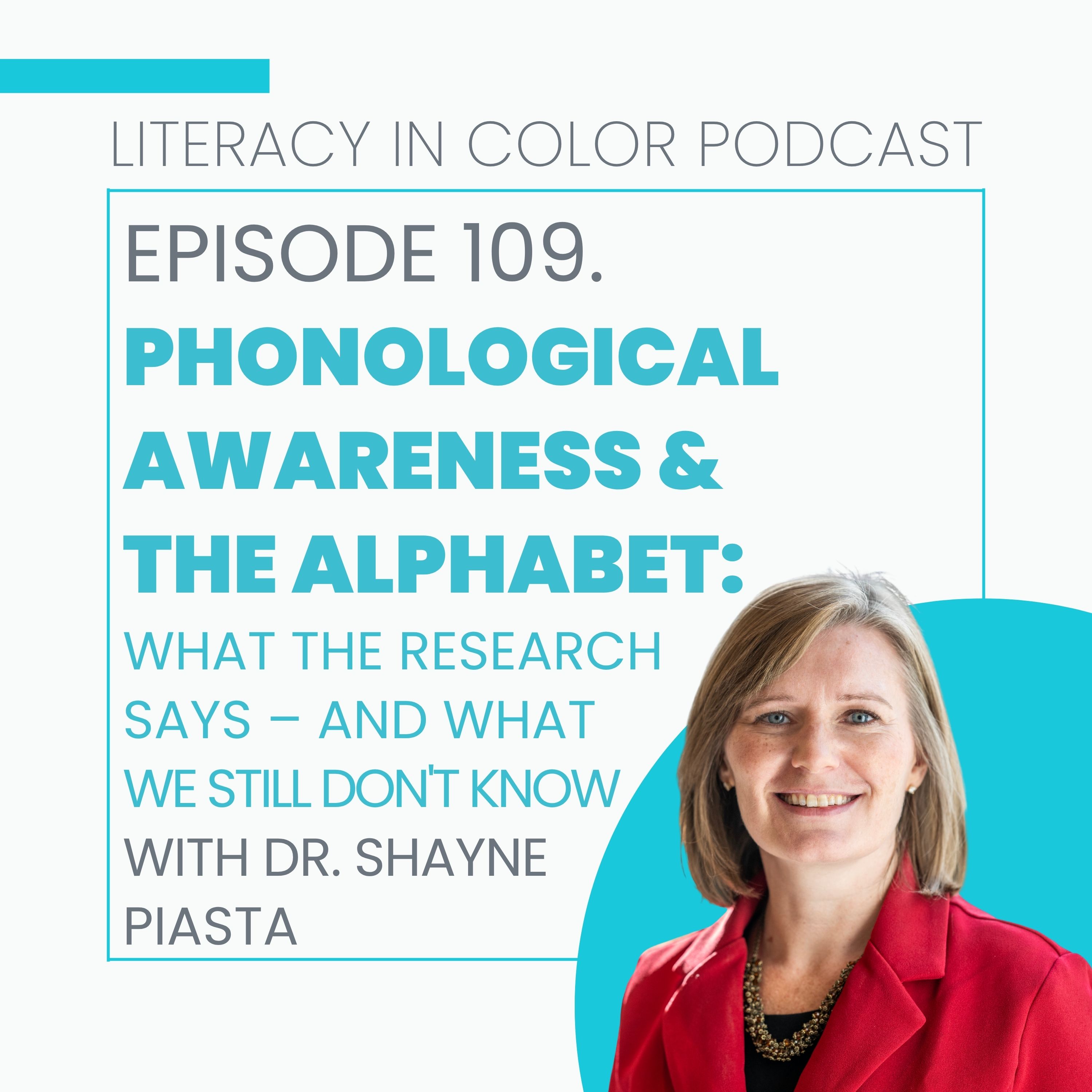
109. Phonological Awareness & the Alphabet: What the Research Says – and What We Still Don't Know with Dr. Shayne Piasta
from Literacy in Color: A Science of Reading Aligned Podcast for Educators
Before we get into what the research currently says about teaching phonological awareness and the alphabet, this episode begins by breaking down some key terminology. What makes a practice evidence-based? What’s the difference between research-based and research-tested? What should we consider when implementing instruction aligned with the Science of Reading?Dr. Shayne Piasta, Distinguished Professor at THE Ohio State University and Faculty Associate at the Crane Center for Early Childhood Research and Policy, helps unpack what we know, what we’re still learning, and how educators can make evidence-informed decisions.We then dig into phonological and phonemic awareness. Dr. Piasta explains what research has established about the importance of PA, why phonemic awareness ultimately matters for reading and spelling, and where questions remain about exactly how PA should be taught. We discuss larger versus smaller units of sound, advanced tasks, group size, dosage, incorporating letters, and even differentiation.Next, we turn to alphabet learning and instruction. Research increasingly supports teaching names and sounds simultaneously. We also discuss what makes certain letters easier (or harder) to learn, the acrophonic principle, letter sequence and pacing, and what effective alphabet instruction can look like in a kindergarten classroom.Finally, Dr. Piasta shares trusted sources for evaluating evidence and reminds us why evidence-informed instruction requires research, professional expertise, and knowledge of the students sitting in front of us.*Please Note: We experienced some audio issues toward the very end of the episode. We did our best to improve the audio quality and appreciate your understanding. Key Takeaways:Evidence-based vs. evidence-informed literacy instructionThe difference between research-based and research-tested practicesWhat we confidently know about phonological and phonemic awarenessWhat we still don’t know about the most effective way to teach PAInformation about Project OPAL and the questions researchers are currently testingWhether letter names or letter sounds should be taught firstAlphabet scope, sequence, and pacingWhat effective alphabet instruction can look likeInformation about CREATE-EBP and teacher-researcher collaborationHow educators can become better consumers of literacy researchResources Mentioned:Project OPAL: Optimizing Phonological Awareness LearningCREATE-EBP: Collaborating Researchers & Educators Apply Technology to Establish Evidence-Based PracticesDr. Shayne Piasta's Early Literacy and Learning Lab, including research, current projects, opportunities to collaborate, and a newsletterThe Early Literacy and Learning Lab Research Interest SurveyDuke & Martin (2011) - 10 Things Every Literacy Educator Should Know About ResearchNational Reading PanelRice et al. (2022) - Phonemic Awareness: A Meta-Analysis for Planning Effective InstructionErbeli et al. (2024) - A Meta-Analysis on the Optimal Cumulative Dosage of Early Phonemic Awareness InstructionAlphabet Learning & InstructionWhat Works Clearinghouse & Institute of Education Sciences Practice GuidesRegional Educational LaboratoriesBest Evidence EncyclopediaReading RocketsNational Center on Improving LiteracyThe Reading LeagueFlorida Center for Reading ResearchLet's Know! / Let's Know! 2 - language-focused curriculumConnect with Dr. Shayne PiastaLinkedInDr. Shayne Piasta's Early Literacy and Learning LabThis podcast is brought to you by Reading Science Academy, where our friend Stephanie Stollar is giving Literacy in Color listeners an exclusive, free grouping resource bundle designed to help you spend less time figuring out what to do with screening data and move more quickly into purposeful, skill-based groups. Get your FREE grouping resource bundle here.Or, become a member of Reading Science Academy to learn in community and receive research-backed support alongside over 1,600 literacy educators. Connect with Michelle:Visit: www.michelleandthecolorfulclassroom.comFollow me on Instagram: @michelle_thecolorfulclassroom & @logosliteracyacademyJoin our Facebook CommunitySign up for my NewsletterShop on TPT: The Colorful ClassroomFor Phonics Resources, grab: The COLORFUL Phonics ToolkitWant to Support the Podcast?Make a Donation to Support ProductionInterested in Learning More about Morphology?Logos Literacy Academy with Michelle Sullivan & Sarah PaulJoin: Beyond Phonics Club - our Membership CommunityMentioned in this episode:Reading Science AcademyGet your FREE grouping resource bundle here:...
Embed this episode
Ready to play
109. Phonological Awareness & the Alphabet: What the Research Says – and What We Still Don't Know with Dr. Shayne Piasta
No transcript for this episode yet
Similar Episodes
No similar episodes found.
Similar Podcasts
No similar podcasts found.