11. Du naufrage du Titanic à la bactérie qui dévore le métal episode artwork

EPISODE · Sep 4, 2021 · 34 MIN

11. Du naufrage du Titanic à la bactérie qui dévore le métal

from La Chaîne du Vivant - Chroniques de Biologie d'Yves Muller

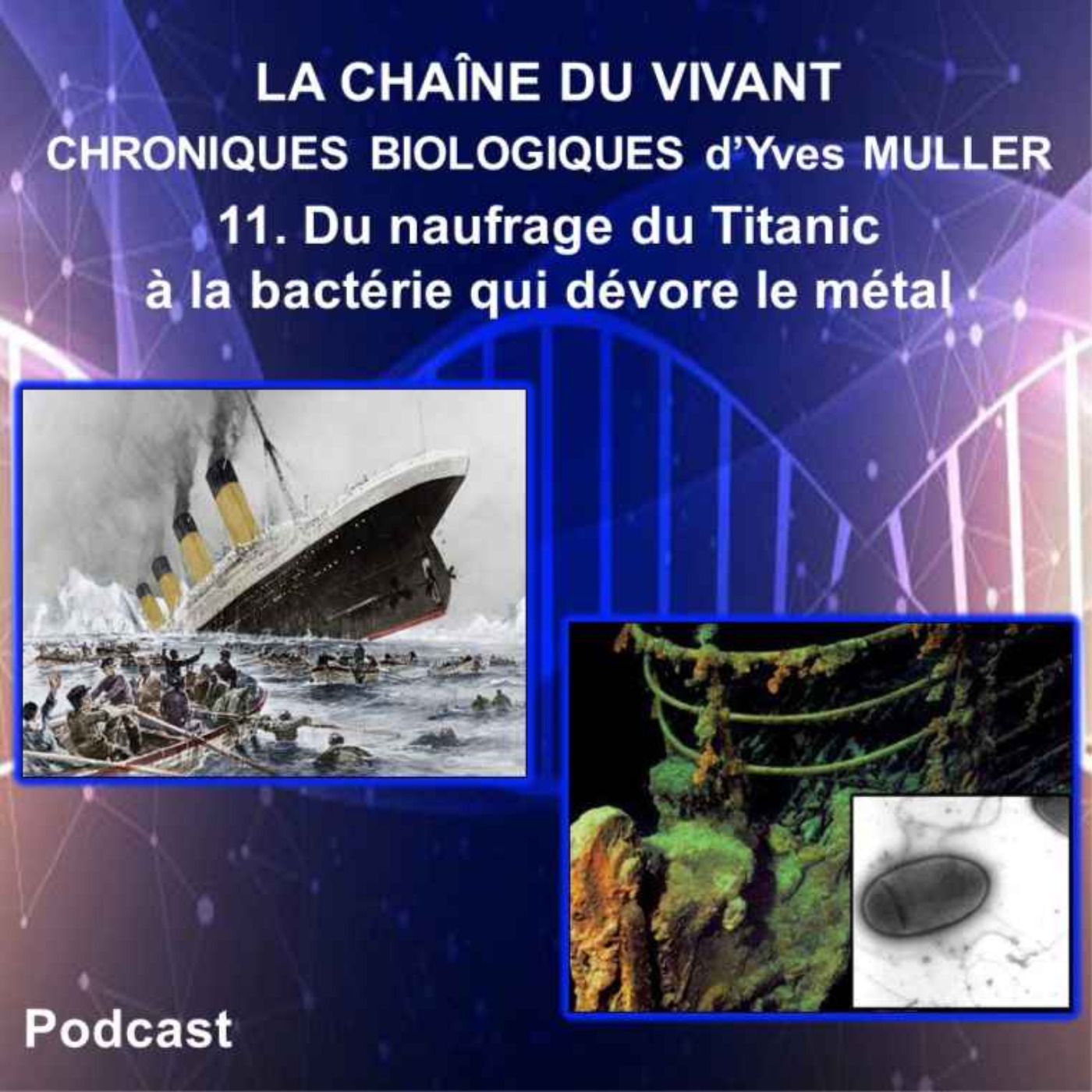
Cette 11ème chronique démarre le 10 avril 1912, avec le départ inaugural d’un immense paquebot transatlantique baptisé le Titanic et qui met le cap sur New-York. Mais dans la nuit du 14 au 15 avril 1912, le Titanic va malheureusement rencontrer un iceberg qui va provoquer son rapide naufrage. Cette chronique se poursuit par la découverte en 1985 de l’épave du Titanic, une carcasse métallique gisant à près de 4000 m de profondeur au large de Terre-Neuve. Cette épave est recouverte de sortes de stalactites de rouille. En 2010, une nouvelle bactérie est découverte dans des échantillons de ces stalactites de rouille récoltés auparavant sur l’épave du Titanic. Cette bactérie baptisée Halomonas titanicae est d’une part capable de supporter de grandes variations de salinité grâce à l’ectoïne qu’elle contient et elle est d’autre part responsable de l’accélération de la corrosion de la coque métallique du Titanic.Auteur : Yves Muller – Professeur Agrégé de classe exceptionnelle – Docteur en Neurosciences - Université de Montpellier11. Biological Chronicles - From the sinking of the Titanic to bacteria that devours metalOur chronicle begins on April 10, 1912, with the maiden voyage of a huge transatlantic liner called the Titanic, which sets sail for New York. During the night of April 14-15, 1912, the Titanic unfortunately strikes an iceberg, causing it to sink rapidly. Our chronicle continues with the discovery in 1985 of the wreckage of the Titanic, a metal carcass lying nearly 4000 m deep off the coast of Newfoundland. The wreck is covered with a sort of rust stalactites or « rusticles ». In 2010, a new bacteria was discovered in samples of these rusticles previously collected from the wreck of the Titanic. This bacteria, known as Halomonas titanicae, is able to withstand large variations in salinity thanks to the ectoine it contains and is also responsible for the acceleration of corrosion of the Titanic's metal hull.Author : Yves Muller – Associate Professor at Montpellier UniversityRéférences :- Galinski E, Pfeiffer H et Trüper H (1985) 1,4,5,6-tetrahydro-2-methyl-4-pyrimidinecarboxylic acid. A novel cyclic amino acid from halophilic phototrophic bacteria of the genus Ectothiorhodospira - European Journal of Biochemistry ; 149:135-9- Ballard R (1988) L'Exploration du Titanic - Glénat- Gérard Piouffre (2009) Le Titanic ne répond plus - Larousse- Sánchez-Porro C, Kaur B, Mann H et Ventosa A (2010) Halomonas titanicae sp. nov., a halophilic bacterium isolated from the RMS Titanic - International Journal of Systematic and Evolutionary Microbiology ; 12:2768-74- Zaccai G, Bagyan I et coll (2016) Neutrons describe ectoine effects on water H-bonding and hydration around a soluble protein and a cell membrane - Scientific Reports ; 6:31434- Dong Y, Lekbach Y et coll. (2020) Microbiologically influenced corrosion of 304L stainless steel caused by an alga associated bacterium Halomonas titanicae - Journal of Materials Science & Technology ; 37:200-6 Hébergé par Acast. Visitez acast.com/privacy pour plus d'informations.

Cette 11ème chronique démarre le 10 avril 1912, avec le départ inaugural d’un immense paquebot transatlantique baptisé le Titanic et qui met le cap sur New-York. Mais dans la nuit du 14 au 15 avril 1912, le Titanic va malheureusement rencontrer un iceberg qui va provoquer son rapide naufrage. Cette chronique se poursuit par la découverte en 1985 de l’épave du Titanic, une carcasse métallique gisant à près de 4000 m de profondeur au large de Terre-Neuve. Cette épave est recouverte de sortes de stalactites de rouille. En 2010, une nouvelle bactérie est découverte dans des échantillons de ces stalactites de rouille récoltés auparavant sur l’épave du Titanic. Cette bactérie baptisée Halomonas titanicae est d’une part capable de supporter de grandes variations de salinité grâce à l’ectoïne qu’elle contient et elle est d’autre part responsable de l’accélération de la corrosion de la coque métallique du Titanic.Auteur : Yves Muller – Professeur Agrégé de classe exceptionnelle – Docteur en Neurosciences - Université de Montpellier11. Biological Chronicles - From the sinking of the Titanic to bacteria that devours metalOur chronicle begins on April 10, 1912, with the maiden voyage of a huge transatlantic liner called the Titanic, which sets sail for New York. During the night of April 14-15, 1912, the Titanic unfortunately strikes an iceberg, causing it to sink rapidly. Our chronicle continues with the discovery in 1985 of the wreckage of the Titanic, a metal carcass lying nearly 4000 m deep off the coast of Newfoundland. The wreck is covered with a sort of rust stalactites or « rusticles ». In 2010, a new bacteria was discovered in samples of these rusticles previously collected from the wreck of the Titanic. This bacteria, known as Halomonas titanicae, is able to withstand large variations in salinity thanks to the ectoine it contains and is also responsible for the acceleration of corrosion of the Titanic's metal hull.Author : Yves Muller – Associate Professor at Montpellier UniversityRéférences :- Galinski E, Pfeiffer H et Trüper H (1985) 1,4,5,6-tetrahydro-2-methyl-4-pyrimidinecarboxylic acid. A novel cyclic amino acid from halophilic phototrophic bacteria of the genus Ectothiorhodospira - European Journal of Biochemistry ; 149:135-9- Ballard R (1988) L'Exploration du Titanic - Glénat- Gérard Piouffre (2009) Le Titanic ne répond plus - Larousse- Sánchez-Porro C, Kaur B, Mann H et Ventosa A (2010) Halomonas titanicae sp. nov., a halophilic bacterium isolated from the RMS Titanic - International Journal of Systematic and Evolutionary Microbiology ; 12:2768-74- Zaccai G, Bagyan I et coll (2016) Neutrons describe ectoine effects on water H-bonding and hydration around a soluble protein and a cell membrane - Scientific Reports ; 6:31434- Dong Y, Lekbach Y et coll. (2020) Microbiologically influenced corrosion of 304L stainless steel caused by an alga associated bacterium Halomonas titanicae - Journal of Materials Science & Technology ; 37:200-6 Hébergé par Acast. Visitez acast.com/privacy pour plus d'informations.

NOW PLAYING

11. Du naufrage du Titanic à la bactérie qui dévore le métal

0:00 34:12

No transcript for this episode yet

We transcribe on demand. Request one and we'll notify you when it's ready — usually under 10 minutes.

No similar episodes found.

Capsules d'analyse financière de Dominique Jacquet Capsules d'analyse financière de Dominique Jacquet Lebe deine Wahrheit Larissa Geiges Was heißt es eigentlich die eigene Wahrheit zu leben? Und wie finde ich sie überhaupt?Für mich bedeutet es, die ehrlichste Version von mir selbst zu sein. All die Masken abnehmen, mit denen wir durch unser Leben gehen, den Menschen zu leben, der man im Kern ist.Wir dürfen immer entscheiden welchen Weg wir gehen. Den Eigenen oder den, den andere für uns gewählt haben. In diesem Podcast nehme ich dich mit auf meine Reise und wünsche mir, dass du viele wertvolle Impulse für dich und deinen Weg mitnehmen kannst. Ich teile mit dir welche Schritte ich auf dem Weg zu meiner Wahrheit gegangen bin und welche Prozesse ich auch heute noch durchlaufe. Ich teile meine Struggles und Ängste mit dir und meine Erkenntnise aus all den Phasen, durch die ich noch gehe und schon gegangen bin.Ich freue mich sehr, wenn du Teil hiervon bist und ich dich auf deinem Weg zu deiner ganz eigenen Wahrheit ein Stück begleiten darf.Alles Liebe für dich,deine Larissa La Corrobra Canal Extremadura El espacio de la radio pública que pone en valor las lenguas autóctonas de Extremadura: el estremeñu, la fala y el portugués rayano.Con Juan Pedro Sánchez. 21 Millionen - Die Bitcoin Akademie Marco Eberle Bist Du bereit für Deine Bitcoin-Reise? Wir stehen vielleicht am Anfang einer finanziellen Revolution, und Bitcoin ist erst am Start seiner Reise.Hast Du Dich jemals gefragt, was hinter Bitcoin steckt und wie Du ein Teil dieser aufstrebenden Zukunft werden kannst? Hier bist Du genau am richtigen Ort!

Frequently Asked Questions

How long is this episode of La Chaîne du Vivant - Chroniques de Biologie d'Yves Muller?

This episode is 34 minutes long.

When was this La Chaîne du Vivant - Chroniques de Biologie d'Yves Muller episode published?

This episode was published on September 4, 2021.

What is this episode about?

Cette 11ème chronique démarre le 10 avril 1912, avec le départ inaugural d’un immense paquebot transatlantique baptisé le Titanic et qui met le cap sur New-York. Mais dans la nuit du 14 au 15 avril 1912, le Titanic va malheureusement rencontrer un...

Can I download this La Chaîne du Vivant - Chroniques de Biologie d'Yves Muller episode?

Yes, you can download this episode by clicking the download button on the episode player, or subscribe to the podcast in your preferred podcast app for automatic downloads.
URL copied to clipboard!