
EPISODE · Aug 31, 2026 · 39 MIN
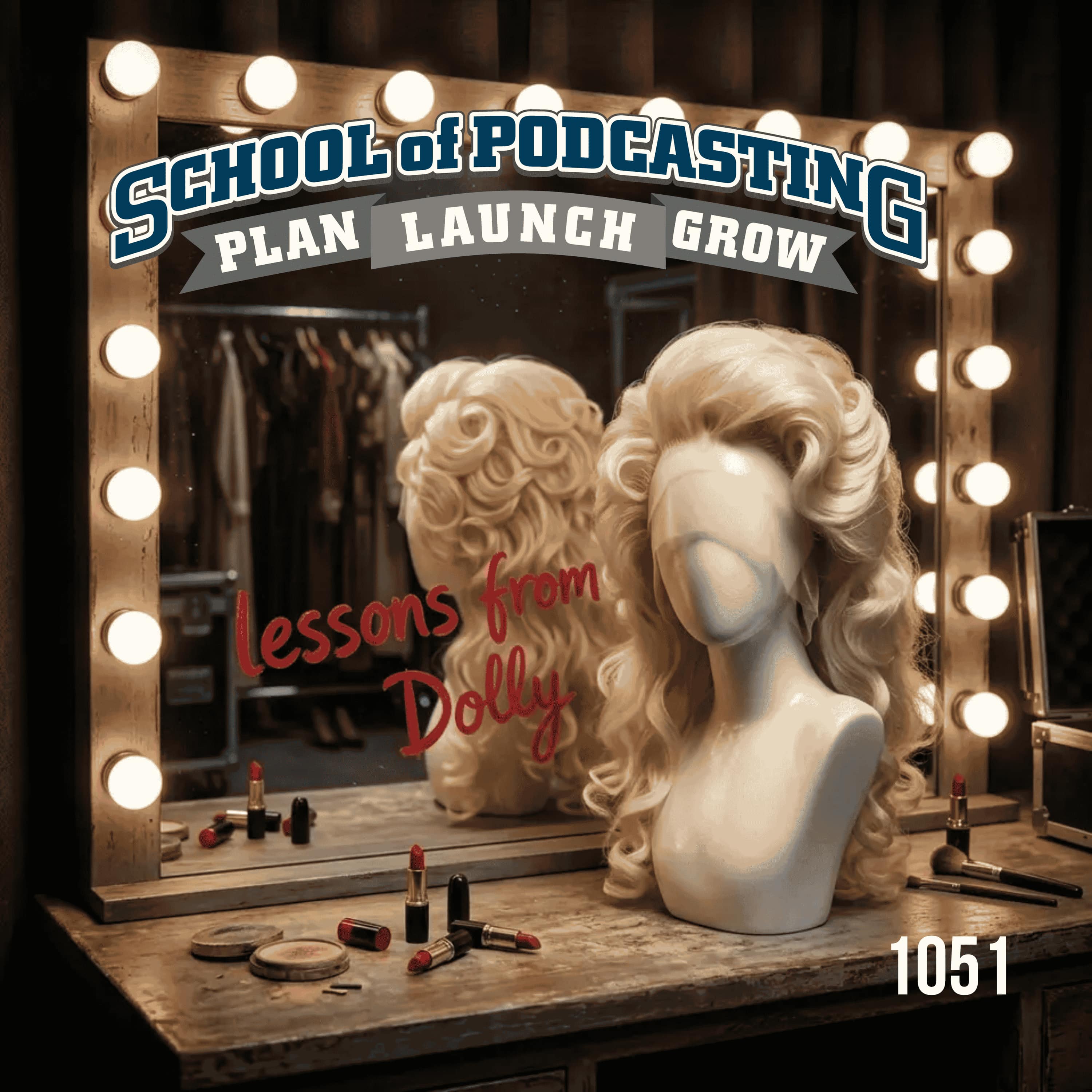
12 Business Lessons Podcasters Can Learn From Dolly Parton
from School of Podcasting: Expert Tips for Launching and Growing Your Podcast
Dolly Parton died on August 25, 2026, at age 80. While most tributes are focused on the music, this episode looks at something else entirely: Dolly Parton the businesswoman and entertainer. She sang at the Grand Ole Opry at 13 and was still building her empire seven decades later, which is rare in an industry where most acts have a five-to-ten-year run. As we like to say around here, success leaves clues, and Dolly left a lot of them. Below are 12 lessons pulled from her career, each one translated into something a podcaster can actually use.Take Advantage of Opportunities When They Show UpIn the late 1960s, a teenage Dolly landed a spot on the syndicated Porter Wagoner Show, earning $60,000 a year — by her own account, more money than she'd ever seen. She could have stayed comfortable as Porter's sidekick. Instead, she used the platform to build her name, and when she'd gotten what she needed from it, she left in 1974 to build something that was actually hers. Wagoner threatened to have her dropped from her label and later sued her; she ended up paying roughly $1 million to settle it, and the relationship took years to repair before the two eventually reconciled (American Songwriter, Cheat Sheet).Why it matters for your podcast: your show builds relationships, those relationships create opportunities, and taking advantage of those opportunities (a guest slot, a speaking gig, a collaboration) is what grows your audience — which creates more relationships. It's a loop, and it only works if you actually act when the opportunity shows up.Build a Podcast Brand People Instantly RecognizeYou knew Dolly when you saw her. Her wig, the rhinestones, the exaggerated glamour, her boobs, wasn't an accident. She said she based it on the town's "tramp."Dolly's response: I wanted to look like her. I thought she was beautiful. Her best line, "It costs a lot of money to look this cheap" says it all. When Barbara Walters pushed her on it in a 1970s interview, essentially implying she looked like a hillbilly, Dolly shot back that she might "kick her in the shin" and laughed the whole way through it.Why it matters for your podcast: a distinctive brand gets you noticed once. Celebrity, a striking name, a bold visual that earns the first click. What earns the return listener is the talent and substance behind it. Dolly had both, and so should your show.Own Your Audience — Don't Rent It to a PlatformDolly wrote "I Will Always Love You" in 1973 as a farewell to Porter Wagoner. When Elvis wanted to record it in 1974, his manager Colonel Tom Parker demanded the publishing rights as a condition for Elvis to record it. This was a standard (crappy) practice for an Elvis cut at the time.Dolly said no, even though it was Elvis. Nearly two decades later, Whitney Houston's version spent 14 weeks at No. 1 and sold an estimated 20 million copies. Because Dolly still owned 100% of the publishing, that single song brought her roughly $10 million in royalties in the 1990s alone, and an estimated $20 million total from the Houston version according to Forbes (American Songwriter).Why it matters for your podcast: As fellow podcaster Steve Stewart puts it, "Don't sell your audience to your sponsor, sell your sponsor on the value of your audience." The same logic applies to platforms: own your website, your domain, and your email list so no single network or app can take your audience away from you. It happens — YouTube pulled a top parenting podcast off the platform entirely (before reinstating it after public pressure). Dolly held onto her publishing because she knew the long game mattered more than a quick win. Hold onto your feed the same way. This is why an RSS feed is important. You can't be cancelled, and you can easily move to a new host if needed.Don't Take Yourself Too SeriouslyLong before a critic could land a joke, Dolly had already made it herself. On plastic surgery: "If I see something sagging, bagging, or dragging, I'm going to have it nipped, tucked, or sucked." Even the announcement of her passing carried her sense of humor forward, joking that she was finally ready to trade the rhinestones for something more comfortable.Why it matters for your podcast: self-deprecating humor makes an audience like you more. If you can laugh at yourself — a mistake, dated gear, a rough first episode — listeners relax and warm up to you faster. Have fun with your show. Otherwise, you'll burn out on it.Be Consistent — It Builds TrustDolly reportedly slept in her makeup in case she had to get up in the middle of the night for an emergency, because she never wanted to be seen without it. More importantly, she was always, unmistakably Dolly be it on stage or off, in an interview or in a duet, across 70 years of performing. People who met her said what you saw on stage is exactly what you got in person.Why it matters for your podcast: consistency isn't just about your publishing schedule (though that matters too) — it's about your output staying recognizably you. A listener who hasn't tuned in for six months should know exactly what they're getting the moment they hit play.Know Your WhyDollywood already existed under a couple of generic names before Dolly bought into it in 1986. She didn't just license her name and collect a check — she built it to bring jobs to her hometown region in Tennessee, rooting the business in something true about her instead of something generic and scalable. Today it generates an estimated $180–580 million a year, with her stake alone valued around $165 million.Why it matters for your podcast: plenty of celebrities slap their name on a generic product — a tequila brand, a theme park, a template — and it doesn't work because the "why" isn't real. If you're just copying someone else's show format and putting your name on it, it's probably not going to land. Know why you're actually doing this.Secondly if you put your name behind it, it better be a positive reflection of you (think about this when it comes to sponsors). If you say a product is great, and your audience buys it and it's not, they won't buy anything else from you as your integrity is shot.Experiment With New Formats Without Losing Your IdentityDolly moved from country into pop in the '70s (9 to 5 and more), then made the bluegrass albums she couldn't make earlier in her career because they were "too niche" — as she put it, "I had to get rich so I could come back and sound poor" (BrainyQuote). She went into TV, movies, and near the end of her life a Broadway musical. It was based on her own story, for which she wrote much of the score (so you could say she liked to stay busy).She initially tried to withdraw her name from Rock and Roll Hall of Fame consideration, saying she hadn't "earned that right," then was inducted anyway and leaned all the way in, dueting with Judas Priest's Rob Halford at the ceremony (Rolling Stone, Fox News). She later recorded "Please Please Please" with Sabrina Carpenter — a genre-crossing pairing where each artist's fans discovered the other (Rolling Stone).Why it matters for your podcast: every new genre, format, or collaboration was still unmistakably Dolly. That's the model — try new things, but stay recognizably yourself. And notice the audience-sharing angle: pairing with an artist (or podcaster) who has an adjacent audience introduces you to people who'd never have found you otherwise. That's exactly what cross-promotion with a show in your niche can do for you.Outsource What You're Not Good AtWhen Dolly wrote and starred in the 1986 TV movie A Smoky Mountain Christmas, she knew the script and the performance were her strengths — but directing wasn't, so she brought in Henry Winkler (yes, the Fonz) to direct (Yahoo News).Why it matters for your podcast: do the parts of your show you're genuinely good at and enjoy, and hand off the rest — editing, show notes, technical setup — to someone who does it better than you.Give Back to Build LoyaltyDespite her wealth, Dolly gave away enormous sums, saying she prayed for "enough to share and enough to spare." In 1995 she launched the Imagination Library in...
Embed this episode
NOW PLAYING
12 Business Lessons Podcasters Can Learn From Dolly Parton
No transcript for this episode yet
Similar Episodes
No similar episodes found.
Similar Podcasts
No similar podcasts found.