
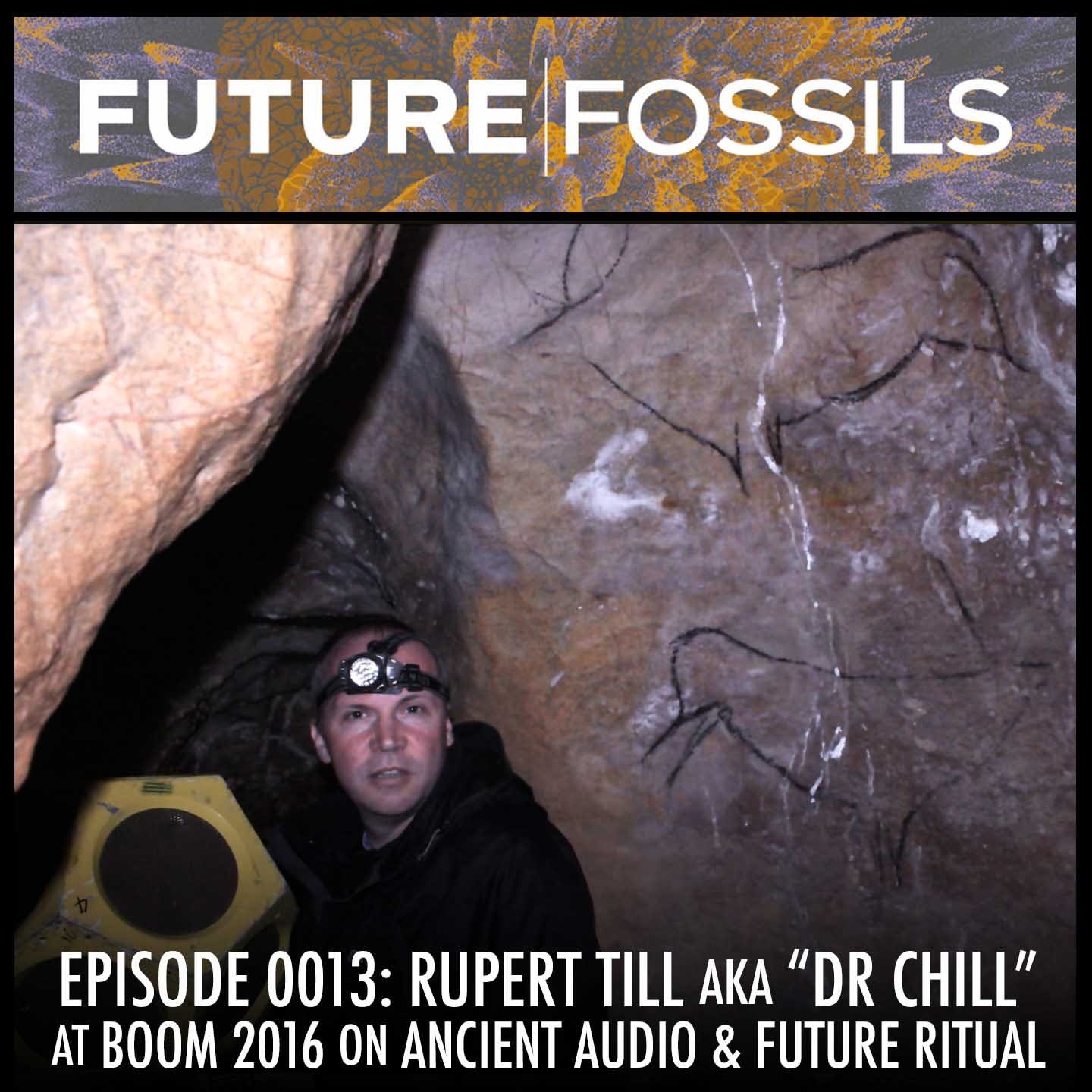
EPISODE · Dec 23, 2016 · 1H 5M
13 - Rupert Till aka Dr. Chill (Ancient Audio & Future Ritual)
from Humans On The Loop · host ✨ Michael Garfield
This week’s episode features Dr. Rupert Till, aka Dr. Chill, who does actually hold the world’s first PhD in Electronic Music. Dr. Chill also has a habit of reconstructing ancient acoustic spaces from caves and temples, then writing electronic chill out music with 3D printed replicas of the world’s oldest instruments. In other words, he’s a badass at the intersection of academic archeology and international dance festival culture. A pretty great place to be.Dr. Chill’s Blog:https://rupertchill.wordpress.com/Dr. Chill’s set from Boom Festival 2016: https://soundcloud.com/rupert-chill/sets/boom-chillout-gardens-live-setDr. Chill on Boom Festival and living on the line between academia and festival culture: “I keep saying to people, this is work. I’m not here on holiday…I’m here disseminating the results from a 3.5 Million Pound European research project.” * Support Future Fossils Podcast on Patreon: patreon.com/michaelgarfield *We discuss the intersection of minimal electronica and the music and instruments of antiquity. Designing interactive and immersive 3D environments with accurate acoustics, and rebuilding the experience of ancient music in digital space. We also get into a tasty back and forth about the need to reclaim lost technologies of ritual and ceremony as we move deeper into the mayhem of electronic media…“Understanding what was going on in the ancient past tells us something about what is happening today. I’m interested in looking at what was similar, then to now.” - Rupert TillThe similarities between modern and ancient humans, and the sense of continuity and kinship we can feel when visiting ancient sacred sites. I mention my talk from Liminal Village, which you can listen to here:https://evolution.bandcamp.com/album/how-to-live-in-the-future-at-boom-festival-2016How the human brain case shrank as a consequence of writing, and how Google might be shrinking our brains even further…oral cultures have a much more sensitive experience of hearing:“At night, when you’re in these caves, you can’t see much. So you’re using your ears ALL THE TIME to get around the place…we’re so surrounded by so much noise nowadays, I think we miss some of that. Some of the caves I’ve been in have been the most remarkable acoustic places because they’re so silent. They’re astonishingly quiet. They were so quiet that our noise meter couldn’t measure. It was reading the lowest it could read. The noise floor of the electronics was all it was measuring. [Then later, coming out of Lascaux Cave,] you go around this corner and this SCREAMING volume of the French countryside was astonishing.” - Rupert TillThe difference between the sensory deprivation of the cave and the noise and color of topside existence.“I can understand that when people went into the dark of the caves, that when they came out, they appreciated sound and people and light so much more. That process of journeying somewhere else, to go somewhere in isolation and them come back to the world, going into the liminal space and then returning again…I think it’s a big part of what’s happening at this festival and most. That rediscovery of ritual is another thing that’s going on in this re-enchantment of the world and this rediscovery of the technologies of the past that are useful today.” - Rupert TillMichael’s story of his overnight stay in a Texas jail and rediscovering the beauty of Texas upon his release. Understanding why the police feel the need to protect this place.How the American emphasis on future-thinking has divorced us from our rites of passage. Refusing a developmental opportunity, it appears regardless, as “horrible fate.” The nature of the infamous “Saturn Return” as the moment in which we’re caught up with all of our postponed developmental crises……and how entanglement with the War on Drugs may be the only modern rite of passage available to many Americans.RJ Stewart’s book The Way of Merlin and the recurring theme in esoteric initiation of being trapped and/or put underground.How we lost our ancient rituals because of modernity’s rejection of religion…and threw the baby out with the bathwater.How art and music may have been the technologies that bonded human communities together tightly enough that it enabled us to out-compete the Neanderthals.“The modern experiment has suggested, ‘No, no, we can just be individuals, have our own just-look-after-yourself world, and it’s the way forward.’ But that’s the kind of existential crisis of the modern world, isn’t it? Always looking for the new. New doesn’t always work.” - Rupert TillIf “any sufficiently advanced technology is indistinguishable from magic,” then hasn’t modernity failed to recognize the high technology of ritual??“Ritual…evolved with us as human beings, and in many ways is a much more sophisticated technology than any modern invention. We failed to recognize it for what it was, and we threw the baby out with the bathwater by believing that ritual was merely superstitious and not the enactment of a holistic cosmovision. That it wasn’t something essential that bound us to one another and to the world around us, and we ended up throwing away something upon which we rely. And now that we’re sort of liquefying the modern world into the postmodern ‘internet of things,’ and we’re experiencing this phase transition, we have this sort of NEED to reclaim all of these ancient technologies in order to stabilize ourselves as we move forward into a much more hyperconnected and communal space that’s organized more musically than it is rationally.” - MGThe complex structure of surviving rituals in electronic music culture.The importance of gathering the stories of our elders and transmitting them through generations.Different kinds of cultures have different kinds of festivals, but every culture has festivals of SOME kind…The essay I mentioned in which I discuss how you can tell a lot about society by the way it handles festivals:“Transformational Festivals Are A Symptom of Dissociation”The book Dancing in the Streets and electronic trance festivals as a reclamation of our original tribal identity as a species.“Our brain is just structured so it will go into trances…and they’re an important part of the psychic culture that we need to be healthy human beings.” - Rupert Till“One of the things that you need to go into a trance is the cultural expectation that it will happen.” - Rupert Till“Time is not the simple thing we thought.” - Rupert TillThe difference between optimizing society for humans versus optimizing society for machines.Specific music for specific functions, specific environments.Site-specific or “vernacular” music versus music without functional purpose and the movement from tribal to modern music and the disdain that some classical musicians feel for ritual/ceremonial music.Natural language interfaces will return us to an oral culture and immersive audio experience – “Writing just feels like an incomplete form of recording now that we can 3D scan things” – so presenting sound and visuals in three dimensions…“Looking and listening SHOULD be completely merged. And that’s the exciting future, for these things to be more integrated…so you can be in virtual spaces that are moving and shifting visually and aurally.” – Rupert TillAndroid Jones & Phong’s Microdose VR, HTC Vive TiltBrush, and other ways to dance simultaneous control of music and light…where movement meets architecture and we project vibratory glyphs into the space around us… Get bonus content on PatreonSupport this show http://supporter.acast.com/futurefossils. Hosted on Acast. See acast.com/privacy for more information. This is a public episode. If you'd like to discuss this with other subscribers or get access to bonus episodes, visit michaelgarfield.substack.com/subscribe
Embed this episode
Ready to play
13 - Rupert Till aka Dr. Chill (Ancient Audio & Future Ritual)
No transcript for this episode yet
Similar Episodes
No similar episodes found.
Similar Podcasts
No similar podcasts found.