
EPISODE · Jul 31, 2026 · 21 MIN
1361-Spatial Mapping of Species-Specific Erythroid Niches
from Paper Talk
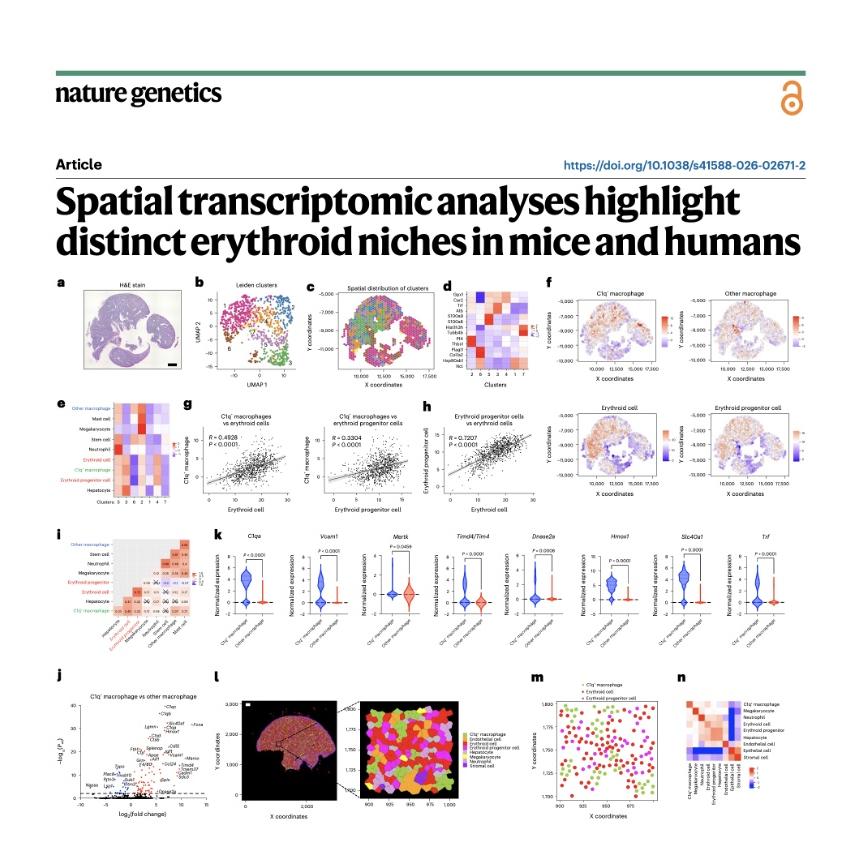
Research published in Nature Genetics utilizes spatial transcriptomics to reveal that the architecture of erythroblastic islands (EBIs)—specialized niches for red blood cell maturation—is fundamentally different between mice and humans. In mice, these structures are centered around C1q-expressing macrophages, which are essential for clearing discarded nuclei during cell development. Conversely, human EBIs in fetal livers and bone marrow often form macrophage-independent erythroid clusters that rely on the adhesion molecule ICAM4 for their structural integrity. These human-specific clusters are frequently disrupted in myeloid diseases but demonstrate the potential for restoration through medical intervention. By mapping these microenvironments at a single-cell level, the study challenges long-held assumptions based solely on murine models and provides a new framework for understanding human erythropoiesis.References:Han X, Ren K, Wang P, et al. Spatial transcriptomic analyses highlight distinct erythroid niches in mice and humans[J]. Nature Genetics, 2026: 1-12.前往小宇宙评论区与主播互动
Embed this episode
Ready to play
1361-Spatial Mapping of Species-Specific Erythroid Niches
No transcript for this episode yet
Similar Episodes
No similar episodes found.
Similar Podcasts
No similar podcasts found.