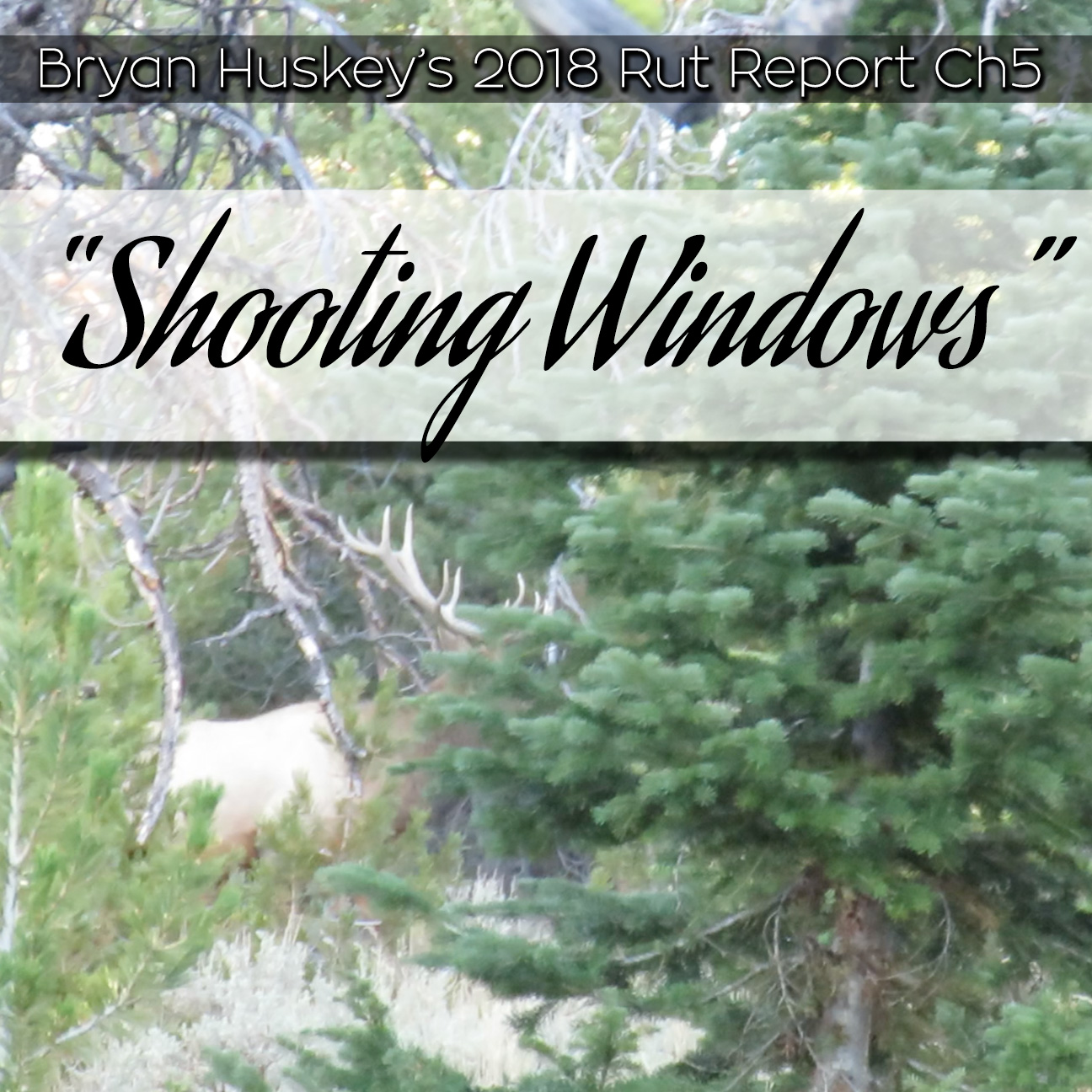
Later that day, after an hour or so of glassing distant ridges and with the luck of a few rogue bugles, I'd identified a small herd with a nice bowl holding court among them. I'd taken a huge loop in efforts of having a shot at this bowl, and the wind gave me the firm middle finger. Even beyond the middle finger, we referred to as the full hand of fingers we call the eagle. But as the sounds of hoofbeats faded, I knew I needed to be listening for bugles too.
Because under almost all but the worst herd busting scenarios this time of year, as a herd bull follows his harem of cows to relocate after being spooked, the bull will bugle. It's like he can't stop himself. I'm not sure if it's the simple stirring from what was a normal setting. The common behavior of broadcasting his presence is normal elk protocol when entering a new zone, or simply getting cranked up following the back sides of all his cows.
He just can't keep his mouth shut. And when a herd like this is relocating, it can also be helpful in the sense of just stirring the pot. If elk enter an area that's already occupied by other elk, there will be some level of dialogue between the groups, which can be at godsend in the middle of the day when everything else is otherwise quiet and tight-lipped. And sure enough, a short time later I caught the bull talking.
The dog-like bull talk was a muted compromise with a grainy thrust at the end, just making the statement that this was indeed a herd bull with cows entering the new neighborhood, and not merely a satellite bull searching for unoccupied refuge. From the sound, I could pinpoint exactly where he was, a finger of white pine forest, thinned by the expansive die-off that's taken place over the past 30 years. The finger was well defined, with nearly impassable borders except for the base, where another finger paralleled out with similar proportions and characteristics. A few minutes later I heard him again, this time on the gently crowned top, and pointing in the direction he might actually wrap around.
But right where he was at the moment would be what I'd guess was the herd's most likely place to stop in bed. It all depended on how hard they spooked. I could only imagine and hope that not that bad. From where they just departed was actually a way short of where I'd glass them, indicating they may have already been up and on their feet even before I arrived.
So with that, they may have actually seen or smelled me. If they only saw me, they could be close to calming down and resettling where they were now. If they caught wind of me as a totally foreign threat, they could push another mile, easy. But at least I had this last waypoint to work with.
It was a place that I knew I could begin to expect finding the elk. I put my head down to follow the herd and get back in the game. The best thing about following up is that they so often teach you the ropes of commuting. You see, they know all the trails.
And in a country that is this steep, rugged and rough, knowing the trails as a priceless currency. So as I trucked along behind the tracks, I took great curiosity and interest in just how a group of elk and hurry get from point A to B in this country. And the patchwork of trails we were now sharing was eye-opening for how I could maneuver in this country in the future. If I should choose to return.
The wind was so goddamn shifty. As I contemplated how I could plan my next move, the wind would blow completely opposite of the rising thermals. So the thermals would rise and then the wind would gust and push everything right back downhill. And for long enough, that scent could absolutely travel one or two hundred yards downhill.
I mean, in general, working with afternoon thermals is a no-brainer, right? The Elkron X, it's noon, you orchestrate your commute and approach to keep everything above, right? But these gusts were so strong, steady and relentless. Sure, I consider if a warm and rising thermal, scent on a steep slope would at least maintain elevation and insist on rising, even if blowing in the downhill direction.
Thus, in this scenario, ending up up over the head of any critter downhill, but also downwind. But I don't know that for certain. It's only something that I ponder. It is, however, way better, I'm sure, than trying to apply this logic to cold, falling thermals.
Regardless, once I'd closed the gap and was within half a mile or so of where I'd last heard the bull, I had to call the ball on what I was going to do. It was frustrating as hell. The wind was not just breezy, it was sincerely gusty, and pushing hard down the fingers of this canyon. With each break in the wind, thermals pushed air and reverse right back up the hill.
I analyzed this to death. I cursed the wind in every sense imaginable. I bumped a rag horn bull out of his bed at like fifteen yards and was a quarter of a second away from lacing him at thirty-four yards. I was losing my mind.
The most crucial element of bow hunting was having its way in a drunken tantrum. There was nothing I could do. I comprised this analogy in my head of dry fly fishing, that you're fishing a river with ultra-technical pocket water, currents, and scenes. And just when you drop the perfectly stacked reach cast to drift flawlessly into a trophy fish's feeding lane, all of a sudden, the river spins like a top and changes direction, which is a big deal because if the fish sees your fly drag in the slightest bit, it will spook and raise full speed two miles down river, if you knew which direction was downriver, because it's still spinning and changing direction.
This bull in particular had been biting fairly good on my fighting cow, a classic piece of hunting paraphernalia introduced by Wayne Carlton, I'd guess back in the early nineties. I'd purchased this call at Stentwise Drugs in Redmond, Oregon, back when they first came out. It was one of my prized possessions easily meeting my long-as-it-last criteria, which is a broad collection of items I've chosen to hold on to, rather than replace or upgrade simply as a pushback to consumerism or being duped into buying more shit for the simple sake of it being new. So as I moved from point to point in approach of where I'd last heard the bull, I chose the same call to make careful casts.
Quietly as possible, which is hard because if you're familiar with a fighting cow call, it's one of, if not the absolute loudest calls in the land, period. But I'd make a few wobbly meows with this call and listen. I'd listen hard, like eyes closed listening. One of my absolute pet peeves is when with another person and someone calls, then during the crucial period when intense listening is important, they shuffle their feet or dig into a pocket and pollute the air with rustling sounds, anything.
You call, you listen. What you hear will be unquestionably important to success, and what you do compromising that listening is an absolute crusher to those odds. At any rate, I just sent a few cow calls and during this listening, I thought I heard something. It was not the sound I was listening for, it was incredibly faint yet unmistakable.
Two consecutive sounds that I questioned as the sound of my chest mount binocular housing, rubbing against the top of my gut. Yeah, this gut thing is a real bitch of getting old, but it keeps my sleeper status staunchly cloaked. It was like the sound as if I just pushed my gut in and out. It was basically like the sound of clothing rubbing softly.
I stood like a statue for a minute or two following and could not hear the sound again. Yet, I couldn't replicate it either. After a few more minutes, I chalked one up to general weirdness and moved on. Working my way up a well-worn side-hill game trail, I frozen my tracks.
There it was again, that sound. I heard it this time clear enough to say with absolute certainty that it wasn't degenerant, and this time from my side-hill location, I could clearly place where it was coming from. It was straight across the canyon, maybe a hundred or so yards over on the next finger. As I strained to hear it again, a few additional muffled sounds rose from the repeating pattern of round clumps of dead trees mixed with living trees.
I could clearly see the general area and knew that something in the zone was making those sounds, breathing sounds, maybe huffing, maybe puffing, maybe a bull-help checking the scent of his cows, maybe a bear. That was my definite conclusion. I was hearing either a bear or a bull, but to be honest, I was completely perplexed. Because where I was standing, the slope was steep and northeast facing.
The air was cool and 99% shade in the dense timber panel. Elk trails, beds, and fresh sign were everywhere. Where I was looking, straight across, was torching in the sun. Equally as steep and quite rocky, it was northwest facing and taking a square and direct hit from the two o'clock sun.
Only a mix of white pine, dead and alive provided a broken patchwork of blotchy shade. It had to be 15 degrees hotter over there compared to where I was standing in the loamy, north-facing shaded timber. It just didn't make sense that elk would be there. There was no question, however, that I'd heard and pinpointed this sound.
Watching and glassing hard for close to 20 minutes, I could spot nothing. It made a lot more sense to be a bear working something that had died there than a herd of elk choosing this as their bedding location. Regardless, this was within a quarter mile of where I'd last heard the bull, so I plotted a route that would wrap me around through the crotch of these two fingers within slight parallel uphill and just above the zone where the sounds were coming from. As I closed into 100 or so yards of the X, I stopped in some sparse shade and knocked an arrow.
I had a weird feeling in my gut that despite the bright sun, crackling dryness, and lofting heat, something sort of creepy was at hand. It almost felt reckless, like playing with a rattlesnake or intentionally spooking a bear at close range. This was not an elky scenario. Trying to sneak into an elkord is super hard.
Trying to sneak up on anything wild is super hard, but this year was especially tough, being as dry as I can remember in my 28 elk seasons. I mean the basic ground of pine needles crackled so loud. A twig of any size snapped like a broom handle over your knee. Anything but hard rock or pure dirt was a non-starter for approaching any self-respecting wild animal inside of 100 yards.
This steep slope I was traversing however offered both. Rocks large enough to step quietly on, and bear dirt exposed from the slipping progress of gravity and erosion. At say, 60% stealth effort. I reached a point I felt confident was directly above the sounds I'd been hearing.
As I moved now and more of a sliding motion, my line of sight broke the plane of a large snake. In below me I spotted fur. It was dark brown and serpentine in shape, forming an S with an ear at the top. I felt a great sense of relief to resolve that it was not a bear, but indeed an elk.
Bedded and facing away from me, I seemed to have managed to sneak, putting me on location of a cow elk bedded below me. And I knew that this had to be the herd that I'd been pursuing that afternoon. By total chance, I'd already arrived inside Bow Range. The cow was below me at a very steep angle.
The first thing I needed to do was get an accurate range, given that I enjoyed this luxurious opportunity of being totally undetected. I was in the process of gripping my rangefinder with my left hand, while in my right hand I held my bow with mid shaft of my number one arrow carefully perched between my first and second fingers like a cigarette. As I was lifting the rangefinder from its holster on my binocular strap, the cow's gaze shifted quickly, and from the back of her head I could tell she was perking up to something approaching her. A shape was indeed breaking its way through the mix of dead branches, washed out bright light and contrasting black shadows.
I could make out enough to tell that it was the bull, maybe 20 yards out and moving right for her. The cow, by the way, was bedded in the center of a perfect shooting window. As wide as an elk but free of any rogue branches, she shifted her weight forward and rose from her bed, rump first. The bull was approaching her head on, and she stepped 180 degrees in her tracks to move away from the sniffing and snorting nose of the bull.
My eyes must have been huge as I let go of the rangefinder and grit my release while sliding it up my bowstring and clipping it around in the process. This bull was headed right for the only shooting window around. I came to full draw just in time as the cow stepped out of the lane and the bull stepped in. It was an absolute perfect shot.
He pushed loud gust of air in and out as he checked the cow who was now just out of sight. I settled my eye behind my string to see through my peep, but as I did, the bill of my hat prevented my standard anchoring position. I had pulled my hat down especially low and tight to my head as this entire stock had once again been peering directly into the blazing sun. I had to take a second entry, this time nudging my hat against the string to push it to the 1 o'clock position on my head.
Now I had my line of sight to the bull. I remember settling my pins just behind his shoulder, madly calculating what I guessed is arranged to be in the necessary compensation for the steep downhill angle. It was likely less than a second of contemplation before the sense of urgency took hold, and I assessed that with this shot all my appropriate pins were covering his vital zone. Basically, my 20, 30, 40, and 50 yard pins were all in the sweet spot.
Just send it now I thought. As my finger fell to trigger the release of my arrow, the bull stepped forward, going in deeper, maybe all the way with the cow. I hesitated. The shot I'd lined up and committed to was perfect, but in slow motion he was walking right out of it.
Barely. I stopped my finger from contacting the trigger and opened both eyes to see how much room I had before this shot was going to be a mistake. With reflex action, I dropped my finger and exhaled. The top wheel of my bow fell forward unimpended as the grip rotated in my hand.
I heard the sound of a hit. It was wet. It was definite. It was dangerous.
Dangerously close to reckless. I regretted the shot immediately.