
EPISODE · Aug 29, 2026 · 20 MIN
1508-Context-Dependent Action Encoding in Human Cortex
from Paper Talk
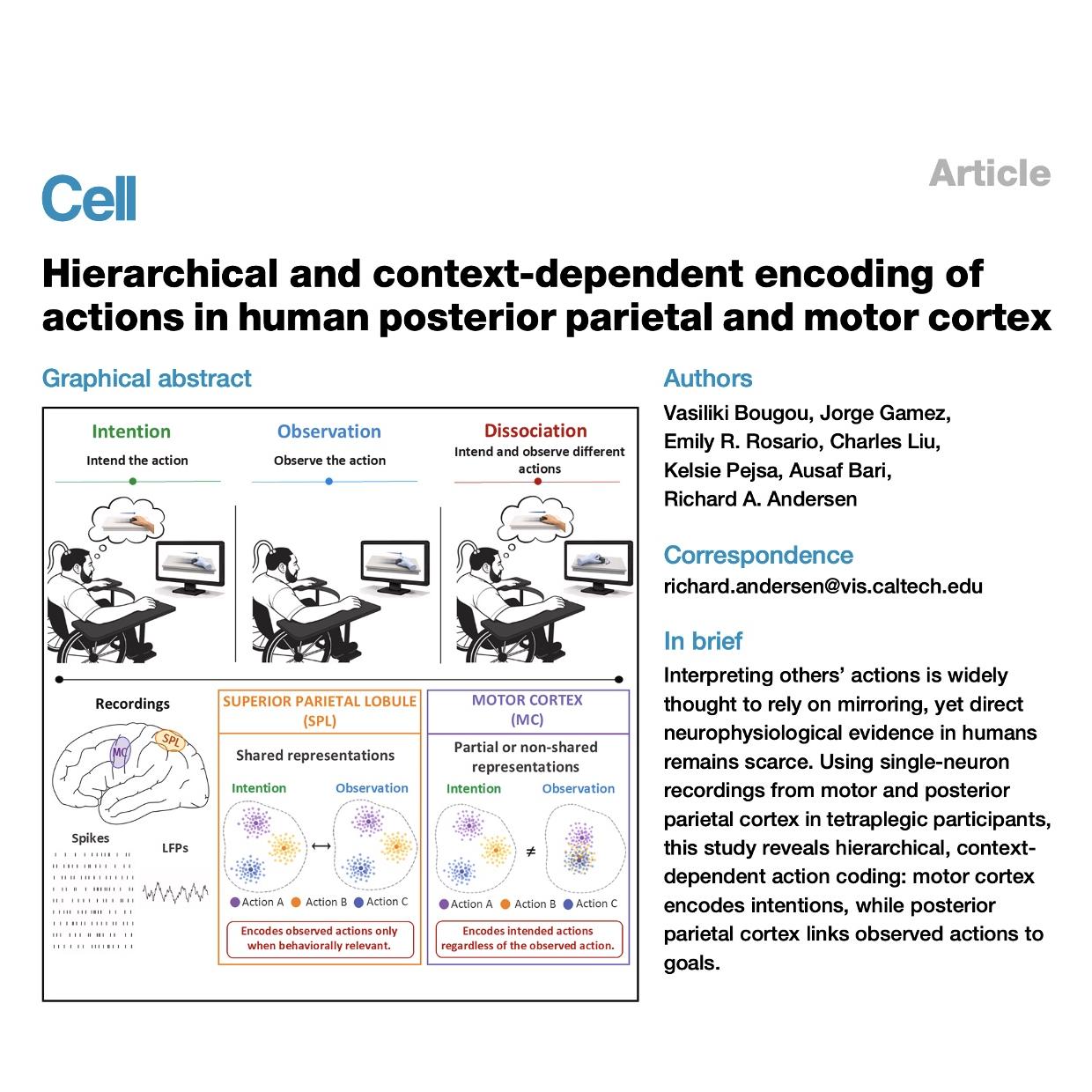
This research study investigates how the human brain processes intended and observed actions using single-neuron recordings from participants with tetraplegia. The findings reveal a hierarchical organization where the motor cortex (MC) primarily focuses on internal intentions, while the superior parietal lobule (SPL) maintains a stable, shared code for both viewing and planning movements. Unlike a fixed mirror mechanism, the SPL flexibly gates information, representing observed actions only when they are behaviorally relevant to the task at hand. Through population-level analysis and representational geometry, the authors show that parietal regions encode the abstract concept of an action rather than just its physical execution. This suggests that understanding others' behavior relies on context-dependent transformations in the frontoparietal system rather than automatic neural resonance. Ultimately, the study provides direct electrophysiological evidence of how the human brain integrates sensory input with internal goals.References:Bougou V, Gamez J, Rosario E R, et al. Hierarchical and Context-Dependent Encoding of Actions in Human Posterior Parietal and Motor Cortex[J]. bioRxiv, 2025.前往小宇宙评论区与主播互动
Embed this episode
Ready to play
1508-Context-Dependent Action Encoding in Human Cortex
No transcript for this episode yet
Similar Episodes
No similar episodes found.
Similar Podcasts
No similar podcasts found.