Standing now with a bright splash of red at my feet and much better to find tracks as well, I felt a giant weight lifted off of my shoulders. It was like hitting a reset button on the circumstance, and about anything was better than the hand of cards I'd been holding just moments earlier. Over an hour had lapsed since my shot, yet I still moved with great care and caution to be quiet. Given that I was standing in relatively thick trees and my general visibility was 50 yards at best, I opted to do something especially cautious.
Before taking another step and setting forth on this new blood trail, which was loaded with new and better outcomes, I paused to take time to reflect on what I was doing and the discipline I needed to adhere to. You see, the number one way to lose a wounded elk is to embark in tracking too soon and bump the bull from its bed while it's still alive. I've always said that when you shoot an animal, depending on the hit location, it may have X number of seconds, minutes, or hours to live. If it spends that time undisturbed wherever it's chosen to bed down, the odds of recovering that animal are at their best.
If it spends that time fleeing, jump from its bed, or feeling like it's being pursued, the odds of recovery fall off drastically. This is never more true than when dealing with a gut shot. If this bull was bedded and still alive, I had to do absolutely everything in my power not to jump him or tip him off. Undetection was by far the highest card that I was holding in this circumstance, that the bull the entire herd for that matter never knew I was ever there.
The bull was shot, but for all he knew a branch or something bizarre slapped him and he was now for some reason feeling very ill. The ten or so elk in the herd never knew that an assassin had infiltrated their camp. So now that I had identified what was indeed the track and heading of the bull, I needed to protect this, my only pillar of advantage, and find the bull without him knowing it, assuming that was he was still alive. First step in this process was to remain in place and just look and listen.
I lifted my binoculars and began scanning details of the tangled mess of rock, trees, and vegetation below me. Inch by inch, I scoured the limits of my field of view, most of which was around 50 yards out. Sliding along the edges of silver dead branches, blades of grass, and jagged edges of tree bark, I spotted it. Tan-colored hair.
I could not believe my eyes. I could only make out a small patch, hidden in a mix of all sorts of natural elements, but I was positive I had once again spotted fur. With further peering, practically climbing through the tubes of my binoculars, I peeled a few sections of antler from the layers of tree branches. It was him.
He was down and he was out. I had not taken a single step in this tracking process and I'd found my bull right under my nose this entire time. While my own guts twisted and dismay regret and self-doubt, the bull traveled only 50 or so yards from where I'd shot him, laid down and died. I could not believe this outcome.
I was entirely overcome with this belief. My shot was practically perfect. Perhaps a rib or two back from where I'd place it if I could walk up and stick it in by hand, but in actuality the resulting effectiveness of this hit somewhat back of the lungs was hard to debate. Apparently the bull was cordoning towards me a bit and my arrow took the back of his lungs before exiting out his guts, creating the dismeying evidence that I'd been wrestling with.
He was a nice 6x6 and just like last year, an active herd bull, the elkunter's ultimate challenge. I had little time to bask in the amazing luck however, as it was hot on this steep slope and I had a lot of work ahead of me, field dressing this bull and getting his meat into the shade to cool. As I ranged it, the bull had gone 52 yards from where I'd shot him, almost the exact distance of the shot itself. Yet I'd been pulled through the ringer of self-doubt and regret in the process of finding him, something I'm painfully all too familiar with.
Regardless, the victory was now mine, and I took just a few minutes to savor it, thank the bull in my own words, and snap a few photos. Field dressing an elk is no easy task, let alone doing it solo, and this fellow was on a heck of a steep hillside. I actually had to tie him off to a tree to keep him from sliding down the hill while I worked to break him down into manageable sections. I am a firm believer in the gutless method of field dressing, and worked quickly through the nine-step process.
Backstraps, tenderloins, and neck roasts would go out with me on the first trip back to Spike Camp. The four legs I bagged and propped against the nearby tree took a few leaks around it and covered them with my extra clothing layers for the night. This method has worked for me to deter bears, coyotes, wolves, or whatever from snacking on my harvest, all but one time at least. The next morning I left camp at sunrise, and about an hour and a half later arrived to resume the field dressing process.
On my way there, I saw the neatest-looking fox I'd ever seen. Compared to as a silver fox, this fell out lacked any orange, but instead had distinct panels of black and gray with perfectly tipped white tail. There's a super quick look at him in the video I mentioned earlier, which I encourage you to watch. Back at the bull, I worked quickly deboning each leg and combining that and all the other miscellaneous meat into the extra-large zippered pillowcases that I used as game bags.
Finally, I removed the head and stripped it down to minimal mass and weight. I'd spent considerable time plotting my best route getting the loads back to the truck, and the distance was substantial enough almost six miles that I opted to break the trip into two segments. I had three loads to carry, one of which would have to include my camp as well. It took all of that day to basically get two of the loads to my halfway point, then returned to spite camp for a final night.
On my trip back to the kill site for the last load, I noticed both bear and cougar tracks on top of mind following down the well-established game trail that negotiated the steepest cliff and shale slide sections of the journey. Times like that, I sure take comfort in having my late father's glock in my belt. Hey there, buddy. Hi.
Daddy's reading his old story. An interesting major I've come to recognize when considering hunting pressure, or just the general census of game is bones. In some areas, I'll come upon more than one scattering of elk bones a day. Others it's rare to find any ever.
Whenever I spot bones, I investigate what's left behind. If there are any saw markings or indications of whether it's a natural or hunter harvest. In this area, there are lots of bones. And with nearly every set I find there is a skull, sans antlers, and a top.
Makes sense in this country, where every critter has to be packed a long ways out. Now, I don't carry a saw with me. I used to, but once learning to be efficient and effective with a knife in the trickery of separating knee joints in the skull with knife alone, I quit carrying one. Plus, I really admire a totally cleaned and intact skull for display of my deer nelk.
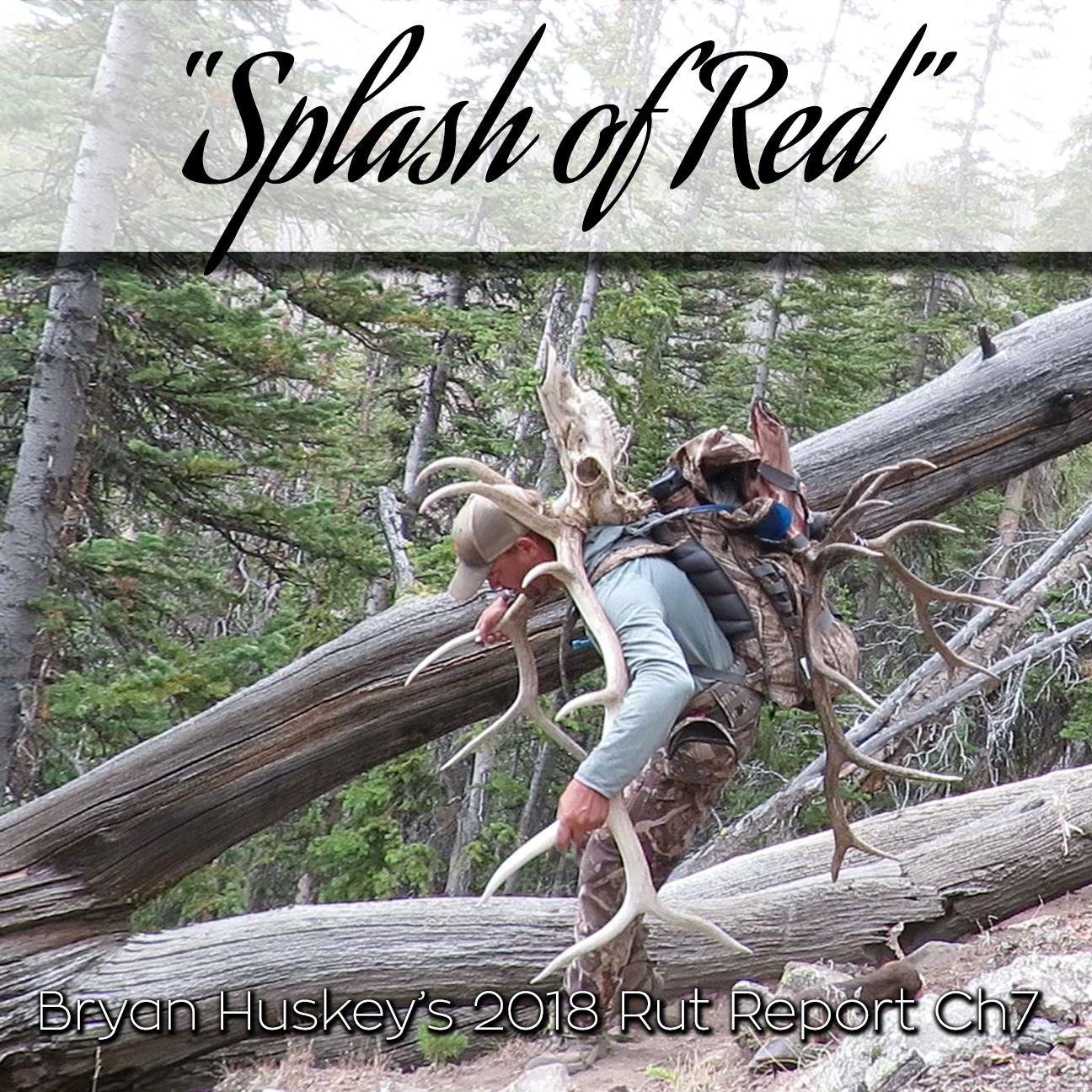
But in this situation, with loads so heavy and so far from the truck, I was really wishing I had a saw to simply cap the antlers from the rest of the head, a solid chunk of additional and non-essential weight to pack out. Lumbering through trees, branches, brush and logs with a decent sized rack added to all the weight of a heavy pack can be held. It's a kind of suffering every hunter hopes for, until it's realized. And then, my god it sucks.
My knees were weak, my footing was tenuous, and my eyes burned like hell as bees of sweat kept creeping into them. This was my final load, which included the bowl's head, and I was teetering as I tried to duck under while also stepping over a large downfall that had to be crossed. On the steep side slope, the antlers snagged on the tree both above and below my awkwardly bent body, like trying to fit between strands of a barbed wire fence and snagging your knee and backpack. As I worked to free myself to familiar white outlines of a skeleton caught in my eye, once upright I took a closer look, and there below me laid what I'd always hoped would accompany a scattering of bones.
A huge rack of antler. Holy shit I murmured out loud. I felt like the Newman character from Seinfeld, but in the movie Jurassic Park when he was slipping and falling in the wet jungle fleeing blosseraptors as I tried to carefully get down to the dead bowl. Struggling not to fall with my heavy pack, I reached the site and lifted the Magnum rack from the rubble.
It was a huge bowl, so wide with exceptionally long main beams he had died in the last year, the bottoms of the antler were still dark brown while the top surfaces were bleached white. Other than that he was undamaged, no broken or chewed off tines, as solid mid 300's bowl, but how the hell am I going to carry this? In my entire life, all the miles I've covered in the boonies I've never found anything like this. And here I am in the exceptionally rare scenario where my payload is not only maxed out, but also overloaded with antler as it is.
I propped the base of the skull over my neck and tried to settle it among the tangle of antler already there strapped to the top of my pack. It was all I had to make it up back to the trail, and as luck would have it I had another multi-level tree to get through. I knew this situation was so remarkable for me at least that I propped up my camera to capture what the scene looked like as I tried to figure out how to get over the obstacle. Dried out shells of maggots fell from the brain cavity and stuck to my sweat-soaked shirt-collar neck and worked their way down my back.
This situation was not sustainable. It quickly became clear that I was struggling to get myself off the mountain alive with just my bowls head and load of meat. I had miles and miles of thick trees, downfall, and trail-less creek bottom to cover as it was. There was no way I could add this massive rack to my load.
I picked out a thick patch of brushy evergreens and stashed the skull and rack after of course taking a few photos. Maybe next year I'll be back in here again and I'll be able to take the monarch bowl out with me. I sure hope so. I shot my bowl on Tuesday and it was now daybreak on Thursday morning.
My body hurt all over as I headed out for what would be the final four of twelve stages of packing this bowl out. A few miles in I slowed to ease carefully over a rise in the folded terrain of the creek bottom. It felt great to rest and walk slowly like this, especially since my pack contained only bare essentials for these meat packing haul trips. I was paused here for a specific reason however, I knew exactly what I was watching for.
Keeping my eyes busy ahead and not really on the trail below me, I snagged my toe on a series of loose rocks and knocked one free, which proceeded to roll downhill. As it did an unmistakable sound hit my ears, rhythmic thumping in the creek bottom below. Dear. The pounding was heavy enough that I knew this had to be my buck, the one who's tracks I seen many times in this very spot and I'd hoped to one day lay eyes on.
As the sound punctuated the slurping creek in thick willows, I ripped my camera from its pouch and prepared to see the buck emerge from the thick cover of the creek bottom and head up the sagebrush slope to flee. He was almost exactly what I'd envisioned in these past two years, a deep forked and heavy buck in his prime. Extra kicker points protruded from each side of his thick typical frame. He was a beautiful buck with a tiny little cousin in tow.
Figured, of course, that I didn't even have my bow in hand, but with everything else I was dealing with the bowl alone, I was content just to finally see this buck like this, a survivor of the severe winter and mule deer die off of 2016. And I was so happy to be shooting video of the buck, yes yet another reason you should watch the video I've mentioned. I admired his silhouette as he made his way up and over the ridge, gracefully disappearing into the deep blue of early morning, over the rim rock and mahogany framed horizon, yet another skyline that will live forever in my fondest of memories. Hey, in closing here I want to thank each of you for listening and for joining me on this adventure.
As I've described in the past, I really write and now record these stories for myself, close friends and family as much as anything. It's super rewarding for me, in a similar way that photography and filmmaking extends experiences in ways that I get to take these moments home with me, not only to share with others, but to relive myself over and over. That said, I'm not sure to what extent I'll continue publishing these rambling essays as it does take a lot of time to polish these up and frankly it's disappointing how few people actually listen. So we'll see how things go.
I still have stories from last year's Rifle Hunt, a really cool Baja rooster fishing adventure and in fact a mule deer hunt that I just ended a few days ago that will be fun to record and publish here. My point is that if you enjoy these and would like me to continue, I'd love to hear from you and I need your help in sharing these to other people you think would enjoy listening. Basically, we need to crank up the number of plays. I'd love to keep doing them but I need to know if there is indeed a larger audience out there.
Maybe there is, maybe there is not. I'm cool if it either way and will continue doing what I'm doing and telling my stories and person to those who ask. They're just not going to be as detailed and colorful as these. Which maybe that's a good thing.
Anyways, I hope you've enjoyed the 2018 Rhett Report. Thanks for listening and coming along.