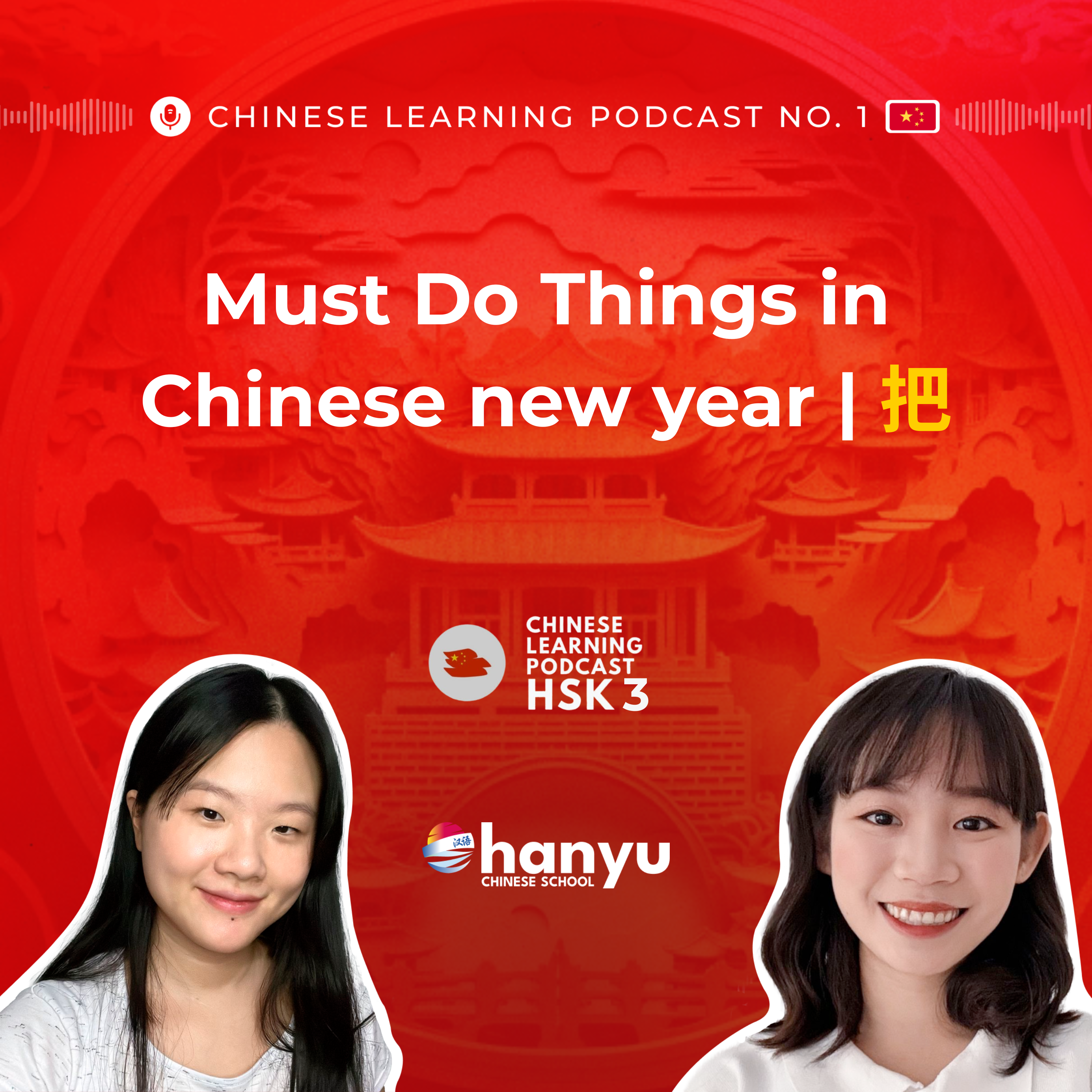
#16 How to Use 把 in Chinese | Spring Festival Traditions & Activities | HSK 3 episode artwork

EPISODE · Feb 28, 2026 · 19 MIN

#16 How to Use 把 in Chinese | Spring Festival Traditions & Activities | HSK 3

from Chinese Learning Podcast | HSK 3 (Season 1) · host Trainlang / Hanyu

In this episode, we tackle one of the most important — and often confusing — grammar structures at HSK 3 level: the 把 (bǎ) sentence. Instead of learning it in isolation, you’ll see how 把 is actually used in real life — especially during one of the busiest times of the year: preparing for Chinese New Year. Through clear explanations, practical examples, and a natural dialogue, you’ll learn how to use 把 to talk about: • Moving objects • Changing situations • Completing tasks • Getting things done properly You’ll understand why 把 focuses on the result or impact of an action, and how this structure helps you sound more natural and more advanced in Mandarin. What You’ll Learn in This Episode:✅ The basic 把 + object + verb + complement structure ✅ When and why Chinese speakers use 把 ✅ Common verbs that frequently appear in 把 sentences ✅ Typical mistakes learners make (and how to avoid them) ✅ Cultural insight into Spring Festival preparation traditions Cultural Insight:Before Spring Festival, families clean the house, decorate with red couplets, prepare food, and organise everything for the new year. This is exactly the kind of context where 把 sentences appear naturally in daily conversation. Practice Challenge:How would you say: “Please put the red decorations on the door” using 把?Write your answer in the comments and try building your own example sentence. At Hanyu Chinese School, we take pride in offering a unique approach to language learning. What makes our school special? Here are some highlights: Online Campus: The best virtual campus. Access study materials, interactive exercises, and additional resources from anywhere, anytime. Private Teachers: Our highly trained teachers provide personalized classes with an individual approach. Trial Classes: Not sure if this language is for you? Try our trial classes! Immerse yourself in the language and discover if it’s the right choice for you. Hanyu Blog: Every week, we publish informative and entertaining articles to help you improve your understanding of the language and culture. Learn more languages with Trainlang! Visit our websites and start your language journey today

In this episode, we tackle one of the most important — and often confusing — grammar structures at HSK 3 level: the 把 (bǎ) sentence. Instead of learning it in isolation, you’ll see how 把 is actually used in real life — especially during one of the busiest times of the year: preparing for Chinese New Year. Through clear explanations, practical examples, and a natural dialogue, you’ll learn how to use 把 to talk about: • Moving objects • Changing situations • Completing tasks • Getting things done properly You’ll understand why 把 focuses on the result or impact of an action, and how this structure helps you sound more natural and more advanced in Mandarin. What You’ll Learn in This Episode:✅ The basic 把 + object + verb + complement structure ✅ When and why Chinese speakers use 把 ✅ Common verbs that frequently appear in 把 sentences ✅ Typical mistakes learners make (and how to avoid them) ✅ Cultural insight into Spring Festival preparation traditions Cultural Insight:Before Spring Festival, families clean the house, decorate with red couplets, prepare food, and organise everything for the new year. This is exactly the kind of context where 把 sentences appear naturally in daily conversation. Practice Challenge:How would you say: “Please put the red decorations on the door” using 把?Write your answer in the comments and try building your own example sentence. At Hanyu Chinese School, we take pride in offering a unique approach to language learning. What makes our school special? Here are some highlights: Online Campus: The best virtual campus. Access study materials, interactive exercises, and additional resources from anywhere, anytime. Private Teachers: Our highly trained teachers provide personalized classes with an individual approach. Trial Classes: Not sure if this language is for you? Try our trial classes! Immerse yourself in the language and discover if it’s the right choice for you. Hanyu Blog: Every week, we publish informative and entertaining articles to help you improve your understanding of the language and culture. Learn more languages with Trainlang! Visit our websites and start your language journey today

NOW PLAYING

#16 How to Use 把 in Chinese | Spring Festival Traditions & Activities | HSK 3

0:00 19:33

No transcript for this episode yet

We transcribe on demand. Request one and we'll notify you when it's ready — usually under 10 minutes.

French Your Way Jessica: Native French teacher founder of French Your Way Boost your French listening skills and test your comprehension with this one of a kind series of podcasts. Get the chance to listen to a real conversation between native speakers talking at normal speed AND customise your learning experience through carefully designed sets of questions (2 levels of difficulty) available for download at www.frenchvoicespodcast.com. All interviews also come with the transcript. French teacher Jessica interviews native speakers of French from around the world who share a bit of their life and passion. Where else would you meet in one same place a French yoga teacher based in Melbourne, a soap manufacturer from Provence, or a couple cycling around the world? That Hoarder: Overcome Compulsive Hoarding That Hoarder Hoarding disorder is stigmatised and people who hoard feel vast amounts of shame. This podcast began life as an audio diary, an anonymous outlet for somebody with this weird condition. That Hoarder speaks about her experiences living with compulsive hoarding, she interviews therapists, academics, researchers, children of hoarders, professional organisers and influencers, and she shares insight and tips for others with the problem. Listened to by people who hoard as well as those who love them and those who work with them, Overcome Compulsive Hoarding with That Hoarder aims to shatter the stigma, share the truth and speak openly and honestly to improve lives. The Small Business Startup School – Business Notes | Financial Literacy | Retail Psychology – For Professionals & Entrepreneurs The Small Business Startup School Inc. Starting or buying a small business? While personal circumstances may vary, business patterns remain timeless. On The Small Business Startup School, we explore strategies, insights, and practical solutions to help entrepreneurs confidently navigate their journey.Hosted by Ola Williams—a retail entrepreneur, fintech founder, and financial coach with over two decades of experience—this podcast marries financial awareness and retail psychology with optimism to deliver actionable takeaways.Join us to learn, grow, and connect as we uncover the keys to business success.Let’s continue to learn together and be encouraged to keep on connecting! DIOSA. Carolina Sanper This podcast is a sacred space created by Carolina Sanper where you connect with your inner wisdom and embody your magnetic feminine power.It is the realization that the mystical realm is where you plant the seeds of your desired reality.It is a portal to your true essence: awareness, presence, and receiving with ease. Welcome home, DIOSA. 🖤

Frequently Asked Questions

How long is this episode of Chinese Learning Podcast | HSK 3 (Season 1)?

This episode is 19 minutes long.

When was this Chinese Learning Podcast | HSK 3 (Season 1) episode published?

This episode was published on February 28, 2026.

What is this episode about?

In this episode, we tackle one of the most important — and often confusing — grammar structures at HSK 3 level: the 把 (bǎ) sentence. Instead of learning it in isolation, you’ll see how 把 is actually used in real life — especially during one of the...

Can I download this Chinese Learning Podcast | HSK 3 (Season 1) episode?

Yes, you can download this episode by clicking the download button on the episode player, or subscribe to the podcast in your preferred podcast app for automatic downloads.
URL copied to clipboard!