EPISODE · Oct 10, 2025 · 14 MIN
163: Animal origins: looping back in time
from Base by Base · host Gustavo Barra
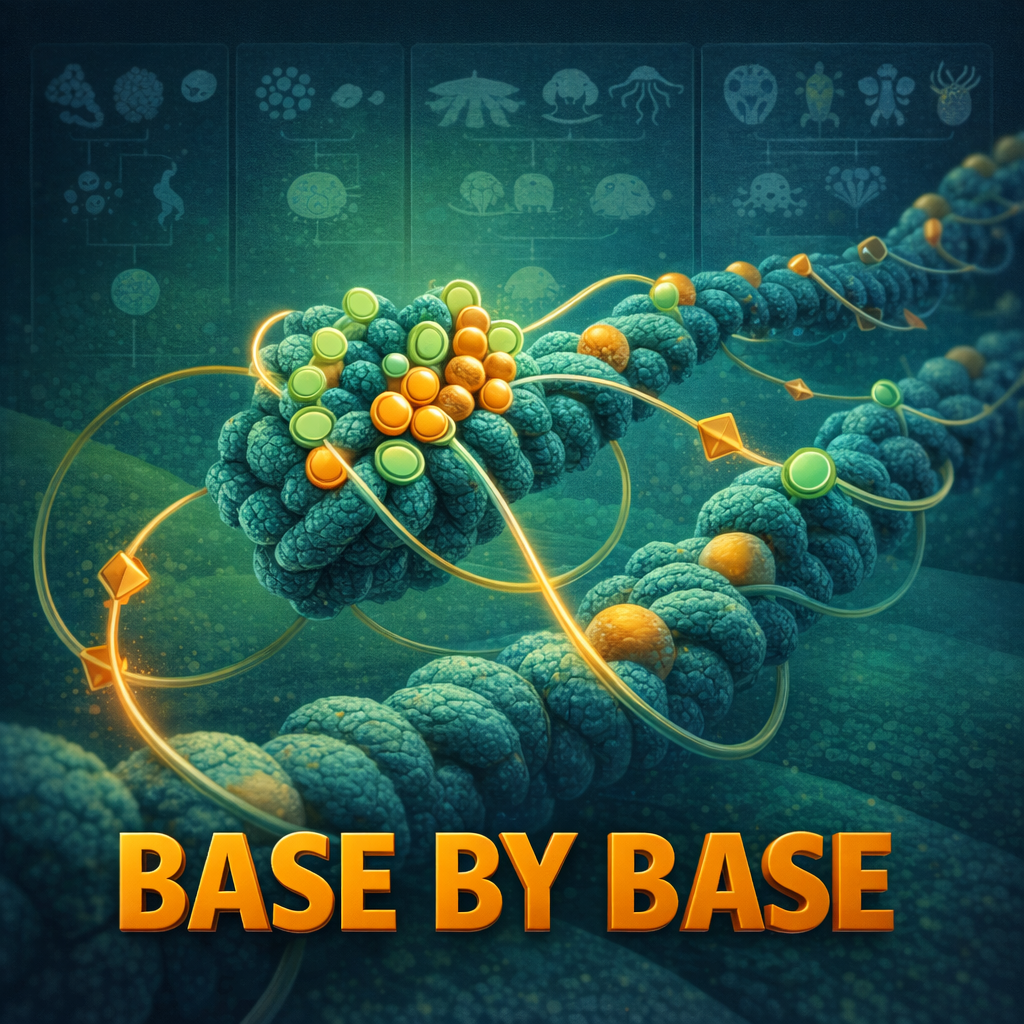
️ Episode 163: Animal origins: looping back in time In this episode of PaperCast Base by Base, we explore how chromatin folding mechanisms emerged alongside animal evolution, focusing on a Spotlight article that synthesizes high-resolution 3D genome maps across unicellular relatives of animals and early-branching metazoans to probe when enhancer–promoter looping first appeared. Study Highlights:This Spotlight reviews evidence from micro-C datasets spanning ichthyosporeans, filastereans, choanoflagellates, sponges, ctenophores, placozoans, and cnidarians, showing that broad A/B-like chromatin compartments and, crucially, enhancer–promoter chromatin loops are features that arise within animals rather than in their unicellular relatives. It emphasizes that loops are readily detected in early metazoans such as ctenophores, placozoans, and cnidarians, while sponges show weaker or absent looping signals, hinting at lineage-specific trajectories or possible secondary loss. The article highlights unusual promoter hubs in placozoans, where hundreds of transcription start sites cluster, potentially coordinating housekeeping expression programs. Mechanistically, ctenophores appear to use abundant C2H2 zinc-finger proteins that bind unmethylated motifs at loop anchors, suggesting alternative loop-formation strategies distinct from the CTCF-driven loop extrusion and insulated TAD architecture characterized in vertebrates. Together, these observations argue that chromatin loops emerged with complex gene regulation in animals and diversified across lineages instead of following a single universal mechanism. Conclusion:Chromatin looping likely originated at the dawn of animal life and diversified across lineages, underpinning the rise of complex gene regulation before the canonical, CTCF-insulated TAD architecture seen in many bilaterians. Reference:Matar, O., & Marlétaz, F. (2025). Animal origins: looping back in time. Trends in Genetics. https://doi.org/10.1016/j.tig.2025.06.013 License:This episode is based on an open-access article published under the Creative Commons Attribution 4.0 International License (CC BY 4.0) – https://creativecommons.org/licenses/by/4.0/ Support:If you'd like to support Base by Base, you can make a one-time or monthly donation here: https://basebybase.castos.com/ Episode Slug: animal-origins-looping-back-in-time Keywords: chromatin loops; animal evolution; Micro-C; ctenophores; enhancer–promoter interactions
What this episode covers
️ Episode 163: Animal origins: looping back in time In this episode of PaperCast Base by Base, we explore how chromatin folding mechanisms emerged alongside animal evolution, focusing on a Spotlight article that synthesizes high-resolution 3D genome maps across unicellular relatives of animals and early-branching metazoans to probe when enhancer–promoter looping first appeared. Study Highlights:This Spotlight reviews evidence from micro-C datasets spanning ichthyosporeans, filastereans, choanoflagellates, sponges, ctenophores, placozoans, and cnidarians, showing that broad A/B-like chromatin compartments and, crucially, enhancer–promoter chromatin loops are features that arise within animals rather than in their unicellular relatives. It emphasizes that loops are readily detected in early metazoans such as ctenophores, placozoans, and cnidarians, while sponges show weaker or absent looping signals, hinting at lineage-specific trajectories or possible secondary loss. The article highlights unusual promoter hubs in placozoans, where hundreds of transcription start sites cluster, potentially coordinating housekeeping expression programs. Mechanistically, ctenophores appear to use abundant C2H2 zinc-finger proteins that bind unmethylated motifs at loop anchors, suggesting alternative loop-formation strategies distinct from the CTCF-driven loop extrusion and insulated TAD architecture characterized in vertebrates. Together, these observations argue that chromatin loops emerged with complex gene regulation in animals and diversified across lineages instead of following a single universal mechanism. Conclusion:Chromatin looping likely originated at the dawn of animal life and diversified across lineages, underpinning the rise of complex gene regulation before the canonical, CTCF-insulated TAD architecture seen in many bilaterians. Reference:Matar, O., & Marlétaz, F. (2025). Animal origins: looping back in time. Trends in Genetics. https://doi.org/10.1016/j.tig.2025.06.013 License:This episode is based on an open-access article published under the Creative Commons Attribution 4.0 International License (CC BY 4.0) – https://creativecommons.org/licenses/by/4.0/ Support:If you'd like to support Base by Base, you can make a one-time or monthly donation here: https://basebybase.castos.com/ Episode Slug: animal-origins-looping-back-in-time Keywords: chromatin loops; animal evolution; Micro-C; ctenophores; enhancer–promoter interactions
NOW PLAYING
163: Animal origins: looping back in time
No transcript for this episode yet
Similar Episodes
Mar 26, 2026 ·1m
Jan 2, 2026 ·47m
Dec 21, 2025 ·46m