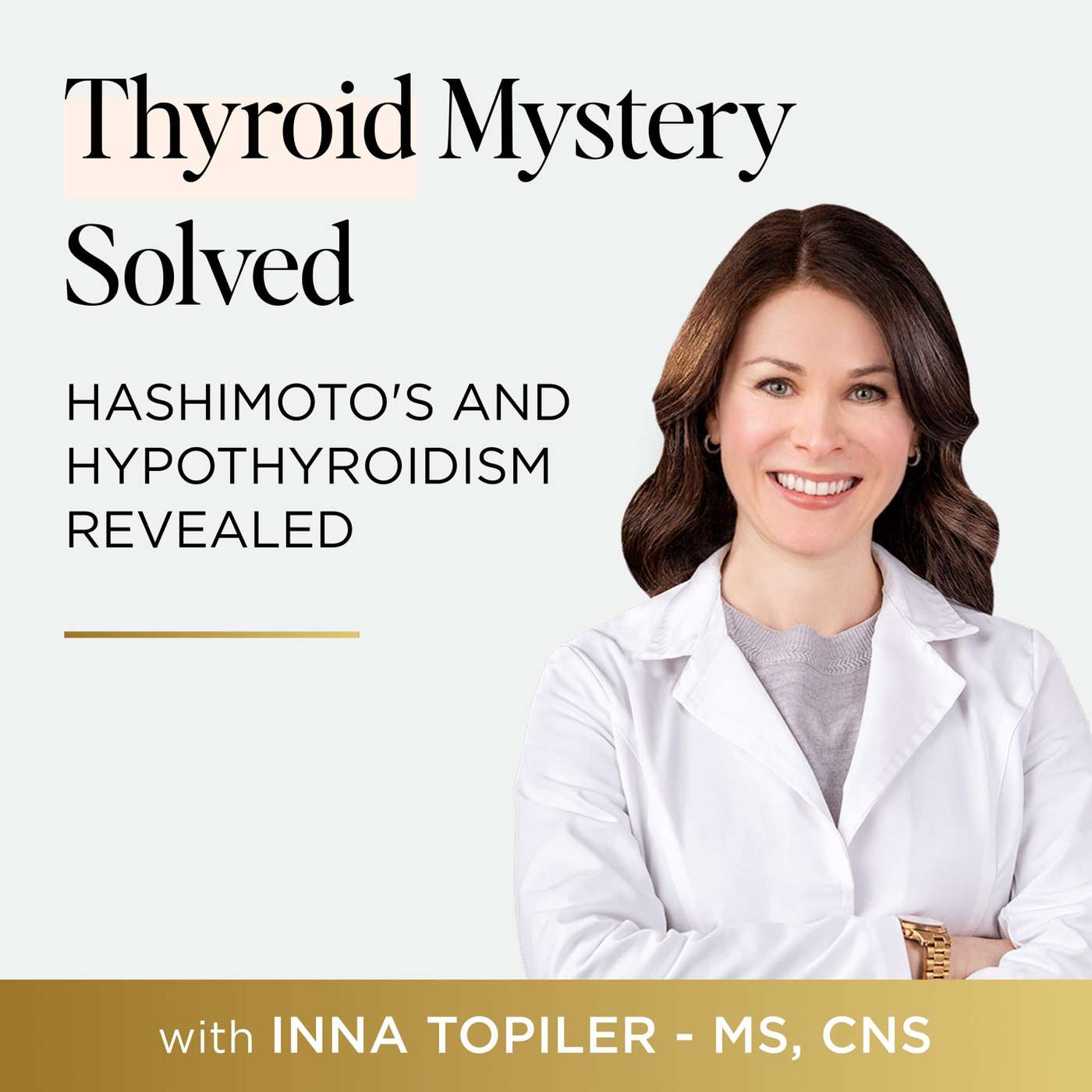
163 Effective Strategies to Manage Inflammation and Reduce Hashimoto's Symptoms with Dr. Tom O'Bryan episode artwork

EPISODE · Mar 14, 2024 · 43 MIN

163 Effective Strategies to Manage Inflammation and Reduce Hashimoto's Symptoms with Dr. Tom O'Bryan

from Thyroid Mystery Solved: Hashimoto's and Hypothyroidism Revealed · host Inna Topiler

Jump to the FULL Episode Show Notes here:https://innatopiler.com/podcasts/163-effective-strategies-to-manage-inflammation-and-reduce-hashimotos-symptomsThe Case: Nancy has Hashimoto’s and hypothyroidism and suffers from frequent flare-ups.She’s experiencing fatigue, anxiety, jitters and is in constant pain. She also finds that she can’t lose weight and often has brain fog. Controlling Common Symptoms of Hashimoto’s While these are common symptoms of Hashimoto’s and hypothyroidism, Nancy was eager to better manage her condition. When I met Nancy in my Hashimoto’s program, I knew that inflammation was the driver and to get to the bottom of her thyroid mystery, I knew just who to share Nancy’s case with as he’s often called the “Sherlock Holmes for chronic disease”. Dr. Tom O’Bryan is an expert in food sensitivities, environmental toxins, and the development of autoimmune diseases. He’s on the faculty at the Institute for Functional Medicine and the National University of Health Sciences. He’s also the author of You Can Fix Your Brain and The Autoimmune Fix. I’m looking forward to his new docuseries, The Inflammation Equation, being released widely on March 20th. He joins me on the show to explore Nancy’s case and right away, we discuss what is at the root of many autoimmune diseases (including Hashimoto’s): inflammation.Inflammation: Our Body's DoubleEdged SwordInflammation isn't inherently bad. Dr. O’Bryan explains that it’s actually our immune system's way of protecting us from invaders like germs. Imagine your immune system as a highly trained army ready to fight off any threat. Inflammation is how it sends in the troops to battle an infection. And while this is a necessary acute response, if it keeps happening and inflammation becomes a chronic state, the inflammation can stop being helpful. Dr. O’Bryan reminds us that chronic, low-grade inflammation is linked to most chronic diseases, including Hashimoto's as well as diseases like heart disease, diabetes, and even cancer.  With Hashimoto’s, the inflammation causes the immune system to attack the thyroid. What Triggers Chronic Inflammation?Many things can trigger inflammation but Dr. O'Bryan mentions some incredibly pervasive and somewhat surprising culprits:Microplastics and nanoplastics: These tiny plastic particles are increasingly found in our environment, even in bottled water! Our bodies see them as invaders so the immune system launches an attack. Unfortunately, these attacks can damage healthy tissues like the thyroid.This is where things get interesting for Hashimoto's patients.Our confused immune system, constantly battling these microscopic plastics, starts mistaking healthy thyroid cells for invaders. It creates antibodies that attack the thyroid, leading to the symptoms we experience with Hashimoto's.Why We Need to Address Inflammation, Not Just the ThyroidSo, we've established that inflammation is the real culprit behind Hashimoto's, not a malfunctioning thyroid itself. Dr. O'Bryan uses a powerful analogy to explain this.  Imagine your body as a chain, constantly regenerating with new links (cells) replacing the old and damaged ones. Your immune system normally creates antibodies to remove these old cells, making way for the new.Here's where things go wrong with Hashimoto's:Microplastics and other environmental toxins act like invaders, triggering the immune system to attack.These attacks also damage healthy thyroid cells, causing the immune system to create antibodies against the thyroid itself.As you continue to consume these toxins (like bottled water with nanoplastics), the cycle perpetuates. More damaged thyroid cells, more antibodies, and a progressively weaker thyroid.This is why focusing solely on fixing the thyroid misses the mark. Dr. O'Bryan emphasizes that we need to address the root cause: the inflammation causing the immune system to attack the thyroid. It's like trying to fix a broken chain by replacing a single link when the real problem is the force pulling the chain apart.Where Does Inflammation Hide?It’s clear that in order to get a handle on Hashimoto’s symptoms, we need to deal with the inflammation but what triggers this inflammation in the first place?Dr. O'Bryan encourages us to ask ourselves: "Where might the inflammation be coming from?" This simple question can be a powerful starting point. By being open to possibilities and exploring the root causes, we can start to identify and address our individual triggers. Here are two areas to start investigating: 1. Environmental TriggersWe often think of food sensitivities as the main dietary culprit for inflammation.  Dr. O'Bryan highlights the importance of considering environmental factors as well. Aside from the microplastics, he also mentions mold as a potential trigger.  Many people may not realize that exposure to mold in their homes or workplaces could be contributing to their inflammation.2. DietOf course, diet still plays a crucial role in managing inflammation. We’ve covered this in many episodes but Dr. O’Bryan places particular emphasis on the role of gluten in Hashimoto's. Gluten sensitivity is a common concern for Hashimoto's patients because of the link between gluten and the HLA genes.Gluten’s Impact on Hashimoto's Dr. O'Bryan shares some very interesting studies in this episode to showcase the science behind why gluten can be such a problem for people with Hashimoto's. Here's a breakdown of his key points:Our Ancestors Didn't Eat Wheat: We haven't evolved to properly digest wheat, a relatively new addition to the human diet.TollLike Receptors: The Gut's Sentinels: These receptors guard the intestines, identifying and flushing out potential threats from food.Gluten Mimics a Threat: When we eat wheat, the incompletely broken-down gluten molecules resemble harmful bacteria to our toll-like receptors.Leaky Gut and Inflammation: This mistaken identity triggers an immune response, leading to leaky gut and inflammation.Not Everyone Gets Gut Issues: While some people experience digestive problems with gluten, others may feel the effects in different ways, like through thyroid issues.Dr. O'Bryan emphasizes a crucial point: all humans experience some level of inflammatory response to gluten. The difference lies in how it manifests. For some, it might be gut problems, while for others, it shows up as thyroid symptoms like those experienced with Hashimoto's.The Problem with Traditional GlutenSensitivity TestsDr. O'Bryan feels that traditional gluten tests haven't always been reliable. He uses the Wheat Zoomer test because he finds it to be a more comprehensive test that identifies gluten sensitivity more accurately. This is important because gluten isn’t a problem for everyone. In fact, Dr. O'Bryan doesn't advocate for everyone to go gluten-free.  However, for those wit...

Jump to the FULL Episode Show Notes here:https://innatopiler.com/podcasts/163-effective-strategies-to-manage-inflammation-and-reduce-hashimotos-symptomsThe Case: Nancy has Hashimoto’s and hypothyroidism and suffers from frequent flare-ups.She’s experiencing fatigue, anxiety, jitters and is in constant pain. She also finds that she can’t lose weight and often has brain fog. Controlling Common Symptoms of Hashimoto’s While these are common symptoms of Hashimoto’s and hypothyroidism, Nancy was eager to better manage her condition. When I met Nancy in my Hashimoto’s program, I knew that inflammation was the driver and to get to the bottom of her thyroid mystery, I knew just who to share Nancy’s case with as he’s often called the “Sherlock Holmes for chronic disease”. Dr. Tom O’Bryan is an expert in food sensitivities, environmental toxins, and the development of autoimmune diseases. He’s on the faculty at the Institute for Functional Medicine and the National University of Health Sciences. He’s also the author of You Can Fix Your Brain and The Autoimmune Fix. I’m looking forward to his new docuseries, The Inflammation Equation, being released widely on March 20th. He joins me on the show to explore Nancy’s case and right away, we discuss what is at the root of many autoimmune diseases (including Hashimoto’s): inflammation.Inflammation: Our Body's DoubleEdged SwordInflammation isn't inherently bad. Dr. O’Bryan explains that it’s actually our immune system's way of protecting us from invaders like germs. Imagine your immune system as a highly trained army ready to fight off any threat. Inflammation is how it sends in the troops to battle an infection. And while this is a necessary acute response, if it keeps happening and inflammation becomes a chronic state, the inflammation can stop being helpful. Dr. O’Bryan reminds us that chronic, low-grade inflammation is linked to most chronic diseases, including Hashimoto's as well as diseases like heart disease, diabetes, and even cancer.  With Hashimoto’s, the inflammation causes the immune system to attack the thyroid. What Triggers Chronic Inflammation?Many things can trigger inflammation but Dr. O'Bryan mentions some incredibly pervasive and somewhat surprising culprits:Microplastics and nanoplastics: These tiny plastic particles are increasingly found in our environment, even in bottled water! Our bodies see them as invaders so the immune system launches an attack. Unfortunately, these attacks can damage healthy tissues like the thyroid.This is where things get interesting for Hashimoto's patients.Our confused immune system, constantly battling these microscopic plastics, starts mistaking healthy thyroid cells for invaders. It creates antibodies that attack the thyroid, leading to the symptoms we experience with Hashimoto's.Why We Need to Address Inflammation, Not Just the ThyroidSo, we've established that inflammation is the real culprit behind Hashimoto's, not a malfunctioning thyroid itself. Dr. O'Bryan uses a powerful analogy to explain this.  Imagine your body as a chain, constantly regenerating with new links (cells) replacing the old and damaged ones. Your immune system normally creates antibodies to remove these old cells, making way for the new.Here's where things go wrong with Hashimoto's:Microplastics and other environmental toxins act like invaders, triggering the immune system to attack.These attacks also damage healthy thyroid cells, causing the immune system to create antibodies against the thyroid itself.As you continue to consume these toxins (like bottled water with nanoplastics), the cycle perpetuates. More damaged thyroid cells, more antibodies, and a progressively weaker thyroid.This is why focusing solely on fixing the thyroid misses the mark. Dr. O'Bryan emphasizes that we need to address the root cause: the inflammation causing the immune system to attack the thyroid. It's like trying to fix a broken chain by replacing a single link when the real problem is the force pulling the chain apart.Where Does Inflammation Hide?It’s clear that in order to get a handle on Hashimoto’s symptoms, we need to deal with the inflammation but what triggers this inflammation in the first place?Dr. O'Bryan encourages us to ask ourselves: "Where might the inflammation be coming from?" This simple question can be a powerful starting point. By being open to possibilities and exploring the root causes, we can start to identify and address our individual triggers. Here are two areas to start investigating: 1. Environmental TriggersWe often think of food sensitivities as the main dietary culprit for inflammation.  Dr. O'Bryan highlights the importance of considering environmental factors as well. Aside from the microplastics, he also mentions mold as a potential trigger.  Many people may not realize that exposure to mold in their homes or workplaces could be contributing to their inflammation.2. DietOf course, diet still plays a crucial role in managing inflammation. We’ve covered this in many episodes but Dr. O’Bryan places particular emphasis on the role of gluten in Hashimoto's. Gluten sensitivity is a common concern for Hashimoto's patients because of the link between gluten and the HLA genes.Gluten’s Impact on Hashimoto's Dr. O'Bryan shares some very interesting studies in this episode to showcase the science behind why gluten can be such a problem for people with Hashimoto's. Here's a breakdown of his key points:Our Ancestors Didn't Eat Wheat: We haven't evolved to properly digest wheat, a relatively new addition to the human diet.TollLike Receptors: The Gut's Sentinels: These receptors guard the intestines, identifying and flushing out potential threats from food.Gluten Mimics a Threat: When we eat wheat, the incompletely broken-down gluten molecules resemble harmful bacteria to our toll-like receptors.Leaky Gut and Inflammation: This mistaken identity triggers an immune response, leading to leaky gut and inflammation.Not Everyone Gets Gut Issues: While some people experience digestive problems with gluten, others may feel the effects in different ways, like through thyroid issues.Dr. O'Bryan emphasizes a crucial point: all humans experience some level of inflammatory response to gluten. The difference lies in how it manifests. For some, it might be gut problems, while for others, it shows up as thyroid symptoms like those experienced with Hashimoto's.The Problem with Traditional GlutenSensitivity TestsDr. O'Bryan feels that traditional gluten tests haven't always been reliable. He uses the Wheat Zoomer test because he finds it to be a more comprehensive test that identifies gluten sensitivity more accurately. This is important because gluten isn’t a problem for everyone. In fact, Dr. O'Bryan doesn't advocate for everyone to go gluten-free.  However, for those wit...

NOW PLAYING

163 Effective Strategies to Manage Inflammation and Reduce Hashimoto's Symptoms with Dr. Tom O'Bryan

0:00 43:27

No transcript for this episode yet

We transcribe on demand. Request one and we'll notify you when it's ready — usually under 10 minutes.

MG Show MG Show The MG Show, hosted by Jeffrey Pedersen and Shannon Townsend, is a leading alternative media platform dedicated to uncovering the truth behind today’s most pressing political issues. Launched in 2019, the show has grown exponentially, offering unfiltered insights, comprehensive research, and real-time analysis. With a commitment to independent journalism and factual integrity, the MG Show empowers its audience with knowledge and encourages active participation in the political discourse. Breaking News Show | eTurboNews Juergen Thomas Steinmetz News is relevant to the global travel and tourism industry, human rights and global issues.Breaking news when it happens and only from the source. Eat to Live Jenna Fuhrman, Dr. Fuhrman Our health is our most precious gift and smart nutrition can change your life. Each month, join Dr. Fuhrman and his daughter, Jenna Fuhrman as they discuss important topics in the world of nutrition. Eat to Live will change the way you eat and think about food. French Your Way Jessica: Native French teacher founder of French Your Way Boost your French listening skills and test your comprehension with this one of a kind series of podcasts. Get the chance to listen to a real conversation between native speakers talking at normal speed AND customise your learning experience through carefully designed sets of questions (2 levels of difficulty) available for download at www.frenchvoicespodcast.com. All interviews also come with the transcript. French teacher Jessica interviews native speakers of French from around the world who share a bit of their life and passion. Where else would you meet in one same place a French yoga teacher based in Melbourne, a soap manufacturer from Provence, or a couple cycling around the world?

Frequently Asked Questions

How long is this episode of Thyroid Mystery Solved: Hashimoto's and Hypothyroidism Revealed?

This episode is 43 minutes long.

When was this Thyroid Mystery Solved: Hashimoto's and Hypothyroidism Revealed episode published?

This episode was published on March 14, 2024.

What is this episode about?

Jump to the FULL Episode Show Notes here:https://innatopiler.com/podcasts/163-effective-strategies-to-manage-inflammation-and-reduce-hashimotos-symptomsThe Case: Nancy has Hashimoto’s and hypothyroidism and suffers from frequent flare-ups.She’s...

Can I download this Thyroid Mystery Solved: Hashimoto's and Hypothyroidism Revealed episode?

Yes, you can download this episode by clicking the download button on the episode player, or subscribe to the podcast in your preferred podcast app for automatic downloads.
URL copied to clipboard!