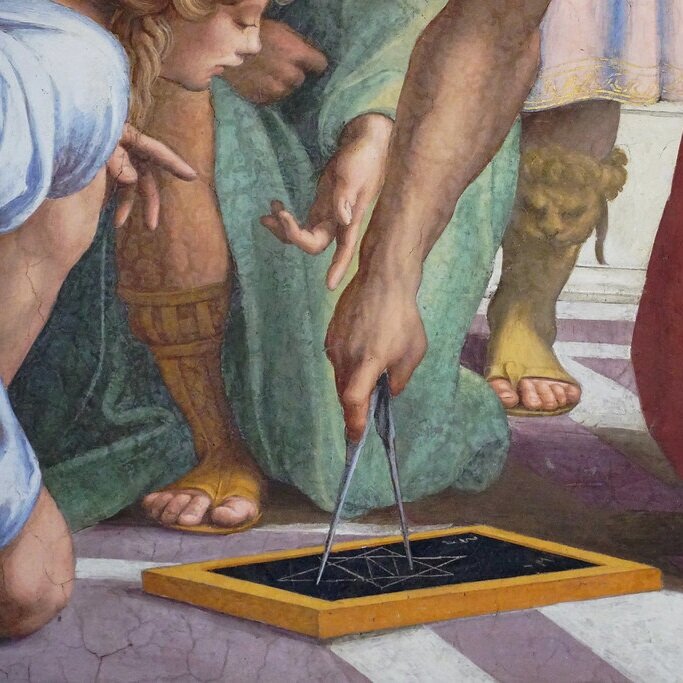
Hi, welcome to classical stuff you should know a podcast about the classical world ancient books ancient texts classical education There's like medieval things in here. I know sometimes we talk about movies and you know we're just it's a podcast I mean come on now, you know what you're doing. My name is Graham Donaldson, and I am joined by my two contemporaries compatriots both what a matter Arthur you on Hamburg that's me and Thomas Fletcher magma. Hello, Tommy Fletch.
No, that's not it And today I have homework apparently yes You gave me something to look at I have a piece of blue paper with triangle on it So I guess we're talking about the Illuminati or something. I'm not Please start by drawing an eye inside of that pyramid that I put in front of you. Are you done? Okay?
Is the Illuminati theme song what do you know? No, I just realized I was talking to God's brother. Oh any particular reason? No, I don't know I was trying to do the ex-fals music, but I'm still at the vaccine in my brain I'm sorry that yep, you did perfect.
Oh, everyone on YouTube will love it. Okay, so yes We will be talking a little bit about Euclid today and his elements So we started off two weeks ago at this point I don't remember how long ago talking about Paul Lockhart is mathematicians lament how their problems with how math is taught right now And so I wanted to take a swing at talking through I mean, you know, essentially the oldest like math textbook that we have right? You could elements are you soggy cheese and we're the slave boys going on perhaps Yeah, I guess we'll get to it's a little triangle I drew in a second But the three letters of it are T AG because it's you know our first names It's AJ Graham and Thomas, but I put myself as the the head point. So yeah, I'm clearly on the boss of this one Euclid elements gentlemen is this you know, you all have gone through mathematics education before you all are well-read people Have you all come across Euclid elements before I've never read it?
Well, you've heard of it before I heard of it. Yeah, only in terms of that Yeah, I've heard of it and then also when people talk about Euclidean geometry. Yep, but that's all I know my knowledge So I was what the elements were if he was like an earth airfire kind of guy. Oh, man.
I love that band. Yeah Or yeah He's like a helium oxygen kind of fella what elements. Yes. No, I got it good.
Yes That's not quite it, but you're you guys are on the right track. So yes, so Euclid I mean there are a number of collections of works of Euclids the elements is his most famous you all said you've heard of the Elements before what's the subject of the elements maybe to take it that way? What do you all know about it? It's geometry just because I've heard of Euclidean geometry When you're talking about the elements, I'm confused because I would think it would be Chemistry like yeah early early chemistry how things are made up or like a farm water So we like base stuff for geometry like the hypotenuse like a square plus B square equals C square That's okay.
We could that's at the end of book one gets to that It's a proposition 47 out of 48. So we get there eventually basic working tools with which you can do geometry is that kind of what this is? Yes, maybe that that is probably the best way to think about it. So it's always a number it's always a question of her ends We keep running tallies from what's your country?
That's why yeah, Hanoverh. Don't worry Thomas. I'll keep track Thanks. What country do you rule over?
Hanen burgundy. Oh good. I've been working on that one. Nope good.
Just look up good. Okay, so Does it like Pennsylvania yeah I would like to point out that there's a place called Pennsylvania that doesn't have vampires. Not that we know Yeah, that's what you think you don't know that. What did you have eight?
I'll eclipse you Didn't you kept the you kept the points. Okay, so yes, so you could elements it's a collection So part of what's when we'll read some quotes in a second and you'll get different numbers of like how many books there are in here Sometimes it's just like it's only certain books get translated and you know the book has been used for such a long period of time Sometimes only certain other books are like accessible or they're like renumber differently the one sitting in front of me has 13 books in it Some translations again will only go through six but you'll see different numbers around that. Um, so it is I guess we yeah, it's calling it geometry always feels like limiting it in some strange way, but yes It's about shapes. I guess would be the way to put that Let's I mentioned last time that Lockhart's summary of geometry is that it's tools of Satan I think was the title of the the section where he talks about geometry.
Do you all like geometry? I forget if we talk about that. I love you. It's great.
I do not like geometry. I loved algebra. You remember why? We're which classes you have to do the graph graphs in general graph things Yeah, I didn't like graphing things because I always got points off because my graph was messy Who cares I got I did the number at the point on the right spot.
How about falling with that? Why does geometry exist? What is geometry for? Build buildings so you can make things look pleasing and art use it for a perspective I will read from the great ideas mr.
Moore Adler the ancient opinion found in Herodotus played on Aristotle that the mathematical arts especially geometry were first developed by the Egyptians Is of interest because of the questions it raises about the circumstances of the origin of mathematics? Herodotus seems to suggest that geometry arose as an aid in the practice of surveying land the word geometry was it mean the study of Geometer so earth measurement so there you go surveying land earth measurement is where geometry literally comes from I will say heres on the other hand separates from the useful arts those which do not aim at utility So there are some that are like four utility and some are just for fun So the two like competing theories of where geometry comes from one is land surveying Which is like literally the name and the other is people were bored and wanted to do something with their leisure time in geometry is what they did Why do I bring it up? Euclid's elements aren't they're not about land survey and they're not about like so you want to build a building like there's no practical thing being described in Euclid's elements. It's a series of He's proving propositions one after the other and they are he's describing like ideal forms of shapes.
He's not actually again There are no measurements. There are no there aren't really numbers in this book and it's a math book We'll get into this in a second. That's why you have a triangle in front of you I'll brief this there are 13 books in Euclid's elements the first book has more of like a kind of preface action at the front He kicks off with a list of definitions. I'm not gonna read through them.
He has 23 definitions in here He defined the point a line. He defines different types of triangles all those things are a part of his definitions What's the definition of a point? Ah, I think this is beautiful. Are you ready a point is that which has no part?
Is that like deep a line is breathless breathless length So a point is just a point is a spot. It has no part. You've never seen a point. You know, yeah, I think that's probably a true thing So how can it be a point?
There you can see draw it's on the page in front of you But it has no point is it has no part has no part that which has no part So it's just one whole thing it takes up no space is the point that he's trying to make so where I've made a little bold Dot for your triangle that doesn't actually exist. There's no thing there There's just this is a theoretical representation point and this is probably more So I'm about to tell you that the triangle in front of you as I saw so least if you were to look at it It's very clearly not as I saw so least because my drawing is really trashy, but that's why I got points off Wait, what well, this is like geometry. Oh, you could what you should have done is go up to teach and be like points off Huh? Well point has no part.
Yeah, I was like hundred percent. Thank you See that one over how do you think that we're gone? I was too much of a rule follower I'm good. I don't know you've been a rule followers.
Why I think you would like Mr. Euclid. Okay, so he kicks off with a line of definitions And the remainder of the elements expect you to know all 23 of these definitions So they'll be cited in reference at different points But you won't be able to progress in any of the propositions without first knowing the definitions And the reason there are 13 books is that each book starts with a new set of definitions So they so You could start with a few things on circles right off the bat in book one You'll cover more advanced shapes as he goes on now Are they really complicated or could you turn them into little kids songs? Like if you were to go and teach this could you turn them all into fun little kids songs that I could learn when they're like Seven and then when they get to 10th grade they'd be like I'm gonna have to rephrase it so again like a point is that which has no part is one of the definitions Which seems like a very simple idea, but it seems like there's a lot to that Yeah, what actually is a point which then you doing the teachers want to go and talk about but the point is that he is claiming These things and then moving on he's not defending any of these yeah, it's Again, all we do is jump around AJ when you teach a lot jump up to get down jump up to get down I'm in logic isn't this also like you have to have a starting place from which to argue aren't there certain things?
You just have to assume off the bat. Oh press is that so are there axi manic? But I'm wondering do you have yes, there's the premise But even like the rules of how to logic those have been I mean at one point there are postulates that were proven like you can prove all of these things And I guess you prove or point have no again. It's like the definitions are circular.
It's not worth going into it No, there's nothing to prove there But the question is like whether they you know many of these you consider basic things an obtuse angle is an angle greater than a right Angle and a cute angle is an angle less than a right angle So again, those are things that could be rephrased and put into a song I'm just saying that like if if he's saying you need to memorize these things before you can move on I'm just wondering if they are easily memorizable or if they're pretty complex. How complex What's the most complicated one in the first chapter like what's the last one? We'll get there in a little bit. So maybe you're thinking like for logic to be truth and falsity But truth is a true thing like it says it is something in actuality, but not all truths are in actuality It seems like the only maybe I'm wrong here, but the only way you can find truth is that it is true, right?
So it's like a foundational thing truth of false. This is not worth it's important This gets into like philosophy of mouth, which is so far beyond my skis But it's the what you could argue is true as long as you take the assumptions at face value Gotcha. Does that not be the other way to say it is that well? You all reference you clitting you clitting geometry.
Do you all know what does that mean? He met it? Again, it's a term that gets thrown around. I don't know.
I mean this is a geometry that you clic did. Yes I mean that's what it is. So after the set of definitions, there's a set of postulates So again, these are things that he will claim and What's your foundation of a postulate? You assume the existence of these things So here are the five things that he assumes the existence of and this will play into your triangle thing So stick with me for a little bit that you're able to draw a straight line from any point to any point So two points you can draw a line between them that you can produce a finite straight line continuously in a straight line So on your triangle, you have two sides of it.
You could extend that line if you wanted to Actually, and also the base could be extended if you wanted to so that's what he's saying with the second one third to describe You can describe a circle with any center and a distance and by distance He's normally talking about a radius that we'll talk about diameter at some points The fourth one that all right angles are equal to one another which is kind of a funny one He's actually that's saying that 90 degrees always equals 90 degrees And 89 degrees always. Yeah, I agree Just said you'll sometimes there are some articles written about how the fourth postulate is the dumb one And then fifth that if a straight line falling on to I'm gonna read it and then yeah, just please glaze over as I talk that The on is also perfect that if a straight line falling on two straight lines makes the interior angles on the same side less than two right angles The two straight lines is produced indefinitely meet on that side on which are the angles less than the two right angles And obviously I don't have to say any more about that. Yeah, I hope you're enjoying your commute to work on this podcast today If we have a sense about like gates that people can't look at and I can do one on math so at least I tried What am I doing? Okay, so what is he saying is um chance you did you took a chance?
You did yes, okay, so imagine that there are Two lines that don't connect with each other and then you draw a straight line that connects with those two lines Yeah, the point that he's making is that the line that you've drawn through yeah The sum of that straight line on both other sides of that line as a 200 nay. That's what he's arguing Listen or that made no sense to you probably on YouTube. I'll have some pictures so get excited Okay, so you're looking at long set of railroad tracks railroad tie across it right so as the railroad tie crosses the track the angles that it produces all the Right of the track yes ends up to 180. Yes, but he won't actually use numbers at any point in his elements But that's what he's that's the easier way to understand what he's arguing cool.
Um that fifth assumption isn't always true. So With a jig example of railroad crossings that assumes a flat surface But if I if there's any curve on like if it's going over a hill It's not gonna add up to 180 degrees because it's not a flat surface That makes sense doesn't sense the difference between Euclidean and non Euclidean geometry is is Euclid right? So if the five postulates of Euclid are correct you're doing Euclidean geometry if any of them are wrong You're doing non-sex or you're doing you're doing something in like could be there's abstract math that is just non Euclidean Your plane isn't flat you're dealing with a curved plane essentially could be one way doing the astral plane Yep, all forms of astrology are non Euclidean geometry. Yep.
That was good without thinking This is my episode. Do I do I take the place? Yeah, I can do that Satisfying okay, so that people have done swimming a cryo at the injustice unfortunately wait, can I get myself points? It's your show man No, actually I want to give a gram his point back that would make me feel better back tonight, but okay, so where are we right now?
We're in Euclid elements. He starts off with a list of definitions in this first part He's defining very basic things points lines circles triangles. These are shapes you've seen before in later books He gets into like the weird stuff, but we're not quite there yet following the definitions He has a set of postulates and again, these are things that he is just assuming to be true It's related to definitions, but they're separated. Hopefully because they're not always true So for anything in Euclid's elements to be true these postulates have to be true also So there's your fun fact and then he has a set of common notions and he'll introduce other ones later I'm not gonna I'll just read through them to give examples of them one things which are equal to the same thing are also equal to one another If a equals b and b equals c then a equals c things which are equal to the same thing are also equal to another That's just a common notion.
That sounds more like than just a common notion It sounds like a law it's a equals b and b equals c then a equals c that's like but he doesn't have to define this notion But isn't that a uh, is it a topology? Like it's a thing that just like he is just he just saying this is a true thing And I guess it's providing more evidence for it than his definitions. Okay, fair Okay, um if equals be added to equals the whole or equals so if you add a and b together that equals the sum of a and b Is that um if equals b subtract it? If equals b subtracted from equals the remainders are equal so again if you um subtract two from eight that will equal eight minus two Things which coincide with one another are equal to one another so things that are the same length are the same length I can't say these blown them out right?
Yeah. Yeah, thank you Okay, thank you. That's actually the perfect point and the whole is greater than the part How do you like that right so nothing is like in a small part plus small part equals big part? That's his fifth one.
Okay, so none of these are like earth shattering and even again He calls those common notions, which maybe is the right term. They're like obvious things It almost feels silly to have written them down. Okay, but he'll start from a set of very um, either given statements or very obvious statements and then Um over the course of 13 books get to like like how do you describe the area of a 13 sided shape or like he gets into weird stuff by the End of it all he has started with are these definitions and postulates and common notions And then the purpose what follows after that are the propositions and each proposition is using proofs to show that something is true And that's the if you ever see that expression qed. That's what qed means.
It's proof. It's um, you've proved that what you set out to prove And so that's what he does he makes a statement as to what he wants to prove and then he goes on to show that something is true Okay Um, I want to pause right there because last time we talked about again mathematicians lament about the badness of Giving things people giving people things to memorize and then just having them regurgitate. Oh, you didn't want me to memorize those This is unfortunate. I would be impressed if you did but doesn't this sound like we're essentially doing that We're giving people a set of definitions and then you have to memorize them and then apply literally that definition to each problem Yep, I just wanted to give any thoughts on this as we go into it I mean so far they're not we're not memorizing the conclusion like a square plus b square equals c square We're memorizing just definitions of like the tools that you're gonna need that feels different Because we'll eventually reason our way into yeah, um the Pythagorean theorem As opposed to just being given given the Pythagorean theorem and then told how to apply it in in problems Yes, but I think my point last time was that math has gone so far that many of those things have to be the assumed thing now Like our our time of here are the things that you have to assume goes further And then we get to the actual reasoning is later, but many as might not I ever actually reach the reasoning is the problem Instance do some of it like they have to prove um That's to prove things in geometry.
Yes, which again is like it's because of Euclid that that's the case because that's how he teaches geometry I guess I'm wondering whether that's good or bad So again things are presented as givens and you like that a middle school Or can just be given a squared plus b squared equals c squared just to take an example As opposed to needing to learn 46 propositions until the 47th, which is the Pythagorean theorem What are like me just thoughts on one versus the other? Well Is uh Euclid saying that this is the way that you need to learn it like he's running a textbook But that doesn't necessarily mean that those are his lecture notes That is correct that is correct that you're saying there are other ways you can teach it now There's there's the book of like What it is, but you don't teach it that way you don't have to but But you're saying that a j hannenberg you mentioned that math is important you mentioned this in the Um, what's the thing called republic? Isn't it republic you remember what they said about math study it for 30 years And then move on to other things um that was then eventually taken even further than that that over plate O's symposium was a sign that originally read let no one come to our school who is not uh studied geometry And that sign was eventually updated they claimed that the greek philosophers used to post upon the doors of their schools The well-known notice let no one come to our school who has not learned the elements of Euclid So geometry wasn't enough geometry wasn't enough that to study philosophy one needed Euclid Not so not only geometry, but the way that Euclid presents it can we do that in our like entrance examinations? To be like can we have that over our door?
You could do that you would limit your number of people. Um, it's like two. Yeah, if you've been right nerdy homeschools. Yeah, but Thomas is My child.
Yeah, I love Euclid or he'll hate Euclid very much. Um, okay, so You're saying is this the only way to learn it the answer is no, but it was You know, but it's symposium. So not just math people but like sure people will just people will send us angry emails But like philosophy people still thought there was value to how geometry is taught here and Euclid's instantiation of how to teach geometry That makes sense. So whether Euclid thinks that are not philosophers for you know thousands of years thought so Um Maybe just to continue on with this train of thought so Euclid writes this somewhere around like 300 BC and um, this Euclid remains the geometry textbook for 2200 years 2300 years.
Um, there's a charming story of Abraham Lincoln Uh who went to law school and wasn't like a very good lawyer. He had trouble he had trouble in law school like formulating his arguments and how he wanted to Or whatever the best way to present evidence. I guess was one way to say it. Um, so this is him writing I said to myself what do I do when I demonstrate more than when I reason or prove how does demonstration differ from any other proof?
I consulted all the dictionaries and books of reference I could find but with no better results at last I said Lincoln You can never make a lawyer if you do not understand what demonstrate means and I left my situation in Springfield when home to my father's house And stayed there till I could give any proposition in the six books of Euclid at site I then found out what demonstrate means and went back to my law studies. So, you know, this is separated by that's um 2000 years. So who's the guy that was like, you know what? I'm gonna write another geometry textbook.
We don't need you. There are lots of people who think that um, do you want to? But if you said this was the genre three textbook for 2200 years who was like the 19th century dude that was like, you know what? Let's just modernize update this for our um, there are uh 12 or 13 of them that were like leading um opposition to um Euclid sorry I didn't have this build up right now.
Um, Lewis Carroll Um, do you know anything about this fellow Lewis Carroll the writer of the new Alice Wonderland? Yes, do you know anything about him? Yeah, he was like he loved uh Psychedelics. Oh, that not the direction we're going but yes, um, Red Alice Wonderland?
Uh, yes, but not recently Uh, Lewis Carroll, Lewis Carroll is not the guy's name. The guy's name is Charles Dodgson and Charles Dodgson is a mathematician that's what he did by trade So in addition to Alice Wonderland which for which he is known, um, in addition to jemmerwaki and other things He wrote a play called Euclid in his modern rivals where Euclid is resurrected and essentially verbally jousts his um, um I think it's actually only three people in the play. It's Euclid this like modern mathematician and essentially two mathematicians who are arguing whether Euclid is good or not. Um, one person thinks he's good one person thinks he's bad Um, but like literally the play is referencing these modern textbooks that are attempting to replace Euclid.
Yeah, yeah Your question is why do you want to like take a swing at it? No, I know why? Because because it's just producing and soul things it could be that um or it's also because the way you were reading right there Sounds impossible for you to understand and we have to teach it to nine three years. Yes, so um, let's Yes, I guess maybe this is the time to jump into um, we're gonna try and talk through one of these propositions to make both points of There's a rigor to what Euclid is doing.
It's kind of Up to some difficult not to do so. Ha see what I did there all these math jokes guys aren't you? Hahaha also grandma got a point for knowing why they I don't lose care lives. Yeah, that's fair.
Okay. You know, I don't know those girls. Yeah, he said that's a point. Hey, he said that first I didn't like your answer.
I can't point away from Graham. I can't those that I didn't need on this episode. There's no eight to four This was going directly to my head. Do you know?
I Call on the podcast. I was gonna say there's more I could have caused Was that a threat? Proposition five has a charming name. Um, I'm going to be the Latin name the Latin name I'm going to butcher.
I'm getting excited. All you listeners the pawns as an orum is the name of this You know what that means? No, I'm five. I'm sorry.
Wait. Why are you laughing? Okay, um, I'm not going to translate it because it's a funny translation, but um Well, I forgot this it's the donkey bridge. This is the donkey bridge.
Oh, but it's because of Just be clear what I pronounced was a SI and oh, um, it's just to be anyway But that is it's the donkey bridge and there are different there are competing theories That's why it's called the donkey bridge one is that the thing you're about to draw what kind of look like a bridge Um, the other apparently this is like a phrase that a pawns as a norm is the point at which many learners fail Especially a theory or formula that is difficult to grasp. So, um, I should be um, so the question is which one of us is a donkey No, no all three of us are the donkey. Let's be very clear. Um, I'm you're the bridge builder.
Ah, thank you good I must give my um, thanks to the quote. I just read for from Lincoln I found via the after thoughts blog. Thank you for sharing that and the thing about pond. That's an arm I found through a sdl.
I think it's erin cow had a uh, lecture a few years ago about eucalyds elements that I found very helpful So thank you to both of you. Okay, so this is kind of a um, the point that cow makes in his lecture is that this Proposition is the one that like if you can't make it through this you're probably not made for math Right. So that's the it proves who are the donkeys and who are the horses. You know, I mean, so again We don't have to do that.
We should do that in class. It feels wrong. Just a fan right there You need to be like up to the challenge. This is how we sort of houses.
Oh my word We had students say that they want to have like a like a training week of some kind and then like a selection at the end of it And I both hate the idea and love the idea right like like a draft. I'm not drafted Literally a draft, but house draft. That's not just an athletic draft because academics matter fine arts matter They're all kinds of things. It's a good idea except except for whoever's the last one pick That's always the problem.
So just throw that out there. How's that problem? It's bad You want to be last picked students at all because that's bad. Okay, so cry for days You know, why are you in favor of students crying?
Graham. That's my question. Okay, so good good good indeed So teaching through talking through this proposition will be made slightly difficult by me changing some of the letters So listeners if you're on YouTube, I'll try and put a picture of this up, but we are I want to beat AJ you won't Because I don't know if either of you will get to it. I'm gonna end up just like reading a lot of things So we're starting with a triangle in this triangle triangle has three points That's one of the definition already and the top so they're the three points are t a and g for the purpose of our The picture that is in front of me, but that listener you cannot see t is the top point a is the bottom left point g is the bottom right point We will talk through this probably for the next 10 minutes or so.
So stick with me is my kind of way of saying that Okay, so first thing that is true just definitionally This is an isosceles triangle. What is an isosceles triangle right left sides are equal So on your On your triangle the side ta is equal to the side tg and that's definitional you don't have to prove anything there Um now there might be another thing that you know about isosceles triangles There's angles a and g are equal so tag is equal to angle tga Now you know that because of u-clad you don't know that at this point in the elements Does that make sense? The thing we're trying to prove right now is that tag the angle tag equals the angle tga So let me read the formal version of it um each proposition starts with the proposition that it's setting out to prove You know asosceles triangles the angles at the base are equal to one another and if the equal straight lines be produced further The angles under the base will be equal to one another as well So if I were to draw a line beyond ta, there's an angle something ag that's equal to the extended line on the other side Does that make sense? Okay, so what we're setting out to prove is that the angles are the same how what would you so Questions how is what would you do?
Can I tell you your options? You can extend lines you can add points and you can connect points with a line Does that make sense? Okay, so what would again like I have a series of steps right here But where you know we're just playing it was having fun. What would you do to try and prove this?
That tag and tga are equal yes gosh Data protractor so thank you. So actually no thank you for saying that so at one level You would want to just like actually look at the image on the paper But the thing is even if we printed it the statement wouldn't be true right we can't draw That I just told you ta is equal to tg. I can't draw that picture unless I'm like very precise What can I just do that and like make? 150 I saw three triangles and measure them and then get enough data to be like hey listen there's one way of doing it and So again, I'm studying it's not approved.
That's just it's not approved. That's the thing to say So we're we're dealing with things part of what's fascinating about Euclid These are all a priori you don't have to see any triangles to know that these are true things You could go out and measure triangles with the downside being but even if you measure every single triangle You could ever create you still improving it Graham a day before we go any further I want to thank our patreon sponsors for making this episode possible Our patreon sponsors support us at one of four levels. I'm gonna go through them right now Because I think many people listening they want to be part of this as well They want to become patrons as well. We have a two dollar month tier Those are gibilines at two dollars a month.
You get access to all of our episodes ad-free You also get access to previous content that we've done mostly at conferences So you get access to many other bonus episodes as well at ten dollars a month You get access to our our in between episodes which we record after every single episode that we record You also get access to our monthly amas Which I think are really funny some of our best content In addition to all the same benefits at the two dollar month tier you get access to ad-free episodes Above that at the $20 a month tier you at that point are giving input into the podcast You are helping us come up with future topics to come up with future merchandise in addition to all benefits from the tiers below that And finally and you heard about this in recent episodes We have added a heliosus acolytes of love tier at $100 a month at this level You are a true believer and you are the most faithful of our listeners at this tier You get all benefits from lower tiers you also get I can't believe what I'm saying these words that you get a heliosus acolytes of love kruenex sweatshirt You get heliosus acolytes of love crocs and you get a free copy of all future merchandise as we create it So incredible incredible benefits at this at this level that is only for $100 a month You can find all of this at patreon.com slash classical stuff Thanks again to our patrons and thank you all for listening because there's no such thing as an isosceles triangle There's no real isosceles triangle because you can't one side will always be short like you make that to be that precise It's very difficult is what I'm trying to say to the like yeah The point I had to draw in school the ruler yeah, but you weren't exactly ten years But even your ruler was wrong if you think about it like the you've never actually seen a real trident No, I'm serious. He's right. You've never seen a true triangle. We're dealing with ideals of triangle There's your fun one listener land.
Um, so just to say that so one instinct would be just measure it And that's in like modern like probability of math. That's simulation theory So instead of knowing about a probability distribution you just stimulate it over and over again That's a way of answering it, but it's not a way of doing it by proof, which is Euclid's approach So we have a triangle tag we're trying to prove that angle tag equals angle tga And that the angle on the other side of the base also equals each other All right. Well, um, I can draw line from t that goes all the way down and cuts ag the the line ag and half So yes, you're going to bisect that angle. I'm gonna bisect that angle.
Right. So then in theory angle t is half by definition So I've now created two triangles. Yes. What do you want to call that point at the bottom?
I will call that point c. Okay, so I'm calling that point c. Yes, and so now tcg by definition needs to equal 180 You're using numbers which you could find tcg needs to eat well needs to equal Well, how's would you say let's take it by proof so um tg. I already know equals to find correct.
Um, yes So, uh, and if I bisected angle t at then even then t uh, it's always going to be half, right? Yes, so ac equals ag yes By function of if the angles got in half then the side on the other side is correct in half There's again. I'm not using fancy names. I'm not well versed and you put enough to do it But that's definitely and so then since I know that those that all Interior angles of triangle need to are going to be equal to all interior angles of every other triangle And I know that angle c Uh angle ac t is going to be 90 degrees or to be a right angle.
Yes, then um And since and since the t angle at the top on both those triangles is going to be the same Then g and a need to be the same for the triangle to equal it's not guaranteed to be a right triangle That's exactly for a bisecting at that first off. That's correct. So this is not how you could solve it This is how modern this is how modern geometry textbooks do it. Just so I say it um just to follow with what you're wrong Yes, but you did it gracefully.
Um, so um, this is how I was taught geometry. I know well, that's part of the point so again with the postulate of um All right angles equal one another you're assuming ac t equals gct because all right angles are equal to one another correct I drew it real straight. Yeah, you sure did but it's uh, if the bottom is at an angle You can still bisect that bottom line having this angle be equal. It's not not such a choice on the point Oh, is that oh, yeah, we're so is also.
Yes. Okay. I'm done. You're not a dumb.
Um, so I do believe what you're National arm Madonki minus points for both of us. You're wrong. You're wrong. You're wrong.
I'm wrong too. I proved it minus points You did technically prove it. So um, you would say you do it by saying that angle a A t g equals a t c and g t c correct and since it's bisected, they're equal Since all right angles are equal to each other ac t equals gct. That's right.
Which means by definition the remainder is t ac and t gc Listen to this mean nothing to you, but we just proved it. That's already me. Good. I'm on the point.
Um So that is that is a way to do it. That is not the way you could do it. So how else can you do it? How else indeed so um, let me redraw it on my piece of paper and then I'll start reading us through Uh, Euclid's answer to this.
So, um, I'll remind you that we are both trying to prove that The lower left and lower right angles are equal, but also trying to prove that the angle on the other side of the base is equal So let's start by extending the line. All right. So ta Is going to be extended even further to the bottom left and I'm going to call a further out point c Um, I also need to then extend um, t g to be further out. So I'm going to call that further out point d Sorry t g.
So this point looks like I'm going to try translate these shapes. I'm just gonna understand this looks like a candy corn kind of a Bottom candy corn no bottom. It's got that's got triangle tip with a big long size. So this is part of why it's called bridge is that Like a mountain.
Yeah, it's called a big letter a you could call it that too. Yeah, it's not creative Um, but you don't need to connect to the end D at the bottom just so it's either there are these like big legs that go up toward a Mountain top. It does look like the letter a um, grand straight. He's never right.
I dare you something like that. Uh, no point. I get put for creativity. That's exactly right.
Um, so we've extended both of our lines. Um, Um What we are setting out to prove is that the angle t ag is equal to t g a and the angle, uh, g ac is equal to a gd That's what we're setting out to prove. Yes. So what we're going to add I'm again, mostly reading through this.
We'll log through as we come across it and he's not he doesn't want to say that those are 180 Like he's just gonna. Okay. He will not use any numbers because he likes to keep things fun. So, um, we're going to add a point.
Um, uh, What's our next number or next letter? We don't see in D correct. So we're gonna add e so along ac So in the bottom half of our candy corn, we're gonna add a point. What'd you say it is?
E? E okay on E because it's the next one on the alphabet. It's a we're gonna add a point E to be taking it random on Bd and from Oh, man. Oh, and then on the other side, we're gonna do the same thing H.
Yes. So we're giving our little letter a knees. Yeah It's got dots in the middle of that knees. It is on these and then we are going to And let this we're gonna add a straight line.
We're gonna connect E and G. E and G. Yes. You don't mean E and H.
I do not mean E and G. Yes. And then we're going to connect A and H. So we've made a bunch of triangles.
It looks like an oil tower. It does look like a roll there or like a again. This is the like the Eiffel Tower. Oh, this is the bridge.
Is it Donkey Bridge? Yes. So the bridge is a G and the supportive of that bridge is E G, which is a diagonal line in A. H.
H. Okay. Or H. A.
What's everyone going to call it? Got you. Okay. So We just added those lines.
Um, so A Um, uh, no, sorry, see I changed all the letters, which was my mistake. I've made you a little harder. Why would I think this is a good idea? I would like to point out that I proved it a while ago.
Um, let me keep going through it. Um, so, um, T E T E is the one. So from the very top of our triangle to I have like to the knee of the A to the knee of the A, but not the A, not the point A. The big letter A.
This is going really well, right? That line is equal to our other side, T H. So we pick a random point, but to put E, we match that random point with H. Therefore the length of T E is the same as the length of T H.
So from the top of the head to the knees, yes, it's the same about both sides. So on a body. Yes. Hopefully your knees are in the same place on both sides.
Is that actually true? I don't know. I think I got one leg shorter. We also already know that T A is equal to T G, right?
Because it's an ice-sophage triangle. So A E and G H are going to be E A E and G H are equal to each other. So I'm marking that on here also. That's one of the postulates from before.
We've subtracted the same amount from both sides. That means the remainder is the same on both sides. So that means that those, um, the two sides, F A and A C are equal to and the G A How much fun are you having right now? They contain a common angle and the common angle is E T H.
So E T H is a common angle. Is that a theorem? Is it an H T H? Oh, E T H.
That's the one. I've been worried about what letters we're going to spell as we go through this. So I took the F out. Yeah.
The correct there's not enough in here. Okay. So that's our common angle. Therefore the base E G.
Hold please. It's equal to the base G B is equal to A H. So E G is equal to A H. So the crisscross beams on the Eiffel Tower.
And the triangle T E G is equal to the triangle. T A H. T A H or T H A. Okay.
So the one from the top of the head to the hip on one side of the knee on the other. Yeah, they're both knees. And the remaining angles will be equal to the remaining angles respectively, namely those which the equal sides. So T E G is going to be equal to T H A.
Yes. So we have overlapping triangles. We've gone from one triangle at the top. We've extended our lines and now we have these two overlapping, um, They might be right triangles, but they don't have to.
We have these two overlapping triangles at the top. Oh, don't keep bridge. Don't keep bridge. Don't keep bridge.
So we've set all we have two identical triangles laying on top of each other without me right here. So then we have the angle. You see, I think already said this T G E is equal to T A H again. This is all because they're all equal angles and the angle A.
Yeah, I already just said that. So all these angles are equal to each other. These two triangles are equal to each other. And since the whole of.
I already said this also, I think that T E is equal to T H. Yep. And then we have to do the part about those two sub points being similar to each other. Therefore, the two sides A E and G H.
I literally said this. I'm getting I'm ahead of Euclid. I'm feeling like a genius right now. And the angle angle BFC.
So then also the lower angle is the same A E G is equal to G H A. Sorry listeners. I'm probably we're almost at the very end of this one. I promise.
Therefore, the triangle B F's no order that one remaining. Yep. Yep. Yep.
Yep. According to this, the whole angle. T A H. I promise we're there was proof equal to this to the other angle that's next to it.
I'm just going to can I can I the point of trying to get across is like how he reasons through this. I'm going to use his letters through the rest of this just to like read it and then we're going to reflect on this because it's anyway. Accordingly, since the whole angle T A H was proved equal to the angle T G E. And in these case and in these the angle G A H is equal to the angle A G.
Yeah. The remaining angle T A G is equal to the remaining angle. T G A. Because you're taking away equal amounts from both sides and both sides are equal.
Is that correct? And they are at the base of the triangle. A B. A G.
They're at the base of that top triangle. But the angle F B. E A G was also proved equal to the angle E G A E G H. And they are under the base.
Therefore, our original proposition is not so triangle is the angles at the base are equal to one another. And if the equal straight lines be produced further, the angles under the base will be equal to one another. That's because you're you're like basically draws a larger triangle that he proves are equal and then takes away smaller chunks to make sure that those smaller portions are equal. So yeah, he adds to the drawing and then shows things are equal about it to make them a statement about the original triangle.
So what Graham did originally is a much simpler way of proving this point. You stick with your triangle that you have, you draw one line, you prove the whole thing. You glid, not interested in that. And is only allowing himself to use the tools of the definitions that he's given himself already to then get to a very roundabout solution.
Okay. Give me a reflection on our last 15 minutes of me stumbling through letters that I changed. This reminds me of, so have you guys ever seen Primer? Mm hmm.
Great movie. Yes, you watched it BMC as a pallet. Yeah, it's great. But there's one part where he talks about two different space races and one, I think it was NASA that decided to write a use a pen that could write in zero gravity and spent like a million dollars figuring out how to make a zero gravity pen because the gravity wouldn't suck the ink out when the Soviets used a pencil.
Yeah, sure. Graham's way feels like the pencil way. Ah. And Euclid feels like the zero gravity pen way.
Mm hmm. Mm hmm. Mm hmm. I don't like that.
I feel like a donkey here. I'm going to take away a point for myself and give one to Graham. Yes. Wait.
Oh, why would that make you a donkey? I didn't figure it out. Oh, but you're kind of not supposed to. Again, in the SCL lecture I referenced a while ago, the Aaron Cowlesman's like, I want to say he said two weeks on this proposition and like, sometimes it doesn't get to it.
So us spending 15 minutes versus two weeks, you shouldn't feel bad about it. He's not a kid. He's a grown man. Sure, but still 50 minutes is like a pretty short amount of time.
And also like none of the letters made sense in all of our listeners are like, but why? So yes, it sounds like Euclid is saying, okay, here are here are the rules. This is the box. I'm not going to leave the box.
I'm going to use all of these rules and see what I can prove. Yes. Um, you're saying that what I did, I use some sort of outside knowledge of something because I kept saying things like, we all know, interior angles are triangles, and you're saying that I'm bringing out outside the box. We don't quite know that.
Euclid writing as like degrees or being like measured as a unit. Yeah. So that's not necessarily a given thing as like what the, there's something inside of this triangle that we don't know what it is. Yeah.
We haven't proven that all of these angles. So I'm begging the question. I'm like, I'm like saying, well, because we know this. Right.
And the same way that I think most listeners probably heard, we want to prove that the angles are equal inside a nice, awesome triangle. We just know that. Yeah. Well, we don't actually know that.
We have to have a way of proving that. And the, we already know that is what Euclid does later on. So because we do the work of Proposition 5, you can just reference it later. You don't have to prove this all over again.
Got you. But you can't, but you're saying that, um, not Lockhart. What's a Lockhart? It was Lockhart.
So Lockhart's beef is that we don't spend the time in class to go through having, so the kids proving. Yes. Preposition. It was a proposition.
No proposition 5. We just give them the conclusion and then make them run problems. Yes. Now Lockhart would not be like a huge fan of like, let's start with the definitions.
Right. Sure. So that's the, we didn't go into it and, you know, time runs through our hands. But like, uh, it's poetic.
Thanks. But starting with these like, you must memorize definitions. At some sense, geometry is going to be taught at the high school level. When we talk about the high school, we talk about a school of rhetoric.
But requiring definitions feels more like a grammar level of, um, to be teaching, correct. I think that's why you're saying teach the definitions when they're little and then show them how it works a bit later. Because it's love singing songs. Yes.
But essentially you would need them to memorize it 10 years before they use it. Exactly. Is what I'm saying. But I don't know if that, does that work?
That's sure. That's sure. So this is called the donkey bridge because this is the problem wherein if the student is just lost at the end of the proof, you're like, all right, well, you can go do art. Well, but not because art is very mathematical.
That's true. But you're probably not going to be good at math if you can't cross over this. This is the weed out class of Euclid's geometry. I love it.
Yes. And again, to the point that that's like an expression, which is kind of interesting. The first ones are about circles and I probably should have done them because they're easier. It's like, how do you draw an equilateral triangle and you just, you make two overlapping circles.
That's how you make an equilateral triangle. Because anyway, you make the, this is not worth going into. Do you mind, I agree? Yes.
And if your radiuses are the same on the two circles, you can make a equilateral triangle. There's your fun fact for the day. Um, I'm with you on your analogy, AJ, of the zero gravity pen versus the pencil. The question is, will you come up against situations where the pencil doesn't work?
And again, this all analogies fall apart. Yes, not from technology. But I see what you mean. And I understand the necessity of proving these postulates so that later we can rely on them.
Right. So at the point of you, so I want to make the connection to logic. Because in logic, the point isn't necessarily, I don't know, you teach the class, not me. Isn't only getting to the conclusion at the end of it.
It's how you get to the conclusion. Does that make sense? Yes. And there are even ways that I teach in the second book where you can, I teach them all these mathematical operators, but you can get rid of them.
Like you can get rid of a lot of operators and then eventually just get to like, if, then, and or and do all of your stuff with just those two or which ones they are. But you mean those are the most common and you don't really need the rest of them? No, the rest of them are some sort of combination of the others. Got it.
Okay. So like, yeah, I could go over it. I'd have to re-look at it. But there's a way to remove logical operators and prove them to be basically a complicated equivalent of a simpler one.
Yes. And then only use the simpler one, even though it looks much more complicated, which is useful if I ever have to program it into a really dumb computer that can't do more than one operator. Right. Or if you're building out some new set of knowledge, again, Lincoln as a lawyer.
Yeah. One way to become a lawyer is to just like learn the outcome of case law and just learn these are the laws, these are the policies. Or you learn here's where this here's what happened in this case that eventually developed this president. Well, that's a deeper knowledge that is more sustainable than just I memorized a bunch of stuff right now.
And so that's where the point of Euclid isn't necessarily getting to like, I could have just told you the angles of Isosceles triangles are the same. Right. The two bottom angles are the same. That doesn't matter.
But you were giving us first principle things, right? You were giving us. At the beginning, you were saying like, this isn't earth shattering because it's almost obvious. But from those obvious points, now we're able to do now we're able to prove something that is much richer than just telling me the conclusion.
Yes. Telling me to prove and saying smart people back in the day figured this out. Yes. Memorize it.
Yes. And then that's where this is a hard book to read. Like in preparation for this, it's like it literally lines about angles being equal to one another. So it's like hard to just pick up and read.
But that's for something to study to see how he's following logical steps. There's a methodology. There's a lot of value in that. Yeah.
And again, that's the link in quote that's like, why do this the hard way? Well, because you're going to have to learn hard things later. Fasting on the link. Yes.
And so it's much more about a process here than it is about the actual geometric knowledge. Though, you'll pick up geometric knowledge along the way. You will at the end of book one know the Pythagorean theorem. But you're going to get there by developing it yourself as opposed to being given a square plus b squared equals c squared.
And that's again, that's I think the value of what's happening in Euclid. And I think why it lasted for so long. It's a book that is almost outside of time in that sense. That it's a thing that is still all the logic in it still tracks 2,200 years later.
And that isn't true for like most scientific literature. Right. Sure. So there's something in this that I think will last long beyond our generation.
Even though the facts of it could be much more quickly learned. Mm-hmm. The process is as necessary now as it was back then. Is that a fair place to get to it?
So I don't know the recommending Euclid doesn't think like the right thing. It's worth taking a look at and following. But you can't read it. It's not it's literally a textbook.
Sounds funny. Doesn't want to do the summer. Well, the thing I want to do, Matt, I mean, math is a huge fact. I don't think I've done math since I was in high school.
And I mean, there was a point where we were in an academic meeting and we were talking about math and so much calculus and pre calculus. And I was just sitting there not really in the conversation because it had to do with a decision that I didn't really need to weigh in on. And I just remember thinking to myself like, there's somebody asking me right now, what's the definition of calculus? I couldn't give the definition of it, just off the top of my head.
And that shamed me. But that's I don't know if that should in the because I want to know what it is, but you know about math. I took a class called calculus in high school and I don't even know what I did. It's the one where you do integrals and derivatives.
That was me? Oh, sorry. The whistle. No, I'm going like, no, over my head.
Hello, sorry. So another I lost it again. One of the points that I didn't share last time is that like you won't remember most of your math knowledge anyway. So like, but this kind of process is a thing that you put in.
There are like, you know, there's probably in any given grade of 50 kids, there's like 13 or 14 kids for whom this is going to be like the meat they've always wanted. Right. Like that kind of rigorous process. And there's gonna be some for whom it's like tedious.
But for some, there's gonna be like, yes. It's almost under like underlies. One of those like everything is learnable. Yeah, exactly.
Which, you know, I'm always raw for maybe some people to figure out that. Well, I always love the concept of give someone easy to understand pre-suppositions. Five little points and see what all these things that you can, all these truths of the world you can derive and prove. Yes.
Not just like theorize, but prove from it. That's very exciting. But then you can also, again, your postulates essentially give you the toolbox. And that means that you can approach any one of these problems.
So the right way to go through this, I assume, is not to give students here the propositions, it's to start with, here's the thing we want to prove. How do you do it? How would you start this problem? They only have three options.
Are you assuming that they would intuit the postulates? No, no, no. The definitions for sure, I think the definitions need to be given. And again, I'm like, this is probably more patron in between.
That's gonna be my first question to you in a future. But I think about it. I just think there's a place for lecture. But I think what Euclid is doing is getting this balance right of the first two pages are lecture.
You need to know these things to be doing math. But then once you're in it, it's this exploration of, okay, we start with, here's the problem I want to do. Can I do it? Or how can I do it?
And then they logic through it. So, we'll do that in the next video. All right. Do you guys want your mind blown in the fast?
Yeah. All right. So I talked about how you can prove, I tried to do some remembering and proving logical operators unnecessary. So I'm gonna do like one or two examples.
One example is an if-then statement. It's an operator. It looks like a big horseshoe. So for example, if I take a shower, then I will be wet.
Okay. Right? Sure. This is an equivalent phrase to an or phrase.
Right? So I can actually remove that operator from the mix and just work with ands and ores. So that phrase, if I take a shower, then I will be wet. Is the exact same phrase is either I don't take a shower or I am wet.
Okay. Right? Yeah. So either I'm wet or I didn't take a shower.
Yeah. One of the two. Sure. Logically those are the same phrase.
So I don't actually need an if-then statement operator. I can just use or. And then there's actually a way to take ors out of the mix by turning them into ands using a thing called the Morgan's theorem. You basically invent some negatives and then like unfactor the negatives and pull them out and turn it into an and statement.
So you don't really need ors either. Right. Why am I bringing any bone? Because it's the mind-button.
Because you literally don't need an or and you don't need an if-then. You can do everything with ands statements. Sure. So, well, I mean, it gets complicated when you try to remove the ors.
But either I didn't take a shower or I am wet becomes it is false that both I did not take a shower and I'm not wet. Morgan's was like the simplifying principle for all of our probability work this year. So anyway, that's fascinating. They're taught that as part of your logic class also.
Yeah. It's essentially a way to distribute a negative in logic. So it's a simplified version is it is false that I'm going with both Jennifer and Cassandra. Right.
To the problem. So therefore I either didn't go with Jennifer or I didn't go with Cassandra. Gotcha. Right.
So I can turn it from an and to an or by distributing that negative but also flipping it from an and to an or. So you can my point is that you can get rid of logical operators thus making something more more simple as far as operators concerned by making your language a little bit more complex. So it's just a it's one of these things where I can prove that an if-then statement is nothing more than a complex or statement. Yep.
Right. I like it. All right. You've been listening to a classical stuff you should know, I guess.
Are you the dog? You know anything. What's going on? That was not the breaker.
What's the final point? Oh, Donald's instill. He's still with eight. He's almost an insurmountable.
Um, six to four. I'm assuming that are you are we putting things on YouTube page? I mean, yes. Okay.
We're currently behind but we'll get there. Oh sure. Well, eventually we're putting stuff on YouTube. But anyway, this has been classical stuff you should know.
What a promise. We're going to continue this conversation in the Patreon after episode where things get spicy. And you can email us email us at no wait the guys at classical stuff.net. You can find us on Twitter where I will like things that you say to me.
Well, you guys on Twitter. What's the last time you posted on Twitter? I post sometimes when we have episodes. I don't know.
I think it's been a while. I don't post very much. I'm towards the dangerous place. Well, an endorsement.
And we're just killing it. Some day we'll put stuff on YouTube. We might tweet at you. But we're not really going to commit to it.
We post a lot on Patreon. So, if I'm trying to look at classical stuff.net where we have pictures next to our episodes. And really the best place to listen to us is on the podcast. But you already know that.
Anyway, thanks for listening. You guys are amazing. And see you. Bye.