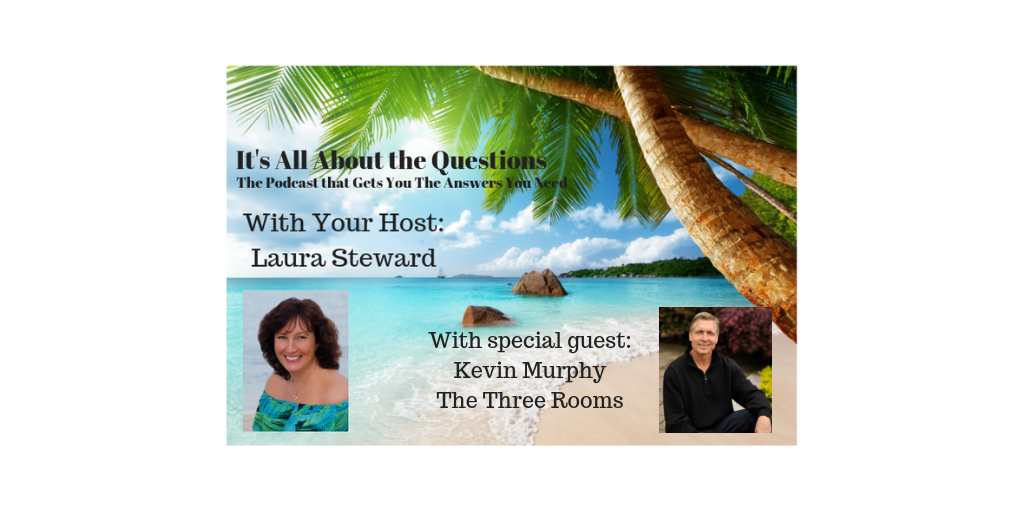
Welcome to It's All About the Questions, where learning to ask the right questions can help you achieve lifelong success. Now, here to help you ask all the right questions is award-winning author, international speaker, and business strategist, Laura Stewart. Good morning, afternoon, and evening, everyone. Welcome, welcome, welcome to the show. Excited, as always, to be here. And, you know, I am here in the moment, in the present. And we've all heard the phrase, live in the now. Be present, don't borrow worry from tomorrow, don't dwell on the past.
Probably heard them over and over and over again. My mom also loved to say, this too shall pass was one of her favorite phrases. And with it being a year since she passed, a lot of mom's phrases just really seem to be coming up. But really, when people talk about living in the now and being present and don't borrow worry from the future, how do you actually do that? I know I've read tons of books on the topics. I've actually spoken on the topic when I've done my keynote speeches.
Really, there is no one right way of doing it. Perspectives can change based on how material is presented, whether you are ready to hear whatever that message may be. And my friend Jackie Lappin recommended that I interview my guest that I have on the show today, Kevin Murphy, the author of The Three Rooms, Change Your Thoughts, Change Your Life. And when Jackie says to me, Laurie, you know, you might want to consider interviewing this person. I always take that.
highly, highly rated because she's never given me bad advice. So I'm honored to have Kevin on the show today because his book is a different way at looking at that whole idea of being in the present. And he does it with this idea of three rooms, the past room, the future room, and the present room. So Kevin, really, thank you so much for being on the show today. Thank you, Laura, for having me on. I'm excited to be here. Yeah, and we do have some commonalities with the Long Island, New York thing, which is a lot of fun reading through the book. Do I know that person? Do I know that person? He's referencing in there. You came from a Wall Street crown. I mean, you're a Wall Street managing director. You're even in the National Wrestling Hall of Fame. You're raising awareness for opioid and drug epidemic research to raise awareness of it. You know, you're a top man, a person at Citigroup, 33-year career, talking high, high-profile business there. You know, in the options trading world, why a book about being present?
Well, firstly, that's a really good question. And I have to say, most people, when I said that I was stepping away to write a book, I think they were expecting an option strategy book or kind of a Wall Street tell-all book. And so all I can say is I did not intentionally think, let me write a book, and what should it be about? I think that over time, certainly over the last 20-plus years, through different things and challenges in my life, I started to look within for more answers, and I started to kind of devour a lot of books in the consciousness-minded genre. And after a while, it was maybe, you know, call it...
Three, four years ago, I just started getting a premonition that I was going to write a book, and I didn't know what it was about. But then I kept getting this image of three doors, and one was the past and one was the future. And eventually those three doors turned into three rooms because I just, the place beyond the doors where our thoughts were kind of the premise. And I think, you know, the premise also might have come from the fact that I was always curious as to why certain people were so happy, even though it seemed like they had so little. And other people seemed like they had so much in terms of possessions, and they just seemed so miserable or just unhappy.
And it seemed like it can't be about what you have. And ultimately the premise of the three rooms is just that, is that our experience of life is not based on what we have or possessions or what we do for a living. It's based on what, and our thoughts can only be in one of three places. They can be in the past or the past realm. They can be in the future or the future realm. They can be in the present or the present realm. And whichever room your thoughts are in determines your experience of life in that moment, in the future. Do that, you just need to observe. And it is that agonist from your thoughts so you're no longer at the effect of that. And that awareness is our consciousness or that divine consciousness that all the mystics talked about.
I've had a number of guests on my show that talk about controlling your thoughts, changing your thoughts, having this whole idea of your thoughts can control everything about your success, your failure, your health, your wealth, all of that stuff. And what's intriguing to me in your book was changing it from sort of a nebulous concept of the past, present and future. Right. Which is kind of concrete. Right. Past is past. Future is future. But you gave it a room. And to me, that was intriguing because a room has four walls, a ceiling, a floor and a door. Right. So it has boundaries. It has definition to it, which when something has definition to it, to me, it's easier to question it because you can say, what makes that wall be a wall? Why can't it be the floor? Why can't it be the ceiling? So this concept of rooms intrigues me.
Can you explain to my listeners what the difference is in your definition of the past room, present room, and future room, please? Sure. And I think it's a great question, and I think it all has to do with emotions and how you feel. Because people say, well, you know, we learn from the past. You can't always be in the present. And we have to plan for the future, so we both have to go into the future, so we can't always be in the present. But it's really all about how we feel. So when I look at the panic of something in the past, it causes us to feel negative emotions. It's experiences that we are perceptive that someone did.
or what we didn't do. Thinking about right now, well, I don't have what I want right now. I'm not going to enjoy. Feeling positive emotions. It's good. Allow yourself to feel good. Imagining a future of the things that you would like to have and feeling the joy of now and you're experiencing it in association now. So that's how I look at the three of your thoughts, thousand thoughts a day, and try to monitor all of those. It is easier to put them behind one of three doors than it is to just always know which room you're in by how you feel. Feeling positive emotions, you have to be in the present. So you can't feel positive and be thinking positively about the future room? Only negativity can be in the future room?
Correct, because when you're thinking positive about the future, you're doing it right now. Ah, okay, okay. All right, wait, stop. All right, because that was kind of interesting to me. It gave me a little bit of goosebumps and an aha. So the difference with positive thoughts in the present, wait, so you're saying you can only have positive thoughts if you are in the moment, if you're in the here and now. As soon as you start to have a less than positive thought, you're either in the future or the past, is that correct?
Correct. And instead of, you know, you can think about a positive thought or a negative thought, but I think of it as just a thought that leads you to have a negative emotion or a positive emotion. Gotcha. So what is the thought? How is the thought making you feel? And so if the thought is causing a negative emotion, by definition, you can't be in the present realm. Because think of it in a couple of different ways, but just more from a spiritual standpoint, think of being in the present, you're aligned with your own soul, your higher self, your inner being, whatever you want to call that.
That's really where we want to be. And once again, that awareness, that consciousness, that divine consciousness that we all share, we want to tap into that. And that's always right here in the present. Your soul is always waiting in the present room. If you're looking at something in the past that's causing negative emotions, by definition, you are just not looking at that the same way your own soul is looking at it, your own higher self. If you're still mad at someone, a co-worker yesterday, for saying something to someone else and they tried to...
You know, blame something on you that the project didn't get done, and you see them the next morning, and you're still mad at them. You have all these negative emotions, and you have to see this person each day, and you're still seething. Well, your own soul is not seething at that person. Your own soul has already moved on. Your own soul is like, you know, what's up? They're not blaming them. But you are, and you keep going back.
to what happened, how it made you feel, and every time you do, you're reliving those negative emotions. Okay, and with that, we're going to go into our first commercial break. Please don't have any negative emotions about that, everybody. It pays the bills around here, keeps the lights on, and, you know, there's some pretty cool stuff on our commercials. So we'll be right back with more from Kevin Murphy talking about how you can change your thoughts, change your life with the three rooms. Kevin, you were talking about thoughts and feelings and being stuck in the past, and it's interesting because when I was reading the book, there is a story on page 214 in the book where you talked about negative energy, and it's sort of...
It's what you were just talking about before the break. And it reminded me of after my divorce in 2013 or 14, whatever it was, I don't even remember anymore, which says a lot. It's a big step. I was really annoyed because my ex-husband took the six-foot ladder. And I still had an eight-foot ladder and a bunch of step ladders and a three-foot ladder as well. But the six-foot ladder was gone. And every single time I went into the garage to get the six-foot ladder and it wasn't there, it would just feed. It would feed the angry wolf inside of me and it would just take me down. And something happened July 4th weekend this year.
I was with my friend in Home Depot. I had to buy something for a handyman to come do something. And all of a sudden I said, I need to buy a six-foot ladder. And they didn't have any on sale. I figured they would. So I went to Lowe's and I got a six-foot ladder for $39.99. And something completely shifted for me. In that moment, I became what, according to your book, would be in the present room now instead of all of that negative energy from the past room. It just completely, completely dissipated from my being. And I felt like I moved forward from that. Is that what you were trying to describe? That's exactly it. It can be a thought as simple as a ladder.
But that thought and that ladder is an image that reminds you of something else, in this case of splitting up properties or things like that, and it causes a negative emotion. And every time you think of that thought, every time you see a ladder, it reminds you that it takes you back there to those negative emotions. So the first key is to be aware that you keep feeling that negative emotion. That means you're out of the present room. Why am I feeling that negative emotion? Oh, it's because I keep looking back. Okay, I keep going back into the past room. And every time you do that, you say, well, I don't want to come here anymore. I'm feeling negative. I want to feel positive. How can I feel positive? Now, it happens to be that you, that...
You ended up getting the ladder. Perhaps you could have done that sooner saying, I keep thinking about this ladder. It keeps making me feel bad. How can I get rid of that negative emotion? I'm just going to get a new ladder, and now it's not going to bother me anymore. But over time, things happen over time, and you end up getting a new ladder. Now it doesn't bother you. It could have been something else as far as just letting it go, especially if it's what someone has done. And we know it's about forgiveness, right? That forgiveness is one of the ways we can also let go of negative emotions, of anger or resentment or things, and come back into the present realm.
Unfortunately for most of us, we have degrees of forgiveness. You hear people say, I'm a forgiving person, but not for that. Or they cross the line. And you have to ask yourself, what line? There's no line of forgiveness. Because if you really want to look at forgiveness, look at people who have really suffered tragedies. And they've come out and they've truly forgiven somebody for that. And it doesn't let that other person off the hook. It lets you off the hook. And now you free yourself to come back into the present room. You're no longer having all those negative emotions.
It's getting stuck in the past room. Keep reliving those negative emotions. You want to say, if you're aware of it, you can start to do things to move back into the present room. One is forgiveness. Two is to say, what is it that's causing that? And is something as simply as getting a new ladder? That's exactly it. Now you can think of every time you see a ladder, it doesn't bring up those negative emotions. It brings up almost a smile, like, I don't have to worry about this six-foot ladder anymore. I got one. It can be that simple. Yeah, I mean, it really became that simple. And I consider myself a relatively enlightened person. You know, I teach on a lot of these things as well. But I was so stuck, I couldn't see how stuck I was.
Over something as simple as a ladder. So I started not doing stuff around the house that needed the six foot ladder because the eight foot ladder was just too big and too heavy. And the three foot ladder wasn't tall enough to get to. And then it seemed like as soon as I got the ladder, it's like, oh, I can change that light bulb. Oh, I can do this. Oh, and it was just like, oh, yeah, it's just ease again. A wonderful thing. So being in the present room is about ease. Yes? No? Maybe? 100%.
And if you think about it, being in the present room is when you're in touch with your own emotions, when you're feeling love, appreciation, gratitude, that feeling of homestasis within the body. In your internal thermostat, everything's working easily. Everything's clicking. Once again, you can look back into the past, recall positive past experiences. You remember that first kiss, you remember that first date, or you remember passing that test, or getting that job, and you go, wow, I remember that. That's okay. It's okay to look back at things and make you feel good, because you're feeling good right now.
But anything, that thermometer, is how you feel. And anything that makes you feel, looking into the past or especially in the future. And I think in today's day and age, it's really about the stress in the future. Because we are at an interesting time in our history where many people are looking within to find peace, that feeling of harmony or unity with others. And yet when you look around, you still see so many people in stress.
struggling with child pressures or addiction, and feelings of isolation. And when you look at everything that's going on, even in the political world, where so many people are taking sides on all these different issues, but they're no longer listening to the other side's point of view. So there's a lot more disharmony than harmony, and that shouldn't be the case. And it comes back to what you were just saying. It's about ease. And if you're not feeling ease, then you're not in alignment with who you really are, your own higher self, your own soul. And the future and the stress is really probably one of the biggest challenges in our society today.
And it's not that idea that you have to go outside your comfort zone. Brandon Webb has been a frequent guest on my show, and he, with John David Mann, wrote a book called Mastering Fear. And he goes, you can't master fear by, you know, being so far outside your comfort zone. You need to take baby steps to get your body used to that stretch, to overcome whatever fear may be coming from your future room to stay in the present. You can't just bash at it. You have to be gentle with it. And I think that's some of what you're saying. Kevin, yes? Yes.
Yes, and you're right on the money when you talk about fear, because when I talk about negative emotions and positive emotions, so negative emotions being in either the past or the future realm, and positive emotions being in the present realm, we're really talking about only two types of emotions, love-based emotions or fear-based emotions, and in the past or future realm. They're just fear-based emotions. Anger, resentment, guilt, all of those are derivatives of fear. Okay, and hold that. We're going to tease people with that because we have to go to the national news. Please, everybody, don't be in fear when you hear the national news. If you're on the podcast, you get to skip it. So stay in the present room and we'll be right back. It's all about the questions. We're learning to ask the right questions can help you achieve lifelong success. Now, here to help you ask all the right questions is award-winning author, international speaker, and business strategist, Laura Stewart.
Welcome back, everyone. If you're just joining us, I am here with Kevin Murphy, author of The Three Rooms, Change Your Thoughts, Change Your Life. He is a former Wall Street managing director and not the guy you would think of who would say in his book, he's a mystic. Not what you would normally think of when you think of somebody who really beautifully put this whole concept of how do you know if you're in the present? How do you know if you're in the future room or the past room? So before the break, Kevin, you were talking about how you know which room you're in and how you can shift out of it. So let's take that to the next level. You talked about feelings. You talked about emotions. What are some of the questions that my listeners should be asking themselves to help them determine if they are in the past room? Well, once again, it's really about awareness. And so it's how do I feel? And when you're thinking about how do I feel, you can say, where are my thoughts?
That iconic question of who am I, when people look deep within, they're really asking who am I, that person on the inside that I'm trying to get in touch with. But the question of where am I simply means where are my thoughts or which room am I in, and you can tell that by how you feel. But the simple asking and answering of the one question, and you can ask it all day long, where am I? Not where your physical body is, because you always know where your physical body is. Look down at your feet, and they'll tell you where your physical body is. But where am I, meaning where are my thoughts and where are my emotions, how am I feeling right now? When you ask that question,
Just to be able to answer that, by definition, you have to be aware of what you're thinking. And so you have already separated your awareness from your thoughts or you're conscious of your thoughts. And that's why we talk about metacognition, thinking about your thoughts. And so you can't, let's say, move out of the past room with negative emotions unless you know you're there. And people get stuck there. And we know people that just always seem angry. They're just mad at something or they seem to be resentful. And likewise, we know people that are constantly worrying about the future.
What about this? And what about that? And we shouldn't do this. And this might happen. And they're constantly worrying and stressing. That just keeps building. And if you're not aware of that, that just kind of becomes your MO. Then those negative emotions just keep staying within you. And our bodies are not meant to constantly deal with all those negative emotions, all of that stress. And that's when you look at the long-term chronic illnesses in this country today, so much of it is caused by stress. So if you're aware that you're not feeling positive emotions, or if you're aware that you're thinking about that's causing a negative emotion, at least you can then start to say, now I know I'm in the wrong room.
I simply want to come back into it. Is it ever okay to visit the past or future rooms? Of course it is. And it's okay. We can learn from the past. We can recall positive past experiences. And we can plan for the future. But we can do it right now. And the difference between stressing about the future and creating our future is the difference of how we define ourselves.
If we define ourselves from being in contact with our own higher self who's saying, you are wonderful, you are amazing, and I am happy, I am healthy. If we start from that place, we can imagine a future that we would like. But when we listen to other people and they say, you know, you're not going to be able to do that, or you're not good enough for that, and you start saying to yourself, I know I'm not going to be able to do that, I'm not good enough. I am not. The more you say, I am not, now you're causing stress when you're looking into the future. Because in the future room, you're looking at what is, and you're thinking about what you want. And by definition, you don't have it yet.
thinking, oh, I don't have this, I'm not going to be able to get this, and you think about all the reasons why you're not going to be able to do it, causes constant stress. But in the present room, if you're thinking, I am happy, I am healthy, and now you're envisioning that, you're doing it right now, and you're envisioning what it would be like to be happy, to be healthy, to get that job, and now you're looking from that place as if it's already happened. You are creating your future, but you're doing it right now. You're in the present room, you're aligned with your own source, and you're, once again, you're using your imagination, you're visualizing things of what you want, And in the present room, you're thinking, what can be? And that's the thought and that's the question. What can be? Not, you know, why I can't do something or looking at what is and not having what I want, but what can be? That's the real question.
So what can be? It's interesting to me because, you know, I help people think up. When I work with my clients, I help them, as somebody described it the other day, Lori, you help us think up and keep thinking of possibilities and start thinking more positively about what can be and where we should be moving forward. Yet it sounds simple when you say it, Kevin, but so many people, my listeners, I hear this from them all the time, they have trouble staying in that space. And in your book you talk about, and what we've talked about in the interview so far, is...
Having that awareness of where your thoughts are. Yet, it's so difficult for people to stay in that present room and stay in there. Why do you think we have such difficulty staying in a place of ease? It's because we let everything we see and hear in the physical world affect how we feel. Instead of starting with how we feel inside and letting that affect everything we see and hear. Because even more and more people are using meditation. And in the mornings, they meditate.
take 20 minutes. I mean, some people say, well, I tried meditation. It doesn't work for me. You have to give it a little bit of time. But what happens a lot is even when they get centered and now they feel all peaceful and now they're, you know, they've meditated, they feel relaxed. They're in the present room. They get in their car, they start driving to work. Somebody cuts them off, yells at them, yell back. They spilled your coffee on your lap. And now all of a sudden you're already worked up and now you're pulled out of it. And then you get to work and you see the person who kind of did something that you perceived as negative to you yesterday. And now all of a sudden, again, all these kind of negative emotions.
or you see that car you want, and someone else is driving it, and I'm not going to be able to do that. Now your mind starts going on that, and you start feeling stressed. So all the things that we see and hear all through the day constantly pull us out of the present room. And the triggers that we see all day long, like you were talking about the latter, it's just a trigger that all of a sudden, boom, it's a negative emotion. I can't believe this. And so what we need is, we need triggers or reminders all through the day to bring us back into the present room, to get back into alignment with it. And so one is just the awareness of where I am. So if all day long you just say, okay, where am I? Which room am I in?
based on how I feel. And any time you know during the day that you're not feeling right, just I'm in the wrong room. I've got to start to come back. So it's where am I and where are my thoughts and how am I feeling? And then how do you stay in the present room throughout the day? I think the best way to get into the present room in the morning is through meditation because it is the absence of thoughts that brings you into the present, and that's where meditation helps. But then the best way to stay in the present room throughout the day is thoughts of appreciation and gratitude. Those keep you there. And we hear it all the time, and people know it. They go, I know gratitude. Yeah, yeah, yeah. You've got to be appreciative.
But really appreciating everything, everything through the day, looking for things to be appreciative of all day long really does help keep you in the present room. And so that's something where being aware of how you feel, being appreciative of little things, that can help keep you there. And again, when you start to think in the future, it is creating that image of what you would like where everyone can sit back and think about something that they would really like and just say, wow, wouldn't that be great to have? And it starts to give you a warm feeling. And what if you thought from the standpoint that you already have it?
And that's so huge, because if we take that one word, already, instead of the word not, because we're talking about, I'm not good enough. I'm not going to be able to do that. And that's how they define themselves, and they cut themselves off from their desires. But if you simply say, I already am. I already am happy. I already am healthy. Now you're coming from the place of having it already, you know, you achieve your desire, and you feel that. And it's powerful when you just say it, I already am. You can feel it in your solar plexus.
And you're coming from the place of it already having happened. And that's how we do create our future. It's not about not ever planning for the future, but it's imagining the future we want and then attracting the things into our lives from that perspective. But it's doing it a little bit differently with the way you describe it in the book. It's not just imagining what we want in the future. It's knowing it's already there, it sounds like. Correct. That's why it's already happened. In the book, I use the story of Dr. Seuss.
27 times before he was walking down the street one day. He bumped into an old friend who happened to be a publisher. His publisher said, oh, give me your book. Let me see, you know, and now try to get it published. They get it published, and he changed the lives of millions of people. But now that's a true story. But think about, because Dr. Seuss, getting his book rejected 27 times. Think about what he had to believe in that. He had to have a vision that I am going to get this book published. Because otherwise, after the fourth time he got it rejected, or the tenth time he got his book rejected, he would have been saying, I'm never going to be an author. Who am I kidding? I can't write children's books. I've got to go back to...
You know, flipping hamburgers or whatever I was doing. This is ridiculous. And he never would have persisted. But he kept persisting to 27 rejections. Now think of the day that he bumped into his buddy walking down the street. You've now had your book rejected 27 times. You see a friend coming up and you're like, I don't want to talk to him. He's going to ask how things are going. I'm going to say, well, I got my book rejected 27 times. How do you think I'm feeling? And instead he ducks into a storeway and lets his friend walk by because he doesn't feel like telling his friend how bad he's doing. How often does that happen? It happens more often than you think, like commercials do. We'll be right back with more from Kevin Murphy after our last commercial break.
Kevin, there is a story in your book on page 168 where you tell about an investment banker and a fisherman. It's an old story. And the fisherman seems totally happy. And the investment banker keeps saying, ah, but, you know, if you work a little harder, you can get a bigger boat. You can do this and you can run this bigger conglomerate. And then you can at the end, you can end up retiring and having the life that he currently has.
Why did you pick that story? And I paraphrased it, everybody. It's on page 167, page 168 of the book. And there's a lot of beautiful nuggets like that throughout this book. The Three Rooms, Change Your Thoughts, Change Your Life. Why that story? Why do you think it so perfectly encapsulates the idea of The Three Rooms? Well, I think especially with The Future Room, we hear so much, I'll be happy when. I'll be happy when I get that job. I'll be happy when I make a lot of money. I'll be happy, oh, I can't wait till I retire. I hear it all the time. Six more years, I'm retiring. I can't wait.
You can't wait for six more years. So it's, I'll be happy when. And that story just encapsulates, be happy now. You don't have to wait. This is all we have. Time isn't linear. It's always now. So to delay, to intentionally delay your happiness. And people say, well, to delay gratification, you have to work for things. Having to work for things that you want in the future still does not mean that you can't be happy now. You can be joyful working now for things that you want but appreciating everything you have. And so you're already there.
All can be happy now. And I think that one of the single biggest, you know, in the book is that we do have control over how we feel. And once again, it depends on whether we let what we see in here in the physical world determine how we feel inside or whether we let how we feel inside determine our awareness of our emotions. But be happy now. Don't be happy when something is going. So if you find your words saying things like what if, what room does that put you in? Well, it depends on kind of what you follow it with. It makes you feel. What if I smash this car? What if I don't get putting you right in the future? But what if you said, what if?
You said, wow, what if, you know, what if this, and use your imagination, you have created a vibrational reality for that image, sitting there waiting for you, because that idea, fired idea, is waiting for you. I've been watching Stargate Atlantis reruns. Have you ever watched that show?
I have not. There's a character, Dr. McKay, and he's a very central character to the show. He's the scientist who can fix everything. But in the course of whatever crisis happens, he immediately goes, but we could die. We could this. We could that. If it breaks, I could blow it up. You know, it's like always worst case scenario. In two seconds, he can run down 30 horrible scenarios that could happen. And it's really kind of fascinating to watch. But yet when he's forced to stop, the other characters actually say to him.
stop talking and just fix it he then becomes so in the moment that bam okay it's fixed and every single scenario crisis he ran through does not come to fruition because he had to literally stop forget all of those things and go what can I do right now I can fix this but he can't get out of his own head until somebody from the outside forces him to stop fretting and running through possible horrible scenarios yeah We constantly create all these worst-case scenarios, and sometimes we create what we try to prevent again. You know, we're so worried about something happening, but then all of our thoughts and our desires and our dreams, their alike and feeling good about it, wait for the movie of our life. And the only thing that's going to derail it is our own thoughts. Kevin, how do people reach out to you? Where can they get The Three Rooms, Change Your Thoughts, Change Your Life? The book is available on Amazon, just Kevin Murphy and The Three Rooms, or they can cite www.thethrerooms.com. It's the three, T-H-R-E-E spelled out.
We're going to be able to find lots of information there. You should probably grab the domain with the number three there, just in case it's available. I do. I have them both. I should link them. I should link them. Yeah, just have the one forward. My web guy, Greg Shuler, he talks about that all the time. Most brilliant web guy I've ever met with, I think his prices are way too low, but he's brilliant. So he talks about all those kind of things as well. Last thought you'd like to take us down for the last few moments of the show. Yeah, I think it's making things simple. And everybody knows how important it is to monitor our thoughts. Just don't do a very good job at it. And so it really can affect
How we feel, we can feel good. And so be aware of your thoughts. Something as simple as, you know, which room am I thoughts in? Then use that because we all want to feel good. We all have the ability to feel good. What's going on? So connect to that, you know, that awareness within us. And it makes life so much more enjoyable. And the three rooms apply to every area of our lives. It's not just our personal lives, but it's our business lives. It's our financial lives. It's every aspect of our being, right? Absolutely. It's business perspective. You know, you can't be effective if you're constantly looking back. You can't be effective if you're always, you can only be effective where you want to be as a company.
And even relationships. Everything has to do with all of our relationships. It always starts with a relationship. And that's a perfect spot. We're about to go off the air. I want to thank you so much for being here. Everybody grab a copy of The Three Rooms by Kevin Murphy. Remember, the right questions can change your life. So what do you ask today? Have a great day, everyone. It's All About the Questions, starring Laura Stewart. Connect with Laura at itsallaboutthequestions.com and download a free workbook that will help you ask better questions starting today.