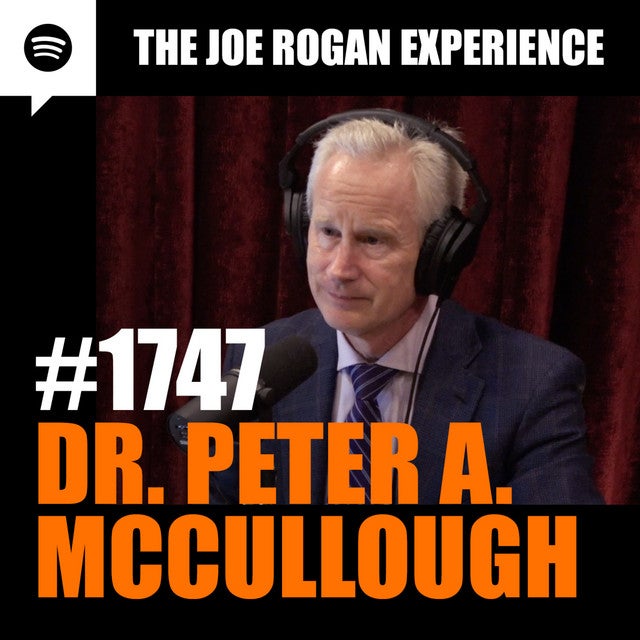
The Joe Rogan experience. Train my day Joe Rogan podcast my night. Well sir, thank you very much. I really appreciate it.
I've seen a lot of your testimonies before they were actually taken down. I've seen some of the videos that were yours that were taken down off YouTube. And then I found that very odd that a doctor talking about a medical disease would have videos taken down. An actual expert would be either testifying or discussing treatments and talking about a disease and have those videos taken down off of YouTube.
First of all, if you would please just tell state your credentials and tell everybody what you do. I'm Dr. Peter McCollum. I'm an internist and cardiologist.
I'm also trained in epidemiology. I'm an academic practice in Dallas, Texas. So I see patients about half the time I saw patients yesterday drove down today to see you here in the studio. And the rest of my time I spend as an author, an editor, an editor of a major journal in cardiovascular medicine, the former editor of an international journal.
I'm the president of a major medical society right now currently, about five years into that position. And I frequently publish, in my field I study the interface between heart and kidney disease. I'm the most published person in my field in history. I have over 650 publications in the National Library of Medicine.
I mentioned this probably ahead of anybody you've had on the show. You mentioned Paul Merrick. I'm just out of Paul Merrick. Peter, Peter Corrie mentioned him in critical care.
I'm just out of Paul younger than he is. And in COVID, when COVID hit, I really dropped everything to put all of my academic efforts on this because I saw it as an all hands on deck situation. Now, when did things start to seem strange to you in terms of the way the information was allowed to be distributed? In terms of the way people were treating patients and not just that, but the information on how to treat patients was distributed.
I didn't see this coming to tell you the truth. I was pretty happy in life. Medicine was moving along for me and had a very highly ranked position at a major academic medical center and traveled frequently. And did all the things we normally do in academic medicine, meeting, interchanging, challenging, being skeptical with one another.
That is the lifeblood of academic medicine. And things are going great. In March this hit, we immediately took efforts. We thought it was going to hit Dallas.
We started looking at things, how to configure our workforces. I went and got a grant, got a large grant to study a prevention approach to protect our workers at our healthcare facility. And I worked with the FDA over a weekend to get an investigation of drug application awarded in my name in order to test a pro-filectic approach. Things were going great in March.
And I can tell you, it wasn't but a few weeks into April. On these task force calls, I was on routine health system calls. Once a week, I was on one with the National Institute's health. And I asked a question.
I said, when are we going to start to treat the problem? I said, people are getting sick out there. They're starting to be hospitalized. Some are dying.
When are we going to start to treat patients? It's too late for the hospitals. Too late to treat people is obvious. They're dying in the hospital.
Was there no thought about it? Was there no discussion? Or was it just not a point of focus? What was the problem there?
I think it was a grip of fear. Doctors for the first time in their lives felt like they could get the disease themselves. If they actually saw and examined these patients. All the discussion was on personal protective equipment, hand sanitizer, negative airflow rooms.
It was all about protecting the healthcare workers. There wasn't any focus on sick patients. And after the weeks went by, I became incredibly frustrated. I started communicating with our Italian colleagues.
I said, what's going on? You guys are getting blasted in Milan. Is there anything we can do to treat patients at home and stop these hospitalizations? Were you alone with this concern?
Were there other doctors that were joining you with this? Were there treatment protocols that had been put into place that were being tested? There were no treatment protocols that emerged. We started looking at work done by Didea Rialt in Marseille, France, by Vladimir Zalenko in Monro, New York.
We started communicating very early on with the Italians. I had great relationships with the Italians in Milan. What we had decided is we had decided on some principles early on. The first collaboration, my contribution was to get people together, get the ideas together and publish.
I had the publication strength that other people didn't. I got the first organized ideas together in April, May, June. We submitted our paper July 1st to the American Journal of Medicine, which is one of the highly ranked journals in medicine. It was published in August.
This is the first publication teaching doctors how to treat COVID-19 with a multi-drug regimen. And the Garan rules were this. We knew it was insufficient time for larger randomized trials. Those take two to four years.
I lead larger randomized trials. I published in the New England Journal of Medicine. I know what this is about. I'm on steering committees.
We don't have two to four years. This is a mass casualty situation. We use the precautionary principle, meaning that this is a mass casualty situation. We can't wait.
We're looking for drugs with a signal of benefit and acceptable safety. We knew very early on that this viral infection had three components. It was a viral replication, cytokine storm inflammation, and then thrombosis. So we know a single drug wasn't going to handle a problem.
No way. It was going to be a multi-drug regimen, just like with HIV, just like with hepatitis C, no difference between multi-drugs. So precautionary principle, we used signals of benefit, acceptable safety, drugs in the combination, test, retest, and go. And so at the time we submitted our paper, Joe, there was about 4,000 papers in the peer-reviewed literature on COVID-19.
I'm sorry, check that. There was 55,000 papers in the peer-reviewed literature on COVID-19, and about 4,000 that could have related to certain drugs, but not a single one put the concepts together and how to treat patients. So this was the first one, and it was published in August. August of 2020, American Journal of Medicine, the title of the paper was the Pathophysiologic Rationale for the Early Ambient Joint Treatment of COVID-19.
That quickly after August spawned the Association of American Physician and Surgeons Home Treatment Guide. So A.A.P.S., interesting organization is independent doctors. They accept no money from pharmaceutical agencies. They've been around since 1943.
They had early on sued the federal government to release the stockpile of hydroxychloroquine. You know, U.S. had the right ideas. Other countries, they stockpiled hydroxychloroquine.
Then there was the problem of it wasn't being released from the stockpile. And so during my development work early in 2020, I got a call from the White House, Peter Navarro called me. So listen, McCulloch, can you help me get hydroxychloroquine released right in others in the FDA, seem to be colluding to block hydroxychloroquine coming out of the stockpile. In Marseille France, video, we all was working with hydroxychloroquine, and it was over-the-counter in France.
They made a prescription, and they started making it hard for him to use. And then simultaneously in Australia, they had taken hydroxychloroquine, and they had put it up in Queensland. And they had put it up in Queensland as basically an untouchable drug. If a doctor attempted to use hydroxychloroquine to treat a COVID patient in early April, that doctor could be put in jail.
So these things started happening early to try to prevent treatment of patients with COVID-19. Why do you think that's the case? And why do you think that hydroxychloroquine would have been effective? 2006, forward, there were studies with hydroxychloroquine that demonstrated that it reduced replication of SARS-CoV-1, the first version of the SARS virus.
Yeah, we talked about that the other day. Wasn't it just chloroquine? Was it chloroquine or hydroxychloroquine? Originally, there was chloroquine, hydroxychloroquine, and methoquine.
So there's anti-malarials. They're similar in terms of their biochemical property, but they have three mechanisms of action. They increase the lysosomal pH. So when the particle is taken into the cell, it doesn't travel so well to the nucleus.
They chloroquine or hydroxychloroquine, bring in zinc. It's a zinc ionophores. Zinc goes in and actually antagonizes the RNA-dependent polymerase, which is needed for the virus to replicate. And then hydroxychloroquine is a well-known and established anti-inflammatory.
We use it in lupus. We use it in rheumatoid arthritis. And it's obviously an intracellular, anti-infective. We use it for the professional malaria.
Was the problem that there was a lot of problems with Donald Trump being in office, that when he would approve of something or when he would talk about something, people would attack that thing. And hydroxychloroquine became something that he talked of as a cure and talked about as a treatment for COVID. And then it became politicized. And then support for hydroxychloroquine became support for Trump.
Would you think that that was accurate? I'd have to look at the time. My boy was quick because the backlash against hydroxychloroquine was so strong in Brazil and Australia. Why do you think that is though?
No, but the timing of the question is, did it happen before after Trump said anything? It happened very quickly. You know, through the course of the year it was extraordinary. You know, the second largest producer of hydroxychloroquine, the plan was mysteriously burned down outside of Taipei.
It was extraordinary what was going on. Doctors from Africa were telling us that, you know, there were some type of mercenary people raising the pharmacies at night and burning the hydroxychloroquine. Now, this is before the emergency use exemption or the emergency use authorization for the vaccines. The emergency use authorization, in order to have that, you cannot have effective treatments.
You have to be careful. The emergency use authorization is a new mechanism, or a previously unused mechanism for regulatory pathways of drugs. And my interpretation of it, and everybody's interpretation is fair game, so it's pretty loosely written quite honestly, depends on indication. So a vaccine would be indicated for the prevention of COVID-19 illness, hydroxychloroquine or bamolivumab or any of these other drugs will be approved for the treatment of COVID-19.
So the EUA should not be viewed, in my view, as competitive. In fact, it can't because, remember, bamolivumab, the lily product, as well as Remdesivir, the gilliant product, they preceded the vaccines. And they didn't preempt the vaccines coming out of the market. But Remdesivir had problems of its own, correct?
With kidney failure? Well, Remdesivir was basically a repurposed failed Ebola drug, and it does have intellectual property ties through gilliant back to the Chinese. So the Chinese originally were collaborating with us very tightly. I mean, tons of emails from the Chinese.
They were trying to alert us what's going on with COVID-19. Remdesivir came up. It's a polymerase inhibitor. As a general, I told you hydroxychloroquine has three mechanisms of action.
You reviewed previously Ivermactin, which also has three separate mechanisms of action. Remdesivir is a one-horse show. It's a single mechanism of action. It inhibits the polymerase.
And unfortunately, as the data have borne out, it's given far too late in the illness. So the polymerase is active early in viral replication. So if you gave it on day one, it may actually do something. But if you give it on day 14 by time someone comes in the hospital, the virus is done replicated at that point in time.
And then all it can do is offer toxicity. And you're right, it's a five-day infusion of Remdesivir. Early on, we heard about the hepatic toxicity. In my experience, I could never get a patient through five days of therapy because of liver function tests, the ASD and ALT, which skyrocketed.
Now, it's become clear it's been associated with acute kidney injury. And the kidney injury is not tolerated in COVID-19, because any retention of fluid makes the oxygen saturation along its far way. So why do you think there was this demonization of hydroxychloroquine? And do you have a theory as to why they would try to restrict the distribution of it, or why they would, if someone wanted to burn down the factories, they would do that?
It was clear that hydroxychloroquine was the most promising drug that we had for COVID-19. By the way, we tested Ritonovir, Lipinovir, HIV drugs that quickly fell to the side. Other drugs were tested. But hydroxy came forward as the lead agent.
And currently, we're up to 300 completed studies with hydroxychloroquine, 32 early treatment studies. And it does have an effect size or an efficacy early in treatment of about 64% globally across the studies. And its toxicity profile is well understood. Hydroxychloroquine, like Ivermactant and the other drugs, are already FDA approved.
The FDA tells doctors to use drugs off-label. It's in their guidance to us. And actually, FDA has a piece to patients that was published in 2018 saying, why does your doctor use off-label drugs? And it says, when the doctors are fulfilling an unmet need, i.e.
COVID-19, there's no no no no drug, COVID-19. So we use these drugs, was called clinically indicated medically necessary, appropriate off-label use of drugs. Hydroxy was the first one up. A giant mistake was to actually place an emergency use authorization on hydroxychloroquine.
And the original E-A that was placed on hydroxychloroquine, which it didn't need one because it's already on the market, right? It was placed for inpatient use. And then the interpretation was that it was hydroxychloroquine was restricted inpatient use. So once it became restricted in inpatient use, then there was messages saying, listen, don't use it unless somebody's an inpatient.
Then, when we found out that hydroxychloroquine, like Ivermectin, works best early and has less of an effect late, like all the other drugs because people are too far gone, once those trials were completed, there's five randomized trials of inpatients with hydroxychloroquine as they're about to go on the ventilator. And those five trials are neutral. They don't show harm. They don't show benefit.
They're neutral. One of them was the NIH trial. There's only two placebo-controlled trials, by the way. So we've based the entire house on hydroxychloroquine on two placebo-controlled small inpatient trials that were, didn't have sufficient power to see an effect if the data was there.
Having said that they were flat on the outcomes of mortality and progression in the hospital. And so based on that, in June of 2020, the FDA came out across the board and said, based on this, do not use hydroxychloroquine to treat COVID-19. Period. Period.
Full stop. They never review the data a second time or third time. And I can tell you as a doctor, the FDA, the CDC, and the NIH are public service agencies to me and you. We don't work for them.
They don't issue us rulings. They work for us. And I'm telling you, as a leader in academic medicine, my expectation was monthly reviews from those three entities and the White House Task Force. Matter of fact, the White House Task Force can do it.
I needed a monthly report of what drugs were working and what drugs weren't. We didn't see any of that. Why do you think that is? I talked to Scott Ellis.
I presented with him a couple weeks ago and I had dinner with Scott. He was on the inside. He works side by side with his people for months. And I said, Scott, what is going on?
Scott goes, I did what Peter McCullough would do. I showed up every day with the data. I analyzed things. I had the updates on what's going on with the pen.
And Scott was focused on mass contagion control in schools, but he's an academic. He's at Stanford Hoover Institute. I said, yeah? I said, what about the other people on the test scores?
What about the head of the NIAAD? What about the CDC director? He goes, they showed up with nothing. I said, you got to be kidding me.
They're not analyzing any data. He goes, have you ever seen them come on TV and analyze any studies? I said, no. He thinks that this is a crisis of academic incompetence, believe it or not.
Just incompetence. Not some sort of conspiracy to demonize hydroxychloroquine for profit, for some other means to promote some other treatment or drug. It wasn't me, but someone in the crowd, this was a post-em that was held by Pam Popper, by the way. Pam Dr.
Popper's got a wonderful book out on COVID-19, and so does Scott Atlas. And so does Scott Atlas. And so does Scott Atlas. And so does Scott Atlas.
And so did they have another intention? Were they directly trying to squash hydroxychloroquine at the time? He said, no, he said they had good intentions for the nation. He says they're just incompetent.
So is it possible that the demonization of hydroxychloroquine was because Donald Trump supported it? Because I know for like the way I had been hearing about it was hearing about it through him. That he talked about it is basically a miracle. Do you remember all that stuff?
He was saying it was a miracle. As I recall, that was late March. I think when it was honestly made illegal in Australia was early April. I went on Tucker Carlson.
We had the same type of discussion. Tucker says, how did the Australians know to make it illegal so early in April? He goes, that's before all the research was done. Remember Henry Ford came out with a 3000 patient study and actually used in the hospital.
It wasn't randomized, but they got consent. It was very carefully done. I was a program director at Henry Ford that passed. I know that institution really well.
High quality, top shelf. I was communicating with them. They said, listen, it works. It is clear.
It works. This is an unconfounded study. And that was one of the studies that in fact we relied upon in order to put hydroxychloroquine in sequence multi-drug therapy. That was before the data with hypermectin came in.
So hypermectin came in later. And so our update, when we published our update in December of 2020, we brought in hypermectin. The Japanese told us about Favi Pieravir and the Russians had. A lot of people don't know this.
There is an oral antiviral approved and used in Japan and Russia and for states in India called Favi Pieravir. That is an oral polymerase inhibitor. So it's like an oral remdesivir. It's very similar to the new drug, molar Pieravir.
This is an oral polymerase inhibitor. So the antivirals, we actually buy our recommendations, now have three antivirals that we can recommend worldwide for that layer of treatment. Now antivirals alone are not sufficient and they are not necessary to treat COVID-19. It's very interesting for people to say this.
People wanted to put up hydroxychloroquine up on a pedestal and say, listen, if we can knock down hydroxychloroquine, there will be no treatment for COVID-19. And we can promote some other agenda. Or if we can knock down ivermectin. And Dr.
Chedi from South Africa and Dr. Brandtios from South America, given the politicization of both drugs. Because ivermectin in the next wave became the next target of politicization, if you will, if it's politics. But I have to tell you, it's so worldwide.
I hate that word politicization. I think it's some other process. But the point is, they demonstrated that the syndrome as an outpatient can be treated without those drugs. They use a different combination of drugs in the sequence.
The Chedi method is called the time method, where you essentially let the virus make its run on replication and then pick it up with Monte Lucas, several heptidines, inhaled steroids, oral steroids, and then antiquigons. They treat it back into the syndrome. Now again, though, why do you think hydroxychloroquine was demonized? Why do you think that it was especially so early on in Australia?
It can't be universal competence across the board. So one of the things that's interesting about ivermectin is it's not demonized worldwide. It's distributed widely in other countries and it's shown some effectiveness. Oh, absolutely.
Ivermectin now is a first line in Japan. It's attributed to crushing the curves in Mexico, in Peru, absolutely crushed the curves in India. We've been in close communication with them. Ivermectin is an interesting drug.
I know you've reviewed it in depth on the show, so I'll leave it to experts like Dr. Corey and others there. I use it every day in my practice. I have no problems with Ivermectin.
It's safe and effective. It's been a Nobel Prize awarded in 2015 for Ivermectin. But hydroxychloroquine, I think worldwide, it's still the leading drug used to treat COVID-19. Just because of its availability, it's known dosing.
The interesting thing between hydroxychloroquine and Ivermectin is Ivermectin has a range inpatient and outpatient and has a bigger effect size in general. Both of them are still lacking the 20 to 40,000 patient clinical trial as a singular drug. I honestly don't think we'll ever get there. By the way, we're in the multi-drug space, so we're never going to go back to single drugs.
We're in the multi-drug environment. So there are no large multi-drug trials even planned at this point in time. So we're left with where we are, signals of benefit, acceptable safety. But to finish the thought, Ivermectin has a range of effect sizes that are gratifying inpatient and outpatient.
Inpatient and outpatient diminishing efficacy later, hydroxychloroquine has really no support on the inpatient side outside the Big Henry Ford study. So hydroxychloroquine is largely an outpatient drug. The advantages of hydroxychloroquine are stable dosing, 200 milligrams twice a day. We either go five, 10 or 30 days.
We even have protocols where it's been done that way. Ivermectin, the dosing is 200, 400, or 600 micrograms per kilogram. And the dose intervals still are yet to be standardized or worked out. So it's interesting.
So you see an entire range of doses. And Ivermectin, even clinically today, I don't know. Do I go five days? Do I do?
I do I do? Do I do every other day? I don't know. We use the drugs.
I'm comfortable with that. I can live with ambiguity in the setting of a crisis. The point is these are very safe and effective drugs are useful drugs. I saw a trend.
You've asked me three times. I'm going to answer it. I've saw a trend starting in April, May and June where it became clear that anything we were doing to try to help patients with early treatment was receiving a chill. And the chill was coming through academic institutions through the medical literature.
I think the capper was in June when there was a fraudulent paper published in Lancet on hydroxychloroquine between Harvard and a company called Surgeosphere. And this never happens. Lancet is like the New England Journal of Medicine of the world. I'm the editor of major journal.
I run a journal. I know what it takes. There are editors, associate editors, reviewers. There is pinpoint accuracy.
We check references. We check plagiarism. Believe me, it's a tight world out there. They basically published a fraudulent paper on hydroxychloroquine in Lancet in 2020 around June.
And they let it hang up there for two weeks stating that hydroxychloroquine was associated with harm when used in patients with COVID-19. Who made this study? It was between one investigator was at Harvard and it was my company called Surgeosphere. Nobody knew what this company was.
It turned out to be a company that literally just dissolved or went away without anybody understanding. So it was a company that was created specifically to do this? No, I don't know. I can tell you I looked at the data, Joe, and they had tens of thousands of people.
They claimed to were hospitalized with COVID-19 fairly early in the pandemic. The average age of these people hospitalized was in the low 40s. I looked at this paper in two seconds. I said, this doesn't make sense.
We were hospitalized in people in their 80s, not in their 40s. And so to me, it didn't look right. And then people started writing Lancet saying, listen, this doesn't look real. They started receiving tons of emails.
And then Lancet basically retracted it and said, we retracted. No apologies. No explanation. I interpret that.
And that occurred right before the FDA said, don't use hydroxychloroquine. It almost looked like it was a step to basically try to bury hydroxychloroquine as a therapy. But why? This is what I still understand.
What do you think is the motivation? And why was it so worldwide? As a doctor, all I can tell you is the medical literature as we're seeing it come about. There was, once the discovery, that the spike protein on the virus, the discovery in the medical literature, now that discovery we learned actually occurred years before this, was amenable to neutralization with vaccine-induced antibodies.
Once that became abundantly clear in the literature, there appeared to be almost a lockstep developed where people said, uh-huh, that's it? That's the solution. We're going to vaccinate our way on this problem. We don't even need to worry about how to treat the problem.
We don't need to hear about drugs to treat the problem. And the enthusiasm and the hubris for vaccination spread across academic medical centers all over the country. But what about the people that were currently sick? And they were still waiting for the rollout of the vaccine.
So if you're talking about August, the vaccine wasn't rolling out for another four months. And that's just for elderly people. I published an op-ed in August of 2020 in the Hill, a Republican journal for Washington people and others in those circles. And the title of the op-ed was The Great Gamble of the COVID-19 Vaccine Development Program.
And what I saw is I saw a total shift on everything for the vaccines. Do you know major clinical trials with hydroxychloroquine were dropped? I've remactant. Things were dropped.
We had programs for Favi Pierivir, the Canadians had a big thrust for Favi Pierivis dropped. I was the principal investigator overall for the Ramachaban program that was a Japanese product. It was an anticoagulant antichistomy. It looked very promising.
We had great preliminary data. We had bear that was going to give us all the doses we needed to treat America. I was on calls between the NIH and the FDA back and forth back and forth. I couldn't get any traction in the summer of 2020.
It was obvious. In fact, I remember one of the Operation Warp Speed Officers telling me, listen, sorry, we have everything organized for the current program. I was also the assistant. I was the second in charge of the Imagellon program, which was a cellular-based vaccine.
That was a vaccine similar to the BCG vaccine, which is given for tuberculosis. We had noticed that regions that were vaccinating for tuberculosis like Haiti and countries in Central Africa, very low COVID. We had the idea we got a Dutch manufacturer to make the cellular-based vaccine. We were going to vaccinate healthcare workers.
Same thing. Endless proposals between NIH and FDA got nowhere because it looked like it was already pre-decided that the current genetic vaccines were going to move forward. There wasn't going to be any discussion on early treatment. I thought it was a gamble.
I was faced with more and more of my patients getting sick with COVID-19. What I told people all over, listen, I can't let the virus slaughter my patients. I'm not going to do it. I said there's got to be something I could do.
Early on, I used hydroxychloroquine, other drugs in combination. Once a pure cori, I gave him great credit. His first contribution is actually steroids in the use of COVID-19. So we started using steroids once it was shown to us.
We added steroids. The data started coming out anti-coagulants. And that's how I put it together. I tell you, Joe, every single one of my high-risk patients, I've always treated to prevent hospitalization and death.
Of the 800,000 deaths that we are right now, I can tell you to a one. They've received either no or inadequate early treatment. All of them. Go look in a table of baseline characteristics of hospitalized patients with COVID-19 and look at what they received before they came to the hospital.
Zilch. In fact, there's one paper by Ip and colleagues. First name is spelled IP. It was published from New Jersey early on.
And in that paper, back when there was a surge of hydroxychloroquine use in the spring of 2020, 7% of people had received some pre-hospital hydroxychloroquine before they got to the hospital, they had improved survival. Even some pre-hospital treatment really worked. So what happened is when we came up with our treatment protocols, the protocol that I mentioned, it sounds like describing what you received as a treatment. You basically received the McCulloch protocols now have been copyrighted.
Sequence, multi-drug, when somatoclonal antibodies came in, that became a building block in our program. And we can maybe show that my multi-drug protocol on the screen if we can look at it. The point is that any pre-hospital treatment was associated with improved survival because we're taking an edge off viral application, reducing some of the inflammation, preventing some of the thrombosis. If we let this thing run for 14 days, the lungs are filling with blood clots.
By the time the oxygen saturation goes down, that's not the virus. The Italian showed us through autopsy studies, very courageous autopsy studies, the lungs are filled with micro blood clots. So in your opinion, if your protocol had been established and distributed worldwide, if people had recognized that this is a way to deal with early treatment, you think that the overall number of COVID deaths would have been significantly reduced? I testified in the U.S.
Senate. November 19th, 2020, I told Americans under oath that 50% of the lives at that time could have been saved. We were at about 250,000 deaths. Based on what I knew, I then testified on March 10th, 2021, in the Texas Senate.
So, our testimony, I up that to 85% of the deaths could have been avoided. We know that because we carried out studies, we did one with Proctor here in Delos Fort Worth, where we demonstrated that even the early primordial protocols before the monolangal antibodies, when we used drugs and combination, we're associated with 85% reductions in hospitalizations and deaths. Compared to fair, compared to groups for death, we used the tricountary in DFW, averages age adjusted, and for hospitalization, we used the Cleveland Clinic calculator, which is a very precise estimate of the risk of hospitalization. Then, simultaneously, Durwand and Zelenko showed that from our own New York data, and then Diddy Rial showed it from our state friends.
So, we have three different areas showing early multi-drug therapy as an outpatient works substantially, and we've had a giant loss of life, a giant number, millions and millions of unnecessary hospitalizations. And it seemed to me, and I've told Tucker Carlson and many others, it seems to me early on, there was an intentional, very comprehensive suppression of early treatment in order to promote fear, suffering, isolation, hospitalization, and death. And it seemed to be completely organized and intentional in order to create acceptance for and then promote mass vaccination. So, you believe this is a premeditated thing that they were doing?
So, they realized that in order to get people enthusiastic about taking this vaccine, the best way to do that was to not have a protocol for treatment. It's not just my idea, now it's completely laid out by the book by Dr. Pam Popper, the book recently published by Peter Bragan, COVID-19 in the Global Predators. We either pray.
I wrote one of the introductions, Dr. Leif-Leif-Leif-Liet, and Dr. Fladmold-Ranko, and Osenko wrote the other introductions. These books are basically nonfiction.
They have a thousand citations in the Bragan book showing how it was coordinated and planned. Now, Bobby Kennedy has his book out, The Real Anthony Fauci, the most mentioned physician in that book, I can tell you that if you want to find the evidence that Moderna was working on the vaccine before the virus ever emanated out of the lab, if you wanted to find the collusions and the operations between the Gates Foundation and Gavi and Suppy and Pfizer and Moderna and the vaccine manufacturers and the Wuhan lab and the National Institutes of Health and Ralph Berrick and your state of North Carolina at Chapel Hill and how all this was organized. So, if you want to see the Johns Hopkins planning seminar called the Spires Pandemic in 2017, where they had a symposium, people showed up, they wrote up their symposium findings, they published this. It says it's going to be a coronavirus, it's going to be related to MERS and SARS, it's going to come over here to the United States, it's going to shut down cities and frighten people.
There's going to be confusion regarding a drug, hydroxychloricone and hypermectin, and we're going to utilize all that in order to railroad the population into mass vaccination. It's laid out in the Johns Hopkins Spires Pandemic training seminar. The only thing that got wrong was the year. They said it was going to be 2025.
Instead, it landed a few years early. How did they organize something like this and how do you get so many doctors to go along with this? How do you get so many doctors to not speak out against the lack of pre-hospitalization care, the lack of early treatment? We think there's about 500 doctors who knows what's going on in the United States.
500. We've got a million doctors in the United States, we've got half a million nurse practitioners and physician assistants. I can tell you the nurses are more awake than the doctors. Why is that?
The doctors appear to be like many of our leaders, by the way, all the leaders of the major churches, every single one of them, the major religious branches are under the spell. Every major global international leader is under the spell. We're in what's called a mass formation psychosis. This is very important.
I give credit to Dr. Matthias Desmond in the University of Ghent in Belgium. Recently, Dr. Mark McDonald, psychiatrist from LA, Mark McDonald's got a new book out, The United States of Fear, describing how the mass psychosis developed.
What your listeners need to know is a mass psychosis is when there is a group think that develops that's so strong that it leads to something horrific. The examples are these mass suicides that occur in these religious cults. The example is Nazi Germany when people walk into gas chambers and we're gas. These horrific things in four elements here.
It's a very important show. First, there must be a period of prolonged isolation, lockdowns. Number two, there must be a withdrawal of things taken away from people that they used to enjoy. That's happened.
Number three, there must be constant incessant, free-floating anxiety. All this news cycle, all the deaths and hospitalizations, more variant mutant strains, everything, people could be coming scared over and over again. The last thing, number four, the capper. The capper is there must be a single solution offered by an entity in authority.
In this case is clear. Worldwide, the solution was vaccination. Everybody must take the vaccination. It's not a US program.
It's not a European court. It's everywhere. And you know what joke doesn't matter what vaccine it is. It could be a China VAC, a corona VAC.
It could be Novavax. It could be Pfizer, Moderna, Jan J. It's interesting that it doesn't even matter what vaccine it is. It's just take a vaccine, take any vaccine.
And so what mass psychosis says is number four, the solution, there's no limit to the absurdity of the solution. Other countries have been much more ruthless in their enforcement of vaccinations. And it's kind of open a lot of people's eyes as to what's possible. When you look at some of the European countries, Germany's handling it, even when New Zealand's handling it, in Australia for sure.
People are terrified when they're seeing these places that they thought of as being as free as the United States falling into this sort of totalitarian regime situation where the government is telling the people what they must do. And literally checking everyone for papers. And people don't seem to think that this is a problem. A large percentage of people don't seem to think this is a problem.
They think it's good because we need to vaccinate everyone. But they don't have an issue with what has historically always been a problem with people. When you give governments extreme amounts of power over people, they tend to like to use that power. And they don't ever want to give it up.
And we've opened the door to these new levels of power for the government. And people say, well, that's important because we have to do it because we're in the middle of the pandemic and we have to treat these people. Some people are silly and they believe conspiracy theories and they don't want to take adequate treatment and that's going to get everybody else sick. Which doesn't really make sense.
But the whole thought behind it is that this is temporary. But it's never temporary. Power lost is never regained. All freedoms lost.
Unless you fight for them. They're kind of lost forever. And so these people that are giving into these green passes and they're seeing that in Israel now, right? Where Israel used to be you have two vaccines, two shots, and then you get the green pass and you're considered fully vaccinated.
You can enter society. Now they're saying no. Now you have to have a third. And now they're considering a fourth.
Which is wild. And there's no end in sight. You know, if it was about COVID, I would say that the world would have adopted something when I presented to the American people and the Senate testimony in November of 2020. I told America, listen, there's four pillars to pandemic response.
We should have always seen teams of doctors in Washington. I would have went if they called me. In fact, I emailed him. I know I am.
We would have seen teams of doctors in Washington working at four pillars. The first pillar is reduce the spread of infection. Terrific. Everything we can to improve airflow.
We know it's spread by the air. It's not a hand infection. This focus on hand sanitizers. We're all getting infected hands.
It's not even old. You still go on DFW airport. There's hand sanitizers every six feet. There was pictures of people spraying football stadiums with the sanitizer.
It's not spread on football seats. It's not a contact organism. It's not Ebola. It's not, you know, it's not cost-streamed.
It's spread in the air. But if we would have focused on contagion control that was reasonable, that would have been terrific. The most effective contagion control, by the way, is 2021 data is actually using oral nasal viral cytotherapy. Far and away.
Yes. Swain that, please. Yeah. Oral nasal viral cytotherapy is basically using virtually anything kills the virus.
Any disinfecting kills the virus. Iodine kills it on contact. So if we use dilute, beta-dine. And so if you take a beta-dine over the counter, it's a brown bottle.
We use it to sterilize ones in the air. Bite it in any pharmacy and take two teaspoons and six ounces of water. Take a nasal spray or a sorroge brim, a syringe bulb, and spray it up your nose, snort it back to the point and sit back your throat and spit it out. I'm sorry, that's gross for your audience, but you got to get it up there and back.
That adequately decontaminates the nose. Then gargle with the rest of it. Spit it out. Finish up with some scoping listerine.
Doing that after you return from a day out with contact with people, especially close contact in close rooms. I'm talking public restrooms, small conference rooms. You have to be in contact with someone for about three hours, honestly, in a small room with no airflow to get it or go into a loaded room like a public restroom or tight places at small stores. At the bottom line, that's where people get it from.
Once it gets home, 85% of it spreads in the house. But using oral nasal viral therapy is such a huge advance that any randomized trial by chowder and colleagues from Bangladesh, 303 patients re-animized to this viral-sidal therapy, which is all topical, no prescription drugs, nothing else needed, versus a control group, which was just warm water. 303 patients in each group, it dramatically reduced the PCR positivity by day three. It knocked it down from 303 down to 24 patients still positive.
Those who got the control, they're still all positive. And it markedly reduced by easily 75% chances of having progressive disease and enough to hospital or death. And it's enormously preventive. And now we learn we can use hydrogen peroxide, dilute hydrogen peroxide with some glucose iodine, and believe it or not, the dentists in the American Dental Association guidelines used for cytomegal virus and Epstein-Barr virus, gingivitis, they use sodium hypochlorite.
That's actually dilute bleach. It turns out it just takes a few drops of bleach in some household water. That's for the mouth. We typically don't use it in the nose around the eyes.
But remember when President Trump mentioned bleach, and everybody had a big horse life on that? It turns out he just couldn't articulate. Someone was giving him the ADA recommendations for antiviral therapy for the mouth. The point is, pillar number one should have been in contagion control.
It should have been focused on the nose of the mouth. We learned it late, but if we could have used any of that early, it would have helped. Randomized trials of masks didn't work. Hand sanitizers and sprain football stadiums.
Even in Europe, they were spraying the sidewalk. That doesn't work. Do you think masks have any effect on limiting the spread? Every time I go on Fox News, Laura Ingraham always tees up some comment on masks.
And masks are not my signature focus. And the reason being, if two people don't have the virus and they wear a mask, can it possibly do anything? Of course not. So in randomized trials of masks, they've asked majority people don't have the virus.
So if you put masks on people don't have the virus, it's not going to do anything. Mask expert, Mr. Steven Petty, who I've presented with. He is a world's expert on masks.
He's an engineer. With a typical mask that someone wears, do you know much air moves around the mask? It's 18% moves around the mask. Of course it doesn't work.
Masks only filter out about three microns. The virus is one micron. So the point is, what do masks do? Do I wear masks?
Sure, I'm a doctor. I go into the hospital. I'm in the cath lab. I'm in close contact with people.
Dentists, hairdressers, people at close range wear a mask. It may stop a big sneeze. It may stop partially some big emanation of inoculum. But we shouldn't have had the airtime and the public health focus on masks.
I think if we would have taken all of that energy and put it on treatment protocols and update on drugs, we would have been better off. But that's Contagion Control. Pillar number two is early treatment. We've talked about that.
Pillar number three, which is really important, is trying to improve the hospital treatments. And we should have had monthly updates from our federal officials and our agencies about where we are with early treatments. And for sure, our local medical schools should have all had early treatment updates once a month. Come on.
The medical centers are facing their Super Bowl. Do you know today in America? We have 300 medical schools. Harvard, Yale, Johns Hopkins, Mayo Clinic.
Do you not a single hospital has their own unique protocol to treat COVID-19? They don't have a single original idea. Do you know that none of those organizations show have ever treated a COVID patient to prevent hospitalization and death? I told Tucker Carlson, he almost fell out of his seat.
I said, yeah, they don't have a single idea how to treat COVID-19 patients outside the hospital. Suddenly our best and our brightest are out of intellectual ammo. I want to talk more about this mass psychosis. Do you believe that this is an organized mass psychosis?
All these steps that you put about isolation, taking away basic freedoms, and then offering up one individual single solution to this? And this is what has sort of fueled this, what's very obvious to people, that there's a lot of people that are not acting well. They're not acting normal. They are attacking people that seem to be ideologically opposed to whatever is going on.
And they're marching in lockstep with the authoritarians. And they're doing it like Stockholm syndrome or something. It's very strange. Do you think this is an organized thing?
Do you think this is just what happens when you have a massive group of people that are dealing with an incredibly tense and anxiety-ridden event like a pandemic where no one knows what the solution is? And then you have to think about what happens when you have a large group of people. A lot of people are terrified of just everyday life. And then all of a sudden something like this comes along and those are the people that are more easily manipulated and they fall in line together because there's sort of a tribal aspect of this type of thinking and behavior.
And you find support from other people that are equally afraid. There is a messenger RNA product. I can use it as a cardiologist called the TIRISAN. It's a small interfering messenger RNA that we use to treat amyloid doses.
But the previous trials of gene transfer technology, which is what these are, were normally to replace a missing protein. So for instance, I'm a cardiologist. I treat a condition called Faberase Disease. It affects the heart.
There was a messenger RNA program to basically replace the missing enzyme, alpha-galactosinase. But in this case, to take these platforms and say, you know what, these are ready to go. We're just going to insert the code for the spike protein, which is now what we've learned is the lethal part of COVID-19. The ball of the virus and nuclear caps of that beach ball is relatively harmless.
What causes all the damage is the spine or the spicule on the surface. Everyone knows the cartoon of the virus. That's called the spike protein. 1,200 amino acids, but it doesn't.
Caustulation sites. It has some homology, by the way, to HIV. And so a lot of people don't know this. But the original, one of the original antigenic vaccines that was tested in Australia exposed that HIV epitope.
It turned everybody in the trial, HIV positive. Who took a COVID-19 vaccine in Australia? These young people were outraged. And so this was on the internet.
It was quickly suppressed. But if anybody wants to type this in right now, you can actually learn that one of the very first vaccines, tried in Australia, actually turned everybody in the trial. They actually turned everybody HIV positive. They didn't have HIV, but there was a molecular trickery that was going on.
Having said this, now we look back. When we look at the books, Popper, Bragan, Robert F. Kennedy, and now Atlas, it's pretty clear that this was planned. And it was planned, and the elements of the mass psychosis are clearly planned.
In fact, the elements of the mass psychosis are in the Johns Hopkins planning document. They had that up on their website since 2017. Once a pandemic hit in March of 2020, March of 2020, they actually published it in the peer-view literature. You can see how it was all done.
That's how the Johns Hopkins Bloomberg School of Public Health had the death count up on CNN and MSNBC and Fox. As a scoreboard, do you remember the scoreboard was number of cases and deaths? How do they get that, Joe? Come on, I fill out deaths or tickets every day.
Do you know the average death certificate comes to me six weeks after the death? How are they getting these deaths, instantaneous numbers, picking up every day? It was extraordinary what Americans saw. So how were they doing that?
To this day, we don't know. To this day, we don't know. All we know on the CDC website is the CDC website says that about 90% of the deaths that have occurred with COVID-19 have been associated with significant comorbidities, meaning other major problems that were in the proximal pathway to death. The Italians are just recoded all their deaths.
They say 97% of the Italian deaths, meaning someone had heart failure, advanced lung disease, kidney disease, undiosis, advanced cancer. A good example was Colin Powell. Colin Powell just died recently. He was in his 80s.
He was fully vaccinated. And he died of multiple myeloma. But he was also COVID positive. And so the question is how much of the COVID did he die of and how much of the multiple myeloma?
Larry King died the same way. We can pick, we have to go far to find well-known personalities where this happened. The point is that deaths were coming in quickly. It may be the fact that the vast majority of them occurred in the hospital.
So we didn't have to have this prolonged outpatient death certificate signing and things where it made from the hospital. We know President Trump's authorization for the testing became the way that the Johns Hopkins School Public Health got the scoreboard for positive tests. And that executive order said all the laboratories and all the departments of public health doing testing will report positive tests to the center, the Johns Hopkins Center. And they did.
That means Quest, LabCorp, Abbott. All of them started to have a flow of tests. Interestingly, there was no reconciliation for duplicates. So if you would have went to one testing center and put your name as Joe Rogan and you went to another testing center and said your name is Jose Rogan or something, you'd come in as two different tests.
There was never any reconciliation. And we understood over time that the number of tests positive was in a sense padded. It was padded by duplicate tests. It was padded by this idea of asymptomatic testing.
So one of the big discoveries in 2020 is that the virus is not spread asymptomatically. It's only spread from sick person to susceptible person. This is a very important two major papers, one by cow from China, one by Madewell nailed this down. Once we learned that asymptomatic testing wasn't happening, it became clear.
The Swedes were right. Scott Atlas was right. The only thing we needed to do was just keep sick people at home. They were the only people who needed a quarantine.
And while people could go do what they were going to do, somebody can't walk into a workplace with no symptoms and give the virus to somebody else. It doesn't happen. The problem is with that is that a lot of people are not honest about their symptoms. We had a guy at a bar that we do stand up at.
He showed up. He was like, I got it. You know, he's just saying, guys got a headache. And someone said, what do you mean you have a headache?
And he goes, I just got this headache. And he goes, have you been COVID tested? And he goes, oh, my, I don't want to test positive. Then I'll have to take off work.
And they went, what? And so they tested him. He was positive. And they sent him home.
But that guy was going to greet customers at a commie club. Valid point, valid point. The new thinking really has to be either we don't trust people and we asymptomatically test everybody. But you know the World Health Organization as of June 25 says no asymptomatic testing.
The FDA has never cleared these tests for asymptomatic testing. The CDC doesn't give a green light to do this asymptomatic testing. And people like you and me, we just walked in. We have asymptomatic testing that if we get a positive, the chances that they're positive as false positive is 97%.