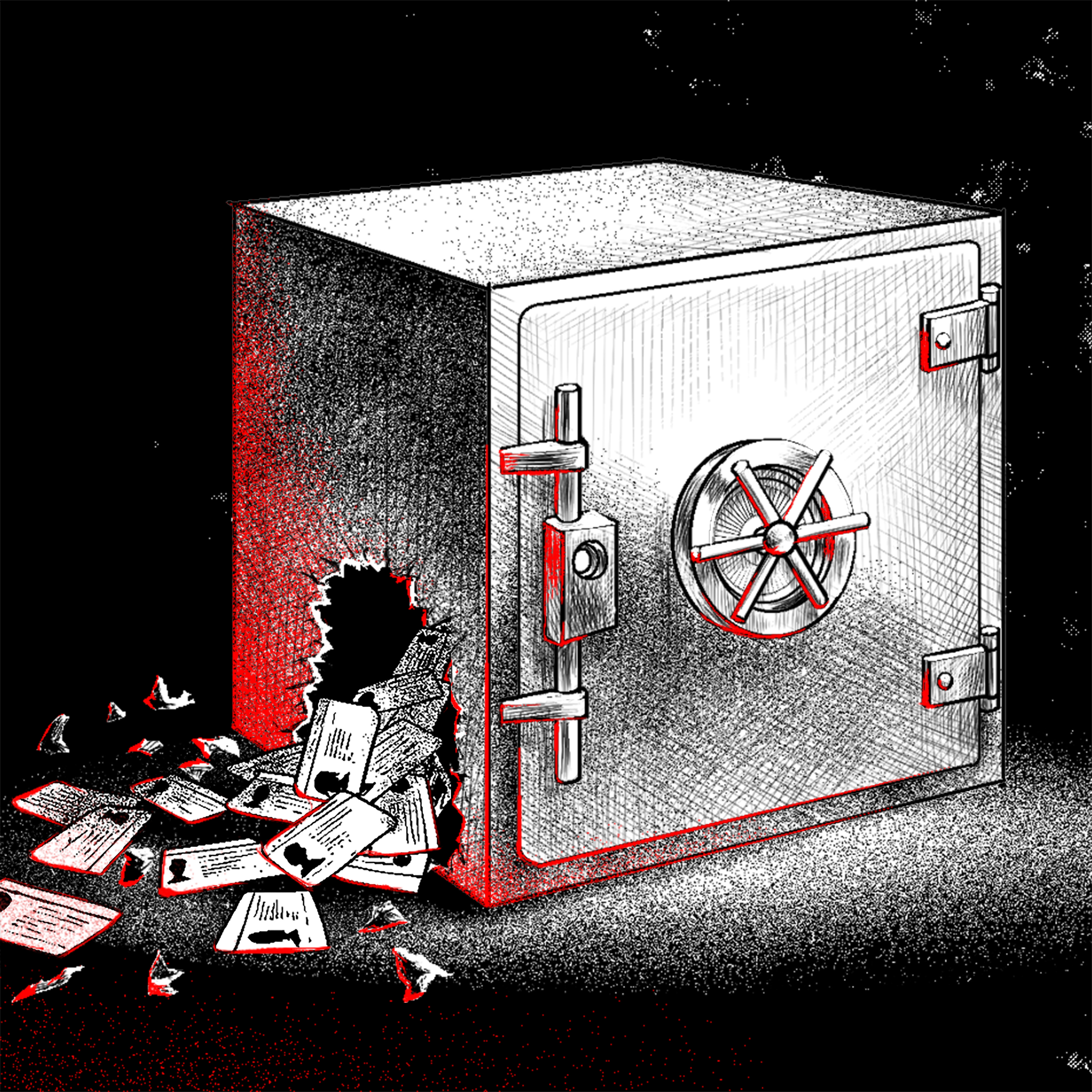
So back in 1988, there was this identity theft incident that happened, which when I read it, infuriated me so badly. And now I want to infuriate you. So there's a check in this story out. This all started in Albuquerque, New Mexico. Like I said, 1988.
And there was a hot dog stand there, which seemed to hire people who were really down and out. Like, if you had a past criminal record, that's fine. You hired a homeless, okay, here's a job buddy. Get yourself together. William Woods was the homeless guy working there.
And then they hired Matthew Keerins. Matthew had a long criminal record. I was trying to separate himself from that past. He was new in town. Just needed like a little cash to probably just get him to the next town or something.
But as soon as Matthew started working at this hot dog stand, he stole William Woods's wallet, the homeless guy that was also working there. William found out that Matthew stole his wallet and confronted him. And he threatened him. And he got the wallet back. But geez, what kind of jerk steals someone's wallet like that?
Neither of them lasted long with this hot dog stand. William, the homeless guy, actually left town to find a new job. He went over to Texas for a while. He did some day labor jobs there. Then went over to Las Vegas and worked in a laundromats and eventually ended up in Los Angeles, scavenging for gems and metals.
But little did he know, while he was struggling to get his life together, Matthew had started calling himself William Woods. And he got a job as William Woods. Because remember, Matthew had a criminal pass and he was eager to leave that behind. A fresh start was really great for him.
And then, after he got married to a woman who saw his name was William Woods and then they had kids and they called themselves the Woods family. Matthew wanted to know more about William to have a solid backstory and went on ancestry.com and give him some of his words and he learned all about his childhood and his family. And actually, this all had a huge payoff for Matthew. This was great for him because he had a criminal passed. But that was essentially a race.
Now he got a hundred thousand dollar year IT job at the University of Iowa and a car and even took out a loan for a house under his assumed identity. This fresh start was looking great for him. The real William still had no clue and was busy scavenging for gems and minerals in California. He was an off the grade kind of guy so he wasn't filing his taxes or opening bank accounts himself and he only used cash where he went and kept up pretty quiet life. Because of that, Matthew was able to use William Woods' name for decades without anyone knowing.
In 2019, the real William started getting a hunch that someone might be using his identity and talked to someone about it and they gave him some money to do a credit check. And that's when William was discovered. There's loans out, had a bank under his name. So he goes in the bank, identifies himself as William Woods, shows them his California ID and they're like, okay, how can we help you? And he's like, well, I don't have an account here.
Someone else is using my social security number or name or whatever because that account is not mine. The assistant branch manager walks over and he looks at William's account and there are some security questions associated with it. And a pin, William cannot answer any of the security questions and doesn't know the pin, obviously. So the manager's like, okay, well, there's a phone number here. And William's like, that's not my phone number.
So the manager's like, well, let's see what happens when I call it. The call's the number and Matthew picks up over in Iowa. But Matthew abandoned that name Matthew long ago. He's like, yeah, I'm William Woods. What's the problem?
And they ask him the security questions and he got it right. So now the bank has two people who have authenticated themselves to be the owner of this account and they have to figure out who's the real owner. The manager is still on the phone with Matthew. And since he knows all the answers to the security questions and the real William looks like some homeless guy, he's more convinced that the guy on the phone is the true account holder. So he tells Matthew, well, there's someone here in the bank claiming to be you.
And Matthew's like, in California, I'm in Iowa. Nobody in California should be accessing my account. So William's standing there. And the manager's looking at him. And the manager starts thinking, this guy in the bank must be faking his identity to get into this guy's account.
So he calls the cops on William for identity fraud. The cops call Matthew and they ask for proof that he's actually William Woods. And Matthew just sends him his driver's license, social security card birth certificate. At this point, Matthew had been using Williams's identity for 31 years, which means he has tons of supporting evidence to prove he's really William. What do you want?
W2s, electricity bills, library cards, credit cards, a marriage certificate. I can give you supporting documents for days. I am the real William Woods. In the meantime, the real William Woods has very little to show that he's actually who he says he is. He has an ID from the state of California, but that's about it.
He just didn't have much documentation to prove he was actually William. But that's just the beginning. Get this. Matthew must have known what was going on because when Williams went to court in California, he was tried under the name Matthew Keren's. So that must mean that Matthew told the cops that William is probably this guy Matthew Keren's, which is so messed up and backwards.
Now William is going out of his mind. He is disgruntled. He is furious. He's confused and absolutely angry with the cops. In the court, I mean, I would be too, but it's not helping his situation at all.
He seems wild and crazy, which makes everyone in the court think he's actually nuts, even his lawyer doubted the story. He got so wild and furious with everyone that they really did think he was having a psychotic breakdown and decided that he's not fit for court and sent him away to a mental hospital without even having a trial. So poor William got thrown in the mental ward. And not only that, but they forced him to take psychiatric drugs the whole time. They were calling him Matthew and he's like, no, I'm not Matthew.
Matthew stole my identity. I'm William Woods. And he was forced to stay in the mental hospital for five months. And when he finally calmed down, he said, okay, now we can have your trial. And the judge looked at the case and found him guilty for trying to steal William Woods' identity.
So they sent him to jail. Not only that, but they charged him $118,000 fee for his hospital bill. This is the stuff that makes me furious. I mean, like absolutely furious that the victim gets treated like this and the actual identity they've got away with it. I'm sure William must have thought he was crazy at times.
And it's no fun when you start doubting your own reality and don't even know who you are anymore, because the court forced him to call himself Matthew. He was admitted to jail as Matthew. The guards called him Matthew and they made him call himself Matthew. So poor William just had to serve his jail time. He didn't have any resources to fight this.
So months go by in jail a year goes by and after a year and a half, he served his complete sentence and was able to get out. And when he gets out, he is mad. So mad at Matthew for putting him through all this that he calls Matthew's work, University of Iowa to report him. And this makes it rounds to some people at the University of Iowa and someone decided to do their own little investigation. They thought, what if William is right and Matthew did actually steal his identity and stand the other way around?
And surprisingly, at this point, no one had done a DNA test on either man. So the person from the University of Iowa figured out who William Woods' real father was, which wasn't easy, and was able to get a DNA sample from the father. And then he went to California and took a DNA sample from William Woods and Bingo. There was a clear match. The investigator called Matthew and asked him what his father's name was, but Matthew had no idea.
So after a year and a half in jail and five months drugged in a mental hospital, everyone finally realized that William was telling the truth the whole time. Ugh. The courts apologized. They exonerated him of all wrongdoing and even canceled out his $118,000 medical fee that they charged him with. It's like, oops, sorry, that was our mistake.
And he was free to go on calling himself William once again. But then the cops turned towards Matthew in Iowa. And were like, bro, you lied to us, you lied under oath and court and you made up poor man suffer for years because of this? Not to mention you conducted identity theft. So they arrested Matthew and sentenced him to 12 years in federal prison.
And he was expected to release date. It's 2037. These are true stories from the dark side of the Internet. I'm Jack Recider. This is Darknet Diaries.
This episode is sponsored by Delete Me. Have you ever thought I should really be doing something to protect myself from stalkers, scammers and hackers? But you're not sure what? Here's what you do. Go to joindeleetme.com slash darknet diaries and enter code DD20 and you get 20% off.
Delete me. A few years ago I signed up and ever since then, delete me has been busy scouring the internet from my name and giving me reports on what they found and deleted stuff. Take control of your data and keep your private life private by signing up for delete me. Now at a special discount just for my listeners, get 20% off your delete me plan when you go to www.joindeleetme.com slash darknet diaries and use promo code DD20 at checkout. The only way to get 20% off is to go to www.joindeleetme.com slash darknet diaries and enter code DD20 at checkout.
That's www.joindeleetme.com slash darknet diaries code DD20. This episode is sponsored by Black Hills Information Security. Black Hills InfoSec loves sharing their knowledge with free webcast blogs, zines, comics and courses designed for beginners and those more advanced. Through anti-cy been training, they teach you the cybersecurity skills you need from SOC analyst tools and methodologies to setting up traps and running the deception operations. It's hands-on practical training built for people who want to advance and hone their skills.
The world of cybersecurity has changed a lot this year and every day seems to bring more questions about what comes next. That's why anti-cy been training is hosting a free summit on December 9th asking what in actual cyber happened in 2026. Join experienced practitioners as they share practical lessons, real-world experiences and insights into the top security news of 2026. Because you're a darknet diaries listener, they've got a little something extra waiting for you at blackhillsinfosec.com slash darknet. That's blackhillsinfosec.com slash darknet.
A few years ago a friend messaged me and said, look out, an APT just followed you on Twitter and I'm like, what? He's like, yeah, the US government is classifying this account as an APT, an active persistent threat to the US government. I'm like, whoa, what's your count as this? He said, oh, your count name is USDOD, USDOD as in Department of Defense and they're in APT and they're following me. Oh, no, that's just their hacker name.
Could be a group, could be a solo person, but they're calling themselves USDOD to be funny, edgy and confusing. So this began my relationship with the APT known as USDOD. He was active in the hacking scene and we post what he's doing right there on Twitter. And I started commenting on his post and he started commenting online and we laughed and we giggled and we started forming some kind of weird pair of social relationships through Twitter. I always had a hard time getting a good read on him.
He contradicted himself a lot. He seemed a bit young in the way he was talking and it was really hard to figure out if what he was saying was true or just something exaggerated or even made up. I think a few times I got him talking to himself even like, you know, just some weird gibberish that probably only he understood. I asked him for an interview. He said, okay.
His story is just beginning. If I interview him now, I'm sure there's going to be much more that comes. So I just held off waiting for the story to ripen more. And I think a year went by and I just watched him do more and more crazy stuff and it was hard to tell what was real and what wasn't. But then he suddenly disappeared.
The account was banned and I never heard from him again. Turns out his story is much more crazier than I realized. Are you ready? So let me give you an example of how strange he is. A few years ago, the reporters at DataBridges.net did in fact interview him and this interview is all over the place.
Like, here, check out this one story. He told them back in 2012, the hacker known as USDA was living in Brazil and said he went to New York for cancer treatment. During his time there, he fell in love with one of the hospital employees. They became deeply involved with each other. They started talking about how corrupt the hospital is.
So him being the little hacker that he was, he decided to hack the hospital and expose the corruption. She said she would help him and with an insider, well, it's super easy to hack into a hospital. So she helped him get into the network and he took incriminating evidence that proved the hospital was corrupt. He said he was going to take this to the media and tell reporters and expose the hospital. And together, they were going to make a big deal of this.
But the day before he was going to meet with the media, she suddenly disappeared. His attention shifted entirely to find her. He became frantic, depressed, emotional, to go from a deeply involved relationship with her to hacking into the hospital together to suddenly being alone in New York. He was distraught. He hired a private investigator to try to track her down, but even a PI couldn't find her.
She vanished like a ghost. So with no reason to stay in the US, he returned to Brazil and never blew the whistle on the hospital. And this made him extremely bitter with the US. It's not entirely clear why he's met at the US government over this, but says this was the thing that made him upset at the US government. Maybe he thinks they made her disappear somehow or kept them apart.
I don't know. But this is what I mean. What a wild story to start with, right? He came to the US, fell in love with a hospital worker, found corruption in the hospital, hacked a hospital, went to expose it, but then she vanished. And he was left holding the smoking evidence that could ruin the hospital, but decided not to publish it due to a heartbreak.
It sounds like a movie plot. Who knows how much of that is true? Since it was just a story he told reporters. Anyway, he says her disappearance gave him a personal vendetta against the US. And this is what started his decade-long campaign to attack the US.
He says it wasn't politics, which is just wild because you decided to become an APT because you were a heartbroken. Okay, I've heard stranger things on this show. Let's go. Let's see where this goes. He joined the dark web communities, met criminals from far off places, Russians, Iranians, North Koreans, and learned more about hacking techniques from them.
He trained up by breaking into small companies that made easy targets. He started making a name for himself among the hackers in the hacker community, unknown to the rest of the world, until one day when he was approached by an associate, a Russian who claimed to be developing some kind of AI platform named Tulip. The Russian needed help. Asked DoD, hey, can you help us collect military data? It would be useful for Tulip.
And I want to clarify, whenever I say US DoD in the story, I'm always talking about this hacker from Brazil. That's the name he was going by. So US DoD accepted the job. And over the next six months, some Russian folks he partnered with were able to build and exploit for an unknown vulnerability in the US Army IT platform called the Program Executive Office Enterprise Information System, PEO. Well, the Russians did that.
US DoD discovered that a way into this network could be to impersonate one of the developers who made it. So we discovered who developed PEO and started working on getting closer to them. He tried getting access through the developer using social engineering techniques. And this strategy worked. Humans are always the weakest link.
And it was a pinch or move, attacking the system from two sides. Together the Russian hackers and US DoD were able to steal source code and get different databases from agencies that use PEO. Agencies like the Department of Defense's Strategic Command, Central Command, Special Operations Command, and Defense Technical Information Center, and Army Specialist Operations Center. The Defense Contractor Lockheed Martin, too. The Russians took what they wanted from the deal.
And US DoD got to take credit for the breach. In three days, in February 2022, he leaked lists of full military emails and passwords to the dark web. And that is how he got the hacker name, US DoD, by breaching the Department of Defense and publishing tons of military emails. Talk about an entrance onto the hacker scene, and it was here when the US considered him a threat. He don't attack the military like that and expect them to ignore you.
They were working hard to figure out who US DoD was. US DoD didn't stop there. He went on a roll after that. His next target was Infragard. This is basically the tip line to the FBI.
If you have an important business, you can register for account an Infragard. And then you can report incidents to the FBI directly and fast. Then critical infrastructure companies like gas companies, dams, water treatment facilities, or banks that might need to contact the FBI quick to take action on an incident. That's what Infragard is. And that was the site that US DoD was trying to attack.
It's normal for companies to apply to join Infragard. So US DoD figured, why not try to apply himself? But his plan was to steal someone's identity who would qualify to be accepted and submit them to join. So first, he looked around for a finance company that would qualify, and he looked up the CEO's name, guys personal information, probably just bought it off the dark web. And US DoD filled out an application on their behalf, put in the CEO's information that he knew and just faked the rest.
Infragard replied back. There's some errors on your forms, these parts seem fixing. So he's like, OK, and so DoD fixed him and sent it back again. And a few weeks later, he got another reply. His application was accepted.
And just like that, he was in the Infragard system. Not quite hacking his way in, but faking his way in. He tricked the FBI that he was someone else. And once there, he saw that you could talk to other members. So he started chatting them up.
And they thought he was a genuine CEO. But then he started poking around the site, trying to test the database or servers to see if there's something weak here. And he found that the site has an API, which is basically a way to query the database, but uses a different authentication mechanism. And while he was examining the API, he discovered that you can ask it for all the members' contact information, and it would give it to you, like a big phone book, basically. But you had to be a member to see everyone else's details.
Nobody knew about this huge vulnerability, maybe because nobody who belonged to Infragard would ever think to attack the site like this. It was a perfect opportunity. US DoD asked a friend to write him a Python script to grab the data. Then he used it to steal every Infragard member's contact information. 80,000 CEOs, executives and security officers.
And again, he posted it all for sale on the internet. And it was around here when he started following me on Twitter. So you can see why they thought of him as an APT. He was advanced enough to sneak into FBI's Infragard and persistent to attack the US government again and again, and definitely a threat. Advanced persistent threat title acquired, which means the US government would be actively investigating him, more now than ever.
And I'm not sure how they figured it out, but they figured out his name. And his name was Luan Barbosa. He's from a small city in Brazil. But Brazil doesn't extradite their own citizens. So I think the US government had a hard time figuring out a way to take him down.
But despite being actively investigated by the feds, his vendetta was just getting started. He thought he was untouchable, taunting the feds and anyone else. I mean, his Twitter photo was just a picture of the cutest kitty you ever saw. He found a certain formula for hacking, which was working surprisingly well for him. Step one, search through data dumps on the dark web.
For someone, he can impersonate to help him reach his target. Step two, impersonate that target or use their account to get in. Step three, profit. In this formula, USDOD or Luan broke into Cybersecurity Defense Center at NATO and a Washington DC club for politicians and the aerospace company Airbus and their 3000 vendors. In two or three years, Luan breached so many US government and government-related organizations that he was planning building a business out of it, a full-on company selling military intelligence.
He had some pretty wild access and information and he knew that people around the world would want to have this or buy it from him. So why not make a business out of stealing this and selling it? To get his business off the ground, though, he needed a steady supply of people to impersonate people with military connections and enough of their information to do it right. He was buying identities from places on the dark web, but this process had friction. I think what he was doing was looking to see who worked in a US military place and then tried to search for their names on the dark web so that he could get their data and impersonate them by time after time, the people he looked for weren't listed, that data wasn't available.
So he thought, what if I just had a big list of people's identities and then figured out who on that list worked in the military or intelligence and I could just go and impersonate them? But he didn't have such a list. He knew lists like that existed, though, and went on a hunt to find one that he could have full access to. We're going to take a quick ad break here, but come back because this story is about to take a whole new turn. This episode is sponsored by NetSuite.
AI isn't just opening new business opportunities, it's changing the way businesses get work done. That's the idea behind NetSuite, the next generation of the business management suite trusted by over 44,000 companies with AI woven into every tool you already rely on. NetSuite, next, surfaces insights when you need them, puts agents to work on routine tasks and problems. It's the service that I would use if I needed it. And if you want ideas for what else it can do for you, experts have created a business guide called Aligning for the Adgentic Era, how AI is changing everyday work.
And right now, it's a free download and see how AI can reshape across your organization and how you can prosper from it. If your revenues are at least in the seven figures, go to netsuite.com slash darknet, get your free guide at netsuite.com slash darknet, netsuite.com slash darknet. There's a new character who comes into our story now. His name is Salvator Varini Jr., but I'm just going to call him Sal. He wanted to get into the entertainment business and decided to produce and start in his own TV shows.
And he was swimming in it. He owned a mini mansion near Miami with palm trees and a three car garage, had a hot red 57 Chevy Bel Air and a hot wife. He was a successful guy. But I went and watched his biggest show, which is called Country Days with a Z, his streams on Amazon Prime. It's a staged reality show starring him and his friends.
Here's a clip from two minutes into the first episode. See what you think. Hey everyone, I'm Sal. The CEO of Everything Country. You know the best part about owning your own business?
You get to hire all your friends. Yeah, baby. That looked good. Hey, what's up Sal? What's going on, big mic?
Nothing much, man. What are you up to? Hey, man. I got to tell you something. I got a video.
I got 100% proof here at this flat. You got to take a look at it. What's the next story on mic. Mic is what they call a flat earther. Well, they think that the earth is actually flat.
I mean, like you really. Dude, again with this. It's round. It ain't round. Just take a look.
I always find it as my life watchness again. You're probably gang five minutes. Oh, dude, come on. Come on. I promise you, you will.
Separnetosi. It's round. Percurbic is the guy, that guy. I know him, this guy. He's the guy thinks it's round.
I'm the guy who knows this flat. I have to stop there because they keep going on and on like this for a long time, like way way longer than they need to. But I played this clip for you to give you a sense of what Sal is like. And I think Sal is not only the star of the show, but also the writer, the director, the producer, the editor, he did it all. I was curious, so I checked.
Turns out nobody watches this show. If you go on IMDB, reality shows usually have like five, maybe 10,000 reviews. Country Days has 11 reviews. Nobody's watching it. Sal's personal IMDB page lists his other shows and movies.
Some of them don't even exist. There's a few pictures of him in an action movie, except if you go on his Instagram, he admits that those pictures were just taken in a photo shoot that he paid for. Which, I think about it. I admit I did that one too. In high school I somehow fakes my way into the picture with the football team.
So if you open up the yearbook that year, it looked like I made the football team, but I was never on the team. So who even is this Sal guy though? Where is all this money coming from? If his shows don't have any audiences, how has he got that big house? And all the money to run a film studio?
Well, here's the truth. He always wanted to be an actor. He was in school plays and got on a Bert Reynolds show, as an extra. He studied theater in college, but he didn't work out for him at all. But his dad, Sal Sr., is a prominent lawyer in Florida.
And when Sal crashed out as an actor, Sal Sr., probably hooked him up with his next gig in a sheriff's office as a deputy. Yeah, Sal became a cop. And it was a huge setback for his dream. But Sal didn't give up. He believed in himself and he hatched a new plan to rekindle his Hollywood dreams.
And I think it was here while working in the sheriff's office that he noticed something which gave him an idea to make money to pursue his dreams again. Years ago, if you wanted to get someone's photo or know their daily routine or who they're in a relationship with or get their phone numbers, stuff like that, you'd have to hire a private investigator who would tail the person and gather what they can. But today everyone is posting their own private data, voluntarily online, especially social media. We see photos of people's kids, their accomplishments, their vacation photos. We see them with their new lover or their new home renovation.
Sometimes you just see people post their whole day on social media. We don't need a private investigator to get information about where people are and what they're doing or what they look like or any of that stuff anymore. It's just all there on social media. And so there are companies that go on social media and scrape all that data to provide it to cops. Like I remember a few years ago, there's a whole controversy about a company called Clearview AI and they were rating major social media websites.
They take Facebook, for example, grab every picture and bit of information they could off of everyone's account and then add it to a file that was created about them. Then they repeat for Twitter and LinkedIn and wherever, automatically. Of course, the social media companies got mad. They're like, hey, that's our data. You're profiting off our data.
Then they sent Clearview AI a cease and desist letter. But even those megacorporations can't stop it. If anything, Clearview is bigger today than they've ever been before. I just saw that they signed a $10 million contract with ICE. So keep that in mind.
Your social media posts are likely scraped and processed through AI and are easily accessible by ICE agents, even if you delete your post or for the record, I don't think this is right. The Fourth Amendment says we should have a reasonable expectation of privacy. It says the government has to have a warrant to conduct a search. Yet ICE is able to get tons of data about us without a warrant. And the loophole they found is that they're allowed to just buy data from data brokers.
It's the data broker loophole. And the thing I hate most about this is we never gave them permission to exploit this loophole. We never voted on this. We never collectively agreed that data brokers are cool and it's totally fine for the government to buy data from them and get around having to have a warrant to conduct a search. This was all decided without our input or support.
And the government hides all this from us. They hide how much they pay data brokers to get information on us. I'm disgusted by how much the government spies on us without a warrant when it's clearly a violation of the Fourth Amendment. The thing is this business model is very profitable for data brokers. They are incentivized to gather as much private data about us as they can since the more they have, the more the government will spend on it.
They are in the business of brokering your personal data. And I think Sal saw how important these data brokers are to law enforcement. And maybe he even caught a glimpse of how much the contract was with one of these. And he might have been like, whoa, I'm in the wrong business. So Sal quit his job as deputy and decided to start his own data broker service.
He created three almost identical websites, records check, criminal screen, and the flagship site, National Public Data. He hired some cheap programmers in Bangladesh to code the initial website for him. Then he started collecting everyone's data. You can think of the data he collected in two buckets. There's what the government publicly posts about us, such as bankruptcy filings, court records, motor vehicle records, death records.
You'd be surprised how big this bucket is. You ever buy property? Yeah, you're in a public database. It got married? Yep, that's public data too.
Registered to vote. In some states, you're in a public database. Then there's bucket too. The dirty work. Scraping it, sneaking it, stealing it, buying it.
I'm not sure what the rules are here, but it seems like data brokers treat rules more like guidelines and actual rules. Because they'll go to great lengths to get private data from people. Sal either bought or scraped data from other data brokers, subscription, and marketing lists, loyalty and rewards programs, social media, and other apps. Some brokers even collected the data leaked by hackers like you as DOD. Eventually, Sal had collected not thousands, not hundreds of thousands, not millions, but hundreds of millions of Americans' personal data records.
Then he packaged it into individual profiles and sold access to law enforcement or whoever wanted to do people search. And it worked unbelievably well. In 2022, Sal made $750,000 from selling our data. And in 2023, he made $1.15 million. And he almost instantly turned around and used the money to make his own TV shows.
Here's what he spent his money on. I'm telling you, it's round. It ain't round. Just take a look. No.
You ever watch those NASA videos? See if you ever run. No, please. You're sitting there flying over to Earth. You see the Earth below.
Hey, see the war board house. See the cruise around. What? Green screen. Green screen.
It's all for you. The green screen. They proved it all here. You just take a look at all. Trust me.
I'm getting dumber by a minute. I'm looking at Sal's financial records now. And there's something telling about the way he spent his money. The Data Broker Company is total cash in the bank. $563, $563.
Insurance expense $1,327. Cyber security budget, $0. Salaries? Yeah, there were no salaries. He ran it all by himself with two desktops, a laptop, and file servers in his home office.
To me, the way I see it, Sal's Data Broker business was only set up for him to make as much money as possible. And didn't spend a lot of effort protecting this data or securing it. So now that you know what Sal was cooking up, let's go back and focus on the one, AKA US DoD. By this point in 2023, Luan was trying to get his military intelligence business set up and needed a lot of military identities to impersonate to get more data and decided to hunt around for vulnerable data brokers. He found Sal's Data Broker site called Records Check.
Records Check advertised instant background checks, social security number traces, and more. Perfect. Luan was now laser focused on his site, locked in, trying to look behind the curtain to see everything the site had on people. He used the tool to try to scour the site and see every file and image that was publicly viewable on this site. And one file stood out, members.zip.
What is this file? And why is it just in the open for anyone to grab and look at? You grabbed it and looked at it. Members.zip had Sal's sites source code and buried inside the code were admin credentials. Luan just got the email and password to access any corner of the site and all the data in it.
So Luan logged in to Records Check as Sal, but then discovered the site was connected to two other sites. And guess what? Sal reused passwords, which allowed Luan to log in to national public data, which gave Luan access to the biggest set of data that Sal had. And Luan took everything, 2.9 billion lines of data, 277 gigabytes worth, personal information about hundreds of millions of people. If you're listening to this and you're American, chances are you were likely in this database.
Then Luan does what Luan does. And he posts it for sale online as USDOD with the cute little kitty picture. And he put the data up for sale for $3.5 million. TikTok was outraged. This is a public service announcement to remind you to check your credit files.
I just received an alert from my credit card and also from my credit reporting agency about my data being leaked online. 2.9 billion records, one of the largest data breaches in recent time. Why is this one important? Because you're not a subscriber to this service. This is for running background checks and fraud prevention.
And so they just randomly collect data about billions of people without your consent. We have to protect ourselves now, although we're going to have a lawsuit against MPDs. They did not protect our data sufficiently. The problem is the data still got out into the public domain. The problem with the MPT data breach is that it is a scraping company that was designed to find out everything it can about you.
Now, if they're a data brokerage company that has other information about you, a hacker can start to put together an identity profile on you, and then with that identity profile breach your security. We all know that data breaches happen all the time, but the most recent one has been with National Public Data. It was over 3 million people's data was breached. That's from the UK, US, and Canada. At the beginning of this episode, I told you about how that guy Matthew Keirin stole William Woods's wallet and later his identity.
And all he took was for him to get William's name, birthday, and Social Security number. And from there, it was enough to impersonate William for decades. National Public Data leaked full names, birthday, Social Security numbers, home addresses, past addresses, email addresses, and phone numbers, all in plain text. A lot of it had errors, but most of it was accurate. The ramifications of a data broker having data breach is huge.
Catastrophic to some people listed in the breach. Researching this episode, I came across all kinds of stories of people who had their identities stolen after a data breach, like a bunch of people in Oakland, California. After the city was attacked with ransomware, they interviewed one guy who was on the news and he said that criminals had impersonated his identity and they were taking tens of thousands of dollars and loans out and making purchases in his name, and he was on the hook to pay it all back. And so you can imagine the huge nightmare that he had to try to convince the bank that he didn't spend any of this money. That hardly compares to this other girl right about.
She was in Florida and she tried to sign up for her first credit card when she went to college, but she got denied because they told her that she already owes $1.5 million dollars and she's in huge debt. Apparently someone had been using her identity since she was nine years old. Another crazy story happened to an LA Times reporter after her wallet was stolen at a bar. She knew it was gone minutes after it happened, so she thought there was enough time to act before something bad happened. So she called the bank, she called the police, she called everyone, but it didn't matter.
The thieves used her info from her wallet to get her Social Security number online, and for a whole year they opened dozens of credit cards in her name, they rented cars in her name, got new iPhones and wrote tons of checks, sometimes more than $10,000. And that's just a couple of things criminals can do if they get your information. We've already talked on the show about SimSwap. So if a scammer knows enough about you, they can convince the phone company to transfer them, your phone number, then they can log in to your bank account or crypto account and steal all your money. I read about multiple people who have lost millions of dollars this way, so I'm sure the victims exposed in the national public data breach have faced a lot of similar nightmare scenarios.
And despite victims being hit with this, they might not even have a clue that national public data is what leaked their data. It's really hard to know how a thief got your info, you know? And the worst part is Sal isn't going to be on the hook for any of the damage done to the victims, because how can you prove that the criminals got their data from this data breach when these criminals hide in the shadows of the internet and are seldom caught? This is one reason why I despise data brokers. They mistreat our private data and don't care how negatively it impacts us.
They're incredibly greedy for our data and then it gets abused in the worst way possible. This is why I've become a privacy freak over the course of making this show. I know these data brokers exist and are trying so hard to get my information and I know there's nothing I can do once they get it. I can't opt out or ask them to delete me. God, I would love to send a cease of this letter to Equifax and tell them, please delete all my data and stop spying on me.
But no, and I know it's just a matter of time before criminals get their hands on my data, either from a data breach or buying the data somehow. There's just no way to protect it. And since I know if someone gets my data, it can be catastrophic to my life. So that's why I take extreme steps to hide from these data brokers, even so much as wearing a disguise when I go in public sometimes. In fact, many of you even have met me in disguise and only know what I look like in my disguise.
It's the only way that I feel like I can empower myself to stay safe in today's internet age. I use fake personas, burner phones, burner emails, even burner credit cards. And I'm super secretive about my personal life when I go online. Anyway, God, these episodes always get me ranting about privacy. Sorry, I know some of you don't care about your privacy, so I'm gonna move on.
But someday I hope to get through to you. I mean, I just want you to understand this one thing. Most companies won't protect your privacy, even if they say they do. They share with data brokers and the profit off of it, or they'll just lose it in the data breach. The only one who can protect you is you.
A couple months after this leak, he taunted CrowdStrike, a cybersecurity company, claiming he hacked into them and he got all their threat actor lists and their indicators are compromised and he has it up for sale. Well, the thing is, CrowdStrike has some pretty impressive cybersecurity researchers and investigators. So they started looking to see who USDA was. And they discovered he uses the same email address for GitHub, all the blogs and social media accounts he has everywhere. It turned out that for years, Luan only used one email for everything he did, hacking or non-hacking.
So CrowdStrike was able to figure out his name, address, phone number, tax registration ID and more. Basically, Luan got docked, but privately and a CrowdStrike law enforcement, some news outlets had his details. And Luan admitted, so what he had done? And the docs were true. But he wasn't done.
I saw him tweet, this is not my end. And then he offered his services to the Brazilian government, but that didn't go well. Now that law enforcement knew his name and location, the Brazilian police swarmed in on him and arrested him and took him to jail. Sal was docked too by reporters, but he just lawyered up. I went silent.
It didn't go well for him. Congress wrote him a letter calling National Public Data's lack of transparency staggering. Now he's being sued for everything he's got. And then some multiple class action lawsuits are against him by people who are in the data set. Unless Country Days takes off this year, he will not be able to pay off even a fraction of that.
And you would think after having a catastrophic incident like this, Sal would you shut down National Public Data? Maybe go back to acting or something. But if you visit nationalpublicdata.com, it's still there. The site's still up, collecting our data and selling it. Sal tried to declare bankruptcy, to wipe out his debt to society.
But the judge just saw right through that and did not accept his bankruptcy plea. So then Sal supposedly sold his data broker company to another company which is ironically called Perfect Privacy, LLC. But you won't find much about Perfect Privacy, LLC online. But you'll find plenty about yourself. If you search your name on their website, the revamped National Public Data advertises that.
You could find pretty much anything you need from someone's contact information, location, age, and birthday to workplace, relatives, and criminal records, which has to be the craziest thing about this old story. Like a data broker can have a total breach and then continue operating, scraping my data, storing it without my consent. Like nothing happened. So what's the solution here? I don't think politicians aren't ally here.
They aren't going to enforce any kind of data privacy law since they're the customer for many of these data brokers themselves. I mean, the government is who mandates that Equifax must be allowed to collect data off of all US citizens without their consent. And even if the government wasn't using data brokers, they'd claim that they need our data for national security reasons. So I think they are no help here. But then I was caught off guard.
When I read that 85% of the members of Congress were also included in the national public data breach. And a lot of them seem pretty upset about this breach and wanted to do something about it. So in April 2024, they did. Weeks after Luan put the 2.9 billion records up for sale, Congress, and the Senate proposed a nationwide privacy law called the American Privacy Rights Act. It listed protections Americans should have, but also had a rule where anybody could file a form with the government to prevent data brokers from collecting their information.
That is, a single form, and all the American data brokers would have to delete your information if you want to opt out. Democrats and Republicans like this bill. It went up for a vote. But then the day before they voted on it, it was sabotaged. Lobbyists came in and put pressure on politicians who then started watering down the bill until most of the useful privacy protections were gone.
And after that, the whole thing died. So the American Privacy Rights Act never got off the ground. And this is what I mean. No one is going to save you. No one is going to protect your privacy.
You have to do it. And lucky for you, there are easy steps that you can take to protect it. I mean, just thinking right off the bat, stop using text messages. Those things historically have been insecure, and they typically are end-to-end encrypted, and they can be monitored by phone companies. So a chat app like Signal takes extreme steps and everybody will see chats.
Even if someone pointed a gun to their head, they would not be able to read your messages. And the same goes for end-to-end encrypted email providers, like Proton or Tutah. They cannot see what's in your emails. Compare that to something like Google, who looks through all your emails to provide ads for you. I also highly recommend a web browser that cares about your privacy.
Google Chrome is the worst on the list. Every character you type into the address market's key logged and sent to Google. They want to know everything about you. So I use the Brave browser, which makes enormous effort to not collect anything from me. So those are three quick news wins.
Use Signal, use an end-to-end encrypted email provider, and use a privacy-focused browser. Because it's not just about stopping Sal or Luan from grabbing at your data and exposing you. You want to future-proof yourself from tyrannical regimes. They're also trying to hoard your data. You might be okay with who's in charge now in the world, but that's going to change one day.
And whoever inherits your data next might decide that you're a criminal. Then it's too late for you to do something about your privacy. In the end, Luan, aka USDD, is still in a jail in Brazil. Since Brazil doesn't extradite their citizens to the US, they'll probably just serve as jail time in Brazil, and it's likely never going to go to the US. And one newspaper speculated that he's facing about four years in prison, but we don't quite know what his prison sentence was.
Are you a premium subscriber of Dr. Darcontario's? If not, why not? Listen, I'm certain that you've bought a book or paid to go see a movie before you knew if that book or movie was any good. I don't want to do that to you.
I want to give you the show for free in order to prove its value to you, and show you that I'm worth pitching a few bucks at. Have I done that? Does this show bring you value? Do you learn from it? Do you get entertained?
Does it help you get through a long car ride without being too bored? If so, I want to ask you to become a premium subscriber to show your things. And hey, if you do, you'll get ad-free episodes, and bonus episodes. There's actually 12 episodes in the premium feed that don't exist anywhere else. So please consider signing up.
Go to plus.darknetdairies.com. I really appreciate it. This show is made by me, the pasta-poner, Jackery Cider. This episode was written by the D-doss, a tech dog, Nathan Nelson, sound design by the VHS Vandal, Garrett Teedeman. And this episode was assembled by the cruise controller, Tristan Ledger, mixing by proximity sound, Rothy Music, it's by the mysterious breakmaster cylinder.
My data has been in many data breaches, and once a hacker messaged me saying, I have everything, bro, I have a name, a password. I'm like, no way, oh my god, thank you. I've been looking for that password for years. This is Darknet Dairies.